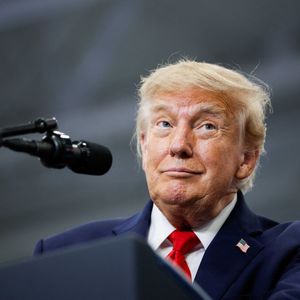
US President Donald Trump speaks during a Republican campaign rally at F&M; Bank Arena in Clarksville, Tennessee, US, October 10, 2026. REUTERS/Eric Lee

Republican campaigns and their allies are filling the midterm airwaves with AI-generated fakes – and most of the ads don’t tell voters about their origins.
The Wesleyan Media Project found more than 220 ads during this election cycle that used AI-generated material, which candidates and political groups have spent more than $137 million promoting, and the New York Times reported that more than 80 percent were produced by Republican campaigns or GOP-aligned PACs.
About 70 percent of the ads had no disclaimer saying AI was used, and nearly half showed AI-generated versions of real politicians.
“I think what we’re seeing with AI has surprised even us,” said Erika Franklin Fowler, co-director of the Wesleyan Media Project. “Some of the ways in which AI is used, honestly, if there wasn’t a disclaimer on the ad, it would be hard to know that AI was there.”
One ad reviewed by the Times showed an AI-generated version of Abdul El-Sayed, the Democratic Senate candidate in Michigan, laughing at cards that read “Death to America” and “Celebrate 9/11.” In Oklahoma, a group called Make Oklahoma Great Again spent more than $200,000 on TV for an ad that showed the Democratic candidate for governor cheek-to-cheek with Hillary Clinton, under the words “Clinton Lover. Trump Hater.” It had no disclosure.
In New York, Republican gubernatorial candidate Bruce Blakeman released an AI-generated ad showing Gov. Kathy Hochul and Mayor Zohran Mamdani selling a “political delusion pill.” “Side effects may include: chronic wallet shrinkage, higher tax,” the narrator says. The ad had no disclaimer. Blakeman has posted at least 22 AI attack ads since April, and only a few disclosed that AI was used.
Researchers said Democrats appear more cautious because their voters are more critical of AI and want it regulated.
“Democratic candidates and groups face more reputational risk when using a tool that they are arguing should be regulated,” said Travis N. Ridout, another co-director of the project. Texas Democratic Senate candidate James Talarico ran one ad with a title that read: “Made by humans, not AI.”
The real number of AI ads is probably higher. Many were identifiable only because they ran in one of the 30 states that require some form of disclosure.
Political consultants are fighting to keep those rules from spreading. Julie Sweet of the American Association of Political Consultants said disclaimers can make honest ads look untrustworthy, and her group is lobbying for federal rules that would override state laws and require labels only on “deceptive” AI content.
Bruce Schneier, a security technologist who teaches at Harvard, said labels alone won’t fix the problem.
“The problem isn’t AI,” he said. “The problem is deception, and it turns out that deception is, you know, a pretty good strategy.”
Report typos and corrections to corrections@rawstory.com.
For customer support contact support@rawstory.com.