Senior Advisor to the President Jared Kushner's extremely rare public appearance Thursday at the Trump coronavirus task force briefing is still drawing strong condemnation for the President's son-in-law. Cries of nepotism are now the least of critics' worries, given that, many say, Kushner's incompetence this time will lead to the deaths of thousands.
The American public's anger and outrage center on these remarks Kushner made during the briefing: "The notion of the federal stockpile was it's supposed to be our stockpile. It's not supposed to be states' stockpiles that they then use."
Many are asking who Kushner thinks "our" is.
Not only is Kushner condescendingly dangerous, he's dead wrong.
"Strategic National Stockpile is the nation’s largest supply of life-saving pharmaceuticals and medical supplies for use in a public health emergency severe enough to cause local supplies to run out," the U.S. Government's website for the Strategic National Stockpile says.
"When state, local, tribal, and territorial responders request federal assistance to support their response efforts, the stockpile ensures that the right medicines and supplies get to those who need them most during an emergency. Organized for scalable response to a variety of public health threats, this repository contains enough supplies to respond to multiple large-scale emergencies simultaneously."
The fury from the American people over Kushner's remarks (not to mention apparent heading of the coronavirus response inside the White House) is palpable. We are in the early stages of a global pandemic that has already infected over one million people, leaving tens of thousands dead. Before it is over, experts say, millions of Americans could lose their lives.
The latest figures suggest most residents at the Southeast Nursing and Rehabilitation Center have been infected.
Most residents at a San Antonio nursing home have tested positive for the novel coronavirus, Mayor Ron Nirenberg announced Thursday evening.
During a news conference, Nirenberg said 59 more residents of the Southeast Nursing and Rehabilitation Center have tested positive after six residents' cases were reported there Wednesday. The previous six residents who tested positive included one person who died Tuesday.
Officials did not immediately have the total number of residents at the center, but Bexar County Judge Nelson Wolff estimated it to be "70-something."
Nirenberg said he learned of the 59 new residents' positive tests late Thursday.
"This is a developing story on a major outbreak that is contained at Southeast Rehabilitation Center," Nirenberg said. "We'll have more updates as information becomes available tomorrow morning."
Wolff added that the 59 residents with positive tests is an "incredibly high number, and it's just ... very, very disturbing."
In addition to the six resident cases that were reported at the facility Wednesday, there were six workers who tested positive. "No additional workers have been tested positive at this point," Nirenberg said Thursday.
There have also been 11 negative tests at the facility and two that were inconclusive, Nirenberg said. It was not immediately clear if those tests were conducted on residents, workers or both.
A U.S. Navy captain was sent off with cheers and applause from his sailors after he was relieved of duty for sounding the alarm about a coronavirus outbreak on board his aircraft carrier.
Capt. Brett Crozier left the USS Theodore Roosevelt after his dismissal for going outside the chain of command to alert service leaders of the outbreak that had infected more than 100 sailors on board the ship, reported Stars and Stripes.
“That’s how you send out one of the greatest captains you ever had,” someone says in a video showing sailors chanting Crozier's name. “The GOAT, the man for the people.”
Crozier warned the Trump administration and Pentagon officials the outbreak could kill sailors under his command if swift action was not taken.
The aircraft carrier was diverted to Guam, where about 1,000 sailors were removed and another 2,700 were expected to be removed by Friday.
In a column for the Daily Beast, conservative Matt Lewis stated that whatever advantage Donald Trump may have had as a sitting president seeking re-election is long gone after botching the government's job to protect the health and safety of Americans from the now-exploding coronavirus public health crisis.
According to the longtime political observer, the COVID-19 crisis has the president back on his heels and spending his days defending his reeling administration from criticism as the country shuts down and thousand die when, in normal circumstances, he would be out on the road touting his achievements and attacking his potential opponents.
Writing "The problem for Trump isn’t just the negative developments he’s being tagged with, but also the negative campaigning he can no longer get away with," Lewis explained, "Trump clearly has his hands full with a major crisis. What is more, the seriousness of this pandemic (and the fact that Trump has already botched his handling of it) makes it very hard to deploy his brand of scorched-earth mockery. Doing so would not just provoke a potential backlash for its unseemliness, it would also reinforce the notion that Trump isn’t fully focused on saving lives."
According to the conservative, Trump's campaign had planned on keeping him in the White House with relentless attacks on his possible opponent, former Vice President Joe Biden, but now that has been shelved as they do damage control.
"Trump is a master at distracting us from big news stories. Except, with this one, he can’t just change the subject with a mean tweet. As Dr. Fauci has said, 'The virus determines what the timetable is, not us.' (God help us if another story comes along that is big enough to overtake the COVID-19 headlines,) he wrote. "Trump’s team never wanted this election to be a referendum on his competence. The plan was to spend the spring smearing his opponent. We know that because that’s who Trump is, and because that has been the plan for every modern incumbent president."
"Joe Biden was poised to be that sitting duck. Although his high name ID makes him less susceptible than past challengers to being 'defined' by an incumbent president, one could certainly imagine a scenario where Trump would have unleashed ungodly amounts of money attacking Joe Biden this spring," he added before predicting, " It’s starting to feel like this election is slipping away from Donald Trump."
However, a study just published in a French medical journal provides new evidence that hydroxychloroquine does not appear to help the immune system clear the coronavirus from the body. The study comes on the heels of two others - one in France and one in China - that reported some benefits in the combination of hydroxychloroquine and azithromycin for COVID-19 patients who didn’t have severe symptoms of the virus.
I am a medicinal chemist who has specialized in discovery and development of antiviral drugs for the past 30 years, and I have been actively working on coronaviruses for the past seven. I am among a number of researchers who are concerned that this drug has been given too much of a high priority before there is enough evidence to show it is indeed effective.
There are already other clinical studies that showed it is not effective against COVID-19as wellasseveral otherviruses. And, more importantly, it can have dangerous side effects, as well as giving people false hope. The latter has led to widespread shortages of hydroxychloroquine for patients who need it to treat malaria, lupus and rheumatoid arthritis, the indications for which it was originally approved.
The idea that the combination of hydroxychloroquine with an antibiotic drug, azithromycin, was effective against COVID-19 gained more attention after a study published on March 17. This study described a trial of 80 patients carried out by Philippe Gautret in Marseille, France. Although some of their results appeared to be encouraging, it should also be noted that most of their patients only had mild symptoms. Furthermore, 85% of the patients didn’t even have a fever – one of the major telltale symptoms of the virus, thus suggesting that these patients likely would have naturally cleared the virus without any intervention.
In another study, posted on medRxiv, which has not yet been peer-reviewed, Chinese scientists from Renmin Hospital of Wuhan University, in Wuhan, China, gave hydroxychloroquine to patients with only mild infections who were free of medical issues, similar to the Gautret study. The results showed that the 31 patients who received the drug showed a lessening of their symptoms 24 hours earlier than patients in the control group. In addition, pneumonia symptoms improved in 25 of the 31 patients versus 17 of 31 in the control group. As noted in several of the comments associated with the manuscript, there are issues related to the translation of the paper, thus clouding interpretations of some of the results. The paper also appears to focus more on pneumonia than COVID-19. However, these issues may cleared up or addressed once the paper finishes the peer-review process.
But two other studies have conflicting results.
A second French group, led by Jean-Michel Molina, has now tested the hydroxychloroquine-azithromycin combination treatment in 11 patients at the Hôpital Saint-Louis in Paris, France, and their results were strikingly different.
Like the Marseille study, the Molina trial was also a small pilot study. Molina and colleagues used the same dosing regimen as Gautret. In contrast, however, to the Gautret study, eight of the 11 patients had underlying health conditions, and 10 of 11 had fevers and were quite ill at the time the dosing began.
These Paris researchers found that after five to six days of treatment with hydroxychloroquine (600 mg per day for 10 days) and azithromycin (500 mg on day 1 and 250 mg on days 2 to 5), eight of the 10 patients still tested positive for COVID-19. Of these 10 patients, one patient died, two were transferred to the ICU and another had to be removed from the treatment due to serious complications.
In addition, a similar study in China also showed no difference in viral clearance after seven days either with or without the hydroxychloroquine with the patients in the trial. This supports Molina’s findings.
Thus, despite the recent approval of this drug for use against COVID-19, questions remain as to the efficacy of this treatment. As Molina and colleagues note: “Ongoing randomized clinical trials with hydroxychloroquine should provide a definitive answer regarding the alleged efficacy of this combination and will assess its safety.”
Dr. Anthony Fauci, the director of the National Institute of Allergy and Infectious Diseases, slapped down the hosts of "Fox & Friends" on Friday after they challenged his medical opinions by quoting Dr. Oz.
During an interview on the Fox News morning show, co-host Steve Doocy asked Fauci why more doctors in other countries were prescribing hydroxychloroquine to treat coronavirus than doctors in the United States.
Doocy then played a clip of Dr. Mehmet Oz hyping hydroxychloroquine as a treatment for COVID-19, as he claimed that it had produced a "statistically significant improvement in recovery from fever, from cough, and in pneumonia as well."
Fauci, however, was not buying it.
"That was not a very robust study," he replied. "It is still possible that there is a beneficial effect, but the study just quoted... that's not overwhelmingly strong."
Fauci then flattened Doocy for quoting a survey of doctors in which a little over a third of them "feel" hydroxychloroquine is beneficial in treating the disease.
"We don't operate on how you feel!" he said. "We operate on what evidence is and data is!"
Social distancing to combat COVID-19 is profoundly impacting society, leaving many people wondering whether it will actually work. As disease ecologists, we know that nature has an answer.
Animals as diverse as monkeys, lobsters, insects and birds can detect and avoid sick members of their species. Why have so many types of animals evolved such sophisticated behaviors in response to disease? Because social distancing helps them survive.
In evolutionary terms, animals that effectively socially distance during an outbreak improve their chances of staying healthy and going on to produce more offspring, which also will socially distance when confronted with disease.
What can we learn about social distancing from other animals, and how are their actions like and unlike what humans are doing now?
Feed the sick, but protect the queen
Social insects are some of the most extreme practitioners of social distancing in nature. Many types of ants live in tight quarters with hundreds or even thousands of close relatives. Much like our day care centers, college dormitories and nursing homes, these colonies can create optimal conditions for spreading contagious diseases.
In response to this risk, ants have evolved the ability to socially distance. When a contagious disease sweeps through their society, both sick and healthy ants rapidly change their behavior in ways that slow disease transmission. Sick ants self-isolate, and healthy ants reduce their interaction with other ants when disease is present in the colony.
Healthy ants even “close rank” around the most vulnerable colony members – the queens and nurses – by keeping them isolated from the foragers that are most likely to introduce germs from outside. Overall, these measures are highly effective at limiting disease spread and keeping colony members alive.
Many other types of animals also choose exactly who to socially distance from, and conversely, when to put themselves at risk. For example, mandrills – a type of monkey – continue to care for sick family members even as they actively avoid sick individuals to whom they are not related. In an evolutionary sense, caring for a sick family member may allow an animal to pass on its genes through that family member’s offspring.
Mandrills live in large groups in the rainforests of equatorial Africa. They will often groom other group members, but actively avoid sick mandrills unless they are close family members.
Further, some animals maintain essential social interactions in the face of sickness while foregoing less critical ones. For example, vampire bats continue to provide food for their sick groupmates, but avoid grooming them. This minimizes contagion risk while still preserving forms of social support that are most essential to keeping sick family members alive, such as food sharing.
These nuanced forms of social distancing minimize costs of disease while maintaining the benefits of social living. It should come as no surprise that evolution favors them in many types of animals.
Altruism makes us human
Human behavior in the presence of disease also bears the signature of evolution. This indicates that our hominid ancestors faced many of the same pressures from contagious disease that we are facing today.
Like social ants, we are protecting the most vulnerable members of our society from COVID-19 infection by ensuring that older individuals and those with pre-existing conditions stay away from potentially contagious people. Like monkeys and bats, we also practice nuanced social distancing, reducing non-essential social contacts while still providing essential care for sick family members.
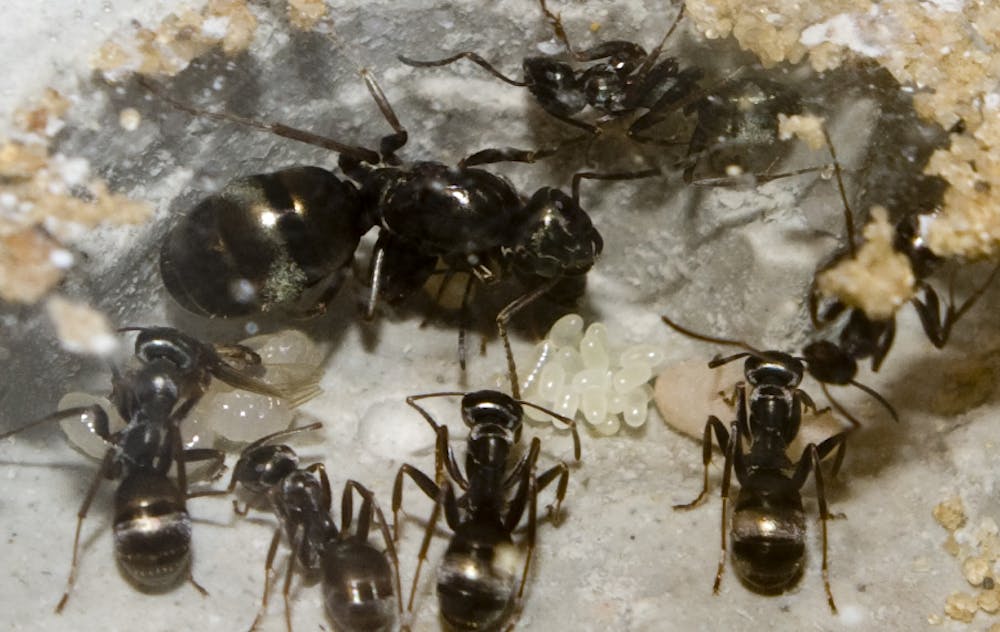
A black garden ant queen (upper left), surrounded by adult ants, larvae (left), eggs (middle) and a cocoon (right).
There also are important differences. For example, in addition to caring for sick family members, humans sometimes increase their own risk by caring for unrelated individuals, such as friends and neighbors. And health care workers go further, actively seeking out and helping precisely those who many of us carefully avoid.
Altruism isn’t the only behavior that distinguishes human response to disease outbreaks. Other animals must rely on subtle cues to detect illness among group members, but we have cutting-edge technologies that make it possible to detect pathogens rapidly and then isolate and treat sick individuals. And humans can communicate health threats globally in an instant, which allows us to proactively institute behaviors that mitigate disease. That’s a huge evolutionary advantage.
Finally, thanks to virtual platforms, humans can maintain social connections without direct physical contact. This means that unlike other animals, we can practice physical rather than social distancing, which lets us preserve some of the important benefits of group living while minimizing disease risk.
Worth the disruption
The evidence from nature is clear: Social distancing is an effective tool for reducing disease spread. It is also a tool that can be implemented more rapidly and more universally than almost any other. Unlike vaccination and medication, behavioral changes don’t require development or testing.
However, social distancing can also incur significant and sometimes unsustainable costs. Some highly social animals, like banded mongooses, do not avoid group members even when they are visibly sick; the evolutionary costs of social distancing from their relatives may simply be too high. As we are currently experiencing, social distancing also imposes severe costs of many kinds in human societies, and these costs are often borne disproportionately by the most vulnerable people.
Given that social distancing can be costly, why do so many animals do it? In short, because behaviors that protect us from disease ultimately allow us to enjoy social living – a lifestyle that offers myriad benefits, but also carries risks. By implementing social distancing when it’s necessary, humans and other animals can continue to reap the diverse benefits of social living in the long term, while minimizing the costs of potentially deadly diseases when they arise.
Social distancing can be profoundly disruptive to our society, but it can also stop a disease outbreak in its tracks. Just ask ants.
As a sociologist who studies agricultural issues, including farm labor, I believe that these workers face particular risks during the current pandemic that, if unaddressed, threaten keeping those grocery store shelves well stocked.
Essential labor
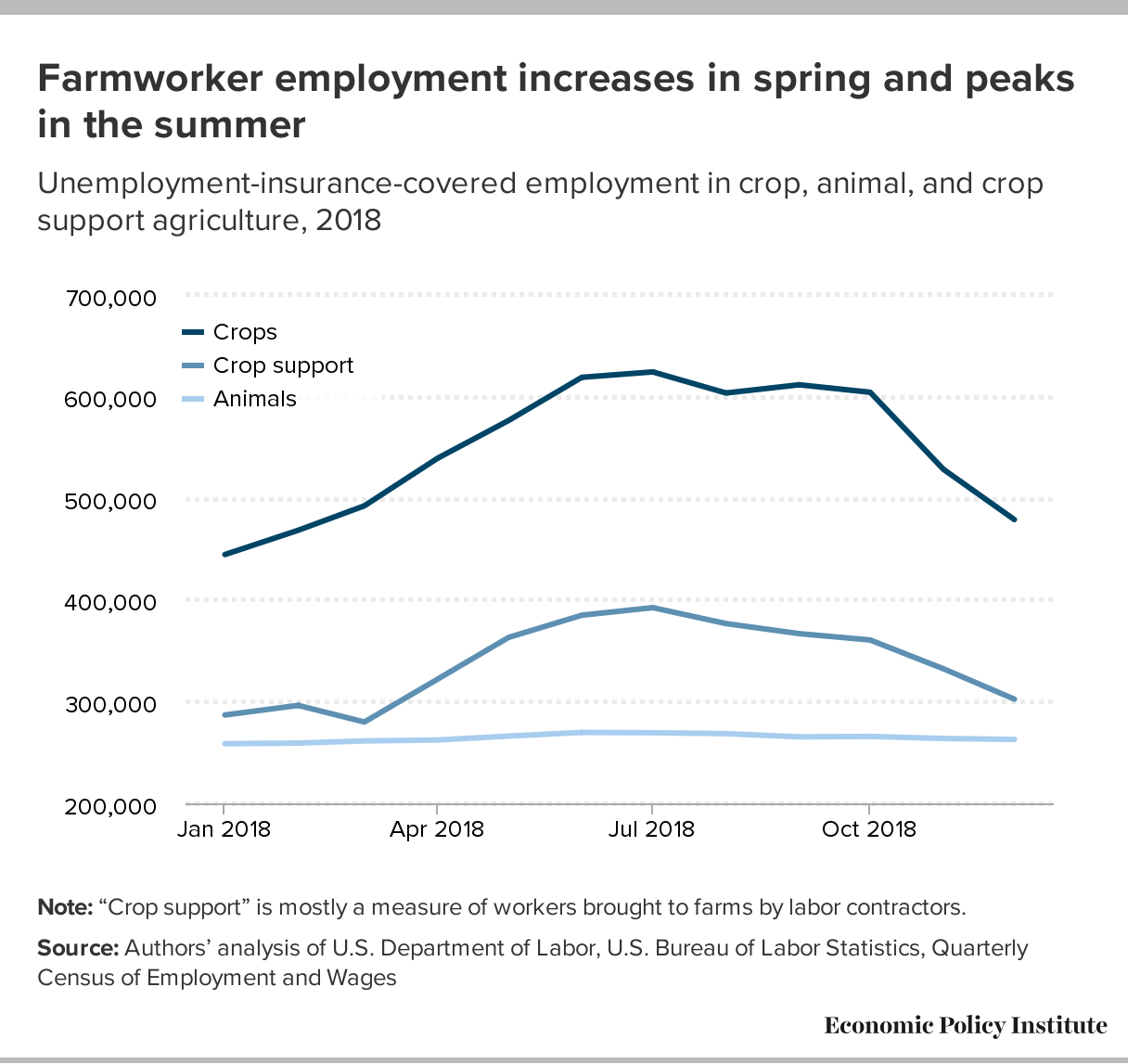
It is difficult to accurately count the number of hired agricultural laborers in the United States, but official sources place the number at
Most of these workers are employed seasonally to perform the hard manual labor of cultivating and harvesting crops. One-half to three-quarters of them were born outside of the United States, with the majority holding Mexican citizenship.
The H-2A visa program authorizes noncitizen agricultural laborers to work in the United States. This program allows farmers to recruit workers for seasonal agricultural jobs, provided the workers return home within 10 months.
But the H-2A program doesn’t cover enough workers to meet the needs of the food system. In 2018, only 243,000 visas were issued under the program – far less than the total number of workers needed to power the farm economy.
Government research suggests that approximately half of the remaining workers on U.S. farms are in the United States without legal authorization. These workers often live in the U.S. year-round, choosing to be in legal limbo rather than risk crossing an increasingly policed border. Some travel from state to state, following the harvest cycle of crops.
The mostly undocumented workers not covered by H-2A visas frequently work for labor contractors, who arrange for their transportation to work sites in shared vans or trucks.
This near-constant physical proximity to one another can facilitate the rapid transmission of the coronavirus.
Seriously susceptible
The nature of their work also makes farmworkers especially susceptible to serious coronavirus infections.
Although COVID-19 tends to be most severe in the elderly and people with underlying health conditions, farm laborers face working conditions that may elevate the risk for severe disease.
Moreover, farmworkers face a number of barriers to accessing medical care, ranging from linguistic and cultural differences to lack of reliable transportation to the limited number of medical facilities in many rural communities.
These barriers are especially high for the many undocumented farmworkers, who are not eligible for insurance coverage through the Affordable Care Act, which does cover workers on H-2A visas.
Finally, the labor contractors who employ undocumented workers generally pay only for work that is completed. This means that a day at the doctor’s office is a day without pay – no small sacrifice for a worker making less than $18,000 a year.
Impact on the food supply
But what would an outbreak of COVID-19 among farmworkers mean for the food system?
However, widespread infections among farmworkers could make it difficult for farmers to harvest crops. Even before the pandemic, farmers in many agricultural areas were already struggling with labor shortages.
Eventually, consumers could begin to see the impact of any labor shortages in the form of higher prices or shortages of products ranging from strawberries and lettuce to meat and dairy.
There’s no easy solution, but a good start would be ensuring farmworkers are able to follow effective social distancing guidelines, are wearing protective gloves and masks, and are able to get the medical care they need without fear of lost wages or deportation.
Americans depend on these laborers to continue putting food on their tables during this crisis. A little support would go a long way.
The U.S. unemployment rate climbed from a half-century low of 3.5% to 4.4% in March – and is expected to go a lot higher.
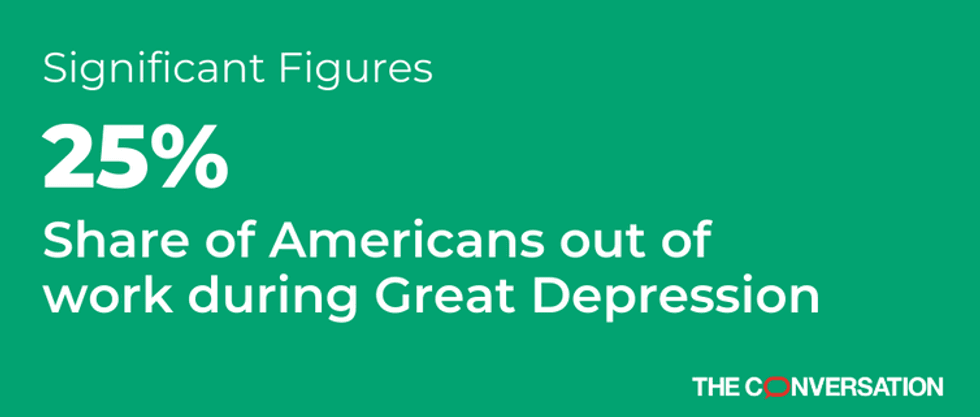
But could the rate, as some predict, surpass the 25% joblessness the U.S. experienced at the peak of the Great Depression?
As a macroeconomist who has tracked the labor force for decades, I’ve been wondering about this myself.
There are actually two figures the Bureau of Labor Statistics uses to estimate employment levels in the U.S.
One is the unemployment rate, which comes from the Current Population Survey. The U.S. Census Bureau contacts about 60,000 randomly selected households every month to get an estimate of this rate.
The other is an estimate of how many nonfarm jobs were lost or created in the month. The Bureau of Labor Statistics creates these figures by asking more than 140,000 private businesses, nonprofits and various state and local governments how many people were on their payroll at any time during the week containing the 12th of the month.
The latest data show the economy lost 701,000 jobs in March.
The employment surveys – single-week snapshots – were both taken in mid-March, around the time the U.S. first began to experience a sharp uptick in cases, and some states, such as New York and California, ordered businesses to close. Both surveys likely only reflect the very early effects of the pandemic.
In addition, they consider someone employed even if they worked only part of that week. Starting off the week employed and ending the week laid off means a person is still considered “working.”
So we won’t begin to see the full scale of the jobs impact until early May, when the April data are released.
So how high could joblessness get?
The record unemployment rate came in 1933, when a quarter of adults who wanted to work couldn’t find a job.
If unemployment in the U.S. does reach 25%, the country would hardly be alone in the world. In fact, before the pandemic, 22 countries including South Africa and Kenya were experiencing estimated unemployment rates over 25%, according to the CIA, which tracks data like this because high unemployment sometimes lead to social instability and government collapse. Burkina Faso, a small country in West Africa, had unemployment north of 75%.
With governments continuing to work on bailout and stimulus programs aimed at mitigating the pandemic’s impact on the economy, it’s impossible to really know how high joblessness will get. These efforts may prevent the worst.
In my view, however, I do believe that no matter what, it will be short-lived. The economy will rebound when life – and our pent-up desire to eat out, shop and spend – returns to normal, eventually.
More than 10 million Americans lost their jobs last month and are in desperate need of immediate financial assistance amid the coronavirus crisis, but the Trump administration said in a draft plan circulated internally Thursday that people who do not have direct deposit information on file with the IRS—a group that is disproportionately low-income—may have to wait until September to receive the one-time $1,200 payment authorized under the latest stimulus.
The IRS said in the draft plan that it intends to start sending electronic payments by late next week to those with direct deposit information on file from their 2018 or 2019 tax returns, the Washington Postreported.
"However, $30 million in paper checks for millions of other Americans won't start being sent out until April 24, as the government lacks their banking information," according to the Post. "And some of those checks won't reach people until September, the document shows, underscoring the reality that many Americans could have to wait five months to receive their checks."
During a press briefing Thursday evening, Treasury Secretary Steve Mnuchin—who just last week dismissed surging unemployment as "not relevant"—promised that Americans without direct deposit information on file will soon be able to access a "web portal" to provide their banking details to the IRS.
Patricia McLaughlin, a Treasury Department spokesperson, told the Post that "the overwhelming majority of eligible Americans" will receive stimulus payments within the next three weeks, but progressive lawmakers and advocates are warning that millions of vulnerable people—including those living on Supplemental Security Income (SSI) and veteran pensions—could fall through the cracks.
"This is unacceptable," Rep. Alexandria Ocasio-Cortez said of the possible five-month delay in an email to supporters late Thursday. "That not even remotely fast enough for the millions of working people who have seen their hours slashed, their expenses rise, and their government refuse to take sufficient action."
"This lockdown could last for months," said Ocasio-Cortez. "As people lose their jobs, we can't leave them in the cold while big corporations easily access their bailout money."
Others similarly raised alarm about the IRS' estimated timeline, which experts warn could be derailed by technical glitches.
"This is such a stupid disaster. We did not have to have mass unemployment," tweetedNew York Times columnist Farhad Manjoo. "The policy response could have been to have the government pay companies' payroll, like European countries are doing. Instead we're letting people lose their jobs and sending them too-small checks too late."
The Washington Post reported that the IRS draft plan "would distribute paper checks to the lowest-income Americans first, prioritizing payments for individual taxpayers with incomes of $10,000 or less on April 24."
"Checks for earners of $20,000 or less would be in the mail May 1, followed by those with incomes of $30,000 on May 8, $40,000 on May 15, and continuing in income increments of $10,000 each week,"according to the Post. "The IRS plans to issue about 5 million checks each week."
Late Wednesday, the Trump administration reversed policy guidance that would have required millions of Social Security recipients to file a tax return in order to receive their payments. However, critics said the reversal needlessly leaves out many SSI recipients and veterans, potentially causing massive delays in payments.
"These are important members of our communities living with additional burdens in this pandemic," Chuck Marr, senior director of federal tax policy at the Center on Budget and Policy Priorities, wrote in a blog post Thursday. "There's no reason to add to that burden by making them navigate filing a tax return when their government has all it needs to deposit a rebate in their bank account."
As millions of people worry about payment delays, many others—including high school seniors, college students, and immigrant families—have learned in recent days that they are not eligible for the one-time $1,200 payments, which are part of a massive stimulus package President Donald Trump signed into law last Friday.
Aaron Klein, a fellow in economics studies at the Brookings Institution, estimated Tuesday that around 70 million Americans "are likely to have to wait at least another month, or more," to receive their stimulus payment because they didn't owe taxes—and thus did not file a return—in 2018 or 2019, or they did not use direct deposit for their tax refund.
"Despite being the largest economy on earth we lack both government run real-time payments and universal bank accounts, systems common among developed countries," Klein noted. "Americans shouldn't have to wait for Congress to act. Federal bank regulators have substantial authority to fix these problems. The Federal Reserve could require all checks under $5,000 to be immediately available to consumers, a power Congress delegated in the 1980s."
"Ultimately, where there is a will, there is a way," Klein wrote. "The president appears more interested in putting his name on the check than getting it to Americans as quickly as possible. The response to COVID is exposing a lot of problems ignored for too long. Add our basic banking and payment systems to this growing list."
As the coronavirus roils the economy and throws millions of Americans out of work, Medicaid is emerging as a default insurance plan for many of the newly unemployed. That could produce unprecedented strains on the vital health insurance program, according to state officials and policy researchers. Americans are being urged to stay home and practice “social distancing” to prevent the spread of the virus, causing businesses to shutter their doors and lay off workers. The Labor Department reported Thursday that more than 6.6 million people signed up for unemployment insurance during the week that e...
Defending President Donald Trump’s coronavirus response, Fox News commentator Jesse Watters highlighted federal efforts to restrict international travelers who may be infected — a ban he claimed mattered more than diagnostic testing.“We were slow with the testing, but very quick with the travel ban. And that’s been much more critical in saving lives,” Watters said during a March 31 episode of “The Five.”The administration has attracted stinging criticism from public health experts and state officials, who say the dearth of COVID-19 tests has made it impossible to get a handle on the disease’s ...
Cars are back on city streets and shoppers are strolling in malls again as life slowly returns to Wuhan. But the cradle of the global coronavirus pandemic remains under the shadow of the contagion.
The city of 11 million people -- along with tens of millions more throughout the rest of Hubei province -- was locked down in late January in an unprecedented and ultimately failed bid to contain the pathogen.
Hubei and its provincial capital Wuhan have accounted for the majority of China's officially reported 3,322 coronavirus deaths and 81,620 overall cases.
But with new infections now virtually nil -- according to the much-questioned Chinese government figures -- authorities have begun loosening restrictions on movement within the city and easing its isolation from the rest of the country.
As a result, Wuhan is stirring again.
AFP pictures and video, shot at the lockdown's height in late January and again this week after curbs began to ease, tell the story.
Then: eerily silent and empty streetscapes, closed shops, residents frantically stocking up on food and medicines, pervasive fear.
Now: light yet growing road traffic, commerce sputtering back to life, and citizens ready to plan for the future again.
"If we don't keep striving, what else in this world is worth striving for?" said Waiwai, owner of a small cafe which reopened Sunday but for take-out only owing to social-distancing rules.
But with China now on guard against a return wave of overseas coronavirus infections, Wuhan authorities on Friday made clear that business-as-usual would not be returning anytime soon.
A government notice said re-opening the city brings the risk of infections from beyond its perimeter and that the health crisis remained "severe".
It instructed authorities to maintain many tight controls on movement, limits on gatherings, mask-wearing and other measures, and avoid any "slackening".
"There's definitely still some risk. People entering from outside the city will probably include some cases imported from overseas," said Bian, a 26-year-old supplier of food to hotels, who declined to give his full name.
"It feels great. I've been stuck at home for so long."