Donald Trump's real estate organization did business with an Iranian bank that U.S. authorities have linked to terrorist group's and Iran's nuclear program.
U.S. officials later accused the bank of helping to obtain sensitive materials for Iran's nuclear program, and American authorities believe Bank Melli was used between 2002 and 2006 to funnel at least $100 million to the Quds Force unit of the Iranian Revolutionary Guard that has sponsored terrorist attacks.
The news organization reported that Bank Melli may have paid more than $500,000 in yearly rent for 8,000 square feet in the GM Building, but it's not clear whether Trump's organization broke any laws by doing business with the Iranian-controlled bank.
a company controlled by Trump secretly conducted business with Cuba while U.S. sanctions were in place.
The U.S. had an embargo in place during that time prohibiting Americans from conducting business with Iran, including accepting rent payments, but some of the nation's organizations were granted licenses exempting certain transactions from the sanctions.
If the rent payments were licensed, the ICIJ reported, it might have been difficult for the Trump Organization to legally evict the bank, which moved out sometimes after 2003.
Regardless, the business arrangement calls Trump's principles into question.
The Republican presidential nominee has described Iran as a "big enemy" on the campaign trail and accused his rival, Hillary Clinton, of being soft on the Iranian regime after receiving donations from foreign governments through her Clinton Foundation.
“It’s a pretty hypocritical position to take,” said Richard Nephew, a former U.S. State Department official who worked on Iran sanctions for nearly a decade for both George W. Bush and Barack Obama. “It suggests that his principles are pretty flexible when it comes to him getting paid.”
Documents obtained by the ICIJ shows that Bank Melli's office in the GM Building, which Trump sold in 2003, was “owned or controlled” by the Iranian government and would have been subject to economic sanctions against Iran.
Bank Melli was prohibited from conducting bank transactions in the U.S., but it may have kept an office in Trump's building in hopes that the sanctions might one day be eased.
Trump has been an outspoken critic of Iran since the 1980s, when President Ronald Reagan imposed new sanctions after the Islamic regime was linked to terror attacks in Argentina and Saudi Arabia.
The real estate developer and future reality TV star suggested in a 1987 speech that the U.S. should attack Iran and seize some of its oil fields, and he continued to bash the regime.
“I’d be harsh on Iran," Trump told The Guardian in 1988. "They've been beating us psychologically, making us look a bunch of fools. It’d be good for the world to take them on.”
Ten years later, Trump -- who likes to brag that he's a hands-on manager of his businesses -- would be cashing rent checks from the Iranian-controlled bank, although a longtime employee denies knowing the bank was a tenant.
“We had any number of tenants in the GM Building,” said George Ross, a longtime vice president of the Trump Organization. “They might have been in there, but I have no knowledge of them.”
A spokesperson for the Trump Organization declined to comment unless the story was positive, the ICIJ reported, but the former State Department official said there's no excuse for renting to the Iranian-controlled bank.
“Should someone in America have known better than to do business with Iran? Yeah,” Nephew said.
Donald Trump claims he should be president in part because he has succeeded at creating jobs and businesses.
While the foundation of his business empire was in New York real estate and construction – thanks to “a million-dollar loan” from his father – he spent about 25 years owning and/or managing casinos in Atlantic City, which sought to rival Las Vegas as America’s gambling capital.
These experiences, he argues, make him uniquely qualified for the Oval Office. He also claims he would create 25 million jobs over the next decade as president. This, in his mind, entitles him to speak for America’s working class.
“I’m the only one on the stage that’s hired people,” he said during a Republican primary debate earlier this year. “I’ve created tens of thousands of jobs and a great company.”
In the paper, I compare the performance of his three Atlantic City casinos – the Trump Taj Mahal, the Trump Plaza, and the Trump Marina – against that of their rivals over a 14-year period.
Even if one does not ordinarily vote on the basis of evidence, I hope that the details presented in my paper help clarify a critical issue in this election.
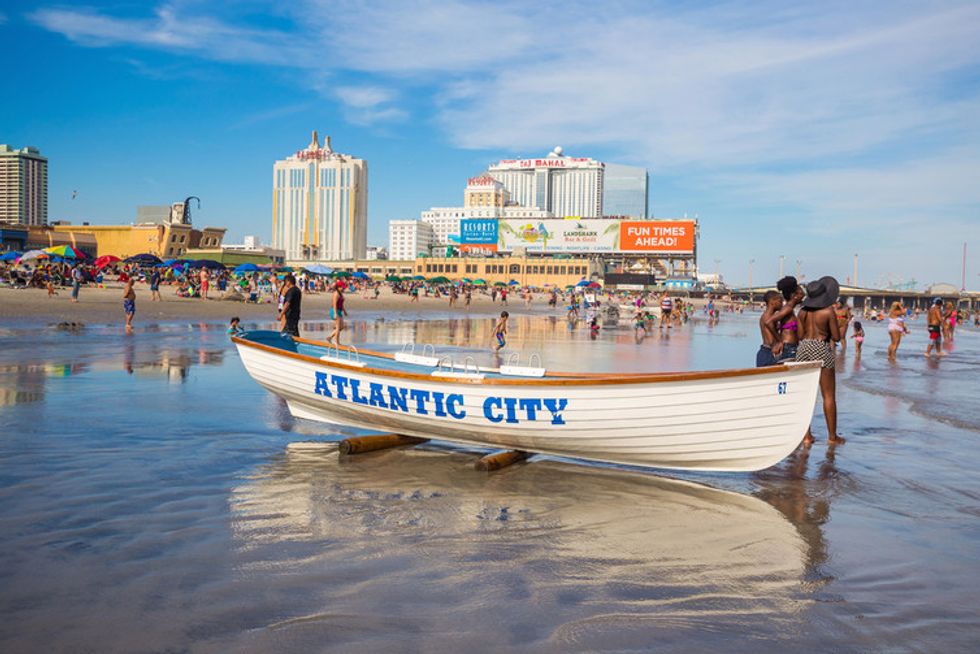
The Atlantic City boardwalk, in all its glory.
AC boardwalk via www.shutterstock.com
Why focus on casinos
The casino data presented and analyzed in my working paper are not like other anecdotes about Trump.
His job-creating performance in other industries, such as construction, is much harder to compare with his peers. Like unsubstantiated claims about his personal wealth and taxes, we cannot assess Trump’s claims about job creation in other contexts because there is no available evidence about it.
His casinos are different. New Jersey requires casino licensees to report extensive jobs and revenue data, which are readily available on the internet. The data are also audited, making them more reliable.
As for why I focused on this time frame, 1997 was the peak year of employment for Atlantic City casinos, and it is also the first year for which New Jersey’s Casino Control Commission (CCC) posted casino jobs and revenue data on its website (revenue data start in 1999). I end in 2010 because that was the year Trump lost control of his casinos after the third of their four bankruptcies. I use data for all casinos in Atlantic City except The Sands and The Borgata, as they did not report data for all years in the study.
During this period, while Trump was the casinos’ chief executive officer, board chair and/or dominant shareholder, Atlantic City went from a booming resort to an eventual bust. All its casinos were hurt, but, on average, Trump’s suffered worst of all. Indeed, all three Trump casinos have closed or soon will.
What the data show
The average headcount at Trump’s Atlantic City casinos declined by 50 percent during the period, from 4,926 employees in 1997 to 2,463 in 2010, for a mean loss of 2,463 per location. The average non-Trump casino, by contrast, lost 35 percent of its employees, dropping from 4,468 to 2,921 for a loss of 1,547 jobs. In other words, Trump lost an average of about 900 more employees per casino than his competitors, a 37 percent difference.
As for their financial performance, average revenues for Trump’s casinos fell 42 percent, from US$377 million in 1999 to $220 million in 2010. Revenue at the average non-Trump casino, by contrast, declined 27 percent in the same period, from $394 million to $286 million. While the entire Atlantic City casino industry suffered as neighboring states like Pennsylvania and Connecticut eased gambling laws, Trump’s performed significantly worse, as their revenue on average fell $50 million per casino more than his rivals’ – or a third more.
These findings are statistically significant, meaning that the Trump casinos’ poor performance was not random. It had something specifically to do with how they were run. In particular, it means that if you worked at a Trump casino, you were nearly 40 percent more likely to lose your job than if you worked at one of the others.
If that is what he did for his casinos’ employees, it is fair to ask whether he would do better for American workers as president.
Trump supporters may object and point out that he did, indeed, create jobs, even if his casinos ultimately lost half of them under his watch. They could also emphasize that all Atlantic City casinos were in trouble, due to regional competition as well as two economic recessions in the period.
The response to these objections is that this is about relative performance. In head-to-head competition – with the same businesses in the same place and time, facing the same challenges – Trump’s casinos performed worse, on average, than their peers at creating sustainable jobs.
His casinos were not the “best” and not even “average” – they were the worst.
Atlantic City was hit by Hurricane Sandy in 2012.
Atlantic City via www.shutterstock.com
Why this matters
These findings are important for three reasons.
First, and perhaps not surprisingly, even as his casinos languished, Trump certainly did well for himself. He has bragged that “Atlantic City fueled a lot of growth for me” and that “[t]he money I took out of there was incredible.”
Based on securities and court filings, I found that from 2001 to 2005, he earned at least $16 million from the casinos, or $3.2 million per year. This included a base salary of $1.5 million per year as CEO and chairman of Trump Hotels and Casino Resorts until 2004, when the casinos commenced their second bankruptcy. Although he lost his position as CEO, he remained chair of the board and agreed to make promotional appearances for the casinos. For doing so, he got a raise – to $2 million.
This means that, according to one report, Trump earned about six times the average base pay of U.S. casino executives. According to CCC data, it also means that Trump received about 120 times the $26,000/year employees at his casinos earned on average.
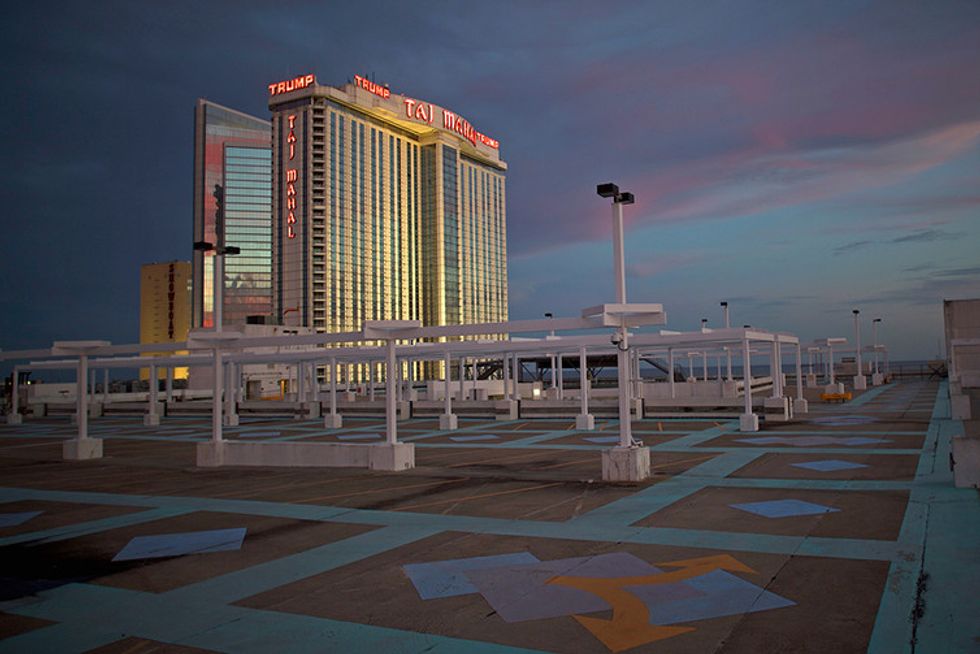
The Trump Taj Mahal Casino, scheduled to close in October, is seen from an empty rooftop parking lot at dusk in Atlantic City.
Mark Makela/Reuters
Second, Trump did not get rich in Atlantic City because the casinos were profitable in this period. Instead, his wealth came in part from causing the casinos to borrow heavily and then slashing that debt in Chapter 11 bankruptcy.
Trump himself admitted that he “used the Chapter 11 bankruptcy laws of our country in four instances, much as many of our country’s elite business people do.”
Trump has failed to acknowledge, however, that no major business in America has gone through bankruptcy as often as his casinos. According to the LoPucki-UCLA Bankruptcy Research Database, only a few large companies have used Chapter 11 more than twice. Among large businesses, only the Trump casinos went through the process four times (three while under his ownership or control).
Trump has justified his casinos’ repeated use of bankruptcy as “an effective and commonly used practice … to restructure a business and ultimately save jobs.” While this is one reason Congress created Chapter 11, the evidence shows that Trump somehow twisted the process to benefit himself, even as the casinos continued to hemorrhage jobs and lose money.
Third, Trump’s claims about job creation are unusually important. Presidential candidates often make improbable claims, and Trump is no exception. Voters may dismiss such claims as electoral exaggerations, and so neither expect them to be honored nor worry about their breach.
Jobs are different. His promise to improve the plight of workers who have lost jobs to foreign competitors is both powerful and plausible. A recent Gallup Poll shows that members of both major political parties consider jobs and economic security two of the top three most important issues in the election. Trump has forcefully articulated a vital issue that “traditional” candidates from both parties have struggled to address.
At the same time, Trump’s ability to solve the problem is, at face value, plausible. He has run many businesses and certainly could have “created” many jobs (I put to one side the difficult question whether any individual can take credit for “creating” jobs). Unlike building a border wall at Mexico’s expense, this might seem like something Trump could actually do as president.
The data from the Casino Control Commission are a red flag, warning that he probably can’t – because he hasn’t. Those data show the performance of Trump and his competitors in a substantially similar line of business (gaming), in the same place (Atlantic City), in the same time period (1997-2010), subject to the same threats, and across dimensions (employment and business acumen) that have become central to Trump’s presidential campaign. On average, Trump was worse than all of them.
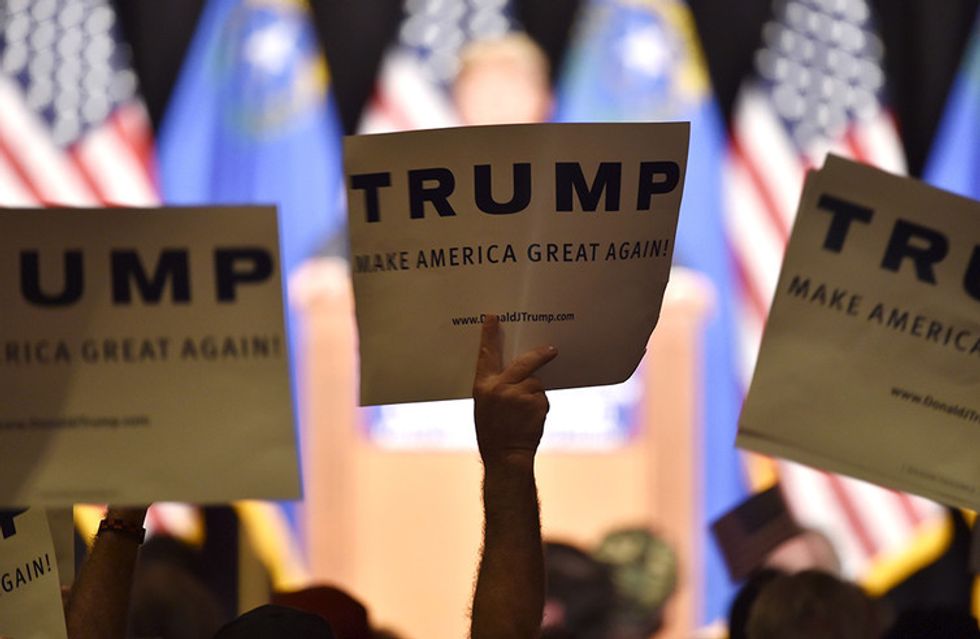
Making America great has been Trump’s main slogan throughout the campaign.
David Becker/Reuters
Make America worse again?
Over the course of the campaign, Trump has tapped into a deep sense of economic anxiety among American workers.
Many believe he can be their champion because he created jobs in the past. Usually, claims like that cannot be assessed, and are dismissed as campaign puffery.
Here, however, we have hard data by which to judge the very track record on which Trump says he can “Make America Great Again.” Contrary to Trump’s claims, my study of that data indicates that he is more likely to make America worse.
On Monday’s edition of Morning Joe, co-host Joe Scarborough said that Republican presidential nominee Donald Trump’s snide, deeply personal insults toward his opponent Hillary Clinton are unlike anything he’s ever seen in U.S. politics.
Morning Joe's panel began by watching some highlights of Trump's latest anti-Clinton speech in Pennsylvania this weekend -- where he mocked her for coming down with pneumonia and suggested that she wasn't loyal to her husband -- and came away thoroughly disgusted with his behavior.
"Mocking her health scare, talking about his temperament, and then moving on to speculating about her personal life in a way that's just so over-the-top," co-host Joe Scarborough said when summing up Trump's Saturday speech. "I've never seen anything like it."
Nicole Wallace, a Republican and former official in George W. Bush's administration, said that any normal person watching Trump's antics will likely be far more revolted by them than at any revelations about his tax returns.
"This is the stuff that, at the gut level, people are rejecting," she said. "And this is the stuff that, if I were running against him, I would want to make sure everybody saw. These are the traits that reinforce her core message, which is that he's temperamentally unfit to be president."
Mark Halperin shared Wallace's assessment and noted that ever since losing the debate last Monday, Trump has done nothing except give the Clinton campaign "more and more material" to prove that he lacks the temperament to be president.
"It's as if [Clinton campaign manager] Robby Mook calls him every morning and says, 'Here's what I need you to do to reinforce the notion that you don't have the right temperament to be president,'" he said.
It has been almost a week, but we had to wait until Sunday night to get the last word on Donald Trump's disastrous Monday night debate performance from Emmy award-winning HBO host John Oliver.
According to the Last Week Tonight comedian, "As I'm sure you know by now, Donald Trump's performance consisted mainly of an incoherent jumble of sniffles and nonsense like a racist toddler coming out of dental surgery."
Sharing a clip of Trump touting his temperament, Oliver quipped, "For the record, you can't incoherently rant about having the best temperament. That is a claim that disproves itself. It's like getting a forehead tattoo that says, 'I have excellent judgement.'"
Oliver also highlighted Trump's insistence that he won the debate by citing easily-gamed online polls, before noting that even Fox News undermined the accuracy of the polls stating, they "do not meet our editorial standards."
"Which is shocking," Oliver admitted. "Because I was pretty sure Fox News' only editorial standards were 'All ladies must be 8's or above,' and 'Try not to say the N-word.'"
President Barack Obama said he faced a candidate similar to Donald Trump eight years ago in his first White House bid -- and he said they're both symptomatic of the deeper problems within the Republican Party.
"I see a straight line from the announcement of Sarah Palin as the vice-presidential nominee to what we see today in Donald Trump -- the emergence of the Freedom Caucus, the Tea Party and the shift in the center of gravity for the Republican Party," Obama told Jonathan Chait in a lengthy New York magazine interview.
He's not terribly optimistic that the GOP will change without some serious soul searching -- regardless of who wins the Nov. 8 election.
"Whether that changes, I think, will depend in part on the outcome of this election, but it’s also going to depend on the degree of self-reflection inside the Republican Party," Obama said. "There have been at least a couple of other times that I’ve said confidently that the fever is going to have to break, but it just seems to get worse."
Obama said he has gotten along with individual Republicans during his presidency, but conservative media insist on an ideology purity that makes compromise impossible.
"We can have really great conversations and arrive at a meeting of the minds on a range of policy issues, but if they think they’re going to lose seats or that they’re going to lose their own seat because the social media has declared that they sold out the Republican Party, then they won’t do it," he said.
Obama cited two examples of GOP politicians who were punished for associating with him in public.
"They’re looking at Charlie Crist down in Florida," he said. "One hug [from me] and he was toast. Chris Christie couldn’t get his presidential race launched — it was basically over before it started — because he was too friendly and cooperative with me in accepting federal aid for a state that had been devastated by a hurricane."
"They’re imagining the potential problems that arise, so it’s pretty hard for them to publicly say, 'Obama’s a perfectly reasonable guy, but we just can’t work with him because our base thinks he’s the Antichrist,'" Obama continued. "It’s a lot easier for them to say, 'Oh, the guy’s not listening to us,' or, 'He’s uncompromising.'"
Obama said he understands that and isn't particularly troubled by that dynamic, and he even offers to help by attacking his GOP friends in public.
"Sometimes I tease them about it behind the scenes," he said. "I’ll tell them, 'Look, if you need some help, me attacking you or you know.' And the times where we have gotten things done, it has been very important for me to, frankly, help them try to manage their base."
Pope Francis on Sunday advised U.S. Catholics who feel they are torn between two imperfect candidates for president to study and pray before they vote and to make sure to follow their conscience.
During his traditional, freewheeling in-flight news conference with reporters on the plane returning from Azerbaijan, Francis was asked how he would counsel American faithful and what wisdom they should keep in mind.
"You have asked me a question that describes a difficult choice because, according to you, there are difficulties with one and difficulties with the other," the pope said, without naming Democrat Hillary Clinton or Republican Donald Trump.
In posing the question, the reporter made allusions to Clinton's support of abortion and Trump's statements vilifying migrants and religious minorities.
"During political campaigns, I never say a word," the pope said. "The people are sovereign. I would only say, study the proposals well, pray and choose with your conscience."
But in the rest of his response, while stressing that he wanted to talk about a "fictional situation," Francis appeared to be saying that the United States was among the countries that had become so politicized that it had effectively lost what he called a culture of politics.
"When in any country there are two, three or four candidates who don't satisfy everyone, it means that perhaps the political life of that country has become too politicized and that it does not have much political culture," he said.
"People say 'I'm from this party' or 'I'm from that party,' but effectively, they don't have clear thoughts about the basics, about proposals," he said.
Last February, while returning from Mexico, the pope was asked if U.S. Catholics could vote for someone with Trump's views on immigration, particularly on the candidate's promise to build a wall at the border with Mexico.
He said a person with such views was "not Christian."
Trump struck back, calling the pope's comments "disgraceful."
(Reporting by Philip Pullella; Editing by Lisa Von Ahn)
CNN's Poppy Harlow grilled a hapless Donald Trump advisor trying to explain away a bombshell report that found the Republican presidential nominee might not have paid federal income taxes for nearly two decades.
The CNN anchor asked former GOP congressman Jack Kingston how he could square Trump's failure to pay taxes with his campaign rhetoric about the crumbling American infrastructure -- and the surrogate instead bashed the messenger.
"I know the New York Times always is looking for a right-winger who did something wrong, but the reality is, he has paid taxes," Kingston said. "He has abided by the law, and by the way, he has made his millions or his billions by creating jobs, by building bricks-and-mortar projects, by injecting economic developments into communities that needed them."
Kingston said, by comparison, Bill and Hillary Clinton had made millions by giving speeches to foreign governments and Wall Street -- but Harlow interrupted to remind him the couple had paid a 31-percent tax rate last year.
"No jobs were created with the Clinton efforts," Kingston said. "But what I'm saying is, the Donald Trump businesses have created lots of jobs, and they have paid lots of taxes."
Harlow asked how Americans could trust Trump with the nation's finances if he had lost nearly $1 billion in one year, even if he had made it all back over time, as his supporters point out.
"I think the American people are a lot smarter than you think," Kingston said.
Harlow asked whether Trump was a hypocrite for complaining in April 2012 that President Barack Obama had paid only a 20.5 percent tax rate on $790,000.
"Under tax simplification, the tax code will be clearer, there'll be more certainty to it, it will be fairer and it'll be better for all Americans," Kingston said, reminding Harlow he had a degree in economics.
Kingston then began a rambling discourse on the candidates' job plans, and Harlow again asked him whether Trump was a hypocrite for attacking Obama on taxes when he possibly hadn't paid them for decades.
"I can't go back on a 2012 Twitter -- there's some big Twitters out there," Kingston said. "I don't know the context of what he was saying."
An exasperated Harlow offered to read the tweet to Kingston again, and Kingston assured her that Trump had paid taxes but could not release his tax forms because he was under audit.
"Okay, what did he pay?" Harlow asked. "What was his effective tax rate in 2012, when he attacked the president?"
Kingston then blamed Clinton for Trump's tax troubles.
"Let's take a step back," he said. "If there's a problem with the tax code, who is the one who's been in office for 30 years -- it's Hillary Clinton."
Harlow said she doesn't disagree the tax code needs reform, but she wanted to know how Trump could attack the president on taxes when he apparently didn't pay them himself.
"I really think the people back in America, the mainstream, who Hillary Clinton calls deplorable and super-predators and basement-dwellers, they're more worried about their own income, which they've seen fall from $57,000 to $53,000," Kingston said. "We have 43 million people on food stamps right now, 94 million people are underemployed or unemployed -- they know the economy is not working for them right now. They want change, they want an outsider."
He again blamed Clinton for the tax code that Trump apparently exploited in the mid-1990s.
"Hillary Clinton has been part of the architect of it because she's been a U.S. senator," Kingston said. "Before that she was working on trade deals with her husband."
Hillary Clinton told a majority-black church in North Carolina on Sunday that she knows her grandchildren are growing up in a different world than many black youth in the U.S. who are concerned about police shootings and gun violence in their communities.
The Democratic presidential nominee’s remarks at the Little Rock AME Zion Church in Charlotte were a frank acknowledgment of the impact of what she has called “implicit bias” in policing can have on black communities.
Clinton cited the death of 43-year-old Keith Scott, a black man who was shot by police in front of a Charlotte apartment complex on Sept. 20. She also lamented the death of 40-year-old Terence Crutcher, who was shot days before during a Tulsa traffic stop. Both shootings led to community protests. The Tulsa police officer has pleaded not guilty to a manslaughter charge.
“I’m a grandmother, and like every grandmother, I worry about the safety and security of my grandchildren, but my worries are not the same as black grandmothers, who have different and deeper fears about the world that their grandchildren face,” Clinton said.
Clinton described testimony that Taje Gaddy, 10, and Zianna Oliphant, 9, gave last week before the Charlotte City Council about violence in their community. Clinton later summoned Oliphant to join her on the stage.
“I wouldn’t be able to stand it if my grandchildren had to be scared and worried the way too many children across our country feel right now. But because my grandchildren are white, because they are the grandchildren of a former president and secretary of state, let’s be honest here, they won’t face the kind of fear that we heard from the children testifying before the city council,” Clinton said.
Clinton has made gun violence a focus of her presidential campaign. Mothers who have lost children in shootings have joined her on the campaign trail. Clinton has said police officers should be trained to recognize implicit bias and called for the official police video of the Charlotte shooting to be released.
Donald Trump, the Republican nominee, said at a rally after Crutcher’s shooting that it looked like he had done “everything he was supposed to do.” On Twitter, he criticized Clinton’s trip to Charlotte, which was postponed one week at the behest of the city’s mayor, as a chance to “grandstand.”
Donald Trump's decision to take a $916 million loss on his 1995 income tax return showed his business acumen and "genius" at figuring out how to minimize his tax bill, two of the Republican presidential candidate's advisers said on Sunday.
"This is a perfectly legal application of the tax code. And he would have been fool not to take advantage of it," said Rudy Giuliani, the former New York mayor who is one of Trump's advisers.
Speaking on the ABC program "This Week," Giuliani said that as a business owner, Trump has a "fiduciary duty" to the investors in his real estate company to maximize profits.
Giuliani compared Trump's ability to come back from the nearly $1-billion loss to turnarounds made by Apple co-founder Steve Jobs and Winston Churchill, the former British prime minister who led the United Kingdom through World War Two.
"It shows what a genius he is. It shows he was able to preserve his enterprise, and then he was able to build it," Giuliani said on CNN's "State of the Union."
The New York Times reported on Saturday that it had obtained Trump's 1995 tax records and it quoted experts as saying that the $916 million loss he reported for that year may have allowed him to avoid paying federal income taxes for up to 18 years.
Susanne Craig, one of the Times reporters who was bylined on the story about Trump's tax records, said the tax documents arrived in a manila envelope in her mailbox at the Times with a return address of the Trump Organization.
She said a lawyer for Trump had threatened the newspaper with legal action if it decided to publish the documents.
The tax benefits outlined in the documents stemmed from financial deals Trump made that went bad in the early 1990s.
The Trump campaign, in a statement on Saturday, said the tax document was obtained illegally and accused the New York Times of operating as an extension of the presidential campaign of Hillary Clinton, Trump's rival in the Nov. 8 election.
"I know our complex tax laws better than anyone who has ever run for president and am the only one who can fix them. #failing@nytimes," Trump wrote on Twitter on Sunday.
Chris Christie, the New Jersey governor and head of Trump's presidential transition team, said that Trump's records showed that the U.S. tax code was an "absolute mess" and that Trump was the best person to fix it.
"There's no one who has shown more genius in their way to maneuver about the tax code as he rightfully used the laws to do that," Christie said on "Fox News Sunday."
But Clinton spokesman Brian Fallon said the tax writeoff "shows the colossal scale of his business failures" and that the wealthy real estate developer operates under a different set of rules than ordinary taxpayers.
Clinton has repeatedly called on Trump to release his tax returns, as is standard procedure for modern presidential candidates.
Trump has declined to release his tax records, saying he will not do so until an audit of his returns by the Internal Revenue Service is complete.
The IRS has said that an audit does not bar an individual from sharing their own tax information.
(Reporting by Alana Wise; Additional reporting by Susan Cornwell and Lindsay Dunsmuir; Editing by Caren Bohan and Nick Zieminski)
Outgoing Senate Minority Leader Harry Reid had a few things to say on Sunday about reports that GOP presidential nominee Donald Trump lost $915 million dollars in 1995.
None of them were nice.
The Nevada Democrat, who is winding down his career in the Senate, issued a statement on Sunday that will likely get under the skin of the supposed billionaire who saw the New York Times expose a very bad year in the form of income tax documents that indicate he's not a very good businessman.
According to Reid's statement: "Trump is a billion-dollar loser who won’t release his taxes because they’ll expose him as a spoiled, rich brat who lost the millions he inherited from his father. Despite losing a billion dollars, Trump wants to reward himself with more tax breaks on inherited wealth while stiffing middle-class families who earn their paychecks with hard work."
“Trump is over-leveraged and deeply indebted to someone, but until he releases his taxes we won’t know who," the statement continues. “Let’s step back and take stock: Senate Republicans have put party so far ahead of country, they’ve endorsed a racist, incompetent failure who managed to lose a billion dollars in a boom year. Now they are helping Trump hide his tax returns and preventing the American people from knowing what individuals, businesses or foreign interests could have leverage over Trump."
It is unlikely that Trump will let the comments pass unless his staffers are able to wrestle his phone away from him and keep him off Twitter.
CNN media critic Brian Stelter shot down a conspiracy theory floated by Donald Trump's campaign that debate moderator Lester Holt interrupted the Republican nominee more often because he was biased in favor of Hillary Clinton.
On Sunday's edition of Reliable Sources, Stelter tried to square the fact that Trump had quickly praised Holt following Monday night's debate but then later criticized the moderator after scientific polls showed that Clinton had won.
"If Lester Holt was refereeing a football game, he would have gotten thrown out of the stadium," Tim Graham, executive editor of the conservative website Newsbusters, opined in Trump's defense. "I think the Saturday Night Live skit I would have done if I was running the show would be Lester Holt -- it would sort of be like the end of Top Gun where he lands on the flight deck after beating the Russians and everybody applauds him."
"Obviously, the whole news media before the debate was was telling Lester, 'Truth squad Trump,'" Graham complained. "He heard the lesson and he obviously did this in a way that was completely one-sided."
Stelter interrupted: "It's not Lester Holt's fault when Donald Trump lies more than Clinton on the stage."
"But the whole assumption of liberal media is Hillary somehow never lies," Graham insisted. "Everybody cites Politifact and says Hillary never lies. The fact of the matter is, why is her trustworthy level so low? Because people have watched her over decades lie about everything."
CNN political analyst John Avlon argued that Politifact's fact checking "is as close as we're going to get to an objective tallying" of the candidates' honesty.
"We know that Donald Trump is, at the end of the day, a hype man," Avlon said. "He admits freely he engages in hyperbole. The problem is that crosses into demagoguery in a political context. Hillary Clinton has problems with honesty and trustworthy -- we know that from polls -- in part because for 25 years she's been demonized by partisan media."
"It is the job of journalists to insist on a fact-based debate," he continued. "Increasingly, we are recognizing that it is also our job to call out lies and to call them lies and not default to this 'on the one hand and the other' moral relativism."
"And those of you on the side of partisan media who say that the implicit bias of the mainstream media over the years can only be corrected by explicit bias. Well, you've carried the day for a while, but now people are hip to your tricks."
Avlon concluded by charging that Graham's organization, Newsbusters, had a "real credibility problem" because it "perpetuates the polarization" by focusing on only one side of the problem.
"You have explicit favor in your donors and your ideological agenda from day one," Avlon declared. "And that's why your credibility fails."
Watch the video below from CNN, broadcast Oct. 2, 2106.
A senior Democratic lawmaker said Sunday he had "no doubt" that Russia was behind recent hacking attempts targeting state election systems, and urged the Obama administration to publicly blame Moscow for trying to undermine confidence in the Nov. 8 presidential contest.
The remarks from Representative Adam Schiff, the top Democrat on the intelligence committee in the U.S. House of Representatives, come amid heightened concerns among U.S. and state officials about the security of voting machines and databases, and unsubstantiated allegations from Republican candidate Donald Trump that the election could be "rigged."
"I have no doubt [this is Russia]. And I don’t think the administration has any doubt," Schiff said during an appearance on ABC's "This Week."
Schiff's call to name and shame the Kremlin came a week after Trump questioned widely held conclusions made privately by the U.S. intelligence community that Russia is responsible for the hacking activity.
"It could be Russia, but it could also be China," Trump said during a televised debate with Democratic candidate Hillary Clinton. "It also could be somebody sitting on their bed that weighs 400 pounds."
On Saturday, Homeland Security Secretary Jeh Johnson said hackers have probed the voting systems of many U.S. states but there is no sign that they have manipulated any voting data.
Schiff said he doubted hackers could falsify vote tallies in a way to affect the election outcome. Officials and experts have said the decentralized and outdated nature of U.S. voting technology makes such hacks more unlikely.
But cyber attacks on voter registration systems could "sow discord" on election day, Schiff said. He further added that leaks of doctored emails would be difficult to disprove and could "be election altering."
The National Security Agency, FBI and DHS all concluded weeks ago that Russian intelligence agencies conducted, directed or coordinated all the major cyberattacks on U.S. political organizations, including the Democratic National Committee, and individuals, a U.S. official who is participating in the investigations said on Sunday.
However, the official said, White House officials have resisted naming the Russians publicly because doing so could result in escalating cyberattacks, and because it is considered impossible to offer public, unclassified proof of the allegation.
Schiff and Senator Dianne Feinstein, the top Democrat on the U.S. Senate intelligence committee, said last month they had concluded Russian intelligence agencies were "making a serious and concerted effort to influence the U.S. election."
(Reporting by Dustin Volz and John Walcott; Editing by Nick Zieminski)
Following a discussion over the Saturday Night Live's portrayal of last Monday's presidential debate, Baltimore Sun media critic Dave Zurawik ridiculed GOP nominee Donald Trump for using Fox News personality Sean Hannity as his wingman.
Appearing on CNN's Reliable Sources with host Brian Stetler, Zurawik sarcastically tore into both Trump and Hannity by saying his own editors couldn't care less what the Fox host had to say about anything with regard to Trump.
Hearkening back to 2008, when he said a "servile" Sean Hannity conducted a "softball" interview Sarah Palin, Zurawik stated he sees the same thing occurring now between the Fox host and Trump.
"I'll tell you what, you saw this in the debate when Trump kept saying, 'I don't know why the media won't call up Sean Hannity? They should call up Sean Hannity!'" the media critic began. "You know, I'm sitting there going, 'Who would care what Sean Hannity said?' If I went to my editors and said, 'Hey, you know that Sean Hannity said Donald really did say about Iraq,' they'd laugh and throw me out of the window in the newsroom!"
"He's in that bubble, the Fox bubble," he continued. "Where he actually believes that Sean Hannity's opinion or Sean Hannity could verify your story and everyone would believe it! He's already too far in that bubble, and it really hurt him in that debate."
Washington Post media critic Margaret Sullivan jumped in to say, "We all kind of understand that Hannity is an arm of the Trump campaign who happens to be on some sort of an island on Fox."
She then added, "We don't see him as a journalist."