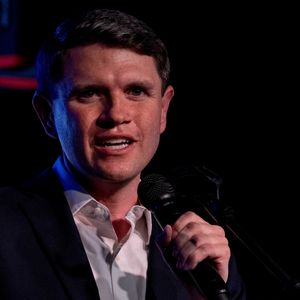
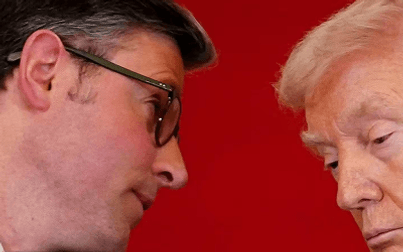
FILE PHOTO: Tesla CEO Elon Musk looks on next to U.S. President Donald Trump talking to the media, at the White House in Washington, D.C., U.S., March 11, 2025. REUTERS/Kevin Lamarque/File Photo

Documentary filmmaker Alex Gibney revealed two pressing reasons that Elon Musk is pouring record sums into the midterms for two reasons.
Musk is on track to be the top Republican donor this cycle, spending at least $276 million on the midterms since July, much of it on the closely watched Texas Senate race, and Gibney, the director of a new, nearly four-hour documentary about the world’s richest man, provided "CNN This Morning" with a one-word answer when asked what the tech mogul gets out of backing President Donald Trump.
“Money,” Gibney said. “I mean, it’s kind of twofold – money, and an ability to escape any kind of criminal or civil reckoning for some of the stuff that his companies have done.”
Gibney noted that Musk and Tesla had been facing a Justice Department criminal investigation over claims about Tesla’s full self-driving technology, along with several civil probes.
“So once Trump became president, as far as we know, all of those investigations are gone,” he said, adding that Musk got rid of some of them himself through his role at DOGE.
The filmmaker named fear as the second motivation for Musk dumping his vast fortune into the November election.
“Now I think he’s terrified that if the Democrats were to take control of one or both houses of Congress, that investigations might resume,” Gibney said. He called that fear the reason for Musk’s “kind of unprecedented” spending.
Gibney said fear also made the film hard to produce. He talked to hundreds of people, but most would speak only on background or off the record because they worried Musk would sue them. Some immigrants, he said, “because of Musk’s relationship with the president of the United States, were afraid of talking because they might be deported.”
He also argued that Musk’s reach goes well past politics, pointing to Starlink, SpaceX and Musk’s Pentagon contracts.
"I think you could say that Starlink, in a way, it has a connected purpose, but it also has a purpose of surveillance, so, and it's also a collection purpose," Gibney said. "It's collecting data for his AI systems. His AI systems have fully infiltrated the Pentagon per Pete Hegseth, and yet his frontier AI system is the worst, so it’s clearly a kind of a payoff.”
“His power is immense,” he added, “and we haven’t even spoken about the sort of propagandistic power he wields through the control of his platform X.”
Musk turned down an interview for the film. “In place of saying, no, thank you, he insulted me directly,” Gibney said. So the filmmakers built an avatar of Musk that mouths real audio clips of him, a nod to his belief that people are living inside a simulation. Gibney described Musk as “an Oz-like figure” trying “to shape our reality.”
That worldview, Gibney argued, lets Musk treat mass firings as a game.
“If you think that we’re living in a game, then you can engage in a kind of performative cruelty and think that it’s funny to brandish a chainsaw,” he said. He went on to claim that Musk’s abrupt shutdown of USAID led to the deaths of hundreds of thousands of children.
“It’s deadly serious and a joke at the same time,” Gibney said.
- YouTube youtu.be
Report typos and corrections to corrections@rawstory.com.
For customer support contact support@rawstory.com.