A large study in South Korea exploring the relationship between age and well-being revealed that whether well-being improves in advanced age or not depends on the personality traits of agreeableness and neuroticism. Notably, well-being did not increase in advanced age in people with low agreeableness and high neuroticism. The study was published in Applied Psychology: Health and Well-being. Researchers studying how happiness and well-being change with age in the past decades reported an interesting relationship. Going towards midlife, happiness tends to decrease. As people move towards midlife...
Woollen clothing has been around for as long as humans have been wearing clothes and sheep have been domesticated. Indeed, our distant ancestors used sheep for three things: food, clothing and shelter – wool makes good insulation and helps to keep in the warmth.
This is why the charity Peta (The People for the Ethical Treatment of Animals) has launched a US$1 million (£844,000) vegan wool challenge to find the first individual, group, or company that can create a vegan wool material that is “visually, textually and functionally akin to or better than sheep’s wool.”
But it seems that back in the 1940s, textile physicist William Astbury was already on the case and making newspaper headlines for wearing what would today be considered a vegan coat.
For Astbury’s jacket was woven not from wool or other conventional textile materials, but from Ardil, a fibre made from monkey nut, or peanut proteins.
The monkey nut coat
In my book The Man in the Monkeynut Coat: William Astbury and How Wool Wove a Forgotten Road to the Double-Helix, I tell the story of Astbury (and that famous coat), who with his colleague Florence Bell laid the foundations for the discovery of the structure of DNA.
Scientists James Watson and Francis Crick are famous for having first worked out the structure of DNA. But their success came 15 years after Astbury and Bell had first shown that X-rays could actually reveal DNA’s structure.
A Daily Mail article on the coat made of peanuts, published in 1944 Author provided
And this work had a surprising origin, for Astbury’s aim was not to answer grand questions about the secrets of life, but to study the humble wool fibre while working as a lecturer in textile physics at the University of Leeds.
Ever since the Middle Ages, wool and textiles were the economic lifeblood of this Yorkshire city – with mills a major source of employment in the late 19th and early 20th centuries.
In 1928 Astbury came to Leeds and used X-rays to reveal the molecular shape of the proteins in wool fibers. He found that they could be compacted or elongated – rather like a slinky toy. This change in their molecular architecture explained the stretchiness of wool – a property that made it so attractive to the textile industry.
And through it, Astbury left another powerful scientific legacy – thanks to his sporting of that rather unusual “peanut” overcoat.
A future wool?
From the mid-1930s onwards, Astbury, along with his collaborators Albert Chibnall and Kenneth Bailey, filed patents on a process that used solvents such as urea to unravel the precise 3D shape of proteins found in seeds – like the peanut. Their method then refolded them by a kind of molecular origami into insoluble fibers, creating a cheap and abundant raw material for the textile industry.
Sharing his optimism, the company Imperial Chemical Industries bought these patents and built a pilot production plant in Scotland to produce a new textile fibre from peanuts, which they called Ardil and gifted Astbury an overcoat made from it.
During the second world war, wool shortages encouraged investment in Ardil and campaigns were launched to persuade the British public of its benefits. This drive to develop new textile fibers at the time may also have inspired a storyline in the 1951 British comedy film The Man in the White Suit.
In the film, an altruistic chemist invents a fabric that resists wear and stain, but (spoiler alert) his dreams come crashing down when management realizes the fabric must be suppressed for economic reasons as it threatens their livelihoods.
Unfortunately, much like the fictional fibre, Ardil did not live up to its promise of saving the British textile industry. But Astbury and his overcoat left an important scientific legacy.
His work remains important because it showcased his lifelong belief that understanding living systems requires solving their molecular architecture. While Ardil did not succeed, Astbury’s research laid the foundation for future innovations in molecular biology and materials science.
This approach, known as structural biology, has since allowed us to understand how the blood protein haemoglobin can carry oxygen around the body, how muscles contract and more recently how the spike protein on the surface of SARS-CoV2 allows the virus to bind and enter human cells.
When Astbury died in 1961, his friend and colleague, the botanist R.D. Preston, fondly remembered him as “a man of many parts – scientist, scholar, musician, bon viveur, humorist, in some ways, a swashbuckler…boisterous to the end with every morning still a Christmas morning.” Maybe to this list of accolades, we should also add a posthumous nomination for the $1 million vegan wool prize.
MIAMI — On a coral reef, white is the color of death. So when researchers see a flash of bone white amid the riot of colorful corals, fish and sea creatures, they know something is wrong. If it’s all white, the coral likely bleached to death in the steamy hot seas. But if it’s a patch of white surrounded by the raggedy brown edges of living coral tissue, they know the most devastating coral disease in the Caribbean has likely struck. Stony coral tissue loss disease is a new and deadly disease affecting reefs throughout the Caribbean. Unlike other coral diseases, it affects more than 20 species...
Chocolate bunnies don’t grow on trees – but cacao pods do. It takes a lot of processing to get from the raw agricultural input to the finished output.
Food scientist Sheryl Barringer from The Ohio State University wrote about various chemical reactions that are part of the transformation of beans into chocolate. One is the Maillard reaction, the same thing that gives the browned bits on roasted meats or a bread’s golden crust their flavor. Barringer also explains that weird white stuff – known as bloom – that might appear on your Easter chocolates if they hang around for a while. (Don’t worry, it’s still edible.)
2. Chocolate is a fermented food
Food science Ph.D. candidate Caitlin Clark from Colorado State University focuses her research on the microbes responsible for much of chocolate’s flavor. As a fermented food, chocolate depends on yeast and bacteria to help turn a raw ingredient into the treat you can recognize.
Clark described how the microorganisms that occur naturally in a given geographical location can give high-end chocolates their “terroir” – “the characteristic flair imparted by a place” you might be more used to thinking about with regard to wine.
Cacao growers rely on another tiny ally to pollinate their crop. Entomologist DeWayne Shoemaker from the University of Tennessee described the mini flies – particularly biting midges and gall midges – that get the job done. “Pollinators must pick up pollen from the male parts of a flower of one tree and deposit it on the female parts of a flower on another tree,” Shoemaker wrote.
But up to 90% of cacao flowers don’t get pollinated at all. People can hand-pollinate the little flowers, but it remains a mystery which other insects might do the job in the wild.
4. Child labor is chocolate’s bitter secret
Harvesting and processing cacao is labor-intensive. To meet this need, some farmers turn to child labor. Cultural anthropologist Robert Ulin from the Rochester Institute of Technology described how the global chocolate industry is tied to inequality via exploitative labor practices.
“The largest chocolate companies signed a protocol in 2001 that condemned child labor and childhood slavery,” Ulin wrote. But he noted that consumers may want more information to make sure their purchase power supports “fair labor practices in the chocolate sector.”
Eating a ton of chocolate is probably not a healthy choice for anyone. But even a little bit of chocolate can be deadly for dogs and cats.
In an article about all kinds of holiday foods that are unsafe for pets, veterinarian and researcher Leticia Fanucchi from Oklahoma State University explained the chemicals in this human delicacy that can cause fatal “chocolate intoxication.” Don’t delay getting veterinary help if your pet does raid your Easter basket.
6. An enslaved chocolatier in colonial America
An enslaved cook named Caesar, born in 1732, was one of the first chocolatiers in the American colonies. Historical archaeologist Kelley Fanto Deetz from the University of California, Berkeley described how Caesar “would have had to roast the cocoa beans on the open hearth, shell them by hand, grind the nibs on a heated chocolate stone, and then scrape the raw cocoa, add milk or water, cinnamon, nutmeg or vanilla, and serve it piping hot.”
Cocoa was a hot commodity for Virginia’s white elite during this period, when it was a culinary component – along with pineapples, Madeira wine, port, champagne, coffee and sugar – of the Columbian Exchange.
Editor’s note: This story is a roundup of articles from The Conversation’s archives.
New research sheds light on heterosexual men’s attraction to gynandromorphs (feminine-presenting individuals assigned male at birth who retain their penises). The findings suggest that men have the capacity to become aroused by gynandromorphic individuals because of the presence of female-typical sex traits. The study has been published in Biological Psychology. The term gynandromorph is used to describe individuals with both male and female physical characteristics. Gynandromorphs in Western culture usually identify as transgender women, while in some non-Western cultures there are specific c...
A study of a large, nationally representative sample of U.S. adults has revealed that those who reported lifetime use of ecstasy (i.e., using ecstasy at least once in their life) were less likely to report having difficulty dealing with strangers, participating in social activities, and being prevented from participating in social activities by their mental health issues. Participants with lifetime use of mescaline also had lower odds of difficulty dealing with strangers. The study was published in Scientific Reports. Human are social beings. We live in a society and performing literally any a...
From Covid-19 to monkey pox, Mers, Ebola, avian flu, Zika and HIV, diseases transmitted from animals to humans have multiplied in recent years, raising fears of new pandemics.
What's a zoonosis?
A zoonosis (plural zoonoses) is a disease or infection transmitted from vertebrate animals to people, and vice versa. The pathogens involved can be bacteria, viruses or parasites.
These diseases are transmitted either directly during contact between an animal and a human, or indirectly through food or through a vector such as an insect, spider or mite.
Some diseases end up becoming specifically human, like Covid-19.
According to the World Organisation for Animal Health, 60 percent of human infectious diseases are zoonotic.
What types of diseases are involved?
The term "zoonoses" includes a wide variety of diseases.
Some affect the digestive system, such as salmonellosis, others the respiratory system, such as avian and swine flu as well as Covid, or the nervous system in the case of rabies.
The severity of these diseases in humans varies greatly depending on the disease and the pathogen's virulence, but also on the infected person, who may have a particular sensitivity to the pathogen.
What animals are involved?
Bats act as a reservoir for many viruses that affect humans.
Some have been known for a long time, such as the rabies virus, but many have emerged in recent decades, such as Ebola, the SARS coronavirus, Sars-CoV-2 (which causes Covid-19) or the Nipah virus, which appeared in Asia in 1998.
Badgers, ferrets, mink and weasels are often implicated in viral zoonoses, and in particular those caused by coronaviruses.
Other mammals, such as cattle, pigs, dogs, foxes, camels and rodents, also often play the role of intermediate host.
All the viruses responsible for major influenza pandemics had an avian origin, either direct or indirect.
Finally, insects such as ticks are vectors of many viral diseases that affect humans.
- Why has the frequency of zoonoses increased?
Having appeared thousands of years ago, zoonoses have multiplied over the past 20 or 30 years.
The growth of international travel has allowed them to spread more quickly.
By occupying increasingly large areas of the planet, humans also contribute to disrupting the ecosystem and promoting the transmission of viruses.
Industrial farming increases the risk of pathogens spreading between animals.
Trade in wild animals also increases human exposure to the microbes they may carry.
Deforestation increases the risk of contact between wildlife, domestic animals and human populations.
Should we fear another pandemic?
Climate change will push many animals to flee their ecosystems for more livable lands, a study published by the scientific journal Nature warned in 2022.
By mixing more, species will transmit their viruses more, which will promote the emergence of new diseases potentially transmissible to humans.
"Without preventative strategies, pandemics will emerge more often, spread more rapidly, kill more people, and affect the global economy with more devastating impact than ever before," the UN Biodiversity Expert Group warned in October 2020.
According to estimates published in the journal Science in 2018, there are 1.7 million unknown viruses in mammals and birds, 540,000 to 850,000 of them with the capacity to infect humans.
But above all, the expansion of human activities and increased interactions with wildlife increase the risk that viruses capable of infecting humans will "find" their host.
Greater experiences of “telepresence” — which refer to a user’s sense of immersion in the world created by social media apps — among both TikTok and Instagram users are linked to higher levels of depression and anxiety, according to new research published in Cyberpsychology, Behavior, and Social Networking. The study examined “flow” experiences resulting from social media use. Flow was first introduced by psychologist Mihaly Csikszentmihalyi in the 1970s to describe a mental state that occurs when someone is fully immersed in an activity. In the context of social media, flow experiences may oc...
Before humans started heating the planet by burning fossil fuels in the 19th century, Earth had experienced centuries-long widespread cool period known as the Little Ice Age.
Records of these eruptions are sparse, and much of our knowledge of them comes from the traces left behind in polar ice and tree rings, which are fragmentary and sometimes contradictory.
In a new study published in Nature, an international team of researchers led by Sébastien Guillet at the University of Geneva has found another way to learn about these historical eruptions: by studying descriptions of lunar eclipses in medieval manuscripts.
Dark eclipses
The researchers compiled hundreds of records of lunar eclipses from across Europe, the Middle East, and Asia, documenting 187 eclipses between 1100 and 1300.
In particular, they searched for descriptions that provided information on the brightness and color of the Moon during the eclipse. Most of these turned out to be from European monks or clerics, writing in Latin.
Based on these descriptions, the researchers ranked the color and brightness of the Moon reported in each total eclipse. The brighter the eclipse, the clearer the atmosphere at the time: darker eclipses indicated a higher level of aerosol particles in the upper atmosphere – a marker of recent volcanic activity.
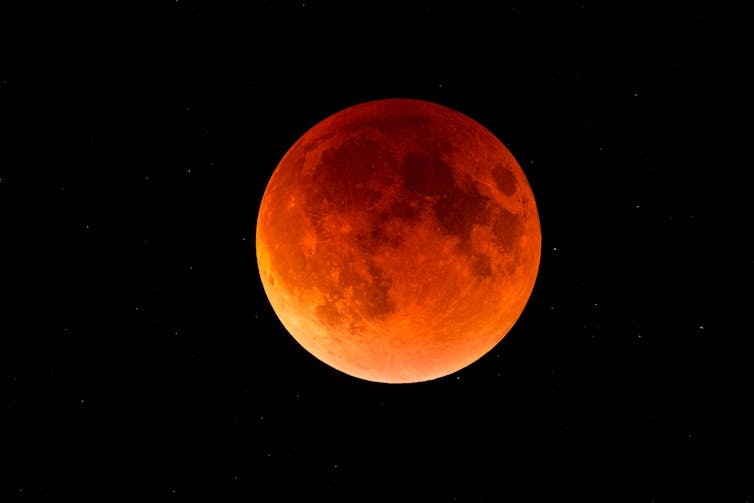
During a total lunar eclipse, the Moon turns red due to sunlight refracted by Earth’s atmosphere. A particularly dark eclipse indicates more aerosols in the atmosphere, which is a sign of recent volcanic activity. Chris Harwood / Shutterstock
The next step was to put the eclipse data together with simulations of how aerosol particles behave in the atmosphere, modern satellite observations, and climatic evidence from historical tree ring records.
This allowed the researchers to estimate the timing of the culprit eruptions more precisely than from previous ice core records – and determine which eruptions reached the stratosphere and would be more likely to generate climatic cooling effects.
What lunar eclipses tell us about the state of the atmosphere
A total lunar eclipse is a beautiful sight. When the Sun, Earth and Moon align perfectly, our planet blocks direct sunlight from reaching the Moon’s surface.
However, Earth’s atmosphere bends sunlight around our planet. As a result, some sunlight reaches the Moon even during a total eclipse.
Earth’s atmosphere also scatters sunlight - acting as a giant color filter. The bluer the light, the more it is scattered – which is why the sky is blue in the daytime, and why the Sun appears ruddy at dawn and dusk.
During a total lunar eclipse, the sunlight reaching the Moon has been filtered by Earth’s atmosphere, removing much of the blue and yellow light. The light that reaches the Moon is effectively the sum of all the dawns and all the dusks occurring at that time.
And the state of Earth’s atmosphere at that time controls just how much light is filtered.
NASA video released to explain the total Lunar eclipse seen from the Americas in December 2011.
How volcanoes affect lunar eclipses
If you’ve ever seen a sunset during a dust storm, or on a very smoky day, you know the extra particles clogging up the sky can produce deep, vibrant reds and oranges.
Imagine a total lunar eclipse occurring while wildfires rage overseas. The fires would pump smoke and dust into Earth’s atmosphere, making the Moon redder and darker during the eclipse.
Which brings us to the effect of volcanoes. The largest volcanic eruptions pump vast amounts of material into Earth’s stratosphere, where it can remain for many months.
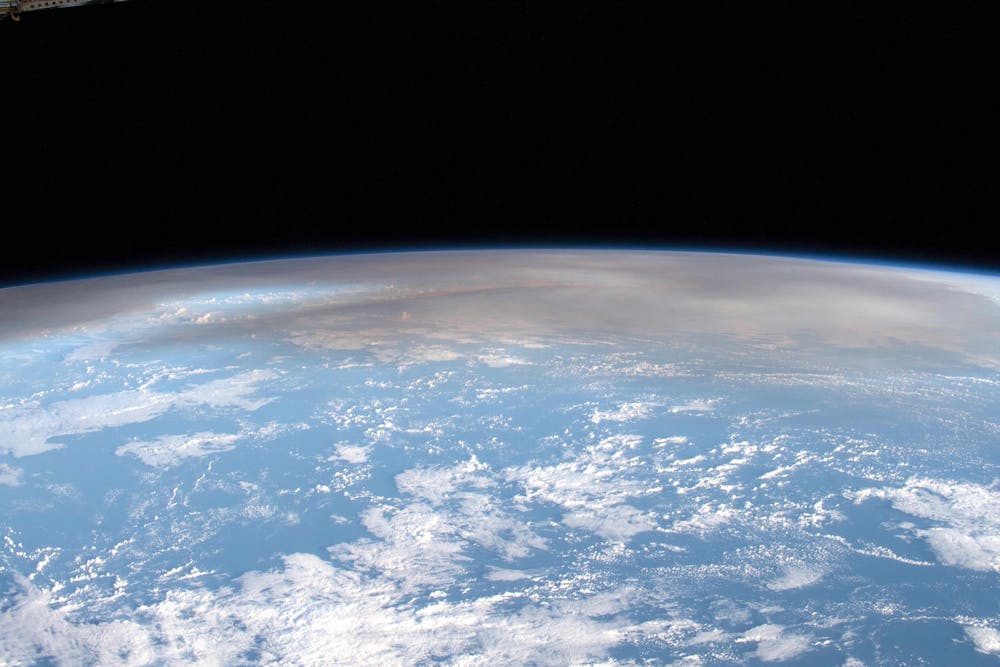
The spectacular volcanic sunsets seen throughout Australia in the months following the Tongan volcanic eruption of January 2022 are a great example. And that material, once in the stratosphere, will spread around Earth.
What effect does this have on lunar eclipses? It turns out the brightness of the Moon during a lunar eclipse depends the amount of material in our stratosphere. In the months after a large eruption, any lunar eclipse would be markedly darker than normal.
How volcanoes affect the climate
Volcanic eruptions can eject huge amounts of ash, sulphur dioxide, and other gases high into the atmosphere. Eruptions can cause either cooling or warming (both temporary). The effect depends on exactly what the volcano spews out, how high the plume reaches, and the volcano’s location.
Sulphur dioxide is particularly important. If it reaches the stratosphere, it reacts with water vapor to form a lingering veil of sulphate aerosols. These aerosols, along with the volcanic ash, block and scatter Solar radiation, often leading to cooling at the Earth’s surface.
Large volcanic eruptions, such as the 1991 Mount Pinatubo eruption in the Philippines and the infamous 1815 eruption of Tambora in Indonesia, slightly lowered global temperature in the years after the eruption. After Tambora, Europe and North America experienced a “year without a summer” in 1816.
The plume of ash and smoke from the 2022 Hunga Tonga-Hunga Ha'apai eruption was visible from the International Space Station. EPA / NASA / Kayla Barron
On the other hand, water vapor and carbon dioxide from volcanic eruptions have a warming effect. It’s only small, as all present-day volcanic emissions produce less than 1% of the carbon dioxide released by human activities.
The past and future of volcanoes, eclipses, and the climate
Eyewitness accounts through historical reports and oral traditional knowledge are often overlooked in the study of volcanoes. However, the inclusion of broader sources of knowledge is incredibly valuable to help us understand past impacts of volcanic eruptions on people and the environment.
In this study, the combination of historical observations with ice records and climate reconstructions from tree rings has enabled more precise timing of those ancient eruptions. In turn, this has allowed us to better understand their potential impact on the climate during the European Middle Ages. Such information can help us to understand the role these eruptions may have played in the transition to the Little Ice Age.
In the future, volcanoes may have to work a little harder to create a “dark” eclipse. As the atmosphere warms, the altitude of the stratosphere will increase. As a result, it may take a bigger eruption to put significant amounts of aerosols into the upper layer where they will hang around to darken the Moon for future generations!
There are many changes that can come with old age – hair turns gray, eyesight isn’t quite what it used to be, mobility often becomes limited. But beyond these physiological changes, people also experience changes to their social world. As we age, our social circles tend to get smaller.
In the past decade, however, scientists have started to think that the shrinking of social networks with age might not be all bad.
Rather than social declines being driven exclusively by the death of friends or deteriorating health, people might become more selective in their social interactions as they age. After all, many older adults tend to focus their social effort on family and close friends. This change in social focus might result from older adults’ being aware of the limited time they have left and prioritizing their most important relationships.
An older female macaque sits alone on Cayo Santiago, Puerto Rico. Noah Snyder-Mackler, CC BY-ND
To investigate whether other animals share these patterns of social selectivity with age, we turned to a free-roaming population of over 200 macaques on the island of Cayo Santiago in Puerto Rico. In collaboration withourcolleagues, we collected eight years of data about how these monkeys interacted with one another as they got older.
We focused specifically on female macaques, because they have the most stable long-term relationships in this population. With the help of several dedicated research technicians, we followed these females for up to seven hours a day over the course of eight years.
Daniel Phillips, a research technician, collects data on macaque social relationships on Cayo Santiago, Puerto Rico. Erin Siracusa, CC BY-ND
First, we found that female macaques did indeed spend time with fewer social partners as they got older. Aging macaques sat near fewer partners and also groomed fewer partners. Grooming is an important bonding behavior in macaques that females do only with their besties.
Importantly, this reduction in females’ social circles was not precipitated by their partners dying or by older monkeys being seen as somehow undesirable and therefore to be avoided. We observed that how often other monkeys sought out older females as social partners did not change with age.
Instead, there seemed to be clear evidence that females were actively reducing the size of their social networks over time. Specifically, as females got older, they initiated interactions with fewer group mates. We observed these declines beginning in females who were in their prime years (around 10 years old) all the way through those who were near the end of their lives (around 28 years old).
A family matter
Of course, an important piece of this puzzle is who these female macaques did choose to interact with as they got older.
We found that, similar to humans, aging female macaques focused their time and effort on family members and “friends” with whom they shared a particularly strong and stable bond.
While this narrowing of networks and focus on kith and kin does not necessarily result from macaques’ being aware they are nearing death – scientists aren’t sure if nonhuman animals have an awareness of their own mortality – it does suggest that there may be a shared evolutionary reason for social selectivity in humans and other primates.
A female macaque grooms her offspring on Cayo Santiagio, Puerto Rico. Lauren Brent, CC BY-ND
Why might this be?
One possibility stems from the fact that as humans and other mammals get older they experience declines in their immune system. We get sick more easily and have a harder time recovering when we do come down with something.
Reducing one’s social circle with age may be an important way to avoid acquiring a disease or other illness. Such a decrease need not be a deliberate strategy, but could be an unconscious tendency that was selected for over evolutionary time because it enhanced biological fitness in our primate ancestors. As a result, this pattern might persist today, even in humans well beyond their reproductive years.
A hopeful outlook
So, what does this all mean? Understanding how people can live longer and healthier lives is a central priority for health organizations worldwide. Figuring out how to maintain valuable social relationships into old age is likely to play a key role in that endeavor.
An older female macaque spends time with her family on Cayo Santiago, Puerto Rico. Lauren Brent, CC BY-ND
The results from this study indicate that the shrinking of networks across the life span is an aging pattern that is not unique to humans but may be present in other primates.
While loneliness in the elderly is a health concern that should not be ignored, there may be important distinctions between those who are unwillingly isolated as they get older and those who choose to stick to a smaller social circle. In the latter cases, shrinking networks with age may not be all bad.
Instead, there may be important benefits to be gained from being selective in our socializing as we get older, which has allowed this pattern to persist for millennia.
ORLANDO, Fla. — With less than 2 inches of rain this year, Orlando is enduring its second driest stretch from Jan. 1 to April 5 since the late 1800s and also its hottest on record for that period.
The city, Central Florida and much of the state’s peninsula are experiencing a widening severe drought, according to the U.S. Drought Monitor, a collaboration of universities and federal environmental agencies. “When was the last time it rained?” said Fran Boettcher, a master gardener at the Orange County and University of Florida agricultural extension center.
A mega exhibition honoring the Egyptian pharaoh Ramses II opens this week in Paris, with his sarcophagus making a rare voyage abroad for the occasion.
But in 1976 the French capital hosted the great man himself when his 3,000-year-old mummy was brought to Paris for a once-in-a-deathtime makeover.
The story of how France literally saved the skin of Ramses II, while hosting a major exhibition on his legendary rule at the Grand Palais museum, is one of the little-known chapters in Egyptology.
Then French president Valery Giscard d'Estaing convinced his Egyptian counterpart Anwar Sadat to temporarily part with the mummy by promising Ramses a reception "fit for a king".
And he meant it.
When a French military transport plane bearing the remains of the venerable Egyptian leader touched down at Le Bourget airport in Paris on September 26, 1976, the red carpet had been rolled out, the Republican Guard were standing to attention and a government minister was waiting to greet him.
Contrary to a popular rumor Ramses did not travel on a passport with a picture of his 3,200-year-old mug -- but it would not have been out of keeping with the pomp and ceremony.
In a sign of the abiding French fascination with ancient Egypt, the welcoming ceremony was carried live on national television.
Onboard the plane with Ramses was French archaeologist Christiane Desroches Noblecourt from the Louvre museum, who travelled to Cairo to accompany Ramses on the journey, submerging the mummy in a bath of plastic balls to cushion it from any knocks.
Mummy needs a makeover
Once in Paris, the mummy did not head to the exhibition, but instead whisked off for urgent medical attention.
The remains of the pharaoh, who was in his nineties when he died in 1213 BC, were starting to show their age.
When the mummy of Ramses II was discovered in 1881 in the Valley of the Kings near Luxor, it was in remarkably good condition.
But contact with fresh air brought creeping damage from parasites and fungi and a major restoration was needed.
The alarm was first raised in 1975, when a French archaeologist doing research at the Egyptian Museum in Cairo discovered the mummy's fungal affliction.
When the Ramses II exhibition opened in Paris, Sadat finally accepted France's offer of a restoration.
Eight months intensive care
The delicate job of restoring the mummy to full health was entrusted to conservationists at the Musee de l'Homme anthropology museum, which sits on a hill across the Seine River from the Eiffel Tower.
Pictures from the era show a phalanx of scientists in white coats gathered around the mummy's bedside in a sterile room.
After X-raying the brittle body and subjecting it to a battery of biological and chemical tests, they got down to work, restoring tissues and creating new bandages before sending Ramses off for radiation treatment to the French Atomic Energy Commission.
After eight months in intensive care, Ramses was "set for a new round of immortality", AFP wrote.
On April 10, 1977, the rejuvenated pharaoh was flown back to Cairo and put back on display alongside other royal mummies in the Egyptian Museum.
Peer-reviewed research out Wednesday shows that parts of a huge ice sheet covering Eurasia retreated up to 2,000 feet per day at the end of the last ice age—by far the fastest rate measured to date.
The new finding, published in the journal Nature, upends "what scientists previously thought were the upper speed limits for ice sheet retreat," The Washington Post reported, and it has sparked fears about "how quickly ice in Greenland and Antarctica could melt and raise global sea levels in today's warming world."
As the Post explained:
Scientists monitor ice sheet retreat rates to better estimate contributions to global sea-level rise. Antarctica and Greenland have lost more than 6.4 trillion tons of ice since the 1990s, boosting global sea levels by at least 0.7 inches (17.8 millimeters). Together, the two ice sheets are responsible for more than one-third of total sea-level rise.
The rapid retreat found on the Eurasian ice sheet far outpaces the fastest-moving glaciers studied in Antarctica, which have been measured to retreat as quickly as 160 feet per day. Once the ice retreats toward the land, it lifts from its grounding on the seafloor and begins to float, allowing it to flow faster and increase the contribution to sea-level rise.
If air and ocean temperatures around Antarctica were to increase as projected and match those at the end of the last ice age, researchers say ice marching backward hundreds of feet in a day could trigger a collapse of modern-day glaciers sooner than previously thought. That could be devastating for global sea levels.
"If temperatures continue to rise, then we might have the ice being melted and thinned from above as well as from below," lead author Christine Batchelor, a physical geographer at Newcastle University, told the newspaper. "That could kind of end up with a scenario that looks more similar to what we had [off] Norway after the last glaciation."
Using ship-borne imagery of ridges along the seafloor, Batchelor and her colleagues found that the Norwegian continental ice shelf retreated 180 to 2,000 feet per day, with the fastest retreat rates lasting for a period of days to a few months.
"This is not a model. This is real observation," Eric Rignot, a glaciologist at the University of California at Irvine who was not involved in the new study, told the Post. "And it is frankly scary. Even to me."
Prior to the publication of the new research, one of the fastest glacial retreat rates detected was at Pope Glacier in West Antarctica. This smaller glacier is not far from the massive Thwaites Glacier, which is nicknamed the "doomsday glacier" due to projections about how its melting is poised to contribute significantly to sea-level rise.
Rignot was part of the team that published a paper last year documenting the retreat of Pope Glacier. Based on satellite calculations, the 2022 study found that during a period in 2017, the glacier retreated at a rate of roughly 105 feet per day, or about 20 times slower than the fastest rate detected for the Eurasian ice sheet in the new study.
"Ice sheets are retreating fast today, [especially] in Antarctica," Rignot said Wednesday. "But we see traces in the seafloor that the retreat could go faster, way faster, and this is a reminder that we have not seen everything yet."
Temperature rise, meanwhile, shows no signs of slowing down.
Before last year's COP27 climate summit—which ended, like the 26 meetings before it, with no concrete plan to rapidly move away from planet-heating fossil fuels—the U.N. warned that existing emissions reductions targets and policies are so inadequate that there is "no credible path" currently in place to achieve the Paris agreement's goal of limiting global warming to 1.5°C, beyond which impacts will grow increasingly deadly, particularly for people in low-income countries who have done the least to cause the crisis.
The U.N. made clear that only "urgent system-wide transformation" can prevent catastrophic temperature rise of up to 2.9°C by 2100, but oil and gas corporations—bolstered by trillions of dollars in annual public subsidies—are still planning to expand fossil fuel production in the coming years, prioritizing short-term profits over the lives of those who will be harmed by the resulting climate chaos.