




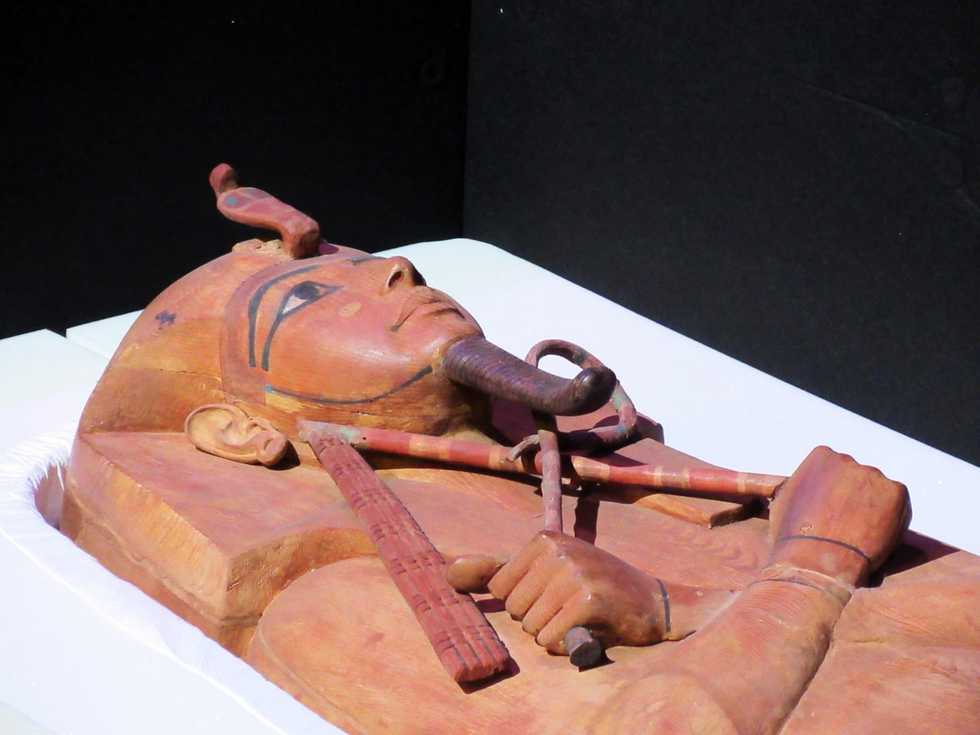
The sarcophagus of Ramses II left Egypt for the first time in 1976 for France, where the mummy was treated against fungal decay.
Now the ancient Egyptian ruler is back in France to go on display in Paris as part of the travelling exhibition "Ramses and the Gold of the Pharaohs."
The exhibition, which has already stopped in San Francisco and Houston in the US, is the only site where the sarcophagus will join the tour.
France greatly appreciates this trust by Egypt, said French Minister Rima Abdul Malak on Monday at the unveiling of the sarcophagus.
The fact that it is back in Paris after more than 40 years is also proof of the excellent relationship between the two countries, she added.
The wooden coffin was taken out of a high-security transport crate at the Grande Halle de la Villette, where it will be the highlight of the exhibition from April 7 onwards.
Until September 6, over 180 objects from the reign of Ramses will be presented, including royal masks, statues and jewellery. Ramses II is considered one of the most important pharaohs of Ancient Egypt.
He was born around 1303 BC and died in 1213 BC. Ruling for 66 years, he was one of the longest reigning heads of state in the world. He had numerous palaces and temples built, such as the temple complex of Abu Simbel.
In 1976, the sarcophagus was received like a head of state - with a red carpet and much pomp. While the wooden coffin was on display in the Grand Palais in Paris, scientists treated the mummy with radiation against its increasing decay caused by bacteria and moisture.
