The tiny lobsters are safe from predators -- including each other -- as they eddy in large white plastic tanks swirling with artificial currents.
In a few weeks' time, as part of a conservation project, they will leave their small shed in the northeastern English port of Whitby for the open sea.
Whitby, whose dramatic abbey ruins were an inspiration for "Dracula" author Bram Stoker, is Europe's third-largest lobster port.
Some 100,000 lobsters are landed each year, providing jobs for 150 people. Joe Redfern, who runs the Whitby Lobster Hatchery, hopes eventually to release the same number each year from his tanks.
"We want to make sure that the marine environment is protected and the lobster populations are conserved for the future," the 31-year-old biology graduate told AFP.
Lobster pots are piled high on the quays of the port, but the crustaceans were once part of a much bigger fishing industry in Whitby.
The town's mainstay catch of white fish has collapsed, a result of overfishing and climate change. Fishermen also blame European Union quotas, before Britain quit the bloc.
In the 1990s, there were about 30 big fishing boats in Whitby but by 2005, "there was only one", according to Redfern, who has been a fisherman himself.
White fish such as cod and haddock have migrated to colder waters north. Some of the Whitby boats moved with them, relocating to the Scottish ports of Peterhead and Aberdeen.
"The guys that didn't want to move, they had to migrate into shellfish," said Jonathan Parkin, a 43-year-old Whitby fisherman.
Mass die-off
A new disaster struck Whitby fishermen from late 2021.
Lobsters, crabs and other crustaceans began dying off in huge numbers. The cause remains a mystery.
Locals suspect a government project to dredge for a new post-Brexit "freeport" in the Teesside region, to the north of Whitby.
They say the dredging has stirred up chemical pollutants in the seabed -- a legacy of Teesside's past as a centre of heavy industry.
But a government-commissioned study by independent experts said in January that it was "as likely as not that a pathogen new to UK waters" was the cause.
Plans for the hatchery began before the mass die-off. But Redfern said it could help "bring a bit of hope back into the communities" and show that "something can be done to start to rebuild".
The project involves harvesting female lobsters, each carrying thousands of eggs, from the North Sea so that they can hatch safely.
Cannibalism
In the unforgiving open sea, the survival rate for lobster larvae is just one in 20,000, or 0.005 percent.
By allowing them to grow in a protected environment, Redfern hopes to increase that to 20 or 30 percent.
As they are fed and develop in their hatchery tanks, the larvae are separated when they reach the stage when, in the wild, they are likely to eat each other.
After two to three months, they are ready for the sea.
"Obviously when we release them, they won't all survive, but what we've done is protect them over the larval stage, which is their most vulnerable period," Redfern said.
The project raised more than £100,000 ($120,000) to get off the ground, from crowdfunding and corporate sponsorship.
Individual donors can sponsor a lobster and follow it until it is introduced into the sea.
The idea came from the Whitby fishing community, drawing inspiration from a similar project in Cornwall, southwest England.
"It's massively, massively important," said Parkin, who is involved in the project.
"We're releasing future generations of lobsters for future generations of fishermen."
Before 2020, when my friends and acquaintances asked me what I study as a molecular biologist, their eyes would inevitably glaze over as soon as I said “RNA.” Now, as the COVID-19 pandemic has shown the power and promise of this molecule to the world at large, their eyes widen.
Despite growing recognition of the importance of RNA, how these molecules get to where they need to be within cells remains largely a mystery.
RNA is a chemical cousin of DNA. It plays many roles in the cell, but perhaps it’s most well-known as the relay messenger of genetic information. RNA takes a copy of the information in DNA from its storehouse in the nucleus to sites in the cell where this information is decoded to create the building blocks – proteins – that make cells what they are. This transport process is critical for animal development, and its dysfunction is linked to a variety of genetic diseases in people.
In some ways, cells are like cities, with proteins carrying out specific functions in the “districts” they occupy. Having the right components at the right time and place is essential.
For example, it makes little sense to put a high-security vault in the fashion district. Instead, it needs to be in the financial district, where there are tellers to fill it with currency. Similarly, proteins devoted to energy production for the cell are most functional not when they are confined to the nucleus but when they are in the cell’s power plant, the mitochondria, surrounded by the raw materials and accessories needed for their job.
The inside of a cell is much like a city.
So how do cells ensure the millions of proteins they contain are where they are supposed to be? One way is as simple as it sounds: transport them directly. However, every transport step costs energy. Dragging a heavy vault across town isn’t easy. An alternative strategy is to instead take the instructions for making the vault directly to the bank so it’s already in the correct location immediately after construction.
The instructions for making a given protein are contained within RNA. One way to ensure proteins are where they are supposed to be is to transport their RNA blueprint to where their specific functions are needed. But how does RNA get where it needs to be?
My research team focuses on this very question: What are the molecular mechanisms that control RNA transport? Our recently published research hints that some of the molecular language governing this process may be universal across all cell types.
The molecular language of RNA transport
For a handful of mRNAs – or RNA sequences coding for specific proteins – researchers have an idea about how they’re transported. They often contain a particular string of nucleotides, the chemical building blocks that make up RNA, that tell cells about their desired destination. These sequences of nucleotides, or what scientists refer to as RNA “ZIP codes,” are recognized by proteins that act like mail carriers and deliver the RNAs to where they are supposed to go.
My team and I set out to discover new ZIP codes that send RNAs to neurites, the precursors to the axons and dendrites on neurons that transmit and receive electrical signals. We reasoned that these ZIP codes must lie somewhere within the thousands of nucleotides that make up the RNAs in neurites. But how could we find our ZIP code needle in the RNA haystack?
Neurites are long, thin branches extending from the body of a neuron.
We started by breaking eight mouse neurite-localized RNAs into about 10,000 smaller chunks, each about 250 nucleotides long. We then appended each of these chunks to an unrelated firefly RNA that mouse cells are unlikely to recognize, and watched for chunks that caused the firefly RNA to be transported to neurites. To extend the mail analogy, we took 10,000 blank envelopes (firefly RNAs) and wrote a different ZIP code (pieces of neurite-localized RNA) on each one. By observing which envelopes were delivered to neurites, we were able to discover many new neurite ZIP codes.
We still didn’t know the identity of the protein that acted as the “mail carrier,” however. To figure this out, we purified RNAs containing the newly identified ZIP codes and observed what proteins were purified along with them. The idea was to catch the mail carrier in the act of transport while bound to its target RNA.
We found that one protein that regulates neurite production, named Unkempt, repeatedly appeared with ZIP code-containing RNAs. When we depleted cells of Unkempt, the ZIP codes were no longer able to direct RNA transport to neurites, implicating Unkempt as the “mail carrier” that delivered these RNAs.
Toward a universal language
With this work, we identified ZIP codes that sent RNAs to neurites (in our analogy, the bank). But where would an RNA containing one of these ZIP codes end up if it were in a cell that didn’t have neurites (a city that didn’t have a bank)?
To answer this, we looked at where RNAs were in a completely different cell type, epithelial cells that line the body’s organs. Interestingly, the same ZIP codes that sent RNAs to neurites sent them to the bottom of epithelial cells. This time we identified another mail carrier, a protein called LARP1, responsible for the transport of RNAs containing a particular ZIP code to both neurites and the bottom end of epithelial cells.
How could one ZIP code and mail carrier transport an RNA to two different locations in two very different cells? It turns out that both of these cell types contain structures called microtubules that are oriented in a very particular way. Microtubules can be thought of as cellular streets that serve as tracks to transport a variety of cargo in the cell. Importantly, these microtubules are polarized, meaning they have ingrained “plus” and “minus” ends. Cargo can therefore be transported in specific directions by targeting to one of these ends.
Microtubules are the roads proteins called kinesin use to transport materials from one cellular location to another.
In neurons, microtubules stretch through to and have their plus ends at the neurite tip. In epithelial cells, microtubules run from top to bottom, with their plus ends toward the bottom. Given that both of these locations are associated with the plus ends of microtubules, is that why we saw one ZIP code direct RNAs to both of these areas?
To test this, we inhibited the cell’s ability to transport cargo to the plus end of microtubules and monitored whether our ZIP code-containing RNAs were delivered. We found that these RNAs made it to neither the neurites in neurons nor to the bottom end of epithelial cells. This confirmed the role of microtubules in the transport of RNAs containing these particular ZIP codes. Rather than directing RNA to go to specific locations in the cell, these ZIP codes direct RNA to go to the plus ends of microtubules, wherever that might be in a given cell type.
We could compare this process to a mailing address. While the top line (“The Bank”) tells us the name of the building, it’s really the address and street name (“150 Maple Street”) that contains actionable information for the mail carrier. These RNA ZIP codes send RNAs to specific places along microtubule streets, not to specific structures in the cell. This allows for a more flexible yet uniform code, as not all cells share the same structures.
Moving mRNA into the clinic
Our research uncovers a new piece of how ZIP code sequences and proteins work together to get RNAs where they need to be. Our findings and methods can also be generalized to discover other new facets of the genetic ZIP code that direct RNAs to other locations in the cell.
Understanding how ZIP code sequences work can help researchers design RNAs that deliver their payload instructions to precise locations in the cell. Given the growing promise of RNA-based therapeutics, ranging from vaccines to cancer therapies, knowing how to make an RNA go from point A to point B is more important than ever.
Ruth Card, 73, and her husband Greg Grace, 75, got a phone call from someone who sounded just like their grandson Brandon saying he was in jail and needed money for bail. They went to two separate banks in Saskatchewan to withdraw the money, but were soon told by a bank manager that another patron had gotten a similar call and learned the oddly accurate voice was faked, The Washington Post reported.
"We were sucked in," Card said in an interview with The Washington Post. "We were convinced that we were talking to Brandon."
According to The Post, impersonation scams are in the rise thank to technology making it easier to for scammers to mimic voices.
"In 2022, impostor scams were the second most popular racket in America, with over 36,000 reports of people being swindled by those pretending to be friends and family, according to data from the Federal Trade Commission. Over 5,100 of those incidents happened over the phone, accounting for over $11 million in losses, FTC officials said," The Post's report stated, adding that cheap online tools powered by AI make impersonating one's voice easier than ever.
Law enforcement has few resources to track down the perpetrators of these scams due to the fact that the victims have few leads to relay when they're targeted.
"It's terrifying," said Hany Farid, a professor of digital forensics at the University of California at Berkeley. "It's sort of the perfect storm . . . [with] all the ingredients you need to create chaos."
Farid says AI voice-generating software analyzes what makes a person's voice unique and searches a vast database of voices to find similar ones and predict patterns.
"Two years ago, even a year ago, you needed a lot of audio to clone a person's voice," Farid said. "Now . . . if you have a Facebook page . . . or if you've recorded a TikTok and your voice is in there for 30 seconds, people can clone your voice."
By David Stanway (Reuters) — Negotiators from more than 100 countries completed a U.N. treaty to protect the high seas on Saturday, a long-awaited step that environmental groups say will help reverse marine biodiversity losses and ensure sustainable development.
The legally binding pact to conserve and ensure the sustainable use of ocean biodiversity, under discussion for 15 years, was finally agreed after five rounds of protracted U.N.-led negotiations that ended in New York on Saturday, a day after the original deadline.
Scores of disemboweled sharks have washed up on a South African beach putting the spotlight on a pair of shark-hunting killer whales whose behaviour has fascinated scientists and wildlife enthusiasts.
Marine biologists were alerted to the find by beach walkers who stumbled upon the grim sight last week in Gansbaai, a small fishing port 150 kilometers (93 miles) south east of Cape Town.
"The dead sharks are torn open at the pelvic girdle, they have Orca teeth marks known as rake marks on their pectoral fins and their liver is missing," said Alison Towner, 37, a shark scientist with the Dyer Island Conservation Trust.
All evidence points to "Port" and "Starboard", an infamous pair of killer whales spotted off Gansbaai only three days earlier.
Recognisable by their twisted dorsal fins, the animals are well known to locals, who have developed a penchant for sharks.
"We found in total 20 sharks," said Ralph Watson, 33, a marine biologist with local conservation and diving group Marine Dynamics.
Victims included 19 broad nosed seven-gill and one spotted gully sharks, he added.
Towner said the slaughter was noticeable as it was the first time that Port and Starboard had hunted those species in the area and "so many of them washed out after one visit."
Yet, it wasn't the orcas' most daring hunt.
Experts credited the duo with having caused white sharks, one of the world's largest sea predators, to disappear from some of the waters near Cape Town.
Last year, Starboard and another four orcas were captured on camera chasing and killing a great white off Mossel Bay, a southern port town.
Unusual behaviour
The unusual behavior had never been witnessed in detail before.
Orcas, the ocean's apex predator, usually hunt dolphins in these parts and have been known to prey on smaller shark species. But evidence of attacks on great whites was previously limited.
Port and Starboard were first spotted near Cape Town in 2015.
"They probably came from somewhere else. West Africa, east Africa, the Southern Ocean, we don't know," said 45-year-old Simon Elwen, who heads Sea Search, a scientific collective.
Unlike other killer whales, the pair likes to hunt near the coast -- something that has made their peculiar fins a common sight in the region.
"Within southern Africa, Port and Starboard have been seen from as far west as Namibia to as far east as Port Elizabeth," said Elwen.
The marine mammals' killing technique is "surgical", added Watson, explaining the pair targets sharks' liver, "a very nutritious organ, full of oils."
"They tear open the pectoral girdle chest area... then the liver flops out," said Watson.
The 2022 video showing Starboard in action has worried biologists, for it suggested the practice was spreading with studies having established that the black and white animals have the capacity to teach hunting techniques.
Some Antarctic orcas use the cunning tactic of hunting in packs and making waves to wash seals off floating ice, according to researchers.
In the Antarctic two orca populations -- not subspecies, but different groups that overlap at the margins -- used very different hunting techniques, taught across generations.
Such behaviour is not hard-wired, but learned -- one of the arguments for suggesting that whales have 'culture'.
In the clip, the other four orcas shown were not known to have attacked white sharks before.
"This is now an additional threat to shark populations on coastal South Africa," said Towner.
Elwen said it was "fascinating, and frustrating" to see "a rare, endangered animal killing another endangered species".
Still, the overall danger Port and Starboard posed to South Africa's shark population remained very limited.
Hundreds of thousands of sharks are fished out of the sea every year, said Watson.
"Two killer whales are not going to wipe out a species," Elwen said.
Researchers believe they have found the earliest evidence of horseback riding, by the ancient Yamnaya people in Europe some 5,000 years ago.
Their conclusions, based on an analysis of human skeletal remains found in Bulgaria, Hungary and Romania, were published on Friday in the journal Science Advances.
Domestication of horses for milk is widely accepted to have begun around 3500 BC to 3000 BC, the study said, but the "origins of horseback riding remain elusive."
The researchers from the University of Helsinki and other European institutions date the earliest horsemanship to 3000 BC to 2500 BC among members of the Yamnaya culture.
"Our findings provide a strong argument that horseback riding was already a common activity for some Yamnaya individuals as early as 3000 BC," the researchers said.
Horse bones have been discovered in Yamnaya settlements but they are not as well preserved as human skeletons, which were given proper burials in earth-covered mounds known as "kurgans."
The researchers said the human skeletons provided the best source of information about horse riding because any riding tack used by early riders would have been made using perishable materials.
The researchers said some of the human skeletons they analyzed bore skeletal traits indicative of what they called "horsemanship syndrome."
"A skeleton of a living person is reacting," Martin Trautmann, a postdoctoral researcher at the University of Helsinki and one of the authors of the study, told AFP.
"If you sit on horseback you need to balance with every step of your mount, you need to cling tightly with your legs."
Doing that repeatedly leaves tell-tale changes in bone morphology, Trautmann said, including "stress-induced vertebral degeneration," a common ailment among avid horse riders.
"We know that saddles and stirrups dated much later," Trautmann said, and the early horse riders were probably riding bareback and gripping the mane of the horse.
'Cowboys, not warriors'
Volker Heyd, a professor of archeology at the University of Helsinki, said the findings "fit very nicely into the overall picture" of Yamnaya culture.
"We were already suspecting them of using horses," Heyd said, and it could help explain the "exceptional" geographic expansion of their society in a few generations.
"It is difficult to envision how this expansion could have taken place without improved means of transport," the researchers said.
"Using horses for transport was a decisive step in human cultural development," they said.
"Trade and cultural exchange as well as conflicts and migrations leapt with the increase in speed and range provided by horsemanship."
The researchers said the Yamnaya were probably not initially using horses for warfare.
"They were cowboys, not warriors," said Trautmann.
Heyd said the early horse riders "were probably helping the Yamnaya people in guarding their animals, their cattle and sheep mostly."
According to the researchers, the earliest figurative evidence of horse riding comes from the Mesopotamian Ur III period shortly before 2000 BC through depictions of a horse and rider.
Images and mentions in cuneiform texts of horseback riding are also found in the Old Babylonian period from around 1880 BC to 1595 BC.
When you think about human evolution, there’s a good chance you’re imagining chimpanzees exploring ancient forests or early humans daubing woolly mammoths on to cave walls. But we humans, along with bears, lizards, hummingbirds and Tyrannosaurus rex, are actually lobe-finned fish.
It might sound bizarre but the evidence is in our genes, anatomy and in fossils. We belong to a group of animals called land-dwelling sarcopterygians, but vast amounts of evolutionary change have obscured our appearance.
We think of fish as expert swimmers, but in fact they have evolved the ability to “walk” at least five times. Some species pull themselves forward using well developed fore-fins, while others “walk” along the ocean floor.
Our sarcopterygian ancestor evolved lungs and other air-breathing mechanisms, bony limbs, and a stronger spinal column before venturing on to land. These adaptations were useful not only in aquatic environments but allowed our ancestors to explore land – they were “pre-adaptations” for life on land.
Walking independently evolved several times in fish, making it an example of evolutionary convergence (similar traits that evolve independently, like wings in bats and birds). The evolution of walking in fish is rare though. There are more than 30,000 species of fish as we know them today (not in the evolutionary sense), of which only a handful can “walk”.
Sarcopterygians differ from other types of fish in several important ways. For example, our fins (limbs) have bony supports and muscular lobes that allow us to move on land.
This adaptation is thought to have been crucial for tetrapod (amphibians, mammals, reptiles and birds) evolution during our transition from water to land in the Late Devonian period, some 375 million years ago. Many of the genes involved in forming limbs and digits in tetrapods are also found in water-bound sarcopterygians like lungfish, which indicates these traits evolved in our ancient common ancestor.
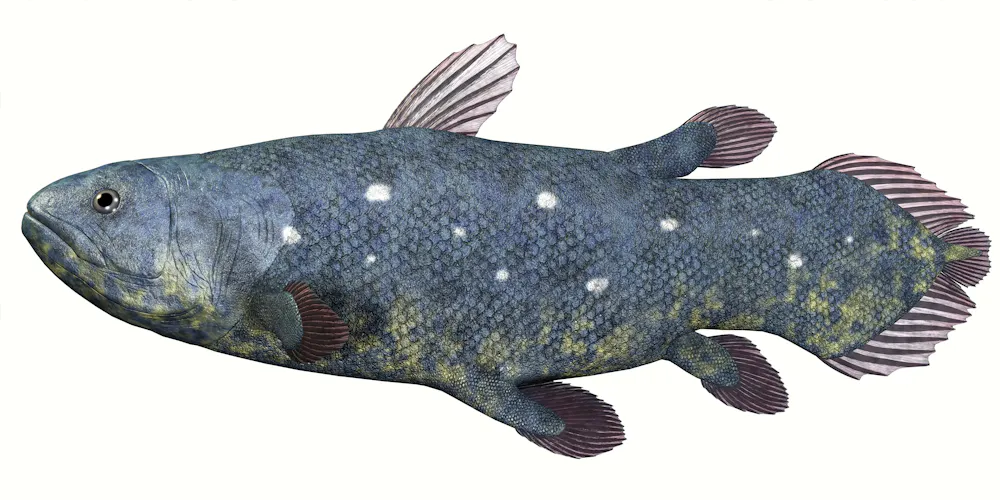
We don’t know which species this ancestor was, but it probably looked similar to the coelacanth, which has a rich fossil record and is a “living fossil” that today inhabits the West Indian Ocean and Indonesia.
Walking sarcopterygian fish are either extinct, like Tiktaalik, or so highly evolved that we don’t recognise them as fish any longer (tetrapods).
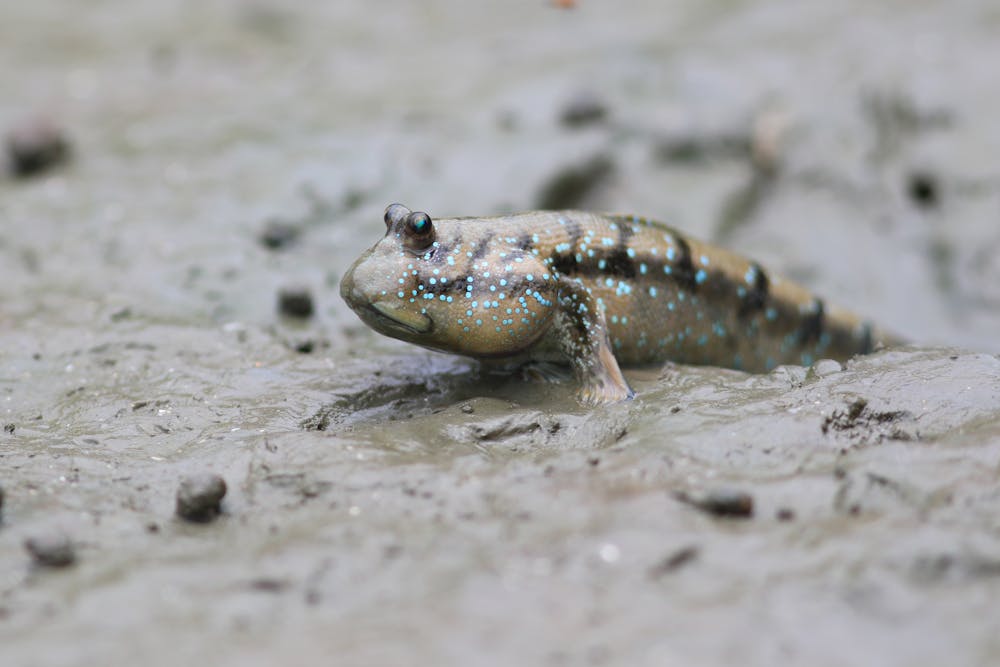
One example of a living fish that walks is the mudskipper (of the Oxudercidae family). These fish live in mangrove swamps and tidal flats and use their pectoral fins to walk on land. These fins help them to escape from aquatic predators, forage for food (they consume organic material in mud), and even interact with each other on land by finding mates.
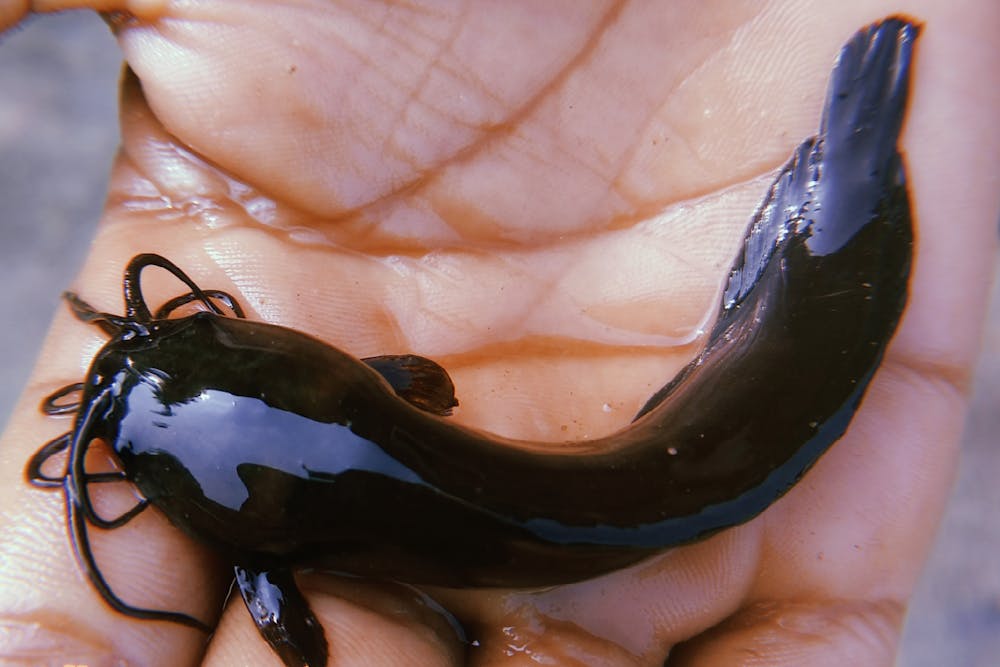
Another example is the walking catfish (Clarias batrachus), which uses its pectoral fins to travel over land, helping it escape from drying ponds and find new habitats.
The walking catfish is a species of freshwater, air-breathing catfish.
The little skate (Leucoraja erinacea) is a cartilaginous fish related to rays and sharks (as opposed to bony fish, including sarcopterygians). It is another fish that “walks” underwater on fins like legs, mimicking the movements of land-based animals.
The little skate is of great interest to scientists researching the evolution of locomotion because it evolved fin-based walking independently from sarcopterygians. However, until now, the genetics behind the walking of the little skate was difficult to study due to a lack of quality data.
That changed recently when researchers from Seoul and New York used cutting-edge technology to construct a high-quality assembly of the little skate’s genome. The scientists discovered that it only uses ten muscles for fin-based walking, while tetrapods commonly use 50 muscles to move their limbs.
A big question about vertebrate evolution is: what genes are important for developing the muscles that enable walking? To find out, the team looked at which genes were active in the nerves that control limb muscles (motor nerves) in a mouse, chicken and little skate.
They discovered similar gene expression patterns in motor nerves that help these muscles function. So walking fish may have taken several different evolutionary paths, but this recent study suggests a common genetic mechanism.
By the end of the Triassic period roughly 201 million years ago, both dinosaurs and mammals had evolved excellent running abilities. Humans refined these locomotor powers, evolving numerous adaptations that make us one of the most efficient and capable running species on the planet.
These adaptations include a spring-like Achilles tendon which helps store energy, a long stride and balanced centre of gravity, and sweating to cool down. These adaptations allow us to run long distances with great endurance, though at slow speeds.
Our ancestors used running for hunting, to escape predators, and for foraging. It has shaped our anatomy, physiology and culture. And many studies show that walking and running are crucial to our wellbeing and physical health.
It has been a long road from the origin of walking in our fish-like ancestors who first colonised land. But walking and running remain a central part of our lives, and our evolutionary success.
Half the world will be overweight by 2035, a health group warns. The World Obesity Federation predicts over 4 billion people will be obese if preventive measures are not implemented, BBC News reported Thursday. The findings show that overweight rates are rising fastest among kids, and that low to middle-income countries in Africa and Asia will undergo the starkest changes. Those countries, the report explains, have dietary preferences which trend towards more highly-processed foods, in addition to increased levels of sedentary behavior, weaker policies on food supply and marketing. Healthcare ...
A new study recently published in BMC Neuroscience indicates that female brains respond differently to pictures of newborn infants as compared to male brains on average. Women’s brains tend to show more activity in areas related to facial recognition, attention, and empathy. This research may contribute to an understanding of male and female parenting differences and how to help men be more responsive to their infants. For infants to get their needs met, the caregivers around them must be able to understand their nonverbal signals. These emotional signals consist of facial expressions and nois...
A group of hippopotami known as the "cocaine hippos" is causing problems in Colombia, where CBS News reports they have been breeding out of control.
The hippos in question earned their nickname due to their location near the estate of late drug lord Pablo Escobar, who was fatally shot by police three decades ago.
Although the hippos themselves are not addicted to cocaine, local scientists say they nonetheless are posing a problem because, after being imported to South America by Escobar from their native Africa, they lack natural predators and thus are able to multiply at astonishing rates.
Additionally, say scientists, the hippos' "feces change the composition of the rivers and could impact the habitat of manatees and capybara" that live nearby.
Because of this, the Colombian government is mulling a plan to take some of the hippos and ship them off to Mexico or India, where they will be more carefully controlled than in their current habitat.
"The hippos would be lured with food into large, iron containers and transferred by truck to the international airport in the city of Rionegro, 150 kilometers away," reports CBS News. "From there, they would be flown to India and Mexico, where there are sanctuaries and zoos capable of taking in and caring for the animals."
Scientists have discovered a hidden passage inside Egypt's Great Pyramid, the authorities announced on Thursday, part of a seven-year international research project.
The passage is nine metres (30 feet) in length and more than two metres in width, the antiquities ministry said in a statement.
Egypt's Tourism and Antiquities Minister Ahmed Issa told reporters at the ancient site in Giza also known as the Khufu, or Cheops, pyramid, that the "gabled corridor" with a triangular ceiling "was found on the northern face of the Great Pyramid of King Khufu".
The discovery was part of the ScanPyramids project, launched in 2015 as a collaboration between major universities in France, Germany, Canada and Japan and a group of Egyptian experts.
Archaeologist Zahi Hawass, Egypt's former antiquities minister, heads the committee supervising the project, which uses advanced technology to visualise hidden parts of the pyramid's interior without having to excavate it.
The technology is a mix of infrared thermography, muon radiography imaging and 3D reconstruction -- all of which the researchers say are non-invasive and non-destructive techniques.
The Great Pyramid is the largest in Giza, standing 146 meters tall, and the only surviving structure of the seven wonders of the ancient world.
Built some 4,500 years ago, it has three known chambers, and like other pyramids in Egypt was intended as a pharaoh's tomb.
Hawass told reporters at the pyramid on Thursday that "there is a great possibility... the tunnel is protecting something. In my opinion, it is protecting the actual burial chamber of King Khufu."
In 2017, ScanPyramids announced the discovery of a passenger plane-sized cavity, the first major structure found inside the Great Pyramid since the 19th century.
Although there have been past panics about the dangers that come with the advance of new technology, artificial intelligence is an entirely different animal that has the ability to distort humans' basic sense of reality.
That’s according to a leading AI researcher, who told The Atlantic’s Matteo Wong “that the apparent AI revolution could not only provide a new weapon to propagandists, as social media did earlier this century, but entirely reshape the historiographic terrain, perhaps laying the groundwork for a modern-day Reichstag fire.”
The emergence of ChatGPT, the artificial intelligence chatbot that reportedly can pass law school tests, figures to be a powerful tool for those seeking to propagate disinformation.
Horvitz told The Atlantic that bad actors could use “deepfakes on a timeline intermixed with real events to build a story.”
“A propagandist could simply connect the news to their entirely fabricated—but fully formed and seemingly well-documented—backstory seeded across the internet, spreading a fiction that could consume the nation’s politics and public-health response,” Wong writes.
SAN JOSE, Calif. -- The boom in electric-powered bicycling is reducing car travel, lowering carbon emissions and introducing homebodies to exercise and the great outdoors. But the activity is on a collision course with an equally cherished environmental ideal: peace and quiet. In response to a new state policy that allows e-bikes anywhere that standard bikes are permitted, local officials are racing to ban their use on unpaved routes in open space preserves. On Monday, the city of Palo Alto voted 5-2 to prohibit them from the popular Baylands Trail, beloved for its sweeping views of the South ...