ORLANDO, Fla. — With the approaching threat of what is forecast to be Hurricane Ian, NASA finally threw in the towel for a launch attempt Tuesday of its Artemis I mission to the moon from Kennedy Space Center. But it held off a decision to roll the massive 5.75-million-pound, 322-foot-tall combination of Space Launch System rocket, mobile launcher and Orion spacecraft to the safety of the Vehicle Assembly Building. In an update posted to NASA’s website, the decision on whether or not to stay on the pad during the impending storm won’t be made until Sunday. “During a meeting Saturday morning, t...
Morbid curiosity — a psychological trait that may help people explore dangerous parts of life — might explain why certain people gravitate toward music like death metal and rap. A recent experiment found that high levels of morbid curiosity can predict enjoyment and consumption of violently-themed music. The findings were published in the journal Personality and Individual Differences. Music genres like death metal and violent rap continue to draw fans, despite lyrical themes of death, violence, and even torture. While some have expressed concern that the consumption of violently themed music ...
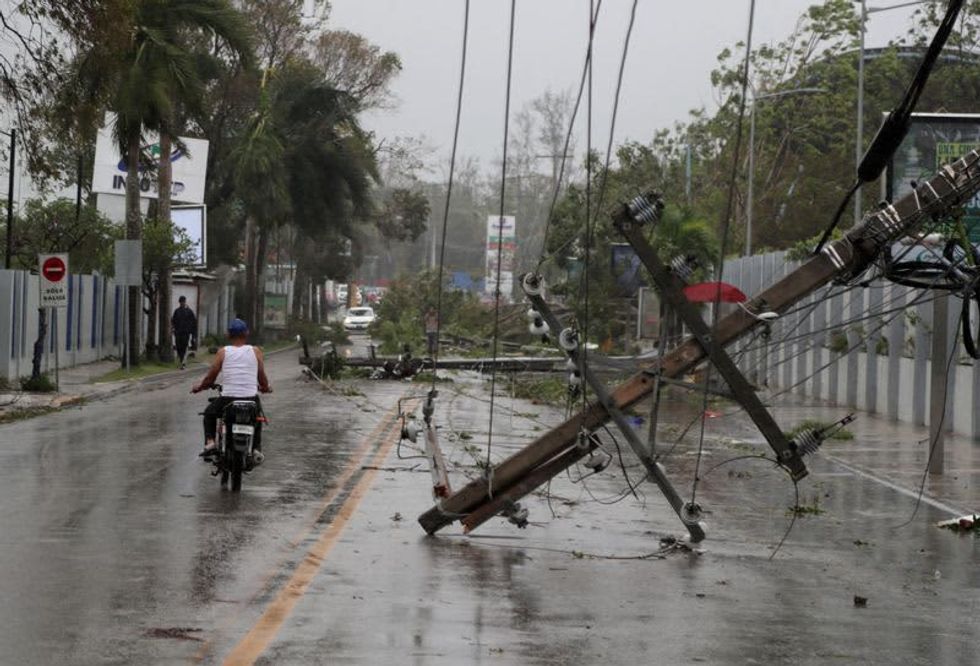
(Reuters) - After a quiet start to the season, Hurricane Fiona slammed into Puerto Rico and then battered the Dominican Republic, leaving more than 1 million people without running water or power.
By Saturday the storm had hit Canada's east coast, knocking out power to hundreds of thousands of homes and businesses.
While scientists haven't yet determined whether climate change influenced Fiona's strength or behavior, there's strong evidence that these devastating storms are getting worse.
Here's why.
IS CLIMATE CHANGE AFFECTING HURRICANES?
Yes, climate change is making hurricanes wetter, windier and altogether more intense. There is also evidence that it is causing storms to travel more slowly, meaning they can dump more water in one place.
If it weren't for the oceans, the planet would be much hotter due to climate change. But in the last 40 years, the ocean has absorbed about 90% of the warming caused by heat-trapping greenhouse gas emissions. Much of this ocean heat is contained near the water's surface. This additional heat can fuel a storm's intensity and power stronger winds.
Climate change can also boost the amount of rainfall delivered by a storm. Because a warmer atmosphere can also hold more moisture, water vapor builds up until clouds break, sending down heavy rain.
During the 2020 Atlantic hurricane season — one of the most active on record — climate change boosted hourly rainfall rates in hurricane-force storms by 8%-11%, according to an April 2022 study in the journal Nature Communications.
The world has already warmed 1.1 degrees Celsius above the preindustrial average. Scientists at the U.S. National Oceanic and Atmospheric Administration (NOAA) expect that, at 2C of warming, hurricane wind speeds could increase by up to 10%.
NOAA also projects the proportion of hurricanes that reach the most intense levels — Category 4 or 5 — could rise by about 10% this century. To date, less than a fifth of storms have reached this intensity since 1851.
HOW ELSE IS CLIMATE CHANGE AFFECTING STORMS?
The typical "season" for hurricanes is shifting, as climate warming creates conditions conducive to storms in more months of the year. And hurricanes are also making landfall in regions far outside the historic norm.
In the United States, Florida sees the most hurricanes make landfall, with more than 120 direct hits since 1851, according to NOAA. But in recent years, some storms are reaching peak intensity and making landfall farther north than in the past – a poleward shift may be related to rising global air and ocean temperatures, scientists said.
This trend is worrying for mid-latitude cities such as New York, Boston, Beijing, and Tokyo, where "infrastructure is not prepared" for such storms, said atmospheric scientist Allison Wing at Florida State University.
Hurricane Sandy, though only a Category 1 storm, was the fourth costliest U.S. hurricane on record, causing $81 billion in losses when it hit the Northeastern Seaboard in 2012.
As for timing, hurricane activity is common for North America from June through November, peaking in September – after a summertime buildup of warm water conditions.
However, the first named storms to make U.S. landfall now do so more than three weeks earlier than they did in 1900, nudging the start of the season into May, according to a study published in August in Nature Communications.
The same trend appears to be playing out across the world in Asia's Bay of Bengal, where cyclones since 2013 have been forming earlier than usual - in April and May - ahead of the summer monsoon, according to a November 2021 study in Scientific Reports.
It's unclear, however, if climate change is affecting the number of hurricanes that form each year. One team of scientists recently reported detecting a rise in frequency for North Atlantic hurricanes over the last 150 years, according to their study published in December in Nature Communications. But research is still ongoing.
HOW DO HURRICANES FORM?
Hurricanes need two main ingredients — warm ocean water and moist, humid air. When warm seawater evaporates, its heat energy is transferred to the atmosphere. This fuels the storm's winds to strengthen. Without it, hurricanes can't intensify and will fizzle out.
CYCLONE, TYPHOON, HURRICANE - WHAT'S THE DIFFERENCE?
While technically the same phenomenon, these big storms get different names depending on where and how they were formed.
Storms that form over the Atlantic Ocean or central and eastern North Pacific are called "hurricanes" when their wind speeds reach at least 74 miles per hour (119 kilometers per hour). Up to that point, they're known as "tropical storms."
In East Asia, violent, swirling storms that form over the Northwest Pacific are called "typhoons", while "cyclones" emerge over the Indian Ocean and South Pacific.
(Reporting by Gloria Dickie; Editing by Katy Daigle, Lisa Shumaker and Frances Kerry)
By Joey Roulette PARIS (Reuters) - Sierra Space, a subsidiary of private aerospace contractor Sierra Nevada Corp, may go public or pursue other funding options that would accelerate the company toward its goal of building a space station, company executives told Reuters. No private company has built a space station. Sierra is working with Jeff Bezos' Blue Origin to construct one, called Orbital Reef, in competition with other programs from companies such as Lockheed Martin and Axiom Space. "It is one of many considerations," Sierra Space President Janet Kavandi said of a public offering, speak...
Politically conservative individuals tend to be slightly more receptive to political bullshit, according to new research that examined participants from three different countries. The study, which examined “statements of political content that intend to persuade voters, but are so vague and broad that they are essentially meaningless,” has been published in the Journal of Social and Political Psychology. Vukasin Gligoric, the corresponding author of the study and a PhD candidate at the University of Amsterdam, said he was motivated to investigate the topic of political bullshit for two primary...
Antiretroviral therapy has had an enormous impact on treating HIV infections around the world. The millions of people currently taking these treatments under medical supervision can reasonably expect to reduce their viral loads to undetectable levels, eliminate the risk of transmission and live a normal life span. However, antiretroviral therapy is not without shortcomings. People need to take these medications regularly for life, and low compliance can lead to drug resistance.
Antibodies are proteins that serve as major players in the immune system’s response to pathogens, which cause disease, and allergens, which cause allergic reactions. Antibodies recognize specific markers, or antigens, on a potentially harmful substance and help the body eliminate it.
Over the past few decades, researchers have been able to isolate individual antibodies specific to the individual pathogen or allergen they are meant to attack. With this advance, monoclonal antibodies made in the lab have become a major segment of the pharmaceutical industry. You can see numerous ads on TV or in magazines promoting monoclonal antibodies to treat osteoporosis, autoimmune disorders and various types of cancers.
Antibodies can also be used to treat viral infections, including COVID-19. But using antibodies gets more complicated with HIV, the virus that causes AIDS in people.
One reason is that HIV has an enormous number of variants circulating across the world and even within a single infected individual. In fact, the genetic variation of HIV within a single patient exceeds the genetic variation of all circulating influenza strains worldwide during an entire flu season.
The immune system of an individual infected with HIV creates antibodies to neutralize the virus. However, because these antibodies can usually recognize only one particular strain, they are unable to neutralize other HIV strains circulating in the population. Furthermore, HIV can mutate within an infected individual and escape antibodies specific to the variant causing the original infection.
This ability to mutate and escape ongoing immune responses is a critical factor in the virus’s ability to continuously replicate, a hallmark of AIDS. It also makes it difficult to design an antibody treatment that can account for HIV’s enormous genetic variability.
Monoclonal antibodies are used to treat many types of cancer.
Broadly neutralizing antibodies show promise
The discovery of rare individuals who make anti-HIV antibodies that can be effective against up to 80% of circulating strains, however, has boosted prospects for antibody treatments for HIV.
These broadly neutralizing antibodies, or bnAbs, have seen impressive results. Monkeystudies have found that a single administration of bnAbs can prevent infection from SHIV, the nonhuman primate version of HIV. One study found that two broadly neutralizing antibodies were able to reduce viral loads to undetectable levels in infected monkeys.
In people, one study administering two bnAbs also saw suppression of HIV replication and nearly undetectable viral loads. One early-phase clinical trial in 2021 showed that one bnAb could potentially offer protection against HIV infection.
Long-term production of antibodies
All the monkey and human studies mentioned above required re-administering the broadly neutralizing antibodies every three weeks or so to maintain effective concentrations. This runs into the same problem antiretroviral therapies face in terms of requiring the individual to retake the drug frequently for life. But researchers have found a potential solution.
Using a small virus that doesn’t cause disease, called an adeno-associated virus, to deliver broadly neutralizing antibodies into the body can stimulate muscle cells to continually produce these antibodies. Because muscle cells have a prolonged life span and can last on average 10 to 16 years, they can be turned into factories that produce the antibodies essentially for life.
Broadly neutralizing antibodies can target many HIV strains circulating around the world.
One study my colleagues and I conducted using adeno-associated virus found that one monkey was able to produce these antibodies for over six years after a single injection.
Another monkey that researchers dubbed the “The Miami Monkey” is considered functionally cured, meaning its viral loads have been at undetectable levels for prolonged periods even without continuous antiviral drug therapy. Two other monkeys have also been cured of their AIDS virus infections with this approach.
Adeno-associated virus vectors for HIV antibody therapies still face one more hurdle: anti-drug antibodies, or antibodies the body produces in response to the antibodies in the treatment. Anti-drug antibodies can result when the body registers an antibody treatment as foreign and mounts an immune response against it, negating the treatment. They have also have caused problems for antibody treatments in cancer and autoimmune disorders. That may especially be the case for broadly neutralizing antibodies, which have unusual structures that deviate from what the body normally expects an antibody to look like.
Researchers are working hard to develop simple and accessible approaches to help patients build tolerance to broadly neutralizing antibodies. Some of these approaches include delivering treatments to other areas that have greater immune tolerance than the muscle, such as to the liver and through the mouth.
Volcanic eruptions cannot be predicted with 100 per cent certainty. However, details about an upcoming eruption can be estimated using the hot and smelly gases a volcano produces.
These gases provide clues about the timing, duration or severity of upcoming eruptions which can help local authorities decide if and when the surrounding communities need to be evacuated.
On average, there are up to 50 volcanoes actively erupting on the planet at any given time. Many of these volcanoes are more likely to be spewing hot gases — like steam and carbon dioxide — than lava. Collecting these gases is key to understanding the mysterious ways of volcanoes, but it can be dangerous.
For the better part of the last decade, I have been visiting such gassy volcanoes regularly to catch them just before, during or after an eruption.
I have worked with other scientists and engineers to measure volcanic gases with a variety of devices attached to drones.
Our latest research uses drones to capture volcanic carbon dioxide at Poás volcano in Costa Rica. We measured the isotopes of carbon in this carbon dioxide and discovered a pattern in the way these chemical fingerprints change during different stages of activity.
Unique carbon makeup
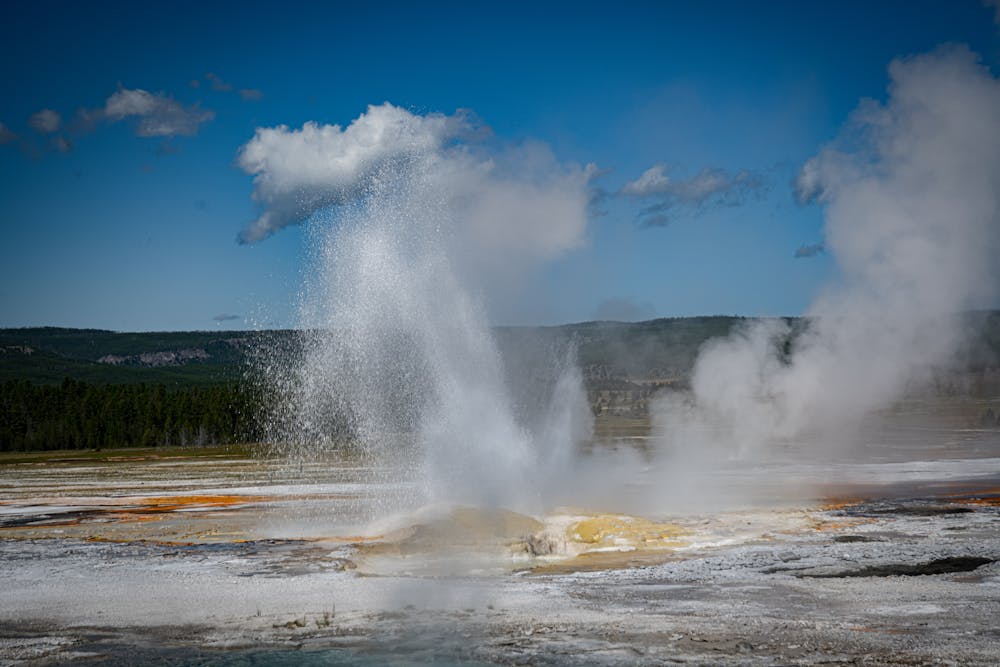
Carbon dioxide is everywhere: in the air we exhale, in vehicle exhaust — and dissolved in magma. At volcanoes, it escapes from magma to the surface through cracks and hydrothermal systems (like the geysers in Yellowstone National Park), by seeping through the soil or by puffing out in a plume of gas.
By obtaining a sample of this volcanic carbon, we can measure the stable carbon isotopic ratio, a unique chemical makeup which reflects the source and pathway the CO2 took to the surface.
Underground pressure forces gas and smoke out of the ground in the geysers in Yellowstone National Park. (Donna Elliot/Unsplash)
Each volcano around the world produces a unique range of these carbon isotopes which change when the volcanic system changes.
However, it took a long time to collect each sample when researchers needed to hike down into a crater, putting them at risk each second they remained in the danger zone. With the evolution of unoccupied aerial systems (UAS, also known as drones), researchers have started sending these machines into the danger areas.
Employing drones
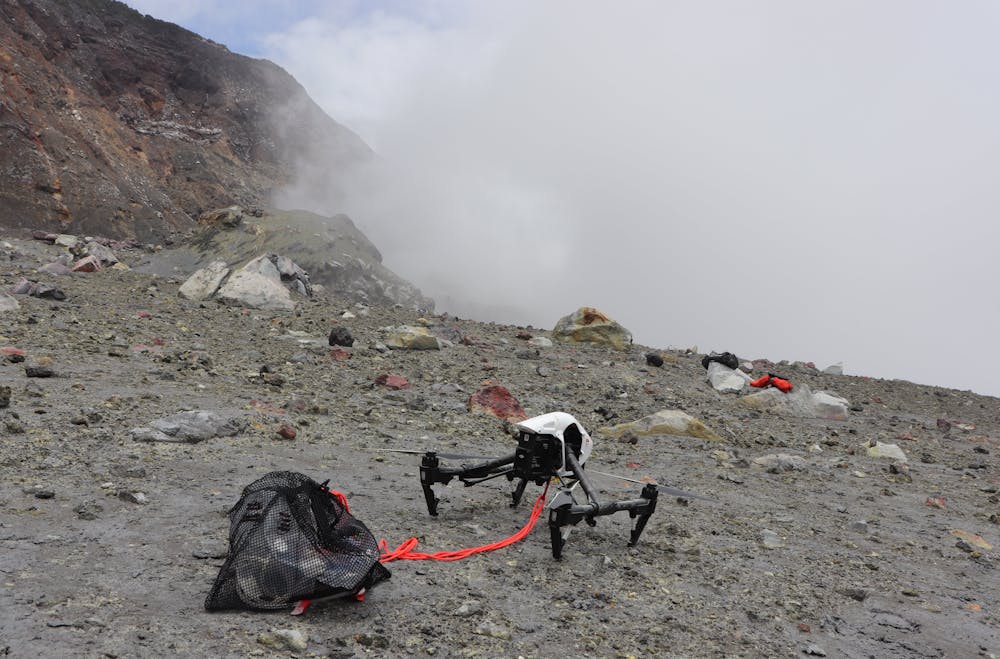
To do this, we used switches and electronics parts to connect gas sensors to the onboard communications systems of the UAS. The volcanic CO2 would be sucked in through a series of tubing with the help of a pump and sensors that would send a signal back to the pilot when we entered the gas plume. With the flick of a switch on the remote control, the pilot could choose — from a safe distance — when and where to collect the gas sample.
A drone equipped to sample volcanic gas captures carbon dioxide. (Fiona D'Arcy), Author provided
We arrived in Costa Rica in April 2019 with our shiny new drone set-up, which we launched at the rim of Poás volcano and which crashed almost immediately. Thankfully, our team whipped up a quick solution for our second drone — a pump and switch hanging from the drone in a laundry bag. It worked flawlessly.
To avoid further losses, we got up close to the crater and flew our assembly directly above it. Later that day, we looked at the stable isotopes of carbon in our drone samples and in the samples we took from the ground. After we accounted for the mixing with the regular air in the drone samples, the two results were strikingly similar. Our drone assembly worked!
A pattern emerges
When we started compiling our data with all the carbon isotopes measured at Poás volcano in the past, we noticed a trend in how the balance of isotopes shifted when the volcano was behaving differently.
During eruptive phases, when Poás was making wet explosions releasing extra hot, sulfur-rich gas, the isotopes of carbon slipped down to lighter values. Meanwhile, during quieter phases when the volcano was sealed, the isotopic balance rose to heavier values.
With this new insight, we could look back even further and stitch together our data with isotope data from older activity. We saw that this pattern was repeating itself, with the carbon isotopes alternating between heavy an light values over the last 20 years of activity at Poás. There were relatively heavy values when the volcano was sealed and there were relatively light values when the volcano was open.
We now have a blueprint of what warning signals to look for in future isotopes of carbon sampled at this volcano when it’s gearing up to erupt.
Future research
Thanks to drones, we captured the first CO2 from Poás volcano since 2014. Volcanic gases sampled before our work were all taken by hand by brave volcano scientists climbing down into the crater of Poás. These expeditions were few and far between.
We hope that with the onset of gas-capturing drones, carbon dioxide at volcanoes can start to be sampled more frequently. This will fill the gaps in the timeline and help us understand and forecast eruptions.
On Sept. 26, 2022, NASA plans to change an asteroid’s orbit.
The large binary asteroid Didymos and its moonlet Dimorphos currently pose no threat to Earth. But by crashing a 1,340-pound (610-kilogram) probe into Didymos’ moon at a speed of approximately 14,000 mph (22,500 kph), NASA is going to complete the world’s first full-scale planetary defense mission as a proof of concept. This mission is called the Double Asteroid Redirection Test, or DART.
I am a scholar who studies space and international security, and it is my job to ask what the likelihood really is of an object crashing into the planet – and whether governments are spending enough money to prevent such an event.
To find the answers to these questions, one has to know what near-Earth objects are out there. To date, NASA has tracked only an estimated 40% of the bigger ones. Surprise asteroids have visited Earth in the past and will undoubtedly do so in the future. Experiments like the DART mission may help prepare humanity for such an event.
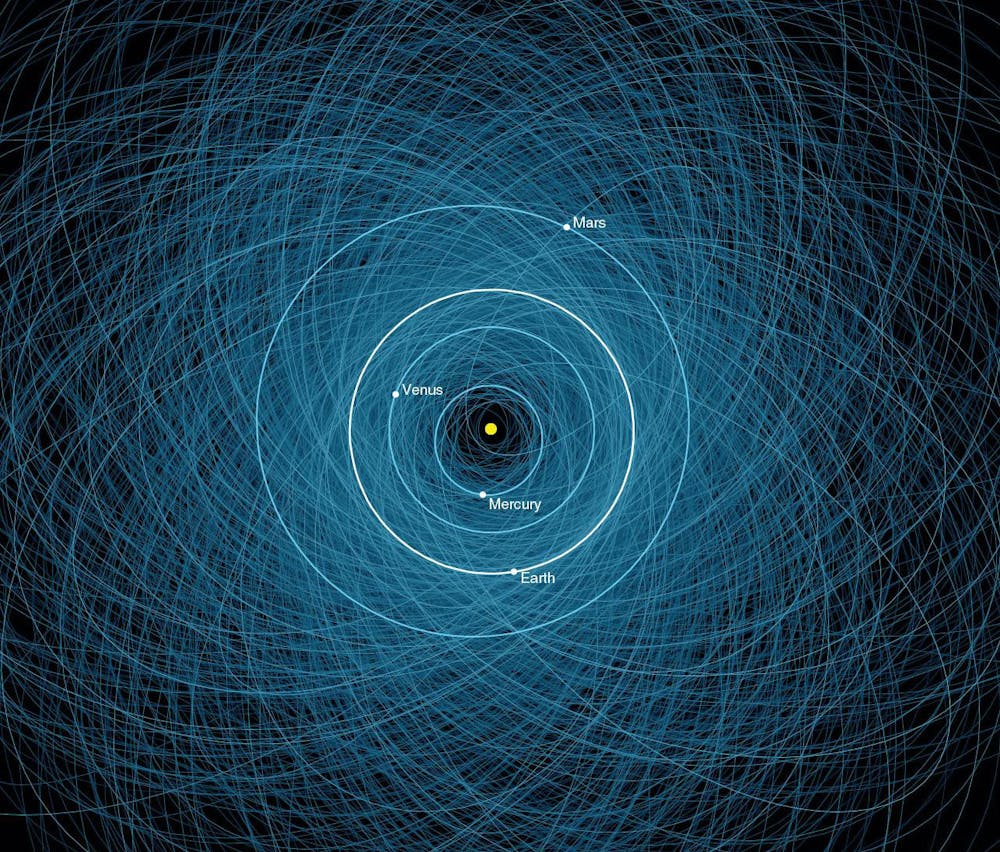
The orbits of thousands of asteroids (in blue) cross paths with the orbits of planets (in white), including Earth’s. NASA/JPL
The threat from asteroids and comets
Millions of cosmic bodies, like asteroids and comets, orbit the Sun and often crash into the Earth. Most of these are too small to pose a threat, but some can be cause for concern. Near-Earth objects include asteroids and comets whose orbits will bring them within 120 million miles (193 million kilometers) of the Sun.
Astronomers consider a near-Earth object a threat if it will come within 4.6 million miles (7.4 million kilometers) of the planet and if it is at least 460 feet (140 meters) in diameter. If a celestial body of this size crashed into Earth, it could destroy an entire city and cause extreme regional devastation. Larger objects – 0.6 miles (1 kilometer) or more – could have global effects and even cause mass extinctions.
But smaller objects can also cause significant damage. In 1908, an approximately 164-foot (50-meter) celestial body exploded over the Podkamennaya Tunguska River in Siberia. It leveled more than 80 million trees over 830 square miles (2,100 square kilometers). In 2013, an asteroid only 65 feet (20 meters) across burst in the atmosphere 20 miles (32 kilometers) above Chelyabinsk, Russia. It released the equivalent of 30 Hiroshima bombs’ worth of energy, injured over 1,100 people and caused US$33 million in damage.
The likely next asteroid of substantial size to potentially hit Earth is asteroid 2005 ED224. When the 164-foot (50-meter) asteroid passes by on March 11, 2023, there is roughly a 1 in 500,000 chance of impact.
Congress recognized this threat, and in the 1998 Spaceguard Survey, it tasked NASA to find and track 90% of the estimated total of near-Earth objects 0.6 miles (1 kilometer) across or bigger within 10 years. NASA surpassed the 90% goal in 2011.
As of Sept. 18, 2022, astronomers have located 29,724 near-Earth asteroids, of which 10,189 are 460 feet (140 meters) or larger in diameter and 855 are at least 0.6 miles (1 kilometer) across. About 30 new objects are added each week.
Smaller asteroids, like the one that exploded over Russia in 2013, can strike Earth without warning, but larger, more dangerous objects have surprised astronomers too.
Cosmic surprises
We can prevent a disaster only if we know it is coming, and asteroids have sneaked up on Earth before.
A so-called “city-killer” asteroid the size of a football field passed less than 45,000 miles (72,420 kilometers) from Earth in 2019. An asteroid the size of a 747 jet came close in 2021, as did an asteroid 0.6 miles (1 kilometer) wide in 2012. Each of these was discovered only about a day before it passed Earth.
Research suggests that Earth’s rotation creates a blind spot, hiding some asteroids from detection or making them appear stationary. This may be a problem, as some surprise asteroids do not miss us. In 2008, astronomers spotted a small asteroid only 19 hours before it crashed into rural Sudan.
The recent discovery of an asteroid 1.2 miles (2 kilometers) in diameter suggests that there are still big objects lurking.
This crater near Flagstaff, Arizona, was created when an asteroid estimated to be 160 feet (50 meters) across crashed into Earth around 50,000 years ago. USGS/D. Roddy via Wikimedia Commons
What can be done?
To protect the planet from cosmic dangers, early detection is key. At the 2021 Planetary Defense Conference, scientists recommended a minimum of five to 10 years’ preparation time to mount a successful defense against hazardous asteroids.
If astronomers find a dangerous object, there are four ways to mitigate a disaster. The first involves regional first-aid and evacuation measures. A second approach would involve sending a spacecraft to fly near a small- or medium-sized asteroid; the gravity of the craft would slowly change the object’s orbit. To change a bigger asteroid’s path, we can either crash something into it at high speed or detonate a nuclear warhead nearby.
The DART mission will be the first-ever attempt to deflect a large asteroid. But this will not be the first time humanity has sent something to an asteroid. NASA’s Deep Space Impact mission crashed a probe into the comet 9P/Tempel in 2005 to take scientific measurements of the comet, and in 2018 Japan’s Hayabusa2 mission collected samples from the asteroid Ryugu and brought them back to Earth, but neither of these was designed as a planetary defense test.
Investing in planetary defense is akin to buying homeowners insurance. The likelihood of experiencing an event that destroys your house is small, yet people buy insurance nonetheless.
If even a single object larger than 460 feet (140 meters) hits the planet, the devastation and loss of life would be extreme. A bigger impact could quite literally wipe out most species on Earth. Even if no such body is expected to hit Earth in the next 100 years, the chance is not zero. In this low-likelihood-versus-high-consequences scenario, investing in protecting the planet from dangerous cosmic objects may give humanity some peace of mind and could prevent a catastrophe.
This is an updated version of a story originally published on March 1, 2022.
Astronomers said Thursday they have spotted a hot bubble of gas spinning clockwise around the black hole at the centre of our galaxy at "mind blowing" speeds.
The detection of the bubble, which only survived for a few hours, is hoped to provide insight into how these invisible, insatiable, galactic monsters work.
The supermassive black hole Sagittarius A* lurks in the middle of the Milky Way some 27,000 light years from Earth, and its immense pull gives our home galaxy its characteristic swirl.
The first-ever image of Sagittarius A* was revealed in May by the Event Horizon Telescope Collaboration, which links radio dishes around the world aiming to detect light as it disappears into the maw of black holes.
One of those dishes, the ALMA radio telescope in Chile's Andes mountain range, picked up something "really puzzling" in the Sagittarius A* data, said Maciek Wielgus, an astrophysicist at Germany's Max Planck Institute for Radio Astronomy.
Just minutes before ALMA's radio data collection began, the Chandra Space Telescope observed a "huge spike" in X-rays, Wielgus told AFP.
This burst of energy, thought to be similar to solar flares on the Sun, sent a hot bubble of gas swirling around the black hole, according to a new study published in the journal Astronomy and Astrophysics.
The gas bubble, also known as a hot spot, had an orbit similar to Mercury's trip around the Sun, the study's lead author Wielgus said.
But while it takes Mercury 88 days to make that trip, the bubble did it in just 70 minutes. That means it travelled at around 30 percent of the speed of light.
"So it's an absolutely, ridiculously fast-spinning bubble," Wielgus said, calling it "mind blowing".
The James Webb Space Telescope has turned its gaze away from the deep universe towards our home Solar System, capturing an image of a luminous Neptune and its delicate, dusty rings in detail not seen in decades, NASA said Wednesday.
The last time astronomers had such a clear view of the farthest planet from the Sun was when NASA's Voyager 2 became the first and only space probe to fly past the ice giant for just a few hours in 1989.
Now Webb's unprecedented infrared imaging capabilities has provided a new glimpse into Neptune's atmosphere, said Mark McCaughrean, a senior advisor for science and exploration at the European Space Agency.
The telescope "takes all that glare and background away" so that "we can start to tease out the atmospheric composition" of the planet, McCaughrean, who has worked on the Webb project for more than 20 years, told AFP.
Neptune appears as deep blue in previous images taken by the Hubble Space Telescope due to methane in its atmosphere.
However the near-infrared wavelengths captured by Webb's primary imager NIRCam shows the planet as a greyish white, with icy clouds streaking the surface.
"The rings are more reflective in the infrared," McCaughrean said, "so they're much easier to see".
The image also shows an "intriguing brightness" near the top of Neptune, NASA said in a statement. Because the planet is tilted away from Earth and takes 164 years to orbit the Sun, astronomers have not yet had a good look at its north pole.
Webb also spotted seven of Neptune's 14 known moons.
- Strange moon -
Looming over Neptune in a zoomed-out image is what appears to be a very bright spiky star, but is in fact Triton, Neptune's strange, huge moon haloed with Webb's famed diffraction spikes.
Triton, which is larger than dwarf planet Pluto, appears brighter than Neptune because it is covered in ice, which reflects light. Neptune meanwhile "absorbs most of the light falling on it", McCaughrean said.
Because Triton orbits the wrong way around Neptune, it is believed to have once been an object from the nearby Kuiper belt which was captured in the planet's orbit.
"So it's a pretty cool to go and have a look at," said McCaughrean.
As astronomers sweep the universe searching for other planets like our own, they have found that ice giants such as Neptune and Uranus are the most common in the Milky Way.
"By being able to look at these ones in great detail, we can key into our observations of other" ice giants," McCaughrean said.
Operational since July, Webb is the most powerful space telescope ever built, and has already unleashed a raft of unprecedented data. Scientists are hopeful it will herald a new era of discovery.
Research based on Webb's observations of both Neptune and Triton is expected in the next year.
"The kind of astronomy we're seeing now was unimaginable five years ago," McCaughrean said.
"Of course, we knew that it would do this, we built it to do this, it is exactly the machine we designed.
"But to suddenly start seeing things in these longer wavelengths, which were impossible before... it's just absolutely remarkable."
New research suggests that athletes are not only better at self-regulating their physical activity, but also at self-regulating their brain activity. The study, published in the journal Biological Psychology, also uncovered differences in brain structure among athletes and nonathletes. Among many other benefits, regular exercise has been found to improve cognitive control. These enhanced cognitive processes, such as inhibition, attention, and concentration, are believed to help regular exercisers self-regulate their physical activity. For example, studies among high-performing athletes suggest...
Although Donald Trump's soon-to-be impeachment attorney Alan Dershowitz sad in 2019 that the then-president would never refuse to step down after losing an election, psychologists and other mental health expertswho spoke to Salon prior to the 2020 election repeatedly made the opposite prediction. Because Trump displays a large number of narcissistic traits, they foresaw that he would react to a loss as if it were "psychic death, as psychologist Bandy X. Lee said at the time.
As we all know now, the mental health experts were right.
"Pathological narcissism ... means that one is incapable of considering the interests of the nation over one's self-interest, and will be dangerously violence-prone."
Now, as Americans sort through the wreckage of the extemporaneous coup attempt that resulted from Trump's braggadocio, a new study in the Journal of Conflict Resolution (JCR) by researchers from Ohio State University and Ripon College reveals a different way in which presidential narcissism has directly changed the course of history — and cost lives.
The study found that presidents who displayed more pronounced narcissistic traits keep America in wars for longer than their less narcissistic counterparts. Indeed, as Salon learned when reaching out to experts, these presidents may also bring out the narcissistic traits of their own supporters to get them to support said wars.
Led by Ohio State political science doctoral student John P. Harden, the JCR study reviewed every president from William McKinley (who oversaw America's rise to superpower status in the late 1890s) to George W. Bush by cross-referencing a wide range of known facts about those presidents' personalities with a dataset of narcissistic traits. It found that the the eight presidents who were on the more narcissistic end of the spectrum (Lyndon Johnson foremost among them) spent an average of 613 days at war, while the 11 presidents who were on the lower end of the narcissism spectrum (with McKinley as the least narcissistic) only averaged 136 days at war for their terms.
Speaking to Salon by email, Harden noted that the researchers have been criticized for not including either Barack Obama or Donald Trump in their analysis. "It is also notable to me that most people don't seem to care if [Joe] Biden is in the data," Harden said. Harden explained that "a pro of this approach is that it minimizes bias."
"The study proves for sure that trait-level grandiose narcissism impacts interstate war duration," Harden told Salon. "While I began supporting the claim that narcissism impacts foreign policy in a prior article, this JCR article goes a bit further in demonstrating narcissism can impact something as overwhelming as war duration." Although scholars of international relations tend to downplay the role of individual personalities in determining sweeping global events, Harden argued that his research joins a larger field "suggesting that view may be far too simplistic to account for movement in global politics."
Dr. David Reiss — a psychiatrist and expert in mental fitness evaluations who contributed to the book "The Dangerous Case of Donald Trump: 27 Psychiatrists and Mental Health Experts Assess a President" — told Salon by email that the conclusions make so much sense "they are almost a tautology." He praised the authors for using biographies and other historical research to analyze presidents in lieu of actual psychological evaluations, which made their conclusions seem reasonable.
"It is not surprising that the behaviors of those who fit those qualifications — exhibited a lack of caring for others, lack of modesty, and lack of straightforwardness, etc. in executing their duties as POTUS" [President of the United States] corresponded with increase lengths of wars, Reiss added. Indeed, "since a POTUS' entire legacy is going to be very much tied to any war/conflict in which they involve the country, it could be expected that narcissist traits (whether minor or severe) will be amplified in a situation that is recognized as going to directly impact the person's historical legacy."
"It follows that to the extent to which Trump supporters invest their own narcissism in Trump's persona . . . any type of 'defeat' or setback will be very poorly tolerated," Reiss pointed out.
Dr. Bandy X. Lee — a psychiatrist who also co-authored "The Dangerous Case of Donald Trump" and was one of the first prominent psychiatrists to draw attention to Trump's narcissistic traits — argued in writing that while narcissism itself is not inherently dangerous among political leaders, "pathological narcissism by definition makes one dangerous and unfit to be in the office of the presidency, not to mention many other, far less consequential positions. It means that one is incapable of considering the interests of the nation over one's self-interest, and will be dangerously violence-prone. This holds even more true for psychopathy, which may be defined as the extreme end of narcissism."
Lee added, "I believe that this points to the great importance of basic mental health considerations with regard to our senior national leaders, most importantly the U.S. president. Indeed, mental capacity is commonly assessed and universally required for senior positions in the military and business leadership. The same should apply to the commander-in-chief."
In addition to being narcissistic themselves, the presidents who commit to longer wars may also get citizens to support those lengthened wars by stimulating their own narcissistic traits.
Dr. Jessica January Behr, a licensed psychologist who practices in New York City, said it would be reasonable to assume that "based on the dataset" that many people who will support these wars "may be motivated at least in part by their own narcissistic traits."
Behr added: "In addition, identification with the presidents or other leaders in power who support and prolong war, may be narcissism-by proxy or a type of Stockholm's syndrome on mass scale."
"My general inclination is that citizens will support a narcissist because of their overweening confidence, their willingness to simplify complex issues into dubiously simple solutions, and their tendency to report that a war is going well even if it is not."
Narcissism by proxy refers to a condition in which a person — or a group of people — think and act in ways that benefit a narcissist's own goals despite not necessarily being narcissists themselves. Often, those affected by narcissism by proxy wind up adapting narcissistic behavior while acting on the narcissist's behalf. Some psychologists believe that narcissism by proxy explained the cult-like devotion that some of President Trump's adherents expressed towards him.
Harden offered a somewhat different take on the intersection between a leader's narcissism and their ability to win support among the masses.
"This is an interesting question," Harden wrote. "My general inclination is that citizens will support a narcissist because of their overweening confidence, their willingness to simplify complex issues into dubiously simple solutions, and their tendency to report that a war is going well even if it is not. For these reasons, citizens may support war under a narcissist leader largely because they are not fully aware of the costs and consequences."
Harden concluded, "So, in a way — yes — pro-war sentiment is fueled by a narcissistic leader's behavior."
To the extent that Trump's Big Lie could be described as analogous (at least in the minds of those involved) to a war, the study's conclusions offer ominous implications about America's ability to move past Trump's coup attempt.
"It follows that to the extent to which Trump supporters invest their own narcissism in Trump's persona, 'success' and 'legacy' (which Trump actively encourages and strongly triggers others to do), any type of 'defeat' or setback will be very poorly tolerated," Reiss pointed out. "This is likely to lead to a range of dysfunctional acting out behaviors" unless the people acting out someone else's narcissism develop self-awareness, which rarely happens among narcissists.