Fish fossils dating back 440 million years are helping to "fill some of the key gaps" on how humans evolved from fish, researchers said on Wednesday.
Two fossil deposits of ancient fish in Guizhou, southern China, and Chongqing in the southwest were discovered by scientists during a field study in 2019.
The fossils "help to trace many human body structures back to ancient fishes, some 440 million years ago, and fill some key gaps in the evolution of 'from fish to human,'" researchers from the Institute of Vertebrate Paleontology and Paleoanthropology (IVPP) under the Chinese Academy of Sciences said.
Their findings, which they said "provide further iron evidence to the evolutionary path", were published in four papers in the journal Nature on Wednesday.
The Chongqing fossil deposit includes a fish -- known as acanthodians -- with bony armour around its fins and is considered the ancestor of creatures with jaws and a backbone, including humans.
Scientists in 2013 said they had found a 419-million-year-old fish fossil in China that disproved the long-held theory that modern animals with bony skeletons (osteichthyans) evolved from a shark-like creature with a frame made of cartilage.
The newly discovered creature, dubbed Fanjingshania, predates this ancient fish fossil by about 15 million years, the study said.
"This is the oldest jawed fish with known anatomy," lead researcher Zhu Min said.
"The new data allowed us to... gain much needed information about the evolutionary steps leading to the origin of important vertebrate adaptations such as jaws, sensory systems, and paired appendages (limbs)."
The Chongqing fossils are also the world's only fossils dating back nearly 440 million years which "preserves complete, head-to-tail jawed fishes", offering a rare peek into a time period regarded as the "dawn of fishes", the statement said.
"It's really an awesome, game-changing set of fossil discoveries," said John Long, the former president of the Society of Vertebrate Paleontology who is currently with Australia's Flinders University.
"It rewrites almost everything we know about the early history of jawed animal evolution."
Italian astronaut Samantha Cristoforetti has become the first woman from Europe to assume the role of commander of the International Space Station (ISS).
Russian cosmonaut Oleg Artemyev handed over the station's symbolic "keys" to Cristoforetti, 45, on Wednesday.
The Italian follows in the footsteps of four previous European commanders. In the role, Cristoforetti is responsible, among other things, for the safety of her crew and ensuring close cooperation between those on board and colleagues on Earth.
Cristoforetti, who was born in Milan, has been on her second tour of the space station since late April as part of the Minerva mission. She is in charge of medical and material science experiments.
In the handover ceremony, which was transmitted directly from the space station, Cristoforetti thanked her predecessor and the team she has been working with for months.
To date, little research has studied incels – involuntary celibates – which describes men who identify around their inability to form sexual or romantic relationships. A study published in Evolutionary Psychological Science provides some of the earliest data, based on primary responses from self-identified incels, reporting that this community represents an “at risk” group for mental health interventions. “Many people wrongfully assume that culture and evolution are conflicting explanations for human behavior – the wrongful assumption that a behavior is either innate or it is learned,” explain...
A new study published in the journal Molecular Psychiatry offers evidence that a simple walk through nature can lower activity in stress-related brain regions. The experiment revealed that participants who walked for an hour in a forest showed decreased amygdala activity during a stress task, while those who walked for an hour in the city did not. Natural environments are known to provide mental health benefits. For example, being around nature can reduce negative emotions and stress. On the flip side, psychologists have long contended a connection between urban living and poor mental health. ...
Switzerland's glaciers lost six percent of their total volume this year due to a dry winter and repeated summer heatwaves, shattering previous ice melt records, a report revealed Wednesday.
The study by the Cryospheric Commission (CC) of the Swiss Academy of Sciences laid bare the drastic scale of glacial retreat -- which is only set to get worse.
"2022 was a disastrous year for Swiss glaciers: all ice melt records were smashed," the CC said, adding that a two percent loss in 12 months had previously been considered "extreme".
Three cubic kilometers of ice -- three trillion liters of water -- have melted away, the report said.
"It's not possible to slow down the melting in the short term," said glaciology professor Matthias Huss, head of Glacier Monitoring in Switzerland, which documents long-term glacier changes in the Alps and is coordinated by the CC.
If carbon dioxide emissions are reduced and the climate protected, "this might save about one third of the total volumes in Switzerland in the best case", he told AFP.
Otherwise, the country "will be losing almost everything by the end of the century".
Saharan dust speeds melt
At the start of the year, the snow cover in the Alps was exceptionally light, then a large volume of sand dust blew in from the Sahara Desert between March and May, settling on the surface.
The contaminated snow absorbed more heat and melted faster, depriving the glaciers of their protective snow coating by early in the European summer.
The continuous heat between May and early September therefore ravaged the glacial ice.
By mid-September, the once-thick layer of ice that covered the pass between the Scex Rouge and Tsanfleuron glaciers had completely melted away, exposing bare rock that had been frozen over since at least the Roman era.
And in early July, the collapse of a section of the Marmolada glacier, the biggest in the Italian Alps, killed 11 people and highlighted how serious the situation had become.
According to an Intergovernmental Panel on Climate Change report published in February, the melting of ice and snow is one of the 10 key threats from climate change.
Smallest glaciers hardest hit
"The loss was particularly dramatic for small glaciers," the CC said.
The Pizol, Vadret dal Corvatsch and Schwarzbachfirn glaciers "have practically disappeared -- measurements were discontinued", the commission said.
In the Engadine and southern Valais regions, both in the south, "a four to six-meter-thick layer of ice at 3,000 metres above sea level vanished," said the report.
Significant losses were recorded even at the very highest measuring points, including the Jungfraujoch mountain, which peaks at nearly 3,500 meters.
"Observations show that many glacier tongues are disintegrating and patches of rock are rising out of the thin ice in the middle of glaciers. These processes are further accelerating the decline," said the report.
"The trend also reveals how important glaciers are to the water and energy supply in hot, dry years," the report stressed -- something to consider given that hydroelectricity provides more than 60 percent of Switzerland's total energy production.
The glacial meltwater in July and August alone would have provided enough water this year to completely fill all the reservoirs in the Swiss Alps.
But Huss said that if the country experienced this year's meteorological conditions in 50 years' time, "the impact would be much stronger, because in 50 years, we expect that almost all glaciers are gone and therefore cannot provide water in a hot and dry summer".
Melt reveals macabre finds
The melting of the glaciers has also had some unexpected consequences.
Hikers are regularly making macabre discoveries as bodies are being freed from the ice they have been encased in for decades or even centuries.
The melting can also be a boon for archaeologists who suddenly have access to objects that are thousands of years old.
Meanwhile the melting of a glacier between Italy and Switzerland has moved the border that ran along the watershed, forcing lengthy diplomatic negotiations.
The asteroid is flying through space in the grainy black and white video, when suddenly a massive cloud of debris sprays out in front of it, meaning only one thing: impact.
Astronomers have hailed this early footage of the first time humanity deliberately smashed a spacecraft into an asteroid, saying it looks like it did a "lot of damage".
That would be good news, because NASA's Double Asteroid Redirection Test (DART) impactor struck the asteroid Dimorphos at 23,500 kilometers (14,500 miles) per hour on Monday night with the goal of deflecting its trajectory.
While Dimorphos is 11 million kilometers (6.8 million miles) away and poses no threat to Earth, it is being used as a historic test run so the world can be ready to defend itself if a future astroid heads Earth's way.
After the impact, ground-based telescopes and the toaster-sized satellite LICIACube, which separated from DART a few weeks ago, revealed the first images of the collision.
"On the LICIACube images, the plume of what came off the surface was quite impressive," Antonella Barucci of the Paris Observatory's LESIA laboratory told AFP.
By examining the plume, "we can begin to estimate the density of the material on the surface," she said.
'Very, very big' plume
The Asteroid Terrestrial-impact Last Alert System (ATLAS) project on Tuesday tweeted a nine-second video of the impact taken by its telescope in South Africa.
Larry Denneau, the ATLAS co-principal investigator, said the telescope took one image every 40 seconds.
"So the whole sequence that you've seen on Twitter lasts about two hours in real time," he told AFP.
He said the "very, very big" plume was made by dust shooting off the asteroid.
"A lot of the dust is released at a speed that's greater than the gravity of the asteroid, and so it escapes," Denneau said.
The plume expanded to around "several thousand miles in diameter," he added.
In the coming days and weeks astronomers around the world will work to confirm whether the asteroid's trajectory was definitively altered by the impact.
Then the European Space Agency's Hera mission will arrive at Dimorphos in 2026 to survey the surface and discover the extent of DART's impact.
Hera mission principal investigator Patrick Michel said "we are all impressed by the magnitude of the event".
"We have done a lot of damage to Dimorphos," Michel said.
"We have a quantity of ejected matter that is quite incredible."
The amount of matter ripped from the asteroid will help scientists work out exactly how much its trajectory has been affected -- if at all.
In the temperate shallows of the Mediterranean, once-vibrant red and purple coral forests that provide a crucial haven for biodiversity now stand bleached and brittle, transformed into skeletons by record summer temperatures, scientists say.
Holding naked branches of gorgonian coral, Tristan Estaque of marine conservation group Septentrion Environnement is returning despondent from an exploratory dive off the coast of Marseille in southern France.
"It is heartbreaking, the deterioration is so fast," he tells AFP.
Dive surveys just two months earlier found an intact landscape, lush with violet-fringed fans of gorgonian coral.
Now it is a "ghost forest", says Estaque, with the majestic fans largely bare of living tissue.
"You have to imagine a tree where there are no more leaves, no more bark."
Fragile forests
Gorgonian corals, which have flexible skeletons encrusted with polyps, are found across the planet.
Those found in the Mediterranean are said to create "forests", sheltering a huge array of species.
But they are acutely vulnerable to human activities.
Fishing nets, anchors and careless divers can rip their delicate structures, while exposure to continuous and intense heat can be lethal.
Marine heatwaves are becoming more common, according to a report this year by UN climate experts.
This summer a major marine heatwave hit the western Mediterranean, with water up to five degrees Celsius (41 degrees Fahrenheit) hotter than normal, according to Mercator Ocean International, the organization that runs the European ocean monitoring service.
In some places water reached 30C.
Recent Septentrion Environnement surveys have shown that between 70 and 90 percent of the red gorgonian population in the 10 to 20-meter zone off Marseille have since died.
The effect was like "an underwater inferno", according to Solene Basthard-Bogain, another of the group's specialists.
And it is not just near the southern French coast.
Gorgonian mortality has also been observed on the Spanish coasts and around the Italian island of Sardinia, according to Stephane Sartoretto of the French research agency Ifremer.
The severity of the impact appears to vary depending on the depth of the corals.
Along the sawtooth coastline of France's Calanques National Park, notched with craggy coves and shallow habitats where the gorgonians are found in waters of just six meters (20 feet) in places, the die-offs have been particularly intense.
In the Balearic Islands, they live deeper, at 40 meters, and were therefore less impacted, Sartoretto says.
'Forest fire'
In addition to the gorgonians, sponges and bivalves have also been affected.
The marine heatwave likewise battered mussel farming, with 150 tonnes of commercial mussels and 1,000 tonnes of young stock -- for next year's crop -- lost in Spain over the summer.
A drop in temperatures in the Mediterranean could help to save those corals that were spared in the summer die-off, says Basthard-Bogain, although she worries that any pathogens that may have spread because of the heat would still be present in the waters.
There are fears, too, that another hot spell cannot be ruled out before the end of the autumn.
Sartoretto says he worries that repeated periods of heat stress could be devastating for the corals.
"We can ask ourselves about the possibility of their disappearance," he says, adding that their reproduction rate is very slow.
"Like after a forest fire on land," he says, "they will take decades to regenerate."
NASA TV is live streaming the latest of the exploration of the asteroid that is flying by the Earth. It's the first test from NASA planning for if there is a "large body" from space headed toward Earth.
The theory is that the rocket, known as the Double Asteroid Redirection Test or, amusingly, DART. Aptly described, the rocket will be sent like a dart toward the target and, ideally will knock the asteroid out of the existing orbit. NASA will then measure the new orbit to see the extent to which it could work for future efforts to keep an asteroid from hitting the Earth.
In the past, Hollywood has crafted at least two films where a life-ending asteroid is headed directly to the Earth. In both, the solution was to blow up the massive rock. NASA didn't see the point of blowing something up when all they really needed to do is nudge it so that it flies by Earth instead of crashing into it.
According to NASA, the video on the rocket will show the footage right before it crashes into the flying rock. The show has been going on all day, but the video of the event itself begins at 7:14 p.m. EST.. And you can watch the video below:
A NASA spacecraft is set to collide with an asteroid Monday and the space agency is inviting spectators to watch. The DART spacecraft, which launched 10 months ago, will hit the rock around 7:14 p.m. Eastern time with a livestream starting on NASA’s website at 6 p.m. The mission, the Double Asteroid Redirection Test, will attempt to deflect Dimorphos, a moon that orbits the asteroid Didymos, which is about 2,560 feet in diameter. While the moon and asteroid pose no real threat to Earth, the technology, if successful, could be used to knock future celestial objects headed toward the planet off-...
ORLANDO, Fla. — With the threat of Hurricane Ian, NASA isn’t going to risk its $4.1 billion rocket to the moon deciding to roll it back to the Vehicle Assembly Building at Kennedy Space Center forgoing a chance to launch Artemis I next week. “Managers met Monday morning and made the decision based on the latest weather predictions associated with Hurricane Ian, after additional data gathered overnight did not show improving expected conditions for the Kennedy Space Center area,” reads a post to NASA’s website Monday. “The decision allows time for employees to address the needs of their familie...
Just how much does our anger impact our judgments? A recent study found that feeling angry increases a person’s preference for dominant-looking leaders in an election, even when the anger has nothing to do with politics. The findings were published in the journal Scientific Reports. Psychology studies have widely demonstrated that our emotions can impact our judgments and decision-making. One interesting example is that feeling angry during a crisis situation seems to increase a person’s endorsement of punitive and authoritarian measures. This finding may be particularly relevant today, given ...
You only get 52 teeth in your lifetime: 20 baby teeth, followed by 32 adult teeth.
It’s not like that for all animals. Some, like rodents, never replace their teeth. Others, like sharks, keep replacing them again and again.
So why do we humans replace our teeth only once? And how does the whole tooth replacement process work?
These are tricky questions, and we don’t have all the answers. But a new discovery about the strange tooth-replacement habits of the tammar wallaby, a small Australian marsupial, may help shed some light on this dental mystery.
Not everybody replaces teeth the same way
It has been long assumed modern mammals all replace their teeth the same way. However, advances in 3D scanning and modelling have revealed mammals with unusual tooth replacement, like the tammar wallaby (Macropus eugenii) and the fruit bat (Eidolon helvum).
These mammals have given us important clues as to how humans and other mammals have evolved from ancestors with continuous tooth replacement.
How do humans make and replace teeth?
Human teeth begin growing between the sixth and eighth week of an embryo’s development, when a band of tissue within the gums called the primary dental lamina starts to thicken. Along this band, clusters of special stem cells appear at the sites of future teeth, known as “placodes”.
The placodes then begin to grow into teeth, going through the bud, cap and bell stages along the way. They form into their final shape and harden with layers of dentine and enamel. Eventually, they will erupt through the gums. The incisors are the first to erupt, as early as 6 months old, which is why its called theteethingphase!
This generation of teeth, which grow from the primary dental lamina, are known as “primary dentition”, or baby teeth.
Secondary or adult teeth grow a little bit differently. An offshoot of tissue called the successional lamina grows out from the baby tooth, and that tissue develops the replacement tooth like an apple on a branch of a tree. Adult teeth begin to grow before we are born, but take many years for the full set to form and eventually appear.
Replacement occurs when the adult teeth get large enough that they finally push out the baby teeth and remain as the permanent set of teeth for the rest of our lives. The first molar usually erupts between 6 and 7 years of age, while our wisdom teeth are the last to appear (roughly between 17 and 21 years of age).
Most mammals replace their teeth once in the course of their lives, like we do. This is known as “diphyodonty” (two sets of teeth).
Some groups of mammals, such as rodents, don’t replace their teeth at all. These “monophyodonts” get by with the same set of teeth for their whole lives. There are also a few unusual mammals, such as echidnas, that don’t grow any teeth at all!
Learning from the wallaby
The tammar wallaby is also a diphyodont, replacing its teeth only once.
Scientists long assumed it replaced its teeth in the same way humans do, though historical notes going back as far as 1893 noticed unusual things about this marsupial’s tooth development. For starters, while we replace our incisors, canines and premolars, tammar wallabies only replace their premolars.
Baby and adult teeth of the tammar wallaby. Scale bar equals 1 cm. Nasrullah et al.
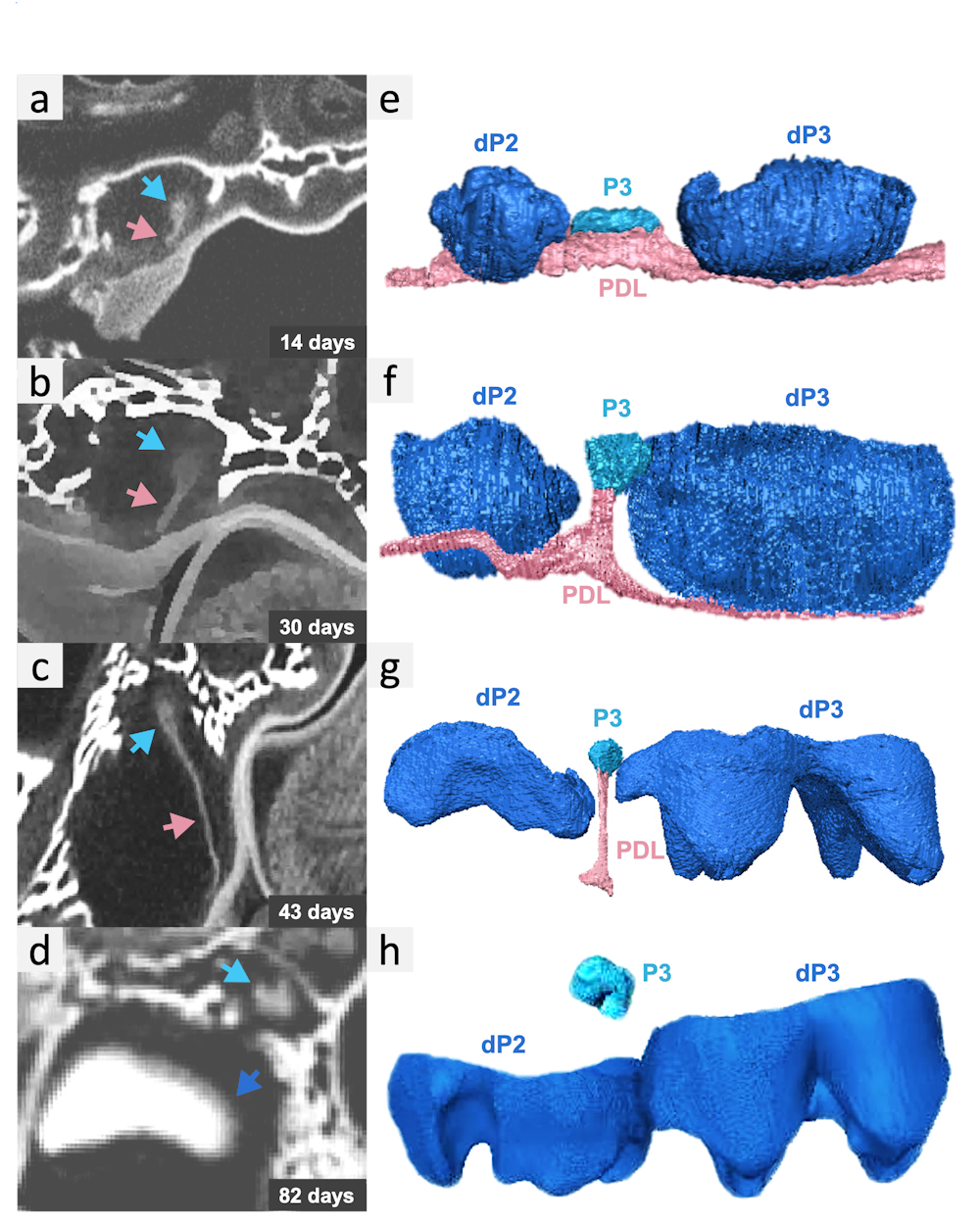
Recently my colleagues at Monash University and the University of Melbourne and I observed the teeth of tammar wallabies from the embryo through to adulthood. We used a technique called diceCT, which combines staining and CT scanning, and found something surprising.
Instead of replacement premolar teeth developing from the successional lamina, they were in fact delayed baby teeth developing from the primary dental lamina.
This means the tammar wallaby does not have any traditional tooth replacement. This discovery opens up a huge set of new questions. What exactly are these teeth?
Tooth development of premolars in the tammar wallaby in 2D and 3D, showing the delayed baby tooth ‘P3’ appearing 47 days after its siblings ‘dP2’ and ‘dP3’
One explanation for these delayed baby teeth could be a link to our ancestry of continuous tooth replacement.
Your teeth are millions of years in the making
Unlike mammals, most other animals, including fish, sharks, amphibians and reptiles, replace their teeth multiple times (they are “polyphyodonts”). Mammals lost this ability around 205 million years ago.
The reason we stop making teeth is because our dental lamina degrades after our second set are made, while it remains active in polyphyodonts.
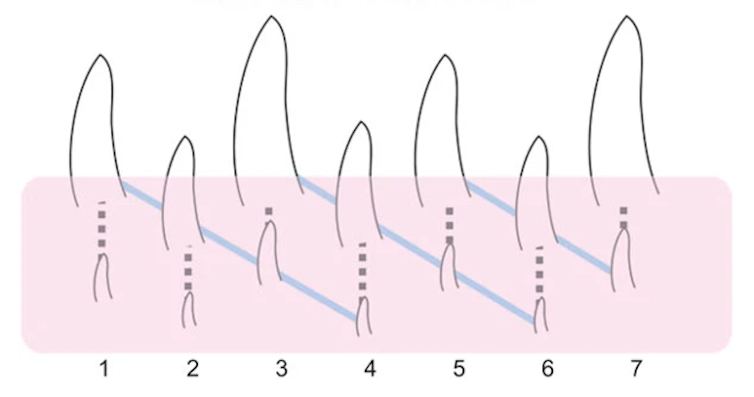
Interestingly, in modern and fossil polyphyodonts the replacement teeth often develop in groups of alternating waves, known as “Zahnreihen”.
While the tammar only replaces its premolars, these delayed baby teeth could represent the presence of the Zahnreihen still occurring in modern mammals.
This gives us a clue about how we have evolved from ancestors with continuous tooth replacement: by modifying and reducing a system that is hundreds of millions of years old.
In reptiles, teeth are replaced in waves, or ‘Zahnreihen’. Each blue line shows a single wave.
Research has also found that fruit bats (Eidolon helvum) make replacement teeth in unusual ways, including growing them in front of the baby tooth, behind it, beside it, or splitting off from it.
This is exciting because, together with the tammar, it shows there may well be a wealth of tooth replacement diversity across mammals happening right under our noses – or our gums!
NASA will on Monday attempt a feat humanity has never before accomplished: deliberately smacking a spacecraft into an asteroid to slightly deflect its orbit, in a key test of our ability to stop cosmic objects from devastating life on Earth.
The Double Asteroid Redirection Test (DART) spaceship launched from California last November and is fast approaching its target, which it will strike at roughly 14,000 miles (22,500 kilometers) per hour.
To be sure, neither the asteroid moonlet Dimorphos, nor the big brother it orbits, called Didymos, pose any threat as the pair loop the Sun, passing about seven million miles from Earth at nearest approach.
But NASA has deemed the experiment important to carry out before an actual need is discovered.
If all goes to plan, impact between the car-sized spacecraft, and the 530-foot (160 meters, or two Statues of Liberty) asteroid should take place at 7:14 pm Eastern Time (2314 GMT), and can be followed on a NASA livestream.
By striking Dimorphos head on, NASA hopes to push it into a smaller orbit, shaving ten minutes off the time it takes to encircle Didymos, which is currently 11 hours and 55 minutes -- a change that will be detected by ground telescopes in the days that follow.
The proof-of-concept experiment will make a reality of what has before only been attempted in science fiction -- notably films such as "Armageddon" and "Don't Look Up."
Technically challenging
As the craft propels itself through space, flying autonomously for the mission's final phase, its camera system will start to beam down the very first pictures of Dimorphos.
Minutes later, a toaster-sized satellite called LICIACube, which separated from DART a couple of weeks earlier, will make a close pass of the site to capture images of the collision and the ejecta -- the pulverized rock thrown off by impact.
LICIACube's pictures will be sent back in the weeks and months that follow.
Also watching the event: an array of telescopes, both on Earth and in space -- including the recently operational James Webb -- which might be able to see a brightening cloud of dust.
Finally, a full picture of what the system looks like will be revealed when a European Space Agency mission four years down the line called Hera arrives to survey Dimorphos's surface and measure its mass, which scientists can only guess at currently.
Being prepared
Very few of the billions of asteroids and comets in our solar system are considered potentially hazardous to our planet, and none are expected in the next hundred or so years.
But "I guarantee to you that if you wait long enough, there will be an object," said NASA's Thomas Zurbuchen.
We know that from the geological record -- for example, the six-mile wide Chicxulub asteroid struck Earth 66 million years ago, plunging the world into a long winter that led to the mass extinction of the dinosaurs along with 75 percent of all species.
An asteroid the size of Dimorphos, by contrast, would only cause a regional impact, such as devastating a city, albeit with greater force than any nuclear bomb in history.
How much momentum DART imparts on Dimorphos will depend on whether the asteroid is solid rock, or more like a "rubbish pile" of boulders bound by mutual gravity, a property that's not yet known.
The shape of the asteroid is also not known, but NASA engineers are confident DART's SmartNav guidance system will hit its target.
If it misses, NASA will have another shot in two years' time, with the spaceship containing just enough fuel for another pass.
But if it succeeds, Chabot said, the mission will mark the first step towards a world capable of defending itself from a future existential threat.