By Samanda Dorger Here are 34 littered items and how long they'll take to break down in the environment. It’s been more than 35 years since beer makers stopped using the pull tabs that littered beaches and cut people’s feet, yet you might still come across one of these cans lying in the woods undergoing its slow process of decomposition. Of the estimated 50 billion pieces of litter on the ground in the U.S., 24 billion are along roadways and 26 billion are along waterways, according to a 2021 litter study by Keep America Beautiful. That’s equivalent to 152 items of litter for each U.S. residen...
The World Meteorological Organization warned Monday that the planet now faces a 50% chance of temporarily hitting 1.5°C of warming above pre-industrial levels over the next five years, another signal that political leaders—particularly those of the rich nations most responsible for carbon emissions—are failing to rein in fossil fuel use.
"For as long as we continue to emit greenhouse gases, temperatures will continue to rise."
In 2015, by comparison, the likelihood of briefly reaching or exceeding 1.5°C of global warming over the ensuing five-year period was estimated to be "close to zero," the WMO noted in a new climate update. The report was published amid a deadly heatwave on the Indian subcontinent that scientists say is a glimpse of what's to come if runaway carbon emissions aren't halted. Thus far, the heatwave has killed dozens in India and Pakistan.
Signatories to the Paris climate accord have agreed to act to limit the global average temperature increase to well below 2°C—preferably to 1.5°C—by the end of the century. Climate advocates have deemed the 1.5°C target "on life support" following world leaders' refusal to commit to more ambitious action at the COP26 summit in Glasgow late last year.
"We are getting measurably closer to temporarily reaching the lower target of the Paris Agreement," Petteri Taalas, the secretary-general of the WMO, said in a statement Monday. "The 1.5°C figure is not some random statistic. It is rather an indicator of the point at which climate impacts will become increasingly harmful for people and indeed the entire planet."
"For as long as we continue to emit greenhouse gases, temperatures will continue to rise," Taalas added. "And alongside that, our oceans will continue to become warmer and more acidic, sea ice and glaciers will continue to melt, sea level will continue to rise and, our weather will become more extreme. Arctic warming is disproportionately high and what happens in the Arctic affects all of us."
Dr. Leon Hermanson, a climate expert at the U.K. Met Office who led the WMO report, stressed that a short-lived breach of the 1.5°C threshold would not mean that the world is guaranteed to fall short of the Paris accord's most ambitious warming target, which climate experts and campaigners have long decried as inadequate.
Such a breach, however, would "reveal that we are edging ever closer to a situation where 1.5°C could be exceeded for an extended period," said Hermanson.
The WMO's latest research also estimates that there is a 93% chance that at least one year between 2022 and 2026 will be the warmest on record. Currently, 2016 and 2020 are tied for the top spot.
Even if global warming is limited to 1.5°C by 2100, countless people across the globe will still face devastating heatwaves, droughts, and other extreme weather, with the poor facing the worst consequences.
Meanwhile, key ecosystems could be damaged beyond repair in a 1.5°C hotter world. One recent study found that 99% of the world's coral reefs would experience heatwaves that are "too frequent for them to recover" if the planet gets 1.5°C warmer compared to pre-industrial levels.
Scientists behind the latest Intergovernmental Panel on Climate Change (IPCC) report cautioned last month that if there's to be any hope of keeping warming to 1.5°C or below by 2100, "it's now or never."
"Without immediate and deep emissions reductions across all sectors, it will be impossible," said Jim Skea, co-chair of IPCC Working Group III.
The James Webb Space Telescope will produce "spectacular color images" of the cosmos in mid-July -- its first observations dedicated to its mission of scientific discovery, an astronomer overseeing the project said Monday.
The successor to Hubble has spent the last five months aligning its instruments in preparation for the big reveal, with scientists deliberately remaining coy about where the cameras will be pointed.
"We'd really like it to be a surprise," Klaus Pontoppidan, a scientist at the Space Telescope Science Institute in Baltimore told reporters, adding that the secrecy was partly due to the first targets not yet being finalized.
NASA and its partners the European Space Agency (ESA) and Canadian Space Agency (CSA) formed a committee to create a ranked list of objects, which they now intend to work through.
Webb's team has already released a series of star field images taken for calibration purposes, but the new photographs will be of astrophysics targets, key to deepening humankind's understanding of the universe, said Pontoppidan.
These images will actually be shot in infrared, and then colorized for public consumption.
Visible and ultraviolet light emitted by the very first luminous objects has been stretched by the universe's expansion, and arrives today in the form of infrared, which Webb is equipped to detect with unprecedented clarity -- giving it an unprecedented view of the first stars and galaxies that formed 13.5 billion years ago.
Webb, which is expected to cost NASA nearly $10 billion, is among the most expensive scientific platforms ever built, comparable to the Large Hadron Collider at CERN, and its predecessor telescope, Hubble.
Its mission also includes the study of distant planets, known as exoplanets, to determine their origin, evolution and habitability.
A view of the entrance to the Max Planck Institute for Extraterrestrial Physics (MPE) in Tuebingen. Astronomers at the Max Planck Institute for Extraterrestrial Physics (MPE) have discovered more than 1,000 trails that probably originate from previously unknown asteroids. Silas Stein/dpa
Astronomers at the Max Planck Institute for Extraterrestrial Physics (MPE) have discovered more than 1,000 trails that probably originate from previously unknown asteroids.
They searched through archive data from the Hubble Space Telescope from the past 20 years, as the institute in Garching near the southern German city of Munich announced. The findings could provide insights into the conditions in the early solar system.
Data was analysed that is otherwise filtered out as noise or interference in most observations. "One astronomer’s trash can be another astronomer’s treasure," said Sandor Kruk, head of the asteroid study.
The detective work combined human and artificial intelligence: First, some 11,500 volunteer lay scientists helped identify clues to asteroids in the more than 37,000 composite images. The astronomers used this to train a machine-learning algorithm that continued to search through the remaining archival data.
The final dataset contained 1,701 trails, according to MPE. A good third were assigned to known asteroids, leaving 1,031 unidentified trails that are now being investigated in more detail.
The objects were probably smaller than typical asteroids detected from the ground, it said. But they had a similar speed and distribution in the sky to those in the so-called asteroid belt, it said.
"The asteroids are remnants from the formation of our solar system, which means that we can learn more about the conditions when our planets were born," said study leader Kruk.
By December 10, 2021, more than 1.1 million comets and asteroids in our solar system had been listed by the Minor Planet Centre, according to the study authors. It collects such discoveries made worldwide.
Companies such as Archer Aviation, whose eVTOL aircraft is seen here, are working on electric-powered aircraft that take off and land vertically like helicopters
San Francisco (AFP) - As urban traffic gets more miserable, entrepreneurs are looking to a future in which commuters hop into "air taxis" that whisk them over clogged roads.
Companies such as Archer, Joby and Wisk are working on electric-powered aircraft that take off and land vertically like helicopters then propel forward like planes.
"'The Jetsons' is definitely a reference that people make a lot when trying to contextualize what we are doing," Archer Vice President Louise Bristow told AFP, referring to a 1960s animated comedy about a family living in a high-tech future.
"The easiest way to think about it is a flying car, but that's not what we're doing."
What Archer envisions is an age of aerial ride-sharing, an "Uber or Lyft of the skies," Bristow said.
Neighborhood parking garage rooftops or shopping mall lots could serve as departure or arrival pads for electric vertical take-off and landing (eVTOL) aircraft.
Commuters would make it the rest of the way however they wish, even synching trips with car rideshare services such as Uber which owns a stake in Santa Cruz, California-based Joby.
Joby executives said on a recent earnings call that its first production model aircraft should be in the skies later this year.
That comes despite a Joby prototype crashing early this year while being tested at speeds and altitudes far greater than it would have to handle as part of an air taxi fleet.
Joby has declined to discuss details of the remotely piloted aircraft's crash, which occurred in an uninhabited area, saying it is waiting for US aviation regulators to finish an investigation.
"We were at the end of the flight test expansion campaign at test points well above what we expect to see in normal operations," Joby executive chairman Paul Sciarra told analysts.
"I'm really excited about where we are right now; we have demonstrated the full performance of our aircraft."
Its eVTOL aircraft have a maximum range of 150 miles (241 kilometers), a top speed of 200 miles per hour and a "low noise profile" to avoid an annoying din, the company said.
Joby has announced partnerships with SK Telecom and the TMAP mobility platform in South Korea to provide emissions-free aerial ridesharing.
"By cooperating with Joby, TMAP will become a platform operator that can offer a seamless transportation service between the ground and the sky," TMAP chief executive Lee Jong Ho said in a release.
Joby has also announced a partnership with Japanese airline ANA to launch air taxi service in Japan.
And Toyota has additionally joined the alliance, with an aim to explore adding ground transportation to such a service there, Joby said.
Rethinking required
Hurdles on the path include establishing infrastructure and adapting attitudes to make air taxis a part of everyday life.
"For mass adoption, people need to have a mindset change," Bristow said.
"Getting people to want to travel in a different way will take some rethinking."
The need for the change, though, is clear, she reasoned.
Roads are congested with traffic that wastes time, frays nerves and spews pollution.
"There is nowhere else for traffic to go," Bristow said.
"You have to go up."
Miami and Los Angeles are already exploring the potential of aerial ridesharing, and Archer is hoping to have a small air taxi service operating in at least one of those cities by the end of 2024.
"It's a monumental task that we're taking on," Bristow said.
"It's going to take a while before the infrastructure supports the mass expansion of what we're trying to do."
Archer last month announced that it teamed with United Airlines to create an eVTOL advisory committee.
The US airline has pre-ordered 200 Archer aircraft with an eye toward using them for "last-mile" transportation from airports, Bristow told AFP.
"Imagine flying from London to Newark, New Jersey, then getting in an Archer and being deposited somewhere in Manhattan," Bristow said.
More time for life
Silicon Valley startup Xwing specializes in making standard aircraft capable of flying safely without pilots, with an aim of turning commuting by air into a cheaper and more efficient way to travel.
"We're strong believers here that the industry is going through a pretty dramatic transformation," Xwing chief and founder Marc Piette told AFP.
"In a few years you'll start seeing taxi networks of electric aircrafts regionally or on long hauls and it's going to be quite a different landscape."
Thousands of regional airports used mostly for recreation could become part of aerial commute networks, air mobility consultant Scott Drennan told AFP.
To Drennan, the primary reason for taking to the skies is to "give people back their time."
By Tobias Carroll As with many species on the planet, emperor penguins are facing an existential crisis due to climate change. The fact that they reside in Antarctica, which has been experiencing heightened levels of instability as of late, has more than a little to do with that. But determining the severity of the threat that they face is no easy task — there isn’t a way for humans to unobtrusively observe penguins in their natural habitat without standing out just a bit. Humans may not be well-suited to this task, but it turns out that robots can do it just fine. At least, there’s one robot ...
New details of our past are coming to light, hiding in the nooks and crannies of the world, as we refine our techniques to go looking for them. Most lauded is the reconstruction of the evolution of humanity since our African origins around 300,000 years ago, by analysing our living and fossil DNA. Replete with the ghosts of African and Eurasian populations of the deep past, these have been resurrected only through the ability of science to reach into the world of the minuscule by studying biomolecules.
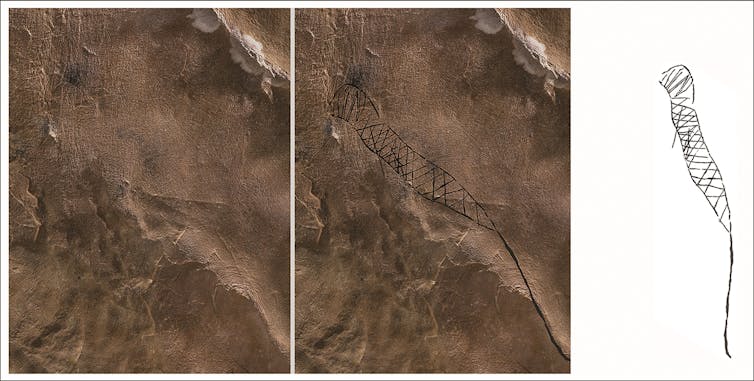
Now, digital analysis of rock surfaces reveals how other ghosts of the deep past - this time from almost 2,000 years ago in North America - have been coaxed into the light. Writing in the journal Antiquity, Professor Jan Simek of the University of Tennessee and colleagues have published images of giant glyphs carved into the mud surface of the low ceiling of a cave in Alabama.
The motifs, which depict human forms and animals, are some of the largest known cave images found in North America and may represent spirits of the underworld. In the first image below, a drawing of a diamondback rattlesnake, an animal sacred to indigenous people in the south-eastern US, stretches almost 3 metres long. The next one down shows a human figure just over 1.8m in length.
Serpent figure with a round head and diamond-shaped body markings. Note that the base of the engraved glyph joins a natural fissure in the ceiling limestone (3.3m long).
Photograph by S. Alvarez; illustration by J. Simek/ Antiquity journal
Human figure (1.81m tall).
(photograph by S. Alvarez; illustration by J. Simek/ Antiquity journal
In terms of dating the findings, ancient people rejuvenated a light in the cave (a flaming torch of American bamboo) by stubbing it against the cave’s wall. This left a residue that the researchers were able to date with radiocarbon to 133-433 AD. This was also in accord with the age of pottery fragments ancient artists left in the cave.
The problem is seeing the paintings. The cave ceiling is only 60cm high, which makes stepping back to view the large images impossible. They were revealed only through a technique called photogrammetry, in which thousands of overlapping photographs of an object or place are taken from different angles and digitally combined in 3D. Photogrammetry is a cheap technique increasingly used in archaeology to record artefacts, buildings, landscapes and caves. It allowed Professor Simek’s team to “lower” the cave floor up to 4 metres, enough for the complete motifs to come into view for the first time.
Ancient art in other places
Rock art is found on almost every continent, and the earliest is at least 64,000 years old. It is likely that we know of only a tiny percentage of the rock art created in the past. Pigments can dull and disappear; thin engravings can erode to nothing; and cave walls can crumble or be covered over by crusts of carbonate deposits or mud. Assuming more art does survive, the chances are we may never see it unless we invest in research and new technologies.
Rock art in the dark zone of caves beyond the natural light in cave mouths was only discovered in North America in 1979, more than a century after its discovery in Europe (at Altamira in northern Spain). Some 500 European caves are known to contain rock art from the Pleistocene era between 2.6 million and 11,700 years ago.
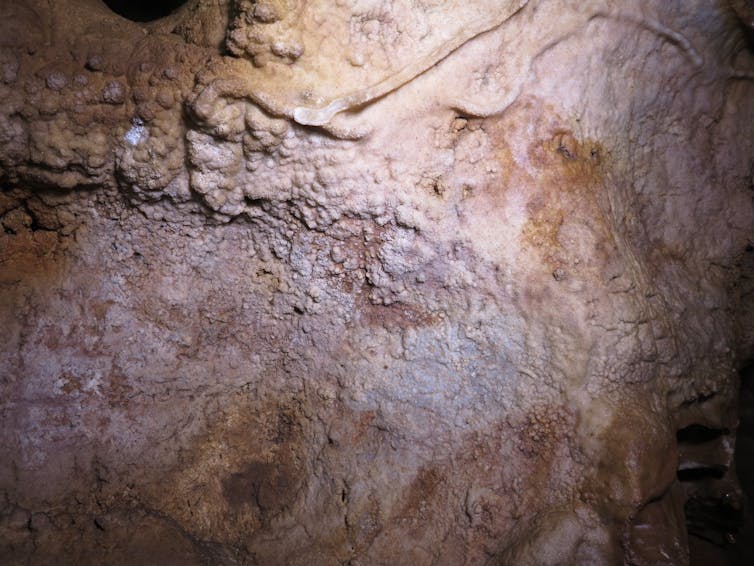
One example critical to our own research only came to light through digital manipulation of images that we took of it. Below is a hand stencil in the cave of Maltravieso (Estremadura, western Spain) which was not immediately apparent when we were searching the cave for suitable samples to date its art.
Digital photograph of hand stencil (GS3B) in Maltravieso Cave, unenhanced.
The stencil had been obscured by the build-up of calcium carbonate deposits. We photographed the area and then used digital image enhancement software which revealed the hand stencil very clearly. Until it re-emerged on our computer screen, this 64,000 year old hand stencil remained undiscovered despite 70 years of intensive study in the cave.
Figure 2 digital photograph of GS3B after image enhancement using DStretch software. The hand stencil is clearly visible (middle right).
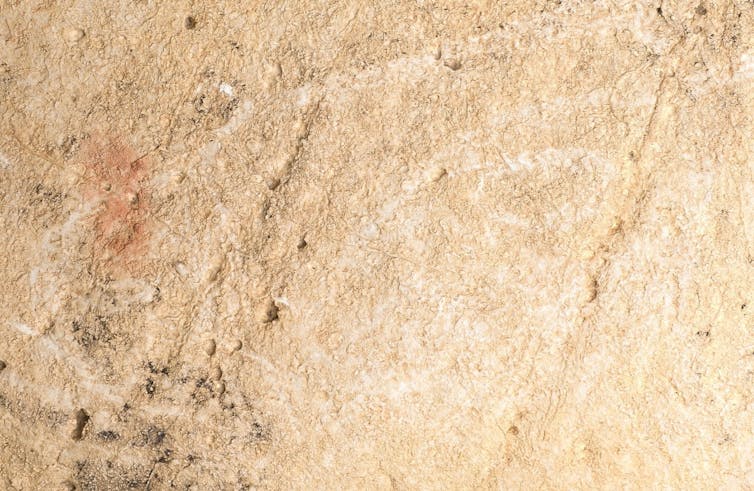
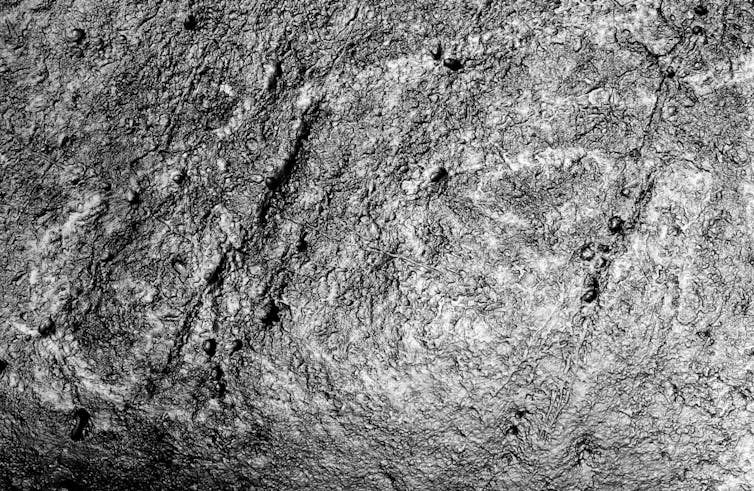
Light engravings – a very common Pleistocene technique – are notoriously difficult to see. Parts of them may come to light using light shone at an oblique angle, which we refer to as raking light. But with a technique known as reflectance transformation imaging (RTI), which is similar to photogrammetry, 3D models can be illuminated from any angle. These can reveal far more complete and complex images. It’s not easy to show this in a couple of stills, but hopefully the two shots below of an engraved bison in a cave in El Castillo in northern Spain give a flavour.
Digital photograph of the head of an engraved bison from El Castillo Cave, Spain.
RTI image of the same bison head.
Future archaeological searches for rock art will probably benefit from recent developments in airport security. Full body scanners use far infra-red frequency light that safely penetrates clothing to reveal concealed weapons or contraband, and similar techniques have been used to “see through” layers of prehistoric wall plaster to paintings underneath. When these scanners become small and cheap enough to take into caves, who knows what further ghosts will come to light?
Who has not contemplated how a memory is formed, a sentence generated, a sunset appreciated, a creative act performed or a heinous crime committed?
The human brain is a three-pound organ that remains largely an enigma. But most people have heard of the brain’s gray matter, which is needed for cognitive functions such as learning, remembering and reasoning.
More specifically, gray matter refers to regions throughout the brain where nerve cells – known as neurons – are concentrated. The region considered most important for cognition is the cerebral cortex, a thin layer of gray matter on the brain’s surface.
But the other half of the brain – the white matter – is often overlooked. White matter lies below the cortex and also deeper in the brain. Wherever it is found, white matter connects neurons within the gray matter to each other.
I am a professor of neurology and psychiatry and the director of the behavioral neurology section at the University of Colorado Medical School. My work involves the evaluation, treatment and investigation of older adults with dementia and younger people with traumatic brain injury.
Finding out how these disorders affect the brain has motivated many years of my study. I believe that understanding white matter is perhaps a key to understanding these disorders. But so far, researchers have generally not given white matter the attention it deserves.
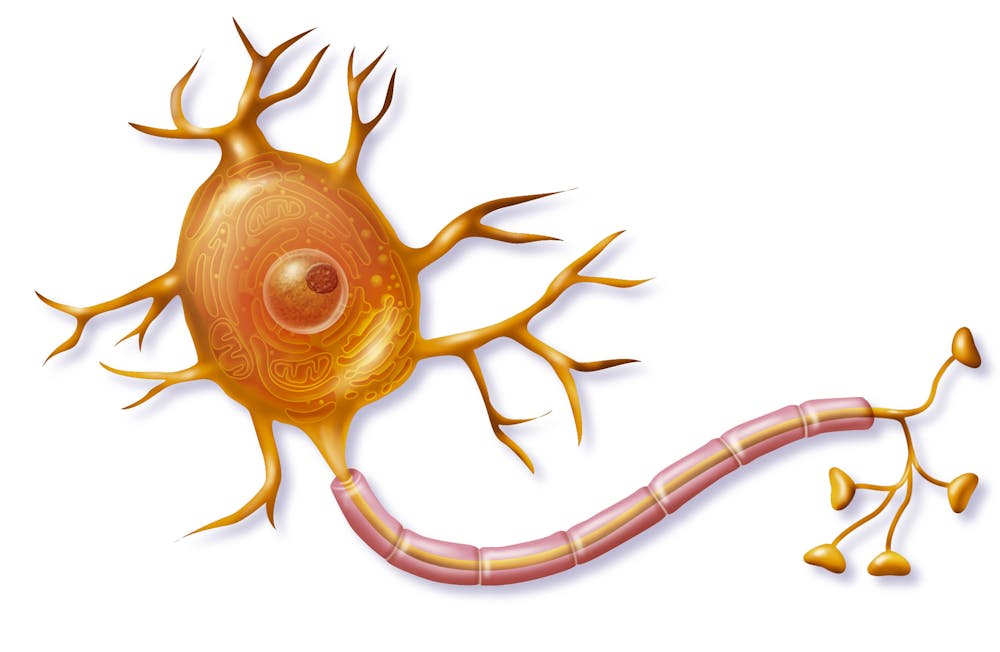
The approximately 100 billion neurons in the human brain are connected to each other by axons, many of which are surrounded by the myelin sheath. These axons, together with their myelin, make up the white matter, which helps facilitate communication between neurons throughout the brain.
This lack of recognition largely stems from the difficulty in studying white matter. Because it’s located below the surface of the brain, even the most high-tech imaging can’t easily resolve its details. But recent findings, made possible by advancements in brain imaging and autopsy examinations, are beginning to show researchers how critical white matter is.
White matter is comprised of many billions of axons, which are like long cables that carry electrical signals. Think of them as elongated tails that act as extensions of the neurons. The axons connect neurons to each other at junctions called synapses. That is where communication between neurons takes place.
Axons come together in bundles, or tracts, that course throughout the brain. Placed end to end, their combined length in a single human brain is approximately 85,000 miles. Many axons are insulated with myelin, a layer of mostly fat that speeds up electrical signaling, or communication, between neurons by up to 100 times.
This increased speed is crucial for all brain functions and is partly why Homo sapiens have unique mental capacities. While there’s no doubt our large brains are due to evolution’s addition of neurons over eons, there has been an even greater increase in white matter over evolutionary time.
This little-known fact has profound implications. The increased volume of white matter – mainly from the myelin sheaths that surround axons – enhances the efficiency of neurons in the gray matter to optimize brain function.
Imagine a nation of cities that are all functioning independently, but not linked to other cities by roads, wires, the internet or any other connections. This scenario would be analogous to the brain without white matter. Higher functions like language and memory are organized into networks in which gray matter regions are connected by white matter tracts. The more extensive and efficient those connections, the better the brain works.
White matter and Alzheimer’s
Given its essential role in the connections between brain cells, damaged white matter can disturb any aspect of cognitive or emotional function. White matter pathology is present in many brain disorders and can be severe enough to cause dementia. Damage to myelin is common in these disorders, and when the disease or injury is more severe, axons can also be damaged.
More than 30 years ago, my colleagues and I described this syndrome as white matter dementia. In this condition, the dysfunctional white matter is no longer adequately performing as a connector, meaning that the gray matter cannot act together in a seamless and synchronous manner. The brain, in essence, has been disconnected from itself.
Equally important is the possibility that white matter dysfunction plays a role in many diseases currently thought to originate in gray matter. Some of these diseases stubbornly defy understanding. For example, I suspect white matter damage may be critical in the early phases of Alzheimer’s disease and traumatic brain injury.
Recent findings increasingly suggest that white matter damage – preceding the accumulation of those proteins – may be the true culprit. As brains age, they often experience gradual loss of blood flow from the narrowing of vessels that convey blood from the heart. Lower blood flow heavily impacts white matter.
Remarkably, there is even evidence that inherited forms of Alzheimer’s also feature early white matter abnormalities. That means therapies aimed at maintaining blood flow to white matter may prove more effective than attempting to dislodge proteins. One simple treatment likely to help is controlling high blood pressure, as this can reduce the severity of white matter abnormalities.
From Loma Linda University Health: New discoveries to help the millions with traumatic brain injuries.
White matter and traumatic brain injury
Patients with traumatic brain injury, particularly those with moderate or severe injuries, can have lifelong disability. One of the most ominous outcomes of TBI is chronic traumatic encephalopathy, a brain disease believed to cause progressive and irreversible dementia. In TBI patients, the accumulation of tau protein in gray matter is evident.
Researchers have long recognized that white matter damage is common in people who have sustained a TBI. Observations from the brains of those with repetitive traumatic brain injuries – football players and military veterans have been frequently studied – have shown that white matter damage is prominent, and may precede the appearance of tangled proteins in the gray matter.
Among scientists, there is a burgeoning excitement over the new interest in white matter. Researchers are now beginning to acknowledge that the traditional focus on the study of gray matter has not produced the results they hoped. Learning more about the half of the brain known as white matter may help us in the years ahead to find the answers needed to alleviate the suffering of millions.
Sunscreen bottles are frequently labeled as “reef-friendly” and “coral-safe.” These claims generally mean that the lotions replaced oxybenzone – a chemical that can harm corals – with something else. But are these other chemicals really safer for reefs than oxybenzone?
In our new study, published in Science, we found that when corals and sea anemones absorb oxybenzone, their cells turn it into phototoxins, molecules that are harmless in the dark but become toxic under sunlight.
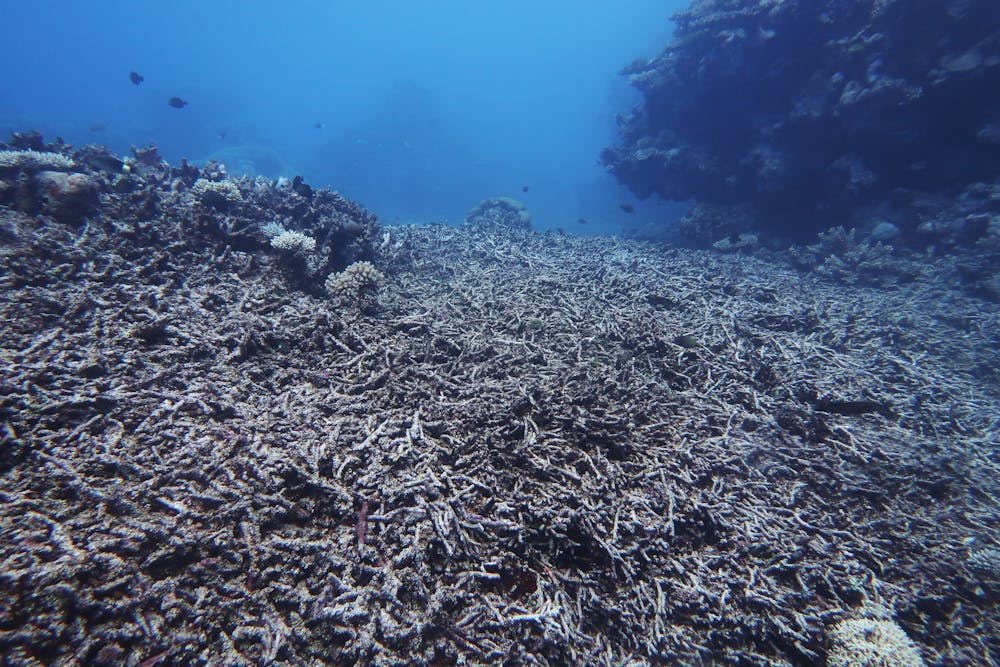
Reefs around the world – like the Great Barrier Reef seen here – are bleaching and dying because of stressors like increased water temperatures, and sunscreens may be exacerbating the issues.
Sunlight is made of many different wavelengths of light. Longer wavelengths – like visible light – are typically harmless. But light at shorter wavelengths – like ultraviolet light – can pass through the surface of skin and damage DNA and cells. Sunscreens, including oxybenzone, work by absorbing most of the UV light and converting it into heat.
Coral reefs around the world have suffered in recent decades from warming oceans and other stressors. Some scientists thought that sunscreens coming off of swimmers or from wastewater discharges could also be harming corals. They conducted lab experiments that showed that oxybenzone concentrations as low as 0.14 mg per liter of seawater can kill 50% of coral larvae in less than 24 hours. While most field samples typically have lower sunscreen concentrations, one popular snorkeling reef in the U.S. Virgin Islands had up to 1.4 mg oxybenzone per liter of seawater – more than 10 times the lethal dose for coral larvae.
Oxybenzone is a common ingredient in many sunscreens.
Likely inspired by this research and a number of other studiesshowing damage to marine life, Hawaii’s legislators voted in 2018 to ban oxybenzone and another ingredient in sunscreens. Soon after, lawmakers in other places with coral reefs, like the Virgin Islands, Palau and Aruba, implemented their own bans.
There is still an open debate whether the concentrations of oxybenzone in the environment are high enough to damage reefs. But everyone agrees that these chemicals can cause harm under certain conditions, so understanding their mechanism is important.
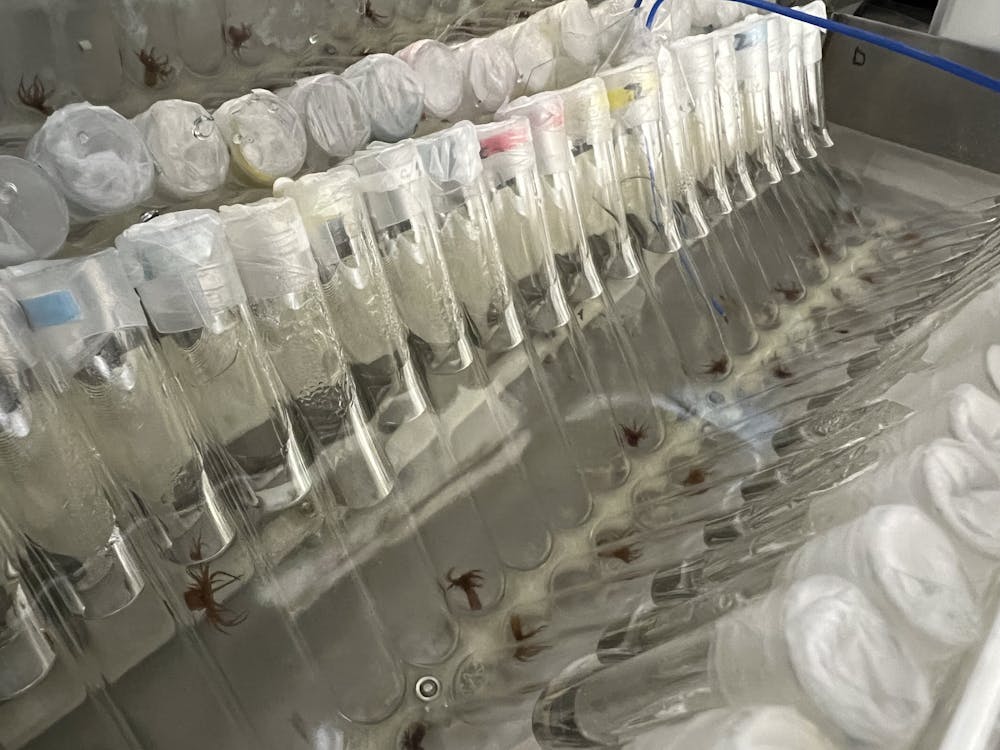
By putting sea anemones into test tubes with oxybenzone and controlling what kinds of light they were exposed to, we could see whether the sunscreen was reacting to light.
While laboratory evidence had shown that sunscreen can harm corals, very little research had been done to understand how. Some studies suggested that oxybenzone mimics hormones, disrupting reproduction and development. But another theory that our team found particularly intriguing was the possibility that the sunscreen behaved as a light-activated toxin in corals.
To test this, we used the sea anemones our colleagues breed as a model for corals. Sea anemones and corals are closely related and share a lot of biological processes, including a symbiotic relationship with algae that live within them. It is extremely difficult to perform experiments with corals under lab conditions, so anemones are typically much better for lab-based studies like ours.
We put 21 anemones in test tubes full of seawater under a lightbulb that emits the full spectrum of sunlight. We covered five of the anemones with a box made of acrylic that blocks the exact wavelengths of UV light that oxybenzone normally absorbs and interacts with. Then we exposed all the anemones to 2 mg of oxybenzone per liter of seawater.
The anemones under the acrylic box were our “dark” samples and the ones outside of it our control “light” samples. Anemones, like corals, have a translucent surface, so if oxybenzone were acting as a phototoxin, the UV rays hitting the light group would trigger a chemical reaction and kill the animals – while the dark group would survive.
We ran the experiment for 21 days. On Day Six, the first anemone in the light group died. By Day 17, all of them had died. By comparison, none of the five anemones in the dark group died during the entire three weeks.
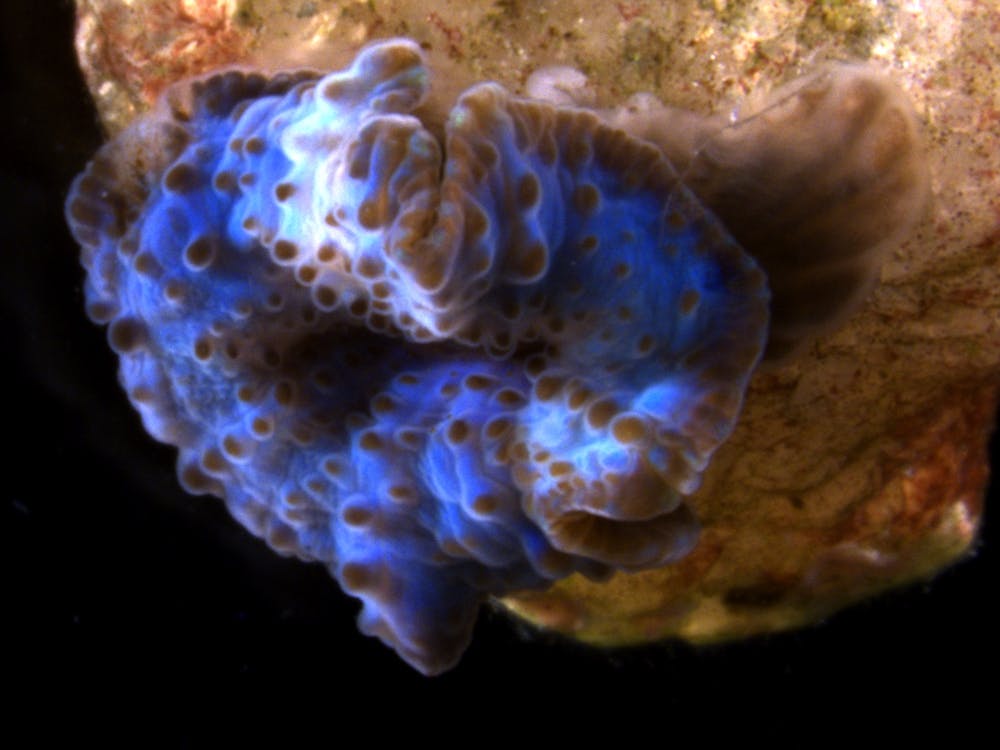
Corals – like the mushroom coral seen here – and sea anemones absorb oxybenzone and metabolize it, but in doing so, they turn it into a toxin.
We were surprised that a sunscreen was behaving as a phototoxin inside the anemones. We ran a chemical experiment on oxybenzone and confirmed that, on its own, it behaves as a sunscreen and not as a phototoxin. It’s only when the chemical was absorbed by anemones that it became dangerous under light.
Any time an organism absorbs a foreign substance, its cells try to get rid of the substance using various metabolic processes. Our experiments suggested that one of these processes was turning oxybenzone into a phototoxin.
To test this, we analyzed the chemicals that formed inside anemones after we exposed them to oxybenzone. We learned that our anemones had replaced part of oxybenzone’s chemical structure – a specific hydrogen atom on an alcohol group – with a sugar. Replacing hydrogen atoms on alcohol groups with sugars is something that plants and animals commonly do to make chemicals less toxic and more water soluble so they are easier to excrete.
When cells try to process oxybenzone, they replace part of an alcohol group (highlighted in red on the left) with a sugar (in red on the right) and in doing so turn the sunscreen into a phototoxin.
But when you remove this alcohol group from oxybenzone, oxybenzone ceases to function as a sunscreen. Instead, it holds on to the energy it absorbs from UV light and kicks off a series of rapid chemical reactions that damage cells. Rather than turning the sunscreen into a harmless, easy-to-excrete molecule, the anemones convert oxybenzone into a potent, sunlight-activated toxin.
When we ran similar experiments with mushroom corals, we found something surprising. Even though corals are much more vulnerable to stressors than sea anemones, they did not die from oxybenzone and light exposure during our entire eight-day experiment. The coral made the same phototoxins from oxybenzone, but all of the toxins were stored in the symbiotic algae living in the coral. The algae seemed to absorb the phototoxic byproducts and, in doing so, likely protected their coral hosts.
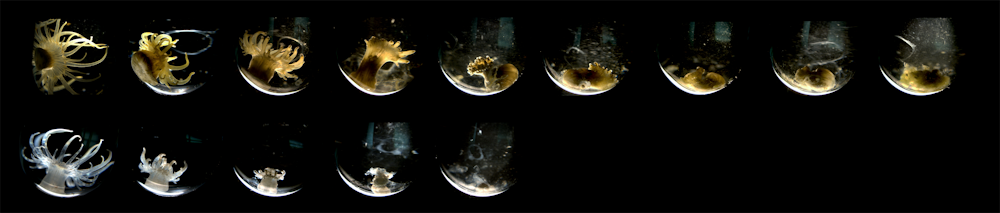
This photo series shows how darker-colored anemones on top with algae in them lived longer than the lighter-colored anemones on the bottom that did not have algae living in them.
We suspect that the corals would have died from the phototoxins if they did not have their algae. It is not possible to keep corals without algae alive in the lab, so we did some experiments on anemones without algae instead. These anemones died about two times faster and had almost three times as many phototoxins in their cells compared than the same anemones with algae.
Coral bleaching, ‘reef-safe’ sunscreens and human safety
We believe there are a few important takeaways from our effort to better understand how oxybenzone harms corals.
First, coral bleaching events – in which the corals expel their algal symbionts because of high seawater temperatures or other stressors – likely leave corals particularly vulnerable to the toxic effects of sunscreens.
Second, it’s possible that oxybenzone could also be dangerous to other species. In our study, we found that human cells can also turn oxybenzone into a potential phototoxin. If this happens inside the body, where no light can reach, it’s not an issue. But if this occurs in the skin, where light can create toxins, it could be a problem. Previous studies have suggested that oxybenzone could pose health risks to people, and some researchers have recently called for more research into its safety.
Finally, the chemicals used in many alternative “reef-safe” sunscreens contain the same alcohol group as oxybenzone – so could potentially also be converted to phototoxins.
We hope that, taken together, our results will lead to safer sunscreens and help inform efforts to protect reefs.
A new discovery deep beneath one of Antarctica’s rivers of ice could change scientists’ understanding of how the ice flows, with important implications for estimating future sea level rise.
Glacier scientists Matthew Siegfried from Colorado School of Mines, Chloe Gustafson from Scripps Institution of Oceanography and their colleagues spent 61 days living in tents on an Antarctic ice stream to collect data about the land under half a mile of ice beneath their feet. They explain what the team discovered and what it says about the behavior of ice sheets in a warming world.
What was the big takeaway from your research?
First, it helps to understand that West Antarctic was an ocean before it was an ice sheet. If it disappeared today, it would be an ocean again with a bunch of islands. So, we know that the bedrock below the ice sheet is covered with a thick layer of sediments – the particles that accumulate onto ocean floors.
What we didn’t know was what was in the tiny pore spaces among those sediments below the ice.
We expected to find meltwater coming from the ice stream above, a fast-moving channel of ice that flows from the center of the ice sheet toward the ocean. What we didn’t expect, but we found in this thick layer of sediments, was a huge amount of groundwater – including saltwater from the ocean.
Our findings suggest that this salty groundwater is the largest reservoir of liquid water below the ice stream we studied, and likely others, and it may be affecting how the ice flows on Antarctica.
How Antarctica’s ice flows through ice streams and ice shelves to the ocean. NASA.
Liquid water is incredibly important to how fast an ice stream moves. If there’s liquid water at the base of an ice stream, it flows fast. If that water freezes or the base dries out, the ice screeches to a stop.
Models of ice streams typically consider only whether ice at the base has reached the melting point or if water has flowed from upstream along the base of the ice. Scientists had never considered that more water was available under the ice sheet, let alone water that is much saltier, which keeps water from freezing at lower temperatures. (Think about why communities put salt on roads in winter.)
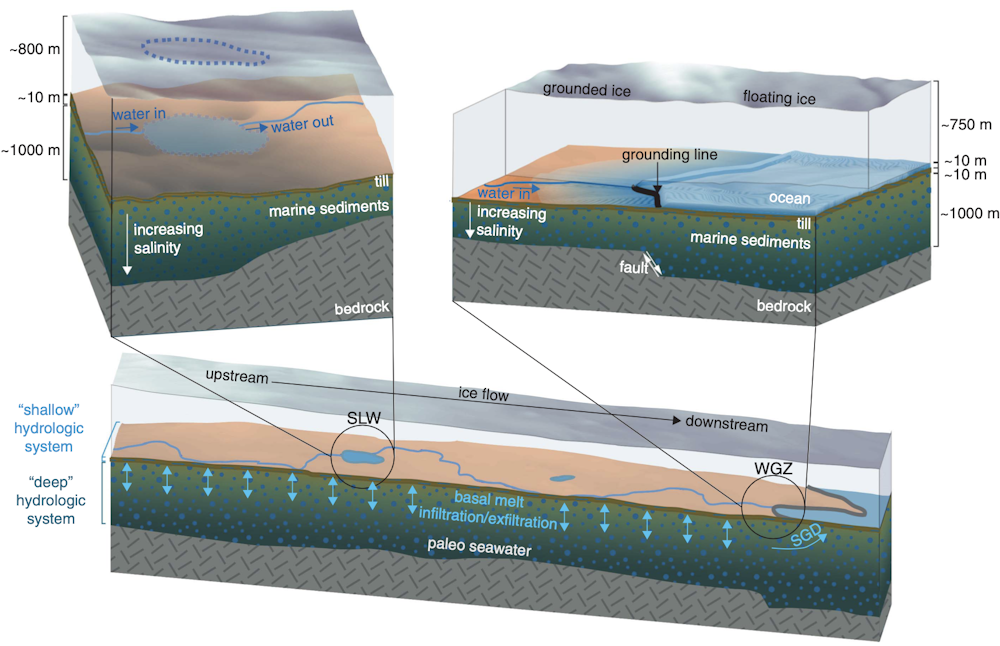
Our observations suggest there is so much water there, if you took the 500 to 1,900 meters (1,600 to 6,200 feet) or so of sediments below the ice stream and squeezed them like a sponge, you’d have a column of water about 220 to 820 meters (700 to 2,700 feet) deep.
Illustrations of the Whillans ice stream show liquid water under the ice from subglacial lakes (left) and groundwater within the sediment. The ice stream moves at about 300 meters per year.
This water can move through the pores in the subglacial groundwater system, just like groundwater elsewhere, but in Antarctica, there is a dynamic ice sheet on top. When the ice sheet gets thicker, it exerts more pressure on the sediment below, so it could drive meltwater from the base of the ice sheet deeper into the sediment. When the ice gets thinner, however, it could draw water, now a little saltier, out of the sediments. That saltier water could affect how fast the ice flows.
Knowing that there is a massive reservoir of water that may be linked to how fast-flowing regions of Antarctica behave means scientists need to rethink our understanding of ice streams.
What does finding liquid water in the sediments tell scientists about Antarctica?
The salty groundwater was a clear sign of how far inland the boundary between the ice sheet and the ocean once reached.
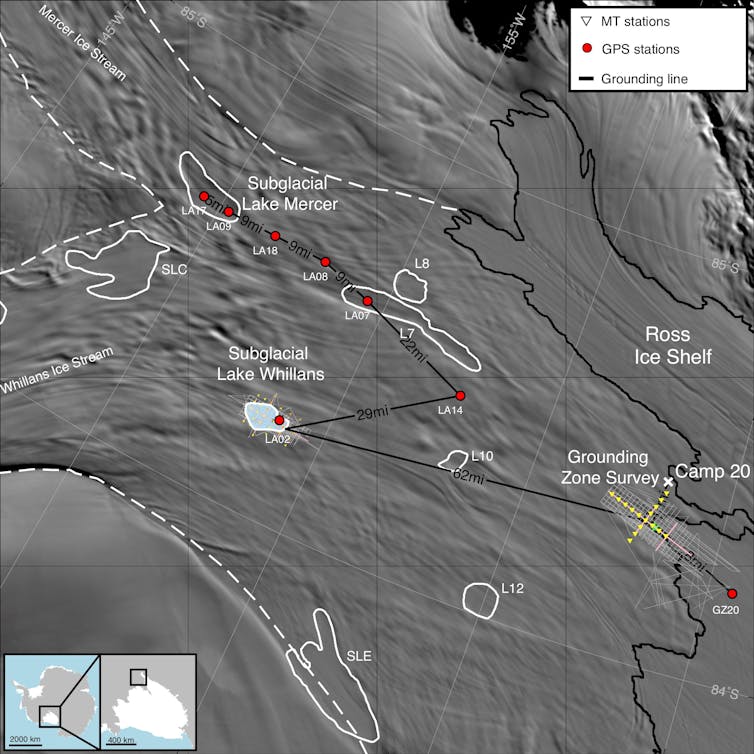
The fact that there were marine waters beneath our feet meant that the grounding line was upstream of us at some point, at least 70 miles (110 kilometers) from where it is today.
The team’s survey points on the Whillan’s ice stream in 2018-2019 and the grounding line.
We argue in our paper that it can’t be too old. The groundwater is flowing, and fresh water is coming into the sediments from the glacier above. We estimate that most of this salty water arrived in the subglacial system within the past 10,000 years, based on how much radiocarbon has been found in the upper sediment in a previous a study.
The ocean would have deposited that seawater when the ice sheet got smaller during warm periods in the past.
Whillans ice stream is pretty remote. How did you determine what was happening a mile below you?
Our site is about a two-hour flight from McMurdo Station, Antarctica. The plane lands on skis and drops off everything you need to live. Then it takes off, and it’s you, your field team, and a couple pallets of cargo.
In all, we slept 61 days in a tent that season. Each day, we packed our snowmobiles, put in the coordinates for a site, and installed magnetotelluric stations.
Each station has three magnetometers – pointing east-west, north-south and vertical – and two pairs of electrodes – aligned east-west and north-south. These instruments can detect the electromagnetic signatures of different Earth materials in the subsurface.
Installing a magnetotelluric station on the Whillans ice stream.
Natural variations in the Earth’s magnetic and electric fields are created by events across the globe, such as solar wind interacting with the Earth’s ionosphere and lightning strikes. A change in the Earth’s magnetic and electric fields induces secondary electromagnetic fields in the subsurface, and the strength of those fields is related to how well the material there conducts electricity.
So, by measuring electric and magnetic fields on the ice surface, we can figure out the conductivity of the subsurface materials, including water. It’s the same method the oil and gas industry used to find fossil fuels.
Any time we’ve poked a hole through Antarctica, it’s been teeming with microbial life. There’s no reason to think microbes aren’t gnawing away at nutrients in the groundwater, too.
When you have microbial ecosystems that are cut off for extended periods of time – in this case, seawater was likely deposited there 5,000-10,000 years ago – you start to have a pretty good analog for how life might exist on other planetary bodies, locked in the subsurface and buried underneath thick ice.
Where there’s life, there is also the question of carbon.
High winds, common at the authors’ camp on the Whillans ice stream, create challenges for the electromagnetic method. Each snow particle has static electricity that creates noise for the instruments.
This is a new environment, and there’s a lot of research still to do. We have observations from one ice stream. It’s like sticking a straw in the groundwater system in Florida and saying, “Yeah, there’s something here” – but what does the rest of the continent look like?
Two years into the coronavirus pandemic, Americans can be forgiven if they’ve lost track of the latest variants circulating nationally and around the world. We’ve heard of the alpha, beta, gamma, delta, and omicron variants, but a new Greek-letter variant hasn’t come onto the scene in almost half a year. Instead, a seemingly endless stream of “subvariants” of omicron, the most recent Greek-letter variant, has emerged in the past few months. How different are these subvariants from one another? Can infection by one subvariant protect someone from infection by another subvariant? And how well ar...
NASA's Crew-3 mission was returning home to Earth on Thursday after six months aboard the International Space Station.
The SpaceX Dragon Endurance spacecraft with NASA astronauts Kayla Barron, Raja Chari, and Tom Marshburn, as well as European Space Agency astronaut Matthias Maurer undocked from the orbital laboratory overnight.
Their 23.5 hour journey back should see them splash down off the coast of Florida at 12:43 am on Friday (0443 GMT).
They leave behind the one Italian and three American astronauts of Crew-4, and three Russian cosmonauts. Ahead of departure, Marshburn handed command of the station over to Russian Oleg Artemyev.
During their mission, Crew-3 carried out hundreds of scientific experiments, including growing chiles in space to add to knowledge of cultivating crops on long term missions, exploring how concrete hardens in space, and Earth monitoring.
"Every day on @Space_Station is #EarthDay for @NASA_Astronauts since we see how thin the precious layer is that protects everything we know & love as a human race," Crew-3 commander Chari wrote in a tweet.
"Hopefully, @NASA research will help w/ H20 purification & carbon dioxide reductions but the rest is up to us."
Chancellor Olaf Scholz wished Maurer, the 12th German in space, "a good and safe journey back with a soft landing," thanking him on Twitter for "all the new discoveries in space that are so important for us here on Earth."
Crew-3's expedition came at an increasingly busy time for commercial space.
They welcomed aboard a private crew that included three wealthy businessmen that came and went on another SpaceX Crew Dragon, as well as a Japanese mission that flew on a Soyuz aircraft to the Russian segment.
The ISS now awaits docking with an uncrewed Boeing Starliner capsule, which is set to launch from Florida on May 19.
NASA is looking to certify a second company to ferry astronauts to the region of space called Low Earth Orbit, leaving it to develop its super heavy space launch system (SLS) rocket for missions to the Moon, and eventually Mars.
Don’t sleep on this study. Middle-age and older people should sleep seven hours each night for ideal rest and recovery, according to a study published last week. The research, published in Nature Aging, studied nearly 500,000 people between the ages of 38 and 73. “While we can’t say conclusively that too little or too much sleep causes cognitive problems, our analysis looking at individuals over a longer period of time appears to support this idea,” co-author Jianfeng Feng said in a statement. Researchers found that people who got exactly seven hours of sleep on a consistent basis saw better m...