An American man was exonerated Wednesday for a decades-old murder he did not commit, using evidence based on DNA and a genetic family tree, the first such result using a revolutionary investigative technique.
Christopher Tapp, 43, had served 20 of his 30-year sentence for the 1996 rape and murder of Angie Dodge.
On Wednesday, a court in the state of Idaho completely overturned his conviction based on evidence found with "genetic genealogy" -- the technique used to identify the suspected "Golden State Killer" by making DNA matches with his distant relatives.
"It's a new life, a new beginning, a new world for me, and I'm just gonna enjoy every day," Tapp said at the end of the hearing, local media reported.
Tapp's exoneration came after police arrested another suspect, Brian Dripps, in May. Dripps, who was identified using genetic genealogy, confessed to the crime.
Genetic genealogy first made headlines in April 2018, after it was used to find the alleged "Golden State Killer" in California who is blamed for 12 murders and more than 50 rapes dating back to the mid-1970s.
In that case -- as well as about 70 others that have been solved since -- DNA found at crime scenes was compared to the databases for genealogy websites.
The websites -- widely advertised in the United States -- allow users to post DNA test results and then generate a list of people with similar genomes, enabling users to find distant relatives.
The databases also allow police officers to search through people with similar genetic profiles to DNA found at crime scenes. Tracing back through family trees and seeing where the DNA crosses can lead investigators to a suspect.
But Tapp's case is the first in which genetic genealogy has been used to prove innocence.
"It's just such an incredible feeling to be a part of clearing an innocent man's name," CeCe Moore, the genetic genealogist who worked on the case, said in an interview with ABC.
The case against Tapp began to crumble before investigators started to use genetic genealogy.
In 1998, Tapp was sentenced to 30 years in prison based solely on his confession, which he then retracted.
In 2017, he was freed from prison in a court agreement, but the murder charge was not dropped.
A year later, his defense team obtained the right to test sperm traces found in Angie Dodge's bedroom. Genetic genealogy led investigators to Brian Dripps.
Dripps, who in 1996 lived just across the street from Dodge, confessed to the crime after officers tested a cigarette butt he had thrown away against the crime scene DNA.
The Idaho Bonneville County prosecutor withdrew the charges against Tapp and filed a motion to exonerate him, which a judge endorsed on Wednesday.
The World Health Organization on Wednesday declared the Ebola outbreak in the Democratic Republic of Congo a "public health emergency of international concern," a rare designation only used for the gravest epidemics.
The Ebola epidemic in DR Congo, the second deadliest on record, has largely been contained to remote areas, but this week saw a patient diagnosed with the virus in the eastern city of Goma, the first case in a major urban hub.
"It is time for the world to take notice," WHO chief Tedros Adhanom Ghebreyesus said in a statement, as he accepted the advice of his advisory board to invoke the emergency provision (PHEIC), activated by the UN health agency four times previously.
Those included the H1N1, or swine flu, pandemic of 2009, the spread of polio virus in 2014, the Ebola epidemic that devastated parts of West Africa from 2014 to 2016 and the surge of the Zika virus in 2016.
The International Federation of Red Cross and Red Crescent Societies said it "welcomed" the decision.
"While it does not change the reality on the ground for victims or partners engaged in the response, we hope it will bring the international attention that this crisis deserves," the IFRC said in a statement.
Goma case
The Ebola epidemic began in DRC nearly a year ago and has since killed more than 1,600 people.
WHO has on three previous occasions held off making the emergency call for the outbreak centred in the eastern DRC provinces of Ituri and North Kivu.
Tedros this week called the Goma patient a "potential game-changer," because the city was a "gateway" to Africa's Great Lakes region and the wider world.
The Goma patient has been described as an evangelical preacher who had travelled from the city to Butembo, one of the towns hardest hit by Ebola.
He had reportedly touched several Ebola patients and concealed his identity in order to evade health screenings while on route to Goma.
The emergency committee cited the patient, who has died, as a "specific cause for concern".
"There are worrying signs of possible extension of the epidemic. Despite significant improvement in many places, there is concern about potential spread from Goma," it said.
Goma is a border city of about one million people located on the northern shore of Lake Kivu, adjacent to Rwanda's town of Gisenyi.
It has a port that links to Bukavu and South Kivu province and an airport with flights to Kinshasa, the Ugandan capital Entebbe and Addis Ababa, the capital of Ethiopia.
At the Goma-Gisenyi crossing on Wednesday, megaphone announcements instructed all travellers to wash their hands "to prevent Ebola sickness virus," using basins of water with added bleach.
Health workers wearing yellow high-visibility jackets took the temperature of people crossing the border, in both directions.
No travel restrictions
The WHO's international health regulations, drafted in 2005, say that the international emergency label should apply to a situation that is "serious, unusual or unexpected; carries implications for public health beyond the affected State's national border; and may require immediate international action".
A main concern in making the emergency call is the fear that other states will close their borders in order to protect their populations.
The head of the WHO emergency panel, Robert Steffen urged against any border closures.
"It is... crucial that states do not use the (emergency declaration) as an excuse to impose trade or travel restrictions, which would have a negative impact on the response and on the lives and livelihoods of people in the region," he said in a statement.
A breakthrough technique harnessing two methods to target disease-carrying mosquitoes was able to effectively eradicate buzzing biters in two test sites in China, according to research published on Thursday.
The mosquitoes targeted are a type that is particularly difficult to control called Aedes albopictus -- more popularly known as the Asian tiger mosquito -- which are a major vector for diseases including Zika and dengue.
The study "demonstrates the potential of a potent new tool", wrote Peter Armbruster, a professor at Georgetown University's department of biology, in a review of the work.
Researchers harnessed two population control methods: the use of radiation -- which effectively sterilizes mosquitoes -- and a strain of bacteria called Wolbachia that leaves mosquito eggs dead on arrival.
They conducted a two-year trial at two sites on river islands in Guangzhou, where Asian tiger mosquitoes are to blame for the highest dengue transmission rate in China.
The results were "remarkable", wrote Armbruster: the number of hatched mosquitoes eggs plunged by 94 percent, with not a single viable egg recorded for up to 13 weeks in some cases.
And the average number of female mosquitoes -- which transmit disease to humans when they bite -- caught by traps fell by between 83 and 94 percent.
In some cases, none were detected at all for up to six weeks.
The results were also borne out by a decline of nearly 97 percent in bites suffered by locals -- which in turn shifted attitudes among residents, who were initially sceptical of the project's plan to release more mosquitoes into the local area.
- Radiation and bacteria -
Guangzhou Wolbaki Biotech Co./AFP / Yajun Wang Male mosquitos buzz around a container at the Guangzhou Wolbaki Biotech Company's laboratory in Guangzhou, China in this handout picture
The research builds on two existing methods: radiation-based sterile insect technique (SIT) and incompatible insect technique (IIT).
SIT works by releasing radiation-sterilized male mosquitoes into an environment to mate with wild female mosquitoes, reducing the size of the population over time as females fail to reproduce.
But irradiation of male mosquitoes tends to reduce both their mating competitiveness and their survival rates, undermining the technique's effectiveness.
The IIT method involves a bacteria called Wolbachia. When males infected with it mate with female mosquitoes that aren't infected, their eggs don't hatch.
The technique doesn't work if the female mosquitoes are infected with the same Wolbachia strain, and successful mating by mosquitoes that both carry the bacteria undermines the technique by producing more female mosquitoes infected with Wolbachia that are resistant to the process.
Preventing the release of Wolbachia-infected female mosquitoes is difficult, with sex-sorting techniques usually resulting in a "female contamination rate" of about 0.3 percent.
To overcome that, researchers decided to subject their Wolbachia-infected lab-reared mosquitoes to low-level irradiation, which rendered the females sterile but left the males able to reproduce.
This allowed the team to avoid the onerous sex-screening process and meant they could release significantly more mosquitoes at a time: in some cases more than 160,000 male mosquitoes per hectare, per week.
- 'Striking results' -
Guangzhou Wolbaki Biotech Co./AFP / Yajun Wang The Guangzhou Wolbaki Biotech Company rears masses of adult mosquitos in large containers at their company site in Guangzhou
Lead researcher Zhiyong Xi, a professor at Michigan State University's department of Microbiology and Molecular Genetics, compared the technique to "producing insecticide".
"Our goal is to use this technique to build a protected area that is disease vector-free," Xi told AFP.
Armbruster, in a review commissioned by the journal Nature that published the research on Thursday, said the study produced "striking results".
That the trial "almost eliminated notoriously difficult-to-control vector mosquitoes from the test sites is remarkable," he wrote.
The results weren't a universal success -- populations in areas with more traffic, near construction or roads, shrank less than those in isolated zones, likely as mosquitoes migrated in from elsewhere.
But Xi said the technique still holds promise if "natural barriers" like highways are used to limit the arrivals of outside mosquitoes.
And he said it could be used against mosquitoes that carry disease, including malaria.
The next steps will involve developing a "highly effective and practical release strategy" suited for urban settings," he said.
Futurist entrepreneur Elon Musk late Tuesday revealed his secretive Neuralink startup is making progress on an interface linking brains with computers, and said they hope to begin testing on people next year.
Musk has long contended that a neural lace meshing minds with machines is vital if people are going to avoid being so outpaced by artificial intelligence that, under the best of circumstances, humans would be akin to "house cats."
Musk and members of the Neuralink team laid out progress they have made on their mission at an event held in San Francisco to recruit talent in software, robotics, neuroscience and more.
"Ultimately, we can do a full brain-machine interface," Musk said.
"Achieve a sort of symbiosis with artificial intelligence."
Neuralink unveiled an early version of a tiny sensor with hair-thin strands that could be implanted in a brain through a small incision by a robot built for the high-precision task.
"They are tiny electrodes and the robot is delicately implanting them," Musk said, noting there could be thousands of the electrodes connected to a brain.
"This is something that is not going to be stressful to put in; will work well, and it is wireless."
The chip will communicate wirelessly with an earpiece, which relays information to a smartphone application, according to Neuralink.
For now, the goal is to let a person with the implants control a smartphone with thought, but the technology could eventually extend to other devices such as robotic arms.
"This has tremendous potential," Musk said.
"We hope to have this in a human patient before the end of next year."
An early focus of the team is using the technology to address brain diseases and paralysis, but the longer aim is to make implants so safe, reliable and easy that they could be elective surgery options for people seeking to enhance their brains with computing power, according to a neurosurgeon on the Neuralink team.
Musk said the goal was to make adding the brain-enhancing implants as easy a procedure as laser eye surgery.
"I've said a lot about AI over the years; I think that even in a benign scenario, we will be left behind," Musk said.
"With a high bandwidth brain-machine interface we can actually go for the ride and have the option of merging with AI. This is very important."
Fifty years ago on Tuesday, three American astronauts set off from Florida for the Moon on a mission that would change the way we see humanity's place in the universe.
The crew's surviving members, Buzz Aldrin and Michael Collins, are set to reunite at the same launchpad on Tuesday, the start of a week-long series of events commemorating Apollo 11.
Their commander and the first man on the Moon, Neil Armstrong, passed away in 2012.
But Aldrin and Collins, 89 and 88 respectively, will meet Tuesday at precisely 9:32 am (1332 GMT) at the Kennedy Space Center's pad 39A to kick off the festivities.
Their spacecraft took four days to reach the Moon, before its lunar module, known as "Eagle," touched the lunar surface on July 20, 1969. Armstrong emerged a few hours later.
Collins remained in lunar orbit in the command module Columbia, their only means of returning back to Earth.
"They knew, I knew, if they couldn't get off for some reason there was nothing I could do about it," he told reporters in New York in May as part of a series of events. "I had no landing gear on Columbia, I could not go down and rescue them."
Aldrin has remained relatively more elusive but has also taken part in a few events, including a gala dinner last Saturday where the cheapest ticket cost $1,000.
Aging but active on Twitter, and always seen in stars-and-stripes socks, Aldrin has faced health scares and family feuds, culminating in a court case over finances, which was settled in March.
On Tuesday, he will be the undeniable star of the show, as the second man to have stepped foot on the Moon. Only four of the 12 men who have done so remain alive.
- Uncertain future -
Despite the festivities, neither the US nor any other country has managed to return a human to the Moon since 1972, the year of the final Apollo mission.
President George Bush promised to do so in 1989, as did his son president George W Bush in 2004, while pledging to also march forward to Mars.
But they both ran up against a Congress that wasn't inclined to fund the adventures, with public opinion markedly changed since the height of the Cold War.
For his part, President Donald Trump relaunched the race to re-conquer the Moon and Mars after taking office in 2017. But the immediate effect has been to create turbulence within the space agency.
Last week, NASA administrator Jim Bridenstine fired the head of the human space exploration directorate Bill Gerstenmaier, likely over disagreements over the 2024 ultimatum set by Trump to return an American to the Moon.
Five years appears unlikely given that neither the rocket, capsule or lander are yet ready or even finalized.
"We don't have a lot of time to waste, if we're going to have new leadership, it needs to happen now," Bridenstine told CSPAN last week.
Sue Finley began work at the Jet Propulsion Laboratory as the US prepared to launch its first satellite into orbit in 1958, racing to match the Soviet Union, which had accomplished the feat months earlier.
Now 82, she is one of NASA's longest-serving women, starting out as one of its "human computers," whose critical yet long-hidden contributions to the space program, including the Apollo missions to the Moon, are finally being recognized.
Finley had dropped out of college and joined a group of mathematically gifted individuals, overwhelmingly women, whose job it was to solve the complex equations thrown at them by rocket scientists before electronic computing became affordable and reliable.
Neil Armstrong may be remembered for his "giant leap for mankind" when he stepped out onto lunar soil a decade later, but it was the work of these women that helped hone the rocket, invent the propellant, and develop the global antenna network that allowed viewers to watch the crew's famous live broadcast.
Finley's story, like many of the other "computers," is one that speaks to the many challenges faced by women of the time.
- Math whizz -
NASA/JPL-CALTECH/AFP / HO Not all of the calculations were carried out by hand: Sue Finley and the other "computers" made use of electro-mechanical adding machines called "Fridens," though these could handle only basic arithmetic
Finley had been a math whizz for as long as she could remember, getting straight As at high school, and winning an award for completing chemistry equations in her head faster than others could with slide rules.
But as a young woman she decided to pursue other interests, majoring in art with the hope of one day becoming an architect.
Her plan failed because she lacked the required flair, "and you can't really learn art," she told AFP.
She got her start as a "computer" at the now-defunct aerospace firm Convair, which worked with the Navy.
Finley had initially hoped to become a secretary but flunked the typing test. "They said, 'How do you like numbers?' And I said, 'Oh, I like numbers much better than letters,'" she laughed.
Not all of the calculations were carried out by hand: she and the other "computers" made use of electro-mechanical adding machines called "Fridens," though these could handle only basic arithmetic, not the advanced calculus and geometry needed for their work.
After getting married and moving farther from her workplace, she found the long drive was getting taxing. Her husband Peter Finley had graduated from Caltech, which founded the Jet Propulsion Laboratory (JPL), and told her about a lab up in the hills above Pasadena that she should go up and see.
But why did the JPL hire all women teams?
"The woman who was in charge of it... thought that men wouldn't take instruction from her and so just hired women," explained Finley. "And women are much cheaper, they still are."
Despite the fact that women could not rise to the rank of engineer at that time, Finley insisted that being a "computer" was still a job that carried prestige.
- Trailblazer -
NASA/JPL-CALTECH/AFP / HO Women working with the NASA Jet Propulsion Laboratory, known at the time as "computers", including Janez Lawson (front row, 5L), the first African American hired into a technical position at JPL, pose for a photo
Finley took a career break from 1963 to 1969 to raise her two young boys -- starting a family had always been the plan following the death of the couple's first son at birth.
But she soon realized being a homemaker was not the path for her and she became clinically depressed.
"I was a complete failure as a housewife," she said. "The psychologist that I went to said that I really needed to go back to work" and that the boys would be alright.
While reluctant to tout her own accomplishments, she acknowledges that the decision was unusual for the time.
"I think that when I went there to work as a mother and a wife, I was being a trailblazer as far as women's lib," she said.
She returned to a drastically changed JPL, one in which flesh and bones "computers" had been replaced with processors and memory -- but she had managed to stay ahead by learning the new computer language Fortran.
Author Nathalia Holt writes in "Rise of the Rocket Girls" that one of Finley's biggest successes came in October 1989 when disaster struck the Galileo probe to Jupiter and its moons.
As the probe orbited Earth, gathering momentum to slingshot toward the gaseous planet, an antenna failed to open, leaving the mission imperiled.
Finley wrote a program that combined the power of Earth's Deep Space Network (DSN) of dishes, so that they could make use of the probe's lower-powered antennas instead.
It ended up sending back stunning footage, including the breakup of a comet and the discovery of a moon orbiting an asteroid.
Her personal favorite mission, though, was the 1985 collaboration between the USSR and France during the Vega program, which dropped probe balloons into the Venus atmosphere.
She improved the accuracy of the antennas to track the balloon probes with the DSN.
AFP / Robyn Beck Sue Finley insists she has no plans to retire as long as she's still wanted by NASA in her role as a subsystems and testing engineer
"That was my favorite, because it was a very small group of people," she said. It was also the only time she got on-lab parking.
Her work on interpreting radio tones to track spacecraft meanwhile helped land the Mars Spirit and Opportunity rovers in 2004, and ensured a safe arrival at Jupiter for the Juno explorer in 2016.
"It's like treasure hunting, or mysteries, you're trying to solve problems," she said of the enduring appeal of her work.
And, she insists, she has no plans to retire, as long as she's still wanted by NASA in her current role as a subsystems and testing engineer.
"I don't plan to stop. I have nothing else I'd rather do."
Species’ extinction rates are accelerating on a global scale. We need solutions that match the severity of the problem.
Say goodbye to one of the dreamiest things about childhood. In the Midwest, fireflies are dying off.
For many Americans, it’s hard to imagine summer nights without the magical glow of dozens of bioluminescent bodies fluttering above the grasses and fields, and lighting up the dark skies above.
But the die-offs aren’t just limited to fireflies — or to the American heartland. As anyone who’s been paying attention to the news this summer knows, species across the globe are taking a nosedive toward extinction. The United Nations report on biodiversity that came out in May is just the latest assessment to warn that the health of our ecosystems is “deteriorating more rapidly than ever.”
Humans are largely to blame. By spraying toxic pesticides, polluting our air and water, degrading the landscape, and emitting ever more carbon, we’ve essentially captured nature in a big glass Mason jar, screwed the lid tight, and neglected to punch holes in the top. According to the UN report, these unsustainable actions are causing nature to decline at unprecedented rates and accelerating the rate of species’ extinction. Around 1 million animal and plant species — more than ever before in human history—are now threatened with extinction, many within decades.
Scientists say that the estimated 2,000 species of fireflies have been declining for years. Losing these glowing creatures, also known as “lightning bugs” in some parts of the U.S., robs future generations of one of the simplest and most pleasurable joys of childhood. It also robs doctors and researchers of a valuable diagnostic tool. By injecting chemicals found in a firefly’s tail into human cells, researchers can detect diseases like cancer and muscular dystrophy.
On a broader scale, losing plant and animal species at an accelerated rate threatens “the very foundations of our economies, livelihoods, food security, health and quality of life worldwide,” warn the UN researchers. Up to $577 billion in annual global crops are at risk from pollinator loss alone.
Yet there’s still time—just barely—to turn things around.
At Earthjustice, our attorneys have fought for decades to protect endangered species big and small from harm. Just recently, we successfully defended against attempts by developers to remove endangered species protections for the California gnatcatcher. This adorable little songbird lives in the rapidly declining sagebrush habitat unique to coastal southern California and northern Baja California, which is also home to many other species.
Of course, we know it’s not enough to address the extinction crisis bird by bird. The UN report recommends a transformative societal shift toward an economic model where we value nature by restoring, conserving, and using it sustainably. That’s why Earthjustice is also tackling the extinction crisis at a broader level.
In the courts, we’re defending core conservation laws like the Endangered Species Act, which has a 99 percent success rate in stopping species’ extinction. On the Hill, we’re supporting bold ideas like the Green New Deal, which lays out a vision for systemic change that matches the scale of the environmental crisis.
We already have many of the legal and policy tools needed to stop a mass extinction. Now we must push for the political will to open the jar and set loose a just and sustainable future for all.
Almost 20 million children missed out on potentially life-saving vaccinations last year, the UN said Monday, as surging measles cases highlighted "dangerous" gaps in efforts to shield kids from preventable illness.
Last year, 19.4 million children were "not fully vaccinated", the World Health Organization and the UNICEF children's agency said in an annual report -- up from 18.7 million in 2017 and about 18.5 million the year before.
This all pointed to a "dangerous stagnation of global vaccination rates, due to conflict, inequality and complacency," the United Nations agencies said.
The comparative birth rate was not provided, but they warned the global quest for widespread vaccination against life-threatening disease has stagnated.
A case in point: the global coverage rate for a key vaccine combination against diphtheria, tetanus, pertussis (whooping cough) and measles has been stalled at 86 percent since 2010, it said, describing the rate as "not sufficient".
Some 350,000 measles cases were reported globally last year -- more than double the 2017 number, a "real-time indicator" of the quest to expand vaccine coverage, UNICEF chief Henrietta Fore said in a statement.
In April, the WHO said 2019 was set to be worse, with preliminary data showing reported measles cases in the first quarter 300 times higher than the same period in 2018.
There was some progress too.
By last year, 90 countries -- though largely wealthy ones -- integrated the human papillomavirus (HPV) vaccine into their national programmes, thus making it available to one in three girls worldwide, the UN said.
The vaccine is given to girls, and recently also to boys, against a sexually-transmitted virus type that causes a range of cancers, including of the cervix.
- 'Outright false information' -
A worldwide resurgence of measles is partly blamed on the so-called "anti-vax" movement based on fake science wrongly linking vaccines to side effects including autism.
This has discouraged many parents, particularly in the United States but increasingly in Europe, from taking their children for their shots.
The director of the WHO's vaccines department, Kate O'Brien, told reporters in Geneva the UN was "concerned about the proliferation of misinformation (and) outright false information," online.
But she stressed that "access" remained the main obstacle. Countries with the weakest public health systems still have the lowest vaccination rates, though coverage in sub-Saharan Africa rose from 50 percent in 1999 to 76 percent last year.
- 'Backsliding' -
A number of countries with coverage formerly well above 90 percent, have regressed, the data showed.
In Brazil for example, application of the first dose of a measles vaccine fell to 84 percent last year from a high of 99 percent.
Ecuador saw a similar drop for the first measles dose, while in the Philippines coverage fell from 87 percent to 67 percent from 2010 to 2018.
The "reasons for backsliding include complacency, lack of investment in public health, conflict, and in some places lack of trust in vaccines," the UN said.
At an International Astronomical Union meeting in 1955, noted astronomer Gerard Kuiper asked for suggestions and collaborators on a project to make a map of the Moon. At the time, the best lunar atlases had hand-drawn images, and Kuiper wanted to use state-of-the-art telescopes to make a photographic atlas.
Only one person responded.
That was indicative of the astronomical community’s general attitude toward the Moon. After all, telescopes were designed to look at distant objects, and the Moon is rather close, and boring as well, since its appearance doesn’t change. Furthermore, Kuiper wanted to make a map, and that’s the sort of thing that geologists, not astronomers, do.
Kuiper proceeded, though, and by 1960, he had moved his small operation to the University of Arizona in Tucson. There he could take advantage of the region’s mountaintops and clear skies, and the university’s willingness to move into a field of study that defied traditional departmental boundaries. The next year, President John F. Kennedy announced that a national goal for the decade was to send a man to the Moon and back safely. Suddenly, the niche pursuit of making maps of the Moon had turned into a national priority.
For the next several years, Kuiper’s Lunar and Planetary Laboratory produced progressively better images of the Moon, using telescopes built for the purpose. Later they used images from robotic spacecraft to the Moon to produce a series of increasingly sophisticated atlases of the lunar surface.
As a child, I was focused on the accomplishments of the astronauts, starting with the day in 1961 that the principal burst into my kindergarten classroom to tell us that Alan Shepard had been launched into space, and culminating in the Apollo 11 landing in 1969.
Like most of us who watched all those missions, I didn’t really expect to go into space science or aerospace engineering. But when I got the chance to study Apollo samples in graduate school, it’s not surprising that I gravitated to them. I eventually spent my career studying rocks from space. Similarly, I didn’t think much about the groundwork that went into mapping the Moon until I ended up at the Lunar and Planetary Laboratory. Once I started learning the stories and talking to those involved, though, I came to appreciate the number of extraordinary things that were done in that era as a result of the political race to the Moon.
Looking at the Moon from another direction
The Lunar and Planetary Laboratory’s first lunar atlases simply consisted of the best images from a telescope. But the group realized they could do better than this. The Moon always keeps the same face toward the Earth. But even on the side facing the Earth, the areas away from the center always appear distorted.
To correct for this, the group made a white globe three feet in diameter, then projected a high-quality telescopic image onto it from down the hallway. By moving around the globe, the surface features then appeared as they would from overhead. Near the edges of the visible portion of the Moon, the shapes of features shifted, with ovals becoming circles and squiggly lines becoming detailed structures. Although the idea had been suggested before, the “Rectified Lunar Atlas” was probably the best use ever made of the technique.
Lunar and Planetary Laboratory graduate student William Hartmann takes one of the images for the Rectified Lunar Atlas, which used an image projected onto a white globe to remove distortion.
LPL/University of Arizona
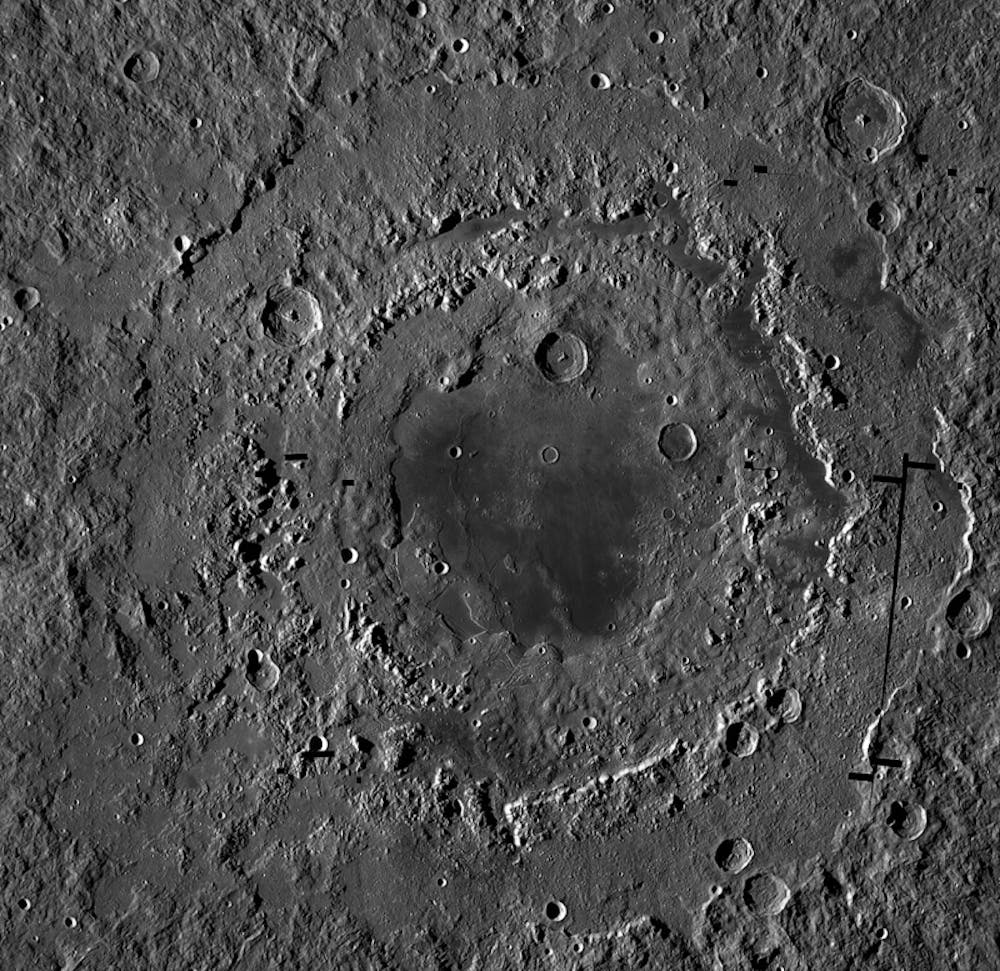
Furthermore, the process yielded scientifically valuable insights. Graduate student William Hartmann, while moving around the globe to take the “rectified” images, noticed that on one edge of the Moon, there was a feature – now known as Mare Orientale – that looked a lot like many of the basins that were well known to telescopic observers. But it had some crucial differences.
For one thing, it had fewer later impact craters within it, suggesting it was younger and better preserved. Furthermore, it had a distinct bull’s-eye appearance, with concentric mountain ranges forming the rings. Hartmann realized that this might have been what all those basins had once looked like, before later impact craters and lava flows smeared out detailed features. And the idea of huge impacts ultimately led Hartmann and others to suggest that the Moon formed as a result of a giant impact on Earth, an idea that is still the basis of the leading theories of the origin of the Moon.
Shaped like a target ring bull’s-eye, the Mare Orientale is one of the most striking large-scale lunar features. Located on the Moon’s extreme western edge, it was formed by the impact of an asteroid-sized object. The collision caused ripples in the lunar crust resulting in the concentric circular features.
But one of the most impressive feats of converting those telescopic images into crucial information for Apollo came from Ewen Whitaker, an unassuming Englishman who had been the only one to respond to Kuiper’s solicitation in 1955. Whitaker moved to America to join Kuiper’s group and moved to Arizona with him.
When the robotic Surveyor 1 spacecraft became the first American mission to make a soft landing on the Moon in 1966, the mission team analyzed the photographs returned and reported where they thought they had landed. But they were wrong. Whitaker used the best telescopic image and compared what hills should be visible in what direction, and suggested the correct location a few miles away.
After Apollo 11 yielded the first successful human landing on the Moon, NASA wanted to use Apollo 12 to prove that it was possible to precisely target a specific location, based just on latitude and longitude. But you have to know the latitude and longitude of some location with precision.
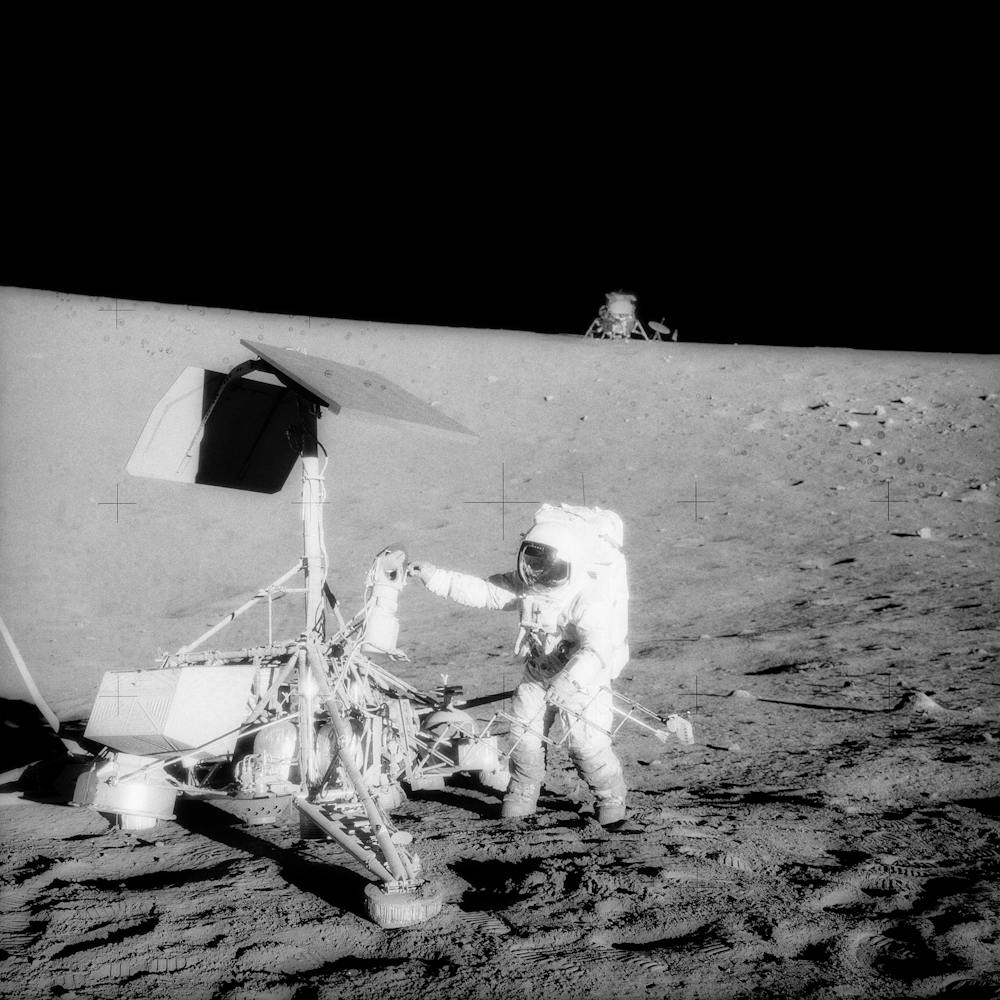
NASA tasked Whitaker with finding exactly where another unmanned Surveyor mission, Surveyor 3, had landed. Whitaker gave his best estimate, and Apollo 12 aimed for it. The astronauts could not see Surveyor 3 on the way in, because it was in shadow. When they looked around after they landed, they found that they were within walking distance, after a journey of 240,000 miles.
Apollo 12 astronaut Pete Conrad examining Surveyor 3, with the Apollo 12 lander in the background.
The maps of the Moon that were created at the Lunar and Planetary Laboratory have long since been surpassed, and those best-ever photographs of the lunar surface aren’t nearly as good as those of taken by more recent orbiters. But the organization that Kuiper started continues to explore. For more than a decade, spacecraft landing on Mars have utilized images taken from orbit by HiRISE (High-Resolution Imaging Science Experiment), operated out of the Lunar and Planetary Laboratory, to select their landing sites. At the moment, the OSIRIS-REx robotic spacecraft, also directed out of the Lunar and Planetary Laboratory, is maneuvering close to the asteroid Bennu, sometimes within a few hundred meters of the surface, making maps in search of a place to grab a sample to bring back to Earth.
After that sample is returned, no doubt scientists will analyze it for decades in the future, just as we are still analyzing the samples returned by the Apollo missions. It is the touchdowns and the samples that we remember, but it is the maps that come first.
Extraterrestrial believers have had enough with restricted access to the so-called Area 51, the infamous government facility in the southern Nevada desert. On Facebook, nearly half a million people signed up to raid Area 51 to "see them aliens” by Friday afternoon.
The description of the Facebook titled "Storm Area 51, They Can't Stop All of Us," event reads:
“We will all meet up at the Area 51 Alien Center tourist attraction and coordinate our entry. If we naruto run, we can move faster than their bullets. Lets see them aliens.”
A "Naruto” run describes a style of running depicted in Japanese graphic novels, where one's arms are stretched backward and hed tilted forward. This event will supposedly take place on Sept. 20 at 3 a.m.
The high-security military or government facility often called Area 51 has been the focus of conspiracy theories for decades. Many people believe it is where the government keeps its secrets about aliens, possibly including the bodies of extraterrestrials or a crashed spacecraft from the "Roswell incident" in 1947. In 2013, the government recognized Area 51 as a military site. Many non-UFO observers believe it's where stealth technology and other Cold War secrets were developed, for example.
Some commenters have said the proposed raid is just a joke, but others seem to be more serious about it asking where attendees should book flights for the event. (Las Vegas would be the nearest city with a major commercial airport.)
The possibility of alien visitors to Earth has been in the news as of late. As reported by CNN in June, a group of senators received a classified briefing about reported encounters between the U.S. Navy and unidentified aircraft.
If military pilots "are reporting flight hazards that interfere with training or put them at risk," Rachel Cohen, the spokeswoman for Sen. Mark Warner, D-Va., told CNN, "then Senator Warner wants answers. It doesn't matter if it's weather balloons, little green men, or something else entirely — we can't ask our pilots to put their lives at risk unnecessarily."
Joseph Gradisher, spokesman for the deputy chief of naval operations for information warfare, confirmed the briefing "with interested congressional members and staffers," which discussed the Navy's "efforts to understand and identify these threats to the safety and security of our aviators."
Will the public storm Area 51 and put an end to all the speculation about whether our planet has been visited by aliens? Probably not — but we'll have to wait two more months to find out.
We've all been there: you're working on something important, your PC crashes, and you lose all your progress.
Such a failure was not an option during the Apollo missions, the first time ever that a computer was entrusted with handling flight control and life support systems -- and therefore the lives of the astronauts on board.
Despite an infamous false alarm during lunar descent that sent Commander Neil Armstrong's heart rate racing, it was a resounding success that laid the groundwork for everything from modern avionics to multitasking operating systems.
Here are some of the ways the Apollo Guidance Computer (AGC), millions of times less powerful than a 2019 smartphone, shaped the world we live in today:
- Microchip revolution -
Smithsonian National Air and Space Museum/AFP / HO Integrated circuits, or microchips, were a necessary part of the miniaturization process that allowed computers to be placed on board spacecraft, in contrast to the giant, power-hungry vacuum tube technology that came before
Integrated circuits, or microchips, were a necessary part of the miniaturization process that allowed computers to be placed on board spacecraft, in contrast to the giant, power-hungry vacuum tube technology that came before.
The credit for their invention goes to Jack Kilby of Texas Instruments, and Robert Noyce, who co-founded Fairchild Semiconductor and later Intel in Mountain View, California.
But NASA and the Department of Defense -- which needed microchips to guide their Minuteman ballistic missiles pointed at the Soviet Union -- greatly accelerated their development by producing the demand that facilitated mass production.
"They had these incredible, absolutely insane requirements for reliability that nobody could possibly imagine," Frank O'Brien, a spaceflight historian and author of "The Apollo Guidance Computer: Architecture and Operation," told AFP.
In the early 1960s, the two agencies bought almost all the microchips made in the US, roughly a million all told, added O'Brien, forcing the makers to improve their designs and build circuits that lasted longer than their early life cycles of just a few hours.
- Multitasking -
Smithsonian National Air and Space Museum/AFP / HO Margaret Hamilton led the team that programmed Apollo's flight computer; their code allowed the machine to prioritize crucial tasks over non-essential ones
Modern computers, such as the smartphone in your pocket, are generally capable of doing a myriad of tasks all at once: handling emails in one window, a GPS map in another, various social network apps, all the while ready for incoming calls and texts.
But in the early era of computers, we thought of them in a fundamentally different way.
"There wasn't a lot they were asked to do. They were asked to crunch numbers and replace humans who would do them on mechanical adding machines," said Seamus Tuohy, the principal director of space systems at Draper, which spun off from the MIT Instrumentation Laboratory that developed the Apollo Guidance Computer.
That all changed with Apollo Guidance Computer, a briefcase-sized machine that needed to juggle an array of vital tasks, from navigating the ship to running its oxygen generator, heaters and carbon dioxide scrubbers.
Instead of a computer operator giving a machine a set of calculations and leaving it for hours or even days to work out the answer -- all of this needed to be done in a time-sensitive fashion, with cut-offs, and the ability for users (astronauts) to give it commands in real time.
NASA felt it required an onboard computer to handle all these functions in case the Soviets tried to jam radio communications between ground control in Houston and US spaceships, and because Apollo was originally conceived to go deeper into the solar system.
All of this required a software "architecture," much of which was designed by engineer Hal Laning.
- Real-time input -
AFP Photo / Issam AHMED "The way that computer handled the overload was a real breakthrough" said Paul Ceruzzi, a Smithsonian Institution scholar on aerospace electronics
It also needed new ways for man to interact with machine that went beyond the punch-card programming of the time.
The engineers came up with three key ways: the switches that you still find in modern cockpits, a hand-controller that was connected to the world's first digital fly-by-wire system, and a "display and keyboard" unit, abbreviated DSKY (pronounced "dis-key").
The astronauts would input two-digit codes for verbs and nouns, to carry out commands like firing thrusters, or locking on to a particular star if the ship, which relied on an inertial guidance system to keep its pitch, roll and yaw stable, had begun to drift off course.
O'Brien used the metaphor of a tourist who visits the US and is hungry but doesn't know much English, and might say "Eat pizza" to convey the basic meaning.
- Passing the test -
Apollo 11's most tense moment came during the final minutes of its descent to the lunar surface, when the computer's alarm bells began ringing and making it seem as though it had crashed.
Such an event could well have been catastrophic, forcing the crew to abort their mission or even sending the vessel spiralling out of control to the surface.
Back in Houston, an engineer realized that while the machine was temporarily overloaded, its clever programming allowed it to automatically shed less important tasks and focus on landing.
"The way that computer handled the overload was a real breakthrough" said Paul Ceruzzi, a Smithsonian Institution scholar on aerospace electronics.
O'Brien noted that while the AGC was puny by modern computing standards, with a clock speed of 1 Mhz and a total of 38Kb of memory, such comparisons belied its true caliber.
"With that terribly small capacity, they were able to do all the amazing things that we now think of as completely normal," he said.
NASA has replaced the head of its human space exploration directorate in a major shake-up, US media reported Wednesday, as the agency scrambles to meet President Donald Trump's ambitious deadline to return astronauts to the moon by 2024.
The project -- named Artemis -- would be the first attempt to return humans to the lunar surface since the last Apollo landing in 1972, but some experts doubt if the deadline is realistic given budgetary constraints and delays in developing the next-generation rockets and equipment needed for the journey.
To meet this "bold challenge", NASA administrator Jim Bridenstine said in an email to employees that Bill Gerstenmaier, head of the agency's Human Exploration and Operations (HEO) missions directorate, has been removed from his position and assigned an advisory role, the Washington Post and other US news outlets.
The widely-respected Gerstenmaier is a NASA veteran who joined the agency in 1977, rising to become one of its top managers, overseeing the space shuttle program and US operations on the International Space Station before becoming head of HEO.
"We, as a nation, are thankful for his service in advancing America's priorities and expanding the limits of science, technology and exploration," Bridenstine wrote of Gerstenmaier in his email, according to CBS News.
Former astronaut Ken Bowersox will be the acting head of the section, according to Bridenstine's email.
The American plan to return humans to the moon -- including the first woman -- is beset with delays and cost overruns, according to an official audit released last month.
The cost of Boeing's giant Space Launch System (SLS) rocket -- at the core of the Artemis project -- has risen by nearly 30 percent to $8 billion, and its already-delayed first flight is unlikely to take place by June 2020 as planned.
Costs for the Orion capsule being built by Lockheed Martin to transport astronauts have also grown.
But Vice President Mike Pence, who announced the accelerated 2024 target in March, has criticized NASA for "bureaucratic inertia" and asked for a new mindset.
Critics have said such tight deadlines may lead to serious risk-taking to save time, including reducing the amount of testing done on rockets.
Bridenstine has described the 2024 deadline as "aggressive" but doable.
Japan's Hayabusa2 probe made a "perfect" touchdown Thursday on a distant asteroid, collecting samples from beneath the surface in an unprecedented mission that could shed light on the origins of the solar system.
"We've collected a part of the solar system's history," project manager Yuichi Tsuda said at a jubilant press conference hours after the successful landing was confirmed.
"We have never gathered sub-surface material from a celestial body further away than the Moon," he added.
"We did it and we succeeded in a world first."
ISAS-JAXA/AFP / Yutaka IIJIMA Officials from Japan's space agency celebrated news of Hayabusa2's successful second touchdown on the asteroid Ryugu
The fridge-sized probe made its second landing on the asteroid around 10:30am (0130GMT), with officials from the Japan Aerospace Exploration Agency (JAXA) breaking into applause and cheers as initial data suggested the touchdown had been a success.
Confirmation of the landing came only after Hayabusa2 lifted back up from the asteroid and resumed communications with the control room.
Research director Takashi Kubota told reporters that the touchdown operation was "more than perfect."
And Tsuda, with a grin, said he rated it "1000 points out of 100."
"The probe moved perfectly and the team's preparation work was perfect," he said.
- Pristine samples -
The brief landing Thursday is the second time Hayabusa2 has touched down on the desolate asteroid Ryugu, some 300 million kilometres (185 million miles) from Earth.
Ryugu, which means "Dragon Palace" in Japanese, refers to a castle at the bottom of the ocean in an ancient Japanese tale.
The complex multi-year Hayabusa2 mission has also involved sending rovers and robots down to the surface.
AFP / Jean Michel CORNU Hayabusa2 space mission
Thursday's touchdown was intended to collect pristine materials from beneath the surface of the asteroid that could provide insights into what the solar system was like at its birth, some 4.6 billion years ago.
To get at those crucial materials, in April an "impactor" was fired from Hayabusa2 towards Ryugu in a risky process that created a crater on the asteroid's surface and stirred up material that had not previously been exposed to the atmosphere.
Hayabusa2's first touchdown was in February, when it landed briefly on Ryugu and fired a bullet into the surface to puff up dust for collection, before blasting back to its holding position.
The second touchdown required special preparations because any problems could mean the probe would lose the precious materials already gathered during its first landing.
- 'The world is watching' -
A photo of the crater taken by Hayabusa2's camera after the April blast showed that parts of the asteroid's surface are covered with materials that are "obviously different" from the rest of the surface, mission manager Makoto Yoshikawa told reporters before the latest touchdown.
JAXA/AFP / JAXA Hayabusa2 has already landed successfully once on the Ryugu asteroid, collecting surface samples
Scientists are hoping the probe will have collected unidentified materials believed to be "ejecta" from the blast after landing briefly in an area some 20 metres away from the centre of the crater.
"It would be safe to say that extremely attractive materials are near the crater," Tsuda said before the landing.
The touchdown is the last major part of Hayabusa2's mission, and when the probe returns to Earth next year to drop off its samples, scientists hope to learn more about the history of the solar system and even the origin of life on Earth.
The Hayabusa2 mission has attracted international attention, with Queen guitarist and astrophysicist Brian May sending a video to the probes team ahead of the landing.
"The world is watching. We love you, take care Hayabusa2," the musician told the team.
Hayabusa2 is the successor to JAXA's first asteroid explorer, Hayabusa -- Japanese for falcon, which returned with dust samples from a smaller, potato-shaped asteroid in 2010.
It was hailed as a scientific triumph despite various setbacks during its epic seven-year odyssey.
The Hayabusa2 mission was launched in December 2014, and has a price tag of around 30 billion yen ($270 million).




 Guangzhou Wolbaki Biotech Co./AFP / Yajun Wang
  Guangzhou Wolbaki Biotech Co./AFP / Yajun Wang
  NASA/JPL-CALTECH/AFP / HO
  NASA/JPL-CALTECH/AFP / HO
  AFP / Robyn Beck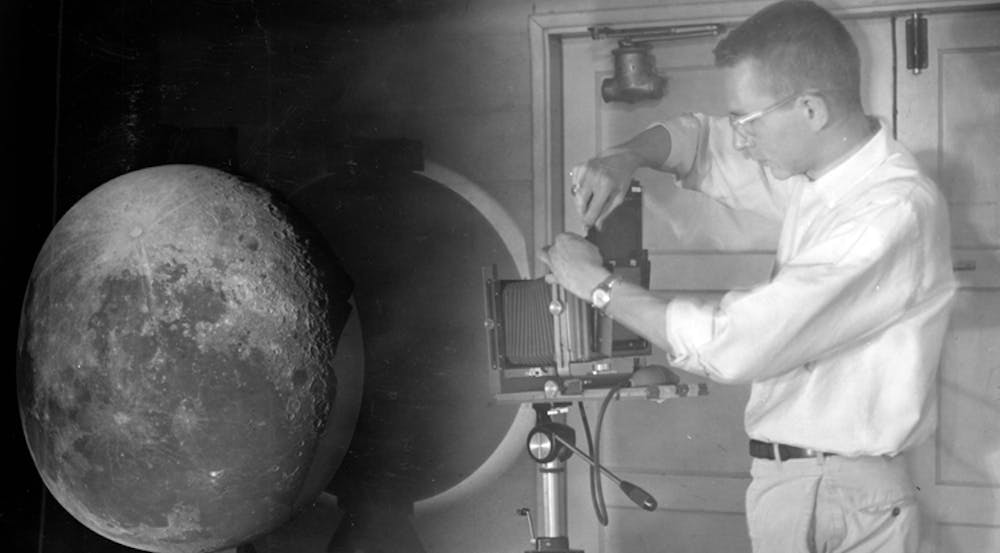

 Smithsonian National Air and Space Museum/AFP / HO
  Smithsonian National Air and Space Museum/AFP / HO
  AFP Photo / Issam AHMED
  ISAS-JAXA/AFP / Yutaka IIJIMA
  AFP / Jean Michel CORNU
  JAXA/AFP / JAXA