New research is in hot pursuit of life's first energy-producing reactions. Image credits Jim Peaco, National Park Service. What's life worth if one can't enjoy a good meal, right? Or, failing that, any meal at all?
Japanese astronaut Norishige Kanai, on a mission to the International Space Station, apologized on Wednesday for saying he had grown 9 cm (3.5 inches) while in space and expressing concern about whether he'd be safe on his return to Earth.
Most astronauts "grow" during protracted space missions because their spines extend in the absence of gravity, but the gains are usually limited to a couple of centimeters (inches) maximum and disappear once they are back on the ground.
The 41-year-old Kanai, who went to space last month for a nearly six-month mission, posted on Twitter on Monday that he had "a big announcement."
"My height's been measured here in space and somehow, somehow, I've grown 9 cm! In only three weeks I've really shot up, something I haven't seen since high school," he tweeted.
"This makes me a little worried that I might not be able to fit in the Soyuz seats for our return."
But a bit over a day later - and in the wake of a flurry of news stories - he apologized, saying that he'd measured himself after his captain raised questions about the apparent growth and he had stretched only 2 cm from his Earth-bound height.
"This mis-measurement appears to have become a big deal, so I must apologize for this terrible fake news," he tweeted, without explaining how the original miscalculation had occurred.
"It appears I can fit on the Soyuz, so I'm relieved."
(Reporting by Elaine Lies; Editing by Michael Perry)
U.S. astronaut John Young, who walked on the moon in 1972 and even smuggled a corned beef sandwich into orbit during a career that made him the only person to fly with three NASA space programs, has died at age 87, officials said on Saturday.
Young, who went to space six times, died on Friday night at his home in Houston following complications from pneumonia, National Aeronautics and Space Administration spokesman Allard Beutel said in an email.
The former U.S. Navy test pilot was the ninth person to set foot on the moon, an experience shared by three others after Young. He eventually became one of the most accomplished astronauts in the history of the U.S. space program.
He flew into space twice during NASA's Gemini program in the mid-1960s, twice on the Apollo lunar missions and twice on space shuttles in the 1980s. He was the only person to fly on all three types of programs.
"Astronaut John Young's storied career spanned three generations of spaceflight. We will stand on his shoulders as we look toward the next human frontier," NASA Administrator Robert Lightfoot said in a statement.
Young, described in a NASA tweet as "our most experienced astronaut," retired in 2004 after 42 years with the U.S. space agency.
The Apollo 16 mission in April 1972, his fourth space flight, took Young to the lunar surface.
As mission commander, he and crewmate Charles Duke explored the moon's Descartes Highlands region, gathering 200 pounds (90 kg) of rock and soil samples and driving more than 16 miles (26 km) in the lunar rover to sites such as Spook Crater.
Recalling his lunar exploits, Young told the Houston Chronicle in 2004: "One-sixth gravity on the surface of the moon is just delightful. It's not like being in zero gravity, you know. You can drop a pencil in zero gravity and look for it for three days. In one-sixth gravity, you just look down and there it is."
Young's first time in space came in 1965 with the Gemini 3 mission that took him and astronaut Gus Grissom into Earth orbit in the first two-person U.S. space jaunt.
It was on this mission that Young pulled his sandwich stunt, which did not make NASA brass happy but certainly pleased Grissom, the recipient of the snack.
Astronaut Wally Schirra, who was not flying on the mission, bought the corned beef sandwich on rye bread from a delicatessen in Cocoa Beach, Florida, and asked Young to give it to Grissom in space. During the flight, as they discussed the food provided for the mission, Young handed Grissom the sandwich.
NASA later rebuked Young for the antics, which generated criticism from lawmakers and the media, but his career did not suffer.
His May 1969 Apollo 10 mission served as a "dress rehearsal" for the historic Apollo 11 mission two months later in which Neil Armstrong became the first person to walk on the moon. Young and his crew undertook each aspect of that subsequent mission except for an actual moon landing.
Young's fifth space mission was as commander of the inaugural flight of NASA's first space shuttle, Columbia, in 1981. He became the first person to fly six space missions in 1983, when he commanded Columbia on the first Spacelab trek, with the crew performing more than 70 scientific experiments.
He never went to space again. Young had been due to command a 1986 flight that was canceled after the explosion of the shuttle Challenger earlier that year.
"John was more than a good friend," former President George H.W. Bush said in a statement. "He was a fearless patriot whose courage and commitment to duty helped our nation push back the horizon of discovery at a critical time."
Young was born on Sept. 24, 1930, in San Francisco and grew up in Orlando, Florida. After receiving a degree in aeronautical engineering from the Georgia Institute of Technology in 1952, he entered the Navy and graduated from its test pilot school. NASA picked him in 1962 for its astronaut program.
(Reporting and writing by Will Dunham; Additional reporting by Alex Dobuzinskis; Editing by Bill Trott and Lisa Von Ahn)
Two passenger jets collided at Pearson International Airport in Toronto on Saturday, creating a fireball that sent passengers scrambling before they were evacuated on emergency slides.
The Washington Post said that 168 passengers were aboard a WestJet Boeing 737 that landed safely from Cancun, but then struck an empty Sunwing jet which workers were towing across the runway.
“There was an audible crunch, and the plane rocked slightly,” said passenger Gustavo Lobo to the Canadian Broadcasting Company (CBC). “Everyone was a little shocked and kind of chuckling at the situation.”
But then passengers noticed a liquid spraying from the wing.
“And then it set in that it’s not steam, it’s gas,” a passenger said to CTV News. “And then the whole thing ignites, and everyone starts panicking.”
"Big fire!" someone said as another voice called for calm, telling passengers, "Remain seated. Remain seated."
"Oh, f*ck me!" said another voice.
"Evacuate, evacuate," said a flight attendant coming down the aisle.
In spite of the record cold, passengers made it safely inside.
Around two hours after the crash, WestJet sent out a tweet that said, “Guests are safely in the terminal and they are in the process of clearing customs.”
Watch videos, embedded below via The Washington Post:
So many buddies are going to show up in your GI tract. Mmmmm, poop. DepositPhotoshttps://depositphotos.com/149698760/stock-photo-woman-drinking-water.html) Do you ever feel like your drinking water is just too clean?
Dr. Bandy Lee -- the Yale School of Medicine forensic psychiatrist who briefed Congress on the possibility that President Donald Trump is dangerously mentally ill -- pushed back on Friday against charges that she is acting outside her purview by discussing the mental health of a person she has not personally treated.
Lee told Vox that Trump is now in accelerating mental health crisis that intensified with special counsel Robert Mueller's indictments of former Trump 2016 campaign manager Paul Manafort and his aide Rick Gates as well as guilty pleas from former foreign policy adviser George Papadopoulos and ousted national security adviser Mike Flynn.
Trump received a certain measure of flattery and deference on his Asia trip, Lee said, which would be soothing to his constant need for flattery and reassurance. That however, "made him more volatile when he returned."
"When he returned and faced the progress of the special counsel’s investigation, he became more paranoid, returning to conspiracy theories that he had let go of for a while. He seemed to further lose his grip on reality by denying his own voice on the Access Hollywood tapes," she said.
Lee -- who has based her decades of work in the study of violence prediction and prevention -- said that Trump's recent behavior is predictive of violence.
"(T)he sheer frequency of his tweets seemed to reflect the frantic state of mind he was entering, and his retweeting some violent anti-Muslim videos showed a concerning attraction to violence. And then there were the belligerent nuclear threats this week," she explained.
A potential nuclear holocaust isn't the only imminent threat posed by an unstable president, Lee said. He could start conflict on many levels with a number of countries, further alienate U.S. allies or spark civil conflict in the U.S. by "laying a foundation for a violent culture that could give way to epidemics of violence."
This is an emergency situation, Lee stressed, and professionals faced with dangerous individuals and emergencies are not diagnosing the threatening individual, but taking protective action.
"We are assessing dangerousness, not making a diagnosis. The two are quite separate: Assessing dangerousness is making a judgment about the situation, not the person. The same person may not be dangerous in a different situation, for example. And it is his threat to public health, not his personal affairs, that is our concern," she told Vox.
"Also, once you declare danger, you are calling first for containment and removal of weapons from the person and, second, for a full evaluation -- which may then yield diagnoses," Lee explained.
With regards to Trump's willingness to undergo psychiatric evaluation, Lee said that mental health professionals are accustomed to the dilemma posed by patients who most urgently need intervention but are the least willing to accept help.
"That is the reason why in all 50 states we have not only the legal authority, but often the legal obligation, to contain someone even against their will when it’s an emergency," she said.
"So in an emergency, neither consent nor confidentiality requirements hold. Safety comes first. What we do in the case of danger is we contain the person, we remove them from access to weapons, and we do an urgent evaluation," she said, adding, "This is what we have been calling for with the president based on basic medical standards of care."
New Scientist magazine has called 2018 "The Year of the Flu" because this year's influenza outbreak is showing signs of being the most lethal and severe since the 1918 "Great Influenza" pandemic that infected a third of the world's population and killed between 20 and 50 million people.
People can acquire immunity to flu strains through contracting the virus or receiving a flu shot, but the virus is constantly mutating and multiple strains often circulate simultaneously. Strains of influenza are categorized by two letters, 'H' and 'N," which stand for hemagglutinin and neuraminidase, two proteins in the surface structure of the virus.
New Scientist's Deborah MacKenzie wrote, "A record number of flu strains are currently circulating, two in the influenza B group and two influenza A strains, H1N1 and H3N2. H3N2 is the real problem. Our strongest immunity is to the first kind of flu we caught. Between 1918 and 1968, no H3N2 viruses circulated as winter flu, so people born before 1968 have weaker immunity to it."
Four times as many deaths occur in flu seasons dominated by H3N2, says the National Institute of Health (NIH) and elderly people are typically among the most vulnerable.
"This year’s H3N2 seems to be especially severe: in Australia in the winter just past, it caused more than three-quarters of all flu cases (see diagram)," MacKenzie said, "and more than 2.5 times more people than usual sought medical help. The likelihood of dying was relatively high, with most deaths among elderly people -- although not all."
The 1918 flu pandemic killed healthy adults as well as the elderly and very young. A pandemic is when a virus emerges that isn't the normal variation of the previous year's mutation, but a completely novel mutation against which the broad population has no immunity.
"In 1918, many people over 71 were also protected, since a related winter virus seems to have circulated before 1847," MacKenzie wrote. "But the Spanish flu was a bird flu that learned to transmit between mammals, and was equipped with fast gene-replicating enzymes that were adapted well to birds, but deadly in mammals. Young adults especially died in droves."
The 1918 flu killed its victims via their own bodies' attempts to defend against it. Patients drowned when their lungs filled with blood and other fluids as their systems frantically tried to fight off the invading virus.
Victims' lungs would become so degraded that air would escape into their other tissues, causing syndromes called pneumomediastin and subcutaneous emphysema. Nurses named the syndrome "Rice Krispie skin" because the bubbles of trapped gas under the skin would raise blisters in the flesh that crackled when patients were moved.
Scientists are still struggling to understand what makes some flu viruses more lethal than others. The key seems to be a combination of the virus' own built-in weaponry and our immune system's ability to recognize the virus as a threat and take action against it.
Derek Smith at the University of Cambridge told New Scientist that this year's H3N2 -- nicknamed the "Aussie flu" -- strain could be taking advantage of both.
Fortunately, the Aussie flu -- while highly infective and severe -- is not expected to be as lethal as the 1918 pandemic, but it could be enough to wake the world to the threat posed by a disease that most people think of as an inconvenience, not a lethal threat.
MacKenzie said, "The real problem, say epidemiologists, is that flu is so familiar. It can be mild -- except when it isn’t. Until we recognize flu for the killer it is, we won’t do better at stopping it."
Every winter, local governments across the United States apply millions of tons of road salt to keep streets navigable during snow and ice storms. Runoff from melting snow carries road salt into streams and lakes, and causes many bodies of water to have extraordinarily high salinity.
At Rensselaer Polytechnic Institute, my colleague Rick Relyea and his lab are working to quantify how increases in salinity affect ecosystems. Not surprisingly, they have found that high salinity has negative impacts on many species. They have also discovered that some species have the ability to cope with these increases in salinity.
But this ability comes at a price. In a recent study, Rick and I analyzed how a common species of zooplankton, Daphniapulex, adapts to increasing levels of road salt. We found that this exposure affected an important biological rhythm: The circadian clock, which may govern Daphnia‘s feeding and predation avoidance behaviors. Since many fish prey on Daphnia, this effect could have ripples throughout entire ecosystems. Our work also raises questions about whether salt, or other environmental pollutants, could have similar impacts on the human circadian clock.
Daily biological rhythms and the circadian clock
In studying how road salt affects aquatic ecosystems, the Relyea lab showed that Daphniapulex can adapt to handle moderate exposures in as little as two and a half months. These levels ranged from 15 milligrams of chloride (a building block of salt) per liter of water to a high of 1,000 milligrams per liter – a level found in highly contaminated lakes in North America.
However, an organism’s ability to adapt to something in its environment can also be accompanied by negative trade-offs. My lab’s collaboration with Rick’s began in an effort to identify these trade-offs in salt-adapted Daphnia.
In my lab, we study how our circadian rhythms allow us to keep track of time. We investigate how the molecules in our cells work together to tick like a clock. These circadian rhythms allow an organism to anticipate 24-hour oscillations in its environment, such as changes from light (daytime) to dark (nighttime), and are essential to an organism’s fitness.
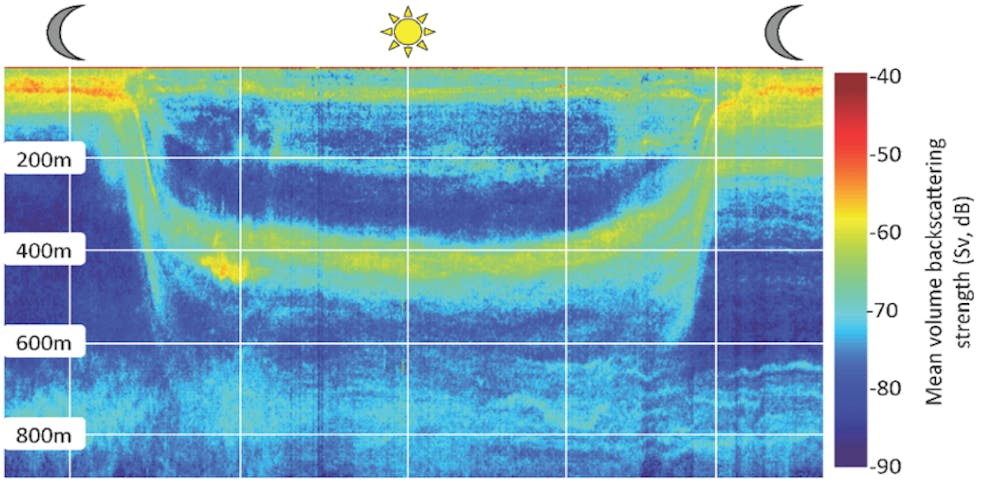
Rick and I hypothesized that adaptation to high salinity could disrupt Daphnia’s circadian rhythms based on recent evidence showing that other environmental contaminants can disrupt circadian behavior. One important behavior in Daphnia that may be controlled by the circadian clock is the diel vertical migration – the largest daily biomass migration on Earth, which occurs in oceans, bays and lakes. Plankton and fish migrate down to deeper water during the day to avoid predators and sun damage, and back up toward the surface at night to feed.
Echogram illustrating the ascending and descending phases of diel vertical migration, in which organisms ascend and descend through the water column. The color scale reflects acoustic scattering by concentrations of organisms at different depths. (DEEP SEARCH - BOEM, USGS, NOAA)
Given what we know about circadian function, it would be logical to assume that exposure to pollution would not affect an organism’s circadian rhythms. While circadian clocks can incorporate environmental information to tell the time of day, they are heavily buffered against most environmental effects.
To understand the importance of this buffering, imagine that the timing of an organism’s day length responded to environmental temperature. Heat speeds up molecular reactions, so on hot days the organism’s 24-hour rhythm could become 20 hours, and on cold days it might become 28 hours. In essence, the organism would have a thermometer, not a clock.
Adaptation to pollution affects key circadian genes
To determine whether clock disruption is a trade-off to pollutant adaptation, we first had to establish that Daphnia is governed by a circadian clock. To do this, we identified genes in Daphnia that are similar to two genes, known as period and clock, in an organism that serves as a circadian model system: Drosophila melanogaster, the common fruit fly.
We tracked the levels of period and clock in Daphnia, keeping the organisms in constant darkness to ensure that a light stimulus did not affect these levels. Our data showed that the levels of period and clock varied over time with a 24-hour rhythm – a clear indication that Daphnia have a functional circadian clock.
We also tracked the same genes in populations of Daphnia that had adapted to increased salinity. Much to my surprise, we discovered that the daily variation of period and clock levels deteriorated directly with the level of salinity the Daphnia were adapted to. In other words, as Daphnia adapted to higher salinity levels, they showed less variation in the levels of period and clock over the day. This demonstrated that Daphnia’s clock is indeed affected by pollutant exposure.
Daphnia and other plankton are among the most abundant organisms on Earth and play critical ecological roles.
We currently don’t understand what causes this effect, but the relationship between salinity levels and decreased variation in the levels of period and clock offers a clue. We know that exposure to pollutants causes Daphnia to undergo epigenetic regulation – chemical changes that affect the function of their genes, without altering their DNA. And epigenetic changes often show a gradual response, becoming more pronounced as the causal factor increases. Therefore, it is likely that high salinity is inducing chemical changes through these epigenetic mechanisms in Daphnia to suppress the function of its circadian clock.
The broad effects of circadian clock disruptions
We know that environmental conditions can affect what the clock regulates in many species. For example, changing the sugar that the fungus Neurospora crassa grows on changes which behaviors the clock regulates. But to our knowledge, this study is the first to show that genes of an organism’s core clock can be directly impacted by adapting to an environmental contaminant. Our finding suggests that just as the gears of a mechanical clock can rust over time, the circadian clock can be permanently impacted by environmental exposure.
This research has important implications. First, if Daphnia’s circadian clock regulates its participation in the diel vertical migration, then disrupting the clock could mean that Daphnia do not migrate in the water column. Daphnia are key consumers of algae and a food source for many fish, so disrupting their circadian rhythms could affect entire ecosystems.
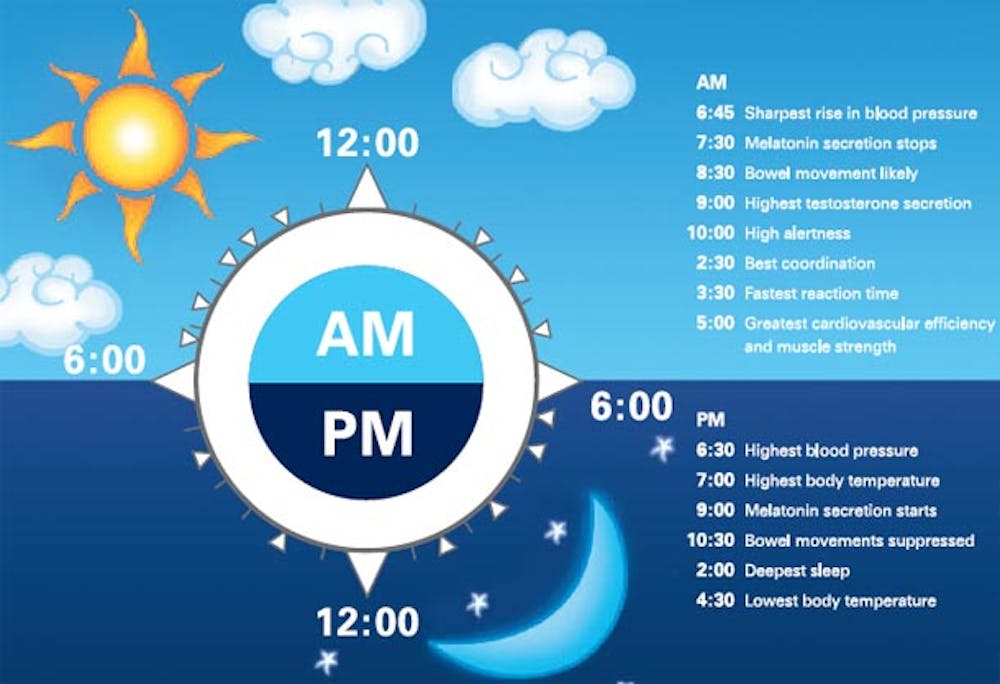
Second, our findings indicate that environmental pollution may have broader effects on humans than previously understood. The genes and processes in Daphnia’s clock are very similar to those that regulate the clock in humans. Our circadian rhythms control genes that create cellular oscillations affecting cell function, division and growth, along with physiological parameters such as body temperature and immune responses.
The human circadian clock regulates the cycles of many bodily functions. (NIH)
We are continuing our work by studying how the disruption of Daphnia’s clock affects its participation in the diel vertical migration. We are also working to determine the underlying causes of these changes, to establish whether and how this could happen in the human brain. The impacts we have found in Daphnia show that even a simple substance such as salt can have extremely complex effects on living organisms.
More than a dozen people have already died from the cold weather that is freezing the lower United States.
As of Tuesday evening, the Weather Channel put the deaths at 12, but overnight that number increased. One elderly woman from Detroit was found by the custodian shoveling snow at a school, WXYZ reported.
Police say that the 96-year-old woman lived alone and seemed to have wandered away from her house. She was dressed only in a nightgown, robe and slippers. The family told police she had just been diagnosed with dementia. Temperatures in Detroit overnight were in the single digits with wind chills below zero.
Each year, the cold claims more deaths than heat waves, the CDC reported in 2016. According to the study, older people are more susceptible to succumb to extreme temperature variations than younger people. Income is also a factor in weather deaths. The Washington Postcited the analysis, finding “weather-related death rates were two to seven times as high in low-income counties as in high-income counties.”
Homeless people living on the streets might be bundled up, but hypothermia can set in after prolonged exposure. Poorer families also face dangers if they live without temperature-regulating luxurious like insulation or heat.
[caption id="attachment_1190754" align="aligncenter" width="445"] Weather related deaths (Data via CDC - chart via Washington Post)[/caption]
Call it whatever you like — a blue red moon, a purple moon, a blood moon — but the moon will be a special sight on Jan. 31. Three separate celestial events will occur simultaneously that night, resulting in what some are calling a super blue blood moon eclipse.
Here are seven terrifying things about this storm, including maps and projections that should warn you to bundle up over the next several days:
1. What is a bomb cyclone?
The term “bomb cyclone” is new to meteorological terminology, though phrases like "polar vortex" have been used in previous years. If the storm continues to develop as scientists expect it will, it's worth the impending doom weather experts are warning of. After a series of snow storms, temperatures are expected to plummet Thursday in record-setting freezes. The atmospheric pressure is also expected to drop Thursday in a way that has scientists glued to satellite data.
"It will be massive," National Weather Service meteorologist Ryan Maue warned on Twitter Tuesday.
“This is not record-breaking for Canada or Alaska or northern Siberia, it’s just misplaced,” said Judah Cohen, a winter storm expert for Atmospheric Environmental Research. He's forecasting a colder than normal winter for much of the U.S.
3. The pressure is expected to fall incredibly fast.
In the popular natural disaster film "The Day After Tomorrow," the eye of a freezing hurricane-like storm causes the temperatures to fall so quickly an American flag froze blowing in the wind. The atmospheric pressure isn’t expected to drop quite that quickly, but the Washington Post’s “Capital Weather Gang” believes the storm will undergo “explosive strengthening.”
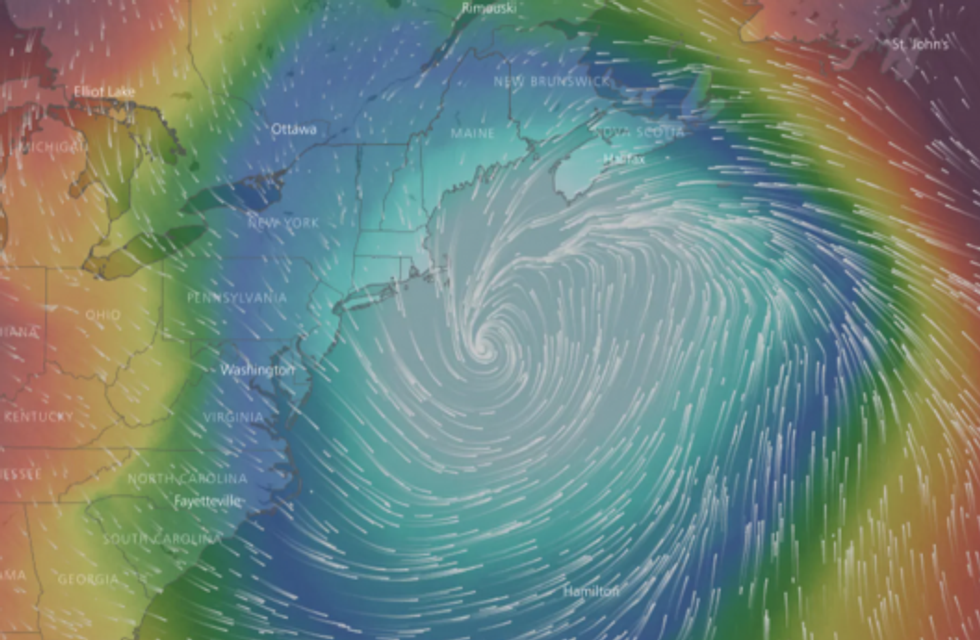
4. It looks like a frozen hurricane:
[caption id="attachment_1190419" align="aligncenter" width="528"] Pressure and wind visualization of storm off the coast of New England on Thursday. (WindyTV.com)[/caption]
The National Weather Service has already posted a winter storm up the coast of Florida. It'll continue it's path up the east coast like a kind of frozen hurricane
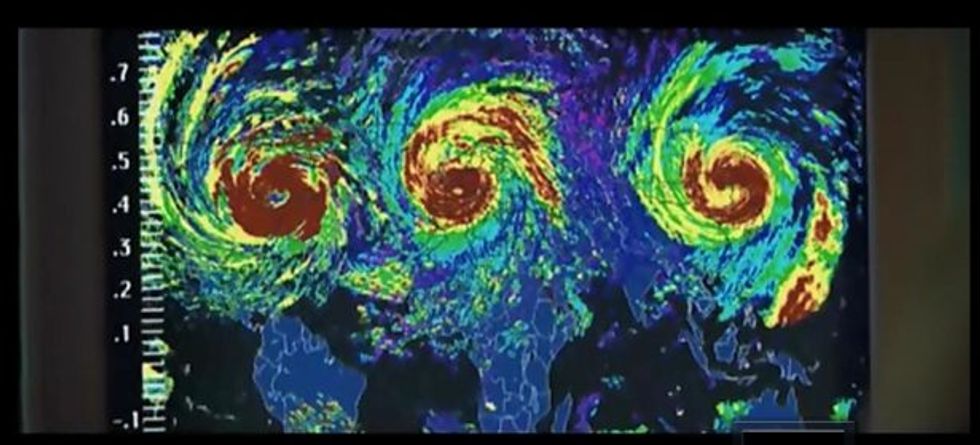
Also like something out of "The Day After Tomorrow," this polar vortex looks remarkably similar to the fictional one that ushered in a new Ice Age.
[caption id="attachment_1190674" align="aligncenter" width="615"] Fake weather map from the film "The Day After Tomorrow" (Photo: Screen capture)[/caption]
5. This is the first winter storm warning issued by the National Weather Service office in Tallahassee in four years.
According to the Weather Channel, the NWS in Tallahasse had to issue a winter storm warning for the first time in four years. The last time was Winter Storm Leon, which produced ice and snow all over the southeastern United States. It caused a travel nightmare in Atlanta and across Florida and Alabama.
6. An ice storm is expected into northern Florida.
In an area of the country that doesn't see severe winter weather, things like snow plows or snow blowers aren't a staple for municipalities. So, when they get dumped on with snow, it will cause massive infrastructure problems. Roads won't be plowed with the speed seen in places like Ohio or Michigan.
North Koreans attending Pyongyang's ice sculpture festival have been treated to a chilling glimpse of the country's latest weaponry -- an ICBM in frozen form. The official Rodong Sinmun newspaper ran a report on Wednesday showing smiling spectators dressed in thick winter coats posing in front of the replica on New Year's Eve, waving cameras and smartphones to grab a shot.
Too much screening has misled us about real cancer risk factors, experts say
The best-known downside of cancer screening, such as PSA tests for prostate cancer and mammograms for breast cancer, is that they often flag cancers that pose no risk, leading to overdiagnosis and unnecessary, even harmful, treatment.




 We are continuing our work by studying how the disruption of Daphnia’s clock affects its participation in the diel vertical migration. We are also working to determine the underlying causes of these changes, to establish whether and how this could happen in the human brain. The impacts we have found in Daphnia show that even a simple substance such as salt can have extremely complex effects on living organisms.
 Weather related deaths (Data via CDC - chart via
  Pressure and wind visualization of storm off the coast of New England on Thursday. (WindyTV.com)[/caption]
 Fake weather map from the film "The Day After Tomorrow" (Photo: Screen capture)[/caption]
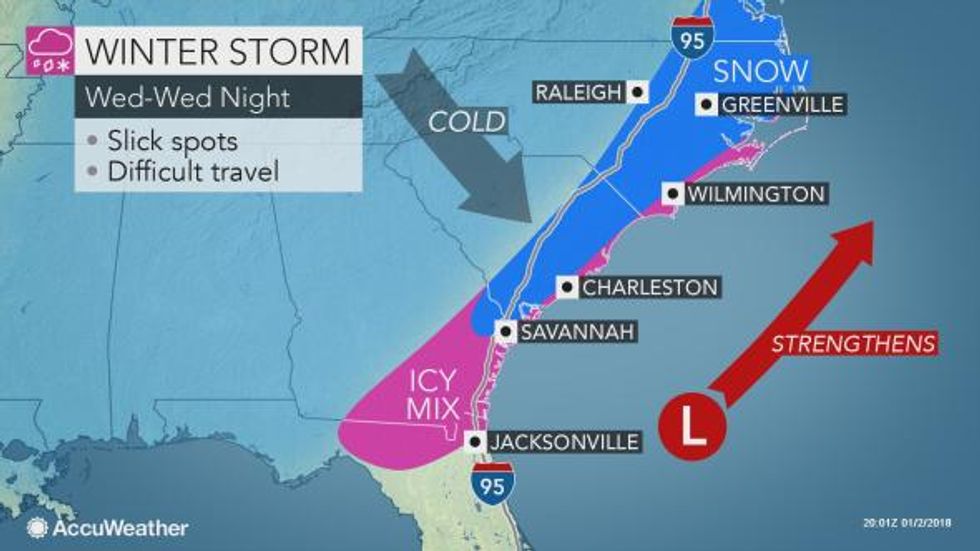 Polar vortex predictions for 2018 (Photo: AccuWeather map screen capture)[/caption]
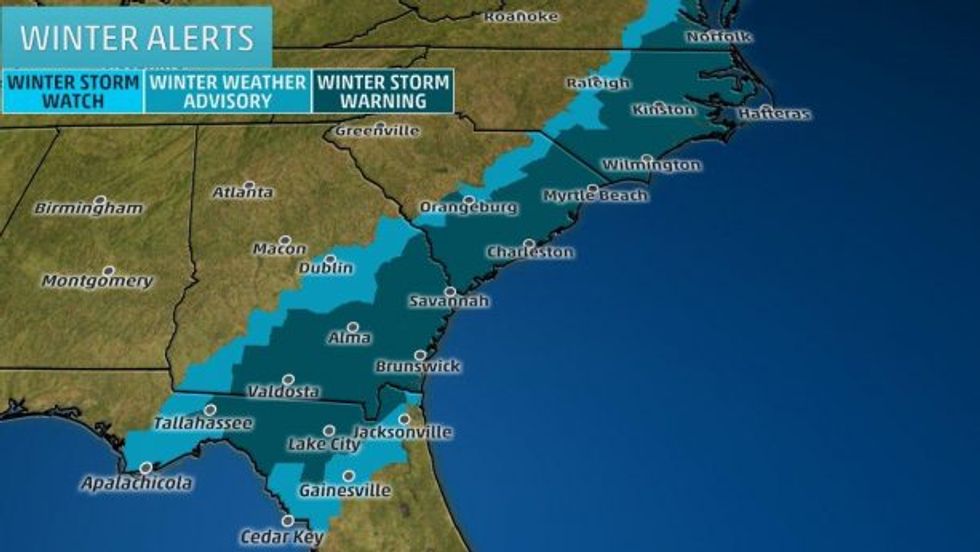 (Photo: Weather channel screen capture)[/caption]