Five people have been stricken with the rare, rodent-borne hantavirus illness in Washington state since February, three of whom have died, in the state's worst outbreak of the disease in at least 18 years, public health officials reported on Thursday.
The three fatal cases also mark the highest death toll from hantavirus pulmonary syndrome in Washington state during a single year since the respiratory ailment was first identified in the "Four Corners" region of the U.S. Southwest in 1993.
The disease has been found to be transmitted to humans from deer mice, either through contact with urine, droppings, saliva or nesting materials of infected rodents or by inhaling dust contaminated with the virus.
Victims in the latest outbreak were men and women ranging in age from their 20s to their 50s from four counties across the state, said David Johnson, spokesman for the Washington State Department of Health.
The first diagnosed case this year was in February and the most recent was last month, when the infection killed a resident of Spokane County in the eastern part of the state near Washington's border with Idaho. Three of the five cases, including another one that proved fatal, were confirmed in the Puget Sound region of King and Skagit counties.
The only common factor among those infected by the disease, which typically kills more than a third of its victims, is that they were all exposed to infected mice, Johnson said.
The last time five confirmed hantavirus cases were diagnosed in Washington state in a single year was in 1999, although just one of those proved fatal, Johnson said.
Washington has reported 49 of the 690 hantavirus cases tallied nationwide from 1993 to January 2016, ranking fifth among 10 Western states that account for the bulk of all documented infections, according to the federal Centers for Disease Control and Prevention (CDC) in Atlanta.
Eighteen infections with four deaths were reported nationally in 2015. The year before, the CDC counted 35 cases, of which 14 were fatal.
The most highly publicized hantavirus outbreak occurred in 2012, when 10 visitors to Yosemite National Park in California were diagnosed with the infection, three of whom died, prompting a worldwide alert. All but one of those were linked to tent cabins later found to have been infested by deer mice.
The ocean didn't break it down— it only made it stronger. A microscopic image of concrete. C-A-S-H stands for the calcium-aluminum-silicate-hydrate material that forms when volcanic ash, lime, and seawater mix. The platy crystals in between the C-A-S-H are Al-tobermorite, a mineral that has grown in between the components here. Courtesy Marie Jackson. What have the…
We're getting our closest view ever of the 10,000-mile-wide storm. On July 10, the Juno spacecraft will get close enough to peer beneath the veneer of Jupiter's Great Red Spot. NASA Humankind has been ogling Jupiter’s Great Red Spot through our telescopes for more than 300 years. The Voyager and Galileo missions brought us closer to…
Praying mantises are fearsome predators in the world of insects. They have heads that turn 180 degrees, quick reflexes, and powerful raptorial legs. And of course, there's that that the females often kill the males during or after mating. It turns out that praying mantises are even more ferocious than we thought and they eat small…
By Richard B. Rood, Professor of Climate and Space Sciences and Engineering, University of Michigan. Best-case scenario, how much are we locked into? Kletr/Shutterstock.com Earth’s climate is changing rapidly. We know this from billions of observations, documented in thousands of journal papers and texts and summarized every few years by the United Nations’ Intergovernmental Panel on…
Hurricane forecasters are warning of potentially catastrophic destruction – from the budget of President Donald Trump, as an Atlantic storm is likely to form into .
"President Donald Trump proposes to cut $250 million from the National Oceanic and Atmospheric Administration, which oversees the National Weather Service," the New Orleans Times-Pacayune reports. "Although the 2018 budget blue book for NOAA states the proposal prioritizes the need for 'timely and accurate' weather forecasts, some warn that the cuts could could reduce important operations that help meteorologists study weather systems."
"It's hanging on really by a thread in terms of funding," chief hurricane forecaster James Franklin told the AP. Franklin retired June 30 after a 35-year career with NOAA, the National Oceanic and Atmospheric Administration.
Meanwhile, an Atlantic storm is threatening to organize into a tropical storm. If the low-pressure system continues to develop, it would be named Tropical Storm Don and then, even Hurricane Don.
"AccuWeather CEO Barry Myers has been named as a frontrunner for the position of NOAA administrator in Trump's administration, and the company has at times butted heads with the weather service over competitive issues," the Time-Pacayune reminded.
Mounting evidence suggests that the richer and more diverse the community of microbes in your gut the lower your risk of disease. Diet is key to maintaining diversity and was strikingly demonstrated when an undergrad student went on a McDonald’s diet for ten days and after just four days experienced a significant drop in the number of beneficial microbes.
Similar results have been demonstrated in a number of larger human and animal studies.
Your gut microbiome is a vast community of trillions of bacteria that has a major influence on your metabolism, immune system and mood. These bacteria and fungi inhabit every nook and cranny of your gastrointestinal tract, with most of this 1kg to 2kg “microbe organ” sited in your colon (the main bit of your large intestine).
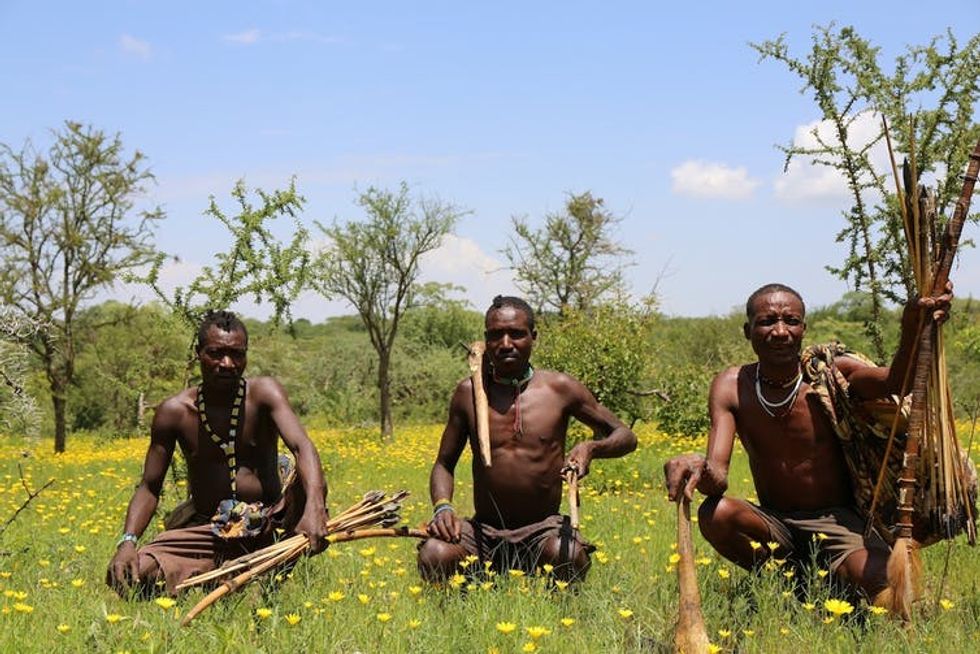
We tend to see the biggest diet-related shifts in microbes in people who are unhealthy with a low-diversity unstable microbiome. What we didn’t know is whether a healthy stable gut microbiome could be improved in just a few days. The chance to test this in an unusual way came when my colleague Jeff Leach invited me on a field trip to Tanzania, where he has been living and working among the Hadza, one of the last remaining hunter-gatherer groups in all of Africa.
Hadza hunters. (Jeff Leach, Author provided)
My microbiome is pretty healthy nowadays and, among the first hundred samples we tested as part of the MapMyGut project, I had the best gut diversity – our best overall measure of gut health, reflecting the number and richness of different species. High diversity is associated with a low risk of obesity and many diseases. The Hadza have a diversity that is one of the richest on the planet.
The research plan was devised by Jeff who suggested I should have an intensive three days of eating like a hunter gatherer during my stay at his research camp. I would measure my gut microbes before heading to Tanzania, during my stay with the Hadza, and after my return to the UK. I was also not allowed to wash or use alcohol swabs and I was expected to hunt and forage with the Hadza as much as possible – including coming in contact with the odd Hadza baby and baboon poo lying about.
To help us record the trip I was accompanied by Dan Saladino, the intrepid presenter and producer of BBC Radio 4’s The Food Programme, who was preparing a Hadza microbe special.
After a long tiring flight to Mount Kilimanjaro Airport in Tanzania, we stayed overnight in Arusha, a city in the north of the country. Before setting off the next morning, I produced my baseline poo sample.
After an eight-hour journey in a Land Rover over bumpy tracks, we arrived. Jeff beckoned us to the top of a huge rock to witness the most amazing sunset over Lake Eyasi. Here, within a stones throw of the famous fossil site of Olduvai Gorge and with the stunning plains of the Serengeti in the distance, Jeff explained that we were never going to be closer to home as a member of the genus Homo, than where we were standing at that moment.
The million-year-old diet
The Hadza seek out the same animals and plants that humans have hunted and gathered for millions of years. Importantly, the human-microbe tango that played out here for aeons probably shaped aspects of our immune system and made us who we are today. The significance of being in Hadza-land was not lost on me.
Unlike the Hadza, who sleep around the fire or in grass huts, I was given a tent and told to zip it up tight as there were scorpions and snakes about. I had to be careful where I stepped if I needed a nocturnal pee. After an interesting but restless night’s sleep, a large pile of baobab pods had been collected for my breakfast.
The baobab fruit is the staple of the Hadza diet, packed with vitamins, fat in the seeds, and, of course, significant amounts of fibre. We were surrounded by baobab trees stretching in the distance as far as I could see. Baobab fruit have a hard coconut-like shell that cracks easily to reveal a chalky flesh around a large, fat-rich seed. The high levels of vitamin C provided an unexpected citrus tang.
The Hadza mixed the chalky bits with water and whisked it vigorously for two to three minutes with a stick until it was a thick, milky porridge that was filtered – somewhat – into a mug for my breakfast. It was surprisingly pleasant and refreshing. As I wasn’t sure what else I would be eating on my first day, I drank two mugs and suddenly felt very full.
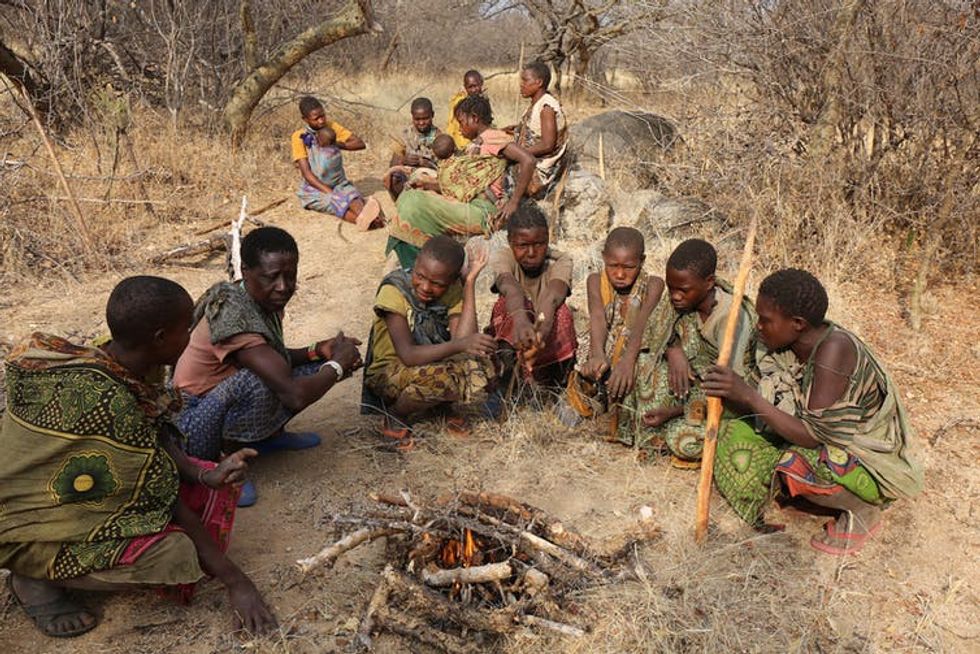
My next snacks were the wild berries on many of the trees surrounding the camp – the commonest were small Kongorobi berries. These refreshing and slightly sweet berries have 20 times the fibre and polyphenols compared with cultivated berries – powerful fuel for my gut microbiome. I had a late lunch of a few high-fibre tubers dug up with a sharp stick by the female foragers and tossed on the fire. These were more effort to eat - like tough, earthy celery. I didn’t go for seconds or feel hungry, probably because of my high-fibre breakfast. No one seemed concerned about dinner.
Hadza women lightly roasting starch and fibre-rich //ekwa tubers. (Jeff Leach, Author provided)
A few hours later we were asked to join a hunting party to track down porcupine – a rare delicacy. Even Jeff hadn’t tasted this creature in his four years of field work.
Two 20kg nocturnal porcupines had been tracked to their tunnel system in a termite mound. After several hours of digging and tunnelling – carefully avoiding the razor-sharp spines – two porcupines were eventually speared and thrown to the surface. A fire was lit. The spines, skin and valuable organs were expertly dissected and the heart, lung and liver cooked and eaten straight away.
Hadza hunter walking back to camp with a dispatched porcupine flung over his shoulder. (Jeff Leach, Author provided)
The rest of the fatty carcass was taken back to camp for communal eating. It tasted much like suckling pig. We had a similar menu the next two days, with the main dishes including hyrax – a strange furry guinea-pig-like hoofed animal, weighing about 4kg – a relative of the elephant, of all creatures.
Harvested high from a baobab tree, our dessert was the best golden orange honey I could ever imagine – with the bonus of honeycomb full of fat and protein from the larvae. The combination of fat and sugars made our dessert the most energy-dense food found anywhere in nature and may have competed with fire in terms of its evolutionary importance.
In Hadza-land nothing is wasted or killed unnecessarily, but they eat an amazing variety of plant and animal species (around 600, most of which are birds) compared with us in the West. My other lasting impression was how little time they spent getting food. It appeared as though it took just a few hours a day – as simple as going round a large supermarket. Any direction you walked there was food – above, on and below ground.
Massive increase in microbiome diversity
Twenty-four hours later Dan and I were back in London, him with his precious audio tapes and me with my cherished poo samples. After producing a few more, I sent them to the lab for testing.
The results showed clear differences between my starting sample and after three days of my forager diet. The good news was my gut microbal diversity increased a stunning 20%, including some totally novel African microbes, such as those of the phylum Synergistetes.
The bad news was, after a few days, my gut microbes had virtually returned to where they were before the trip. But we had learnt something important. However good your diet and gut health, it is not nearly as good as our ancestors’. Everyone should make the effort to improve their gut health by re-wilding their diet and lifestyle. Being more adventurous in your normal cuisine plus reconnecting with nature and its associated microbial life, may be what we all need.
What’s it going to take to win American independence from dirty energy?
The Fourth of July seems like a good time to ask — especially as we celebrate the first Independence Day under an administration whose motto might as well be “Make America Suck Coal Again.” (Now watch, Trump will put that on a hat.)
But beyond that, it’s also a good time to ask because of a … let’s just call it a spirited debate that recently broke out between two groups of scientists who work on climate and energy. Both want to see the United States fight climate change, ditch polluting fossil fuels, and ramp up renewables. But there’s a bitter disagreement between them over how it can happen.
The whole thing started in 2015, when Stanford professor Mark Jacobson and some colleagues published a paper arguing that, by mid-century, the United States could be powered entirely by clean energy sources — and by clean, he meant the really clean stuff (wind, solar, hydropower), not the only-somewhat-cleaner-than-coal stuff like natural gas, nuclear energy, and biofuels.
As you can imagine, that got the kind of folks who get excited about clean energy pretty excited. (Bernie Sanders, Mark Ruffalo, big green groups, Grist vet David Roberts. And we were no exception — our editors put Jacobson on the inaugural Grist 50 list of game changers and planet savers.) Better still, Jacobson’s blueprint started to inform policy discussions, with serious people taking the idea of 100 percent renewables pretty seriously.
Still, it’s a long way to go in a relatively short period of time (add up wind, solar, and hydro, and it’s currently just 13 percent of the U.S. energy supply). Many experts sweated the details of the sunny picture that Jacobson and his colleagues presented.
Last month, they did it with the scientific equivalent of a switchblade. Twenty-plus researchers published a study in the Proceedings of the National Academy of Sciences arguing that Jacobson’s original paper (published in the same journal — ouch) “used invalid modeling tools, contained modeling errors, and made implausible and inadequately supported assumptions.”
Those are fighting words for research-types, and Jacobson struck back, which elicited yet another reply. The whole thing probably looked pretty bad to outsiders. In fact, to anyone not enmeshed in the details, it probably looked like a fight over whether it’s even possible to convert the entire United States to clean energy and combat climate change.
Except it wasn’t. Regardless of whether Jacobson took some shortcuts on his road map, both sides agreed that the goal of weaning ourselves off fossil fuels and shutting off greenhouse gas emissions is possible. The question is: What’s the best route to follow?
So rather than continue to focus on an internecine squabble, we talked to six of the smartest energy experts around and asked them to program the GPS coordinates for America’s clean energy future. Here’s how they responded.
It’s too late to stop clean energy
Ramez Naam, former Microsoft computer scientist, technologist, and science fiction author
It’s true: Wind and solar are intermittent. So how do you deal with that? You really have three choices:
One, build so many wind turbines and solar panels that you can fulfill America’s energy need even when there’s barely any wind or sun. The problem with that is, it’s expensive. You have a lot of capacity you don’t need most of the time.
Two, you build storage for that wind and solar energy. But we don’t really have a viable technology for seasonal storage. [Editor’s note: Folks are working on it.]
Your third option is to keep something that’s not wind or solar running — some nuclear, or maybe some natural gas.
If we had to go off the economics and the technology we have today, we’d say it’s cheapest to take the third option. In the future, the declining cost of tech might change those economics, but overcoming climate change is too important to bet entirely on that.
Here’s my best guess of what the clean energy world of the future looks like: a lot of wind turbines in the Great Plains and Texas, and some offshore. A lot of solar in the West, the Southwest, and the South. Together, solar and wind are providing 70 percent or more of our electricity. Hydro is another 10 percent or more. And we’ve built a lot of long-range transmission.
People think that wind and solar mean getting off-grid or less dependent on the grid, but the opposite is true. You need more grid investment and more movement of energy from the sunniest and windiest places (where it’s cheapest and most reliable to produce) to the places the energy is consumed.
Possibly, in the future, we’ve solved the long-duration storage problem. More likely, there are still nuclear plants running, and there may even be some natural gas plants lingering in the system — not running at full capacity, but they have the ability to power up quickly when there’s not a lot of sun or wind. Along the way, we’ve electrified most of the things that currently run on fossil fuels.
Many people are concerned Trump is dooming us. I don’t think so. We’ve missed the window where policy makers could really stop clean energy. The biggest drivers of clean energy in the United States right now are economics and the states. The congressional districts that produce the most clean energy in the country are almost all Republican. Climate change is hugely polarizing, while clean energy is bipartisan and loved across the board.
The question is no longer if we’ll get to a mostly clean grid, it’s a question of when.
The shiny future
Varun Sivaram, acting director of the Council on Foreign Relations energy security and climate change program (and member of this year’s Grist 50)
In the United States, wind and solar power just cracked the 10 percent threshold for energy use. (And we are at far more than 10 percent clean energy use, thanks to nuclear and hydro.) But fossil fuels still account for the majority of both electricity use and primary energy use overall, and at no time in the near future will that change.
So we’re not aiming for 100 percent renewable. We’re aiming for near-zero greenhouse gas emissions, or “deep decarbonization.” The target we tend to look at is an 80 to 100 percent reduction in electricity sector emissions by 2050. That’s a goal that we can get our heads around. The strategy looks something like: Make electricity nearly zero-carbon, and then electrify as many end uses as possible. Make transportation run off electricity, make industry run off electricity, and voila, you’re going to get to deep decarbonization of the whole economy.
It’s not feasible with today’s technologies. It could be feasible if we invest in innovation. That can be technological innovation: better nuclear reactors, better forms of energy storage, better solar panels. We could reimagine the way the power grid works. Instead of today’s AC power grid, we could have a bunch of networked DC microgrids that are super efficient. We could have a massive supergrid. We could have both!
You can imagine a world in which you have very cheap solar coatings. These coatings convert sunlight into electricity just like today’s panels, but these are so dirt cheap and flexible and colorful you can do anything with them. You can paint skyscraper windows with them, you can paint your house with them — but they still only generate power when the sun is shining. So, you also have super-efficient concentrated solar plants that take the sun’s rays, convert them by heating up something like a molten salt, and store that heat so you can generate electricity 24/7. You put them together, and you have very reliable power.
On top of this, you also want fuels for your planes, ships, cars, and trucks. So you have technologies that will look something like a tarp that you unroll over a football field. It soaks up the sunlight and spits out hydrogen, and you use that hydrogen fuel for cars, ships.
That’s a vision of the world where new technologies allow us to basically power all of our uses with sunlight.
There are different paths to meeting greenhouse gas emissions reduction targets, and some will cost a lot more than others. The long-run political viability of decarbonization depends on finding lower-cost paths.
Traditionally, we’ve built gas plants to meet demand in these peak hours. Instead, we could be providing incentives to trim these peaks! For most electricity consumers — say, the person who wants to inefficiently run his air conditioner with the windows open — the price doesn’t change hour-to-hour, not even at the moment at which that extra electricity requires a whole new plant to come online. That makes economists sad.
It’s kind of crazy if you think about it: There’s no information sent to consumers about when it’s expensive to supply more electricity and when it’s not.
Think about a world with a lot of renewables, where the sun is rising and setting, and the wind is gusting and ebbing. You need to match this variable supply with demand. You can do this with more investment in flexible gas plants or batteries that bank supply and move it to meet demand. But there’s another important lever we should be using. If you just charge people a lower price when there’s a lot of wind and sun (when the supply of electricity is abundant and cheap) and a higher price at times when there’s not, they’ll reduce consumption when electricity is scarce.
In an experiment, we tried sending people a price signal, where they were paying more in those peaks, and we saw a significant response: People use less electricity when the price is high.
This may seem like it’s in the weeds, but it’s important. We can’t achieve our goals if we ignore cost.
After President Trump pulled us out of the Paris Agreement, I thought it was an encouraging sign that so many mayors and governors and university presidents committed to reducing carbon emissions – the “We Are Still In” campaign.
It’s hard to put an exact time on it, but I do think we can still hit the Paris Agreement’s target of net zero emissions by the second half of this century. It is achievable. But fossil fuels will still serve as a source of energy demand, and so the only way to achieve our goal is through carbon-capture technology.
We want to achieve deep decarbonization as quickly and as cheaply as possible. And I think that carbon capture is the cost-effective way to do it.
Politically it makes a lot of sense, too. There’s a lot of disagreement between Republicans and Democrats about energy, but with CCS you get bipartisan support. What else gets coal companies, some environmental groups, and labor unions in support of it? If there’s a bipartisan agreement on something that can help us, we should seize it.
I’m definitely a proponent of the “all of the above” strategy. I don’t know if there’s one silver bullet. You need multiple sources of energy — wind, solar, natural gas. Maintaining our nuclear energy is important to hit our clean-energy goals.
It’s also going to require stable policy from federal and state governments and corporate leadership with research and development. I think we need a lot of private-public partnerships, like Petra Nova in Texas, where NRG Energy and other companies retrofitted a coal-fired power plant with carbon capture technology. It’s the largest carbon capture project in the world. It received investments from U.S. and Japanese companies — the technology was created by Mitsubishi — and also the Recovery Act.
There are federal financing policies that could help fund renewable energy and carbon capture. We need to double our R&D spending. And obviously, a price on carbon would help us get corporations to focus on this.
A lot of states have renewable portfolio standards. Some states, a few, have clean-energy standards, sometimes called alternative-energy standards. They’re broader than wind and solar and can include nuclear and carbon capture storage. Massachusetts has one that includes capture. Utah and Michigan have similar standards. If states could expand this, it would do a lot to drive investment.
If we’re going to eliminate greenhouse gas emissions, the two biggest opportunities are transportation and electricity. These complement each other: If we fully electrify transportation and run it off renewables or nuclear, you’d reduce the energy transportation consumed by two thirds.
So, what would we have to pay for it? America uses about 3.5 terawatts of energy. If we electrified transportation and everything else, we’d only need 2 terawatts. The cost of solar is about $1 per watt when you have the most sun, and about five times as much if you want power all day long. So switching over to 24-hour renewables is $10 trillion. Add in electric cars and let’s call it $15 trillion.
That’s a lot of money, but we’ve made that kind of investment before. There’s 8.6 million lane-miles of road in America, and it costs us upwards of $1.5 million to build a lane. If you do the math, the current value of the U.S. road system is $13 trillion, an investment made over the last century. And if we got the incentives right, the private sector would pay for 90 percent, which brings public costs down to $1 trillion.
If we cared, we could do this in a decade. To be more practical, think about the replacement rate of the components of our system. The turnover in the U.S. car fleet is about 10 years, so if everyone bought an electric car the next time they bought a car, you’d have 95 percent electric cars in 10 years. If half of people buy an electric car, you have 87 percent electric cars in 30 years. And if we waited until the end of each power plant’s lifespan to replace it with clean energy, we could be done in 25 to 50 years.
We lock ourselves into bad carbon behavior every time we replace one retiring piece of infrastructure with another that runs on fossil fuels. What we really need to do is focus on the big purchases — like cars and power plants — and provide the information and financing to help people make better choices.
Policy comes first
Andrew Campbell, former ExxonMobil engineer, Energy Institute at Haas executive director
I don’t view fossil-fuel independence per se as a goal. Reducing greenhouse gas emissions is the goal. And to get there, we’d need to put in place underlying policy mechanisms. Pricing carbon dioxide would be a big one, and coupling that with aggressively funding research and development in many different areas.
I’m most enthusiastic about policy approaches that are either technology neutral or pursue lots of options. It could be that carbon capture and sequestration is going to be a very important piece of this. It could be nuclear power. It very well could be solar and wind, combined with storage.
Getting to an emission-free future will require a real commitment to research and development, technology development, and support for technologies as they enter the market — like ARPA-E, but at an even larger scale. I could imagine maybe 12 different technologies supported through that process, and it turns out two or three will end up having a big impact.
The Paris accord is hugely encouraging, even though the United States pulled out. It’s the first international agreement where almost all countries agree that climate change is an issue that needs to be addressed. There’s also been sustained success of some of the cap-and-trade markets in Europe and North America. I understand that China is moving forward with cap-and-trade markets. That’s been a very encouraging development that seems to be spreading outside of the United States.
I’m most pessimistic about the transportation sector. It’s much more consumer driven — people and businesses making choices about where they live, where they work, the characteristics of the transportation they want to use.
Cities like to keep things as they are and aren’t really promoting the sort of business and residential development necessary to reduce people’s travel. On the vehicle side, politicians are very afraid of gasoline taxes — a key ingredient to begin to transition the sector.
I don’t know if being emission free by 2050 is possible, and certainly we’re taking significant steps back domestically in terms of no longer pursuing regulations — not making CAFE standards more aggressive and not moving forward with the Clean Power Plan. One thing to keep in mind, though, is that the current four-year presidential term is just a blip in the next 35 years.
Siberian wildfire season is off and running with multiple blazes searing the boreal forest and tundra. It’s the latest example of the vast shifts happening to the forests that cover Siberia and the rest of the northern tier of the world as climate change alters the landscape.
Those forests are burning at a rate unheard of in at least 10,000 years due largely to rising temperatures. They contain vast reserves of carbon stored in trees and soil and when they burn, they send that carbon into the atmosphere. That creates a dangerous cycle of more severe wildfires and ever rising temperatures.
[caption id="attachment_1074452" align="aligncenter" width="555"] A satellite image captured on June 23, 2017 shows the extent of wildfires burning across Siberia. (Credit: NASA Earth Observatory)[/caption]
The current constellation of conflagrations had burned through roughly 133,000 acres to the west of Lake Baikal in southern Siberia as of last week. Strong winds have sent smoke spiraling hundreds of miles northeast, impacting air quality across the region.
NASA’s satellites captured the scene on Friday from a few different vantage points. The Aqua satellite captured the extent of the thick plumes of smoke and fires dotting the region while the Suomi NPP satellite was able to analyze the air quality. Both show the stunning breadth of impacts wildfires can have. The Suomi NPP measurements in particular show that the aerosol index — a measure of air quality — hit 19, a mark that denotes very dense smoke.
According to NASA Earth Observatory, scientists are also investigating signs that the fires were burning so intensely, they altered the local weather. There’s evidence pyrocumulus clouds formed, a phenomenon that occurs when wildfires burn so hot that they cause localized convection that eventually forms clouds.
The region where fires are burning has been a hot spot on the global temperature map. Since November, temperatures have been up to 7°F above average with some months far exceeding that mark. Climate change has been driving up temperatures around the world, but the northern tier of the planet has seen temperatures rise twice as fast.
[caption id="attachment_1074453" align="aligncenter" width="666"] Temperatures in Siberia were up 7.2°F above normal from November 2016-April 2017. (Credit: NASA)[/caption]
The extra heat has caused a string of severe wildfire seasons not just in Siberia, but in other stretches of the boreal forest that also covers Canada and Alaska. Last year, a massive blaze overran Fort McMurray, Alberta and became the costliest natural disaster in Canadian history. The year prior, Alaska had an explosive early start to its wildfire season. This is the third year in a row massive fires have lit up Siberia.
These individual events are part of a new reality that the boreal forest is burning at a rate unprecedented in modern history. Large fires in Alaska are twice as common as they were 75 years ago, according to Climate Central’s own research. That same report found that Alaskan wildfire season is 40 percent longer as well. Similar changes have been observed in Canada as well.
Climate change is expected to continue driving conditions that make destructive fires more common in boreal forests. That will reshape some of the most unique ecosystems on earth and the climate system itself. Boreal forests store about 30 percent of the world’s carbon. When they burn, they put that carbon in the atmosphere, increasing the impacts of climate change and creating a vicious cycle that will likely lead to more fires.
Meet the bug whose bite is so bad that all you can do is lay down and scream — yes, really
The scariest wasp on the planet is called the “Tarantula Hawk”– a name that sounds more like a super-villain than an insect that naturally occurs in nature. The nasty little bug gets its name from its food of choice, tarantulas. That’s right, this thing actually goes around hunting those terrifying spiders. Watch the video The sting…
The problem was not in reigniting the American strive to achieve planetary travel or even Trump's inability to understand Buzz Aldrin's "Toy Story" quote during his speech. The concern many found was that the president seemed to misunderstand what exactly "space" was.
"At some point in the future, we’re going to look back and say how did we do it without space?" Trump asked, as if "space" was one of the scientists on the team.
Aldrin's response was obvious and captured on camera.
This is a bit of Trump's remarks about space today during his E.O. signing. Just listen (and watch Buzz Aldrin's face). pic.twitter.com/hrUFAUpptX
Reading from his speech, Trump had a poignant comment about "discovery" and a journey that "will not only make us stronger and more prosperous but will unite us behind grand ambitions and bring us all closer together." But the moment was short-lived as Trump ad libbed, "Wouldn’t that be nice? Can you believe that space is going to do that?"
Trump then sat down at the table to sign the executive order. "I know what this is. Space!" he announced, enthusiastically.
Aldrin again seemed uncomfortable. "To infinity and beyond!" he joked, and those at the event chuckled.
Trump missed the joke.
"This is infinity here. It could be infinity. We don’t really don’t know. But it could be. It has to be something — but it could be infinity, right?" he said and signed the order.
Leaping lizards! Artist's impression of 241 million year old reptile Eusaurosphargis dalsassoi. Beat Scheffold, Paleontological Institute and Museum, University of Zurich A lot can happen in 241 million years. Dinosaurs can rise and fall, and so can the Earth itself. Take Switzerland: In the past 241 million years it went from being beachfront property to a…
A new Scientific American analysis of stroke trends reveals that millennials are having more strokes than ever before -- and that risk factors include living in large cities in the Midwest and on the west coast.
Along with higher risk factors based on living in West and Midwestern urban centers (rather than rural areas), the analysis also found that strokes in millennial women spiked 32 percent between 2003 and 2012, and 15 percent in men of the same age group.
The analysis notes that although young people living in the Southeastern U.S. tend to be at higher risk for other health disorders, "in western cities with more than one million residents, for example, the analysis found strokes increased about 85 percent during the 2003 to 2012 time period." The Midwest saw increases of 34 percent among their millennial populations in that time frame, whereas the same age group living in the South did not experience significant increases in strokes.
While stroke experts and analysts are baffled as to why this increase is occurring specifically in that region, "pollution might be a contributing factor, which could help explain the higher rates in urban settings," according to Mitchell Elkind, a Columbia University stroke expert interviewed for the report.
Ralph Sacco, the president of the American Academy of Neurology, told Scientific American that although "data has been scant" about strokes in younger populations, some risk factors have been identified, including drug use and other lifestyle factors.
“There has been mounting evidence from different studies suggesting that even though the incidence and mortality of stroke is on the decline, the rates may not be dropping quite as much—and even [may be] increasing—among younger populations,” Sacco told the magazine. “The reasons for these trends are not entirely clear but there are concerns about obesity, diabetes and physical inactivity having a greater impact in younger stroke victims.”





 The bad news was, after a few days, my gut microbes had virtually returned to where they were before the trip. But we had learnt something important. However good your diet and gut health, it is not nearly as good as our ancestors’. Everyone should make the effort to improve their gut health by
 A satellite image captured on June 23, 2017 shows the extent of wildfires burning across Siberia. (Credit: NASA Earth Observatory)[/caption]
 Temperatures in Siberia were up 7.2°F above normal from November 2016-April 2017.