If we want a smooth transition into a sustainable future, we need to act fast. A comment article in the journal Nature says we have to act fast if we hope for a painless transition to a low-carbon society. Pexel If you want to lose 10 pounds by a certain date there are, broadly speaking, two…
Opioids could kill nearly half a million people across America over the next decade as the crisis of addiction and overdose accelerates. Deaths from opioids have been rising sharply for years, and drug overdoses already kill more Americans under age 50 than anything else. STAT asked leading public health experts at 10 universities to forecast the…
In addition to attacking President Donald Trump's "extremely stupid" attacks on former FBI Director James Comey, "Last Week Tonight" host John Oliver also took a jab at parents who refuse to vaccinate their children.
Oliver and his wife welcomed their first child in late 2015 and he noted that in modern times "vaccines work," yet, people don't bother posting Facebook status updates like "I didn't get polio again today!" Still, some parents are asking whether they should vaccinate their children, whether they should eat the placenta or let their kids cry. He answered simply, "yes, no and yes."
"I kind of get why vaccines creep people out," the new father admitted. "Vaccination can mean getting injected by a needle filled with science juice. Although, pretty much every medical practice sounds terrifying when you break it down like that. An appendectomy means removing one of your organs through stabbery. Antibiotics are poisons used to murder things living in you. And even exercise means forcibly burning up your insides. My point is, the human body is a true carnival of horrors and frankly, I'm embarrassed to have one."
He called out the rise of preventable diseases like measles that are back on the rise, yet, despite the evidence, some parents believe the MMR vaccine causes autism. "This atmosphere of confusion about vaccines has caused real problems," he said, referring to a measles outbreak in Minnesota. Some parents have even taken to deliberately infecting their children with diseases with pus-filled clothing and used lollipops.
The only doctor to say that there was a link turned out to be "the Lance Armstrong of doctors." Dr. Andrew Wakefield went on to lose his license for his thoroughly discredited "study" that vaccines cause autism. Any parent that believes their child was "given" autism through a vaccine, which banned the practice of using mercury, hasn't been paying attention to the FDA, which outlawed the practice of using mercury in any kind of infant vaccine.
Still, 93 percent of pediatricians have been asked to "spread out" vaccines, even though the Center for Disease Control says doing so puts kids at risk. It's the "middle ground" between something sensible and something insane. Which, Oliver said was like acknowledging that eating a whole bar of soap was a bad idea, so you'll just eat half. Today, kids are indeed getting more shots, but they're being given fewer antigens, which can induce an immune response in the body the way some flu vaccines do.
Despite his child being born prematurely, Oliver said that he vaccinated his son. On a personal note, Oliver said, "Children are f*cking disgusting."
While vaccines have saved millions and millions of lives, for some reason "small groups are both skeptical and vocal about vaccines, which is nothing new, but these days their voice has been amplified by the human megaphone that is the president of the United States."
He played a clip of Trump during the 2016 campaign debates saying that the shot they give to children looks like one they'd give to a horse - holding his hands out to approximately the size of a loaf of bread.
“So what’s going on with autism?” Trump asked a teacher in the audience of a separate event. “When you look at the tremendous increase, it’s really — it’s such an incredible — it’s really a horrible thing to watch, the tremendous amount of increase.”
"Now the good news is," Oliver began again. "These days, very few people will say they are completely anti-vaccine. Instead, like the president, they'll say, 'I'm not anti-vaccine, but...' — and it's what comes after that 'but' that week need to look at."
"I honestly know for some people this is still hard, but what can help is to try and anchor yourself to what we know to be true about the risks of vaccines," he said. He went on to say that parents should think more about the benefits of the vaccine than inaccurate memes on Facebook.
In the end, not vaccinating children ends up hurting kids who can't be vaccinated because they're sick. Oliver gave an example of one young boy who has leukemia and relies on "herd immunity." Oliver used a fake quote from Jesus Christ to illustrate his point: "Don't be a di*k."
The Mod Squad. With drought parching the West, seeding clouds for snow is more important than ever. Stuart Patience THE RESEARCHERS HAD ALREADY DONE FOUR FLIGHTS, earlier in January, before they saw the first hints of what they were looking for. The crew of meteorologists, atmospheric scientists, and students had converged near Idaho’s Snake River Basin,…
This month marks the 30th anniversary of the U.S. Supreme Court’s decision in Edwards v. Aguillard, a groundbreaking case that ruled it unconstitutional to require creationism to be taught in public schools.
Though much has changed in 30 years, the broad questions raised by this case remain timely. Who gets to decide what knowledge will be transmitted to the next generation – parents? Elected officials? Academic experts? What role (if any) should the courts play in policing such decisions?
As a scholar of education law and First Amendment law, I’ve seen these very questions animate curricular controversies over climate change, American history, and more.
While recent debates seem to share a common structure with controversies about the teaching of evolution, there’s a key difference: Edwards v. Aguillard stands not for the broad idea that it’s unconstitutional for public schools to teach “bad science,” but for the narrower idea that it’s unconstitutional for them to teach religion as truth.
A century of science and religion
In 1883, illustrator Joseph Ferdinand Keppler envisioned a future where religion and science were one.
Early resistance took the form of statutes criminalizing the teaching of evolution, most famously the Tennessee ban at the heart of the famous “Scopes Monkey Trial” of 1925.
In the next four decades, the legal playing field changed dramatically. The Supreme Court applied the Constitution’s Establishment Clause to the states in 1947, initially reading the clause to require the “separation of church and state.” In the early 1960s, cases banning school-sponsored classroom prayer and devotional Bible reading interpreted the separation of church and state to mean that schools could teach about religion, but they couldn’t constitutionally teach religion as true.
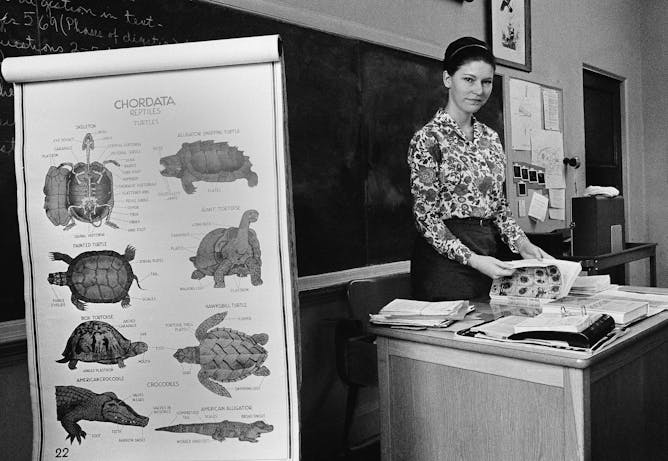
It followed that teaching the biblical creation story as a true account of human origins was out of the question. The Supreme Court put a categorical end to Tennessee-style “monkey laws” in its 1968 decision in Epperson v. Arkansas.
Biology teacher Susan Epperson challenged Arkansas’ ban on the teaching of the theory of evolution. Little Rock Central High School, Arkansas, Aug. 13, 1966.
AP Photo
In 1971’s Lemon v. Kurtzman, the Supreme Court solidified its views on church-state separation by adopting a three-prong “test” to determine whether laws violated the Establishment Clause. To be constitutional:
A law must have a secular legislative purpose.
Its primary effect must neither advance nor inhibit religion.
It must not foster excessive government entanglement with religion.
Lemon’s support on today’s Supreme Court is much weaker than it was 40 years ago, but it has been the dominant test employed in the case law on creationism and evolution.
Can we teach a bit of each?
Why, then, didn’t the Supreme Court’s adoption of the Lemon test close the book on creationist teaching once and for all? The answer, in a nutshell, is that creationism went underground.
Once the state could neither teach biblical creationism nor categorically forbid the teaching of evolution, creationists turned to new strategies.
The first post-Epperson wave of resistance involved a number of state legislatures that required the “balanced treatment” of both evolution and “scientific creationism” in the science classroom. Students would be presented with two “scientific” accounts side by side and could make up their own minds.
Yet, for this strategy to succeed, proponents needed to convince courts that “scientific creationism” was more than just Sunday school in disguise. In McLean v. Arkansas (1982), a federal district court struck down Arkansas’s balanced treatment law, ruling that it merely omitted biblical references without actually changing the religious purpose of the law. The court also developed a definition of “science” and concluded that “creation science” did not satisfy it.
Edwards v. Aguillard
Supreme Court Justice Antonin Scalia wrote the dissenting opinion in Edwards v. Aguillard. Today’s court is likely more sympathetic to Scalia’s views of the Establishment Clause.
Under the law’s terms, no school was required to teach either evolution or creation science, but if one were taught, the other had to be taught as well. The declared purpose of the law was protecting “academic freedom.”
On June 19, 1987, the Supreme Court ruled 7-2 in the case of Edwards v. Aguillard that the Louisiana law was unconstitutional. Writing for the court, Justice Brennan explained that the act had no secular purpose – and thus violated the first prong of the “Lemon test.” Further, Brennan rejected the act’s purported purpose of protecting academic freedom:
“The Act actually serves to diminish academic freedom by removing the flexibility to teach evolution without also teaching creation science, even if teachers determine that such curriculum results in less effective and comprehensive science instruction.”
‘Teaching the controversy’
Like Epperson v. Arkansas, the Edwards case was a decisive Supreme Court defeat for anti-evolution forces.
As creationists came to understand that the Supreme Court would not approve laws with religious agendas so close to the surface, many shifted their focus to more subtle tactics, which involved some version of “teaching the controversy” regarding evolution. One strategy was to adopt disclaimers explaining to students that evolution was a “theory, not a fact” or that teaching evolution was “not intended to influence or dissuade the Biblical version of Creation.” Courts uniformly ruled against these disclaimers.
Kitzmiller v. Dover School District (2005), the best-known post-Edwards case, addressed the strategy of substituting “intelligent design theory” for “scientific creationism.” A Pennsylvania school district’s evolution disclaimer included the suggestion that students consider the theory of “intelligent design” as developed in the textbook, “Of Pandas and People.”
A federal judge barred the Dover, Pennsylvania school district from teaching ‘intelligent design’ in biology class, saying the concept is creationism in disguise.
AP Photo/Bradley C Bower
Intelligent design proponents argue that mutation and natural selection cannot adequately explain the emergence of “irreducibly complex” biological structures; such structures must have been designed. Officially, the “designer” could have been anyone – a space alien, perhaps – thus “intelligent design” is claimed not to be religious in character.
The district court, however, soundly rejected these arguments. As had the court in McLean v. Arkansas, the Kitzmiller court discussed the nature of science and concluded that intelligent design was not science.
The legacy of Edwards today
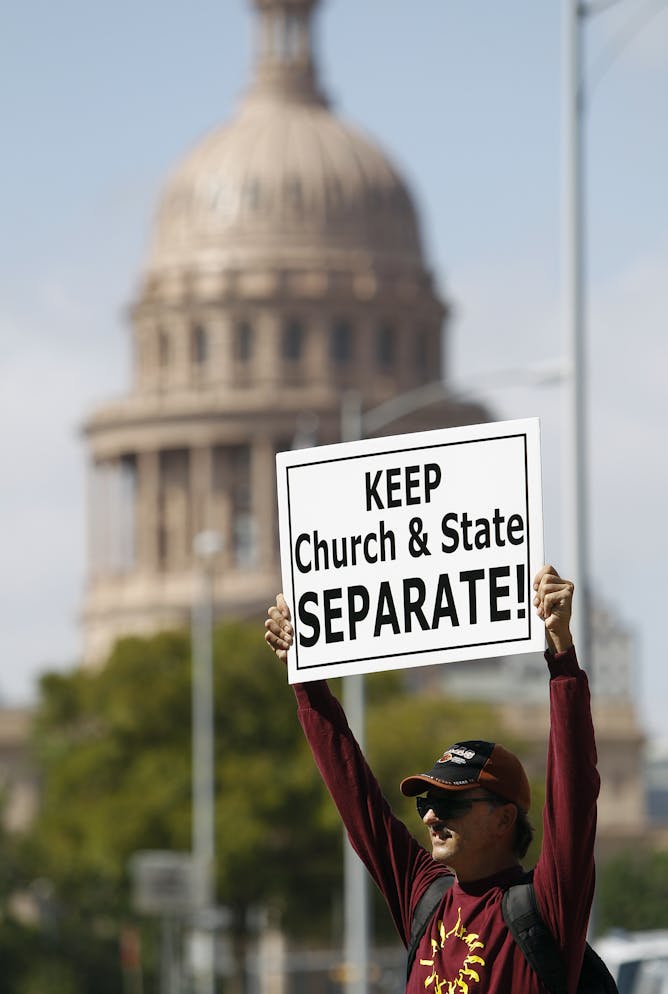
Courts have been remarkably consistent in rejecting creationist efforts to undermine the teaching of evolution. It’s tempting to see these cases as a sign that courts will protect the integrity of science and of academic judgments generally. (One might think, for example, that courts would just as readily step in when political actors reject the teaching of mainstream climate science in public schools.) But the cases don’t sweep so broadly.
In 2011, Joe Zamecki protests outside a building where the Texas Board of Education was considering how the next round of science textbooks should address issues of creationism and climate change.
AP Photo/Eric Gay
Even in cases where courts explicitly state that creationism/intelligent design is not science, they make this point only as a step toward the critical point that creationism is religion. In other words, courts do not weigh in on whether science lessons must be supported by mainstream scientific experts, only that religious views can’t be taught as science.
Respect for academic expertise is incredibly important. One might argue, as Robert Post has done, that the expertise fostered by academic disciplines deserves First Amendment protection. But the courts aren’t there yet.
Recent efforts to undermine the teaching of evolution have mainly taken the form of so-called “academic freedom” or “science education” bills, which have been proposed in a number of states and have passed in Louisiana (2008) and Tennessee (2012).
These bills exploit an opening left by Edwards v. Aguillard: Teachers are not required to teach creation alongside evolution; rather, they’re given the “academic freedom” to emphasize critiques while teaching evolution in their science classes. The bills downplay religion by not mentioning the topic of evolution or by mentioning it alongside other controversial topics like climate change.
Legal precedent would not allow public school teachers to explicitly use this “academic freedom” to undermine science education in favor of religion. However, it’s difficult to know how many teachers are choosing to do so – and whether those choices have anything to do with the legislation.
Edwards v. Aguillard struck an important blow for science education, and it fundamentally reshaped the tactics available to creationists. Its influence on these fronts has been significant and laudable, but its reasoning is heavily reliant on historical links to old-school creationism and on a conception of the separation of church and state that’s stricter than the likely views of current Supreme Court justices. These points limit the case’s ability to speak to the full range of curricular problems we confront today.
Here's how. Visualization of wind within a hurricane. Ventusky In October 2016, Hurricane Matthew killed more than 550 people and caused $15 billion in property damages. The most powerful storm to hit the Caribbean and Southeastern United States in a decade, it whipped winds up to 160 miles per hour and pushed a 10-foot surge of…
Reactions to the antibiotic can fade over time. Have you ever gotten a skin test for a penicillin allergy? Fiona Moore via Flickr "Are you allergic to any medications?" I've answered that query dozens of times since a childhood incident when penicillin, taken to treat a minor infection, instead gave me an itchy rash all over…
Two U.S. studies on the effects of marijuana on drivers in states where it is allowed for recreational use came to different conclusions about whether it increases risks behind the wheel.
A study by the American Journal of Public Health published on Thursday looked at motor vehicle fatalities and found no significant increase in Colorado and Washington State, where recreational marijuana use is legal, compared with eight states where it is not legal that have similar populations, vehicle ownership, and traffic laws. Alabama, Kentucky and Texas were among the states in the comparison group.
“Our study focused on deaths and actually found what we expected going into this," Jason Adedoyte, lead author of the study said in a telephone interview. Adedoyte is a trauma surgeon at Dell Seton Medical Center at the University of Texas at Austin.
"Back in 2012 some argued that people would ride around in their cars crash and die. Our study proved that isn't true," he said.
The American Journal of Public Health examined data from 2009 to 2015 taken from the U.S. Fatality Analysis Reporting System.
In another study published on Wednesday, the Highway Loss Data Institute analyzed the frequency of car insurance collision claims in Washington, Colorado and Oregon, where recreational marijuana is also permitted.
It found a 3 percent increase in collision claims in those states compared with Wyoming, Idaho and Nevada, where it is not legal.
“In states that passed legislation approving the recreational use of marijuana, the data showed that there was a strong indicator that marijuana was a factor in considering the rise of claims,” Matt Moore, senior vice president of The Highway Loss Data Institute, said in a telephone interview.
The Institute examined about 2.5 million insurance collision claims from January 2012 and October 2016.
Mason Tvert, communication director of the Washington, D.C.-based Marijuana Policy Project, a pro-legalization group, questioned the methodology of the Institute's study.
“There’s no clear evidence that marijuana is a factor. It’s going to take several years and studies before we can determine that,” he said in a telephone interview.
The Institute's Moore defended its approach, saying, "We looked at the correlation of states with similar insurance claim frequencies, and the states we chose had the highest correlation.”
Federal law prohibits recreational use of marijuana in the country, however, it has been approved by eight states including Maine, Massachusetts, Colorado, Washington, Alaska, Oregon, California, Nevada and the District of Columbia.
(Reporting by Taylor T. Harris in New York; Editing by Frank McGurty)
The first total solar eclipse across the continental United States in a century is expected to spark watching parties and traffic jams as it darkens skies from Oregon to South Carolina, authorities said on Wednesday.
During the Aug. 21 eclipse, the moon will pass between the sun and Earth, blocking the face of the sun and leaving only its outer atmosphere, or corona, visible in the sky.
It is the first coast-to-coast total eclipse since 1918.
Weather permitting, people can watch as the moon's 70-mile (113-km) wide shadow crosses through 14 states from 10:15 a.m. PDT (1715 GMT) around Lincoln Beach, Oregon, to 2:49 p.m. EDT (1849 GMT) in McClellanville, South Carolina.
With 200 million Americans within a day's drive of the path, national parks and highways officials are bracing for a travel surge.
“Be prepared," Martin Knopp of the Federal Highway Administration said at a news conference, cautioning drivers against simply showing up. "It’s not the time to pull over and be on the side of the road.”
Travel groups and many scientists will be heading to Oregon's northwest desert seeking favorable weather for viewing, according to the website eclipsophile.com.
Total solar eclipses occur somewhere on Earth every year or so, but most cast their shadow over oceans or remote land. The last total eclipse over part of the contiguous U.S. was in 1979.
All of North America will experience a partial eclipse, though the difference between a full and partial eclipse is "literally the difference between night and day," said astronomer Rick Fienberg of the American Astronomical Society.
He noted that even a 99 percent eclipse will not reveal the sun's corona. And during a total eclipse, the temperature drops and the horizon is ringed by the colors of sunset.
"The sky gets deep twilight blue and bright stars and planets come out," Fienberg said. "Animals and birds behave strangely, like it's the end of the day."
NASA said it plans to fly high-altitude research balloons and airplanes for solar physics and other experiments. Nearly a dozen U.S. science satellites will observe the sun and Earth.
The U.S. space agency will also broadcast the eclipse live from locations along the path.
Experts caution that the only safe time to look at the sun without special eclipse glasses is during totality when the surface of the sun is completely blocked by the moon.
The feat made headlines around the world: "Scientists Say Human Genome is Complete," the New York Times announced in 2003. "The Human Genome," the journals Science and Nature said in identical ta-dah cover lines unveiling the historic achievement. There was one little problem. "As a matter of truth in advertising, the 'finished' sequence isn't finished," said…
Astronomers on Monday added 219 candidates to the growing list of planets beyond the solar system, 10 of which may be about the same size and temperature as Earth, boosting the chances for life.
Scientists found the planet candidates in a final batch of NASA's Kepler Space Telescope observations of 200,000 sample stars in the constellation Cygnus.
The candidates include 10 newly discovered rocky worlds that are properly distanced from their parent stars for water, if it exists, to pool on their surfaces. Scientists believe liquid water is a key ingredient for life.
“An important question for us is, ‘Are we alone?'" Kepler program scientist Mario Perez said in a conference call with reporters. “Maybe Kepler today is telling us indirectly ... that we are not alone.”
The National Aeronautics and Space Administration launched the Kepler telescope in 2009 to learn if Earth-like planets are common or rare. With the final analysis of Kepler data in hand, scientists said they will now work on answering that question, a key step in assessing the chance that life exists beyond Earth.
During a four-year mission, Kepler found 2,335 confirmed planets and another 1,699 candidates, bringing its tally to 4,034. That number includes about 50 worlds that may be about the same size and temperature as Earth.
Including other telescope surveys, scientists have confirmed the existence of nearly 3,500 planets beyond the solar system.
Kepler’s data also provided a new way to assess whether a planet has a solid surface, like Earth, or is made mostly of gas, like Neptune. The distinction will help scientists home in on potential Earth-like planets and better the odds for finding life.
The Kepler team found that planets which are about 1.75 times the size of Earth and smaller tend to be rocky, while those two- to 3.5 times the size of Earth become gas-shrouded worlds like Neptune.
“It’s like finding what we thought was a single species of animal is really two different things,” said Benjamin Fulton, a graduate student in astronomy who analyzed the Kepler data.
So far, these planets, which scientists refer to as “super-Earths” and “mini-Neptunes,” have not been found in Earth’s solar system, though scientists are on the hunt for a potential ninth planet far beyond Pluto.
“It is interesting that we don’t have what appears to be the most common type of planet in the galaxy,” Fulton said.
(Reporting by Irene Klotz; Editing by Colleen Jenkins and Lisa Shumaker)
Creationist Ken Ham has long drawn ridicule for his insistence that Noah brought dinosaurs with him on his ark -- and now he's promoting a book that shows the Biblical hero squaring off against a tyrannosaurus rex.
Despite featuring a giant dinosaur on its cover, the book's description doesn't once mention any battles between Noah and prehistoric creatures.
"After years of serving God, Noah reaches crisis of faith due to his mounting frustrations with the proliferation of sin and the apparent silence from the Creator," the description reads in part. "Thrust into a series of perilous situations, Noah's deepest convictions are challenged. His response will direct his course and change the world forever."
Not about the speed, it's about how it uses that speed. In foreground, Russian Kirov Class battlecruiser 'Pyotr Velikiy', with HMS Dragon in background Russia's Pyotr Velikiy battlecruiser is the kind of ship that may someday carry Zircon missiles. Royal Navy, via Wikimedia Commons Every missile is a carefully packaged bad day traveling at high speeds.…







 Edwards v. Aguillard struck an important blow for science education, and it fundamentally reshaped the tactics available to creationists. Its influence on these fronts has been significant and laudable, but its reasoning is heavily reliant on historical links to old-school creationism and on a conception of the separation of church and state that’s stricter than the likely views of current Supreme Court justices. These points limit the case’s ability to speak to the full range of curricular problems we confront today.