Researchers at the Cleveland Museum of Natural History marked their discovery of a new way to identify praying mantis species by naming a new species after Supreme Court Justice Ruth Bader Ginsburg, the Washington Post reported.
"We named it for her in honor of her commitment to womens' rights and gender equality," said Sydney Brannoch. "We also named it for her in appreciation of the jabot, which is a lace bow that drapes around the neck."
According to Brannoch and Gavin Svenson, Ilomantis ginsburgae has a neck plate that echoes Ginsburg's signature neck bow. The new species was identified based on a specimen collected in Madagascar in 1967.
But what makes this discovery unique is that Brannoch and Swenson based their findings on the genitalia of female specimens.
"Traditionally in praying mantis taxonomy, we use the male genital characters to help delimit and describe new species," she explained. "However, we were curious to see if we could use female genital characters to do the same thing."
According to the Post, the duo researched 30 female specimens from different collections using genital characteristics to identify differences between the species.
"Many praying mantis species have males and females that look very different," Svenson said in a statement. "If a person finds one sex, they may only be able to identify the specimen if their specimen’s sex matches what is known from previous research. Our work reduces this impediment by characterizing both sexes for praying mantis species."
Watch Brannoch's remarks on the new species, as posted online, below.
The now-deceased PBS icon Bob Ross occupies a prominent if confusing space in the psyche of a small-but-growing chunk of the population. It's not Ross's artistic prowess that has posthumously earned him a following. Rather, it's the entrancing sounds of his brushstrokes and signature style of whisper-narrating his painting process. The calming, visceral effects of watching (or listening to) Ross create banal landscapes is a "condition" (for lack of a better term) that went unnamed until 2010. Then, thanks to online forums, the way Ross makes some people feel became known as ASMR, short for Autonomous Sensory Meridian Response.
The gist of ASMR is as puzzling as it is simple: For an unknown percentage of us, certain soft, repetitive or "close" sounds trigger physical tingles, as well as feelings of euphoria and relaxation. This might sound deserving of a fetish label, but the ASMR community doesn't consider the sensations erotic. Instead, the experience is often described as similar to a post-meditation calm. (Full disclosure: I unknowingly have had ASMR my whole life, and only stumbled on the term this past year; Bob Ross is my god.)
What's also curious about ASMR is that it's apparently common, and has potentially existed since the dawn of humankind, yet largely evaded formal scientific scrutiny. Since its 2010 "discovery," ASMR been the subject of only one peer-reviewed study, in 2014. And we don't really know what causes ASRM or why some people have it. Of course, ASMR is far from the only neurological whodunit related to sleep. To the contrary, the human nervous system is capable of all sorts of hijinks, some eye-opening, some laughable, some excruciating. Here are a few standouts that continue to challenge researchers.
Kleine-Levin Syndrome
More informally known as "Sleeping Beauty Syndrome," Klein-Levin Syndrome is a condition in which sufferers, typically adolescents, suddenly require extended periods of sleep — up to 23 hours a day for days, weeks or even months at a stretch. They may wake up only to eat or use the toilet, then collapse again due to unrelenting exhaustion. This need for sleep often comes with neurological symptoms, including weird food cravings, altered personality and a sudden lack of sexual inhibition. KLS was first named in 1962 but researchers have traced reports of the condition back to the early 1800s. There are theories about its cause — genetic factors may lie at the root — but still no reliable medical explanation. Luckily, KLS is exceedingly rare — with only one case per million people in the US.
Exploding head syndrome
Quite likely the greatest-named syndrome in the world, Exploding Head Syndrome (EHS) shouldn't be mistaken for the plot of "Scanners," as it's a largely benign sleep disorder. Sufferers describe being jolted awake by some variety of loud noise right as they're falling asleep or, in some cases, waking up. Think: gun shots, cymbal crash, explosions. Understandably, EHS is distressful to sufferers, for whom symptoms typically start around age 50. Researchers have yet to pin down a cause. Some believe EHS incidents are minor seizures. Others believe they're mechanical glitches caused by the inner ear. And many attribute EHS to psychological triggers, such as anxiety or stress.
Sudden Infant Death Syndrome
Ask any parent what they fear most, and they will all say SIDS, the tragic boogeyman that continues to claim newborns while they sleep, for no known reason. People have known about the condition has been know about for centuries — some claim the Bible mentions it — but it only earned its acronym in 1963. Since then researchers have doubled down on studying SIDS. In the US, the number of cases has fallen by two-thirds since 1990, simply from counseling new parents to place sleeping babies on their backs. Despite such successes, researchers have yet to pin down the actual cause of SIDS, and it continues to be among nature's cruelest rituals, with some 3,500 SIDS deaths occurring per year in the U.S. alone.
REM Behavior Disorder
The concept of Random Eye Movement underlies a phenomenon many of us have casually observed while watching other people sleep (yeah, we're all creeps): the quick, darting eyeball movements that happen while we dream. It's less well-known, however, that during REM sleep, your brain doses out chemicals that temporarily paralyze your muscles so you don't act out the light-saber fights and gymnastics of your nocturnal fantasies. For RBD sufferers, this little mechanism doesn't work so well, for unknown reasons, and the results range from the annoying, like sleep-kicking, to the hilarious, like sleepwalking naked down the street, to the dangerous-but-hilarious, like sleepwalking to the local Sleven, then hopping on a bus to visit an uncle the next town over. Researchers have isolated a few of the neurotransmitters responsible for the paralysis, but not the root cause, leaving RBD sufferers as the inevitable punch line of every pub night bullshit session.
This article originally published by Van Winkle’s, vanwinkles.com, the editorial division of Casper Sleep
One of the moon’s greatest mysteries has long been whether it has any water. During the Apollo era in 1960s and 70s, scientists were convinced it was dry and dusty – estimating there was less than one part in a billion water. However, over the last decade, analyses of lunar samples have revealed that there is a considerable amount of water inside the moon – up to several hundred parts per million – and that it’s been there since the satellite was very young.
But exactly where this internal water came from has remained an enigma. There have been many suggestions, such as comets or asteroids bringing it there. Another is that some of the water could have been there since the moon formed, from material that originally came from the Earth. Now our new study suggests that most of the water inside the moon must have been delivered by asteroids some 4.5 to 4.3 billion years ago.
The moon formed some 4.5 billion years ago – shortly after Earth. But whereas Earth has been constantly renovated through the effects of plate tectonics, the moon has been relatively quiet. The Earth’s ever-changing face means that we know very little of its earliest history. The moon, however, has acted like a time capsule, helping us better understand its history – and the Earth’s.
Digging for water
To probe how water got to the moon’s interior, we performed calculations using published data for water in lunar samples and bulk estimates of water inside the moon. We also used data available for the water content and composition of meteorites and comets. The model also accounted for different types of water, (such as “heavy water” which is made up of relatively more deuterium than hydrogen). This is very useful because because water in different objects in the solar system has different signatures – most comets, for example, have heavy water.
By calculating different mixtures of water from different sources and comparing the results to what we observe for the moon, we discovered that water-rich carbonaceous asteroids are the most likely candidates for bringing the majority of “volatile elements” (elements and compounds with low boiling points) to the moon – such as water, nitrogen and carbon. We also found that comets most likely delivered a maximum of 20% of such elements to the lunar interior.
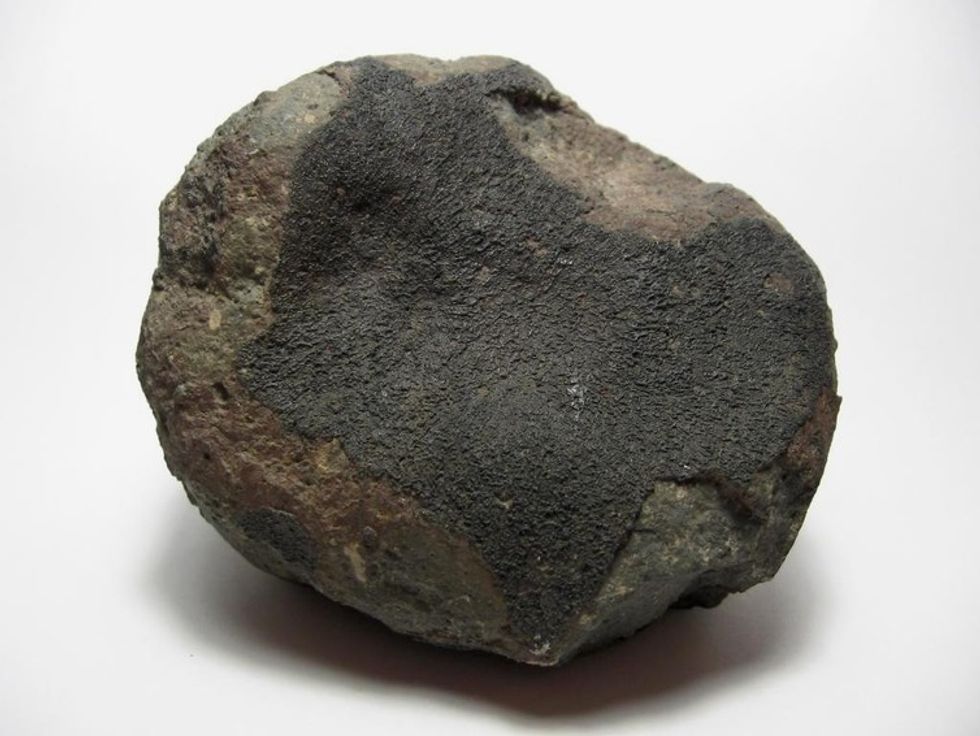
Carbonaceous chondrite meteorite that fell in Mexico in 1969 (weight 520g).
Based on the data and models currently available, we think that these impacts happened over a couple of hundred million years after the moon formed, just before its huge magma ocean solidified. The asteroids and comets crashed into this magma ocean and were likely retained (rather than boiled off) due to a thermal lid which formed at the surface of the huge pool of magma.
The results are important because they tell us about the kinds of objects that struck both the moon and the Earth more than four billion years ago. Potentially it could also help us understand the origin of water in the Earth. In fact, water inside the Earth is so similar in composition to the water in the moon that, along with other geochemical evidence, it seems likely that our water also came from asteroids.
Of course, this is not an open and shut case, there is still a lot that we do not know about water and other volatiles in the moon and how they relate to each other. For example, we still need to fully understand the processes that operated inside the moon over geological time and work out what happened to the volatiles when lavas were erupted to the lunar surface. We can gain a huge amount of information from further study of samples returned from the Apollo and Luna missions. There are some 382kg of such samples, but only 2% have been investigated for analyses of volatiles.
But ultimately, we need to explore the entire moon to properly understand it. Our work is timely especially in light of the plans to send robotic and human prospecting missions to previously unexplored regions of the moon. In fact, the Apollo astronauts covered a distance on the lunar surface equivalent to a return journey from Edinburgh to Glasgow, so there is every possibility that rocks from the far side and polar regions of the moon may tell a different story.
In addition to the water trapped in glasses and minerals, there is also water-ice and other volatiles on the surface of the moon. As national space agencies gear up for the next era of lunar missions they are primarily focused on investigating how much water is on the surface, where it is and in what form. This will be crucial to determine whether water can be used as a resource for sustaining a moon base or enabling further exploration of the solar system. My feeling is that our nearest neighbour still has a lot to show and tell, and that the next 10 to 20 years are going to be eye-opening.
An infant is back home after traveling with her family to Colorado, where she became the youngest patient to be treated with a controversial cannabis oil.
Amylea Nunez suffered from frequent and debilitating seizures that sometimes prevented her from waking up for a full day, and she was diagnosed shortly after her December birth with a rare form of epilepsy, reported KRQE-TV.
“There’s times were she would only wake up every other day,” said her father, Ernie Nunez. “Just sitting there while she’s having a seizure, it’s horrible and there’s nothing you can do. The worst one was an hour long."
Doctors prescribed eight different medications for the newborn infant, but her condition remained relatively unchanged.
Amylea was flown from New Mexico to a hospital in Aurora, Colorado, where the baby's parents begged doctors to prescribe cannabis oil.
Doctors were reluctant to give the drug to such a young patient, but they eventually agreed -- although physicians wouldn't administer cannabis oil themselves.
Amylea began cannabis oil at two months old, and she lifted her head for the first time three months later.
“It was kind of like I could tell the doctors, ‘Look what she’s capable of,’ compared to them saying she’s never going to be able to hold up her head,” said her mother, Nicole Nunez.
She came back home to Albuquerque last week, at six months old, and her family said the baby still requires special care.
“We still have to get her back to eating by mouth because the seizures did so much to her ability to be able to actually take a bottle like a normal baby,” said Ernie Nunez.
The family is applying for a medical marijuana card in New Mexico, and they hope to change state laws to help other children suffering from seizures.
Amylea is still taking a hemp oil called Haleigh's Hope, and she and her family must still return to Colorado for checkups.
Her parents encouraged others to consider cannabis oil to treat some childhood illnesses.
“Always speak up for your kids,” said Nicole Nunez. “I’m very glad I fought.”
War and disease have marched arm in arm for centuries. Wars magnify the spread and severity of disease by disrupting populations. As large groups of people move across borders, they introduce and encounter disease in new places. Often, they move into crowded, resource-poor environments that allow diseases to thrive.
Before World War II, soldiers died more often of disease than of battle injuries. The ratio of disease-to-battle casualties was approximately 5-to-1 in the Spanish-American War and 2-to-1 in the Civil War. Improved sanitation reduced disease casualties in World War I, but it could not protect troops from the 1918 influenza pandemic. During the outbreak, flu accounted for roughly half of US military casualties in Europe.
As the Second World War raged in Europe, the US military recognized that infectious disease was as formidable an enemy as any other they would meet on the battlefield. So they forged a new partnership with industry and academia to develop vaccines for the troops. Vaccines were attractive to the military for the simple reason that they reduced the overall number of sick days for troops more effectively than most therapeutic measures.
This partnership generated unprecedented levels of innovation that lasted long after the war was over. As industry and academia began to work with the government in new ways to develop vaccines, they discovered that many of the key barriers to progress were not scientific but organizational.
World War II sped the development of flu vaccine
The 1918 flu pandemic devastated US forces in World War I
In 1941, fearing another pandemic as it braced for a second world war, the US Army organized a commission to develop the first flu vaccine. The commission was part of a broader network of federally orchestrated vaccine development programs.
These programs enlisted top specialists from universities, hospitals, public health labs and private foundations to conduct epidemiological surveys and to prevent diseases of military importance.
Wartime vaccine programs expanded the scope of the military’s work in vaccines well beyond its traditional focus on dysentery, typhus and syphilis. These new research initiatives targeted influenza, bacterial meningitis, bacterial pneumonia, measles, mumps, neurotropic diseases, tropical diseases and acute respiratory diseases. These diseases not only posed risks to military readiness, but also to civilian populations.
These programs were not a triumph of scientific genius but rather of organizational purpose and efficiency.
Wartime vaccine programs expanded the scope of the military’s work beyond diseases like syphilis.
Scientists had been laying the groundwork for many of these vaccines, flu included, for years before. It was not until World War II, however, that many basic concepts were plucked from the laboratory and developed into working vaccines.
The newly formed flu commission pulled together knowledge about how to isolate, grow and purify the flu virus and rapidly pushed development forward, devising methods to scale-up manufacturing and to evaluate the vaccine for safety and efficacy.
Under the leadership of virologist Thomas Francis Jr, the commission gained FDA approval for their vaccine in less than two years. It was the first licensed flu vaccine in the US. In comparison, it takes eight to fifteen years on average to develop a new vaccine today.
Flu vaccine, as the Army later discovered, required annual tweaking to match circulating strains of the virus, which it still does today. Even so, the timeline from development to use was a remarkable achievement.
Military needs drove vaccine development
Wartime programs, like the flu commission, developed or improved a total of 10 vaccines for diseases of military significance, some in time to meet the objectives of particular operations.
For instance, botulinum toxoid was mass-produced prior to D-Day in response to (faulty) intelligence that Germany had loaded V-1 bombs with the toxin that causes botulism. Japanese encephalitis vaccine was developed in anticipation of an Allied land invasion of Japan.
Some of these vaccines were crude by today’s standards. In fact some might not receive broad FDA approval today, but they were effective and timely.
How did these programs develop so many vaccines, so fast?
Scientists often conducted research at their home institutions, which allowed the military to gain access to valuable expertise and facilities in the civilian sector.
The government used “No loss, no gain” contracts that covered the cost of research and, occasionally, indirect costs, but did not provide a profit. Under normal circumstances, universities would have resisted this technocratic reorganization of their research agenda, but the threat of war softened opposition.
Manufacturers also began to work on projects with little to no profit potential. Because vaccines were recognized as an essential component of the war effort, participating in their development was seen as a public duty.
Packing typhus vaccine for shipment. Here is enough vaccine to innoculate a town of 15,000 population. USPHS (United States Public Health Service) Rocky Mountain Laboratory, Hamilton, Montana
With industry as a willing partner, wartime programs forged a new research format that effectively translated laboratory findings into working products.
At the time intellectual property protections were less of a barrier to information sharing than they are today. Without these restrictions teams were able to consolidate and apply existing knowledge at a rapid rate.
Borrowing management techniques from industry, flu commission head Francis and his fellow project directors exercised top-down authority, transferring people, resources and ideas to the most compelling projects.
Project directors also managed development in an integrated fashion, coordinating activities across disciplines and developmental phases so that everyone involved understood the upstream and downstream requirements for vaccine candidates.
Working together for the greater good
This cooperative, duty-driven approach to vaccine development persisted into the postwar era, even after the urgency and structure of wartime programs dissolved. This contributed to high rates of vaccine innovation through the middle of the 20th century.
Don Metzgar, a virologist who began working in the vaccine industry in the 1960s explained to me in an interview that, “pharmaceutical companies looked at vaccine divisions as a public service, not as huge revenue generators.”
When the military requested limited-use vaccines, such as meningococcal meningitis and adenovirus, industry obliged. But a series of legal, economic and political transformations in the 1970s and 80s disrupted this military-industrial partnership. Without industry cooperation, new vaccine development stalled and some existing vaccines were discontinued.
Whether at war or in peace, timely vaccine development is vital. New diseases with pandemic potential occur regularly: SARS in 2003, bird flu in 2005, swine flu in 2009, and Ebola in 2014. Our current vaccine development capabilities are not keeping pace.
Scientific obstacles can be formidable, as our continued struggle to develop vaccines for tuberculosis, malaria and HIV demonstrate. But many vaccines languish in the pipeline for reasons that have nothing to do with science.
Scientists at the National Microbiology Lab in Manitoba, prepare an experimental Ebola vaccine for shipment to the World Health Organization.
Public Health Agency of Canada/Handout/Reuters
Mobilizing federal resources on a massive scale, as we did in the 1940s, is not a sustainable solution, but we can still take a page out of the World War II playbook.
In a crisis, such as the West African Ebola outbreak, industry demonstrated that it still has the capacity to partner for the greater good, even when the business case for a particular vaccine is not compelling.
We need to leverage this capacity by reintroducing the highly integrated research practices to accelerate the translation of laboratory findings into working vaccines. Let’s not wait for history to teach us that lesson again.
The Dutch government on Friday announced it wants to allow growing human embryos "under strict and limited conditions" for scientific research, thereby giving hope to parents struggling to conceive.
Dutch Health Minister Edith Schippers "wants to allow the creation of embryos for scientific research -- and under very strict conditions to give people the possibility of (healthy) children," the health ministry said in a statement.
"The research has to do with infertility, artificial reproduction techniques and hereditary or congenital diseases," the statement added.
It also specifically included people who became infertile after being treated for cancer at an early age.
The Netherlands will change its laws on embryonic research, which until now only allowed tests to be conducted on leftover embryos procured from in vitro fertilisation processes.
The so-called "14-day rule" -- which says that human embryos cannot be cultured in the lab for more than two weeks -- will also still strictly be adhered to, the statement said.
"Until now the ban on the cultivation of embryos have hampered research which could help with the treatment of diseases on the short to medium-long term," it added.
This included various hereditary illnesses such as mitochondrial diseases, which affect cells in the body.
Britain this year granted its first research licence to genetically modify human embryos to a project that will help women who battle to fall pregnant.
The decision made Britain one of the first countries in the world to grant this type of authorisation on one of science's new frontiers and follows months of deliberation by the country's embryology regulator.
US-based scientists earlier this month reported they had grown human embryos in the lab for nearly two weeks, for the first time challenging the 14-day rule simply because no one had succeeded in keeping the embryos alive for that long.
The scientists then destroyed the embryos in order to avoid breaching the two-week limit.
Astronauts aboard the International Space Station will try again on Saturday to inflate a novel experimental habitat after the fabric module failed to unfurl as planned earlier this week, NASA officials said on Friday.
The problem may have resulted from its materials becoming stiff. The Bigelow Expandable Activity Module, or BEAM, was unpacked 10 months later than expected due to launch delays, manufacturer Bigelow Aerospace told reporters on a conference call.
The impact was likely most serious on the outer layers, said Lisa Kauke, BEAM deputy program manager at Bigelow. The prototype habitat, which could provide living quarters for crew one day making trips to Mars, is made of impact-resistant, Kevlar-like materials and flexible layers of fabric and foam.
"The longer they’re packed, the more they are compressed and it takes a little while for those shapes to return," Kauke said.
NASA astronaut Jeff Williams on Thursday tried to inflate the module with spurts of the space station's air, but it failed to expand as planned.
Left alone overnight, the barrel-shaped module grew slightly in both length and diameter, giving the U.S. National Aeronautics and Space Administration and Bigelow Aerospace confidence that the problem can be resolved.
Astronauts will make another attempt to inflate BEAM on Saturday morning, station operations manager Kenny Todd said during the call.
The lightweight habitats could save millions of dollars in launch costs compared with metal modules. They may also offer better radiation protection for astronauts.
The module is designed to expand to the size of a small bedroom, a 10-fold increase in volume. NASA plans to keep it attached to the International Space Station, a $100 billion research laboratory that flies about 250 miles (400 km) above Earth, for a two-year trial run.
The Red Planet is emerging from an Ice Age, according to radar images of Mars's polar regions that are shedding new light on our neighbor's climate cycle, researchers said Thursday.
The ice began its retreat about 370,000 years ago, said the study in the journal Science, led by Isaac Smith, a postdoctoral researcher at Southwest Research Institute in Boulder, Colorado.
The findings are based on data collected by NASA's Mars Reconnaissance Orbiter, which has been circling Mars for 10 years.
The research confirms previous models that found the glacial period ended about 400,000 years ago.
It also deepens scientists' understanding of the climate shifts that happen on Mars, and how they differ from Earth.
"On Earth, ice ages take hold when the polar regions and high latitudes become cooler than average for thousands of years, causing glaciers to grow toward the mid-latitudes," NASA said in a statement.
"In contrast, the Martian variety occurs when -- as a result of the planet's increased tilt -- its poles become warmer than lower latitudes."
The result is the retreat of Martian polar caps and the buildup of water vapor toward the equator, forming ice on the ground and glaciers at mid-latitudes.
Now that the most recent Ice Age has ended, ice is building up on the poles again.
Smith and colleagues found a maximum ice thickness of 1,050 feet (320 meters) across the polar cap, matching previous models' predictions in 2003 and 2007.
"This suggests that we have indeed identified the record of the most recent Martian glacial period and the regrowth of the polar ice since then," said Smith.
"Using these measurements, we can improve our understanding of how much water is moving between the poles and other latitudes, helping to improve our understanding of the Martian climate."
He added that studying ice on Mars is important to the future of human exploration because "water will be a critical resource for a Martian outpost."
The US space agency has said it plans to send humans to Mars in the future, perhaps by the 2030s.
The schools were evacuated, resulting in panic and disruption for staff and students – some of who were scheduled to take GCSE and A-Level exams. Police searched the schools but no bombs were found and the calls have been classified as hoaxes.
It’s the type of thing where, if you were on the receiving end of the phone, you might like to think you would be able to tell the difference between a hoax call and a real threat. Not just by what the caller said, but also by the “tone” of his or her voice. But just how realistic is this?
In everyday speech, the use of language can provide some clues to a speaker’s intentions, but we can never be sure that a person means exactly what they say. Or indeed, whether they are actually telling the truth. Research has shown that speech cues cannot accurately determine whether somebody is lying or not. So saying with any degree of certainty whether the caller in the recent bomb threats was lying about the bombs from his “tone of voice” alone, is therefore impossible.
What’s in a voice?
It has been suggested that speaking in a low-pitched voice can make a speaker sound physically larger and more threatening. With this in mind, the Phonetics of Threat Speech research group at York is conducting experiments to see if manipulation of the phonetic aspects of a voice (things like a speaker’s pitch, how fast or slow, or how loud they speak) can lead listeners to infer greater or lesser levels of threat in a speaker’s voice.
Although the work is in its early stages, preliminary investigations have highlighted that listeners may indeed use certain aspects of voice, like pitch and speed, as cues when evaluating how threatening a speaker sounds. Our early findings indicate that listeners are willing to make personality judgements about a speaker and infer how threatening they sound based on their “speech cues” alone.
Part of this research involves asking participants to listen to a prerecorded clip then give a rating from one to seven for how threatening they think the speaker sounds. Along with any thoughts on personal attributes of the speaker. This includes height, body size and any other descriptors that sprung to mind when the listener hears the voice in the clip.
When hearing “indirect” threats such as: “I wouldn’t do that if I were you” and: “I know where you live”, listeners described a low-pitched London cockney speaker as “intimidating” and “menacing looking”. But a high-pitched “BBC English” speaker saying exactly the same phrases was judged as being “not intimidating” with one listener describing the speaker as “student looking”. The low-pitched speakers were also described as being physically larger than the high-pitched speakers.
Given the words spoken were the same for both speakers – and, in this case, the accents actually being put on by a single actor with the pitch artificially altered, it looks like the difference in accent and pitch can create contrasting impressions of two “speakers”.
This goes to show that when it comes to linguistic analysis it isn’t always a straightforward process. Phonetic analysis can contribute to a better understanding of “cues” a listener may use to judge how threatening a speaker sounds, but this needs to be done without straying into psychological profiling and without making assessments of “sincerity” from vocal cues alone.
Just because a listener may be inclined to think a speaker sounds more threatening based on different aspects of their voice, there is no basis to say this makes a speaker any more likely to commit any action they threaten. And the less we rely on stereotyped impressions of speech in potentially high-stakes situations, the better.
A devastating report detailing damage to the Great Barrier Reef has been leaked online after the Australian government quashed it over fears it could impact tourism, the Independent is reporting.
The report on the reef, which is experiencing extensive coral devastation, was removed after officials admitted it wanted it kept under wraps for economic reasons.
According to the report -- written by Adam Markham from the Union of Concerned Scientists – the reef is showing damage due mostly to climate change, with half of the coral either dead or dying.
The critical portion was omitted from UNESCO’s ‘World Heritage and Tourism in a Changing Climate’ report at the request Australia’s Department of Environment who objected to its inclusion.
“Recent experience in Australia had shown that negative commentary about the status of world heritage properties impacted on tourism,” explained a spokesperson for Australia’s environment department in an interview.
What may have drawn the department's ire was a section that blamed tourism specifically.
“Tourism infrastructure, along with other coastal developments, can cause habitat degradation and damaging pollution and sediment run-off,” states the report, which can be found at the Union of Concerned Scientists’ website.
According to the researchers, failure to take immediate environmental measures -- including curbing greenhouse gas emissions -- may lead to a coral decline of 80 percent within the next 40 years.
For certain members of the deaf community, dreams are a rare time when communication is easy.
From solar-powered hearing aids to sign language translation devices, today’s deaf community have many tools and options that make communication much simpler than it once was. Nonetheless, during waking hours, being unable to hear in a world driven by sound remains a significant challenge. Lip reading is more difficult and less accurate than popularly believed. And while the use of American Sign Language (ASL) and cued speech has increased, they are still only used by a small fraction of the U.S. population.
But in some dreams, deaf people find they don’t need lip reading or have to worry whether people know sign language. In many of their dreams, everyone knows ASL or communicates through a sort of telepathy where everyone simply knows instantly what everyone else is trying to say.
“I never actually see people signing or speaking,” Gabriel Paulone, a student at Washington D.C.-based school for the deaf Gallaudet University said in an email. “It is as if we use extrasensory perception (ESP). It is like we share similar language without having to say something.”
Paulone’s experience is not unique. According to many of the people in the deaf community interviewed for this story as well as those who’ve posted on online forums like Alldeaf and Reddit’s /r/deaf, effortless, telepathy-like communication is a common occurrence in the dreams of those who cannot hear.
Andrea, a Missouri social worker who posts on Reddit as LanguageVirus, said that while she was born able to hear, no one has spoken in her dreams; she’s simply able to know someone’s meaning.
“I can't even imagine hearing in dreams,” she wrote in a Reddit post about how deaf people dream. “Can't even wrap my mind around it. It's as strange to me as I imagine not hearing in dreams is to the people who do.”
There’s no accurate count of ASL users, but even a high estimate of two million ASL speakers amounts to about one percent of the 231 million English speakers in America. That’s a small community. But in some of the dreams of deaf people, that percentage skyrockets.
A 2007 study of deaf and hearing dreams found that people communicated in dreams as they do in their waking lives, with people who habitually used ASL in their waking lives using the sign language in their dreams. Some of the people interviewed for this story reported ASL use during sleep. National Association of the Deaf employee Violet Blake, who said that “everyone and anyone” can sign in her dreams.
Of course, deaf people do not all live the same lives and don’t dream the same dream. Indeed, several people interviewed for this story said they didn’t think their deafness had a great influence on their dreams, an idea supported by medical experts.
One of them, Dr. Steven Ellman, a New York University Psychology Professor who has extensively researched sleep and dreams, said that while the dreams of the blind are noticeably different than those of people with sight, the dreams of the deaf are close to dreams of people who hear.
“Since dreams are more visual than auditory, typically, the dreams of deaf people look more like ordinary dreams than the dreams of blind people,” Ellman said.
That doesn’t mean the communication that takes place in the dreams of deaf people isn’t meaningful. Several deaf people we interviewed described their dream communication as enjoyable and profound. Blake, who was born without hearing to deaf parents, said she’s experienced universal ASL use and ESP in her dreams. She said both types of dream communication were a contrast to the feeling of disconnection from the general population she often feels in her waking life.
“It’s really cool” Blake said. “It’s only in my dreams that I feel that we are all communicating universally.”
This article originally published by Van Winkle’s, vanwinkles.com, the editorial division of Casper Sleep
Yesterday, scientists discovered vaping weed! In an article published in Science Reports, a team at the University of Lausanne in Switzerland wrote that “therapeutic cannavaping” could be a better way to administer medical marijuana than smoking it with tobacco.
This article was originally published by The Influence, a news site that covers the full spectrum of human relationships with drugs. Follow The Influence on Facebook or Twitter.
They claim that it would be healthier and allow users to have regular micro-doses of the drug’s active ingredients throughout the day, which doesn’t work as well with THC pills.
“Cannavaping appears to be a gentle, efficient, user-friendly and safe alternative method for cannabis smoking for medical cannabis delivery,” they wrote.
“I think it’s a great idea, but this would be illegal in the UK,” said David Nutt, head of neuropsychopharmacology at Imperial College, London. It would likely be illegal as of yesterday, when the UKenacted the Psychoactive Substances Act, which banned “Novel Psychoactive Substances (NPS).” Cannabinoids in vapable oil form would likely be considered under this category.
“I hope parliament makes cannabis a medicine soon,” Nutt added.
This article was originally published by The Influence, a news site that covers the full spectrum of human relationships with drugs. Follow The Influence on Facebook or Twitter.
Mount St. Helens is “recharging” with magma, setting off more than 100 earthquakes in recent weeks — but scientists warn a nearby “sleeping giant” may pose a bigger threat.
More than 130 earthquakes have been detected beneath the northwest's most active volcano since March 14, although none of them have been bigger than magnitude 1.3, as molten rock moves into its magma chamber five or six miles below the surface, reported the Seattle Times.
“What’s going on at the volcano is nothing that new,” said Seth Moran, scientist-in-charge of the U.S. Geological Survey’s Cascades Volcano Observatory.
He said the seismic activity isn't powerful enough or close enough to the surface to suggest an eruption is imminent, but the volcano is preparing for another blast -- which is likely years away.
Volcanoes can recharge for years before erupting -- as Mount St. Helens did before eruptions in 1980 and 2004.
However, some experts warn that Mt. Rainier, about 90 miles northeast of Mount St. Helens and closer to Tacoma and Seattle, might also be preparing to erupt.
Mt. Rainier last erupted in 1820 and 1854, although smaller eruptions were reported over the next five decades.
It has also been experiencing an increase in volcanic activity -- although its long dormancy has given it the perception of being "too big to fail," according to some experts.
"Mt. Rainier is a dangerous, dangerous sleeping giant within immediate reach of 80,000 people and another indirect half million in and around the Puget Sound," wrote John Pennington, a former official with the Federal Emergency Management Agency and an emergency services consultant.
Statistics show that volcanic eruption happen in the Cascades -- of which Mt. Rainier is the tallest mountain -- two to three times per century.
“This is just an impermanent piece on our landscape," geologist Carolyn Driedger told KUOW-FM. "Our lifetimes are just too short to appreciate how much change can happen."
An eruption of Mt. Rainier could set in motion catastrophic events -- such as lava flow, avalanches of hot rocks and gas, and flooding caused by melted snow from the mountaintop.
The lava would likely stop flowing near the boundaries of the national park, Driedger said, but flash flooding would carry boulders hurtling from the mountain and pull down trees as it turned into a nightmarish mudflow called a lahar.
It's not certain how far a lahar could flow from Mt. Rainier, but scientists fear a mudflow could carry devastation as far away as Tacoma and create food shortages if trucking routes were blocked.
The lahar could also carry sediment into ports in Tacoma and Seattle that would cost billions to dredge, the radio station reported, and mud could also wreck the region's hydroelectric dams and water sources.
Pennington also warned that Glacier Peak, about 40 miles north of Mt. Rainier, might also erupt in the coming years, although researchers have only recently begun to closely its seismic and volcanic activity.
"There are numerous volcanic peaks other than Mt. St. Helens that are seeking our attention," Pennington wrote. "Many are considered more dangerous and they are lurking much, much closer to our own homes and the atmospheric transportation system of our jet stream."