An enigmatic ring of icy particles circling Saturn, herded into a narrow ribbon by two tiny moons, was probably born of a cosmic collision, according to a study published Monday.
The so-called F ring, some 140,000 kilometres (87,000 miles) beyond the sixth planet from the Sun, orbits at the border between Saturn's other rings and several moons.
Further toward Saturn, millions of ice blocks populating the planet's haunting halos are prevented from cohering into moons by its powerful tidal forces.
Further out are Saturn's main moons, distant enough to have cohered into spheres with their own gravity: Mimas, Enceladus and Titan, which is the only moon in our Solar System with a substantial atmosphere.
And in the boundary zone F ring's icy particles whirl around the planet in a band barely 100 kilometres (60 miles) across, itself orbited by moons Prometheus and Pandora.
Scientists have long known that these so-called shepherd moons were partly responsible for keeping the F ring in tight formation.
What they did not know was how this unusual configuration came into being.
Ryuki Hyodo and Keiji Ohtsuki, astronomers from Kobe University in Japan, used computer simulations to show that Prometheus and Pandora are likely the by-product of a collision at the outer edge of Saturn's ring system.
Previous speculation along these lines concluded that two icy mini-moons crashing head-on would have simply disintegrated, adding yet another ring to Saturn's collection.
But what if the objects were made of something less fragile, and hit each other at an angle?
In that case, "such an impact results in only partial disruption" of the mini-moons as opposed to their total destruction, the authors conclude.
The collision would also produce "the formation of a narrow ring of particles" which becomes a new ring.
Hyodo and Ohtsuki further speculate that this sort of process might not be a once-off oddity but rather the "natural outcome" of ring formation under certain conditions for giant gas planets.
This "may explain not only Saturn's F ring, but also features of the Uranian system," Aurelien Crida, a scientist at France's National Centre for Scientific Research wrote in a comment, also in Nature Geoscience.
Saturn is the second largest planet in our Solar System after Jupiter, and has a radius about nine times greater than Earth.
Its spectacular ring system has nine complete rings and several discontinuous arcs, all of them mainly made of ice particles, with lesser amounts of rocky debris and dust.
Some 60 moons circle Saturn, not including hundreds of "moonlets" such as the F ring's Prometheus and Pandora.
Much of the data and high-resolution images we have from Saturn and its rings was collected by the Cassini space probe, which arrived near the giant planet in 2004.
A study published in the Proceedings of the National Academy of Sciences (PNAS) has concluded that cats are a "more successful" species than dogs.
According to Mashable, an international team of scientists from the Universities of Göthenburg (Sweden), São Paulo (Brazil) and Lausanne (Switzerland) studied more than 2,000 fossils of prehistoric cats and dogs to determine how the different species coped with climate change and other environmental pressures over the millennia.
Prior to domestication by humans, feline and canine species historically competed for the same food. Cat species, being better hunters, typically beat canine species like foxes, wolves and wild dogs to prey. The preeminence of feline hunters, according to the study, doomed more than 40 species of canines to extinction.
"We usually expect climate changes to play an overwhelming role in the evolution of biodiversity. Instead, competition among different carnivore species proved to be even more important for canids," said the study's lead author Daniele Silvestro of Göthenburg.
The study also showed that while feline species had a major impact on canines wherever they shared territory, competition with canines had little to no effect on feline species.
Being the child of an active-duty military member may present increased risks for violence, substance abuse and becoming the victim of bullying, a new study in the Journal of the American Medical Association Pediatrics finds.
The study adds to a growing body of research on the emotional stresses and resilience of service members’ children, conducted primarily in the past 14 years of America’s multiple military engagements.
The study’s principal researcher, who focuses his research on bullying, said he became interested in studying military members’ children when he heard stories about them being harassed in schools.
“I heard stories about war, and the military, and that’s different. It’s not just bullying,” said professor Ron Avi Astor in the University of Southern California’s social work department, a co-author on the study. “So, I started almost being ashamed as a civilian that I never saw this group, or understood them.”
“I really do think of them as an invisible diversity group, almost like 20 years ago we thought of lesbian and gay and transgender kids as a group.”
The study, Substance Abuse and Other Adverse Outcomes for Military-Connected Youth in California, analyzed a state-administered survey to study the children of military members. More than 630,000 California children in middle and high schools take the survey each year, answering questions about drug use, violence, bullying and students’ propensity to bring weapons to school.
Nearly every school district in California administered the survey. More than 54,000 children self-identified as children of American military members, and Astor’s analysis of the data found that military-connected children have increased rates of risky behavior almost across the board.
For example, 45% of military-connected children reported using alcohol in their lifetimes compared with 39% of their peers. Military-connected students reported being pushed, kicked, slapped or hit in school at a rate of 36%, almost 9% higher than their peers. They are also more like to carry guns or knives to school – 10% said they brought a gun to school while less than 5% of their peers did; 15% said they’d brought a knife to school, but less than 9% of their peers had done the same.
Astor attributes many of the increased risks to the nature of military family life, including multiple moves, worries about family members’ safety, and separation from parents.
Providing services for these children is complicated by the relative lack of data on the population. Only 14 states, according to the study, track whether school-aged children have an immediate family members in the military, and even fewer track veterans status.
In many settings, Astor said, he had to remind educators that there are still 1.4 million active-duty military members, many serving abroad, with most of their children in public schools.
“There’s many, many, many districts I go to, and people say ‘Oh, we don’t have any military or veterans kids.’ And sometimes they have military and veteran employees and staff members ... Suddenly everybody comes out and they have hundreds,” said Astor. “It’s almost like coming out of the closet in major cities.”
Estimates are that roughly 1 million school-aged children are so-called “military-connected”, or the immediate family of active-duty military members. When veterans status is included, that tally jumps to roughly 4 million.
That reflects less than 1% ( actually 0.4%) of the American population that has borne the burden of multiple military engagements since September 11, 2001.
“We have kids whose parents have had 13, 14 deployments, both the mom and the dad, and it seems like there’s almost no end in sight,” said Astor. “We have some cases where kids have been in six, seven, eight, in some cases 20 schools, going from base to base, country to country.”
Even with the emergence of increasingly large population studies, however, the area of research remains controversial. Studies on the impacts of military deployment on children of military members is a relatively new area of study. Researchers said the most significant studies have been conducted in the past decade.
Further, some research has focused on the resilience of military families relative to the challenges they face, rather than risks that might be associated with service.
“They’re a population to watch for a lot of reasons, both in terms of resilience science, but in terms of being able to get them early intervention as quickly as possible,” said Anita Chandra, a senior policy researcher at Rand Corporation. Despite challenges however, Chandra said: “It’s sort of incredible that there’s that much ability to respond and recover.”
On Monday morning, residents of the Bay Area in northern California felt a brief, explosive earthquake.
According to CNBC, the U.S. Geological Survey reported that the quake was a 4.0 on the Richter scale. Its epicenter was located about one mile north of Piedmont, California at 6:49 a.m. local time.
People close to the epicenter said that the quake felt more like a punch than a shaking sensation. One resident told Raw Story that they thought a vehicle had struck their building at first.
A weatherman who felt the shaking remarked on air that this temblor was "a good one."
Scientists can't say when the so-called "Big One" -- an earthquake that scientists believe will devastate the state of California and the region -- will come, but a group of researchers issued a report earlier this year describing what will happen when the massive San Andreas fault does shift.
Smithsonian magazine featured a report on The ShakeOut Scenario, a collaboration between seismologists, engineers, social scientists and other earthquake experts which attempts to predict exactly how the "Big One" will unfold.
"Our goal in the ShakeOut Scenario is to identify the physical, social and economic consequences of a major earthquake in southern California and in so doing, enable the users of our results to identify what they can change now—before the earthquake—to avoid catastrophic impact after the inevitable earthquake occurs," said the report abstract.
U.S. Geological Survey geophysicist Tom Brocher told Discovery.com, "What we know for sure is that the Hayward Fault is capable of producing a major quake at any time. xBut there isn't any scientifically accepted basis for predicting earthquakes, so we don't know when that quake will happen."
The Hayward Fault is a 74-mile line that runs along that base of the hills on the eastern side of San Francisco Bay. Those faults alone could generate enough destructive force to level the city of San Francisco.
However, Southern California, say scientists, is much more overdue for a powerful temblor.
“We think Southern California is locked and loaded, that the stresses have really built up, and when things start unleashing, they could unleash for years,” said U.S. Geological Survey seismologist Ned Field to Smithsonian.
California sits atop two massive, constantly-moving tectonic plates, the Pacific Plate and the North American Plate. As a result, the state is zigzagged with fault lines, the other most potentially troublesome of which is the San Andreas fault.
It was a quake from the northern San Andreas fault that flattened San Francisco in 1906. The southern fault has not erupted in centuries and some geologists say it's long overdue.
The ShakeOut Scenario team examined the hypothetical effects of a 7.8 quake that would have stricken the Coachella Valley at 10 a.m. on November 13, 2008. Temblors and aftershocks would crisscross the state, toppling older buildings, severing power and phone lines and disrupting water service to millions.
"Hundreds of fires start," wrote Smithsonian's Sarah Zielinski, "and with roads blocked and the water system damaged, emergency personnel aren’t be able to put them all out. Smaller fires merge into larger ones, taking out whole sections of Los Angeles. The lines that bring water, electricity and gas to Los Angeles all cross the San Andreas fault—they break during the quake and won’t be fixed for months. Though most modern buildings survive the shaking, many are rendered structurally unusable. Aftershocks shake the state in the following days, continuing the destruction."
USGS seismologist Lucy Jones said that this is something of a conservative estimate. If the quake were to come during the westerly Santa Ana winds, the resulting brushfires would devastate the area. Currently, she noted, California's reservoirs are low due to a years-long drought. Even if water could be transported to the site of the blazing fires, she said, there wouldn't be enough.
Such a quake would cause an estimated $200 billion of damage, injure around 50,000 people and kill approximately 2,000.
Jones said “it’s not so much about dying in the earthquake. It’s about being miserable after the earthquake and people giving up on Southern California.”
A complete lack of services for up to a year or more, Jones said, could lead to a mass population exodus away from the earthquake zone, further gutting an already damaged economy.
“Imagine America without Los Angeles,” she said.
Jones has been working with L.A. city officials over the last year in an attempt to shore up local infrastructure ahead of the big quakes, whenever they come.
The region is also conducting statewide ShakeOut drills. The next is on October 15.
There's no doubt that McDonald's french fries are, as the company regularly trumpets, "world famous." But like many who are touched by fame, those legendary taters have a dark side that remains largely hidden from public view. And this dark side has nothing to do with the obesity crisis.
McDonald's purchases more than 3.4 billion pounds of potatoes grown in the United States every year. The company's preferred variety is Russet Burbank. While certainly delicious to the "billions served," the problem with this 130-year-old variety is its susceptibility to rot and other diseases, which means farmers regularly employ a significant amount of pesticides on their crops.
Rural communities in northern Minnesota that live near potato farms that supply the Golden Arches have had enough. They have become victims of "pesticide drift," in which the wind carries sprays and dusts away from the farms where they are used to other regions, negatively impacting public health, the environment and other crops. In Minnesota, where 98 percent of the state's 50,000 acres of potatoes are sprayed with chemicals to prevent the growth of fungus — as often as every five days during the height of the growing season — pesticide drift is a major problem. The Environmental Protection Agency estimates that up to 10 percentof agricultural pesticide sprays drift from the target crop.
According to air quality tests across several Minnesota counties conducted between 2006-2009, a third of air samples test positive for one or more pesticides, including probable carcinogens like chlorothalonil and pendimethalin, chlorpyrifos (which has shown to disrupt nervous system development in children), PCNB (a probable carcinogen and suspected endocrine disruptor) and 2,4‐D (a possible carcinogen that puts male farm workers who use the product at risk for abnormally shaped sperm).
The potato purchasing power of McDonald's gives it the power to dictate policy in the American potato industry. Jeanne Debons, the director of the Potato Variety Management Institute describes the situation as "a card game where McDonald's holds nine-tenths of the cards."
For its part, McDonald's defends the use of pesticides on conventional potato farms and has tried to assuage public fears. According to a statement on the company's website:
Our suppliers source potatoes from conventional farmers, many of which use pesticides to protect their crops, including potatoes. If they didn’t apply pesticides, the quality of the potatoes would be affected. The use of pesticides is highly regulated and we expect any farmers in our extended supply chain to operate within regulated limits determined to be safe. We have engaged our suppliers and U.S. potato growers to identify best practices in pesticide reduction and are seeing progress in better management.
But claims of progress aren't enough for the residents of northern Minnesota. A group of small farmers, White Earth tribal members and other rural community members have banded together to form the Toxic Taters Coalition in order to mobilize direct action and put pressure on McDonald's and its potato suppliers to stop contaminating their communities with toxic pesticide drift.
The group suspects that drift is the culprit behind residents' chronic health problems as well as the deaths of livestock and wild birds. "The companies responsible need to stop this chemical trespass into our land, air, water and our lives," said coalition member Bob Shimek, a resident of Mud Lake, Minnesota.
The group has publicized its case at McDonald’s stores across the state, organized a tour of an organic potato farm and urged the company's shareholders to speak up on this important issue. They have called on McDondald's to require that its potato suppliers release information about their chemical use, achieve measurable and significant decrease in the use of toxic pesticides, and adopt sustainable agricultural practices. They have also asked the company to fund an independent study of the effect of potato production on human and environmental health.
In addition to negative impact on human and animal health and ecological impacts, pesticide drift causes economic loss on several fronts. According to the EPA, up to 70 million pounds of pesticides are wasted due to pesticide drift every year. These drifting chemicals can damage crops on nearby farms, making them unsellable. The EPA notes that each year, thousands of complaints about pesticide drift lodged with state and local agencies require "substantial resources" to investigate.
Without legal or governmental intervention — or public pressure — McDonald's may not be so willing to change its potato suppliers or demand that they use less toxic pesticides on their crops. Generating public outcry on this issue may be difficult; the gustatory lure of those famous fries may be too powerful to ignore.
"Americans who walk through McDonald's restaurants' doors do so to indulge," writes food reporter Robert A. Ferdman in an article for the Washington Post earlier this year about the ingredients in McDondald's fries (there are 19). "People visit cheap burger chains for a respite from their (hopefully) healthier dietary regimens, not for yet another reminder from their conscience that they could be eating something better for them."
Still, activists remain hopeful that as their message gets out, consumers will join their cause. "If people knew how the french fries they eat are contributing to the health and environmental problems of others, I think they would care," said Carol Ashley, a member of Toxic Taters Coalition from Park Rapids, Minnesota. "McDonald's needs to look at who's growing their potatoes. They talk about sustainability, and I think this is a part of that picture. Is it healthy and sustainable for the community that lives nearby?"
Environmental groups remain confident that, if and when the fast food giant decides to change its potato policy, the situation may change fairly quickly. The prospect of losing a buyer of McDonald's stature is simply too much to ignore for a conventional potato farmer. "McDonald's can do this," the Pesticide Action Network of North America asserted in a recent email. "As one of the largest buyers of potatoes in the world, McDonald's can change what happens in potato fields across the country."
In his epic poem "The Divine Comedy," Dante proclaimed, "Worldly fame is nothing but a breath of wind, that now blows here, and now there." Unfortunately for the residents of rural Minnesota, the breath of wind that carries McDondald's world-famous fries seems to blow only in one direction.
Scientists have genetically modified mice to be super-intelligent and found they are also less anxious, a discovery that may help the search for treatments for disorders such as Alzheimer's, schizophrenia and post traumatic stress disorder (PTSD).
Researchers from Britain and Canada found that altering a single gene to block the phosphodiesterase-4B (PDE4B) enzyme, which is found in many organs including the brain, made mice cleverer and at the same time less fearful.
"Our work using mice has identified phosphodiesterase-4B as a promising target for potential new treatments," said Steve Clapcote, a lecturer in pharmacology at Britain's Leeds University, who led the study.
He said his team is now working on developing drugs that will specifically inhibit PDE4B. The drugs will be tested first in animals to see whether any of them might be suitable to go forward into clinical trials in humans.
In the experiments, published on Friday in the journal Neuropsychopharmacology, the scientists ran a series of behavioral tests on the PDE4B-inhibited mice and found they tended to learn faster, remember events longer and solve complex problems better than normal mice.
The "brainy" mice were better at recognizing a mouse they had seen the previous day, the researchers said, and were also quicker at learning the location of a hidden escape platform.
They were also less able to recall a fearful event after several days than ordinary mice, and as PDE4B is also found in humans, this could be of interest in the search for treatments for brain conditions as well as mental decline linked to aging.
The experiments also showed that PDE4B-inhibited mice suffered less anxiety, choosing to spend more time in open, brightly lit spaces than normal mice, which preferred dark, enclosed spaces.
And while mice are naturally scared of cats, the modified mice responded less fearfully to cat urine, suggesting that inhibiting PDE4B could increase risk-taking behavior.
The European space probe Rosetta captured a range of scientific data Thursday as it trailed an ancient comet past the Sun which could help scientists better understand the origins of life on Earth.
During its run before the Sun the probe collected particles and gas put off by the comet 67P/Churyumov-Gerasimenko as it delivered a solar heat-driven fireworks show of gas jets and shed about a tonne of dust per second.
The samples as well as images Rosetta took of the comet as it came within 186 million kilometres (116 million miles) of the Sun at about 0200 GMT will be analysed in the coming weeks and months, the European Space Agency said.
"It's really a fantastic milestone that has been achieved by Rosetta today," Nicola Altobelli, acting Rosetta Project scientist, said during a online presentation marking the occasion.
"Beyond the obvious scientific achievement, it was also technically a masterpiece in space engineering," he added.
However, project scientists said the washing machine-sized lander Philea -- sent to 67P's surface last November -- remains incommunicado, with some of its equipment not working properly any longer.
Experts, however, sounded a hopeful note that the lander could wake up again and transmit scientific data as well as images from the surface of the comet to Rosetta.
Pictures taken from Rosetta's navigation camera showed that 67P was "very active" as its surface was buffeted by solar wind and heat, said Sylvian Lodiot, the engineer in charge of the spacecraft at ESA's European Space Operations Centre in Germany.
"There are jets of gas and dust just about everywhere," he told AFP.
Rosetta, which continues to shadow the comet on its 6.5 year orbit around the Sun, "is working perfectly," he added.
- 'Quite worrying' -
During the 67P's solar swingby, Rosetta retreated to a safe distance of 330 kilometres (200 miles) to protect its star tracker navigation system from the debris.
The comet is made up of minerals, ice and -- most critically for scientists -- organic molecules that may have been similar to the precursors that kick-started life in Earth's early oceans.
"In looking at this comet ?- a step in that process of understanding -- we are trying to understand why our system turned out the way it did, why Earth had stable water, and the ingredients that led to what we are today, that is a planet of living beings," astrophysicist Jean-Pierre Bibring of the Institute of Space Astrophysics told radio France Inter on Thursday.
Scientists hope the heat of perihelion -- when the comet comes closest to the Sun in its orbit -- will have caused the lifeless voyager to shed a significant layer of its icy crust.
If so, it will disgorge some of these pristine particles left from the solar system's birth about 4.6 billion years ago.
Yet it is not clear if the lander Philae will help unravel the mystery.
"We have not heard from Philae in more than a month and that is quite worrying," Barbara Cozzoni, a lander engineer, said during the online presentation.
She noted one of the reasons Philae may have been out of contact so long is that its transmission equipment has been steadily degrading.
One transmitter is out of commission and two receivers are not working properly.
"We are here we are working, we are trying to find a work-around to the situation. We are working hard to get some science from Philae," Cozzoni added.
The lander, which runs on solar power, has the energy it needs to operate through October, but after that days will start getting shorter and the robot lab could run short of power.
Footage recorded using light-sheet microscopy could help scientists understand how the brain and nerve cord interact to generate behaviour
The neural activity of an entire central nervous system has been captured in a fairly complex animal for the first time.
The video footage shows neurons firing in the nervous system of a fruit fly larva, Drosophila melanogaster, as it crawls back and forth.
Scientists at the Howard Hughes Medical Institute in Ashburn, Virginia, imaged patterns of motor neuron activity in the organism as it crawled backwards and forwards.
The images were captured five times per second for up to an hour, at a resolution high enough to see single neurons firing.
“We are curious to see neural activity as behaviours are being produced,” said Philipp Keller, an author of the study in Nature Communications .
“By imaging different parts of the nervous system at the same time, we can see how behaviours are controlled and then build models of how it all works.”
The study advances on previous work which was limited to large scale imaging of tiny creatures, such as nematode worms, or to parts of more complex animals, such as the brains of zebrafish larvae.
The team measured the neural activity of the millimetre-long larva with a technique called light-sheet microscopy. The procedure illuminates the specimen with laser light from both sides, while twin cameras record images from the front and back. The scientists genetically modified the larva’s neurons to make them fluoresce when they fire.
Light-sheet microscopy produces two views of the specimen, usually its back and belly, which build up to produce high-resolution 3D images. They could help scientists understand how the brain and nerve cord interact to generate behaviour.
The work lays the foundations for further studies in fruit flies and larger organisms by providing a new method to image their entire central nervous systems in real time.
The researchers are now looking at neural activity in adult fly brains, zebrafish and early-stage mouse embryos.
Dark skies due to a nearly invisible moon will make this year's Perseid meteor shower -- peaking Wednesday and Thursday -- an especially star-studded event, astronomers say.
So grab a folding chair, prepare a list of wishes, and get as far from bright city lights and clouds as you can to watch the natural firework display.
You do not even need a telescope or special, geeky glasses.
At its peak, up to 100 shooting stars per hour will streak across the sky -- more than one a minute.
Viewing is expected to be even easier this year because the moon's glow won't interfere with meteor-watching, as it will be approaching its darkest or "new" phase, experts say.
The light show will be visible around the globe, but especially bright in northern latitudes above the United States, Europe and East Asia.
What we often call "falling stars" are actually tiny bits of space rock that smash into the atmosphere at about 60 kilometres (37 miles) per second, burning up in flashes of light.
Occasionally, longer and brighter streaks are seen, from pea- or marble-sized comet remnants.
The flaming nuggets visible over the next couple of days are from the tail of the Swift-Tuttle comet, which swings around the solar system every 130 years or so.
"All comets probably have a bad case of dandruff," said Carolin Crawford, the public astronomer at the University of Cambridge's Institute of Astronomy.
"But this one is one where the Earth's orbit takes it smack through the centre of the trail of debris that it leaves behind."
Swift-Tuttle last crossed paths with Earth's orbit in 1992.
The visual intensity of the meteor shower is caused not only by the number of space pebbles streaking into the atmosphere but also by the angle at which we approach them.
"It's like driving through a snow storm," said Jackie Faherty, an astronomer at the American Museum of Natural History.
"A meteor shower is a collision between the Earth" -- whipping through Space -- "and this debris tail," she explained.
"We are not hitting one little spot, but turning through it. As in a snow storm, when you are in the front of a car it looks way worse than when you are at the back."
Amateur interest around the globe is high, but astronomy shops in London were not exactly buzzing with talk of the meteor shower Wednesday.
"It's not something we spend a great amount of time chatting to people about," said someone from The Widescreen Centre, an astronomy supplies store.
"Meteor showers are best seen with the unaided eye and we can't sell people equipment to do that."
The showers are named after the constellation of Perseus, the hero from Greek mythology who beheaded the snake-headed Medusa to save the princess Andromeda.
"It's going to be a spectacular show this year," astronomer Morgan Hollis of the Royal Astronomical Society told AFP previously. "You'll be able to a see a lot more than normal."
This year marks the 103rd anniversary of the birth of nuclear physics, when Ernest Rutherford, Hans Geiger and Ernest Marsden’s experiments at the University of Manchester led them to conclude that atoms consist of tiny, positively-charged nuclei orbited by negatively-charged electrons.
This year is also the 70th anniversary of the first nuclear bomb, dropped on Hiroshima. Though their discoveries led to the harnessing of nuclear energy as a weapon, it should not be forgotten that the purpose of Rutherford, Geiger and Marsden’s experiments, as with much of scientific research, was simply to understand nature. And in this they succeeded, handing us an understanding that has changed forever how we see the fabric of the world, and one which had led to much good, too.
Nuclear physics, a window on the world
So much science and technology has followed from the nuclear model of the atom. It spurred Danish physicist Niels Bohr to develop the nascent quantum theory into a fully-fledged quantum mechanics that could describe the way atoms worked. That in turn has paved the way for so much of modern technology, not the least of which of course is the silicon chip and computerisation.
Rutherford’s experiments fired the nuclei of helium atoms at other nuclei, making use of the fact that radioactive decay generates fast alpha particles to emerge from the nucleus.
To provide much more control, particle accelerators were developed in order to fire the basic building blocks of matter such as alpha particles, protons, or electrons at other objects. They didn’t know it at the time, but this set in motion the entire field of research now known as particle physics. The grandchildren of those first accelerators are devices such as the CERN Large Hadron Collider, at which the Higgs boson was discovered last year, inching us closer to understanding the universe.
Nuclear understanding permeates everything
A century is a long time in science, and things move quickly. It wasn’t long ago that we all had particle accelerators in our homes – the cathode ray tubes in our televisions. These have been superseded by LCD, LED and plasma displays, which are founded on our development of quantum technologies.
Perhaps the most prevalent application of particle accelerators today is in hospitals in the form of radiotherapy machines for the treatment of cancer.
In addition, Nuclear physics is the key to more or less all diagnostic imaging such as such X-ray, PET, CT, MRI, NMR, SPECT and other techniques that allow us to look inside the body without resorting to the knife.
If you’ve ever benefitted from one of these, thanks are due to many people, not least the nuclear physics pioneers who just wondered “what is this stuff?” and “what if…?”.
From power stations to carbon dating
The Hiroshima and Nagasaki bombs, those most infamous uses of nuclear physics, shocked the world 70 years ago. Nuclear processes are extremely energetic and can be manipulated to generate devastating explosive power. Yet the atomic bombs of World War II pale in comparison to the destructive force of modern thermonuclear weapons, which mimic the nuclear reactions taking place in the stars.
Less well-known are the applications of nuclear physics in earth sciences. It’s our grasp of nuclear physics that helps us understand the Earth’s historical temperature record, through studying the ratio of oxygen isotopes in ice cores from Greenland and the Antarctic. Isotope tracking helps us understand the flow of ocean currents, the nature of aquifers in parts of the world where water is scarce, the migration of long-dead human populations, and the geological evolution of the earth as well as what is happening in stars.
It’s hard to disentangle one field of scientific research and place it in isolation. The words we use to isolate one from another are only to help humans categorise them – nature does not see it that way. Nuclear physics is so closely interwoven with so much of science and technology, and the social, cultural impact it has had in the last century, that it is interwoven with everything we know and use – we should be thankful for it, not fear it.
When it comes to getting high on marijuana, the conventional wisdom is that one of two species of the plant—cannabis sativa or cannabis indica—will determine whether you get an up high or you get couch lock. (A third species, cannabis ruderalis, has also been identified, but it doesn't have much psychoactive effect and is more hemp-like.)
There is a good bit of truth to the conventional wisdom—indicas do tend to produce stuporous, narcotized highs, while sativas tend to produce giddy, exhilarating ones—but there's a bit more to it than that. And those relying on the good old sativa = up / indica = down as a guide may find themselves in for a surprise.
The differences between the two species are evident to the naked eye. Sativas typically are tall and lanky, with long narrow leaves, while indicas are shorter, stouter, bushier, and have thicker, stubbier leaves. That, says Krymon deCesare, chief research director at Steep Hill Halent Lab in Oakland, is because the two cannabis species developed in different environments.
He told High Times that marijuana's origins are in South and Central Asia, and that the plant differentiated itself into distinct species to accommodate different humidity regimes. The thin, lanky stems and long leaves of sativa plants allow the plant to respirate more efficiently and prosper in high humidity, while short, squat indicas evolved to deal with hot, dry conditions.
Thus, landrace varieties — "pure" original strains of indica, such as Afghani and Hindu Kush— developed in the dry foothills of the Himalayas, while pure sativas evolved in humid lowlands and river valleys. But in the US market today, landrace strains are a rarity. The vast majority of the weed grown and consumed in the US is one indica-sativa hybrid or another.
That makes sense, for both growers and consumers. For growers, even if they want that trademark stimulating sativa high, they don't want to spend extra weeks waiting for it to mature, so they use hybrid strains with varying amounts of indica that will ripen faster than a pure sativa.
For consumers, hybrids are similarly attractive. You can get couch lock and the giggles without being thoroughly sedated or completely zonked. Pot buyers will look for a hybrid they think will satisfy their desires: Do they want to be mainly up with just a hint of a body high? Then they may want a sativa-heavy hybrid such as Haze, Blue Dream or Strawberry Cough. Do they want to get stuporous, but maybe laugh a little, too? Then they'll go for indica-dominant strains such as Hash Plant, Blueberry or Girl Scout Cookie.
But you don't always get the high you think you're going to get. That's because growing conditions make a difference, and even stabilized strains, pure or hybrid, can exhibit new traits when grown in conditions to which they are not accustomed. But part of the reason is a bit stranger—and calls into question the traditional reliance on the indica/sativa distinction.
"The terms sativa and indica are only really valid for describing the physical characteristics of the cannabis strain in a given environment," deCesare told High Times. "They are not nearly as reliable as terms for making assumptions about energy versus couch lock."
He explained that the effects of THC, whether in indicas or sativas, are the same: It creates a euphoric, uplifting sensation when smoked. That sound pretty much like a sativa high, so if indica contains THC just like sativa, why does some indica leave you in a prostrate stupor?
DeCesare has the answer. While both indicas and sativas generally contain the full complement of cannabinoids in addition to THC, and the same terpenes—chemical compounds that create odors and essential oils—some indicas are especially heavy in one terpene that flips the switch on the up THC high. That terpene is myrcene.
"We found consistently elevated levels of the terpenoid myrcene in C. indica, as compared to C. sativa," he explained. "Myrcene is the major ingredient responsible for ‘flipping’ the normal energetic effect of THC into a couch lock effect."
In fact, deCesare says, myrcene rather than THC is probably the most important variable in creating the psychoactive differences between indica and sativa. That conclusion is based on the analysis of more than 100,000 marijuana samples taken over the past seven years.
He points to the theory of the "entourage effect," developed by his colleague, Ethan Russo, as a better explanation for different highs than the indica/sativa distinction. That theory postulates that it is the combination of different cannabinoids and terpenes working together that creates the distinctive highs of various strains.
Myrcene isn't limited to marijuana. It exists in many fruits and plants around the world, and some of them provide additional support to deCesare's theory.
"Notice the warm, relaxed feeling you get from a couple of hoppy beers?" deCesare asked. "That effect is, to a good extent, due to the myrcene present from the hops."
In his work at Steep Hill Halent, deCesare has found that myrcene levels make a difference. A level below 0.4% doesn't seem to affect the "upness" of the high.
But go beyond that and "the strain becomes increasingly more sedative and stony,” deCesare noted. “OG Kush is considered by most to be a strong couch lock flower at about 1.25% myrcene. A few strains have a myrcene content in excess of 3%. Other chemicals may well play minor roles in the couc hlock effect, including CBD, CBN and linalool, when they are present in couch lock strains—but they aren’t always present or as influential."
Once marijuana is widely legal, myrcene content should be part of the labeling, he suggested.
"Moving forward to a time when the USDA and FDA oversee cannabis-distribution regulations," he replied, "they will insist on accurate labeling to assure that if a customer purchases an energetic strain—or a couch lock strain—then what they get is what they paid for. And the only reliable way to make this determination is by lab-testing for myrcene content."
Can't wait for that USDA-certified couch lock sticker.
Dominant species spread across the globe are just as vulnerable during a mass extinction event as more fragile ones confined to a single locale, according to a study published Tuesday.
As Earth enters the sixth such concentrated annihilation of life over the last half-billion years, this could be bad news for humans, the researchers say.
The last major wipeout occurred 66 million years ago when a giant asteroid put a relatively quick end to the age of dinosaurs after their spectacular 150 million-year run.
By comparison, humans have been around for about one tenth of one percent of that time.
Outside of these moments of planetary upheaval -- each of which decimated 50 to 95 percent of life forms -- species tend to disappear at a steady "background" rate that has varied remarkably little.
During the previous big five extinction, however, that rate increased by at least 100-fold.
And that's about where we are today.
"Rates of extinction amongst modern animal groups are as high, if not higher, than those we see in the fossil records during times of mass extinction," comments Alexander Dunhill, a professor at the University of Leeds, and lead author of the study.
Most mass die-offs were associated with climate change, itself triggered by some cataclysmic event -- a massive, continental-scale rupturing of volcanoes in the case of the Triassic-Jurassic juncture 200 million years ago.
"Organisms are unable to adapt quick enough to rapidly changing conditions and thus become extinct," Dunhill said.
Looking at the fossil record of land-living animals around the Triassic-Jurassic event -- in which 80 percent of species ceased to exist -- Dunhill and colleague Matthew Wills asked whether geographically far-flung creatures fared better.
The answer, published in the peer-reviewed journal Nature Communication, was "no".
"Wider geographical range conferred greater resilience ... throughout most of the Triassic and Jurassic," the study concludes.
"However, this insurance weakened towards the end of the Triassic, and was imperceptible during the mass extinction itself."
Thus, the age of giant amphibious reptiles and crocodile-like creatures gave way to the dinosaurs, which in turn yielded to small mammals and birds when their time was up.
Will the same "rule" apply to species alive today, including our own?
There are disquieting parallels, Dunhill said.
The volcanic effusion 200 million years ago spewed vast amounts of CO2 and other greenhouse gases into the atmosphere, causing rapid -- and deadly -- global warming.
"In effect, we are creating the same conditions today via human activity, only on a more rapid timescale," he said.
"Adding to that, human-caused habitat destruction and general exploitation of the natural environment is also a major driving force of extinction today."
Humans may be more resourceful and resilient than any creatures to have slithered, walked or swum across the planet.
"You could say that we have altered our habitat so much that we may well be exempt from such evolutionary process," Dunhill said.
"But most of the world's population is still heavily dependent on the natural world for food, water and energy," he added.
"Massive and rapid upheavals in the natural environment will certainly impact humans in a negative way."
In response, global health authorities are starting to sound a little giddy. “We believe that the world is on the verge of an efficacious Ebola vaccine,” said Marie Paule Kieny, the World Health Organization’s (WHO) assistant director-general for health systems and innovation (and an author on the study). “It could be a game changer.”
She’s right: this is wonderful news, and a great testament to human ingenuity. A genetically engineered hybrid of the benign vesicular stomatitis virus and the Zaire strain of Ebola, together called rVSV-ZEBOV, was tested in a multi-site clinical trial conducted amid a massive aid response in Guinea, one of the poorest countries in Africa. The scientific and logistical acrobatics required to pull this off boggle the mind.
Yet, for three reasons, we cannot know if the vaccine really worked, or how well. Those reasons are the lack of placebo comparison, the way the investigators diagnosed vaccine failure and the possibility of statistical flukes.
Reason #1: There was no placebo to test the vaccine against
In response to the challenging ethics of Ebola vaccine research, investigators studying rVSV-ZEBOV opted not for the standard placebo-controlled trial with which most vaccines are tested but instead for an innovative approach called “ring-vaccination.”
In the clinical trial, the investigators drew a “ring” of vaccination around people with known exposures to Ebola. Groups of people who were exposed to a person with Ebola virus disease, or to someone who had been in contact with someone else with Ebola virus disease, were invited to participate in the study. Researchers recruited 7,651 people who fit that profile and randomized them to receive immediate vaccination with rVSV-ZEBOV or vaccination that was delayed by 21 days.
Afterwards, investigators followed all study participants for several weeks to see if they developed Ebola virus disease. In the immediate vaccination groups, no one developed Ebola virus disease more than 10 days after vaccination, whereas 16 patients in the delayed vaccination group did. Because the number of cases of Ebola virus disease was so much lower (ie, zero) in the immediate vaccination group, the investigators concluded the vaccine was 100% effective.
This conclusion was reasonable, but it also could be wrong. Without a placebo comparison, it’s easy to get fooled. Perhaps people with deferred vaccination were more likely to engage in risky Ebola exposures, or those who developed Ebola virus disease in the immediate vaccination group were less likely to stay in study follow-up. The investigators did as good a job as possible to avoid these problems, but without a placebo arm in the study, we just cannot be sure.
Reason #2: The definition of vaccine failure isn’t failsafe
No cases of Ebola developed in the immediate vaccination group 10 days after vaccine was given. But nine cases of Ebola developed in the immediate vaccination group within 10 days of vaccination. Since the incubation period for Ebola virus disease is typically longer than 10 days, the investigators concluded that the nine cases of Ebola virus disease that developed within 10 days of getting the vaccine resulted from pre-vaccine exposure.
Again, this was a defensible conclusion, but it could also be wrong. Sometimes Ebola develops in less than 10 days, which means some or all of the nine people in the immediate vaccination group could have been infected with Ebola after being vaccinated. That means sometimes the vaccine may have failed to provide protection against Ebola, and we do not know exactly how often.
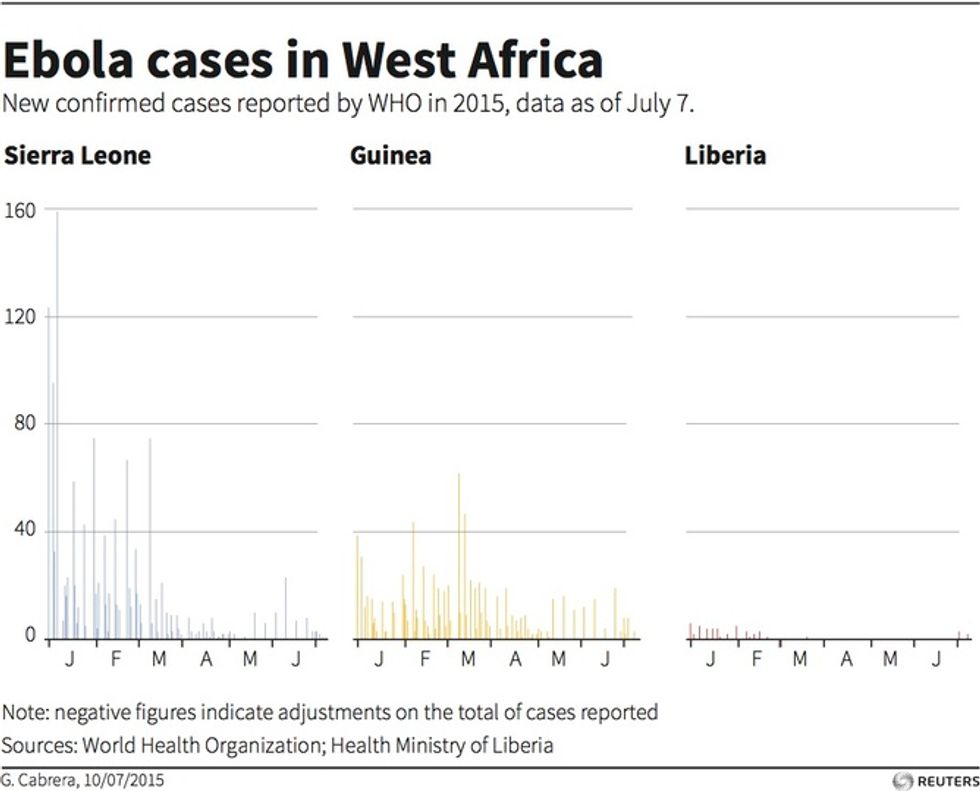
On the decline. New confirmed Ebola cases reported by WHO in 2015.
Reuters
Reason #3: The possibility of statistical flukes
When investigators were following study participants to see if the vaccine prevented Ebola, the total number of Ebola cases was shrinking rapidly. That is good news for people living in West Africa but problematic for the study. With such a small number of total cases, comparisons between immediate and delayed vaccinees become harder to make with confidence, because statistical flukes can occur.
How easily could a fluke event have thrown off the results?
Let’s go back to those nine cases of Ebola in the immediate vaccination group. Imagine if just a few of them were cases of vaccine failure, and in fact, were cases where Ebola virus disease developed after vaccination. Further, what if a few immediate vaccinees lived in communities where infection control measures were better, coincidentally, than in communities where vaccination was delayed? Perhaps immediate vaccinees were less likely to encounter Ebola because burial practices were less risky in their communities, by chance, or there was a better supply of gloves and other protective equipment. If both easily imaginable circumstances occurred in just a few cases, vaccine efficacy could be much lower than 100% and our public health messaging would be considerably more muted.
The study investigators took meticulous steps to prevent each of these problems, and they argue persuasively that it is unlikely the protection they saw from rVSV-ZEBOV was entirely due to chance. I agree. The point is that it is easy to imagine ways the vaccine is far less than 100% effective, and even possible (if unlikely) the vaccine provided no protection whatsoever. The reasonable doubt that remains is why most vaccines are tested and then retested in placebo-controlled clinical trials so that the public can trust us when we say vaccines work.
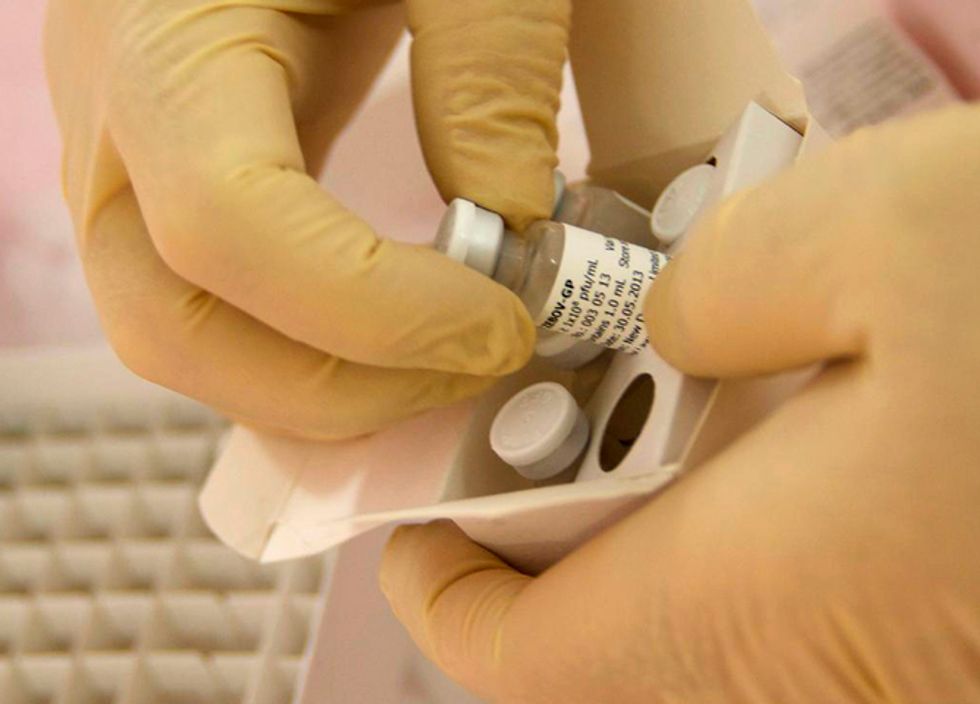
Scientists at the National Microbiology Lab in Winnipeg, Manitoba, prepare an experimental Ebola vaccine for shipment to the World Health Organization in Geneva.
Reuters/Public Health Agency of Canada/Handout
Despite need for more info, we aren’t likely to get it
In response to this uncertainty, Lancet editorialists were properly guarded about the vaccine. They wrote, “More data on efficacy are needed before it can be widely deployed.”
More data are needed – but we will probably never get more data. Ebola is burning out in western Africa. That means it is becoming increasingly impossible to test the efficacy of any intervention against Ebola. This is one reason that the clinical trial results for the rVSV-ZEBOV vaccine were released earlier than expected: the data safety and monitoring board for the trial recognized that with so few cases of Ebola, the trial could no longer acquire meaningful efficacy data. That means the Guinea rVSV-ZEBOV vaccine trial is likely to remain the best evidence we have for an effective Ebola vaccine for a long time.
Ordinarily, the next step would be to prove vaccine efficacy beyond a shadow of a doubt by comparing the vaccine to placebo in a large randomized clinical trial. To get this done, we would need to wait for the next time Ebola emerges in some remote village in Guinea or a neighboring country, and then mount the mother of all Ebola vaccine trials designed to prove that the magic bullet we seek is really in hand.
We will probably never take this step. Just as many scientists decried placebo-controlled studies amid the present Ebola epidemic, surely any future resurgence of Ebola cases will be accompanied by a similar hew and cry. In fact, the critique will be even more vehement: with a vaccine already touted as “100% effective,” how can we possibly deny it to people at risk of death in days? As a harbinger of this conversation to come, upon release of the rVSV-ZEBOV study results, the study data safety and monitoring board recommended and ultimately Guinean ethics authorities approved of immediate rVSV-ZEBOV vaccination for all people in the study region who were newly exposed to Ebola.
Are we lowering our standards for vaccines in the developing world?
In a time when we benefit from a panoply of effective vaccines, it is easy to assume all vaccines work well. Yet many vaccine candidates have failed. To list a few, there are failed vaccines against herpes simplex virus and Staphylococcus aureus and even two HIV vaccines that seemed to increase the risk of HIV infection. The reason we test vaccines in rigorous placebo-controlled trials is to avoid exposing the public to vaccine duds, or worse.
Does our well-founded fear of Ebola, and our equally legitimate fear of unethical placebo research in Africa, convince us that people in West Africa should be given a vaccine that hasn’t been proven effective using the same standards as vaccines given in the rich countries of the world?
It might be politically easier, and logistically expedient in the short term, to answer “yes.” But, in the long run, I fear saying “yes” will make it harder to deliver to low- and middle-income countries vaccines of the same quality as are used in rich countries.
That is why it is so important to know whether the Ebola vaccine was 100% effective, or 100% lucky. The good money is on a percentage somewhere in between, but in truth, I doubt we will ever know.