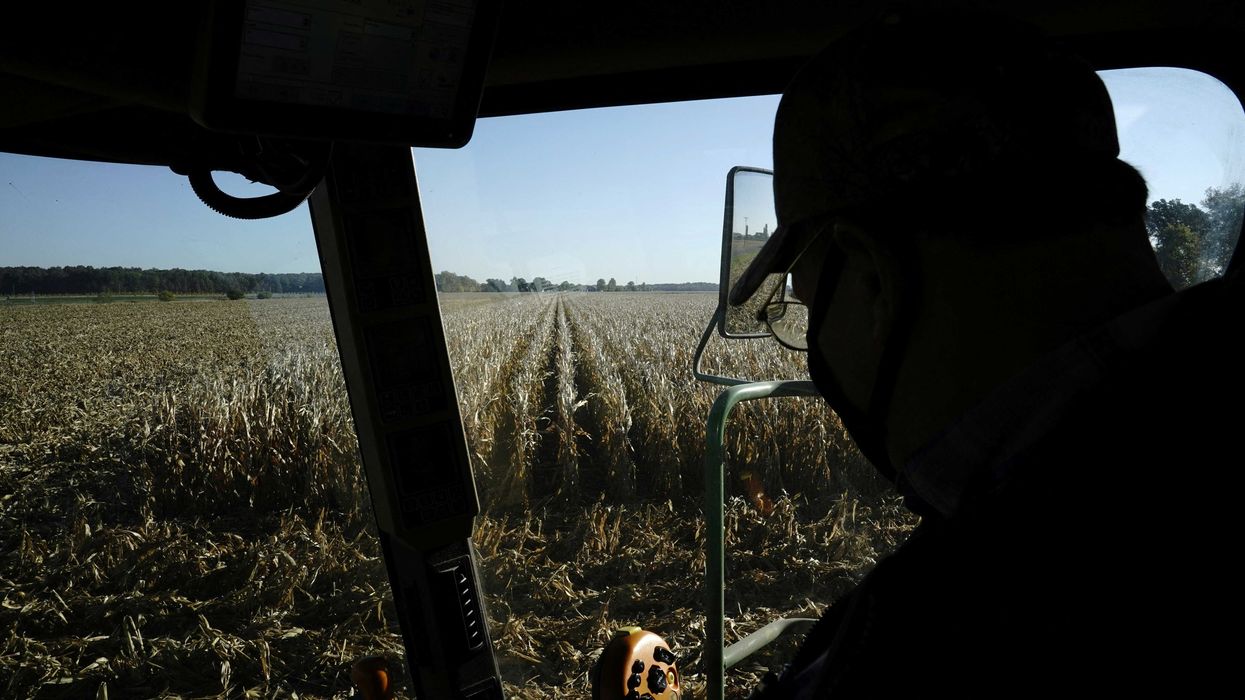
FILE PHOTO: Roger Hadley looks out through the windshield of his John Deere combine at his corn fields on his corn and soybean farm in Woodburn, Indiana, U.S., October 16, 2020. Picture taken October 16, 2020. REUTERS/Bing Guan/File Photo

American farmers are bracing for two years of pain as fallout from President Donald Trump's war with Iran collides with an unresolved trade war and a punishing Midwest drought, six months into a conflict that has upended the cost of running a farm.
A study by the American Farm Bureau Federation found growers of the nation's nine principal row crops are on track to lose more than $31 billion this year and $32 billion in 2027 – which would mark the sixth straight year of losses on their most important crops – even after federal aid, reported the Financial Times.
"The [Iran] war has made so much uncertainty for us as farmers," said Pam Johnson, who farms in northern Iowa and is a former president of the National Corn Growers Association. "It's projected that farmers aren't going to make any money for the next two years."
AFBF economist Faith Parum projects corn producers will lose $131 an acre this year and $167 in 2027, while soybean growers face losses of $80 and $138 an acre.
“I am afraid that we’re looking into the barrel of another farm crisis,” Wendy Johnson, a fourth-generation farmer, told the Washington Post, "and we all know historically what that did to our … rural communities.”
Since Trump launched the U.S. attack on Iran in February, slowed tanker traffic through the Strait of Hormuz has pushed crude above $110 a barrel. Anhydrous ammonia, the Corn Belt's dominant nitrogen fertilizer, jumped 36 percent, from $828 to $1,123 a ton, University of Illinois economists found. Diesel has climbed to $5.45 a gallon nationally, up from $3.81 before the war.
"This is the worst financial downturn in the sector since the 1980s," said John Hansen, president of the Nebraska Farmers Union.
Economists say the comparison isn't exact — farms carry less debt and crop insurance is now widespread — but Chapter 12 farm bankruptcies still rose 46 percent nationally in 2025, with Midwest filings up 70 percent.
China has resumed soybean purchases under a deal reached after a Trump-Xi summit, but accounted for less than 30 percent of U.S. soybean exports from September through March — roughly half its pre-trade-war share.
"It almost comes across as a Band-Aid," said Andrew Muhammad, a University of Tennessee agricultural economist.
The administration requested $11 billion in emergency aid in June, on top of a $12 billion package from December, but AFBF's own analysis shows the assistance doesn't close the gap. Republican Sen. Thom Tillis (R-NC) warned this week that with 71 days until the midterms, "we don't have a positive message to sell farm country."
Trump has also angered ranchers by waiving tariffs on 300,000 metric tons of imported beef, which Sen. Tim Sheehy (R-MT) said would make it "more difficult for American ranchers to rebuild our herd."
Drought has compounded the losses. The USDA's August report cut corn yield forecasts to 180.7 bushels an acre, well below 2025's record, sending corn and soybean futures higher — a rally that has taken December corn up 10 percent this month to $5.15 a bushel, its highest level since 2023.
Report typos and corrections to corrections@rawstory.com.
For customer support contact support@rawstory.com.