




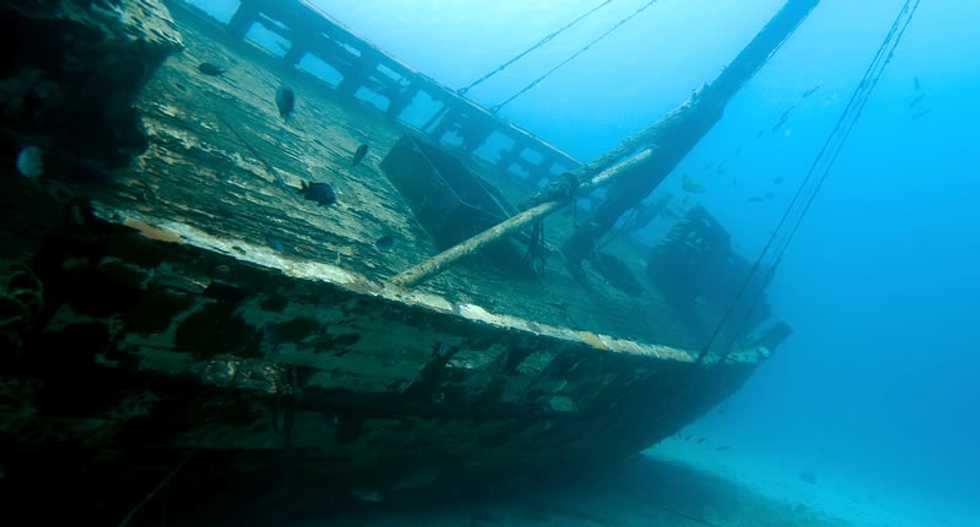
Archaeologists working on the wreckage of the pirate Blackbeard's ship, the Queen Anne's Revenge, have unearthed medical equipment that demonstrates just how unhealthy the life of an 18th Century pirate could be, Live Science reports.
The Queen Anne's Revenge was a former slave vessel that Blackbeard captured, in part, because its crew was so ill they could not effectively fight back. He did, however, retain the three French surgeons who were on the boat at the time he captured it, and only abandoned the vessel after it ran aground off the coast of North Carolina in 1718.
The wreckage was discovered in 1996, and archaeologists working with the Queen Anne's Revenge Project have been excavating ever since. Recently, they have found a number of medical artifacts -- the engravings on many of which indicate their French origins -- that illustrate the difficulty of keeping men in fighting condition.
One of the project's curators, Linda Carres-McNaughton, said that "[t]reating the sick and injured of a sea-bound community on shipboard was challenging in the best of times." Blackbeard's underlings would have had to contend with circumstances such as "chronic and periodic illnesses, wounds, amputations, toothaches, burns and other indescribable maladies."
One of those "indescribable maladies" was syphilis -- and the "cure" for it was almost as bad as the disease itself. Archaeologists discovered a "urethral syringe" that would have been used to inject mercury, which would alleviate the symptoms of syphilis.
[caption id="attachment_688296" align="alignnone" width="615"] Photo credit: N.C. Department of Cultural Resources[/caption]
Also found in the wreckage was a "clyster pump," which would have been used to pump fluid into the rectum to treat severe cases of dehydration.
[caption id="attachment_688297" align="alignnone" width="370"] Photo credit: N.C. Department of Cultural Resources[/caption]
Live Science contributor Owen Jarus noted that medical supplies and equipment were so crucial to Blackbeard's survival that he and his crew once blockaded the port of Charleston, South Carolina.
They took the crew and passengers of boats attempting to enter the port hostage, and threatened to "murder all their prisoners, send up their heads to the governor, and set the ships they had taken on fire" if the governor did not send them a chest full of medical supplies -- which according to Capt. Charles Johnson's 1724 account, he promptly did.
