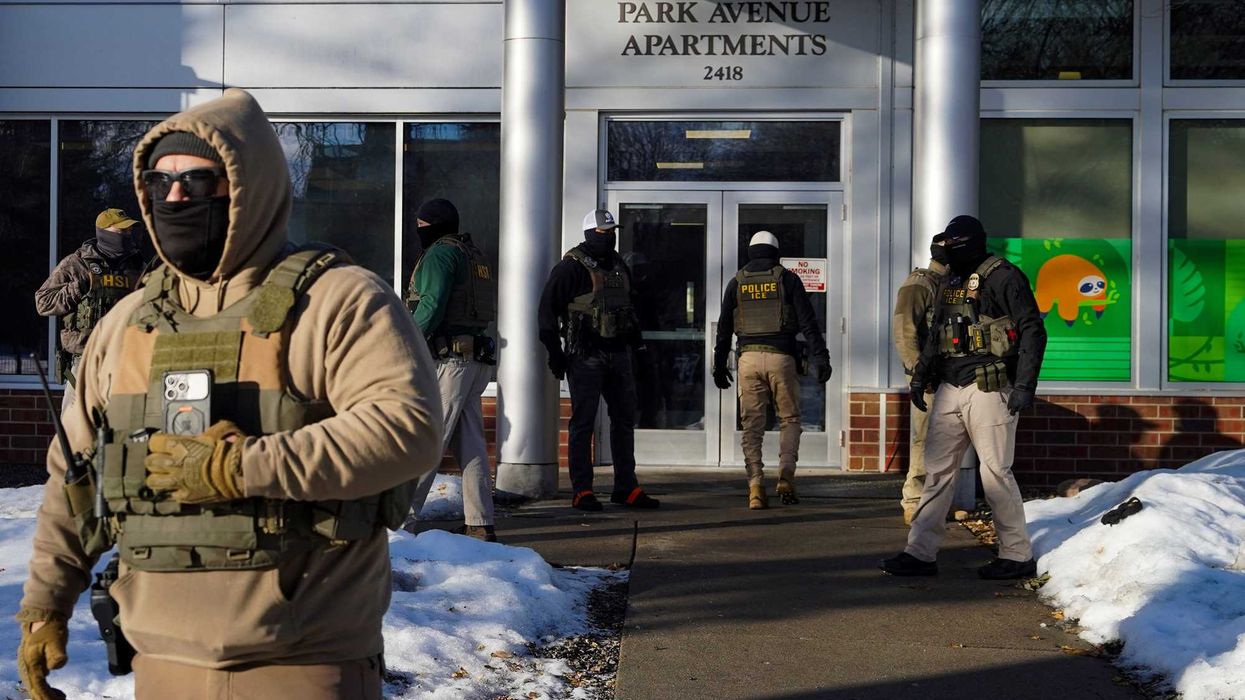
Immigration and Customs Enforcement (ICE) agents conduct an immigration raid days after an ICE agent fatally shot Renee Nicole Good, in Minneapolis, Minnesota on Jan. 13, 2026. REUTERS/Ryan Murphy

In a rare reversal, the Justice Department has secured a federal grand jury indictment against an ICE officer accused of lying about a shooting during last winter's immigration crackdown in Minnesota.
According to The New York Times, a grand jury indicted Christian Castro on charges of "making false statements" about the January shooting, marking an unusual instance of Trump's Justice Department accusing one of its own agents of criminal wrongdoing on the job.
The indictment remains under seal, with officials expecting to make their case in public once Castro is taken into custody, according to the report.
Castro was among thousands of federal agents deployed to Minnesota during "Operation Metro Surge," a campaign local officials opposed that led to thousands of arrests and repeated clashes with residents, the Times reported.
Agents shot three people during the operation, killing two U.S. citizens, Renée Good and Alex Pretti, the report stated.
Castro now stands accused of shooting and wounding Julio Cesar Sosa-Celis, a Venezuelan national without legal status, on Jan. 14, according to the Times.
"Top Trump administration officials initially came to Mr. Castro’s defense," the Times reported. "But in contrast to the administration’s position in other shootings, federal officials publicly distanced themselves from Mr. Castro in the weeks that followed. Criminal charges against Mr. Sosa-Celis and another man were dropped, Mr. Castro was suspended, and video footage emerged that contradicted key aspects of the initial federal account."
Hennepin County prosecutors charged Castro with second-degree assault in state court in May, according to the report. He was arrested in Texas that month and jailed for roughly three months after Texas Gov. Greg Abbott refused to sign off on his extradition — prompting Minnesota to sue Abbott in federal court.
A judge sided with Abbott, and Castro was released last week under a Texas law capping extradition detentions at 90 days. He has yet to answer the state charges, and it's unclear whether he has retained a lawyer for the federal case.
Report typos and corrections to corrections@rawstory.com.
For customer support contact support@rawstory.com.