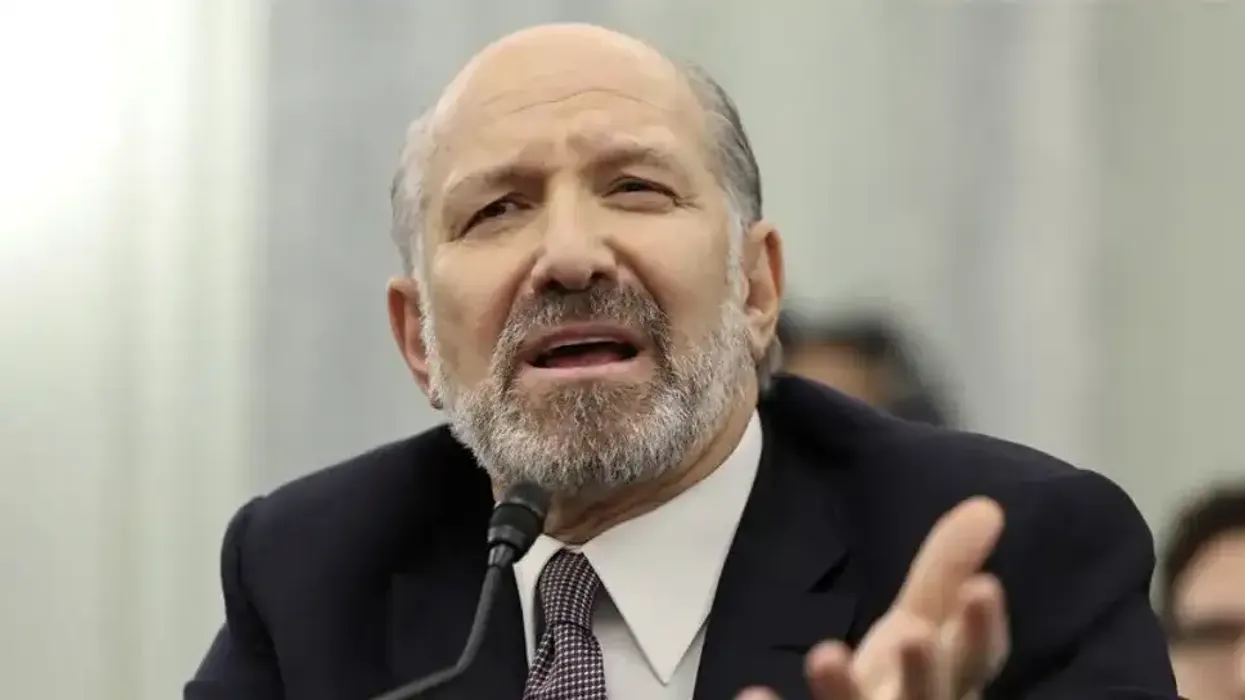
Donald Trump delivers remarks at the U.S. Ambassador's Residence in Tokyo. REUTERS/Evelyn Hockstein

Experts quoted in a controversial New York Times report are pushing back on it, with one blasting the outlet outright, as critics accuse the paper of handing the Trump administration a pretext to commit war crimes.
“These hacks are playing semantic games. Beyond disgusting,” wrote sanctions scholar Ali Ahmadi in a social media post on X.
Published on Monday and written by Sanam Mahoozi and Erika Solomon, the report characterizes some of the quoted experts as having “concluded that the water projects may have been developed to support the country’s military buildup.”
Attacking civilian infrastructure is generally a war crime unless the target also serves a military purpose, and even then, legal scholars say, the military gain must outweigh the civilian harm. President Donald Trump has openly threatened to “blow up” Iran’s power plants and desalination facilities.
Promoting the report on social media, Mahoozi wrote the following: “Experts point to an intriguing overlap with military sites. Could some water projects have served to support Iran’s military buildup? No conclusive evidence—but questions worth asking.”
She also included the hashtags “#IranWar” and “#MissileCity,” though subsequent social media posts similar to her initial one excluded the “#MissileCity” hashtag.
Kaveh Madani, a former deputy head of Iran’s environment department who now leads the UN University Institute for Water, Environment and Health, ripped into the report on X.
“Speculation is not evidence. Spatial proximity is not causality,” Madani wrote, calling the piece “irresponsible journalism with potentially dangerous consequences for civilian water infrastructure.”
“The New York Times should know better,” he added.
Madani also said his own words had been pulled into an argument he never made.
“I’m one of the people quoted in the article, but my comments had nothing to do with dams or missiles!” he posted.
Nima Shokri, the Hamburg University of Technology researcher whose dam mapping anchored the story, also put distance between himself and its implications.
“The proximity of dams to military targets does not establish why those dams were built, nor does it justify attacks on them,” Shokri wrote. “I strongly oppose attacks on dams and civilian water infrastructure, regardless of who carries them out.”
Amir AghaKouchak, a UC Irvine researcher the Times also cited, sided with Shokri.
“Dams and water infrastructure are essential to civilian life and must never become targets of military attacks,” he wrote.
As outrage over the story spread, the Times stood firm. Spokesperson Nicole Taylor argued that “framing the independent reporting as a pretext for violence is dangerous.” Mahoozi, according to an X translation of her Persian-language post, acknowledged the article had “faced widespread attacks,” some of which she suggested had stemmed from “a misunderstanding of the report’s main message.”
Countless critics argued the paper couldn’t walk the story back.
“No no, you need to own this. You all knew exactly what you were doing when you published this,” independent journalist Caitlin Johnstone wrote in reply to Mahoozi. “You knew exactly what this story would be used to justify.”
“You are doing what NYT did in the run up to the illegal war on Iraq over 20 years ago. You own this,” wrote Columbia University social work lecturer Anthony Zenkus.
In comments carried by Al Jazeera, analyst Rami Khouri described the story as “another attempt to support the US-Israeli urgency to find any reason to carry out more war crimes against Iran.”
Iranian leaders seized on the controversy. Parliament Speaker Mohammad Bagher Ghalibaf, Iran’s chief negotiator, mocked the story’s logic: “New rule: Any dam, port, or power plant near a US or Israeli base is dual-use. We’ll apply your logic consistently and even-handedly.”
The backlash is unfolding while Trump openly threatens to restart the bombing. He warned last week that the U.S. could take out vital Iranian infrastructure in a span of three days, according to Al Jazeera.
Report typos and corrections to corrections@rawstory.com.
For customer support contact support@rawstory.com.