"The pressure is working," said Indivisible. "We need to hear from Bolton and the other witnesses who know exactly how egregious Trump's abuse of power was."
President Donald Trump fired off a pair of tweets Tuesday night ranting about what he called the "impeachment hoax" and "political con job" shortly after Senate Majority Leader Mitch McConnell reportedly admitted in a closed-door meeting with GOP lawmakers that he doesn't have the votes to stop witnesses from being called to testify in the ongoing trial.
"No matter how many witnesses you give the Democrats, no matter how much information is given, like the quickly produced Transcripts, it will NEVER be enough for them," Trump tweeted. "They will always scream UNFAIR."
In a separate tweet hours later, Trump asked why former national security adviser John Bolton—the most prominent potential witness with first-hand knowledge of the president's actions—didn't "complain about this 'nonsense' a long time ago, when he was very publicly terminated."
Bolton alleges in an unpublished book manuscript that Trump said he wanted to withhold congressionally approved aid to Ukraine until that country agreed to launch investigations into former Vice President Joe Biden and his son, Hunter.
The president's tweets came after McConnell reportedly told fellow Republican senators that he lacks the votes to continue blocking witnesses for the Senate trial, stonewalling that Democratic lawmakers and other critics have described as a cover-up. Just four Senate Republicans would have to vote with Democrats to approve witnesses.
"He's desperate," Rep. Eric Swalwell (D-Calif.) wrote in response to Trump's tweets, urging the public to continue calling GOP senators who could vote to call witnesses.
According to the Wall Street Journal, McConnell told Republicans following the final day of presentations from Trump's defense team that the "vote total wasn't where it needed to be on blocking witnesses or documents."
"He had a card with 'yes,' 'no,' and 'maybes' marked on it, apparently a whip count, but he didn't show it to senators," the Journal reported. A vote to approve witnesses for the Senate trial is expected to take place Friday.
"The pressure is working," declared progressive advocacy group Indivisible, which has been driving calls Republican senators. "This is huge. We need to hear from Bolton and the other witnesses who know exactly how egregious Trump's abuse of power was."
"This is no time to ease up—keep calling every day until the vote," the group added.
MSNBC's Joe Scarborough warned Republican senators that "an avalanche of incriminating information about Donald Trump" would be revealed in the coming months -- and he urged them to get ahead of the deluge before the impeachment trial ends.
The "Morning Joe" host said they're betting that voters will forget their impeachment coverup by Election Day, but Scarborough said that's a risky gamble.
"Whether it comes out tightly confined in the Senate trial or whether it just gets blown out all over the airwaves over the next two for three months, that information is going to come out," he said, "which is going to include a lot of incriminating information about Donald Trump, which is going to lead to more incriminating information about Donald Trump, which is going to lead to an avalanche of incriminating information about Donald Trump."
New reports Wednesday morning show the president tried to kill investigations into a corrupt Turkish bank and possibly into Chinese entities for his own personal financial reasons, and Scarborough said that won't be the end of these damaging stories.
"Why don't we look into the crystal ball," Scarborough said. "How bad does this look for them the last week of the election, when we know so much more then than we know now, and they are the ones who voted to stop Americans from learning the truth about Donald Trump?"
Trump might somehow survive this onslaught of damning evidence, Scarborough said, but he doubted that individual Republican senators could.
"In Trumpworld you never think about tomorrow," he said. "In Trumpworld there never are consequences. In (Martha) McSally world -- oh, she's already seen there are consequences. You lose elections. Cory Gardner, he's seeing that, too. He's getting pounded right now in the polls, he's upside down, his favorability. Joni Ernst blathered a couple days ago on television, said something really stupid, she used her outside voice when she should have kept her thoughts inside and revealed that everything she is doing in this political conspiracy with Donald Trump, where she's parroting every word that Donald Trump wants her to say proves that this whole exercise has been to slander Joe Biden, to attack Joe Biden."
These senators aren't Donald Trump, the host said, and they will face voter wrath in November.
"I just wonder if these senators really have convinced themselves that they can shoot somebody on Fifth Avenue and get away with it," Scarborough said.
While political parties in both Australia and Britain have recently moved towards leadership contests that give more say to ordinary party members, nothing matches the democratic scale of the American process to nominate presidential candidates.
The Democratic nomination contest, which begins on Monday with the Iowa caucuses and then continues with the New Hampshire primary on February 11, looks and feels a lot like the presidential election that will be held in November.
In 2016, 57.6 million voters participated in the primaries or caucuses to choose the Republican and Democratic candidates, which was just shy of the record turnout in the 2008 contests.
The amount of money now invested in these nominating contests is staggering, as is the attention focused on them by the media.
Americans have not always chosen presidential candidates this way. Throughout the early days of US politics, state party leaders chose candidates at the national conventions in a deal-making process mostly hidden from ordinary citizens.
A few states adopted primaries early in the 20th century as part of the progressive revolt against elite control of all institutions. Party leaders still made the final choice, but primaries served as a useful “beauty contest” to test a candidate’s viability in the presidential election.
The turning point came with the Democratic National Convention of 1968, a violent affair at the height of the Vietnam War. The vast majority (80%) of the votes in the 13 state primaries that year had gone to anti-war candidates, but party leaders swung the convention to the pro-war vice president, Hubert Humphrey, who hadn’t contested the primaries and went on to lose the election to Richard Nixon.
This bitter and divisive event led to reforms in the Democratic Party that made primaries the main means of selecting candidates. Republicans quickly followed suit, and by 1976, primaries and caucuses decided the nominees for both major parties.
In another quirk of the process, candidates are awarded a certain number of delegates depending on how they fare in these nominating contests. The final vote for the nominee takes place among these delegates at the national party conventions in July and August.
Technically, the delegates decide, but they nearly always affirm the results already decided in the primaries.
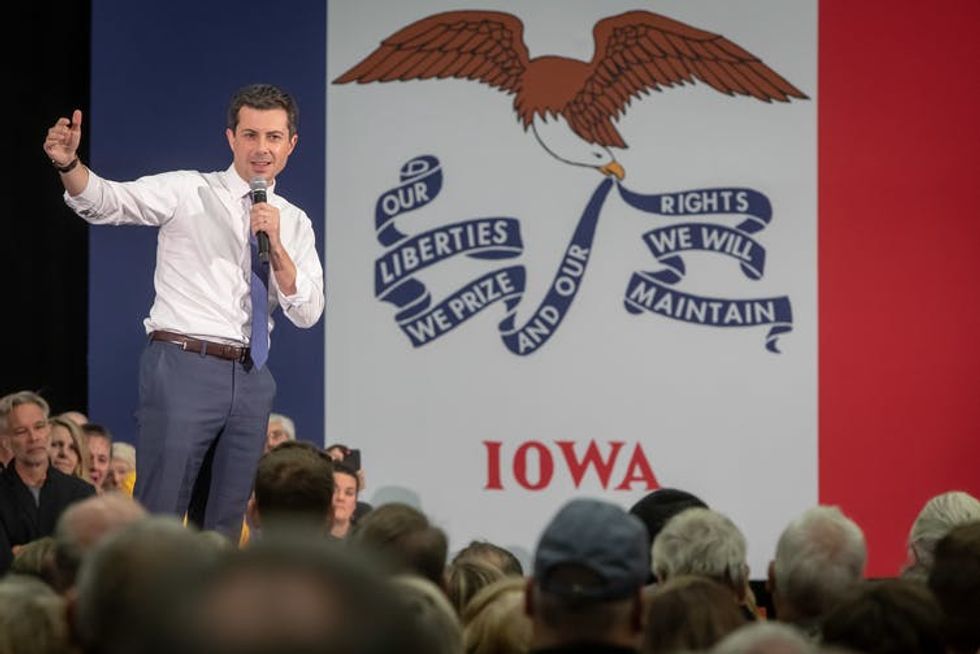
Because of the US voting system, presidential candidates like Pete Buttigieg focus an inordinate amount of attention on states like Iowa.
Gary He/EPA
Declining influence of the parties
Despite this democratic reform, the party elites didn’t entirely lose power.
An landmark study published in 2008 examined the importance of the “invisible primary” before voting even begins. In this process, party leaders effectively vet candidates and choose a front-runner to support during the actual primaries and caucuses.
When party leaders coordinate with each other, the authors found, they nearly always get their preferred candidate.
This model has been highly influential, but has required serious re-evaluation since the 2016 election when Donald Trump won the Republican nomination despite fierce opposition from party elites.
Trump’s nomination showed the weakness of the party “establishment” compared to the sheer force of celebrity. His ability to command media attention far outweighed endorsements from party leaders during the nominating process.
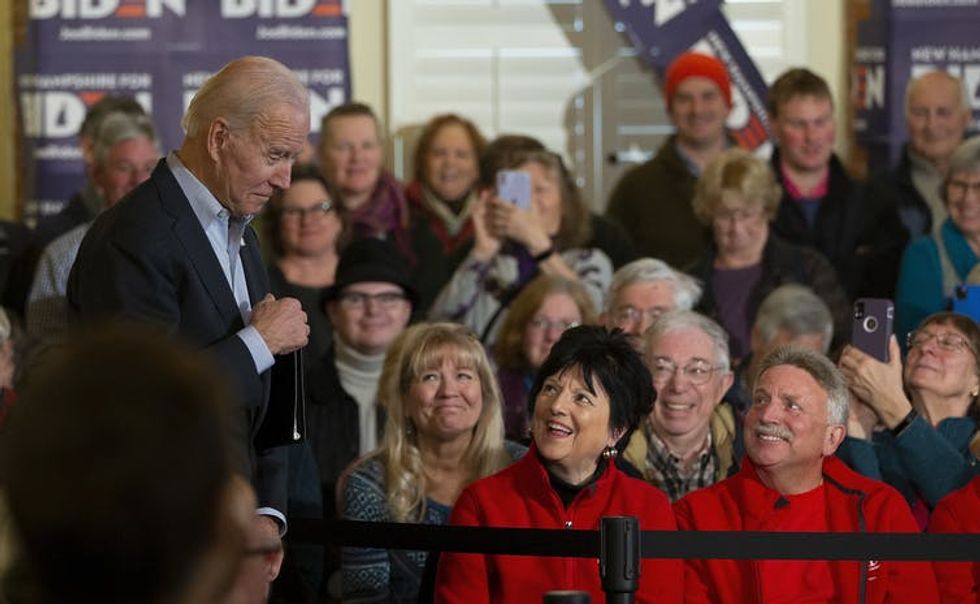
Joe Biden has spent considerable time in New Hampshire ahead of the first primary on Feb. 11.
CJ Gunther/EPA
The power of Iowa and New Hampshire
As in presidential elections, the outcome of the nominating contests is determined state by state, not by a single popular vote. And as in presidential elections, not all states are created equal.
States vote at various times between February and June, and a huge amount of attention is given to the states voting first.
Iowa comes first with its caucuses (small gatherings of voters that discuss candidates and choose delegates), followed soon after by New Hampshire with its primary (a straightforward ballot election). South Carolina and Nevada round out the voting in February before the Super Tuesday contests on March 3, when more than a dozen states vote.
With a large field of candidates, Iowa and New Hampshire play a crucial role in giving some candidates momentum, while denying others a pathway to the nomination. It’s not unusual to see candidates drop out after these contests, despite the fact there are still 48 states left to vote.
To make matters more complicated, every state and territory has its own rules on how primaries and caucuses are conducted.
Iowa earned its first-place status because its unique process takes so long. Iowans will meet at more than 1,600 caucus sites on Monday to choose delegates to go to county conventions. Those representatives will then select delegates for the state convention, where it will be decided how Iowa’s delegates to the national convention will be divided up.
This system was devised to give more power to grassroots activists. It often results in chaos. In 2016, there were ties at some caucuses with results decided by games of chance, and the Iowa Democratic Party unilaterally changed one result.
The Democratic National Committee has since imposed new rules to make the process clearer and more transparent.
The problem of race
Another problem is that Iowa and New Hampshire are both whiter and more rural than the rest of the country. Both states are particularly unrepresentative of the Democratic Party electorate, which is more than 40% non-white.
Though Iowans are proud of giving Barack Obama a crucial, early win in 2008, no African-American or Latino candidates gained enough traction in these early states this time around to even make it to the voting.
Julián Castro, one of those minority candidates who has already dropped out, said last year that Democrats can’t
complain about Republicans suppressing the votes of people of color, and then begin our nominating contest in two states that hardly have people of color.
Castro is not alone with this complaint, though others have argued that white and non-white Democratic voters have similar preferences this time around.
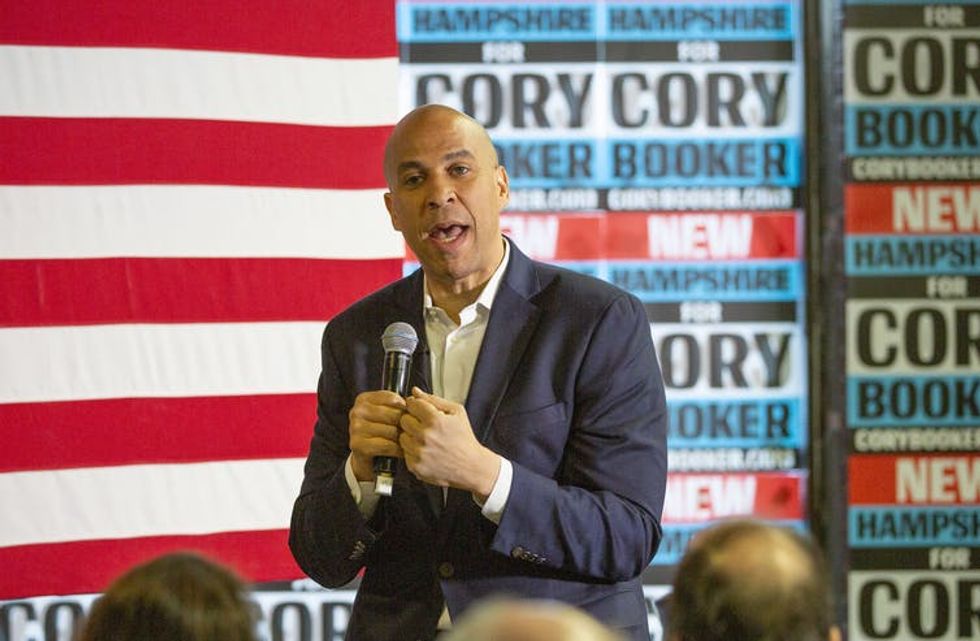
Cory Booker was one of several minority candidates who dropped out of the presidential race before the Iowa caucus and New Hampshire primary.
CJ Gunther/EPA
There have beenattempts since the 1970s to reduce the importance of these two states in the nominating process, but they have fiercely resisted change.
New Hampshire has enshrined in law that it must hold its primary before any other state. And even without Republican challenger to Trump this year, the Iowa Republican Party is still holding its laborious caucuses.
we cannot go one year without Iowa first-in-the-nation or we are done.
Little momentum for change
The nominating system, then, is a huge and unwieldy monster. Other than the reforms of the 1970s, there has been little conscious design of nominating institutions.
Instead, haphazard bargains have hardened into historical legacies. The
constitution also has nothing to say about political parties and provides no guidance on how nominations could or should be done.
There may be widespread dissatisfaction with the length and expense of primary campaigns, the outsized influence of early states and the ugly conflicts primaries cause before the real election even begins.
But major reforms are unlikely in the near future. As a result, those who want to succeed must master an arcane system, not try to change it.
President Donald Trump’s impeachment trial is shifting to questions from senators, a pivotal juncture as Republicans lack the votes to block witnesses and face a potential setback in their hope of ending the trial with a quick acquittal.
After Trump’s defense team rested Tuesday with a plea to “end now”, Senate Majority Leader Mitch McConnell privately told senators he did not yet have the votes to brush back Democratic demands for witnesses now that revelations from John Bolton, the former national security adviser, have roiled the trial.
Bolton writes in a forthcoming book that Trump told him he wanted to withhold military aid from Ukraine until it helped with investigations into Democratic rival Joe Biden. That assertion, if true, would undercut a key defense argument and go to the heart of one of the two articles of impeachment against the president.
“I think Bolton probably has something to offer us,” said Senator Lisa Murkowski, Republican from Alaska.
Not in Trump’s view. “Why didn’t John Bolton complain about this ‘nonsense’ a long time ago, when he was very publicly terminated,” Trump tweeted shortly after midnight. “He said, not that it matters, NOTHING!”
The uncertainty about witnesses arises days before crucial votes on the issue. In a Senate split 53-47 in favor of Republicans, at least four GOP senators must join all Democrats to reach the 51 votes required to call witnesses, decide whom to call or do nearly anything else in the trial. Several Republicans apparently are ready to join Democrats in calling witnesses.
The two days set aside for questions, Wednesday and Thursday, also allow each side more time to win over any undecided senators pondering the witness issue. In the meantime, all will have the opportunity to grill both the House Democrats prosecuting the case and the president’s defense team.
Held to submitting written questions to be read by Chief Justice John Roberts, senators are expected to dig into the big themes of the trial – among them whether what Trump did or may have done rises to the level of “high crimes and misdemeanors” – as well as pointed and partisan attacks on each side’s case.
Trump faces charges from Democrats that he abused his power like no other president, jeopardizing US-Ukraine relations by using the military aid as leverage while the vulnerable ally battled Russia. Democrats say Trump then obstructed their probe in a way that threatens the nation’s three-branch system of checks and balances.
The president’s legal team tried to lock up its case Tuesday and convince GOP senators that the president was right to ask Ukraine for investigations of Biden and his son Hunter and was well within his power to block the aid. They said he was not bound to abide by the congressional investigation.
Trump complained anew at a Tuesday night rally in Wildwood, New Jersey, charging that “congressional Democrats are obsessed with demented hoaxes, crazy witch hunts and deranged partisan crusades".
Trump attorney Jay Sekulow addressed the Bolton controversy head-on in closing arguments by dismissing the former national security adviser’s manuscript as “inadmissible”. Attorney Alan Dershowitz, the Harvard scholar, said earlier that even if Bolton’s story is true the actions don’t rise to an impeachable offence.
Senate Republicans spent considerable time in private discussing how to deal with Bolton’s manuscript without extending the proceedings or jeopardizing the president’s expected acquittal. That effort lost steam as Democrats showed no interest, Minority Leader Chuck Schumer saying, “We’re not bargaining with them.”
GOP senators were warned that if they agree to call Bolton or try to access his manuscript, the White House will block him, likely sparking a weeks-long court battle over executive privilege and national security.
Nonetheless, Senator Mitt Romney of Utah and Susan Collins of Maine appeared to be backed by others in the move to seek more testimony.
Some Republicans including Senator Pat Toomey want reciprocity – bringing in Bolton or another Democratic witness in exchange for one from the GOP side. Some Republicans want to hear from Biden and his son, who was on the board of a Ukrainian gas company when his father was vice president.
“If people want witnesses, we’re going to get a lot of witnesses,” said Republican Senator Lindsey Graham, one of Trump’s strongest defenders in the Senate.
He said they would want to know, “was it legitimate for the president to believe there was corruption and conflicts of interest on the Bidens’ part in the Ukraine?”
Those swaps, though, seem likely to fail as most Republican senators don’t want to call Bolton and most Democrats would rather avoid dragging the Bidens further into the impeachment proceedings. The Bidens were a focus of defence arguments though no evidence of wrongdoing has emerged.
“I don’t know that the manuscript would make any difference in the outcome of the trial,” said Roy Blunt of Missouri, a member of GOP leadership. And some Republicans said they simply don’t trust Bolton’s word. Senator Rand Paul of Kentucky called Bolton “disgruntled”’ and seeking to make money off his time at the White house.
But John Kelly, Trump’s former White House chief of staff, told an audience in Sarasota, Florida, that he believes Bolton.
“If John Bolton says that in the book, I believe John Bolton,” he said.
White House officials privately acknowledge that they are essentially powerless to block the book’s publication but could sue after the fact if they believe it violated the confidentiality agreement Bolton signed.
Trump and his lawyers have argued repeatedly that Democrats are using impeachment to try to undo the results of the last presidential election and drive Trump from office.
“What they are asking you do is to throw out a successful president on the eve of an election,” said White House counsel Pat Cipollone.
Democrats, meanwhile, say Trump’s refusal to allow administration officials to testify only reinforces that the White House is hiding evidence. The White House has had Bolton’s manuscript for about a month, according to a letter from Bolton’s attorney.
The Republican Party of January 2020 has yet to turn against President Donald Trump in the way that so many Republicans were turning against President Richard Nixon in August 1974, when Nixon decided that it would be easier to resign and let Vice President Gerald R. Ford take over than wait around to be removed from office via an impeachment trial in the U.S. Senate. But former National Security Adviser John Bolton is one right-wing Republican who certainly cannot be accused of having unwavering loyalty to Trump, and conservative Washington Post opinion writer Jennifer Rubin compares Bolton to John Dean in a January 28 column.
“We once speculated that sooner or later, Bolton would figure out that playing the role of John Dean — the once-loyal adviser to President Richard M. Nixon who pulled down the whole administration — is much better for one’s career and book sales than clamming up is,” asserts Rubin, a Never Trump conservative who has been consistently critical of the president.
The New York Times reported over the weekend that Bolton makes a very damning allegation against Trump in a leaked copy of his book, “The Room Where It Happened: A White House Memoir” — which isn’t due out until March 17 but has Trumpistas in a state of rage. The allegation: Trump told Bolton himself that he was making an investigation of former Vice President Joe Biden and his son, Hunter Biden, a condition of military aid to Ukraine — no investigation, no military aid.
“Bolton is already, as one would expect, getting hammered by the Trumpist crowd, which decries his disloyalty,” Rubin explains. “Bolton must have known this was coming and apparently, has decided to leave the Trump cocoon. He has no future with them and no place in the Trump cult. What Bolton does have is the truth, likely backed up by notes that speak to Trump’s impeachable acts, ignorance about foreign policy, affinity for conspiracy theories, oddly sympathetic view of Russia and determination to spout Russian propaganda.”
Bolton, according to testimony from foreign affairs expert Fiona Hill, described Trump’s personal attorney, Rudy Giuliani, as a “hand grenade” who was going to blow up Trump’s administration by pushing for a Bidens investigation in Ukraine. But according to Rubin, Bolton is the one who Trump has to worry about.
“It is not Giuliani who is the grenade ready to blow up the administration,” Rubin writes. “It is Bolton.”
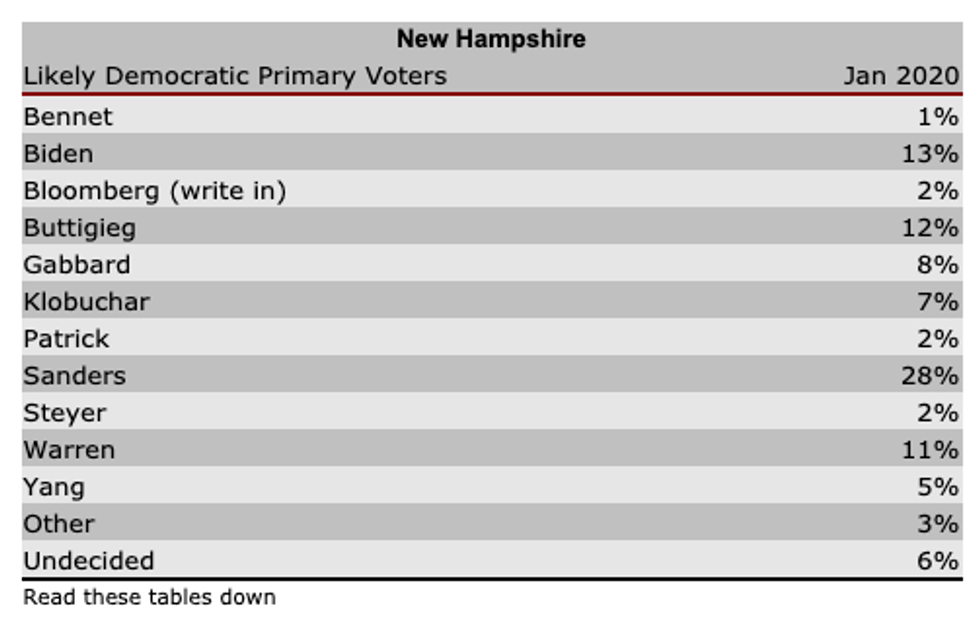
A new poll out of the key early voting state of New Hampshire on Tuesday showed that Sen. Bernie Sanders now has double the support of his next closest rival, former vice president Joe Biden, less than two week's before the first-in-the-nation primary on February 11.
According to the American Research Group survey, conducted between Jan. 24 and Jan. 27, Sanders has the support of 28% of likely Democratic primary voters, compared to Biden's 13%. Coming in third and fourth place in the poll were former South Bend, Indiana mayor Pete Buttigieg with 12% and Sen. Elizabeth Warren with 11%.
Among voters aged 18 to 44, Sanders received 43% of support compared to Biden. Broken down by gender, Biden garnered 6% from women voters while Sanders recieved 25% and Warren recieved 15%.
With a 15-point lead over Biden overall, The Hillnotes that the new ARG poll "shows Sanders with a larger lead than other recent polls have found"—though it does comport with an overall surge seen in numerous states and nationally over recent weeks. "Sanders leads by 8 points in New Hampshire in the RealClearPolitics average," The Hill reported, "with the other most recent surveys finding him ahead by between 5 points and 12 points."
As Common Dreams reported Sunday, it appears the "big-monied interests are getting very nervous" as polling continues to move in the direction of the senator from Vermont.
The race to take on Donald Trump begins in earnest Monday in Iowa with Democrats struggling to identify a clear-cut presidential challenger, as the crowded contest heads to a photo finish in the heartland state.
Liberal Senator Bernie Sanders and the more moderate former vice president Joe Biden, both in their seventies, are setting the pace days before the first-in-the-nation Iowa caucuses.
But the two frontrunners' divergent political views suggest Democrats remain undecided on which path -- revolution or realism -- their party torchbearer should take as they battle to avoid a Trump re-election in November.
With many Iowa voters still undecided, the race remains fluid, bringing uncertainty to a contest watched closely by voters nationwide, and no doubt by Trump himself.
As 12 Democrats make their final pitches to voters, Sanders this week jumped into a narrow lead in Iowa polling over Biden, the 77-year-old national frontrunner.
The vote in the sparsely populated, snow-covered Midwestern battleground serves as the starting gun for the long election slog ahead, when Democrats decide whether to nominate a far-left firebrand like Sanders, 78, or tack towards the political center.
Monday will likely be a springboard for the top-performing candidates who can claim all-important momentum heading into the race's next chapters: New Hampshire on February 11 and Nevada February 22.
Pressure to perform is intense: a poor showing in Iowa is likely to send a candidate packing.
A handful of hopefuls have a realistic shot at winning the state.
South Bend, Indiana's centrist ex-mayor Pete Buttigieg is polling in third in Iowa, followed by Senator Elizabeth Warren, 70, who more closely aligns with Sanders and who has lost some polling steam in recent weeks.
Pragmatist 59-year-old Senator Amy Klobuchar from neighboring Minnesota is a wild card looking to score a major upset, as is tech entrepreneur Andrew Yang, 45.
With polls fluctuating and the race tight, few observers are making definitive forecasts.
On Tuesday a center-left thinktank warned Americans against choosing Sanders, a self-described Democratic socialist, to challenge Trump.
If Democrats nominate Sanders, "Trump's odds of winning a second term go up dramatically, which is why Team Trump has labeled him their 'ideal' nominee," the group Third Way said in an open letter to Iowa Democrats.
Biden claims Trump is terrified of facing him in November, and the former vice president points to Trump's pressure on Ukraine last year to investigate Biden and his family -- an accusation at the heart of Trump's impeachment -- as evidence.
Trump's defense team repeatedly focused on Biden this week as it argued its case in the Senate impeachment trial, saying calls to investigate the Bidens were appropriate because Biden's son Hunter served on the board of a Ukrainian gas company accused of corruption.
"The whole impeachment trial for Trump is just a political hit job to try to smear me because he's scared to death to run against me," Biden told a campaign rally Tuesday in Muscatine, Iowa.
Whether Trump's anti-Biden effort will singe the candidate is yet to be determined.
But the impeachment process has weighed on Iowa in another way: Senators Sanders, Warren and Klobuchar are pinned in Washington during the trial, forcing them to campaign for Iowa votes with one hand tied behind their back.
Klobuchar made a point of high-tailing it back to Iowa Tuesday after the trial adjourned, seizing the overnight break to campaign in Council Bluffs.
Meanwhile others were barnstorming the state unencumbered by Washington duties.
They include Buttigieg, a 38-year-old gay military veteran, who was urging voters to "turn the page" -- apparently not just from Trump, but the aging Democratic establishment too.
"If we want to win... we've got to be ready to do something different, and I think the biggest risk we could take is to try to recycle the same old approach," he told reporters in Ottumwa.
With everything to play for, campaigns have deployed thousands of volunteers to knock on Iowa doors in a bid to enlist support. Television advertising is incessant.
But Iowans are used to face-to-face intimacy with candidates, who spend countless hours personally courting individuals in the months-long run up to the vote.
Iowa Democrats participate in caucuses, meetings where candidates are selected through a cherished if convoluted process that includes sales pitches from a presidential hopeful's representatives, and sometimes extensive debate, before votes are cast.
Some Iowans "actually feel they have a moral responsibility to push the candidates to take positions and explain themselves," Iowa State University professor Steffen Schmidt told AFP.
Caucus participants "take politics very seriously."
On CNN Tuesday, Sen. Rand Paul (R-KY) tried to downplay President Donald Trump's extortion scheme in Ukraine by claiming that President Barack Obama did something similar in Egypt several years before — and anchor Wolf Blitzer promptly shot down his comparison.
"I think that the question is whether or not the president's pause on foreign aid is an impeachable offense," said Paul. "President Obama paused it twice, and once to the Egyptians and never gave the aid to the Ukrainians, and also to el-Sisi, who took over Egypt in a military coup against the will of Congress, and yet nobody talked about impeaching President Obama. I had a specific bill to vote against the Muslim Brotherhood, and I lost. The will was not to stop the aid, and President Obama stopped the aid. It is a good thing, but it was against the will of Congress and against the law. Restarting the aid was against the law, and yet nobody wants to talk about whether or not President Obama obeyed the law."
"But it is one thing to stop the foreign aid if a country is doing something inappropriately and dealing inappropriately with their own people, and taking steps that are counter to the national interests, and in that way, the U.S. Congress is going to be with that aid and the allegation that Bolton and others are making, is that the aid is stopped for political purposes, because the president wanted so-called dirt on Joe Biden," pointed out Blitzer.
Caught in a false comparison, Paul quickly tried to change the subject again.
"But over the last 24 hours, we have heard from the president's team say over and over again that the president was concerned with two main things, burden sharing, that should not be us doling out money, and I have heard him publicly and in private dozens and dozens of times rail about the money that we give away to people, and he was concerned about corruption, and not only the corruption of the Bidens ... but he was concerned with general corruption."
US President Donald Trump's lawyers accused Democrats Tuesday of bringing politically motivated charges in his Senate impeachment trial in an attempt to reverse the 2016 election result, closing their defense with a call for a speedy acquittal.
But the trial was bogged down in a battle over whether former national security advisor John Bolton will be called to testify against his old boss, and Republican counter-threats to subpoena Democratic presidential hopeful Joe Biden and his son Hunter.
"What they are asking you to do is to throw out a successful president, on the eve of an election, with no basis and in violation of the constitution," Trump's lead counsel Pat Cipollone said at the end of defense arguments.
"The American people are entitled to choose their president," he told the senators sitting as the jury. "We urge the Senate to reject these articles of impeachment."
- Low bar -
Trump is accused of cheating in his 2020 reelection effort by pressuring vulnerable ally Ukraine to announce investigations into both Bidens and a debunked Russian conspiracy theory that Kiev helped the Democrats in 2016.
AFP/File / Sergei GAPON Former national security advisor John Bolton could be asked to testify in the impeachment trial against his former boss, President Donald Trump
His Democratic opponents say the president froze vital military aid to Ukraine for two months in summer to pressure President Volodymyr Zelensky to publicly announce the probes, illicitly drawing a foreign nation into US electoral politics.
Over their three-day defense before the Senate's 100 members, Trump's lawyers mostly steered clear of those specific allegations.
Instead they argued that the impeachment case was rooted in "policy differences" and that the charges against him, abuse of power and obstruction of Congress, are too weak and thinly-sourced to justify his removal from office.
They said a conviction would set a precedent for US politics that would result in retribution-driven political battles for years to come.
"The bar for impeachment cannot be set this low," said Jay Sekulow, another Trump lawyer.
"If partisan impeachment is now the rule of the day... future presidents -- Democrats, Republicans -- will be paralyzed the moment they are elected," he said.
- Battle over Bolton -
The trial, which began eight days ago, turns now to senators submitting written questions to the prosecution and defense through presiding Supreme Court Chief Justice John Roberts over the next two days.
AFP/File / STEPHEN MATUREN Republicans say they could demand that Democratic presidential candidate Joe Biden testify
Both sides were gearing for a fight on Friday over calling witnesses, after the bombshell news that a draft of Bolton's forthcoming book offers direct evidence of Trump's wrongdoing.
Bolton reportedly says Trump told him in August that aid to Ukraine, totaling almost $400 million, would stay frozen until Zelensky announces the two investigations.
Trump and his allies have denounced the longtime US diplomat whom Trump fired last September.
"The Witch Hunt continues!" Trump tweeted.
But John Kelly, Trump's second hire as White House chief of staff who lasted around 18 months, declared Tuesday that he trusts Bolton on the matter.
"If John Bolton says that in the book, I believe John Bolton," he said in Florida.
The witness issue threatens to extend the trial beyond what Republicans, who hold a 53-47 majority in the Senate, expected would be a rapid vote to exonerate Trump by this weekend.
Democrats need four Republicans to join them in voting to call witnesses, and after the revelations of Bolton's book, it appeared that threshold could be met.
"I think it's increasingly likely that other Republicans will join those of us who think we should hear from John Bolton," said Utah Senator Mitt Romney.
- 'A lot of witnesses' -
AFP / Jonathan WALTER John Bolton
Adam Schiff, the Democrat leading the House prosecution team in the trail, said calling Bolton was essential for a fair trial.
"Are we going to get a fair trial or not? Is the Senate going to hear from someone everyone knows is a key and important witness to the most egregious of the president's conduct, or are we not?" he said after Tuesday's hearing.
Republicans -- who have leveled vague accusations of corruption at the Bidens without offering any details or evidence -- said they would demand that the father and son testify in exchange.
Democrats believe Republicans would use the appearance to smear the former vice president, a favorite to win the Democratic Party's presidential nomination and challenge Trump for the White House.
Senator Lindsey Graham, one of Trump's staunchest defenders, said they would call multiple witnesses, including the whistleblower whose complaint sparked the investigation into Trump's Ukraine dealings, and a Democratic consultant with Ukraine ties.
"If people want witnesses, we're going to get a lot of witnesses. This idea of calling one and one makes zero sense to me," Graham said Tuesday.
Trump complained the "pathetic" network was trying to be "politically correct" by interviewing a Democratic senator
President Donald Trump predicted "the beginning of the end" for Fox News after it interviewed a Democratic senator, blasting the right-leaning network for its alleged attempt "to be so politically correct."
"Really pathetic how @FoxNews is trying to be so politically correct by loading the airwaves with Democrats like Chris Van Hollen, the no name Senator from Maryland. He has been on forever playing up the Impeachment Hoax," Trump tweeted on Tuesday, after also sharing his complaints about CNN's coverage.
Van Hollen appeared on Fox to discuss the revelations in a leaked book manuscript authored by former Trump national security adviser John Bolton. Van Hollen argued that the response to Bolton's claims will show whether Republican senators truly want an impartial trial, which he said must include witnesses.
"Dems wouldn't even give Fox their low ratings debates. So, what the hell has happened to @FoxNews," Trump tweeted. "Only I know! Chris Wallace and others should be on Fake News CNN or MSDNC. How's Shep Smith doing? Watch, this will be the beginning of the end for Fox, just like the other two which are dying in the ratings. Social Media is great!"
Trump's attack on Wallace came after the host challenged Trump attorney Alan Dershowitz for claiming that a crime must be codified by statute to merit impeachment, which is the opposite of what he argued for former President Bill Clinton.
"We just put the sound bite up where you said it doesn't have to be a crime," Wallace said.
Dershowitz claimed that "academics change their minds all the time."
"It's also what lawyers do . . . depending on the facts of the case and the side they're arguing," Wallace shot back.
Wallace later repeatedly challenged conservative journalist Katie Pavlich for claiming that all witnesses testified to the House by the time the Senate trial began.
"Katie, what you're saying just isn't true," Wallace said. " To say that in the Clinton investigation that these people were interviewed by the House ― one, they weren't ― and . . . the Justice Department refused to carry out the investigation. Get your facts straight."
"From the day I announced I was running for President, I have NEVER had a good @FoxNews Poll," Trump tweeted in October. "Whoever their Pollster is, they suck. But @FoxNews is also much different than it used to be in the good old days."
The latest Fox News polling shows that 50 percent of the country supports Trump's removal from office in the Senate trial. Independents support his removal by a 19-point margin, according to the results. The network's survey also finds that Trump trails former Vice President Joe Biden by nine points and Sen. Bernie Sanders, I-Vt., by six points.
Trump has also taken issue with Fox News legal analyst Judge Andrew Napolitano, whose opinions he frequently shared on Twitter before the judge sided against him on the issue of impeachment. Trump ret-weeted a post arguing it was not "fair" for Fox to "allow him to have national air time" and called the judge "terrible."
Napolitano, for his part, has not wavered in his views on Trump's impeachment.
"What is required for removal of the president?" Napolitano wrote in an op-ed last week. "A demonstration of presidential commission of high crimes and misdemeanors, of which in Trump's case the evidence is ample and uncontradicted."
Igor Derysh
Igor Derysh is a staff writer at Salon. His work has also appeared in the Los Angeles Times, Chicago Tribune, Boston Herald and Baltimore Sun.
In a piece published in The New Yorker this Tuesday, columnist Susan B. Glasser wrote that sometimes, "it’s what happens outside the courtroom that throws a trial into turmoil—even in a Senate impeachment proceeding whose outcome we all think we know."
Glasser is of course referring to the leaked details from the unpublished manuscript of John Bolton's upcoming book, where he confirms that Trump "conditioned nearly four hundred million dollars in military aid to Ukraine on politically motivated investigations."
According to Glasser, the ensuing attack on Bolton from Trump's defenders was "swift and predictable," but may not have had its intended effect.
"It only takes four Republican votes to buck Party leaders and call for witnesses," Glasser writes. "By Monday morning, it was clear that a vote for witnesses had become much more likely, and that the fight was now over the terms. Trump’s ally Lindsey Graham laid it out starkly, threatening to call witnesses such as former Vice-President Joe Biden and his son Hunter Biden, whose work in Ukraine Trump wanted investigated, as a way of embarrassing the potential 2020 Democratic Presidential nominee."
But as Glasser points out, Graham's colleagues were even more revealing in their attempts to distract from Bolton's revelations.
"At any other moment in Washington in my lifetime, I would have predicted with absolute confidence that the Bolton revelation would force Republican senators to switch their position and support witnesses," she writes. 'And not just a few, but almost all of them. But this is now, and the unthinkable and inconceivable have become increasingly routine. Here it was, the proverbial smoking gun, right in the middle of the trial, crucial evidence that Trump, his advisers, his lawyers, and his enablers on Capitol Hill knew about and were trying to suppress."
Ukraine's efforts to strengthen ties to the United States were unraveled after the country's new government was pulled into a scheme that got President Donald Trump impeached, according to a former top official there.
Oleksandr Danylyuk, the former chairman of Ukraine’s National Security and Defense Council, said Trump's requests to announce an investigation into Joe Biden "rattled" the country's newly elected president Volodymyr Zelensky, and Danylyuk eventually resigned from the government over the situation, reported The Daily Beast.
“At that time it was clear to me that we should not be dropped into this battle at all,” Danylyuk told the website. “If we were dragged into this internal process … that would be really bad for the country. And also, if there’s something that violates U.S. law, that’s up to the U.S. to handle.”
Danylyuk told The Daily Beast he worked with then-U.S. national security adviser John Bolton to craft a roadmap for cooperation between the two countries, but both men left their posts within two weeks of one another in September 2019.
“I would say it was definitely John who I trusted,” Danylyuk said. “I think John, because we worked together on trying to set up an official framework for a U.S.-Ukraine relationship.”
Bolton's testimony could be pivotal in Trump's impeachment trial, and Republicans face new pressure to call him after an excerpt from his upcoming book shows the president explicitly tied Ukraine aid to an investigation of Joe Biden.
“At the time I said there are some serious things that we need to discuss and agree on between the two countries, and that needs to be where the attention goes,” Danylyuk said. “And if we’re talking about dragging us into internal politics … using our president who was fresh on the job, inexperienced … that could just destroy everything.”
Danylyuk said relations between the two countries grew "worse" after the infamous July 25 phone call between Trump and Zelensky that prompted a whistleblower complaint -- and then launched the impeachment inquiry.
“One thing I can tell you that was clear from this call is that that issue [of the Biden investigations] is an issue of concern for Trump," Danylyuk said. "It was clear."
Danylyuk said he first learned that U.S. aid had been withheld from Ukraine by reading an Aug. 28 report by Politico, although some impeachment witnesses said Ukrainian officials became aware of problems with the aid as early as July.
“I was really surprised and shocked," Danylyuk told The Daily Beast. "Because just a couple of days prior to that … I actually had a meeting with John Bolton. Actually, I had several meetings with him, and we had extensive discussions. The last thing I had expected to read was an article about military aid being frozen."
"After that," he said, "I was trying to get the truth. Was it true or not true?”
Danylyuk saw Bolton a few days later at a meeting in Poland, where the two officials met on the sidelines, and tried to find out why the administration had paused the congressionally approved aid.
“I had my suspicions," he said. "There was a special situation with one of our defense companies that were acquired by Chinese, and the U.S. was concerned about this. Bolton actually made the public comments about this as well, so somehow I linked this to things and tried to understand -- okay, maybe this could be related to this.”
Both men were out of government by the end of that month.
John Kelly, a former chief of staff to President Donald Trump, told a crowd in Sarasota, Florida on Tuesday that he believes former national security adviser John Bolton's claim that Trump directly linked releasing military aid to Ukraine with launching investigations into former Vice President Joe Biden.
The Sarasota Herald-Tribune reports that Kelly told an audience at a Ringling College Library Association Town Hall lecture that Bolton is a reliable source and should be heard out if reporting about his upcoming book is accurate.
"If John Bolton says that in the book I believe John Bolton," Kelly said, and then added that "every single time I was with [Bolton]... he always gave the president the unvarnished truth."
Kelly also said that it was important for the Senate to hear from witnesses so American voters could get the full picture of what happened with Trump's purportedly "perfect" Ukraine call.
"I mean half of Americans think this process is purely political and shouldn’t be happening but since it is happening the majority of Americans would like to hear the whole story,” Kelly said. "I think some of the conversations seem to me to be very inappropriate but I wasn’t there. But there are people that were there that ought to be heard from."





 AFP/File / Sergei GAPON
  AFP/File / STEPHEN MATUREN
  AFP / Jonathan WALTER