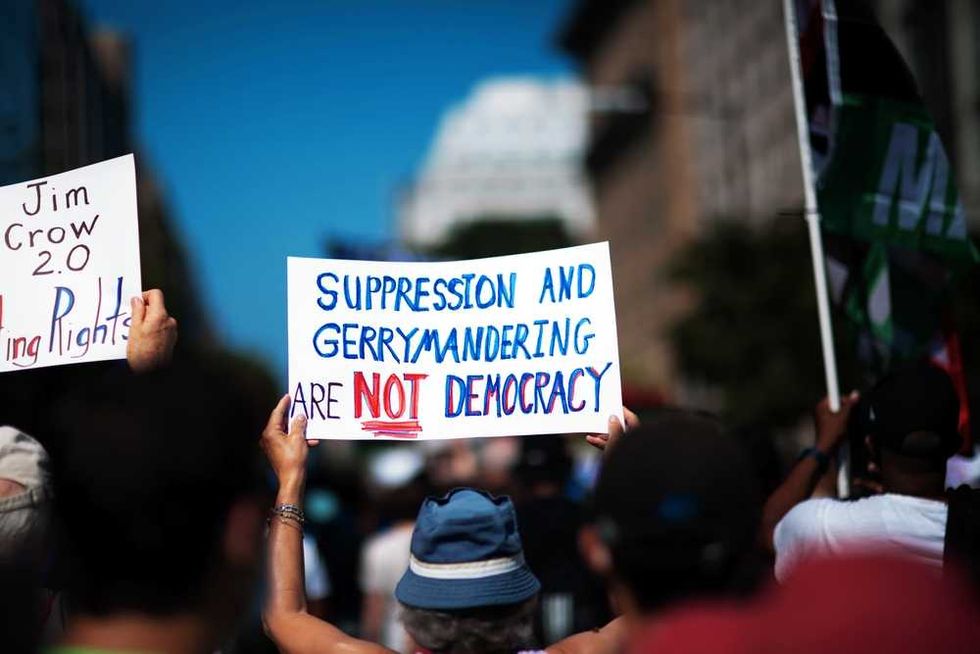
Washington, D.C. | U.S.A. - Aug 28, 2021: March On for Voting Rights "Suppression and Gerrymandering are Not Democracy" (Photo credit: Johnny Silvercloud / Shutterstock)

Missouri voters rejected a Republican-drawn congressional map earlier this month. But was that the end of the state’s redistricting fight?
Some GOP officials are leaving open the possibility of trying again, potentially targeting a different Democratic congressional district or pursuing a map designed to give Republicans an even larger advantage.
Whether they can is far less certain. And after the results of the Nov. 3 election, so is whether another attempt would actually benefit Republicans.
Voters rejected the congressional map passed last year at President Donald Trump’s urging and approved Amendment 6, a constitutional change restricting lawmakers’ ability to enact legislation similar to measures rejected through a referendum.
Together, those votes raise questions about what options remain before the next census in 2030 — questions that could ultimately be decided in court.
State Sen. Nick Schroer, a St. Charles County Republican who will become Senate majority leader in January, has been among the most vocal advocates of revisiting congressional boundaries.
After the Missouri Supreme Court blocked the legislature’s 2025 map from taking effect, Schroer posted “8-0 2027” on social media, suggesting Republicans could pursue a map designed to defeat every Democratic member of the state’s congressional delegation.
But Amendment 6 has raised questions about how much freedom lawmakers will have to revisit decisions voters have already rejected.
Speaking more broadly about future ballot fights, Schroer acknowledged the uncertainty.
“Are we handcuffed by Amendment Six?” he said. “We’ve got several attorneys looking into this, myself included, to see what options are out there without wasting a lot of judicial resources, so we have to be strategic in what we do.”
Incoming Senate President Pro Tem Jason Bean, a Holcomb Republican, suggested his caucus may not be eager for another redistricting fight.
“I don’t think redistricting is high on our list of priorities,” Bean said.
Prop A and the fight over Missouri’s congressional map
And at least one incoming Republican senator believes lawmakers should abandon the idea altogether.
“The voters spoke,” Sen.-elect Mike Deering said during an interview with St. Louis Public Radio’s Politically Speaking podcast. “They want to keep the map as is, and that’s what we should do.”
Deering said lawmakers should stick to redrawing congressional boundaries once every decade rather than revisit an issue voters have already decided.
Secretary of State Denny Hoskins, meanwhile, has suggested lawmakers could have no choice but to revisit redistricting because of a recent U.S. Supreme Court decision.
“It may be forced on their hands because right now the 2022 map, according to the U.S. Supreme Court, is unconstitutional because it includes a majority-minority district,” Hoskins said after the election.
The Supreme Court did not declare Missouri’s map unconstitutional. Its April ruling involved Louisiana, where justices struck down a congressional district drawn predominantly on racial grounds. The decision could have implications for other states, but it did not order Missouri lawmakers to redraw their districts.
The most immediate uncertainty involves Amendment 6.
The constitutional amendment prohibits legislators from passing laws “similar in effect” to those rejected by voters through referendum. Lawmakers could send such a measure back to voters, but only with support from at least 80% of both legislative chambers.
That would require 131 votes in the House and 28 in the Senate, meaning Republicans would need substantial Democratic support.
But Amendment 6 does not define what constitutes legislation “similar in effect.”
Would a new congressional map targeting St. Louis rather than Kansas City qualify? What about an entirely different configuration of the state’s eight districts? And would the same restrictions apply if a federal court ordered Missouri to redraw its congressional boundaries?
Travis Crum, a Washington University law professor who specializes in election law, told The Independent in September that he believes another attempt before the 2030 census would fall under the amendment’s restrictions.
Amendment 6 could make another Missouri congressional gerrymander much harder
“A new map would be viewed as similar in effect to the map that was rejected,” Crum said, “and so therefore the 80% requirement would apply.”
But that interpretation has not been tested in court, and a new redistricting bill could produce another round of litigation.
Even if a new map survived scrutiny under Amendment 6, opponents could again use the referendum process to suspend it pending a statewide vote.
Republicans spent much of the past year unsuccessfully fighting that outcome in court.
There is also the question of whether another attempt would accomplish what Republicans want.
The 2025 map was designed to help the GOP defeat Democratic U.S. Rep. Emanuel Cleaver of Kansas City, giving Republicans seven of Missouri’s eight congressional seats.
Instead, Cleaver won reelection under the state’s 2022 map, Democrats flipped a suburban St. Louis congressional seat and Republicans lost 16 seats in the Missouri House, ending their legislative supermajority.
And an analysis shared after the election by Republican pollster Titus Bond suggests the rejected map might have put additional GOP seats at risk.
Bond, president of Remington Research Group, calculated how the congressional contests would have looked under the boundaries lawmakers approved last year.
His calculations showed Cleaver narrowly defeating Republican Rick Brattin by 491 votes despite the attempt to make the district more favorable to Republicans.
Meanwhile, Republican U.S. Rep. Mark Alford would have defeated Democrat Jordan Herrera by fewer than 2,000 votes. Republican U.S. Rep. Bob Onder would have beaten Democrat Bethany Mann by about 10,700 votes.
But those hypothetical results assume voting patterns would have remained the same under different district boundaries. They cannot account for changes in campaigning, spending or turnout.
Incoming Senate Minority Leader Stephen Webber, a Columbia Democrat, said another redistricting push would suggest Republicans had failed to understand the message voters delivered.
“People are worried about affordability. They’re worried about their schools,” Webber said. “They are not worried about whether Republican politicians should try to gerrymander the congressional map.”
Richard von Glahn, executive director of the People Not Politicians campaign that organized the referendum against the 2025 map, said during an October interview on the Missouri on the Record podcast that lawmakers should move on to other priorities.
If Republicans try again, however, he indicated opponents would be prepared to launch another referendum campaign.
“Will People Not Politicians continue to exist?” von Glahn said. “I guess we will.”
Missouri Independent is part of States Newsroom, a nonprofit news network supported by grants and a coalition of donors as a 501c(3) public charity. Missouri Independent maintains editorial independence. Contact Editor Jason Hancock for questions: info@missouriindependent.com.
Report typos and corrections to corrections@rawstory.com.
For customer support contact support@rawstory.com.