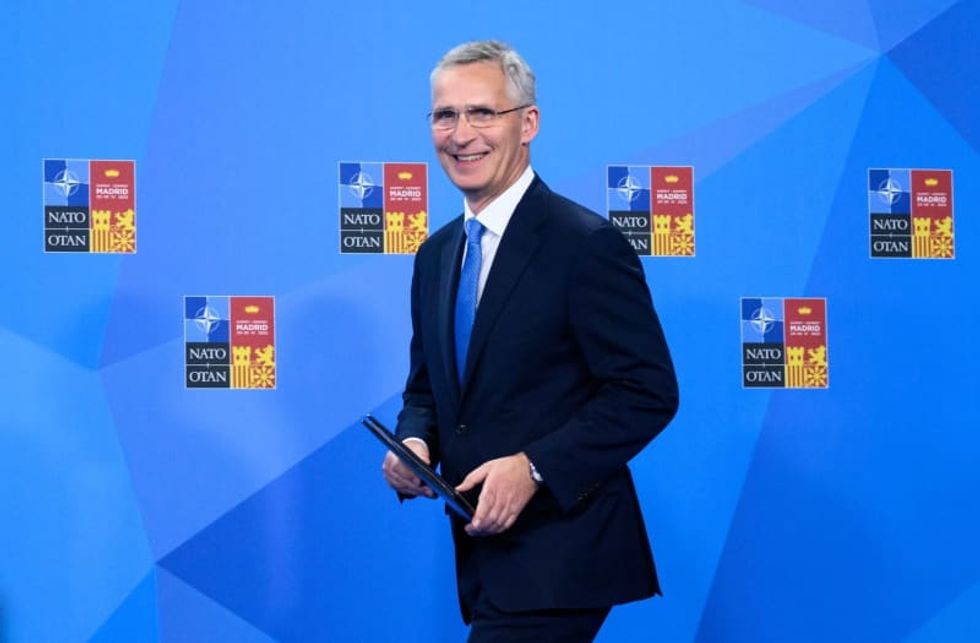
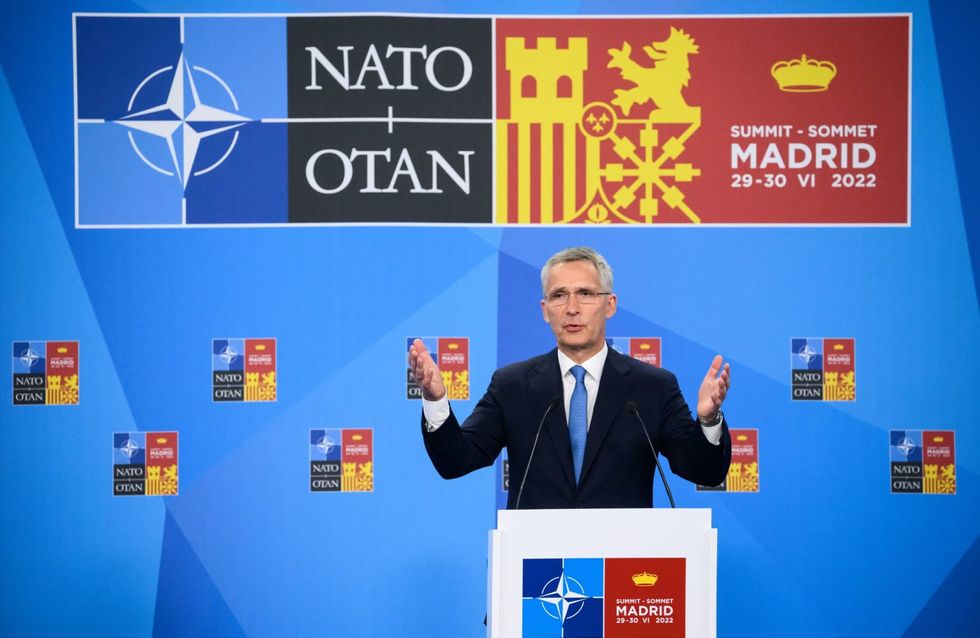
NATO leaders agreed a new security doctrine that sees Russia as the organization's "most significant and direct threat," alliance Secretary Jens Stoltenberg announced in Madrid on Wednesday.
The doctrine removes Russia's status as a strategic partner of the alliance, Stoltenberg said in a press conference at the summit while outlining NATO's view of China for the first time.
"China's coercive policies challenge [NATO's] interests, security, and values," Stoltenberg said, remarking the alliance's current security doctrine has a lot of detail on it, differently from the document in 2010, which did not mention China at all.
NATO leaders were in Madrid to sign off the alliance's Strategic Concept, a policy blueprint outlining the organization's aims and tasks for the next 10 years, last formulated in 2010.
While removing Russia's status as strategic partner, the doctrine stresses that NATO "does not seek confrontation and poses no threat" to the country.
NATO also addressed the relationship between China and Russia in view of the war in Ukraine and Beijing's growing assertiveness on the world stage.
China and Russia's "deepening strategic partnership" and their "attempts to undercut the rules-based international order run counter to our values and interests," the doctrine states.
After a series of engagements between NATO allies and Australia, New Zealand, Japan and South Korea, the alliance announced plans to boost cooperation with Indo-Pacific partners over China's activities.
This cooperation extends to "cyberdefence, new technologies, maritime security, climate change, and countering disinformation," Stoltenberg said in a press conference closing the second day of the summit.
NATO leaders also agreed to ramp up reinforcements in Eastern Europe in view of the Russian invasion of Ukraine at the summit in Madrid.
The alliance plans to increase the number of rapid reaction forces available to NATO to more than 300,000 soldiers according to Stoltenberg, up from current figures of around 40,000 troops.
The NATO Response Force (NRF) are usually under national command, but can be requested for deployment to another ally by NATO’s Supreme Allied Commander Europe (SACEUR).
The Baltics, especially Estonia, have pushed NATO hard to shift tactics in light of the Russian invasion of Ukraine and move to fully-fledged defence of alliance territory in Eastern Europe, replacing a model to relinquish and later recapture lost ground.
NATO also agreed to boost the number of soldiers in the alliance's multinational battlegroups in Eastern Europe, rotating extra troops in and out of the selected alliance members to train with local forces. Germany has pledged already to reinforce Lithuania like this.
"This is the first time since the Cold War that NATO has these kind of plans with preassigned forces," Stoltenberg said, describing the plans.
NATO leaders also addressed climate change for the first time, describing the challenge as a "threat multiplier ... with a profound impact on Allied security," in a joint statement.
In the same statement, NATO leaders agreed to step up support to Ukraine with long-term aid including more equipment, supplies, training and help to transition away from Soviet-era military machinery.
Earlier on Wednesday, US President Joe Biden said the United States military presence in Europe is set for a long-term expansion, speaking alongside Stoltenberg.
"We're going to make up sure that NATO is ready to meet threats from all directions across every domain, land, air and the sea," Biden said.
The US president outlined plans for increased US troop deployments in the Baltics, the deployment of two squadrons of US F35 fighters in Britain and additional air defences in Italy and Germany.
Biden also announced the establishment of a permanent headquarters for the US Fifth Army corps in Poland. The announcement follows a US decision to up the number of US destroyers based in Rota, Spain from four to six.
In response, Russia threatened "compensatory measures."
"What's happening [NATO's buildup in Eastern Europe] now will invariably prompt compensatory measures on our part," Deputy Foreign Minister Sergei Ryabkov was quoted by TASS news agency as saying.
"We won’t turn a blind eye to this move. We have the capabilities and resources for that. Security will be 100% guaranteed," Ryabkov said.
Moscow had offered Washington talks on mutual security guarantees last year in order to avoid an escalation scenario, Ryabkov said, according to the Interfax agency.
Notwithstanding the fact that Russia attacked neighbouring Ukraine more than four months ago, the Kremlin repeatedly portrays NATO and the US as the main threats to Europe's security
Against this backdrop, Moscow has already repeatedly stressed that it wants to strengthen its western borders.
Ukrainian President President Volodymyr Zelensky also joined the summit via video-link, calling for more weapons supplies for his country and warning of further Russian aggression in Europe.