dpa international provides clear and unbiased coverage of the world's biggest news stories. Headquartered in Germany, we offer an independent European perspective.
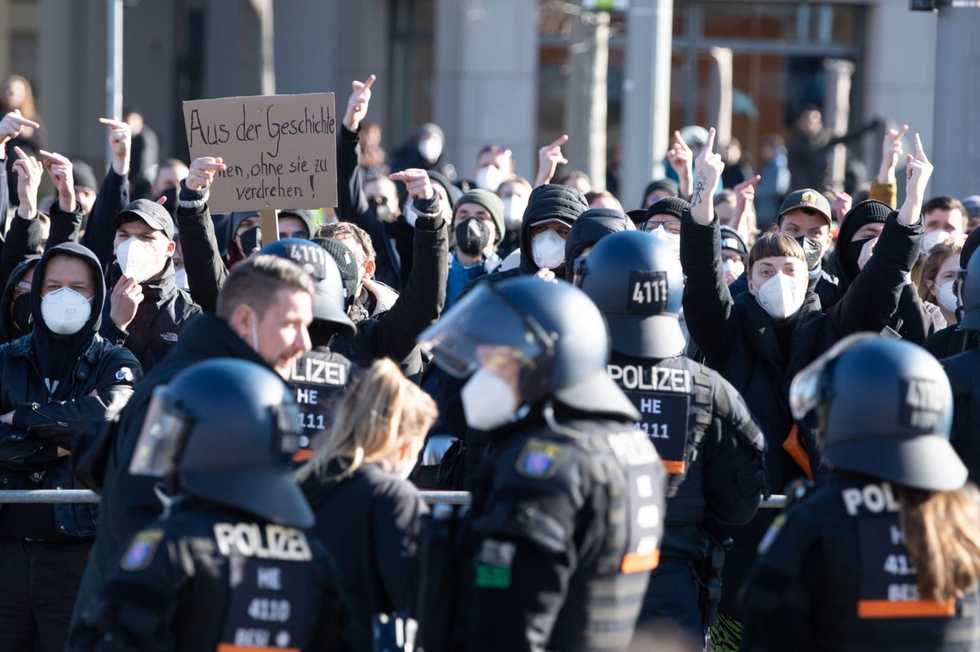
Counter-demonstrators react behind police officers during a rally by neo-Nazis held to mark the bombing of Dresden in World War II. On 13-14 February 1945, a British-American aerial bombing attack on Dresden killed up to 25,000 people during the World War II. Sebastian Kahnert/dpa-Zentralbild/dpa
Counter-demonstrators react behind police officers during a rally by neo-Nazis held to mark the bombing of Dresden in World War II. On 13-14 February 1945, a British-American aerial bombing attack on Dresden killed up to 25,000 people during the World War II. Sebastian Kahnert/dpa-Zentralbild/dpa
On the outskirts of Dresden's Old Town, hundreds of neo-Nazis gathered in the morning for a "commemoration in honour of the Dresden air war dead of February 13, 1945."
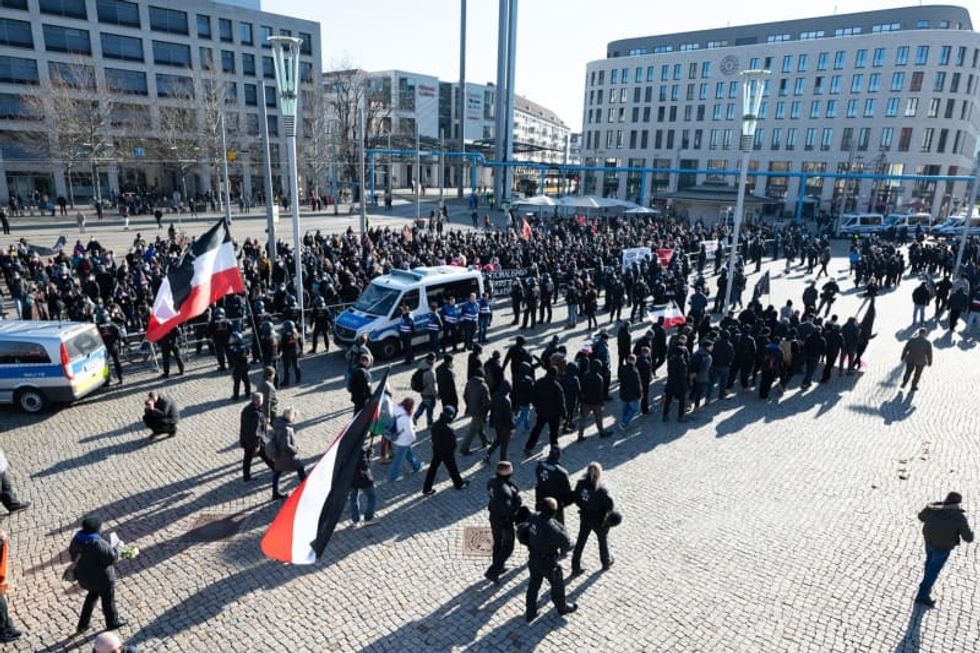
Police estimated the number of participants in the procession at up to 500, which grew to around 750, who walked into the city centre to the sound of Wagner music and loud counter-protests nearby from hundreds of people.
At the Baroque landmark Zwinger palace, hundreds of counter-demonstrators loudly opposed the "silent march," which was already accompanied by shouts of "Nazis out" at the roadside.
A helicopter circled over the old town, while a water cannon and an evacuation tank stood near the route.
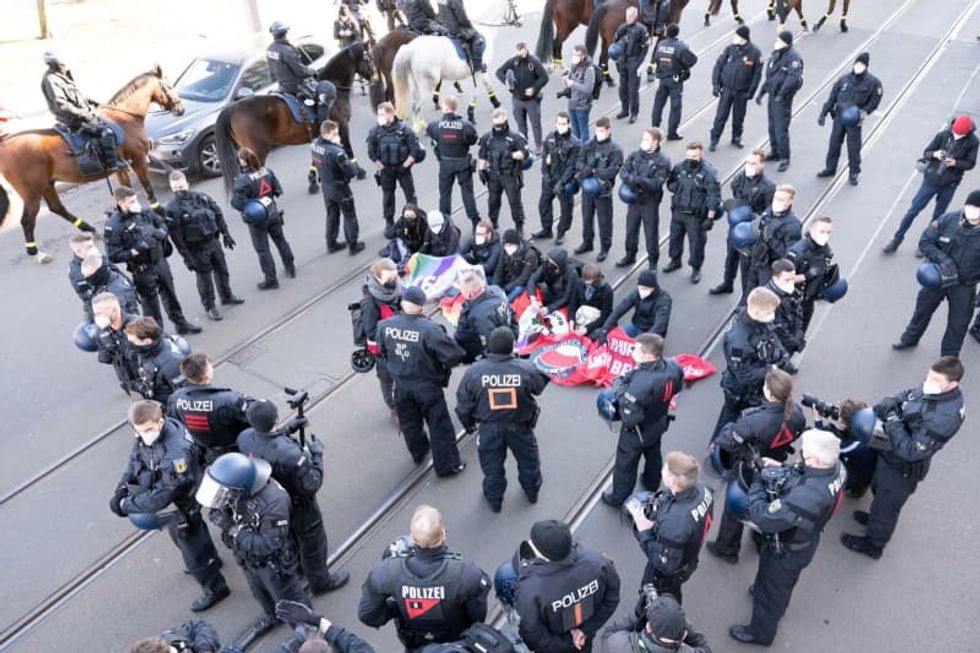
Police officers surround counter-demonstrators during a rally by neo-Nazis held to mark the bombing of Dresden in World War II. On 13-14 February 1945, a British-American aerial bombing attack on Dresden killed up to 25,000 people during the World War II. Sebastian Kahnert/dpa-Zentralbild/dpa
Numerous neo-Nazis walk in front of counter-demonstrators (back) during a rally marking the bombing of Dresden in World War II. On 13-14 February 1945, a British-American aerial bombing attack on Dresden killed up to 25,000 people during the World War II. Sebastian Kahnert/dpa-Zentralbild/dpa