Grassroots organizations across the country are reporting record levels of interest from thousands of volunteers who want to help their neighbors vote and prevent interference with this year’s midterms, organizers said.
But, beyond the helpers dressed in bright yellow shirts to answer questions at polls, as is the case for Common Cause volunteers in Florida, or those escorting people into polling places under cover of umbrellas, as some with Popular Democracy plan to do — experts said these groups are gearing up for ferocious legal battles during and after the election on Nov. 3.
“We are prepared to take action after the election. That's what's different. We're prepping for mobilization after in a way that we have never done before,” said DaMareo Cooper, executive director of Popular Democracy, a grassroots network focused on building political power for Black, brown, and low-income people across the country.
“We know this administration lies. We know that they serve interests outside of the goodwill of the people.”
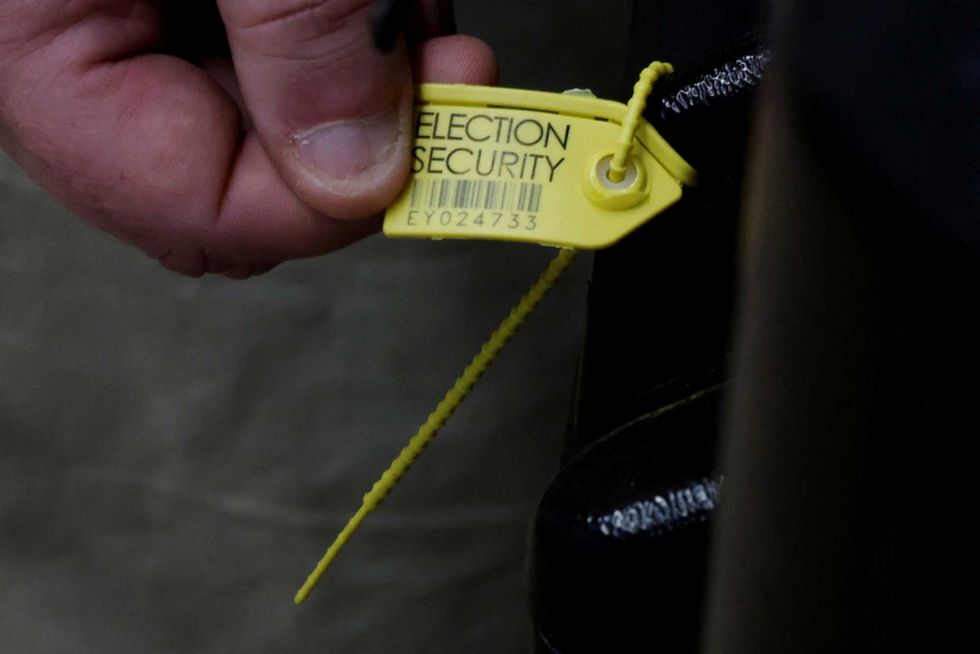
Popular Democracy is prepared for “a mass mobilization if we see something fishy with the election” and is preemptively pushing petitions encouraging attorneys general, governors and secretaries of state to certify the election, Cooper said.
President Donald Trump has continued to sow doubts in election integrity, citing widespread election fraud, despite investigations showing that illegal voting, and convictions for such a crime, are infinitesimal compared to the hundreds of millions of votes cast in the past decade.
Numerous Republican legislators refused to certify the election results in 2020, and election officials in 2024 were prepared to do the same in 2024.
“If someone's taking ballots or if some agents are taking ballots out of an election location, or if a state chooses not to certify the election for whatever reason, or if they don't seat the new Congress, we are all preparing across the country for what that means and how we need to react to those types of moments,” Cooper said.
“We've been training people, making sure that they understand what an election sabotage might look like … we need our people to understand that this is what it looks like for someone to be stealing or tampering or corrupting the free and fair election.”
Jill Garvey, executive director of States at the Core, which works to combat authoritarianism and political extremism, said her organization has heard from people across the country who want to go beyond volunteering as election observers to ensure their neighbors vote without interference.
Did you see anything suspicious while voting? Raw Story wants to know. Contact our investigations team at tips@rawstory.com
“This election is a vulnerability for authoritarian movements and their leaders,” Garvey said.
“This is one of those windows of opportunity when we can see how much resistance, how much opposition there is to this authoritarian advance, and most people have a way to exercise some agency over whether that advance continues.”
Some voters are concerned about encountering physical threats to themselves or ballots, particularly in light of an unprecedented ballot seizure that took place in Riverside County, California, Garvey said. Others worry about “anti-democratic actors” who aim to “disrupt voting or intimidate people or surveil people as they try to vote,” she said.
“I think the level of concern is really heightened right now because, potentially, the leaders of authoritarian movements become really desperate in this moment, not just on Election Day, but in the sort of period right after,” Garvey said.
“They're going to be desperate to hang on to power and potentially they won't be able to, so there may be more extreme measures that certain factions of these movements go to in order to maintain control.”
Common Cause, a nonpartisan democracy watchdog, has already engaged in litigation and policy advocacy to protect voter rights, such as fighting to block deployment of U.S. Immigration and Customs Enforcement agents at polling places, a possibility floated by Homeland Security Secretary Markwayne Mullin, said Andrew Walchuk, senior policy director and counsel for voting and fair representation at Common Cause.
“From the policy and legal attacks to the dangerous xenophobic rhetoric to violence unleashed in our neighborhoods by federal agents, we have seen time and again how the Trump administration is targeting Latino, Black and immigrant voters across the country,” Walchuk said at an Oct. 14 media briefing.
“This is all part of this administration's effort to decide from the national level who can and cannot vote, in an effort to evade accountability for its actions.”
'Purely an intimidation tactic'
While Common Cause’s work begins in the courts long before and after Election Day, volunteers on the ground still respond in real-time.
“For example, if we receive a report of possible immigration enforcement activity, our teams will work to verify what's happening, communicate with local election officials, ensure that voters have the accurate information and know where they are able to vote safely, and bring in national voting experts and partners when necessary,” Walchuk said.
Anthony Gutierrez, Texas director at Common Cause, said election protection work looks like bracing for a range of potential issues from federal interference to natural disasters and contending with Texas having “the most antiquated, archaic voter registration system in the country.”
“The list of potential problems that we're on the watch for is much longer than ever before,” said Gutierrez, who has spent the last 10 years doing election protection.
Popular Democracy has engaged poll watchers who will document issues at the polls such as ICE activity, and the group is on the lookout for “nationalist groups showing up to the polls and threatening folks,” Cooper said.
“There's no reason to have federal agents at polling locations unless you're trying to intimidate people," Cooper said. “If that happens, it is purely an intimidation tactic.”
Popular Democracy’s volunteers also serve a role of “reminding people, even if there is some form of voter intimidation, that you have the complete right to vote, guaranteed by the 14th Amendment of the Constitution,” Cooper said.
For instance, the volunteers are instructed to encourage voters to stay in line to cast their ballots even if polling sites start to shut down.
Common Cause directs people to call the national election protection hotline, 866-OUR-VOTE, if they encounter any issues at the polls. The hotline also offers language services in Spanish, Asian languages and Arabic.
Garvey, whose group also hosts ICE Watch trainings, said the worst-case scenario her group is preparing for is people who simply “feel too frightened to exercise their right to vote, or they feel like they can't trust the system.”
All of the grassroots groups encourage voters to vote early and come up with a plan to ensure they can cast their ballot by Election Day, especially if they arrive at the polling place and find deterrents requiring them to return another day.
“Regardless of what the outcome is, Election Day is not the end," Garvey said. "It is the beginning. It is the beginning of the next phase of how people can defend democracy and potentially push back against authoritarian movements.”