



Donald Trump’s announcement earlier this week that he received a target letter from Special Counsel Jack Smith set in motion an indictment watch for new criminal charges that will likely center on a scheme to install fake electors to cast fake electoral votes on his behalf.
And buried deep in the U.S. House’s January 6 select committee’s 845-page final report is a single, all-but-unnoticed line about installing fake presidential electors that could foreshadow Trump’s fate.
“It was my understanding that the president made this decision” to initiate the fake elector gambit, former Trump campaign associate general counsel Joshua Findlay told committee investigators.
The committee, for its part, described the fake elector scheme as “carefully planned” and “many weeks in the making”.
The investigation by the January 6th Committee provides a glimpse into the potential factual allegations that could form the basis for a looming indictment against Trump centered on his effort to overturn the 2020 election.
Neither Trump nor representatives of his campaign could be reached for comment for this story.
ALSO READ: Prison playbook: How Trump could run his campaign – and the nation – from behind bars
Trump’s announcement about his impending indictment comes as 16 Republican electors were indicted in Michigan on Tuesday for their role in the scheme. A similar inquiry by the state attorney is currently underway in Arizona. A grand jury in Georgia, meanwhile, is expected to hand down indictments in the coming weeks related to Trump’s efforts to overturn the election in that state — including the fake electors scheme and Trump’s Jan. 2, 2021, call to Secretary of State Brad Raffensperger requesting that he find 11,000 votes to erase Joe Biden’s win.
Trump already faces charges in the special investigation related to his mishandling of classified documents after leaving the White House. In a separate case brought by the Manhattan district attorney, Trump also faces criminal charges for falsifying business records related to hush-money payments to the adult-film actress Stormy Daniels during the 2016 presidential campaign.
But the evidence compiled by the January 6 Committee could yet pose the greatest legal threat of all to Trump’s future as a leading 2024 presidential candidate — and free man. Before the committee was unceremoniously disbanded with the Republican takeover of the House, the committee issued criminal referrals against Trump, specifically citing the fake electors scheme.
‘The president made this decision’
It wasn’t hostile Democrats or the “deep state” or the “fake news” media that offered up the idea that Trump himself puppet-mastered a fake elector scheme.
Trump’s own lawyers provided the fodder.
Findlay, the Trump campaign’s associate general counsel, told congressional investigators that Matthew Morgan, the campaign’s general counsel, requested that he look into the feasibility of the scheme.
As Findlay recalled it, Morgan’s request was something along the lines of: “This is a long shot. There is some precedent. We don’t know if it’s going to be effective. This is what the client wants to do, the campaign wants to do. And so, we need to look into it and see if this is an option.”
Morgan, in turn, told the committee that Justin Clark, the campaign’s deputy campaign manager and senior counsel, “asked me to look into the matter as a contingency,” per a committee interview transcript.
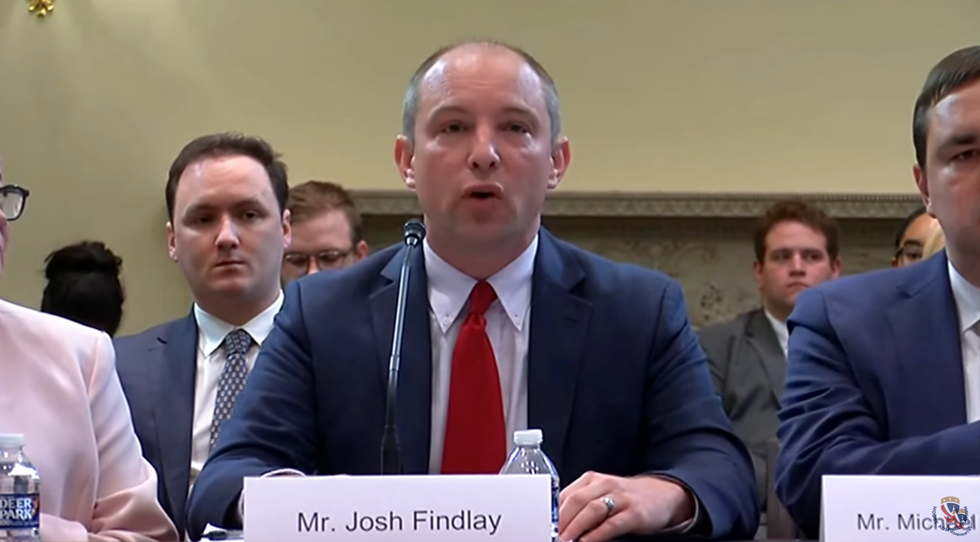 Joshua Findlay testifies before the U.S. House Committee on House Administration Subcommittee on Elections on March 23, 2023. Source: Committee on House Administration
One of the congressional investigators asked Findlay: “Did Matt Morgan tell you or did you get a sense of whether this was something that he had come up with on his own or whether he was, you know, telling you, reading you into this concept at the direction of someone else?”
“My understanding is that he did not come up with this on his own,” Findlay responded.
“How did he learn of it?” the investigator asked.
“So, I don’t know exactly, but it was my understanding that the president made this decision, like, this was something that came from even higher than Matt.”
Only three days before the GOP electors assembled in their respective state capitals on Dec. 14, 2020, to cast bogus votes for Trump, senior campaign legal staff, including Morgan and Findlay, extricated themselves from the scheme.
Morgan told the committee that when the framework shifted from reserving the slates of Republican electors as a contingency in case a court ruled in favor of Trump to submitting them as alternate slates, he decided “this was not an exercise” that he “necessarily wanted to continue with.”
They handed off responsibility to an outside lawyer named Kenneth Chesebro, whom Findlay described in an email to his state contacts as “the point person for the legal documents.”
Political operative Mike Roman — officially director of election day operations for Trump’s 2020 campaign — would remain “the lead for executing the voting” in the Dec. 14 meeting of the fake electors, Findlay wrote in the email.
They all would report to Rudy Giuliani, the president’s personal lawyer, who had wrested control of Trump’s post-election litigation efforts from Morgan within about two weeks of the election.
Giuliani had promoted bizarre conspiracy theories about vote switching while aggressively lobbying state officials in Pennsylvania, Arizona and other battleground states to block certification of Biden’s electors.
Roman repeatedly invoked his right to avoid self-incrimination under the Fifth Amendment during his deposition before the January 6th Committee. But the operation he ran to pressure state lawmakers to back alternate slates of Trump electors, assemble the electors and even hand-deliver some of the certificates to the U.S. Capitol on Jan. 6 is amply described in contemporaneous emails and phone texts. Other campaign staff and electors also spoke to the committee about Roman’s role.
The evidence uncovered by the committee shows that a team led by Roman’s deputy, G. Michael Brown, began lobbying state lawmakers at least two weeks before the Trump electors met to cast their votes in the capitals of the battleground states.
A congressional investigator asked Roman if he ever learned, directly or otherwise, that Trump “wanted alternate electors to submit electoral college votes in states that he had lost” so that Vice President Pence “could choose them during the joint session of Congress on January 6.”
Roman responded by pleading the Fifth.
But an email chain produced to the committee shows Roman confirming that the effort to get state lawmakers on board came from the Trump campaign.
The chain shows Tim Murtaugh, the Trump campaign’s director of communications, mentioning that a reporter was asking about whether the Trump campaign was responsible for emails and voicemails “to Michigan lawmakers, urging them to appoint their own electors.”
“So what is the answer actually?” Murtaugh asked. “Is the campaign pushing emails and voicemails?”
“The campaign did send emails and voicemails,” Roman responded on Dec. 2, 2020.
Roman has accepted a “proffer agreement” from special counsel Jack Smith’s team to speak informally with prosecutors while avoiding testimony before a grand jury, according to a recent report by CNN. Typically, under such conditions, according to the report, prosecutors agree to not use witnesses’ statements against them in future criminal proceedings.
‘On behalf of the president’
The Trump campaign’s efforts to pressure state lawmakers into supporting fake elector slates began in late November 2020 — weeks after Roman’s duties as director of election day operations should have wrapped up.
Congressional investigators showed Roman text messages between himself and Matt Stroia, an aide to Rep. Mike Kelly (R-PA), about efforts to secure a venue for an unofficial legislative hearing on Nov. 25 in Gettysburg, Pa.
The goal: showcase a presentation of purported election fraud by Giuliani and other lawyers.
Following the Gettysburg hearing, in which Trump called in to air his complaints about the election, Giuliani hosted a similar hearing on Nov. 30 at a hotel in downtown Phoenix.
The two hearings marked the beginning of an organized effort by the campaign that was delegated to G. Michael Brown, Roman’s deputy, to pressure state lawmakers into backing the scheme.
“Good morning. We are going to call state leadership across the country today,” Brown wrote in a phone text to a team of Republican National Committee staffers on Nov. 30. “We may set up in the Union league or in my room, but we are going to win this thing. We are going to explain the process for legislative redress and tell them how to send representatives to th [sic] electoral college. They’ve heard from lawyers who failed to explain it. So, we will. And we will convince them. There’s no team I’d trust more to do this. Touch base at 10 am. Be ready to deliver.”
Later in the text thread, Brown wrote: “Waiting to hear from Roman. But let’s be ready.”
Brown, who declined to comment for this story on the advice of his lawyer, appeared before a grand jury convened for Smith’s investigation last month, according to report by NBC.
The January 6 select committee obtained various drafts of scripts used by Brown’s team to call state lawmakers.
One version references Arizona, while another appears to be customized for lawmakers in Georgia.
Both include the line, “I wanted to personally reach out to you on behalf of the President as you will be a crucial part of President Trump’s reelection.” The staffers were instructed to close the calls by saying, “When there is a resolution to appoint electors for Trump, can the president count on you to join in support?”
One of the calls to a state lawmaker in Michigan was leaked to a newspaper in Lansing.
According to a text obtained by the January 6 select committee, Brown congratulated Angela McCallum, the Republican National Committee staffer who placed the call.
“It got the message out there,” he told her. “They unwittingly got your message out there. I would save this. The time you used the awesome power of the presidency to scare a state rep into getting a statewide newspaper to deliver your talking points.”
‘Electors Whip Operation’
Roman was more directly involved in the effort to assemble Republican electors in the capitals of the six targeted states.
The January 6 select committee obtained an email from Roman to Brown, his deputy, and election day directors for each of six states, with the subject line heading “Electors Whip Operation,” that was dated Dec. 12 — two days in advance of the scheduled meetings.
“I need a tracker for the electors,” Roman wrote. “One tab for AZ, GA, MI, NV, PA, WI.”
Roman asked the team members to fill in first names, last names, contact phone numbers and addresses, and then check off if they had been contacted, while notating whether the electors planned to attend the Dec. 14 meeting with a “Y” or “N,” according to the email. Roman instructed the team members to report their progress by 6 p.m. and then be prepared for a conference call at 9 p.m.
Another email chain obtained by the committee shows an exchange between Roman and Christina Bobb — a One America News reporter who took time off from her journalism job to assist Giuliani with the post-election legal effort. Bobb provided a summary of the call to Roman, who asked his assistant to forward it to members of the whip team.
Andrew Hitt, chairman of the Republican Party of Wisconsin and one of the designated electors in that state, told congressional investigators that Roman personally called him that day to confirm that the Wisconsin electors would be meeting. Recent reporting by the Washington Post confirms that one of the Republican electors in Arizona also received a call from “representatives of the Trump campaign.”
When the appointed date for the electors to meet rolled around on Dec. 14, Roman emailed his team at 10:49 a.m.: “Please send me an update as soon as the State Electoral College has adjourned and all paperwork is secured.”
Reports confirming that the electors had assembled and cast their votes came back from Nevada, Pennsylvania and Georgia.
‘Certifying illegal votes’
As the Republican electors were meeting in Phoenix, Atlanta, Lansing, Carson City, Harrisburg and Madison, Stephen Miller, a high-level White House adviser known for shaping Trump’s immigration policies, publicized the effort on Fox News.
“The only date in the Constitution is January 20th,” Miller told the hosts of Fox News program “Fox and Friends.” “So, we have more than enough time to right the wrong of this fraudulent election result and certify Donald Trump as the winner of the election.
“As we speak, today, an alternate slate of electors in the contested states is going to vote and we’re going to send those results up to Congress,” Miller continued. “This will ensure that all of our legal remedies remain open. That means that if we win these cases in the courts, that we can direct that the alternate slate of electors be certified.”
Miller was introduced on the show as a “senior advisor to the Trump campaign,” but he told the committee that he was briefed by Justin Clark, the campaign’s deputy campaign manager and senior counsel, before the media appearance.
Congressional investigators tried to talk to Miller about Trump’s involvement in efforts to pressure Republican state lawmakers to submit slates of fake electors during his deposition in April 2022, but Miller’s lawyer invoked executive privilege to block that line of questioning.
While Miller trumpeted the fake electors scheme, other senior-level campaign staff were trying to distance themselves.
In a phone text on the eve of the electors meetings, Clark proposed language for a press release: “As election contests continue in various states, the only prudent course was to have the President’s electors vote in those places to preserve the campaign’s rights.”
But there was one problem, Clark said.
“The way this has morphed it’s a crazy play so I don’t know who wants to put their name on it,” he said.
Jason Miller, a senior adviser to the campaign, indicated they were under pressure, alerting them that they should expect a call from the White House, while adding in text message shorthand that Trump “wants to put out statement on electors, so Rudy making me call into conference call now.”
Others invited to the conference call were members of Giuliani’s legal team.
“Star Wars bar,” Miller snickered.
“Certifying illegal votes,” added Eric Hershmann, a senior adviser to the president.
The electors had misgivings of their own.
The language in the Pennsylvania certificate had to be tweaked with new “language for dealing with the concern raised in the PA conference call about electors possibly facing legal exposure at the hands of a partisan AG if they seem to certify that they are currently the valid electors,” Chesebro wrote in a Dec. 12 email.
Chesebro invoked the Fifth Amendment when asked about the email by the January 6 select committee in October.
In another email, Chesebro wrote to other members of the legal team that Kelli Ward, an Arizona elector, and Kelly Townsend, a state senator involved in lining up support from other lawmakers, were “concerned it could appear treasonous for the AZ electors to vote on Monday if there’s no pending court proceeding that might eventually lead to the electors being ratified as the legitimate ones.”
Jack Wilenchik, a lawyer who helped organize the pro-Trump electors in Arizona, expressed skepticism about the plan to Boris Epshteyn, an outside lawyer working under Giuliani, according to emails obtained by the New York Times.
“We would just be sending in ‘fake’ electoral votes to Pence so that ‘someone’ in Congress can make an objection when they start counting votes, and start arguing that the ‘fake’ votes should be counted,” Wilenchik wrote on Dec. 18, 2020.
Other texts obtained by the January 6th Committee reference a discussion by Republican leaders in Wisconsin about a request by Giuliani to refrain from alerting the media about the electors meetings.
“These guys are up to no good, and it’s going to fail miserably,” commented Andrew Hitt, chairman of the Republican Party of Wisconsin and one of the electors in a phone text to a colleague in the state GOP.
Robert Sinners, the state director of election day operations who was tasked with assembling the GOP electors in Georgia, told the January 6th Committee that he would not have been involved had he known that the “three main lawyers for the campaign” — Findlay, Morgan and Clark — “were not on board.” He said when he learned later that Trump’s allies were using the fake electors as part of an elaborate scheme to pressure Pence into setting aside the Biden electors he felt that he and other state-level participants in Georgia had become “kind of useful idiots or rubes at that point.”
‘Drag motherf------s through the streets’
The January 6 select committee drew a direct line between the fake electors scheme and the Jan. 6, 2021 attack on the U.S. Capitol, but it remains to be seen whether Smith’s team will do the same — or potentially carve out separate charges against Trump related to the attack.
Trump summoned his supporters to Washington with a tweet promising a “wild” rally five days after the GOP electors met in the state capitals. The slates of fake electors set the stage for Trump and his allies to lobby members of Congress to support objections to the certification on Jan. 6, while urging Pence to set aside the legitimate electors in the six states narrowly won by Biden.
Speaking to thousands of assembled supporters at the Ellipse on Jan. 6, Trump stoked anger and also a sense of dramatic suspense by telling them: “So, I hope Mike has the courage to do what he has to do. And I hope he doesn’t listen to the RINOs and the stupid people that he’s listening to.”
As his supporters marched to the Capitol, one rioter livestreamed a diatribe, fuming, “I’m hearing that Pence just caved…. I’m telling you if Pence caved, we’re gonna drag motherf-----s through the streets.” A leader of the Oath Keepers relayed to members of a Zello chat group that they were “marching on the Capitol” because “it has spread like wildfire that Pence has betrayed us.”
The attack on the Capitol resulted in the deaths of five people, while more than 140 officers were attacked and seriously injured, according to the final report of the January 6 select committee.
At 2:24 p.m. on Jan. 6, shortly after his supporters broke into the Capitol, Trump tweeted, “Mike Pence didn’t have the courage to do what should have been done to protect our Country and our Constitution, giving states a chance to certify a corrected set of facts, not the fraudulent or inaccurate ones which they were asked to previously certify. USA demands the truth.”
The tweet drew a direct line from the fake electors scheme that was executed at the direction of Trump himself, according to his campaign’s senior legal staff.
“It was an unprecedented scene in American history,” the report of the January 6th Committee observed. “The president of the United States had riled up a mob that hunted his own vice president.”