




The notion was once unthinkable.
More recently, purely theoretical.
Now, there’s a legitimate chance Donald Trump could be running for president, or even serving as commander in chief, from behind bars.
Two overriding factors contribute to this bizarre reality.
Firstly, there’s very little — legally speaking — preventing Trump from doing so.
Secondly, Trump himself has offered no indication he’ll step away. To the contrary, he’s as emboldened as ever to run for and win the presidency he lost in 2020.
To recap:
For the first time in U.S. history, a grand jury on June 8 federally indicted a former president — Trump.
Trump faces 37 felony counts related to the alleged willful retention of classified documents and conspiracy to conceal them. If convicted, Trump could face significant prison time.
Separately, Trump is charged in New York with 34 felony counts of falsifying business records in relation to payments the Trump Organization made to adult film actress Stormy Daniels. His trial is slated for March 2024, in the midst of the Republican presidential primary.
There’s more: Fulton County, Georgia, District Attorney Fani Willis is in the final stages of a criminal investigation into Trump’s alleged efforts to overturn the 2020 election results. And Special Prosecutor Jack Smith, who is prosecuting the classified documents case, is also investigating Trump’s involvement in inciting the January 6, 2021, insurrection in the U.S. Capitol.
Such a laundry list of legal woes could sabotage any politician’s campaign efforts. But the looming federal indictment and other pending cases haven’t slowed Trump down in his pursuit of a second term as president or slashed his chances at getting the Republican nomination.
Trump has made it clear he has no intention of dropping out of the race.
“I see no case in which I would do that,” Trump said on Sunday during an appearance on a radio show hosted by political strategist Roger Stone, a longtime confidant. “I just wouldn't do it. I wouldn't do it. I had opportunities in 2016 to do it, and I didn't do it.”
But Allan Lichtman, a professor of history at American University, said campaigning for president and defending himself against criminal charges are two very different endeavors.
“He thinks he can win this case in the court of public opinion, but the truth is, Trump can huff, and Trump can puff, but he can't blow the courthouse down,” Lichtman said. “It’s a very, very different game once you enter a federal courthouse or a state courthouse. You can't just bluster. Anything that you present has to be proven, and you're subject to perjury.”
Still, Trump can continue to run his campaign while facing these charges — and he could even do so from prison in the event he were to be tried, convicted and sentenced before the 2024 election.
“Trump’s legal problems shouldn’t affect his campaign. Many of his supporters believe that he is being treated unfairly, and there is no prohibition against a defendant under indictment or even a convicted felon from serving as president,” said Neama Rahmani, a former assistant U.S. attorney and president of West Coast Trial Lawyers. “Theoretically, Trump could even be president while in prison.”
Indeed, the U.S. Constitution stipulates only that a presidential candidate be a natural-born citizen of the United States, be at least 35 years old and a U.S. resident for 14 years. Trump easily checks all those boxes. And congressional Democrats’ strongest efforts to potentially disqualify Trump from ever again seeking the presidency — convicting him following impeachment trials — failed.
So what would it take for Trump to run a presidential campaign — or govern the nation — from prison?
Raw Story interviewed historians, legal experts, political operatives and former government leaders who pieced together a playbook for how he could do it — and the peril that he’d face along the way as he attempts to defeat a field of GOP rivals ahead of a 2024 general election rematch with President Joe Biden.
Campaigning from a cell
Each of the charges Trump faces in the federal indictment carries maximum prison sentences between five and 20 years.
Being behind bars would, of course, prevent Trump from campaigning in his signature fashion: at big, rowdy MAGA rallies.
But Amani Wells-Onyioha, operations director at Democratic political firm Sole Strategies, envisions Trump still figuring out ways to communicate with potential voters.
“There's no doubt in my mind that he would have some recorded press from the little prison phone. There's no doubt in my mind that he would set up press opportunities whenever he's out on the yard getting his recreational use in, that there would be cameras there,” Wells-Onyioha said. “He would be using every opportunity to campaign. I don't see him stopping at all, and I only see him using this as fuel to make him go harder.”
Keeping up his Truth Social posts from prison might not be such a challenge for Trump, Wells-Onyioha said, as some jails and prisons might allow internet access.
“I do see him using the internet because that's all that he has, and he's great at that already,” Wells-Onyioha said. “He's a huge internet, TV personality type of guy, so it really would just force him to be in a position to do something that he's the best at, which is unfortunate for the country, but as far as he's concerned, I think he thinks that this is political gold for himself.”
Plus, Trump isn’t building a campaign from scratch. His 2024 presidential campaign is flush with staffers. He enjoys the support of super PACs, which may raise and spend unlimited amounts of money on his behalf to promote the former president and attack his opponents.
And few politicians are as good at Trump at presenting himself as a victim — he’s single-handedly vaulted the terms “witch hunt,” “deep state,” “hoax” and “fake news” into the contemporary political lexicon. As an inmate, Trump could become a martyr to the MAGA cause.
“You’re obviously handicapped to campaign, but in this electronic age, you can certainly campaign virtually, plus Trump's pretty well known. It’s not like he has to introduce himself to the American people,” Lichtman said.
If not prison, maybe jail
Although it seems unlikely Trump will be serving an active prison sentence before the 2024 election, it’s conceivable he could wind up in pre-trial confinement while campaigning.
This, several legal experts said, will depend on Trump himself.
“He has to behave himself during a trial, and that's not beyond the realm of possibility that he'll act up, thinking that somehow he can win over the jury, but that would be a mistake,” said Kevin O’Brien, a former assistant U.S. attorney and partner at Ford O’Brien Landy LLP who specializes in white-collar criminal defense.
Brazenly defying a judge’s order or attempting to intimidate witnesses are among the more common ways a defendant can get himself thrown in jail before or during his trial.
This isn’t merely conceptual, according to Mike Lawlor, a criminal justice professor at the University of New Haven and former member of the Connecticut House of Representatives, who helped lead impeachment hearings against then-Gov. John Rowland, who ultimately pleaded guilty in federal court to political corruption.
Lawlor expects delays in the federal trial — jury selection alone for a former president could prove a months-long headache — so he’s doubtful the trial will even have started by next year’s elections.
Still, knowing Trump’s penchant for cutting outbursts, Lawlor can envision a judge sanctioning Trump for defying directives. Trump will not only have one judge to contend with, but at least two — and possibly more — given the multiple legal actions against him.
“The opportunity to engage in contempt of court or witness tampering or obstruction of justice is fraught at this point. I’m not sure he has the self-control to keep himself from doing something that would get him confined pre-trial,” Lawlor said.
The U.S. House Jan. 6 select committee accused Trump of potential witness tampering, and Lawlor says he’s monitoring similar allegations here, especially because so many of the witnesses are GOP staffers of the former president.
“It’s so easy to imagine a situation where someone could be contacted and intimidated,” Lawlor said. “I think the temptation to do that for a guy like Trump is probably irresistible. I’m not sure his attorneys or the advisors he listens to can stop him from doing so. I don’t rule it out. As I said, it’s unlikely, but I can definitely see it happening.”
Using legal danger to fuel fundraising
The Trump campaign has wasted no time in exploiting the indictment to raise money, leaning into a familiar claim that the candidate is a victim of a Democratic witch hunt.
Only one day after news broke about Trump’s indictment, a fundraising appeal built around the charges appeared on the campaign website prominently displayed in a column on the left-hand side of the page, suggesting contribution amounts ranging from $24 to $3,300. The message lays out a bill of particulars with the former president at the center of the persecution narrative, beginning with the apocalyptic opener: “We are watching our Republic DIE before our very eyes.”
Trump Save America, the beneficiary, is a joint fundraising committee for Donald J. Trump for President 2024 and the Save America PAC, which supports Trump.
The fundraising appeal contends that a “witch hunt began when the FBI RAIDED my home and then staged it to look like a made-for-TV crime scene with police sirens and flashing red and blue lights.”
Alluding to his previous indictment in New York state, the appeals continued: “So, after a state prosecutor failed to break us, the Deep State sharpened their attacks and unleashed a FEDERAL prosecutor to TRY and take us down.”
Notwithstanding Trump’s claim, the charges in New York state remain pending, and Smith, the special prosecutor appointed by U.S. Attorney General Merrick Garland, was investigating Trump for allegedly mishandling classified documents four months before a grand jury in New Manhattan returned an indictment on the state charges related to the Stormy Daniels affair.
At least one prominent surrogate has helped retail the fundraising push.
Kari Lake, a fellow election denier who lost her race for governor of Arizona last year, joined a Twitter Spaces co-hosted by Dustin Stockton and Jennifer Lynn Lawrence on the night news broke about Trump’s indictment on charges of mishandling classified documents. Stockton and Lawrence helped organize the rally that provided the springboard for the Jan. 6 insurrection. During her appearance on Stockton and Lawrence’s Twitter Space, Lake told more than 1,300 listeners she had just gotten off the phone with Trump shortly after news broke about the indictment on June 8. Lake said it wasn’t enough for Republican voters to just say they stand with Trump or condemn the indictment.
“And if we really stand with him, we need to go to DonaldTrump.com and make a donation tonight,” Lake said. “Everybody, whether it’s $5, $10, $500 — whatever you can afford. Because if we’re gonna stand with him, we need to put our money where our mouth is tonight.”
The political monetization of Trump’s legal woes grows deeper by the month. Go to Trump’s campaign website and you’ll find several items on sale — a black-and-white ceramic coffee mug is $24 — featuring a fake mugshot of Trump above the words “NOT GUILTY”.
The Federal Election Commission, which enforces federal campaign finance laws, would have no grounds to intervene in Trump’s fundraising efforts while facing criminal charges or even time in jail or prison, said Ann Ravel, who served as an FEC commissioner from 2013 to 2017, including one year as the commission’s chairwoman.
 Trump's campaign is selling these black-and-white ceramic coffee mugs for $24.
Trump’s campaign could easily continue sending supporters incessant fundraising emails and text messages in Trump’s name.
“The only problems for him would be if there's failure to disclose, or if people are giving more than the limits, all of the things that are traditional FEC issues, but they don't have the authority to do anything with regard to a person who's been indicted and is still fundraising,” Ravel said. “That in and of itself is not sufficient for the FEC to take any action.”
Lessons of Eugene Debs, incarcerated presidential candidate
Trump wouldn’t be the first candidate to run for president from prison if he were convicted.
In the weeks before the 1920 election, Eugene V. Debs, the Socialist Party candidate for president of the United States and an inmate in federal prison, touched on the significance of the moment.
“Has there ever been anything like it in American history before?” Debs said, as reported by the socialist newspaper Appeal to Reason. “Will there ever be anything like it in American history again? We must impress it upon the people that this scene is symbolic of what has befallen this country.”
There has been one other. Lyndon LaRouche, whom The New Republic called “The Godfather of Political Paranoia,” ran from prison in 1992 after being convicted of tax evasion and mail fraud.
His vice presidential running mate, the Rev. James Bevel, did most of the campaigning. This suggests that a jailed Trump could lean heavily on the presence of a charismatic vice presidential candidate — be it someone such as Lake of Arizona, Rep. Marjorie Taylor Greene of Georgia or even banished Fox News host Tucker Carlson.
LaRouche received .02% of the popular vote — 26,334.
Debs, who was serving a 10-year sentence for decrying the United States’ involvement in World War I, received 3.4% of the popular vote — 919,799.
He received 6% of the vote as a candidate eight years earlier, in 1912.
While emphasizing that she’s speaking as an individual, Allison Duerk, director of the Eugene V. Debs Museum, located in Debs’ home in Terre Haute, Ind., said she cringes at comparisons between Debs and Trump. In material ways, the two men are polar opposites.
“I bristle at recent casual references to the 1920 campaign — not because they are inaccurate on the surface, but because these two men and their respective projects are diametrically opposed,” she told Raw Story.
Duerk does believe Debs predicted the emergence of American political leaders such as Trump.
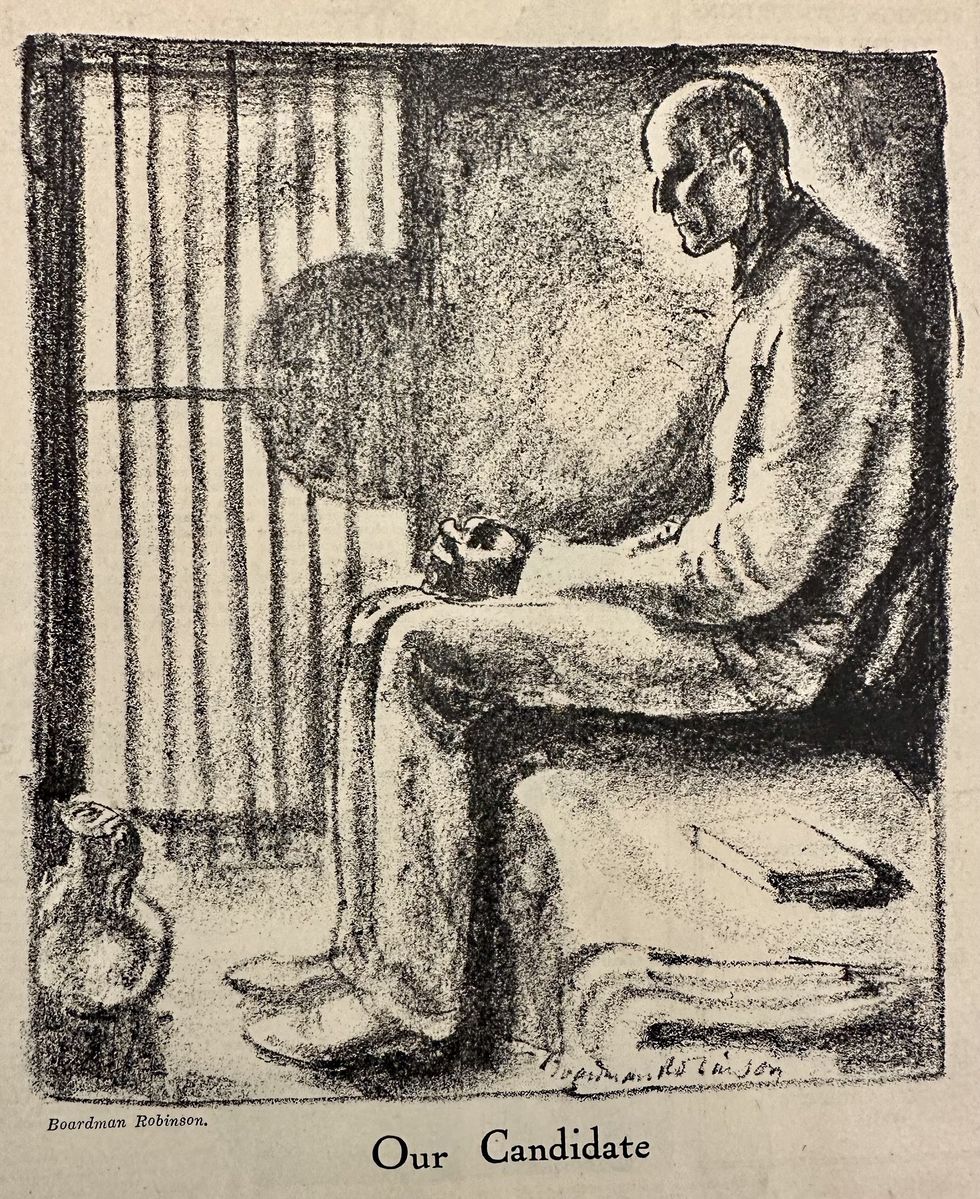 Illustration of Eugene Debs while running for president in prison. Indiana State University archives
“Take this quote from the speech that got him locked up,” she said, quoting Debs: “‘In every age it has been the tyrant, the oppressor and the exploiter who has wrapped himself in the cloak of patriotism, or religion, or both to deceive and overawe the people.’"
In an Appeal to Reason article, Debs said he believed in change “but by perfectly peaceful and orderly means.” He added, “Never in my life have I broken a law or advised others to do so.”
Unlike Trump, who nurses grievances daily, the article said of Debs, “Nothing embitters him. Injustice, oppression, persecution, savagery do not embitter him. It is a stirring, an uplifting thing to find a man who has suffered so much and remains so ardent and so pure.”
The U.S. government and the prison warden made small accommodations to Debs’ candidacy. He was, for one, allowed a single written message per week to voters.
“Where Debs had once stormed the country in a verbal torrent,” wrote Ernest Freeberg, author of Democracy’s Prisoner, “he would now have five hundred words a week.”
Debs still had some of the trappings of a political campaign, including a button that had his photo from prison with the words, “For President - Convict No. 9653.” He had printed material that said, “From Atlanta to the White House, 1920,” a reference to his residency inside the Atlanta Federal Penitentiary.
On election night, Debs received the results in the warden’s office and soon conceded the election to President-elect Warren Harding.
In his book Walls and Bars, Debs wrote that the question came up in the room about his potential ability to pardon himself as president — an action over which Trump has reportedly mused.
“We all found some mirth in debating it,” Debs wrote.
Serving as president from prison
If Trump ran a successful campaign from jail or prison, is there anything stopping him from assuming the Oval Office if he were elected president?
“There is nothing in our traditions or the Constitution that prevents someone who is indicted or convicted or, in fact, serving in jail, from also serving as the president,” said Harold Krent, law professor at the Chicago-Kent College of Law, who formerly worked for the Department of Justice. “Does it make any sense? No. But there is no Constitutional disablement from that happening. So, you could think of a scenario in which the case goes to trial, maybe after the primary and results in a prison time with President Trump and then he is inaugurated, and he gets to serve as president from some prison farm somewhere.”
Lichtman said “of course” Trump would just pardon himself of any federal crimes were he were reelected president. There’s also the possibility of Trump attempting to preemptively pardon himself, with then-President Gerald Ford’s pardoning of Richard Nixon serving as an imperfect template.
But if Trump is convicted on any state-level charges, where federal pardons do not apply, that’s a different story.
“That's unprecedented, but the pardon power is pretty absolute,” Lichtman. “He can’t pardon himself for the New York case because that’s a state case. If he's convicted in New York, he's stuck. If charges are brought in Georgia, and he's convicted in Georgia, he can’t pardon himself from that either, because that's also a state case.”
Trump’s ability to pardon himself is widely debated in the academic community, Krent said.
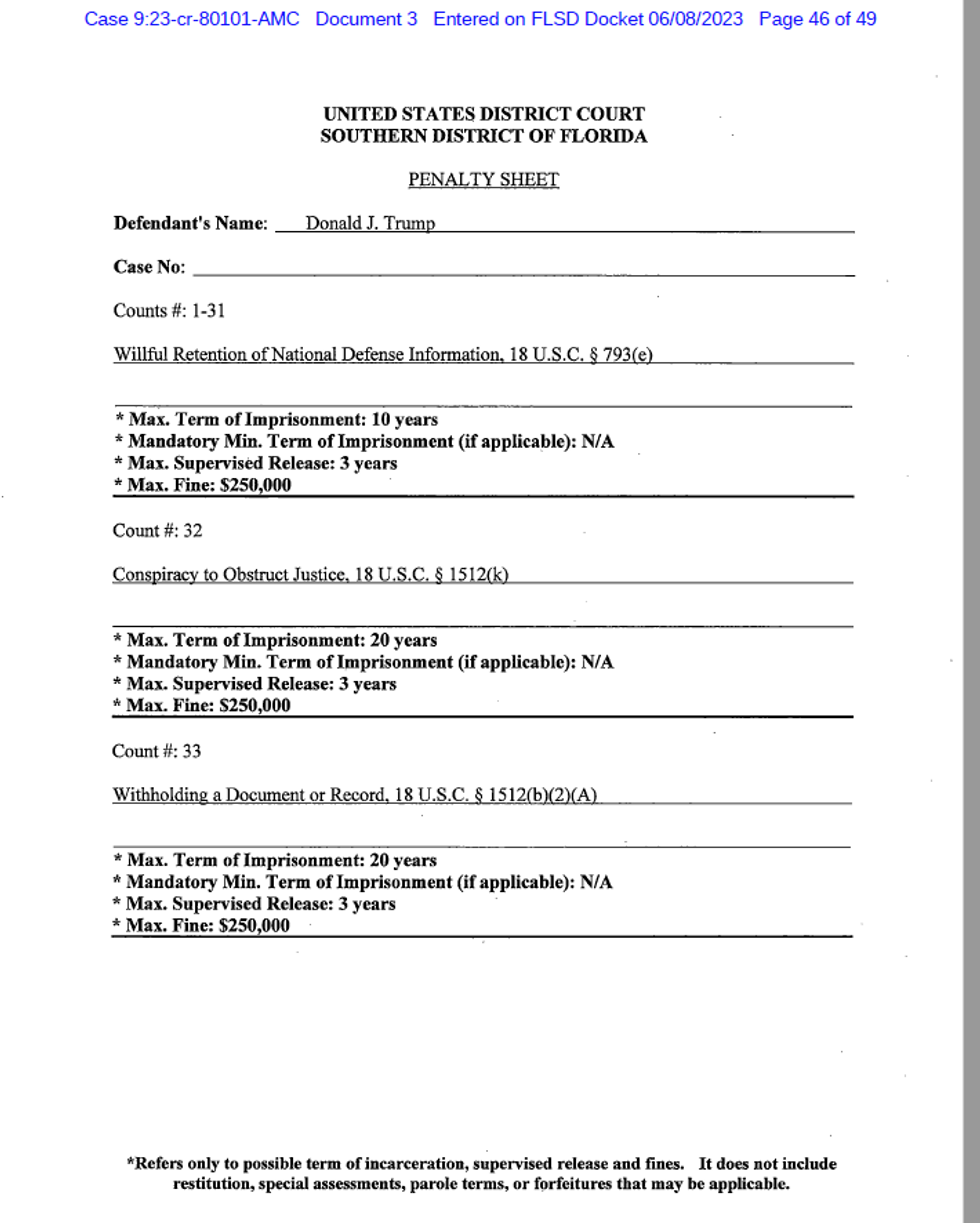 Federal document listing indictment counts against former President Donald Trump. U.S. District Court, Southern District of Florida
“There's no law on the books that says you can't. You just have to reason from the idea of separation of powers and the Constitution or to think that it doesn't make any sense to have one person aggregate or accumulate so much power,” Krent said. “As a constitutional matter, I think that that would be too much of a conflict of interest to be able to pardon yourself.”
Interestingly, the federal indictment didn’t include counts related to 18 U.S.Code 2071, which deals with the concealment, removal or destruction of government documents. This would disqualify anyone found in violation of the code from running for office, Rahmani said.
“That particular provision was passed after Nixon as a disqualification provision that prevents anyone convicted of it from holding public office,” Rahmani said. “Trump's lawyers would have said that it's unconstitutional because only the Constitution can place limits on who could be president. You can be a felon. You can be in prison and still theoretically be president of the United States.”
The Constitution could be interpreted — ostensibly by the U.S. Supreme Court — that an imprisoned president wouldn’t qualify as capable of carrying out his duties, preventing him from taking the office, Ravel said.
“There's nothing to stop him from becoming president either because the provisions in the Constitution about the presidency and the requirements for presidency don't reflect any concern if a president has been indicted or is in jail,” Ravel said. “Although if he goes to jail, it would create a problem for him because the Constitution does have concerns about the inability to carry out the obligations of the office, which he certainly wouldn't be able to do in jail.”
Specifically, Section 4 of the Constitution’s 25th Amendment potentially empowers Congress to determine — via a two-thirds vote of both chambers — that a president is “unable to discharge the powers and duties of his office” and thereby transfer presidential powers to the vice president.
But if Trump is elected next year, and a Trump trial takes place after November 2024, some of his legal peril could subside — at least at the federal level.
“There's clear Department of Justice memos and policies. It's pretty clear that a sitting president cannot be prosecuted,” Rahmani said.
If Trump won and was convicted but on appeal, he would “probably” still be able to get inaugurated, Krent said.
“The question is whether they would stop the appeal and let him serve out the presidency before it would continue,” Krent said. “Uncharted waters in terms of how this would go. It's gonna affect the primary. It would affect the general election, and it certainly would affect his ability to conduct a presidency.”
