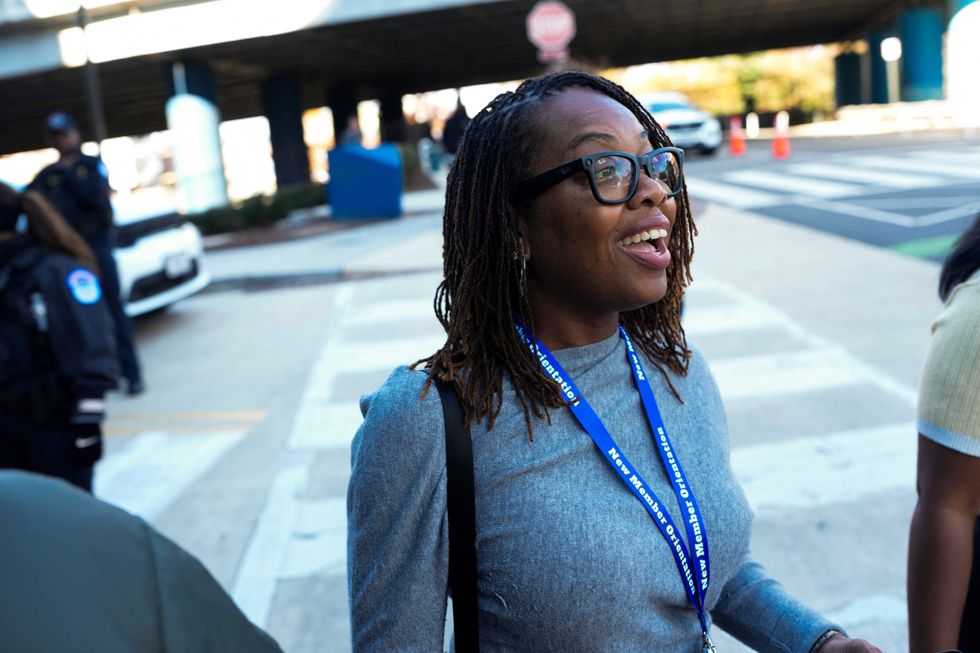
US Representative-elect LaKesha Womack (D-NC) takes a question from a reporter at the beginning of several days of new member orientation in Washington, DC, US, November 8, 2026. REUTERS/Elizabeth Frantz

When the House convenes in January, roughly a quarter of members will be serving for the first time after a turnover that seems likely to surpass the most recent high-water mark of 1993, when Bill Clinton became president.
Fueled by a blue tsunami, a stampede of retirements and a redistricting war that backfired on Republicans, at least 108 new members will join the House. The incoming cohort includes pastors, political strategists and labor organizers, veterans, mayors and a throng of state legislators and county commissioners.
With five races yet to be called in which political newcomers hold the lead, the number of first-term members is on track to reach 113, surpassing the 109 new members seated in 1993. If the trajectory holds, it will be the largest freshman class since 1933, when the record for the modern era was set with 158 new members.
The new members whose races have been called include 74 Democrats and 32 Republicans.
A teeming group of first-term lawmakers suggests the new Congress is likely to tackle an ambitious agenda, said historian Allan J. Lichtman, author of Great American Presidents.
“Usually, when you get new members, it pushes the Congress to be bold and not fall back into conventional ways, which will advance the investigative and legislative agenda of the Democratic Party,” Lichtman told Raw Story.
The common thread connecting the 2026 midterms to previous eras that propelled new members into the House is “a rejection of the administration.”
“In 1932, you had, of course, the American people revolting against the inability of the Hoover administration to deal with the Great Depression,” Lichtman said. The 1992 election followed an eight-month recession that sunk the presidency of President George H.W. Bush, a Republican.
When the 103rd Congress convened in 1993, lawmakers ratified the North American Free Trade Agreement. Significant legislation they sent to the new Democratic president’s desk for his signature included the “Motor Voter” bill allowing people to register to vote when they obtained driver’s licenses, the “Brady Bill” requiring background checks and a five-day waiting period on firearms purchases, and the creation of the AmeriCorps program.
But the “stinging defeat” of healthcare reform — “the signature policy of the Clinton administration” — the following year set the stage for the wave election that allowed the Republicans to retake control of Congress.
The dynamics driving the 2026 midterm elections combine the popular dissatisfaction of the early Clinton era and the Great Depression with a third period of upheaval: the resignation of President Richard Nixon following the Watergate scandal and weariness with the Vietnam war, Lichtman said.
“This time we have an abidingly unpopular president and the most unpopular war in U.S. History,” Lichtman said. “Unlike every other war, the Iran war was unpopular from the start. We hate high inflation and a sour economy, and something we haven’t seen since Watergate; that is corruption and democracy being critical voting issues.”
Voters’ repudiation of the Trump administration and widespread discontent incentivize new members to put pressure on party leadership to undertake an ambitious agenda because they will feel the need to deliver on their promises, Lichtman said.
The incoming freshman class of Democrats includes a deep bench of national security and military experience, including Eileen Laubacher, a retired U.S. Navy rear admiral who served on the National Security Council during the Biden administration, who is replacing Lauren Boebert in a Colorado district; retired U.S. Navy Vice Admiral Nancy S. Lacore, representing the Charleston, South Carolina area, who was fired from her post as chief of the Navy Reserve by Defense Secretary Pete Hegseth; and Cait Conley, a former national security official with responsibility for counterterrorism and elections who ousted Rep. Mike Lawler in New York’s Hudson Valley.
It also includes insurgents who have pushed to change institutions from the outside, including William Lawrence, co-founder of the climate action group Sunrise Movement in Michigan, and Leticia Gutierrez, an environmental justice campaigner from Houston. It includes labor organizers such as Donavan McKinney, a member of the Democratic Socialists of America who primaried a Democratic incumbent in Detroit, and Sam Forstag, a former smokejumper who flipped a red district in western Montana.
LaKesha Womack, an ordained minister and leadership consultant who has experienced homelessness, unexpectedly ousted a Republican who had served as state House speaker and redrew his North Carolina congressional district to his own advantage.
The Democratic newcomers also include Bobby Pulido, a Tejano recording artist from South Texas, and Janelle Stetson, a former TV news anchor in central Pennsylvania. It includes a half-dozen current and former mayors: Cyril Jefferson (High Point, North Carolina), Oliver Gilbert (Miami Gardens, Florida), Daniel Biss (Evanston, Illinois), Paige Cognetti (Scranton, Pennsylvania) and Zack Mullock (Cape May, New Jersey).
On the Republican side, the newcomers include Paul LePage, the former governor of Maine, along with conservative policy wonks, such as Jessica Steinmann, a former Trump DOJ official, representing a suburban district outside of Houston, and Sydney Gruters, an ally of Florida Gov. Ron DeSantis and the spouse of Republican National Committee Chair Joe Gruters.
The Republican newcomers also include former Major League Baseball player Mark Teixeira, representing the Texas Hill Country. Michael Alfonso, who previously produced the podcast of former FBI Deputy Director Dan Bongino, will represent a district in northern Wisconsin. At 27, he makes history as the first member of Gen Z to serve in Congress.
While Republican primary voters dispatched two MAGA avatars — Andy Ogles in Tennessee and Cory Mills in Florida — at least one new Republican member is poised to carry on the Trump movement’s pugilistic streak. Anthony Constantino, who succeeds Rep. Elise Stefanik as representative of a district in New York’s Adirondack region, has received support from Trump confidante Roger Stone while earning the sobriquet “most uncontrollable loudmouth” of the Republican caucus from Mother Jones.
Six incoming representatives are technically first-term members who have previously served in the House, albeit prior to the current session: Hilda Solis (D-CA), Melissa Bean (D-IL), Colin Allred (D-TX), Ben McAdams (D-UT), Elaine Luria (D-VA) and Jerry Carl (R-AL).
Lichtman, who is known for developing “the 13 keys” system for predicting the outcomes of presidential elections, said the repudiation of Trump in this year’s midterm elections casts a shadow over whoever becomes the Republican nominee in 2028. But he said the Democrats' willingness to take bold action in the next session — likely with the urging of first-term members — will also play a role in shaping conditions for the presidential race.
“This election has profound implications for 2028,” Lichtman said. “Number one — midterm losses are one of the 13 keys to the White House. It’s not dispositive in and of itself, but it’s a negative mark. If the Democrats succeed in exposing threats to democracy and corruption, that would turn the scandal key.
"In addition, this midterm greatly complicates the Republican nominating process. It taints the two frontrunners, [Vice President] JD Vance and [Secretary of State] Marco Rubio…. It sets up a bruising party fight for an open seat.”
Report typos and corrections to corrections@rawstory.com.
For customer support contact support@rawstory.com.