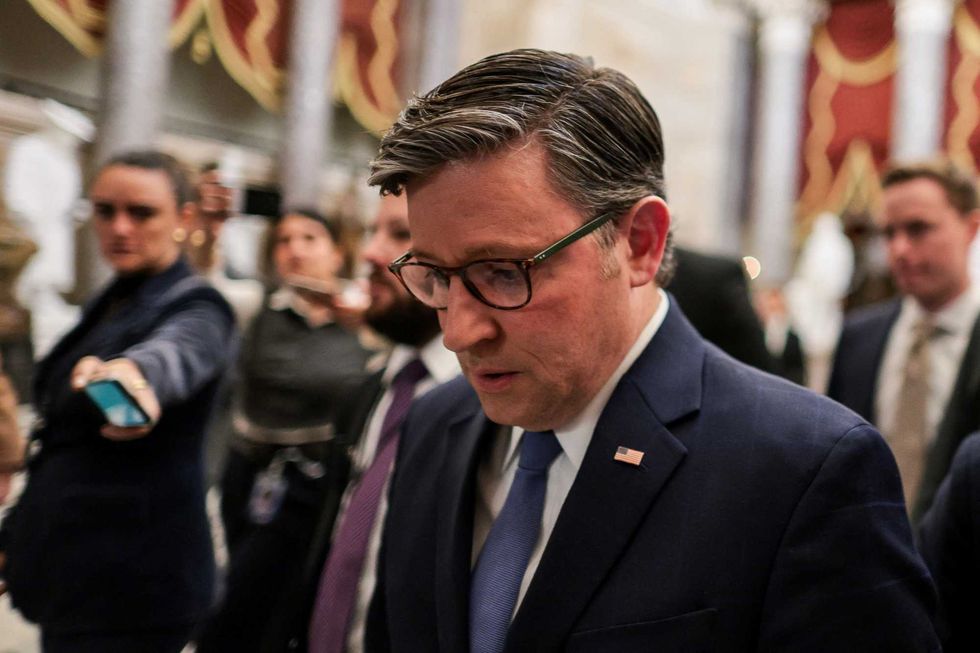
Imagine for a minute it’s Jan. 3, 2027.
At noon, the U.S. House of Representatives for the 119th Congress, led by Speaker Mike Johnson (R-LA), officially dissolves, as is determined by the Constitution.
Under the rules of the House, as set out in the U.S. Constitution, before the new members can even be sworn in, they must elect a speaker. The clerk — the one House official whose powers carry over from one term to the next — calls a roll based on a list prepared from certificates of election submitted by state officials in advance.
As the new 120th Congress begins, it's widely understood that the Democrats have a razor-thin majority and will retake the House. After the roll is called, the members-elect vote in Rep. Hakeem Jeffries (D-NY) as the new speaker.
But before Jeffries can administer the oath to the new members, a Republican with a history of coordinating with President Donald Trump to try to overturn the 2020 election rises and objects to swearing in Will Lawrence, a Democrat who flipped a Republican seat in central Michigan, and Jared Moscowitz, a Democrat who fended off a challenge in his Atlantic coast of Florida district. The Republican invokes an obscure measure last used in the House in 1985 to force Lawrence and Moscowitz to “step aside,” citing concerns surrounding the legitimacy of their election which must be addressed before they are seated.
With 433 members seated, and two Democrats in limbo, the Republicans now have a 217-216 majority, and they call for a new election for speaker, angling to restore Johnson to the post. Faced with what amounts to a legislative coup, Speaker Jeffries is hard pressed to not rule the motion out of order — but if he does, it’s all but certain to unleash procedural chaos.
The scenario described above is fictional, albeit with some factual details. But it’s one of a handful that House Democrats have reportedly contemplated as they game out the various ways the system could break down following the Nov. 3 elections.
The prospect of Republican lawmakers, goaded by Trump’s baseless claims of election fraud, seizing on doubts raised about one or two races that determine control of the House to essentially overturn the 2026 midterm elections is also remarkably similar to a scenario described in a 2021 article for the Marquette Law Review by Michigan State University professor Brian C. Kalt.
Instead of referencing Democrats and Republicans as the two major parties, Kalt’s hypothetical describes a “Silver Party” as winning a 218-217 majority, with a “Purple” party challenging two members-elect from the majority party and then attempting to elect one of their own as speaker.
“It would be outrageous for a party to try to seize control of the House this way,” Kalt writes. “Unfortunately, if conditions were just so, it is not hard to imagine either party launching such an attempt.
“Things could unravel further,” he warns. “Contending for ultimate control, both sides could level motions, appeals, and tit-for-tat pre-oath challenges against each other’s members-elect. The proto-House could degenerate into a chaotic mass of votes, meta-votes (about who gets to vote), and meta-meta-votes before anyone has even been sworn in. Instead of the House being controlled by the party that won the most seats in the election, it might go instead to the party that is more disciplined and unified — or failing that, to the party that is more adept at parliamentary machinations.”
Asked about the potential for an effort by Republicans to thwart the transfer of power, Democratic Leader Hakeem Jeffries' staff pointed Raw Story to a comment he made on a podcast last week in which he said Democratic leaders are working with civil society groups to ensure "that results are properly certified so that when the American people give us an opportunity to govern the majority, those results are actually brought to life on January 3 of next year."
Rep. Terri Sewell (D-AL), the ranking member on the House Elections Subcommittee, is a key member of a squad of Democrats troubleshooting potential election challenges.
"House Democrats are taking President Trump's threats to interfere in our elections extremely seriously," Sewell told Raw Story. "We are working diligently to prepare for and defend against those threats, while protecting the right of every eligible American to cast their ballot and have it counted fairly."
Kalt has flagged the “step aside” procedure as a key vulnerability in the election process. Kalt argues that the procedure, which was instituted after the Civil War as a mechanism to enforce a prohibition against office-holding by anyone who had supported the Confederacy, is obsolete and should be ended.
House Democrats are also girding against a potential scenario even more worrisome than challenges to swearing in members-elect in contested races.
The House clerk, Kevin McCumber, was appointed to his position by Johnson in 2025, but is generally regarded as nonpartisan, having worked off and on in the Office of the Clerk under the leadership of both parties over the past three decades, and having served as deputy clerk under former Democratic Speaker Nancy Pelosi.
House Democrats are reportedly worried about one particular “disaster scenario” in which Johnson fires McCumber after the Nov. 3 election if it becomes apparent that Democrats are winning a majority of seats, and replaces him with a partisan who is pliant to Trump’s wishes and assembles a roll that eliminates Democrats whose races were subject to the president’s fraud claims to arrive at an artificial Republican majority.
“The role of the clerk and making the roll of new members — that’s the most vulnerable part,” Kalt told Raw Story. As described in Kalt’s article, under current practices, the Clerk’s office begins to communicate with state authorities in September — well before the election — about what they “must do to certify and submit their election results properly.” After the November election, the states submit their certified results to the Clerk’s office, which “reviews them to ensure they comply with state law.” If there are any inadequacies, the clerk typically notifies the states and gives them an opportunity to correct the paperwork.
Rep. Joe Morelle, the ranking member on the House Administration Committee, described the worry that Johnson might fire the clerk to legal journalist Jeffrey Toobin for an opinion piece published by the New York Times last month. Morelle has been traveling around the country to hold shadow hearings on election security.
“It’s close enough to a realistic scenario that there are Democrats concerned about it,” Toobin told Newsweek in a video interview on Aug. 10. “And interestingly, since my piece came out… I have subsequently heard from Democrats, like, ‘Wow, I didn’t know you knew about this, but we’ve really been worried about this for some time.’”
Morelle told Raw Story: "We have been preparing for what is certain to be Donald Trump's next assault on democracy. He will not succeed in subverting the will of the American people. We are ready, legally and legislatively, to ensure the 120th Congress will be seated without incident."
Washington state Attorney General Nick Brown, who chairs the Democratic Attorneys General Election Protection Working Group, told Raw Story that he hopes the process of transmitting election results from the states to the House clerk remains boring and ministerial, but it warrants attention.
"I think it would be remarkable in the worst sense to imagine that the House would somehow reject certification from a state," he said. "But I think these things that used to be totally ridiculous hypotheticals are now much more imaginable."
Many Democrats argue that a blue wave election is the best insurance against potential meddling by Trump and his congressional allies.
"I have full confidence in our democracy and in the American people to make their voices heard loud and clear in November," Repo. Sewell told Raw Story. "By turning out in historic numbers, we will make this election too big to rig."
If a new clerk — potentially a MAGA hack — appointed by Johnson were to assemble a roll of members-elect predetermined to ensure a specific party or faction assumed control of the new House, it wouldn’t be the first time in American history.
As detailed in Kalt’s article, in 1863, a clerk who resented President Abraham Lincoln’s policies of emancipation and reconstruction hatched a conspiracy with one of the president’s legislative opponents to rig the vote for speaker. When the new House convened, the clerk kept 16 Republicans supportive of Lincoln off the roll and added three conservative Republicans more skeptical towards his policies.
During that procedural scuffle, the Lincoln Republicans responded by voting to restore their exiled colleagues to the roll. But if the rebels had maintained discipline, Kalt writes, “they could have controlled the majority and chosen the speaker.” In the aftermath, the House could have been faced with protracted procedural fights, and even an effort by partisans “to remove the clerk by force.”
Johnson and members of the Republican leadership team did not respond to emails from Raw Story about whether the possibility of firing the House clerk is being actively considered or has been discussed. They also left unanswered a question about whether they will honor the results should Democrats win a majority of the seats.
When he was first elected speaker in 2023, Johnson batted away questions about Trump’s effort to overturn the 2020 election and Republican members’ actions to stall the certification of Joe Biden as president on Jan. 6, 2021 as Trump’s supporters overran the Capitol.
Johnson has also repeatedly amplified Trump’s election conspiracies, while expressing in softer language what critics charge helps lend legitimacy to the president’s unhinged rants.
During a February 2024 news conference in support of a restrictionist election bill, Johnson told reporters: “We all know intuitively that a lot of illegals are voting in federal elections, but it’s not something that is easily provable. We don’t have a number.” (A ProPublica report last week revealed that the government has only charged 41 alleged noncitizens with voting since January 2025, compared to 150 million people who voted in the most recent presidential election, despite an unprecedented effort to task Homeland Security Investigations to identify offenders.)
Johnson has repeatedly complained about Republican candidates falling behind as late-returning ballots favor their Democratic opponents — a commonly understood phenomenon known as the “red mirage” — while saying he can’t prove fraud “because it’s so far upstream.”
When Trump said in February that Republicans “should take over the voting” in “15 places” — a number roughly aligns with the number of states with House or Senate races considered to be toss-ups — Johnson defended him.
“What you’re hearing from the president is his frustration about the lack of some of the blue states, frankly, of enforcing these things and making sure that they are free and fair elections,” the speaker said.
As recently as June, when Trump ended a televised interview after being challenged on his baseless accusation of a “rigged election” and “cheating” in the California primary, Johnson again came to the president’s defense.
“They are counting votes weeks after the election,” Johnson said. “I’m not saying it’s rigged. I’m saying it stinks to high heaven, and everybody knows that.”