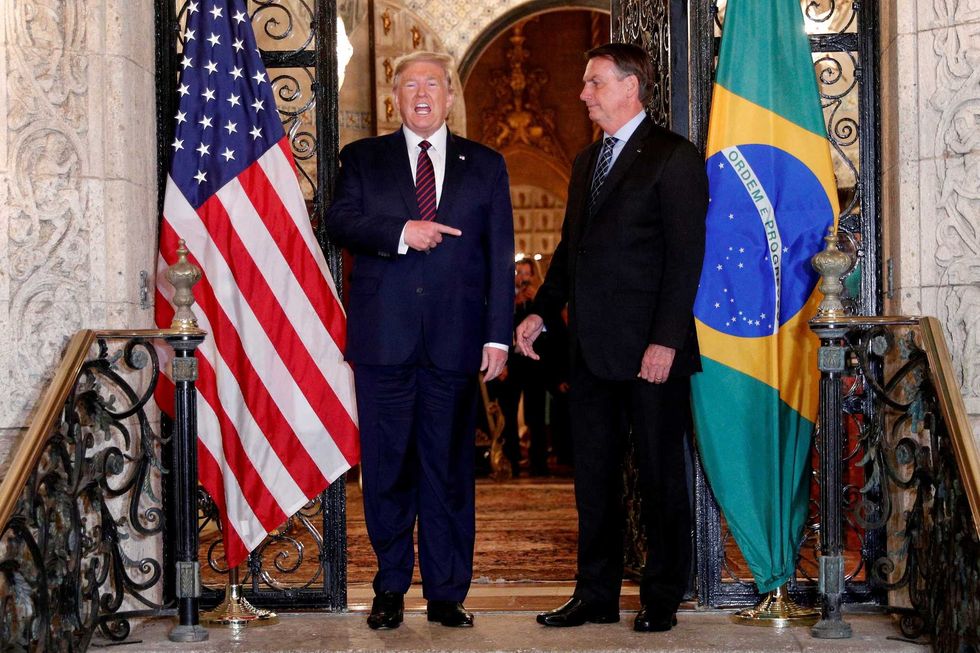
U.S. President Donald Trump hosts a photo-op with Brazilian President Jair Bolsonaro before attending a working dinner at the Mar-a-Lago resort in Palm Beach, Florida, U.S., March 7, 2020. REUTERS/Tom Brenner/File Photo

A stunning electoral upset just lost President Donald Trump the "biggest prize" — as his allies abroad topple, a political expert told Raw Story on Monday.
Brazilian President Luiz Inácio Lula da Silva's runoff victory Sunday against Flávio Bolsonaro, the far-right son of a former president imprisoned for staging a coup, delivered a stinging blow to Trump's plans, Berea College Professor Carlos G. Poggio told Raw Story.
"Lula’s victory represents a significant defeat for Donald Trump and [Secretary of State] Marco Rubio," Poggio, a Brazilian political scientist, said in an email. "Brazil was the biggest prize in the conservative tide sweeping Latin America."
The defeats for Trump are numerous and multifaceted — they span from the U.S. to Latin America and China and hit his power, and his wallet, Poggio argued.
Bolsonaro, 45, had aligned himself with Trump by pledging to mine the Amazon rainforest for critical mineral deposits, which would ease U.S. dependence on Chinese rare earth exports, limited in 2025 in response to Trump's tariffs.
Trump would also have had the support of Latin America's largest economy with a GDP of $2.65 trillion, according to data collected by independent statisticians at Worldometer, and the power such money can access.
"A Flávio Bolsonaro government would likely have become Trump’s most important regional ally, supporting the Trump administration’s security agenda and closer U.S. access to Brazil’s critical minerals," Poggio said.
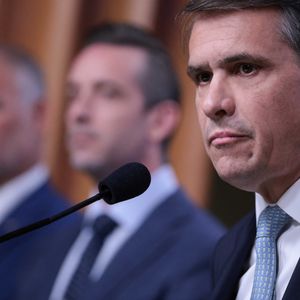
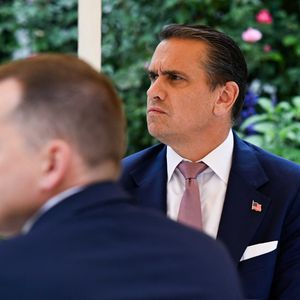
That may be why the Bolsonaro family have had help from two officials from within Trump's State department since 2025, as a Reuters report revealed earlier this month.
The officials, Darren Beattie and Ricardo Pita, first tried to reinstate former President Jair Bolsonaro, ousted in 2022 and charged after attempting a coup that reportedly involved plans to assassinate Lula.
Then in September 2025, when Jair Bolsonaro received a 27-year sentence for leading the coup attempt, the pair pivoted to his son, according to the report.
Both men advocated for punitive measures to weaken Lula, including the designation of Brazilian gangs as terrorist groups and the imposition of sanctions against the Brazilian Supreme Court Justice who led investigations into Jair Bolsonaro, Reuters reported.
Meanwhile, Flávio Bolsonaro promised to seek amnesty for his father and the rioters who supported him, as well as impeachments for the Supreme Court justices who jailed them, according to the New York Times.
But Lula stood up to Trump, refusing to drop coup charges against the elder Bolsonaro.
While this act of resistance garnered Lula some support, it was not strong enough to win his initial contest against Bolsonaro earlier this month. The Brazilian incumbent won only 45 percent of the vote to Bolsonaro's 47 percent, triggering a runoff as neither met the nation's 50 percent requirement for victory.
Poggio believes this initial defeat worked in the favor of the Partido dos Trabalhadores (PT)or Workers Party, and Lula, who won on Sunday by 4 million votes.
"Flávio Bolsonaro’s lead encouraged some complacency among supporters who believed the election was largely won," Poggio said. "Lula’s defeat instead generated urgency: the PT reactivated its grassroots organization, while unions, social movements, artists, intellectuals and civil-society figures turned the runoff into a broader mobilization against the return of bolsonarismo."
That grassroots organization moved fast to deliver what Poggio described as "a concrete economic message" from Lula.
Brazilians were promised a "pacote de bondades” or “goodies package” that included a 15 percent increase in Bolsa Família, a financial aid program for Brazil's lower income citizens, as well as fuel-tax reductions, debt relief and education and transportation initiatives, Poggio said.
All the while, Bolsonaro struggled to present an equally strong counterpoint, said Poggio.
"He promised to maintain or expand Bolsa Família and other popular programs associated with Lula, while retreating from some unpopular positions," said Poggio.
"This allowed Lula to argue that voters could preserve social protections without accepting the political and institutional risks associated with the Bolsonaro family’s return."
Brazilian voters were not alone last week in rejecting the risks involved with a Trump ally's leadership.
In Serbia, President Aleksandar Vučić lost control of his government to a group of academics, professionals and public figures who call themselves the Student List and protested their government's increasingly authoritarian measures.
And in April, Hungary's leader Viktor Orbán — an autocrat and staunch Trump supporter — was thrown from power in a popular vote.
On Tuesday, Israeli President Benjamin Netanyahu faces the possibility of joining Bolsonaro, Vučić and Orban's ranks as he bids for reelection amid wars in Gaza and Iran that Trump is also involved in.
Left-leaning leaders across the world were celebrating Lula's victory Monday.
Mexico's President Claudia Sheinbaum called it a win for democracy and the people of Brazil. Spanish Prime Minister Pedro Sánchez replied to the news, "The global progressive resurgence has just begun."
Poggio concurs the Brazilian vote will serve as a vital check.
"Lula’s victory interrupts that rightward momentum and preserves Brazil as a counterweight to Washington," he said, "committed to multilateralism, regional autonomy and relations with the Global South."
Report typos and corrections to corrections@rawstory.com.
For customer support contact support@rawstory.com.