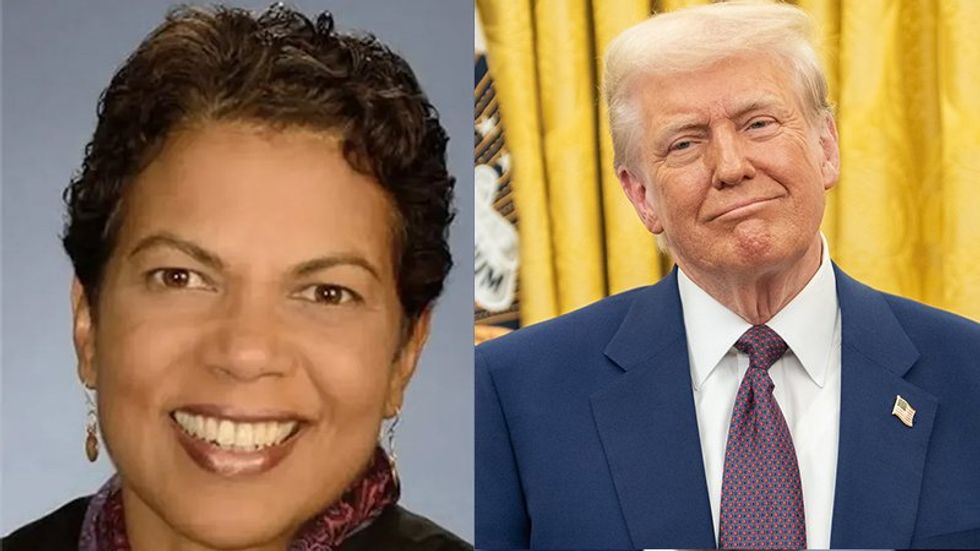
Judge Tanya Chutkan and President Donald Trump (Photos: Historical Society of the D.C. Circuit and White House/Flickr)

U.S. District Judge Tanya Chutkan delivered two blows to the Trump administration Monday, the day before the midterm elections. She blocked federal agencies from sending lists of suspected noncitizen voters to state and local election officials, and she put tight new deadlines on President Donald Trump’s planned arch in Washington.
In a 30-page opinion, Chutkan granted a preliminary injunction barring the Department of Homeland Security and the Department of Justice from further transmitting the lists. She also stayed what the plaintiffs call the “Voter Data Transmission Policy.”
“Election day is tomorrow, and in many states voting is already underway,” wrote Chutkan, an Obama appointee who presided over the now-dismissed federal case against Trump over his efforts to overturn the 2020 election.
The suit was brought by the League of Women Voters, the League of United Latin American Citizens (LULAC) and the Electronic Privacy Information Center (EPIC). It accuses the administration of amassing a national database of voter information from at least 47 states, including Social Security numbers, birth dates, voting history and party affiliation. The government then sent lists of people it claims are noncitizens to election officials, asking them to investigate and, in some cases, to set aside those people’s ballots.
Chutkan found the plaintiffs are likely to win on their claim that no law authorizes the program. The administration pointed only to the federal statute that criminalizes noncitizen voting. Chutkan wrote that the law “contains no language authorizing the broad program of bulk transmission of sensitive voter data for the purposes of intervening in state election procedures.”
She also found the administration likely violated the Privacy Act by failing to publish required public notices about its voter databases and by disclosing records in bulk without a valid legal exception. She noted that the government “do[es] not meaningfully respond” to the plaintiffs’ core Privacy Act claims.
Chutkan cited several examples of the lists’ flaws. After DHS claimed 15,903 noncitizens were registered to vote in Nevada, a manual review by the state found that “every single individual was a United States citizen,” she wrote, quoting a California federal court. In Los Angeles County, DOJ hand-delivered a thumb drive with information on more than 20,000 people it claimed were likely noncitizens. Only 7,035 of the records had addresses in the county.
When the county refused to segregate the ballots, DOJ sued. A federal judge and the Ninth Circuit both denied DOJ’s requests for emergency relief. Chutkan noted that the Supreme Court also denied DOJ’s emergency application in that case on Monday.
The judge cited a letter showing DOJ planned to send Washington state a second list of suspected noncitizens before Election Day. She also cited internal DHS documents naming “priority states,” including Michigan, Pennsylvania, Arizona, Georgia and Florida.
Chutkan rejected the government’s argument that the Supreme Court’s Purcell principle, which cautions courts against changing election rules at the last minute, weighed against her stepping in. It “counsels in favor of it,” she wrote, because more transmissions could “usher in electoral chaos.”
She also pointed out a contradiction in the government’s position. The government argued that states were free to ignore its demands, and Chutkan wrote that this “undercuts any claim that an injunction imposes harm on the government’s efforts to combat purported fraud.”
“Yet another judge – Tanya Chutkan – has barred DHS and DOJ from transmitting lists of purportedly ineligible voters to states, saying the Trump admin’s handling of voters’ data likely violates privacy law,” wrote Politico senior legal affairs reporter Kyle Cheney.
Earlier Monday, Chutkan issued an order in a separate case over Trump’s planned arch at Memorial Circle, near Arlington National Cemetery. Three Vietnam veterans and an architectural historian sued to stop the arch, and so did the District of Columbia and Virginia, the Associated Press reported.
Chutkan ordered the administration to notify her within one hour of any decision by the National Capital Planning Commission, the National Park Service or the Interior Department about the arch. She also ordered it to file notice within 30 minutes of “any activity related to or in preparation for the construction of an arch on Memorial Circle.”
The government has said construction could begin as early as Wednesday, pending the planning commission’s approval that day, according to the AP. At a hearing last week, Chutkan asked what harm the government would suffer from an injunction “apart from the executive’s desire to bedazzle the city.”
Conservative writer Julie Kelly mocked the arch order, saying, “DC judges turned construction foremen can’t stop themselves.”
Report typos and corrections to corrections@rawstory.com.
For customer support contact support@rawstory.com.