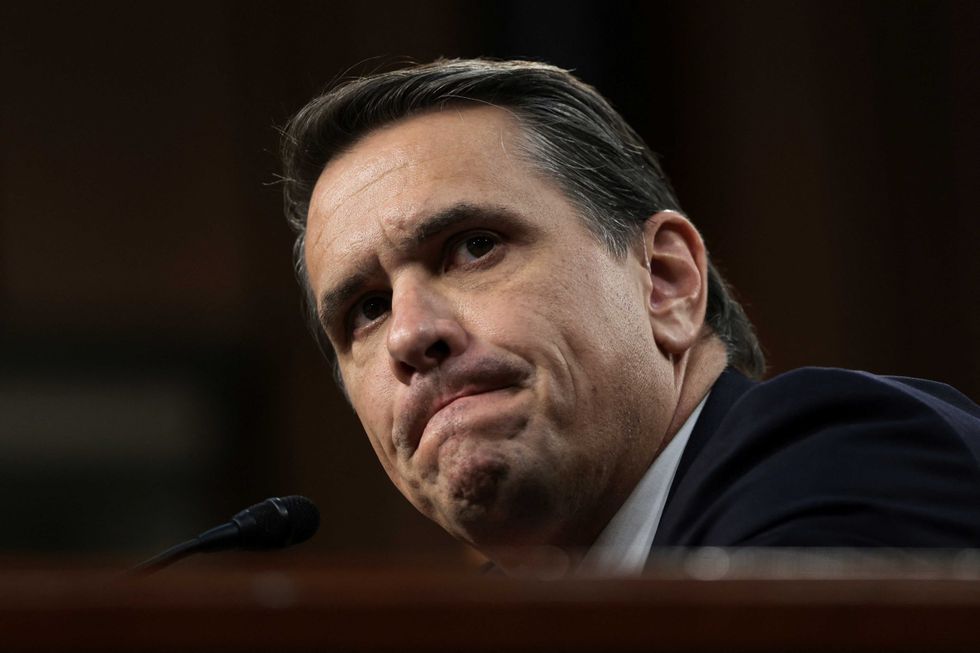
Acting Attorney General Todd Blanche testifies before a Senate Judiciary Committee confirmation hearing on his nomination to be attorney general, on Capitol Hill in Washington, D.C., on July 15, 2026. REUTERS/Evelyn Hockstein

Former U.S. Attorney Joyce Vance predicted the Justice Department was in for “a rude awakening” if it thought it could push around U.S. District Judge David O. Carter. On Thursday, the judge proved her right.
Carter refused the Trump administration’s demand that California set aside more than 20,000 ballots cast by voters the federal government suspects may not be citizens. His "epic opinion" repeatedly questions the government’s credibility, according to Vance's Thursday Substack newsletter.
“This case is about the right of every American citizen to vote in a free and fair election,” Carter wrote. “Never before in American history has the federal government, on the eve of an election, sought to coerce a state and local government to abandon their own Constitutional elections procedures and bend to the will of the Executive Branch.”
“In bringing this lawsuit, the Executive would have this Court believe that it reigns as a sole sovereign,” he added. “But California and its people are sovereign, too.”
Carter, 82, is a Clinton appointee and a former Marine who earned a Bronze Star and a Purple Heart in Vietnam. Vance described him that way in her Civil Discourse newsletter Tuesday, before the ruling, and wrote, “If the Justice Department thinks it’s going to push him around, I suspect it’s in for a rude awakening.”
The DOJ sued California on Oct. 15, minutes after a 48-hour deadline it had given the state to review a list of more than 20,000 voters it called “likely noncitizens.” The list arrived on a thumb drive sent to the Los Angeles County registrar after roughly 5.9 million mail ballots had already gone out. The registrar concluded that the DOJ’s instructions were “legally prohibited” because the government provided no evidence for its claims.
Carter picked apart how the list was built. Homeland Security Investigations bought a California voter file, and it was run through federal immigration data and a third-party analytics platform. The government didn’t reveal until the night before the hearing that the platform was LexisNexis. Carter said the government never disclosed its matching rules, its confidence thresholds, what its “enrichment process” involved, or any error rates.
“The Court cannot conclude that Plaintiff’s process is credible,” Carter wrote. “Given that Plaintiff’s entire claim for relief rests on the sincerity of this allegation, Plaintiff’s lack of credibility weighs against a finding in their favor.”
He also pointed to the DOJ’s track record. The department “has filed at least thirty-one lawsuits in federal district courts across the country seeking complete voter rolls from the States. Out of the twenty-six decided cases, the DOJ has prevailed in precisely zero.”
The judge found the government likely lacks standing, and that its request would likely violate the National Voter Registration Act’s ban on systematic voter purges within 90 days of an election. He also said any emergency was of the government’s own making. It bought California’s voter rolls in May but waited until mid-October to sue.
“Plaintiff’s theoretical risk of imminent harm is solely due to its own neglect,” Carter wrote.
He warned that naturalized citizens were most at risk of losing their votes. He cited evidence that federal employees were given “only twelve minutes to determine if a subject is a U.S. citizen.”
“It is no surprise that citizens are wrongly identified as noncitizens,” he wrote.
Carter closed with a blunt warning.
“If the Executive can discount votes and threaten an ongoing election due to unproven allegations, then our democracy is in danger,” the judge wrote. “This Court declines to be a party to such process.”
The DOJ has already filed an emergency appeal with the 9th Circuit and could take the case to the Supreme Court if it loses there.
Report typos and corrections to corrections@rawstory.com.
For customer support contact support@rawstory.com.