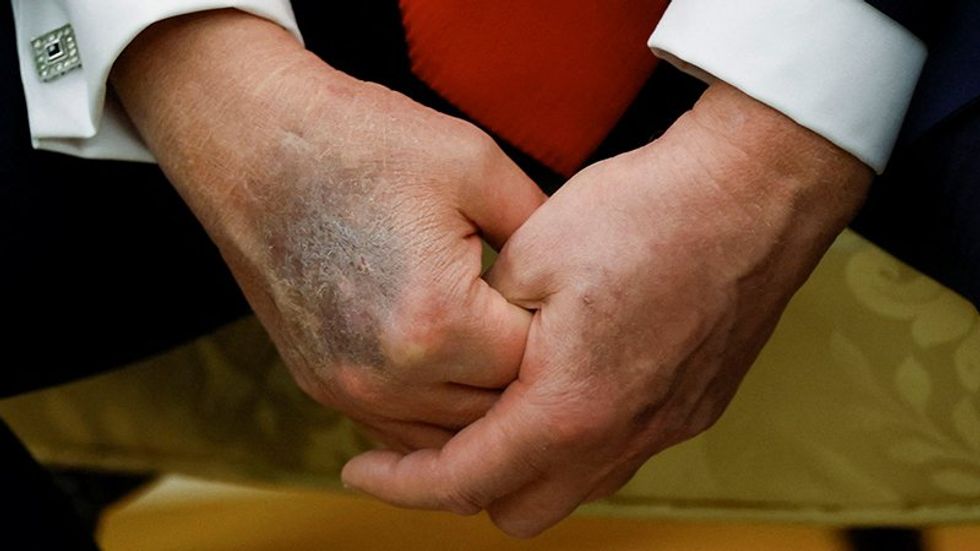
The bruised right hand of U.S. President Donald Trump is visible during a meeting with South Korean President Lee Jae Myung at the Oval Office, at the White House, in Washington, D.C., U.S., August 25, 2025. REUTERS/Brian Snyder

Former Vice President Dick Cheney's doctor urged Congress to take action as he rang alarm bells about a host troubling discrepancies in President Donald Trump's health reports.
Dr. Jonathan Reiner, a George Washington University professor and Cheney's cardiologist for 27 years, urged Congress to form a commission under the 25th Amendment to study the true state of Trump's health — and listed off a slew of questions he said need to be answered immediately.
"Despite reassurances from the White House to the contrary, at times over the past year, the president has not looked well," Reiner wrote.
"He’s had large bruises on both hands, swelling in his legs and episodes when it appears that he is struggling to stay awake. He’s also had advanced imaging performed for unclear reasons. The public is again left to wonder whether the nation’s leader is OK."
Reiner threw his support behind Rep. Jamie Raskin's bill to form a panel empowered to review data from Trump's physical examinations assessments.
Here are the questions Reiner told the New York Times he wants answered about the 80-year-old's health.
1. Why was Trump recently examined by 22 consultants?
2. Why are his hands bruised and why does he take so much aspirin?
3. Why did a recent physical examination not include Trump's chronic venous insufficiency diagnosis? Is it acute, which is a "much more consequential finding that can be caused by issues such as heart and kidney disease," Reiner noted. Why this discrepancy?
4. Why was Trump's apparent fatigue not addressed in a recent report on Trump's health in May? Has his medical team identified a problem and is it being treated?
5. Why did Trump undergo heart and abdomen imaging at Walter Reed National Military Medical Center in October? Was there a symptom or event that prompted the testing?
6. Why wasn't Trump's use of the hair-loss prevention drug finasteride mentioned in his most recent medical examination? What, if any, other medications has the White House decided to withhold from the public?
7. Why does Trump keep taking a "brief and basic" mental screening test? Have more sophisticated neurocognitive assessments been performed?
Reiner concluded his list with one last call to action.
"The United States does not have a king," Reiner concluded. "In a representative democracy, the people must have confidence in the health of their leader, and in the leader’s capacity to guide the nation. We have been kept in the dark too long."
Report typos and corrections to corrections@rawstory.com.
For customer support contact support@rawstory.com.