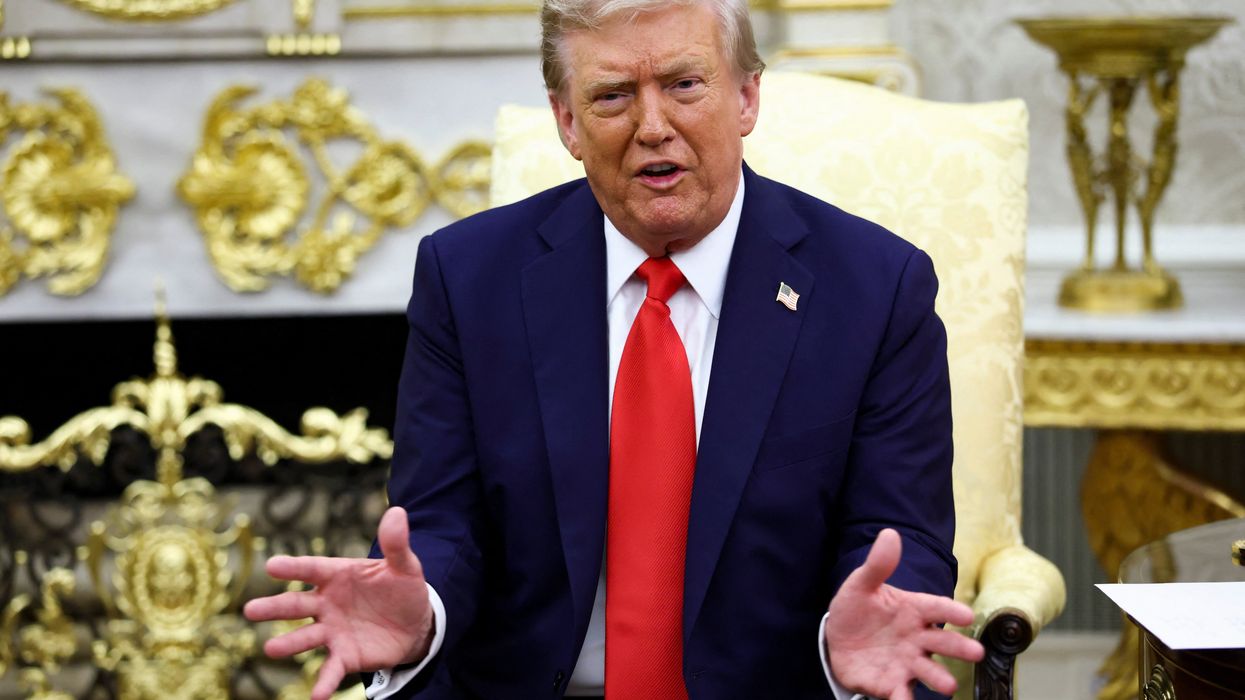
U.S. President Donald Trump gestures during a meeting with Ukrainian President Volodymyr Zelenskiy at the Oval Office of the White House, amid negotiations to end the Russian war in Ukraine, in Washington, D.C., U.S., August 18, 2025. REUTERS/Kevin Lamarque
Sarah Burris is a long-time veteran of political campaigns, having worked as a fundraiser and media director across the United States. She transitioned into reporting while working for Rock the Vote, Future Majority and Wiretap Magazine, covering the Millennial Generation's perspective during the presidential elections. As a political writer, Burris has had bylines at CNN, Salon.com, BNR, and AlterNet and serves as a senior digital editor for RawStory.com.
Former Homeland Security chief of staff Miles warned that President Donald Trump is going to invoke the Insurrection Act because he's wanted to do it for a long time, and that the U.S. Supreme Court will likely let him do it.
Speaking to MSNBC on Monday, former FBI general counsel Andrew Weissmann and ex-Justice Department official Mary McCord debated the legal challenges to whether or not Trump could invoke the Act and how it would be argued in court. But Taylor was the one who made it clear that his time in the Trump administration had shown him a deep desire to declare something a legal "insurrection" and invoke martial law.
"We need to do what Stephen Miller is doing right now, and that is gaming this out all the way to the Supreme Court," Taylor explained, recalling his exchanges with the far-right Trump advisor during the first term.
"He has been since the first administration, when he told me it would be a 'shock and awe' blitz in the second administration, and they would try to run decisions to the high court as fast as possible so that they could be on the highest ground possible," Taylor continued.
He doesn't anticipate that the John Roberts court will stop Trump.
"Surely Donald Trump is going to invoke the act, mark my words, he's going to invoke the act," said Taylor, noting that no policy debates are happening with Trump's underlings at the White House.
"And when and if this gets tothe Supreme Court ... what do you need to know about the Roberts court? The Roberts court has been deeply deferential when it comes to executive power, and has wanted to do what Andrew Weissmann says," Taylor noted. "If things have the ability to be pushed into the political sphere, say it's the political job, look as far back as Obamacare, the first really big decision the chief justice had to helm. He could have overturned it with his vote. Instead, he decided to say, 'Look, it's Congress's job to decide what happens.'"
That's what he predicts will happen in this case. Roberts will "cobbletogether a majority and say,you know what? I don't like thepresident of the United Statesdeclaring martial law. A lot ofthese things are scary, butit's ultimately the job ofCongress to fix this," Taylor predicted.
In this case, the House and Senate, led by Republicans, have been resistant to standing up to Trump. So, Taylor assumes a "two-house Republican Congress that will say nothing and do nothing. And the president of the United States will have effectivelybeen allowed to declaresomething close to martial lawin this country, which could gofrom mild to wild very, veryquickly."