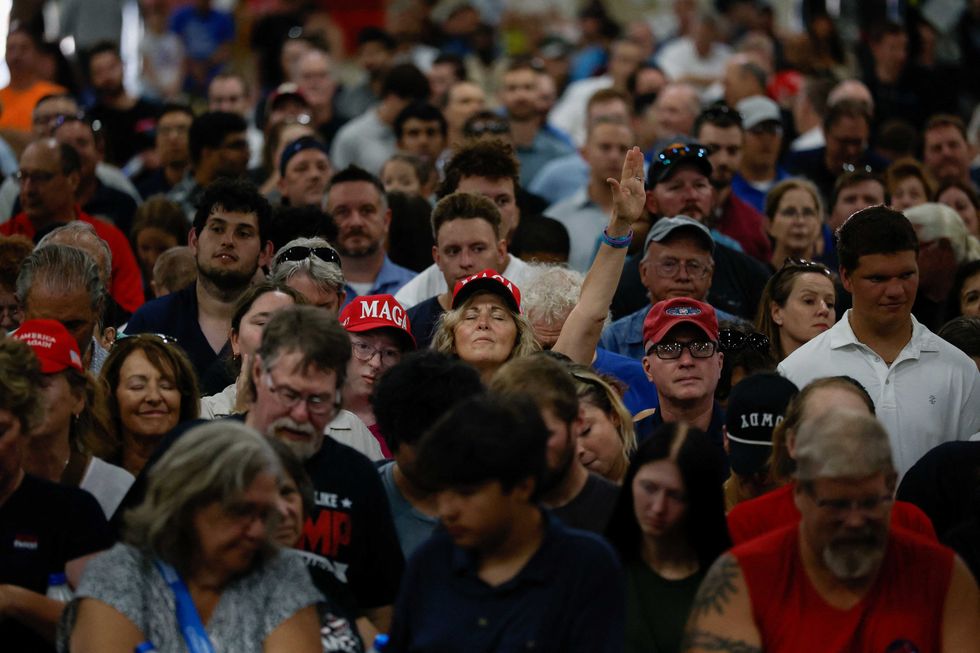
A woman wearing a MAGA hat raises her hand, on the day of U.S. President Donald Trump's speech at the General Motors Proving Ground, in Milford, Michigan, on July 27, 2026. REUTERS/Carlos Osorio

New polling data shows President Trump's MAGA movement is hemorrhaging support among one of its characteristic demographics.
CNN's Harry Enten found non-college-educated voters who formed President Donald Trump's base have a less favorable view of the MAGA movement, saying that stood at plus-six in October 2024, but that figure has since collapsed to negative-22, a 28-point swing away from the movement.
"So the bottom line is this: The group in which the Trump movement was built upon, they are shifting away and saying, 'We don't like MAGA anymore," Enten said.
"The erosion extends to Trump personally, Enten said. Non-college voters backed him by 13 points in the 2024 election — the margin that delivered his victory, given that college-educated voters broke against him. Current polling puts Trump at negative-19 among that same group, a 32-point reversal.
"This is why he's in so much trouble," Enten said. "It's not just that college voters are against Trump. Now it turns out that non-college voters, the ones that he built his presidential bid on, have waved adios."
The shift also threatens congressional Republicans heading into the midterms. Republicans won the generic House ballot among non-college voters by 13 points in 2024.
In current polling averages, Democrats now hold a narrow edge among that group. While the margin is slim, Enten noted that combined with Democrats' strength among college-educated voters, "these are the types of numbers in which blue waves are built."
Asked whether Republicans might benefit if non-college voters are simply souring on both parties, Enten said the data doesn't support that theory. "It turns out that the non-college voters are turning on you, too," he said, warning it "may, in fact, turn you out of power."
- YouTube youtu.be
Report typos and corrections to corrections@rawstory.com.
For customer support contact support@rawstory.com.