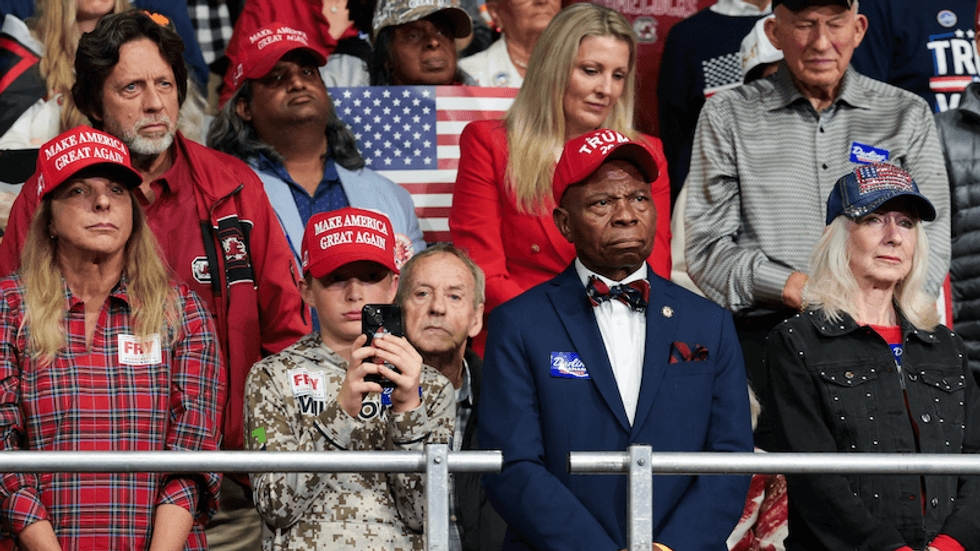
Supporters of US President Donald Trump listen as he delivers remarks at a midterm election campaign rally for incumbent US Senator Darline Graham (R-SC) at an event center in Rock Hill, South Carolina, US, October 29, 2026. REUTERS/Jonathan Ernst

Alyssa Farah Griffin, who served as communications director in President Donald Trump’s first White House, said Friday that his last-minute decision to swap in-person rallies in Kansas and Iowa for tele-rallies is “definitely not a sign of confidence.”
Trump canceled the in-person events just days before the midterm elections, with races in both states still tight, and Griffin, now a CNN political commentator, told anchor Sara Sidner that Trump “still can turn out huge crowds,” especially in deep-red parts of the country. But she noted that his crowds at a rally in Ohio earlier this week fell short of past events.
“I’ve been to many Trump rallies in my day,” Griffin said. “The stadiums he was filling were not as big or as widely attended as he’s used to.”
She said even “three-time Trump voters” are frustrated “at a time when everything is more expensive, gas prices are high, especially in the heartland of the country.”
“I suspect that they were not getting good turnout and that they opted instead for this tele-town hall approach, because it’s a little bit safer,” Griffin said. “You can still say you showed up in all these races ... but you’re not having to show up and have protesters and have sparsely attended crowds.”
Sidner noted that Kansas, which hasn’t elected a Democrat to the Senate since the 1930s, is now in play. Griffin said she wasn’t sure whether an unpopular president helps or hurts Republicans there. Trump can still “gin up” low-propensity voters, she said, such as the “young white men who showed up for him in 2024 and got him across the finish line.” But moderates such as Sen. Susan Collins (R-ME) and Rep. Ashley Hinson (R-IA) are “trying to create some serious distance right now.”
Griffin also criticized Trump’s comments about Michigan Democratic Senate candidate Abdul El-Sayed, whom Trump has targeted with Islamophobic attacks. In a recent clip, Trump told voters: “If you’re Black or if you’re Jewish, and if you vote for Abdul, you’re crazy.”
El-Sayed has struggled with Black and Jewish voters, Griffin acknowledged, noting that Jewish voters number about 100,000 in Michigan and that Sen. Elissa Slotkin won her race by only about 20,000 votes.
“It doesn’t help for the president to name and shame them,” Griffin said. “I’m not sure who advised him of that message,” she added, calling it “completely unhelpful in a race that, by the way, I think is incredibly tight.”
- YouTube youtu.be
Report typos and corrections to corrections@rawstory.com.
For customer support contact support@rawstory.com.