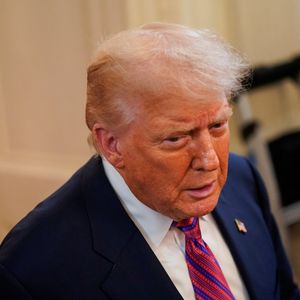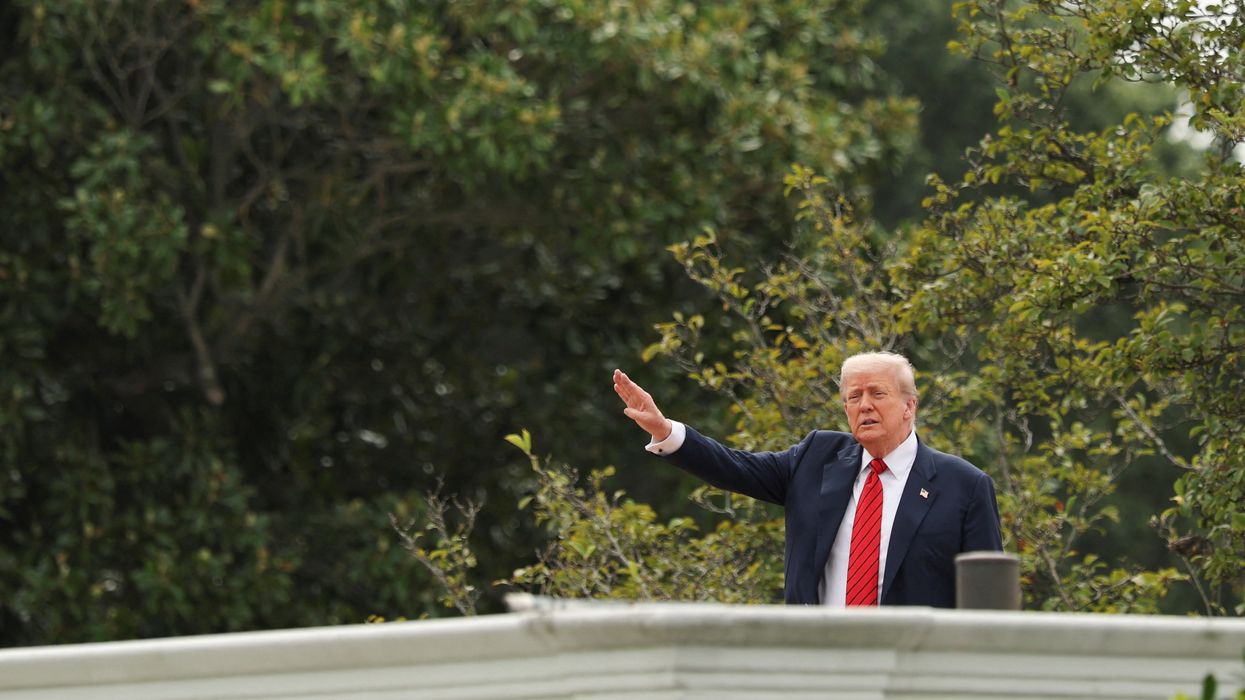
U.S. President Donald Trump gestures as he jokes to reporters that he's planning to install nuclear missiles, on a with an architect and aides on the roof of the White House in Washington, D.C., U.S., August 5, 2025. REUTERS/Jonathan Ernst

West Virginia residents are up in arms after learning that Republican Gov. Patrick Morrisey’s administration offered a Civil War battlefield near Harpers Ferry as a potential storage site for radioactive nuclear waste from around the country.
The Washington Post reported that the governor’s energy office sent the Trump administration a detailed proposal offering four sites for a “Nuclear Lifecycle Innovation Campus,” and that neither residents nor local officials were consulted. West Virginia was one of six finalists for the program.
Under the program, states that host a campus must agree to store spent nuclear fuel in exchange for federal support for nuclear research, development and production facilities. The administration claims the campuses could create 25,000 jobs.
One of the sites was Old Standard Quarry in Jefferson County. The land saw fighting during the Civil War, was later mined and now draws visitors for bungee jumping, tubing and water slides.
“I thought it was a joke,” said Pasha Majdi, president of the Jefferson County Commission. “It doesn’t make any sense.”
Locals say the site is wildly unsuited for the job. Half of it is federally protected as part of the historic battlefield, and the rest, according to one local conservation leader, sits underwater. The porous limestone beneath it poses another danger.
“Limestone essentially works like a highway for waste,” said County Commissioner Cara Keys. “You could put something here, and it could infect someone’s well 20 miles away.”
The state’s pitch promised that “social buy-in and community alignment are foundational.” But it also touted a new state law, written for data center developers, that fast-tracks permits while bypassing local governments.
“It felt for many of us like, ‘Here we go again,’” said Christine Wimer, president of the Jefferson County Foundation. “This is the same old thing in West Virginia. People come here. They get the good stuff. We get taken advantage of.”
The state’s pitch promised that “social buy-in and community alignment are foundational.” It also highlighted a new law, written with data center developers in mind, that speeds up permitting and lets projects skip local approval.
“It felt for many of us like, ‘Here we go again,’” said Christine Wimer, president of the Jefferson County Foundation. “This is the same old thing in West Virginia. People come here. They get the good stuff. We get taken advantage of.”
The plan also offered a former mountaintop-removal coal mine in Boone County, where the local state delegate complained that the community hadn’t been consulted.
The proposal came to light through a public records request by the Charleston Gazette-Mail. Morrisey first dismissed the report as “fake news.” Days later, he withdrew the state from consideration altogether. His administration did not respond to the Post’s requests for comment.
An Energy Department spokesman told the Post the program’s success stems from “allowing states and local communities decide for themselves if an innovation campus is right for them.”
Residents remain rattled.
“People like it here the way it is,” said David Liskey, 75, whose family has farmed nearby since the mid-1700s. “We don’t want what they are talking about doing.”
Gabby Wilson, a recent transplant who owns an art studio in Charles Town, was even more blunt.
“It’s just gross,” she said of the nuclear campus proposal. “We moved here to get away from things like that.”
Report typos and corrections to corrections@rawstory.com.
For customer support contact support@rawstory.com.