With the Covid-19 pandemic taking a heavy toll on Brazil’s Amazonas state, some Amazon tribes are turning to traditional medicine to treat the illness amid what they say is a lack of help from the country’s government.
Using ingredients including tree bark, mango peel mint and honey, as well as knowledge passed down through generations, members of the Sateré Mawé say their concoctions are effective against the virus.
"We have treated all the symptoms we have been experiencing with homemade remedies,” community leader André Sateré Mawé told AFP.
“Thanks to knowledge passed over generations, each member of the community has gathered an understanding of remedies. We have been experimenting, each remedy fights a symptom of the disease."
But they also say they have little choice but to turn to traditional medicine.
"It seems that the government chooses who to attend to and they leave us without attention. We have learnt to manage ourselves. We have learnt to fight alone,” said the community leader.
Amazonas is one of the states most affected by the pandemic in Brazil with 22,132 confirmed cases of Covid-19 and 1,491 deaths, according to official figures, overwhelming hospitals in the state’s capital Manaus.
Local officials and NGOs have warned that indigenous tribes are particularly at risk due to a lack of health services in remote areas, while the government of Jair Bolsonaro has been accused of doing little to help.
On Tuesday the mayor of Manaus, Arthur Virgilio Neto, warned of an impending “genocide” of indigenous people as a result of government inaction.
"I fear genocide and I want to denounce this thing to the whole world. We have here a government that does not care about the lives of indigenous people,” he said.
Although there was an enthusiastic response to the news, the purpose of all phase I trials is primarily to demonstrate safety and tolerability. While the early results are tantalizingly positive, what Moderna has not revealed is raising some doubts.
I am a data scientist and was, until last month, working on vaccine development for Zika and dengue fever. Since the beginning of the COVID-19 pandemic, I have spearheaded building a consortium of more than 100 cancer centers to collect data about cancer patients who have been infected with COVID-19. The purpose of the COVID-19 and Cancer Consortium is to rapidly collect and disseminate information about this especially vulnerable population. Having a background in vaccine development, I found Moderna’s press release lacking some key details.
What is a vaccine?
A vaccine imitates the infection to give the immune system a preview of the disease. Vaccination became a public health tool after Edward Jenner showed in 1796 that inoculation with the less virulent cowpox could prevent smallpox. After his son’s death from smallpox, Benjamin Franklin regretted his decision not to inoculate his son against it. Today vaccines are widely credited for the prevention and eradication of many of once feared deadly diseases.
Vaccines prepare the immune system by generating disease-fighting proteins called antibodies, which seek out and attack if the real infectious virus ever shows up.
Traditional vaccines against viruses are either weakened versions of the whole virus that are unable to cause disease; or they are made from signature viral proteins called antigens, that then spark an immune response. An antigen in the new coronavirus SARS-CoV-2 is the crown-like spike (S) protein through which the virus latches to the lung and respiratory cells.
However, developing vaccines based on the viral proteins is a slow process because of the difficulties in producing pure proteins at medical standards in large quantities. But now scientists have developed a different type of vaccine: mRNA vaccines.
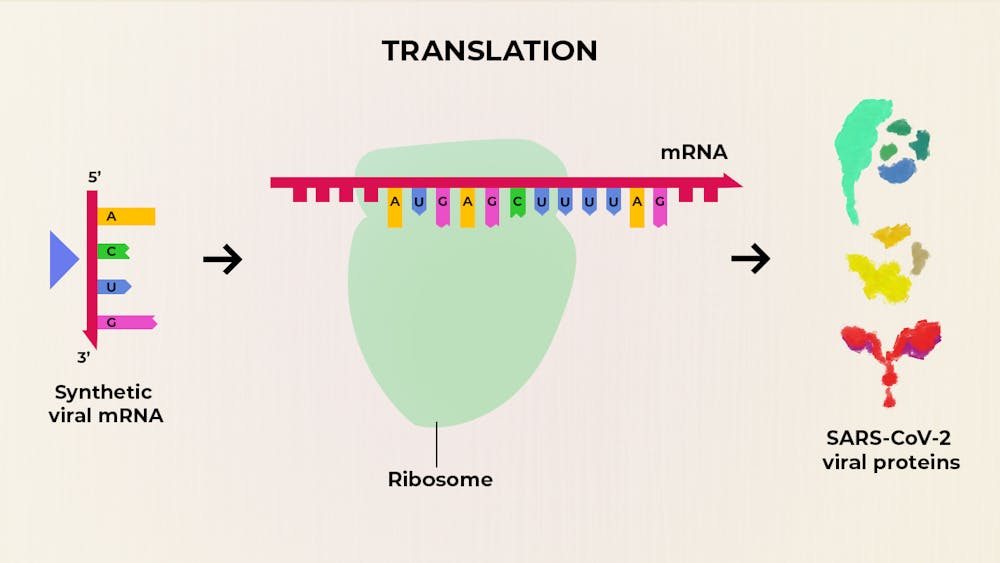
Rather than giving a person a protein vaccine, researchers are giving them mRNA, which is the biological code that the cells read and translate to make their own proteins. So, instead of the traditional viral protein vaccines, an mRNA vaccine provides a synthetic copy of mRNA-encoding individual proteins from the virus, which the host body uses to produce the viral protein itself. As with other vaccines, the presence of the protein kicks off the body’s immune system to fight the virus.
A big advantage of mRNA vaccines is that scientists can skip the laboratory production of proteins by directly injecting the molecular instructions to make the protein into the human body itself.
Rather than provide a vaccine made from viral proteins, Moderna’s COVID-19 vaccine is composed of synthetic viral mRNA. These molecules are injected into people and cellular protein-making machines, called ribosomes, read and translate the mRNA. It’s these proteins that then trigger an immune response.
Massachusetts-based Moderna Inc. has fast-tracked development and testing of an experimental COVID-19 mRNA vaccine called mRNA-1273. Its collaborators at the National Institute of Allergy and Infectious Diseases (NIAID) were already working on experimental Middle East respiratory syndrome (MERS) vaccines, which targeted a closely related coronavirus spike protein. So as soon as the genetic sequence of SARS-CoV-2 became available, Moderna and its collaborators at NIAID got a head start.
With up to US$483 million in federal funds to speed development of a coronavirus vaccine, Moderna began testing the 2019-nCoV vaccine (mRNA-1273) on Feb. 25, 2020.
The phase 1 study of the investigational vaccine, led by the NIAID, part of the National Institutes of Health (NIH), was designed to assess the safety, tolerability and ability to induce an immune response at three dose levels – 25, 100 or 250 micrograms.
On May 18, Moderna announced the interim phase 1 data. mRNA-1273 was generally safe and well tolerated, except for minor redness and swelling at higher doses.
No volunteers faced any life-threatening events during the six weeks of study.
The mRNA-1273 produced antibodies which could bind the target spike protein at each of the injected doses, in all 45 volunteers (ages 18 to 55). The production of the binding antibodies response from mRNA-1273 injection was similar to the one found in patients who have recovered from previous SARS-CoV-2 infection. It is important to highlight, though, that even among the survivors of COVID-19, the antibody response is highly variable.
What has not been revealed
Unconventional for a scientific study, data was given from only eight of the 45 volunteers — four each from the 25 and 100 microgram doses, who developed neutralizing antibodies.
Neutralizing antibodies are essential for an effective long-lasting vaccine because they not only bind to the virus, but they block an infection. The age of the eight volunteers is not known. That is important information because COVID-19 is far more deadly for older patients. It’s important to know if this immune response was limited to the younger participants.
Also, the neutralizing antibody response in the remaining 37 volunteers was not disclosed. So it is impossible to know whether the mRNA-1273 was ineffective in them, or whether the results were not available at this point.
The phase 2 trial for mRNA-1273 has already been approved by the Food and Drug Administration. In this trial each subject will receive two vaccinations – prime and booster – of either a placebo, a 50 microgram, or a 250 microgram dose given 28 days apart.
The amended choice for a higher dose suggests that the lowest 25 microgram dose of phase 1 was not very effective. Moderna expects phase 3 trial to start in July and anticipates to produce 1 billion doses of the vaccine soon thereafter.
As restaurants and bars reopen to the public, it’s important to realize that eating out will increase your risk of exposure to the new coronavirus.
Two of the most important public health measures for keeping illnesses to a minimum are nearly impossible in these situations: First, it’s hard to eat or drink while wearing a face mask. Second, social distancing is difficult in tight spaces normally filled with back-to-back seating and servers who weave among the busy tables all evening long.
So, what should you look out for, and how can you and the restaurant reduce the risk? Here are answers to a few common questions.
How far apart should tables and bar stools be?
There is nothing magical about 6 feet, the number we often hear in formal guidance from government agencies. I would consider that the minimum distance required for safe spacing.
If there is a fan or current generated in a closed space such as a restaurant, particles will also travel farther. This was shown in a paper from China: People in a restaurant downwind of an infected person became infected even though the distance was greater than 6 feet.
The closer the distance and the greater the time someone is exposed to a person who is infectious, the greater the risk.
If the servers wear masks, is that enough?
If servers wear masks, that will afford a layer of protection, but customers eating and talking could still spread the virus.
One way to mitigate that risk in this imperfect situation, at least from a public health point of view, would be to have tables surrounded by protective barriers, such as plexiglass or screens, or put tables in separate rooms with doors that can be closed. Some states are encouraging restaurants to limit each table to only one server who delivers everything.
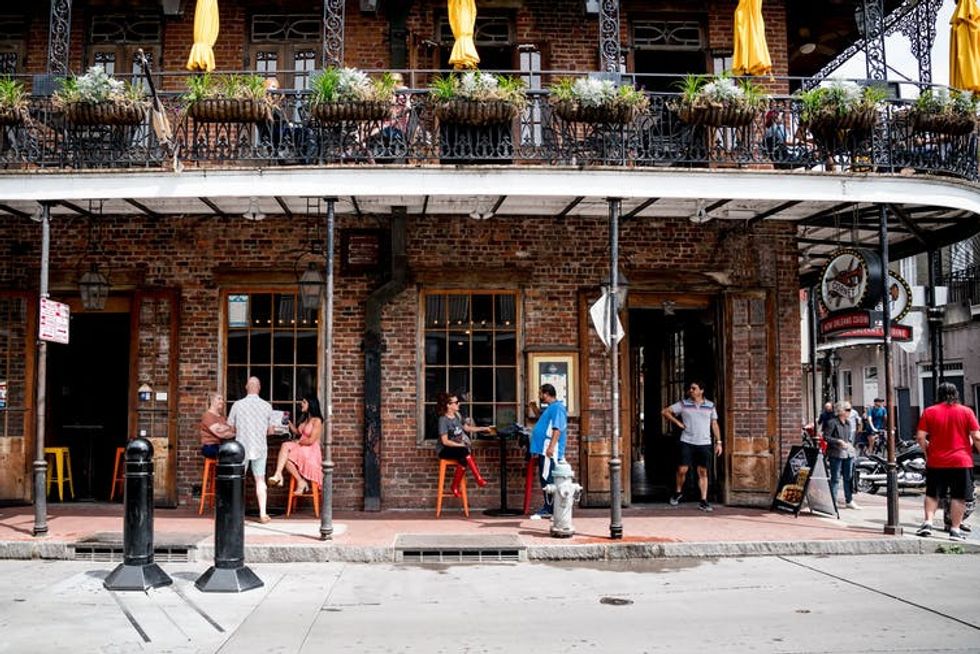
Guests filled the street seating and balcony at a restaurant on Bourbon Street on May 16, 2020, as New Orleans began lifting some restrictions following two months of closures over the coronavirus.
Restaurants could also screen guests before they enter, either with temperature checks or questions about symptoms and their close contacts with anyone recently diagnosed with COVID-19. It’s controversial, but restaurants in California have tried it. Washington state tried to require restaurants to record visitors’ contact information in case an outbreak is discovered, but it pulled back to only recommend doing so.
It’s easier to screen employees. In fact, guidelines from the Centers for Disease Control and Prevention recommend restaurants have employee screening in place before they reopen. But while screening employees for possible infection could decrease risk, it’s important to remember that people can be infectious six days before they develop symptoms. That is why masks, eye protection, social distancing and hand hygiene are critical measures for preventing infection.
Should I ask for disposable utensils and wipe everything down?
Regular dishwashing of plates, glasses and utensils, and laundering of napkins and tablecloths, will inactivate the virus. No need for disposables here.
The table should also be cleaned and disinfected between uses and marked as sanitized.
Menus are a bit more problematic, depending on the material. Plastic menus could be disinfected. Disposable menus would be more ideal. Remember, even if someone touches a surface that has infectious virus, as long as they don’t touch their mouth, nose or eyes they should be safe. So, when in doubt, wash your hands or use hand sanitizer.
Can I get the virus from food from the kitchen?
The risk of becoming infected with the new coronavirus from food is very low.
This is a respiratory virus whose primary mode of infection is accessing the upper or lower respiratory tract through droplets or aerosols entering your mouth, nose or eyes. It needs to enter the respiratory tract to cause infection, and it cannot do this by way of the stomach or intestinal tract.
The virus also is not very stable in the environment. Studies have shown it loses half its viral concentration after less than an hour on copper, three and a half hours on cardboard and just under seven hours on plastic. If food were to be contaminated during preparation, cooking temperature would likely inactivate much if not all of the virus.
The use of masks and maintaining good hand hygiene by food preparers should significantly reduce the risk of food contamination.
Is outdoor seating or a drive-through any safer?
Vulnerable people may want to pass on dine-in options and focus on pickup or perhaps outside dining if the conditions are appropriate.
Drive-up windows or carry-out are probably the safest; transient interaction with one individual when everyone is wearing masks is a lower-risk situation.
Overall, outside dining is safer than indoor dining with everything else being equal on a nonwindy day due to the larger air volume. Maintaining eye protection via glasses and intermittent mask use between bites and sips would further decrease the risk.
You might also be interested in other parts of this series:
Shafiqul Islam hid under a bed with his wife and two children for hours as the fiercest cyclone to hit Bangladesh this century ripped the tin roof off his home.
Islam had thought he could ride out Cyclone Amphan but soon regretted his "huge mistake" as winds of 150 kilometres (95 mile) per hour slammed into Satkhira district, destroying his home and those of his neighbors.
"The wind was so powerful that it felt like it would flatten everything," the 40-year-old farm labourer told AFP on Thursday, standing in the twisted wreckage.
"It destroyed everything we had. I don't know how I am going to survive. Thanks to Allah that it did not kill me or my family. We came very close to death."
After sending their children to a shelter, Aleya Begum and her husband stayed behind to protect their four properties.
Their efforts were in vain.
"All I have built over the decades have been destroyed in a few hours. I have witnessed quite a few cyclones. This was the worst," said Begum, 65.
"Everything is gone."
'Paupers'
Village after village was flattened in Satkhira, which bore the brunt of the first "super cyclone" recorded in the Bay of Bengal since 1999.
Better forecasting and the swift action of authorities to move 2.4 million people into shelters helped keep the death toll at 12 in Bangladesh -- a fraction of the human cost in previous cyclones.
In 1970, half a million people perished in a cyclone. Another in 2007 killed 3,500.
But the powerful winds of Amphan and accompanying wall of sea water that rushed inland still had a punishing impact.
In Purba Durgabati, hundreds of locals battled through the night in the howling wind and teeming rain to mend a breach in a river embankment protecting the village and several others.
But the river rose by four meters (13 feet) in places and washed away around two kilometers (over a mile) of the levee, which doubled as a road, inundating 600 houses.
"My home is under the water. My shrimp farm is gone. I don't know how I am going to survive," Omar Faruq, 28, told AFP.
Modhusadan Mondol, who usually sells shrimps to Japan, said the coronavirus had brought one of Bangladesh's biggest export industries to a halt.
He had hoped to resume shipments once the lockdown was lifted.
"But the cyclone washed away my shrimp farm and thousands of other farms. We lost everything," said Mondol, estimating his losses at tens of thousands of dollars.
Bhabotosh Kumar Mondal, a local councillor, said the cyclone had "left an unprecedented trail of devastation", with seven villages in his area under water and 2,000 mud and tin homes destroyed.
"The coronavirus has already taken a toll on people. Now the cyclone has made them paupers," he said.
Mondal estimated that about 3,000 shrimp and crab farms had been washed away or suffered major damage, causing losses of more than $20 million.
"It destroyed our only means to survive," he said.
The Histories by Herodotus (484BC to 425BC) offers a remarkable window into the world as it was known to the ancient Greeks in the mid fifth century BC. Almost as interesting as what they knew, however, is what they did not know. This sets the baseline for the remarkable advances in their understanding over the next few centuries – simply relying on what they could observe with their own eyes.
Herodotus claimed that Africa was surrounded almost entirely by sea. How did he know this? He recounts the story of Phoenician sailors who were dispatched by King Neco II of Egypt (about 600BC), to sail around continental Africa, in a clockwise fashion, starting in the Red Sea. This story, if true, recounts the earliest known circumnavigation of Africa, but also contains an interesting insight into the astronomical knowledge of the ancient world.
The voyage took several years. Having rounded the southern tip of Africa, and following a westerly course, the sailors observed the Sun as being on their right hand side, above the northern horizon. This observation simply did not make sense at the time because they didn’t yet know that the Earth has a spherical shape, and that there is a southern hemisphere.
1. The planets orbit the Sun
A few centuries later, there had been a lot of progress. Aristarchus of Samos (310BC to 230BC) argued that the Sun was the “central fire” of the cosmos and he placed all of the then known planets in their correct order of distance around it. This is the earliest known heliocentric theory of the solar system.
Unfortunately, the original text in which he makes this argument has been lost to history, so we cannot know for certain how he worked it out. Aristarchus knew the Sun was much bigger than the Earth or the Moon, and he may have surmised that it should therefore have the central position in the solar system.
Nevertheless it is a jawdropping finding, especially when you consider that it wasn’t rediscovered until the 16th century, by Nicolaus Copernicus, who even acknowledged Aristarchus during the development of his own work.
2. The size of the Moon
One of Aristarchus’ books that did survive is about the sizes and distances of the Sun and Moon. In this remarkable treatise, Aristarchus laid out the earliest known attempted calculations of the relative sizes and distances to the Sun and Moon.
It had long been observed that the Sun and Moon appeared to be of the same apparent size in the sky, and that the Sun was further away. They realised this from solar eclipses, caused by the Moon passing in front of the Sun at a certain distance from Earth.
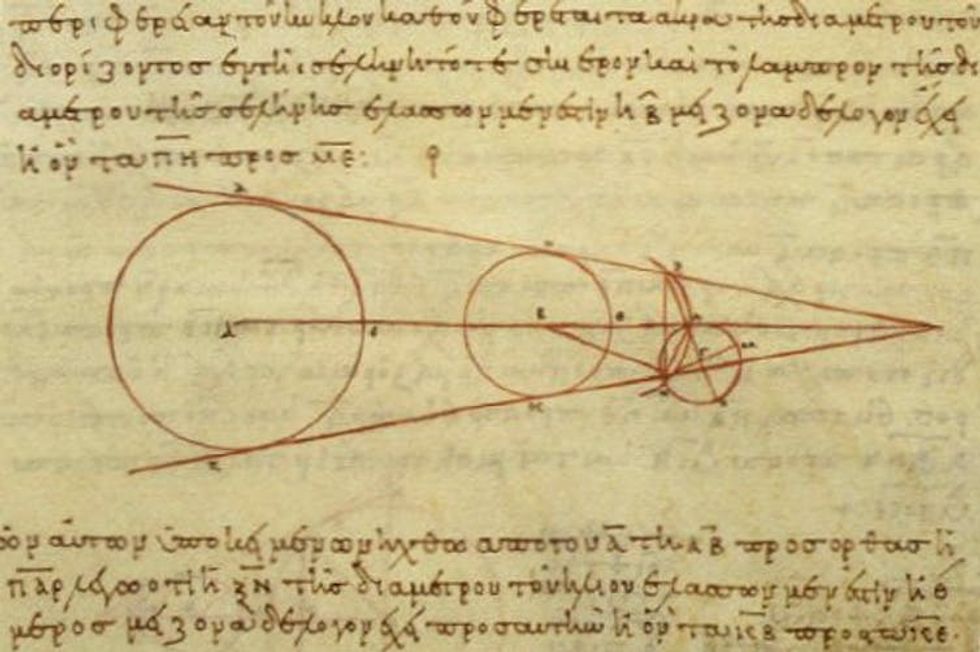
Also, at the instant when the Moon is at first or third quarter, Aristarchus reasoned that the Sun, Earth, and Moon would form a right-angled triangle.
As Pythagoras had determined how the lengths of triangle’s sides were related a couple of centuries earlier, Aristarchus used the triangle to estimate that the distance to the Sun was between 18 and 20 times the distance to the Moon. He also estimated that the size of the Moon was approximately one-third that of Earth, based on careful timing of lunar eclipses.
A 10th century reproduction of a diagram by Aristarchus showing some of the geometry he used in his calculations.
While his estimated distance to the Sun was too low (the actual ratio is 390), on account of the lack of telescopic precision available at the time, the value for the ratio of the size of the Earth to the Moon is surprisingly accurate (the Moon has a diameter 0.27 times that of Earth).
Today, we know the size and distance to the moon accurately by a variety of means, including precise telescopes, radar observations and laser reflectors left on the surface by Apollo astronauts.
3. The Earth’s circumference
Eratosthenes (276BC to 195 BC) was chief librarian at the Great Library of Alexandria, and a keen experimentalist. Among his many achievements was the earliest known calculation of the circumference of the Earth. Pythagoras is generally regarded as the earliest proponent of a spherical Earth, although apparently not its size. Eratosthenes’ famous and yet simple method relied on measuring the different lengths of shadows cast by poles stuck vertically into the ground, at midday on the summer solstice, at different latitudes.
The Sun is sufficiently far away that, wherever its rays arrive at Earth, they are effectively parallel, as had previously been shown by Aristarchus. So the difference in the shadows demonstrated how much the Earth’s surface curved. Eratosthenes used this to estimate the Earth’s circumference as approximately 40,000km. This is within a couple of percent of the actual value, as established by modern geodesy (the science of the Earth’s shape).
Later, another scientist called Posidonius (135BC to 51BC) used a slightly different method and arrived at almost exactly the same answer. Posidonius lived on the island of Rhodes for much of his life. There he observed the bright star Canopus would lie very close to the horizon. However, when in Alexandria, in Egypt, he noted Canopus would ascend to some 7.5 degrees above the horizon.
Given that 7.5 degrees is 1/48th of a circle, he multiplied the distance from Rhodes to Alexandria by 48, and arrived at a value also of approximately 40,000km.
4. The first astronomical calculator
The world’s oldest surviving mechanical calculator is the Antikythera Mechanism. The amazing device was discovered in an ancient shipwreck off the Greek island of Antikythera in 1900.
The device is now fragmented by the passage of time, but when intact it would have appeared as a box housing dozens of finely machined bronze gear wheels. When manually rotated by a handle, the gears span dials on the exterior showing the phases of the Moon, the timing of lunar eclipses, and the positions of the five planets then known (Mercury, Venus, Mars, Jupiter, and Saturn) at different times of the year. This even accounted for their retrograde motion – an illusionary change in the movement of planets through the sky.
We don’t know who built it, but it dates to some time between the 3rd and 1st centuries BC, and may even have been the work of Archimedes. Gearing technology with the sophistication of the Antikythera mechanism was not seen again for a thousand years.
Sadly, the vast majority of these works were lost to history and our scientific awakening was delayed by millennia. As a tool for introducing scientific measurement, the techniques of Eratosthenes are relatively easy to perform and require no special equipment, allowing those just beginning their interest in science to understand by doing, experimenting and, ultimately, following in the foot steps some of the first scientists.
One can but speculate where our civilisation might be now if this ancient science had continued unabated.
We often hear that Britain is a “class-based society”. Ask people what class is and you’ll get a wide range of answers – from accent to cultural tastes – leaving you perplexed as to how it might ever be a useful construct to understand much about the realities of British life. But really it’s all about what job you do.
I study the relationship between a person’s class and their life chances and it has become glaringly apparent during the coronavirus crisis that class – what job you do – has never been more important.
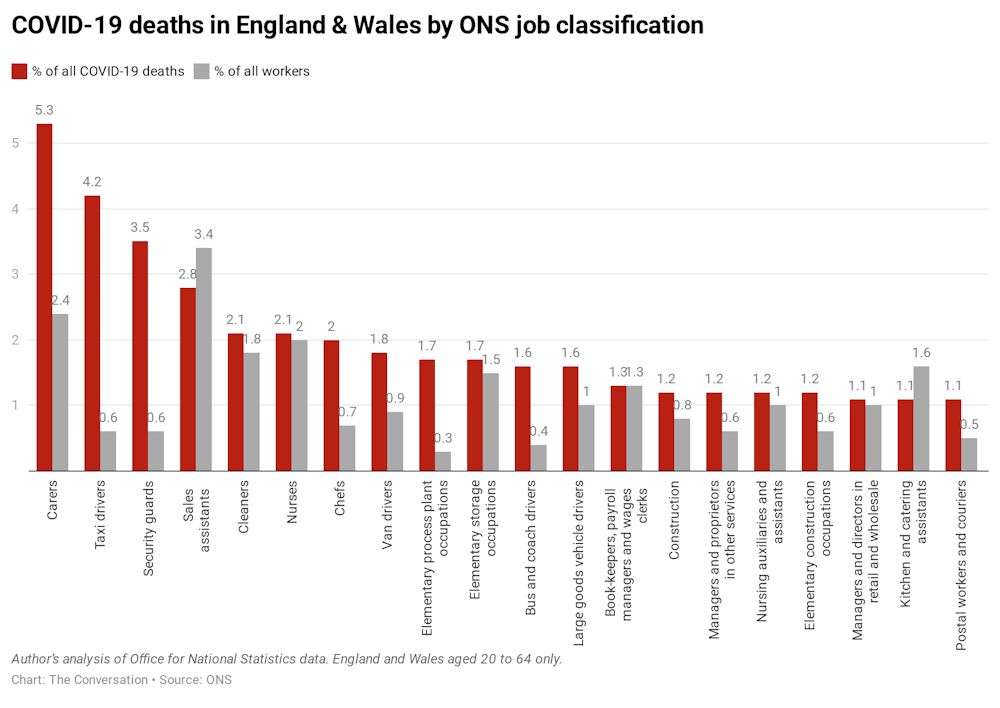
There is a clear class divide in the COVID-19 death rate, with working class jobs such as carers, taxi drivers, security guards and retail assistants clearly worse affected than middle and upper class jobs who can much more easily self-isolate and work from home.
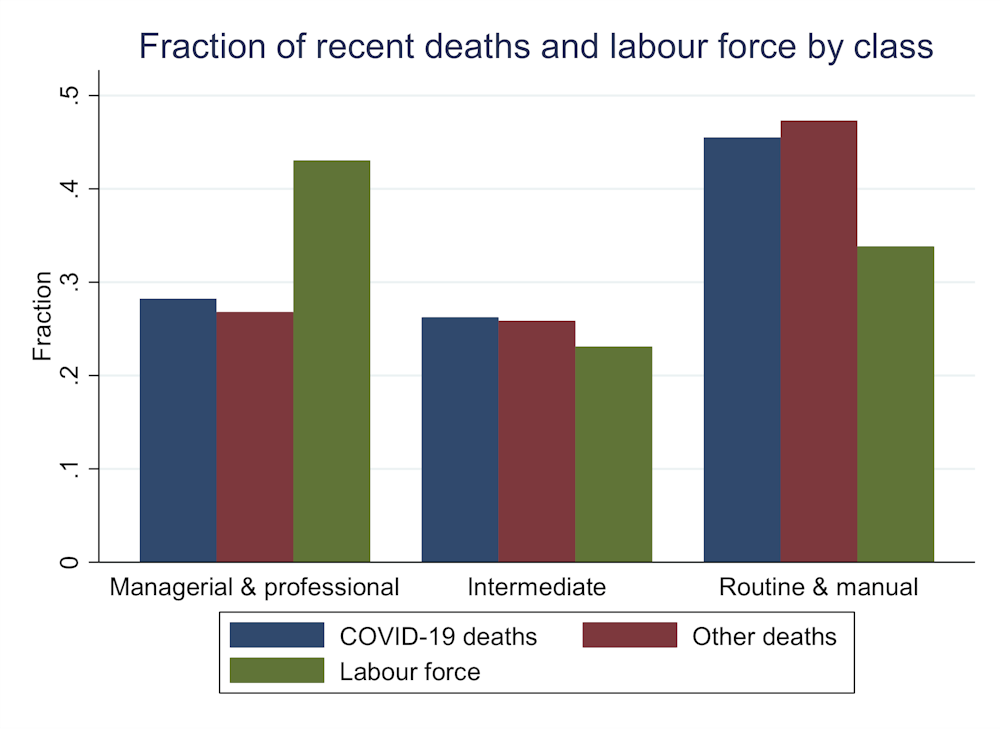
Analysing data released by the Office for National Statistics (ONS) on registered deaths in England and Wales among people aged 20 to 64, up to and including April 20, I find a sharp divide between the fraction of deaths in managerial and professional occupations and routine and manual occupations. While routine and manual occupations account for around 34% of jobs, those working in such jobs account for more than 43% of COVID-19 deaths among those of working age. Conversely, managerial and professional occupations account for 43% of all jobs but 28% of these deaths so far.
Author’s analysis of Office for National Statistics data. England and Wales aged 20 to 64 only.
Digging further into the detail makes very tragic reading. The deaths are highly concentrated in occupations that have been working on the frontline: caring and health, delivery workers, drivers and those working in retail. Of the 369 occupations listed by the ONS, just five account for 17% of COVID-19 deaths among those of working age in England and Wales. Just ten occupations account for 27% of these deaths, with 20 accounting for 40% (only 20% of people work in these 20 occupations).
These jobs are also overwhelmingly manual and routine occupations – those carried out by the economically least advantaged. While the class divide in COVID-19 deaths is not wholly out of sync with the divide in non-COVID deaths, these figures are a powerful reminder that what you do quite literally determines your life chances.
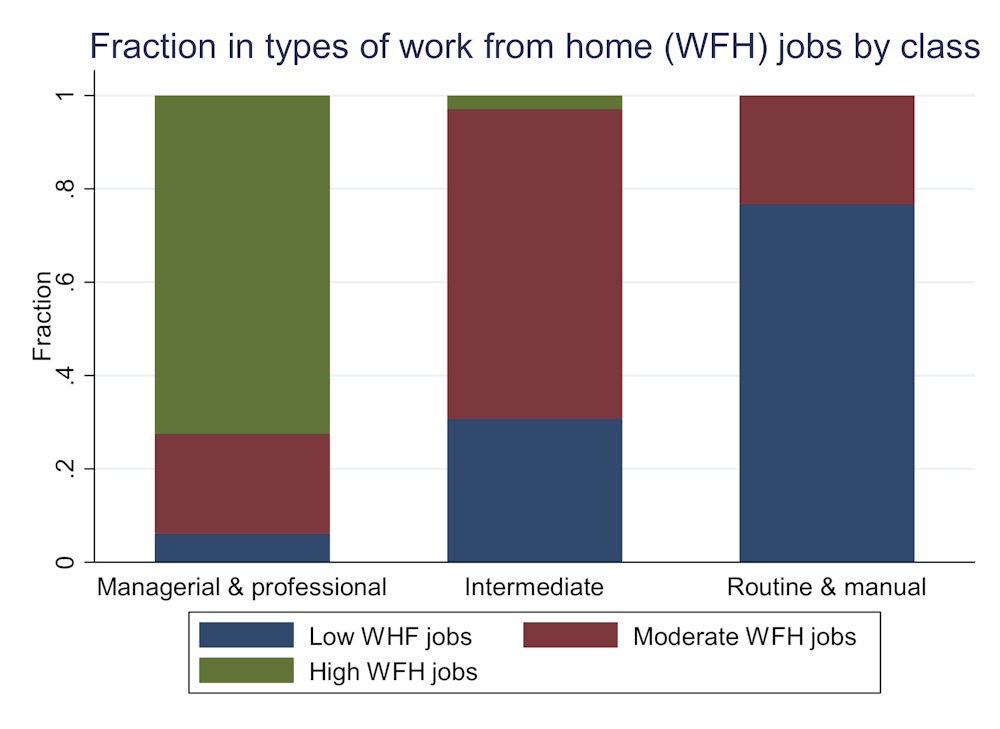
Workers who cannot work from home can now return to their workplaces. This will clearly affect classes differently. Around 75% of managerial and professional workers will almost certainly carry on working from home because they can. By contrast, a similar proportion of routine and manual workers will most likely be back at their workplaces. According to my analysis of ONS data, these are occupations where less than 10% have ever worked from home.
Author’s analysis of ONS data. England and Wales aged 20 to 64 only.
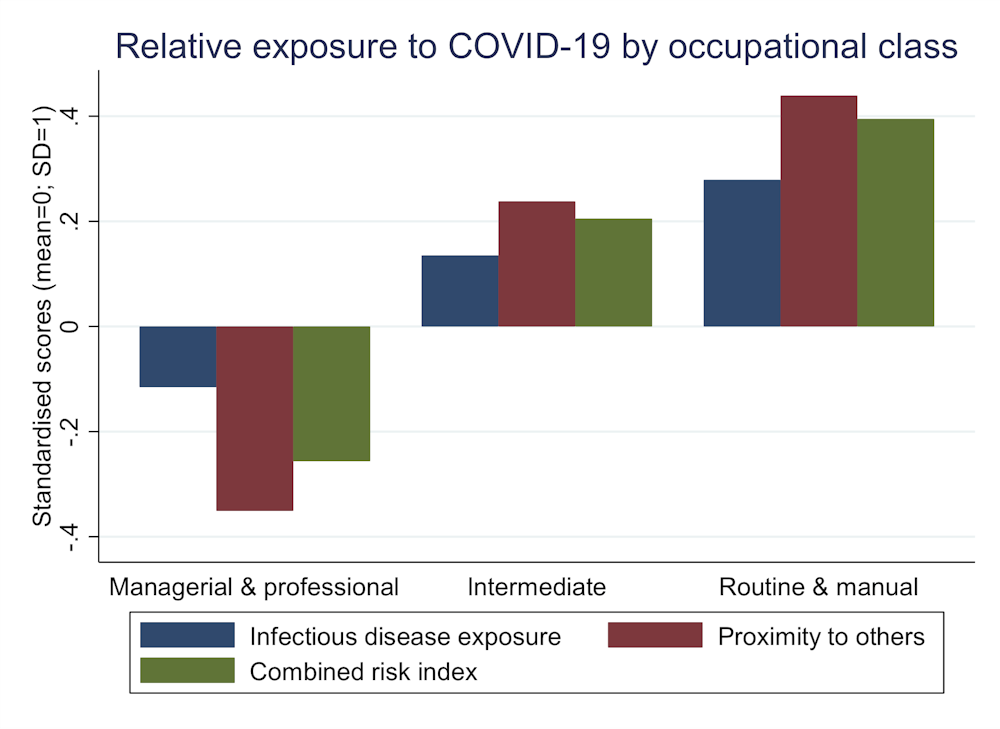
One way to get a handle on the class dimension of the risks of going back to work is by using recent statistics published by the ONS on occupational exposure to infectious diseases and proximity to others at work. The first indicator in the graph below (blue bars) shows those in routine and manual occupations are most likely to be exposed to infectious disease in their job. The second indicator (red bars) shows these workers are also most likely to work in close proximity to others, making social distancing measures more difficult.
Author’s analysis of ONS data. This uses pre-pandemic data and does not reflect changes made since.
Combining these two indicators to form an overall risk index (green bars) reinforces the pattern that those workers being told to go back to work are also most vulnerable to infection at work. By contrast, managerial and professional occupations are less at risk – with some notable exceptions, such as those related to health like medical practitioners, nurses and dentists.
What is more, routine and manual jobs are the lowest paid, have the poorest sick pay and other workplace benefits and are the most insecure. But this predates the coronavirus crisis – class inequalities in conditions of employment have been becoming more entrenched over the past four decades.
What COVID-19 does is accelerate the impact of these class differences and throw the issue into stark relief. Reorganising workplaces to enable social distancing will likely be the most challenging and least effective in those jobs being told they can go back to work. They are also most at risk to infection, as well as being the ones needing to go back to work the most to make ends meet. What kind of job you have has never been more important for your life chances.
Japanese prosecutors said Thursday they would seek the extradition of a former special forces soldier and his son, arrested in the United States and accused of helping fugitive former Nissan chief Carlos Ghosn jump bail and flee Japan.
Michael Taylor and his son Peter were detained Wednesday in Massachusetts on suspicion of involvement in what prosecutors called "one of the most brazen and well-orchestrated escape acts in recent history".
The plot to spirit Ghosn away involved "a dizzying array of hotel meet-ups, bullet train travel, fake personas and the chartering of a private jet", prosecutors wrote in court documents.
They said Peter Taylor had been preparing to travel to Lebanon, where Ghosn fled after sneaking out of Japan last December, allegedly inside a musical instrument case.
Ghosn was out on bail in Tokyo awaiting trial on multiple charges of financial misconduct -- which he denies -- when he fled the country.
He said after his arrival in Lebanon that he had been forced to escape because he feared he would not get a fair hearing.
Ghosn's escape proved highly embarrassing for Japan, which has sought to extradite both the former Nissan chief and his alleged accomplices.
Lebanon does not have an extradition treaty with Japan, and has so far resisted requests for Ghosn's return to Tokyo, but the United States and Japan do have an agreement.
In Tokyo, prosecutors confirmed they would be asking for both Taylors to be brought to Japan.
"We are making preparations so we can swiftly request their extradition," Takahiro Saito, deputy chief of the Tokyo District Public Prosecutors Office, said in a statement.
The pair was arrested after being named in a Japanese arrest warrant, and prosecutors argued for their continued detention, warning they posed a significant flight risk.
A judge granted the request, and the pair will be held as Japan prepares its extradition request.
In court documents, prosecutors recounted details of Ghosn's stunning escape, allegedly aided by the Taylors and a Lebanese man named George-Antoine Zayek.
Ghosn had been living in a court-appointed apartment in Tokyo under the strict terms of his release on bail, which also prevented him from using the internet unsupervised or meeting his wife, Carole.
But despite the restrictions, he was able to move around Japan freely, and was given access to one of his passports as the country requires foreigners to carry proof of identification at all times.
According to prosecutors, Peter Taylor met with Ghosn at least seven times in Japan between July and December 2019.
Reports have suggested he and his alleged accomplices carried out extensive research on possible escape routes for Ghosn, eventually settling on Kansai airport near Osaka, where security for cargo was considered weaker.
Michael Taylor and Zayek then entered the country posing as musicians, and on December 29 travelled with Ghosn from Tokyo to Osaka where the three men entered a hotel room near the airport, court documents said.
But only Taylor and Zayek were seen leaving, because Ghosn was taken out in instrument cases brought into the hotel room a day earlier.
The cases were allegedly used because large cargo loaded onto private jets at Kansai airport was not routinely scanned, meaning Ghosn could be wheeled onto a plane without detection.
Taylor and Zayek boarded a private plane with the instrument cases bound for Istanbul, where Ghosn then switched to another plane heading to Beirut.
Ghosn was first arrested in Japan in November 2018, and his detention sent shockwaves through the business world.
The auto titan was eventually charged with four counts of financial conduct over claims he hid compensation and misused Nissan funds.
He has been stripped of his roles at Nissan, Renault and an alliance grouping the firms with partner Mitsubishi Motors.
In a brief statement, Nissan said only it was aware of the US arrests, adding "as previously announced, Nissan finds the former chairman's (Ghosn's) flight from justice extremely regrettable".
The firm added it "continues to reserve the right to take further legal measures as appropriate".
China offered a low-key rebuttal to United States President Donald Trump's accusation of mass killing on Thursday, with a foreign ministry official insisting the country did its best to protect lives during the pandemic.
Tensions between the US and China have been on the rise as the deadly coronavirus, which first surfaced in the central Chinese city of Wuhan, ravaged the global economy.
Trump has since made attacking Beijing a centrepiece of his November re-election bid, alleging it covered up the initial outbreak of the virus -- a claim that China forcefully denies.
Beijing's latest response came a day after Trump blamed China for "mass Worldwide killing" in a tweet, which also referred to an unidentified "wacko".
Chinese foreign ministry spokesman Zhao Lijian told a regular press briefing: "We have persisted in speaking the truth, presenting the truth and speaking with reason, doing our utmost to protect the lives and health of the people."
Zhao reiterated China's stance that it has "always had an open, transparent and responsible attitude" as it battled the pandemic.
He added the country has been doing its best to promote international cooperation against the pathogen.
China has come under fire for its initial response over the outbreak, which has since claimed over 325,000 lives around the globe.
As the virus continued its worldwide march, governments including the US and Australia called for an investigation into its origins, with US leaders pushing a theory that the pathogen had leaked from a Chinese maximum-security laboratory.
China has since said it supports a "comprehensive evaluation" of the global response to the pandemic after it has been brought under control.
Zhao, however, said earlier in the week that the draft motion currently under discussion at the World Health Assembly is "completely different from the so-called 'independent international inquiry' into the pandemic previously mentioned by Australia".
Brazilian President Jair Bolsonaro neatly sums up how thoroughly politics has hijacked the debate over using malaria drugs against the new coronavirus: "Right-wingers take chloroquine."
The far-right leader made the remark Tuesday, a day before his government recommended widespread use of chloroquine and a less-toxic derivative, hydroxychloroquine, to treat COVID-19 even in mild cases, despite questions about their safety and effectiveness.
The "Tropical Trump," as Bolsonaro has been called, shares his US counterpart's enthusiasm for the two drugs, as well as his tendency to disregard scientific evidence that contradicts him.
Based on preliminary studies in China and France -- and, apparently, a heavy dose of hope for something other than economically painful lockdowns to contain the pandemic -- Trump and Bolsonaro have been touting chloroquine and hydroxychloroquine as potential wonder drugs against COVID-19, despite scientists' insistence that further testing is needed.
Trump even revealed Monday he has been taking hydroxychloroquine daily as a preventive measure.
But he has not been able to do what Bolsonaro has done: get national health authorities to expand the recommended use of the drugs from clinical testing and severe cases to the entire infected population, starting with the onset of symptoms.
"There is still no scientific proof, but (chloroquine) is being monitored and used in Brazil and around the world," Bolsonaro tweeted Wednesday.
"We are at war. 'Worse than defeat is the shame of never having fought at all,'" he added.
"God bless Brazil."
With Trump up for re-election in November and Bolsonaro determined to fight what he has called the "hysteria" around the pandemic, the chloroquine debate has turned intensely political.
Brazil's former health minister Nelson Teich resigned last week after less than a month on the job, reportedly after clashing with Bolsonaro over the president's insistence on expanding the use of chloroquine against COVID-19.
Political analysts predicted Bolsonaro, now on his third health minister of the pandemic, would seek a pliable replacement willing to ignore the lack of scientific evidence on chloroquine.
Indeed, after interim minister Eduardo Pazuello signed off on the new treatment guidelines, Bolsonaro said he planned to keep him in the post "a very long time."
The new guidelines recommend doctors in the public health system prescribe either chloroquine or hydroxychloroquine from the onset of symptoms of coronavirus infection, together with the antibiotic azithromycin.
Patients will be required to sign a waiver acknowledging they have been informed of potential side effects, including heart and liver dysfunction, retina damage "and even death."
They leave the final decision on using the drugs up to doctors and their patients.
The health ministry acknowledged that "there are still no meta-analyses of randomized, controlled, blind, large-scale clinical trials of these medications in the treatment of COVID-19."
However, it said the government had a responsibility to issue guidelines using the information currently available.
"Brazilians are asking to receive this medication, which has shown positive results in various clinical studies. And we need to give them that right, even if the number of studies is still scarce," health ministry official Mayra Pinheiro told a news conference.
Chloroquine and hydroxychloroquine are typically used against malaria and to treat certain auto-immune diseases, including lupus.
COVID-19 is another matter.
"Chloroquine has clearly shown it does not do what we wanted it to in terms of treating the coronavirus. On the contrary, it leaves a legacy of side effects," said infectious disease specialist Jean Gorinchteyn of Albert Einstein Hospital in Sao Paulo.
He also worried the illusion of a treatment could make people less inclined to observe stay-at-home measures.
"When you say there's a treatment, people let their guard down... and think it's OK to go to work. And the more people circulate, the more the virus circulates."
There is also concern that widespread use of the drugs against coronavirus will create shortages for other patients who need them.
Many pharmacies in Brazil say they have already run out of both drugs.
"Before the pandemic, we sold one box a month, maximum. Then in late March demand started to increase, and now we can't even get it in stock," one pharmacist in Rio de Janeiro told AFP.
Amid the government's disjointed response, Brazil has emerged as the latest flashpoint in the pandemic.
The country has registered more than 290,000 cases and nearly 19,000 deaths so far, and the increase in infections is not expected to peak until June.
Experts say under-testing means the real figures are probably much higher.
The World Health Organization has reported the largest single-day increase in coronavirus cases, as US President Donald Trump proposed hosting world leaders for the annual G7 summit as a sign of "normalization."
The WHO said Wednesday that more than 106,000 virus cases had been reported -- the most in a single day since the outbreak erupted in the Chinese city of Wuhan in December.
The UN body's chief, Tedros Adhanom Ghebreyesus said he was "very concerned" about the situation in low- and middle-income nations.
Latin America has seen infections surge in recent days and, in some cases, countries have reinstated lockdown measures that had been eased.
Brazil has been hardest hit, logging the third-highest number of cases in the world. Peru, Mexico and Chile have also seen steady increases in infections.
Health officials in Brazil reported 1,179 new coronavirus deaths in a single day, although far-right President Jair Bolsonaro remains bitterly opposed to lockdowns, having described them as unnecessary over a "little flu."
With the outbreak in the world's sixth-largest country expected to accelerate until early June, Bolsonaro has refused to accept experts' advice, pressing regional governors to end stay-at-home measures.
And like Trump, he has promoted the use of anti-malaria drugs against the virus despite studies showing they have no benefit and could have dangerous side effects.
Trump, determined to reignite the troubled US economy ahead of his re-election bid in November, said Wednesday the country was "Transitioning back to Greatness" and announced he could host June's G7 summit at a presidential retreat, instead of holding it as a virtual gathering.
"I am considering rescheduling the G-7, on the same or similar date, in Washington, D.C., at the legendary Camp David," he said on Twitter.
"The other members are also beginning their COMEBACK. It would be a great sign to all -- normalization!"
G7 countries -- Britain, Canada, France, Germany, Italy, Japan and the United States -- take turns organizing the annual summit.
French President Emmanuel Macron's office said he would attend if "health conditions allow," while German Chancellor Angela Merkel said she would "wait and see what happens."
With a global death toll of more than 325,000 and nearly five million people infected, governments around the world are desperately hoping for a vaccine that would allow them to dispense with the lockdowns that have hammered their economies.
There was encouraging news on that front Wednesday, as experiments on monkeys offered hope that humans can develop immunity to the virus.
Researchers reported progress from one study that looked at a prototype vaccine, and another on whether infection with COVID-19 confers protection against re-exposure.
"We demonstrate in rhesus macaques that prototype vaccines protected against SARS-CoV-2 infection and that SARS-CoV-2 infection protected against re-exposure," said senior author Dan Barouch of the Beth Israel Deaconess Medical Center in Boston.
Europe appears to be over the inital hump of infections, with the number of new cases and deaths on a steady decline, allowing some lockdowns to be eased.
"I haven't seen the sea for two months," said Helena Prades at a beach in Barcelona. "We just really wanted to hear the sound of the waves."
As Spain emerges from one of the world's toughest lockdowns, face masks are mandatory for anyone aged six and over in public where social distancing is not possible.
European officials have now turned their attention to trying to save the summer tourism season, which is crucial for the continent's economies.
European Union tourism ministers held a virtual meeting on Wednesday as Greece announced plans to restart its travel season.
Prime Minister Kyriakos Mitsotakis said seasonal hotels could reopen from June 15 and international flights would resume from July 1.
In Italy, airports were given the green light to reopen from June 3, including for international flights.
Countries in Asia are also gradually reopening.
India said domestic air travel will resume on May 25 after a two-month shutdown, even as the world's second-most populous country reported its biggest daily jump in coronavirus infections, with more than 5,600 new cases in 24 hours.
New Zealanders were finally able to go back to the pub on Thursday, but acknowledged that normality was still a way off.
"I think we've got to be realistic and say it's going to be pretty rubbish for the next six months," said Kevin McAree, who runs an upmarket winery in Wellington.
"People's habits have changed (during lockdown). They're used to maybe having a nice bottle of wine at home and spending a bit more on takeaway food.
"But eventually they'll want to get out and enjoy themselves."
Islamabad (AFP) - Before the virus shutdown, dancer Adnan Ali had carved out a comfortable living performing at parties for newlyweds and newborns, avoiding the financial hardship faced by many in Pakistan's transgender community.But the closure of wedding halls and scrapped celebrations where she would twist and twirl in front of applauding crowds have frozen her income, forcing her out of the one-bedroom apartment she rented in a wealthy suburb of Islamabad. Now she shares a cramped single room in a shelter with other transgender dancers who have also lost work because of a nationwide lockdo...
Satkhira (Bangladesh) (AFP) - At least 22 people died as the fiercest cyclone to hit parts of Bangladesh and eastern India this century sent trees flying and flattened houses, with millions crammed into shelters despite the risk of coronavirus.Millions were left without power after Cyclone Amphan, packing winds of around 150 kilometres per hour (95 miles), carried away electricity pylons, walls and roofs, officials said Thursday as they began to assess the damage.Residents in the Indian city of Kolkata, the capital of the hard-hit West Bengal state, awoke to flooded streets with some cars wind...
Legendary photographer Sebastiao Salgado has warned of a "genocide" of the Amazon's indigenous peoples if the Brazilian government does not do more to protect them from the coronavirus.
The country's far-right president, Jair Bolsonaro -- who has dismissed the virus as a "little flu" -- has long been accused of encouraging loggers and farmers to invade indigenous reserves and of dismantling government agencies set up to protect them.
Brazilian-born Salgado, who shot to fame with his almost biblical images of gold miners in the Amazon, told AFP that "there was a huge risk of a real catastrophe".
"With gold miners, loggers, farmers and religious sects invading their territories... there is a big risk of the coronavirus infecting the indigenous people, who don't have any antibodies."
According to some estimates, 90 percent of the native population of the Americas was wiped out by disease after the arrival of the first Europeans.
Salgado has launched a petition calling for action to protect the Amazonian peoples which has garnered almost a quarter of a million signatures, including Madonna, Oprah Winfrey and Brad Pitt.
He said the risk of genocide was not an exaggeration.
- 'Near collapse' -
"That is what I call it. Genocide is the elimination of an ethnic group and also of its culture.
"I believe that is where the Bolsonaro government is leading us, because their position is 100 percent against the indigenous people."
With hospitals in Sao Paulo, Brazil's biggest city, reported to be at "near collapse" as the country has become the epicentre of the pandemic in South America, Salgado warned that the threat of death was hanging "over a large portion of the population".
"Bolsonaro is against a lockdown, and they do not have the medical infrastructure that we have" in Europe, said Salgado, 76, who has long lived in Paris.
"If the virus gets into the forest, they don't have the means to help. The distances are so huge. The indigenous people will be abandoned," the photographer said.
The virus has already infected 40 indigenous groups, with 537 positive cases and 102 deaths, according to the Brazilian Indigenous Peoples' Association.
And on Tuesday, the indigenous rights group, Forest Guardians, warned that one tribe of hunter gatherers, the Awa Guaja, which traditionally has no contact with the outside world, was in danger of being wiped out because of encroachment by loggers and farmers.
- We need a 'new system' -
Brazil has an estimated 800,000 indigenous people from 300 ethnic groups.
"If you don't put an end to the invasions of our territory, the uncontacted Awa Guaja people will die," said the Forest Guardians, several of whose members have been murdered in recent months.
Salgado said that the coronavirus was "also a product of our destruction of the environment and the planet".
Yet, he added, it had given us a chance to rethink everything.
"We have become the aliens" living in towns and cities, he said.
"We destroy everything so we can feed it into the cities and keep them going."
He said that humanity needed to have a long hard look at how it was living, and change course.
"We will have so much to do" after the virus, he said.
"We have to create a new and properly productive system... If we go in that direction, we will have to guarantee that a large part of the riches of the planet go towards its reconstruction."