The United States said Wednesday it was donating 200 ventilators to help Russia in the coronavirus pandemic, turning the tables a week after a high-profile shipment by Moscow.
Secretary of State Mike Pompeo announced the shipment by posting on Twitter a picture of a military cargo airplane with a US flag and boxes bearing the USAID logo.
"The United States is donating 200 US-produced ventilators to the Russian people to help fight COVID-19," Pompeo wrote.
"We've committed over 15,000 ventilators to more than 60 countries and continue to be a global leader in contributions to fight this pandemic."
The State Department did not immediately respond to questions on whether and when the shipment was delivered to Russia, which has seen a sharp spike in virus infections.
The image had striking similarities to pictures released by Russia of a shipment of goods on April 1 to New York, which was then a major epicenter of the global illness.
President Donald Trump, who has sought closer ties with Russian President Vladimir Putin, praised the shipment as "very nice."
Hailing Russia's "high-quality stuff," Trump said at the time he was "not concerned about Russia and propaganda, not even a little bit."
But the State Department contradicted Russia by saying the shipment was a purchase rather than a donation -- and the equipment itself later came into question.
Russia recently halted use of the domestically manufactured Aventa-A ventilators after they were blamed in two fires.
US authorities said the Russian ventilators were given to the states of New York and New Jersey but were returned to the Federal Emergency Management Agency as a precaution as Russia conducts a safety probe.
An agency spokesman said they were never used as the United States did not have the need.
US authorities feared major shortages of ventilators at the start of the crisis but, after ramped-up production, Trump has been speaking to a number of countries about buying them.
Israeli Prime Minister Benjamin Netanyahu on Wednesday warned arch-foe Iran after supreme leader Ayatollah Ali Khamenei tweeted comments accusing Israel of "state terrorism" and calling for "eliminating the Zionist regime".
"He should know that any regime that threatens Israel with extermination will find itself in similar danger," Netanyahu wrote on his official Twitter feed in Hebrew.
He was responding to comments posted on Twitter by Khamenei on Wednesday in Farsi, English and Arabic.
"Eliminating the Zionist regime doesn't mean eliminating Jews. We aren’t against Jews," Khamenei wrote, explaining that what he meant was to "expel thugs like Netanyahu".
"This is 'eliminating Israel'," he added.
"The Zionist regime is the most evident example of state terrorism," Khamenei also wrote, saying that since the foundation of the Jewish state, Zionists "have been acting like a cancerous tumor, furthering their goals by massacring children, women and men".
US Secretary of State Mike Pompeo condemned the comments.
"The United States condemns Supreme Leader Khamenei's disgusting and hateful anti-Semitic remarks," he tweeted.
"They have no place on Twitter or on any other social media platform."
Pompeo made an eight-hour visit to Israel last week, during which he accused Iran of using its resources to "foment terror" even as its people face the Middle East's deadliest novel coronavirus outbreak.
Brazilian President Jair Bolsonaro neatly sums up how thoroughly politics has hijacked the debate over using malaria drugs against the new coronavirus: "Right-wingers take chloroquine."
The far-right leader made the remark Tuesday, a day before his government recommended widespread use of chloroquine and a less-toxic derivative, hydroxychloroquine, to treat COVID-19 even in mild cases, despite questions about their safety and effectiveness.
The "Tropical Trump," as Bolsonaro has been called, shares his US counterpart's enthusiasm for the two drugs, as well as his tendency to disregard scientific evidence that contradicts him.
Based on preliminary studies in China and France -- and, apparently, a heavy dose of hope for something other than economically painful lockdowns to contain the pandemic -- Trump and Bolsonaro have been touting chloroquine and hydroxychloroquine as potential wonder drugs against COVID-19, despite scientists' insistence that further testing is needed.
Trump even revealed Monday he has been taking hydroxychloroquine daily as a preventive measure.
But even he has not been able to do what Bolsonaro has done: get national health authorities to expand the recommended use of the drugs from clinical testing and severe cases to the entire infected population, starting with the onset of symptoms.
"There is still no scientific proof, but (chloroquine) is being monitored and used in Brazil and around the world," Bolsonaro tweeted Wednesday.
"We are at war. 'Worse than defeat is the shame of never having fought at all,'" he added.
"God bless Brazil."
- Side effects including 'death' -
With Trump up for re-election in November and Bolsonaro left isolated by his minimalist response to the pandemic, the chloroquine debate has turned intensely political.
Bolsonaro's full quote on the matter Tuesday evening was, "Right-wingers take chloroquine, left-wingers take Tubaina" -- the name of a cheap soft drink that happens to rhyme with chloroquine (cloroquina) in Portuguese.
Brazil's former health minister Nelson Teich resigned last week after less than a month on the job, reportedly after clashing with Bolsonaro over the president's insistence on expanding the use of chloroquine against COVID-19.
Political analysts predicted Bolsonaro, now on his third health minister of the pandemic, would seek a pliable replacement willing to ignore the lack of scientific evidence on chloroquine.
Indeed, after interim minister Eduardo Pazuello signed off on the new treatment guidelines, Bolsonaro said he planned to keep him in the post "a very long time."
The new guidelines recommend doctors in the public health system prescribe either chloroquine or hydroxychloroquine from the onset of symptoms of coronavirus infection, together with the antibiotic azithromycin.
Patients will be required to sign a waiver acknowledging they have been informed of potential side effects, including heart and liver dysfunction, retina damage "and even death."
They leave the final decision on using the drugs up to doctors and their patients.
The health ministry acknowledged that "there are still no meta-analyses of randomized, controlled, blind, large-scale clinical trials of these medications in the treatment of COVID-19."
However, it said the government had a responsibility to issue guidelines using the information currently available.
- Surge in cases -
Chloroquine and hydroxychloroquine are typically used against malaria and to treat certain auto-immune diseases, including lupus.
They are both synthetic forms of quinine, which comes from the cinchona tree and has been used to treat malaria for centuries.
There is concern that widespread use of the drugs against coronavirus will create shortages for other patients who need them.
Many pharmacies in Brazil say they have already run out of both drugs.
"Before the pandemic, we sold one box a month, maximum. Then in late March demand started to increase, and now we can't even get it in stock," one pharmacist in Rio de Janeiro told AFP.
Bolsonaro has compared the new coronavirus to a "little flu" and condemned the "hysteria" around it, arguing lockdown measures imposed by state and local authorities will trigger an economic crisis that could cause more death and suffering than the virus itself.
Amid his government's disjointed response, Brazil has emerged as the latest flashpoint in the coronavirus pandemic.
The country has registered more than 270,000 cases and nearly 18,000 deaths so far, and the increase in infections is not expected to peak until June.
Experts say under-testing means the real figures are probably much higher.
The United States on Wednesday accused China of employing border clashes with India to try to shift the status quo, and encouraged New Delhi to resist.
Alice Wells, the top US diplomat for South Asia, drew parallels between the growing skirmishes in the Himalayas and Beijing's years of increasing assertiveness in the dispute-rife South China Sea.
"For anyone who was under any illusions that Chinese aggression was only rhetorical, I think they need to speak to India," Wells told the Atlantic Council think tank.
"If you look to the South China Sea, there's a method here to Chinese operations, and it is that constant aggression, the constant attempt to shift the norms, to shift what is the status quo.
"It has to be resisted," said Wells, speaking as she retires from the State Department.
Indian and Chinese troops have engaged in a growing number of brawls and other low-level clashes on their sprawling border, including a recent standoff at the Nathu La Pass which connects the Indian state of Sikkim and Chinese-ruled Tibet.
The world's two most populous nations have longstanding border tensions and fought a brief 1962 war, which shattered the hopes of India's first prime minister, Jawaharlal Nehru, for solidarity between the Asian powers.
China still claims about 90,000 square kilometers (35,000 square miles) of territory under New Delhi's control.
Wells reiterated that the United States backs India's claims and encouraged New Delhi and Beijing to resolve their issues diplomatically.
The United States has for two decades been building close ties with India and has an increasingly acrimonious relationship with China on multiple fronts.
Lt. Gen. Michael Flynn's name was never "masked" by the FBI in the document that cited it. It flies in the face of President Donald Trump's claim that someone illegally leaked it from former President Barack Obama's administration.
According to the story from the Washington Post, the Republican attempt to tie former Vice President Joe Biden to a scandal that doesn't exist has failed spectacularly.
According to the report: "in the FBI report about the communications between the two men, Flynn's name was never redacted, former U.S. officials said."
Sen. Lindsey Graham (R-SC) announced that he wants to subpoena witnesses over the unmasking of Flynn. He sent a letter demanding Director of National Intelligence Richard Grenell ask why a declassified list of Obama officials made the requests "that revealed Flynn's name in intelligence documents 'did not contain a record showing who unmasked' Flynn's identity in relation to "his phone call with" the Russian diplomat, Sergey Kislyak," said the Post.
"They were unmasking anyone and everyone so that they could leak information to a press that was willing to take that illegal information to build a fake, phony narrative, to set up numerous people on the Trump team, not just General Flynn," claimed Rep. Devin Nunes (R-CA) in a Fox News interview.
Conservative super PAC director Matt Schlapp implied during a Fox News interview last week that it was Biden that leaked the information to the Washington Post. It didn't hold up against actual information, however, because the former vice president requested the information after the article appeared in the Post, according to the date on the list Grenell released.
"The list, prepared at Grenell's request by the National Security Agency, covered requests made between Nov. 30, 2016, and Jan. 12, 2017. The majority of requests occurred before Flynn's communications with Kislyak on Dec. 29," said the Post. "It was the FBI, not the NSA, that wiretapped Kislyak's calls and created the summary and transcript, the former officials said."
"When the FBI circulated [the report], they included Flynn's name from the beginning," saying that it was essential to understanding its significance, a former senior U.S. official told the Post. "There were, therefore, no requests for the unmasking of that information."
The Post called Graham's office to tell him that the name was never masked, but Graham's aide said the committee would still like a "written answer" to their question.
When told by The Post that the name was never masked in the Dec. 29 communication, a Graham aide said the committee would still like the Office of the Director of National Intelligence's "written answer" to its question.
No Republican Senator has yet to ask for the notes from the actual call Flynn had with Sergey Kislyak, but former national security adviser Susan Rice has asked what the White House has to hide.
The American men accused of smuggling former Nissan chief Carlos Ghosn out of Japan are a former US special forces operative who spent time in prison and his football-playing son.
On the surface, Michael Taylor, 59, and Peter Taylor, 27, appeared to be living a quintessential American middle-class life in the small, wealthy town of Harvard, Massachusetts.
But from there, US prosecutors say, the pair drew on the elder Taylor's experience as an ex-Green Beret to plot a brazen escape worthy of a Hollywood movie.
Ghosn is now living as a fugitive in Lebanon after he absconded on December 29, 2019 while awaiting trial on alleged financial crimes.
Michael Taylor's relationship with the country stretches back 40 years.
Taylor was deployed to Beirut as a member of America's special forces in the early 1980s, according to US media.
He received an honorable discharge in 1983 and then became a private security consultant, the Boston Globe reported, carrying out work across the Middle East.
Taylor learnt Arabic and married a Lebanese woman.
He was often hired to help people get out of high-risk situations such as abductions and worked as an undercover informant for federal investigators, the Globe reported in January.
The New York Times said it hired Taylor to help rescue its then reporter David Rohde, who was kidnapped by militants in Afghanistan and held for seven months in Pakistan's tribal areas.
Rohde escaped on his own in June 2009.
Taylor's career has courted trouble along the way.
In the late 1990s he pleaded guilty to planting drugs in the car of a client's estranged wife, according to a local media report.
He was also charged with wiretapping offences in relation to illegal activity while working undercover, the Boston Globe has reported.
AFP/File / JOSEPH EID In this photo taken on January 8, 2020 in Beirut, former Renault-Nissan boss Carlos Ghosn addresses a large crowd of journalists on his reasons for dodging trial in Japan, where he is accused of financial misconduct
In 2011, he was investigated for paying kickbacks to obtain a series of contracts from the Department of Defense worth approximately $54 million.
He pleaded guilty to wire fraud and was sentenced in 2015 to two years in jail, according to the Justice Department.
- Japan trips -
Away from his murky professional dealings, Taylor looked to be living a blissful suburban existence on the outskirts of Boston.
Pictures taken by an AFP photographer Wednesday showed Michael and Peter Taylor's home situated in picturesque woodland, the garden's lawn perfectly manicured.
The Boston Globe reported that Taylor senior played softball and from 2008 spent three years coaching American football at Massachusetts' prestigious Lawrence Academy school.
Peter is a former player for the school's football team, according to the paper.
Their alleged involvement in Ghosn's escape was first reported by the Wall Street Journal in January.
They were arrested early Wednesday, as the younger Taylor was preparing to travel to Lebanon.
According to prosecutors, the Taylors and Lebanese man George-Antoine Zayek helped Ghosn hide inside a large music audio equipment case, which they then loaded onto a private jet.
Between July and December 2019, Peter Taylor made multiple trips to Japan and met Ghosn at least seven times, prosecutors say.
During the coronavirus crisis, phrases like “post-American world” and “post-American decade” have been coming up a lot — the assertion being that when the United States, under President Donald Trump, was faced with a deadly pandemic, it failed to show leadership the way that it did during World War II, the Great Depression and other crises of the past. Carl Bildt, who served as Sweden’s prime minister from 1991-1994, discusses the United States’ fall from grace in his Washington Post column — and he certainly isn’t happy about it.
The 70-year-old Bildt sees evidence of a “post-American world” in the recent annual meeting of the World Health Assembly. This year, Bildt laments, something “very different” was happening from past meetings: “the post-American world was on full display as it has seldom been seen before.”
“It is not that the United States has ceased to exist — far from it,” the former Swedish prime minister writes. “But it has left behind any ambition of global leadership and any function as a global inspiration. And that is very new. Tragically so.”
Bildt notes that at this year’s World Health Assembly meeting, which was held online rather than in person, the first speaker was Chinese President Xi Jinping — and his speech was followed by speeches from French President Emmanuel Macron and German Chancellor Angela Merkel. Macron and Merkel, according to Bildt, “spoke about the vaccine” for COVID-19 “that everyone is hoping for as a global public good.”
The former Swedish prime minister explains, “It was the European Union that carefully maneuvered the diplomatic work needed to get a global consensus around a resolution calling for a comprehensive review into the handling of the coronavirus pandemic…. It took four hours or so of speeches by ministers from around the world before the United States made its presence felt. Until then, the United States hadn’t even been mentioned.”
Bildt wraps up his column by lamenting how marginal a role the U.S. played in this year’s World Health Assembly gathering.
According to Bildt, “This was the post-American world on display: China assertive and confident, Europe trying to save what can be saved of global cooperation, and the Trump administration mostly outside firing its heavy artillery in all directions, but with limited actual results…. Rarely has the United States been as marginalized at a major diplomatic gathering.”
The World Health Organization expressed concern on Wednesday about the rising number of new coronavirus cases in poor countries, even as many rich nations have begun emerging from lockdown.
The global health body said 106,000 new cases of infections of the novel coronavirus had been recorded in the past 24 hours, the most in a single day since the outbreak began.
"We still have a long way to go in this pandemic," WHO director-general Tedros Adhanom Ghebreyesus told a news conference. "We are very concerned about rising cases in low and middle income countries."
Dr. Mike Ryan, head of WHO's emergencies program, said: "We will soon reach the tragic milestone of 5 million cases."
The WHO has come under fire from US President Donald Trump, who accuses it of having mishandled the outbreak and of favoring China, where the virus is believed to have emerged late last year. This week Trump threatened to withdraw from the WHO and permanently withhold funding.
Tedros acknowledged receiving a letter from Trump, but declined to comment further.
Tedros said he was committed to accountability and would carry out a review into the response to the pandemic. Such a review was demanded by member states in a resolution this week that was passed by consensus, although the United States expressed reservations about some elements of it.
"I said it time and time again that WHO calls for accountability more than anyone. It has to be done and when it's done it has to be a comprehensive one," Tedros said of the review, while declining to say when it would start.
Ryan said such assessments are normally conducted after an emergency is over.
"I for one would prefer, right now, to get on with doing the job of an emergency response, of epidemic control, of developing and distributing vaccines, of improving our surveillance, of saving lives and distributing essential PPE to workers and finding medical oxygen for people in fragile settings, reducing the impact of this disease on refugees and migrants," he said.
Tedros said he had long been looking for other sources of funding for the WHO, saying its $2.3 billion budget was "very, very small" for a global agency, around that of a medium sized hospital in the developed world.
In comments that could further annoy Trump, Ryan, said people should avoid using the malaria medicine hydroxychloroquine to treat or prevent coronavirus infection, except as part of a clinical trial to study it.
Trump has said he is taking hydroxychloroquine to prevent coronavirus infection.
"At this stage, (neither) hydroxychloroquine nor chloroquine have been as yet found to be effective in the treatment of Covid-19 nor in the prophylaxis against coming down with the disease," Ryan said. "In fact, the opposite, in that warnings have been issued by many authorities regarding the potential side effects of the drug."
A 17-year-old accused of murdering a woman at a Toronto massage parlour has become the first person in Canada to be charged with terrorism over his suspected ties to the misogynist "incel" movement.
The young man was originally charged in February in the stabbing death of a 24-year-old woman in downtown Toronto.
Another woman and a man were also injured in the attack.
On Tuesday, police announced that they were adding terrorism charges after discovering that the teen had allegedly been inspired by the "incel" movement, an online group of women-hating men who describe themselves as "involuntary celibate."
Members of the loose collective have targeted attractive and sexually active women and men with violence and online vitriol.
But this case marks the first time in Canada that police have recognized an allegedly misogynistic crime as terrorism.
"The accused was inspired by the ideologically motivated violent extremist movement," the Royal Canadian Mounted Police (RCMP) said in a statement.
"Terrorism comes in many forms and it's important to note that it is not restricted to any particular group, religion or ideology," it added.
Anti-violence advocates and legal scholars told Canadian media this was a watershed moment for Canada's 2001 anti-terrorism act, and also possibly a global first.
If the young man is convicted of murder he would face an automatic life sentence or 25 years in prison before being eligible for parole.
The "incel" group made headlines in Canada in 2018 when a man claiming to have been part of the movement drove a rented van onto a busy Toronto sidewalk, killing 10 people -- mostly women -- and injuring 14 others.
The attacker, Alek Minassian, faces trial for murder, but has never been charged with terrorism.
About 60 terrorism charges have been laid in Canada over the past two decades, but most have been linked to Al Qaeda or the Islamic State group.
US President Donald Trump on Wednesday again lashed out at China over the coronavirus pandemic, blaming Beijing for "mass Worldwide killing."
His early morning tweet, which also referred to an unidentified "wacko in China," was the latest heated rhetoric from the White House, where Trump is making attacks on Beijing a centerpiece of his November reelection bid.
"It was the 'incompetence of China', and nothing else, that did this mass Worldwide killing," the president tweeted.
The virus first appeared in the Chinese city of Wuhan last December and spread rapidly around the world, killing more than 323,000 people at the latest count, and triggering huge economic damage.
Trump initially played down the seriousness of the threat and said repeatedly he believed China was addressing the outbreak.
He later pivoted to blaming China for allowing the international spread.
The White House has also suggested, without offering evidence so far, that the virus originated in a laboratory and was accidentally released.
Trump has made repeated but vague threats of retaliation against the chief US economic rival.
He has also threatened to break off US funding to the World Health Organization over what he says was its assistance to China in covering up the extent of the outbreak.
The diplomatic rift is rapidly opening just after Trump had been celebrating a truce in his trade war with China and comes after months of effusive praise for his Chinese counterpart Xi Jinping.
- US 'lies' -
Tempers are also fraying in China, where foreign ministry spokesman Zhao Lijian previously provoked Washington's ire by promoting a conspiracy theory that the virus was first brought to China by the US military.
Pushing back at Trump's WHO criticism, Zhao on Wednesday highlighted what he called the "many mistakes and loopholes on the US side, their lies and rumors."
"The US has seemingly forgotten that in the past, US leaders have repeatedly and publicly praised China's anti-epidemic work," Zhao said.
Zhao blamed US politicians "who want to shift the blame but can't shift it away."
During a phone call with Bangladeshi Prime Minister Sheikh Hasina, Xi also appeared to swipe at the United States.
"Xi emphasized that China opposes actions that interfere with international anti-epidemic cooperation and harm the world's –- and especially developing countries' -- efforts to fight the pandemic," state news agency Xinhua reported.
"China is willing to continue to work with the international community, including Bangladesh, to support the WHO's leadership role, promote international joint prevention and control cooperation, and safeguard global public health security," Xi said.
But US secretary of State Mike Pompeo told a news conference on Wednesday that the COVID-19 crisis had ended US illusions of close ties with China, saying "we greatly underestimated the degree to which Beijing is ideologically and politically hostile to free nations."
Pompeo, a close Trump ally, said China was led by a "brutal, authoritarian regime."
"The Chinese Communist Party's response to the COVID-19 outbreak in Wuhan has accelerated our more realistic understanding of Communist China," he said.
"Today, as we all sit here this morning, Beijing continues to deny investigators access to relevant facilities, to withhold live virus samples, to censor discussion on the pandemic within China and much, much more."
An Israeli court on Wednesday denied a request by Prime Minister Benjamin Netanyahu to be excused from attending the start of his impending corruption trial.
The ruling by the Jerusalem District Court, where the first hearing is to be held on Sunday, cited a clause in Israeli criminal law stating that "a person may not be tried on criminal charges except in his presence".
Netanyahu's legal team on Tuesday asked the court to allow Netanyahu's absence from the formal reading of the charges against him, despite written objections by the state attorney's office.
The premier's presence in the court requires five bodyguards, his lawyers wrote, meaning the hearing would not be able to take place "within the limitations set by the health ministry due to the coronavirus pandemic".
Netanyahu's lawyers insisted that Sunday's hearing was "technical" and there was "no need for the prime minister to attend".
The prosecution's real reason for insisting Netanyahu be in court was "a media campaign seeking to show the prime minister in the dock", the lawyers claimed in their request, seen by AFP.
The court's ruling on Wednesday, published by the justice ministry, was unequivocal.
"We reject the request of the petitioner to be absent from the reading (of the charges)," it said.
Netanyahu's trial on charges of bribery, fraud and breach of trust had been scheduled to start in March, but was postposed to May 24 due to lockdown measures to contain the spread of the novel coronavirus.
Netanyahu denies allegations that he accepted improper gifts and sought to illegally trade favours in exchange for positive media coverage.
He is the first prime minister in Israel's history to be indicted while in office.
The Jewish state's premier since 2009, Netanyahu extended his record tenure on Sunday when parliament swore in a new three-year coalition government to end more than 500 days of political deadlock.
Netanyahu, head of the right-wing Likud party, will lead the government for 18 months before vacating the premier's office for his former rival Benny Gantz.
Netanyahu's trial, including all appeals, could take several years.
From the 11th century until around the 19th century, Muslim cultures witnessed the use of magic bowls, healing necklaces and other objects in hopes of warding off drought, famine, floods and even epidemic diseases.
Many of these amulets and talismans are beautifully crafted objects, and so are of interest to art historians such as myself. And while they are now largely seen as relics of folk belief and superstition, in the premodern era these ritual objects emerged from elite spheres of Islamic knowledge, science and art.
Islamic personal protective gear
The phrase “personal protective equipment” – or “PPE,” in hospital lingo – has become part of our daily lives as we watch frontline health workers don gowns, face shields and gloves to protect themselves from COVID-19.
The Arabic language still reflects this historic understanding of disease as an invading enemy: The term for “plague” – ta‘un – derives from the verb “ta'ana,” to pierce or strike.
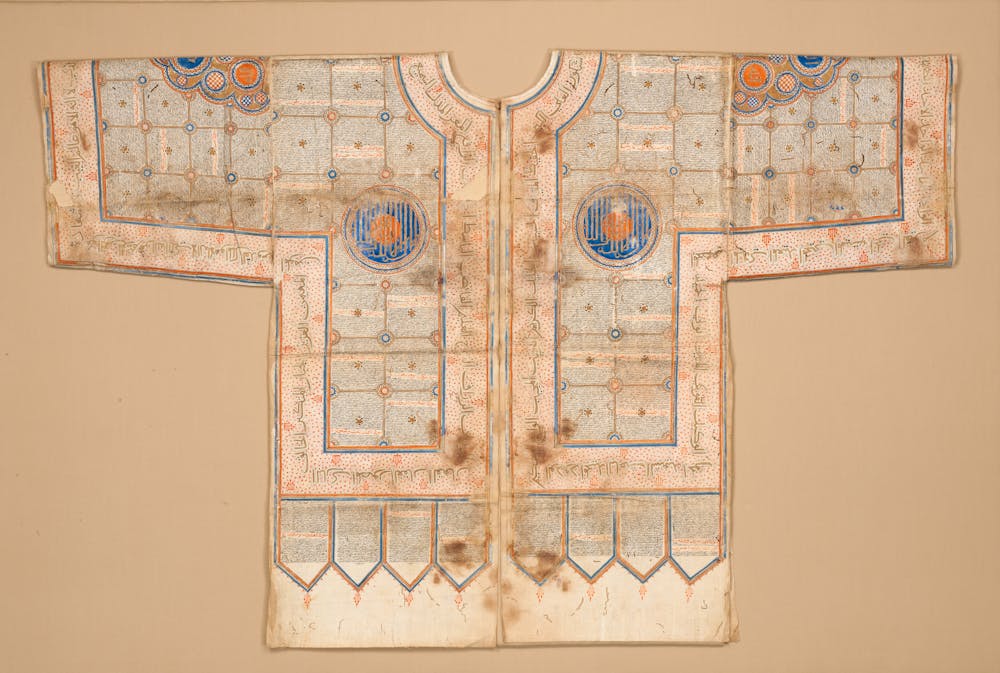
Protecting its wearer against a range of assaults, the quintessential premodern Islamic PPE was the talismanic shirt – a cloth garment inscribed with holy text and often worn in warfare. Featuring circular designs on the chest, shoulder pad roundels and a fringed lapel, the talismanic shirt may sound like something out of the disco era – but in practice it more closely recalls the body armor of war.
A Talismanic shirt made in India in the 15th or 16th century.
Covered in squares, numbers and designs, the shirts were “amuletically charged,” meaning they were thought capable of physically protecting the wearer against disease and death.
Other talismanic shirts, from India, included a protective panel on the back inscribed with a Quranic verse calling God “the Best Guardian and the Most Merciful of the Merciful Ones.”
Anti-plague design
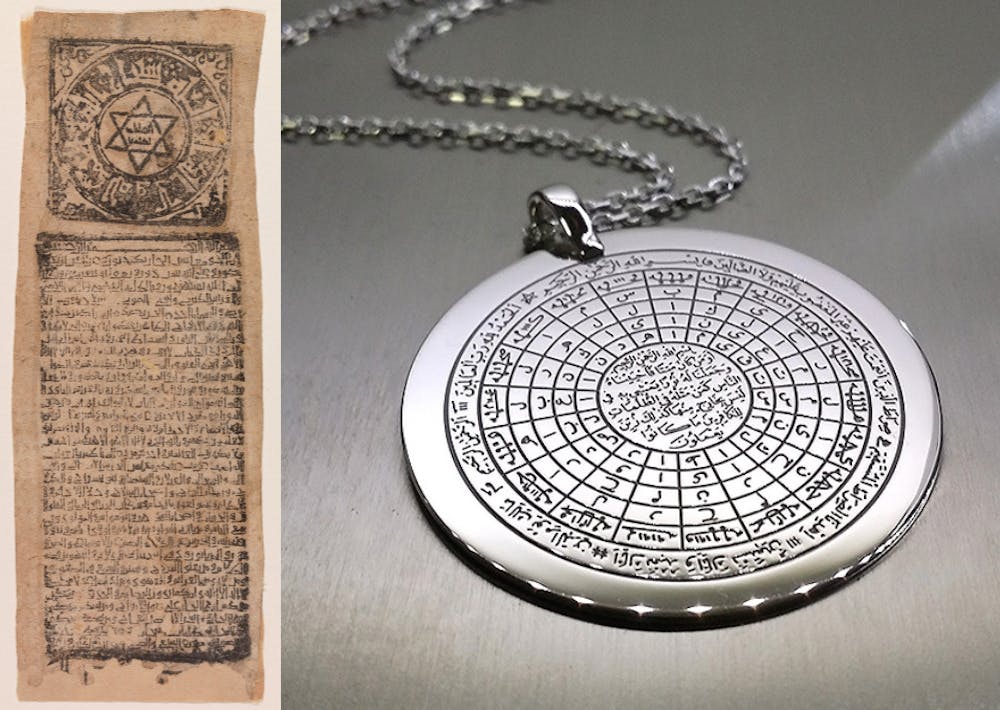
Other common medieval Islamic PPEs included the miniature talismanic scroll – a tiny roll of Quranic verses on affordable block-printed paper – and amuletic designs like the six-pointed seal of Solomon.
Eleventh-century talismanic scroll from Egypt (left) and pendant with the ‘Garden of Names’ anti-plague amulet for sale online today (right).
Quranic scrolls and amulets were worn around the neck or otherwise attached to the body, suggesting that physical contact with the object was thought to unlock the enclosed blessings or life force, known as “baraka” in Arabic.
Perhaps most germane to today’s pandemic was the Islamic anti-plague talisman known as the “Garden of Names,” used across the Islamic world and especially popular in Ottoman lands.
The Garden of Names, or Jannat al-asma’ in Arabic, is a circular amuletic design that contains 19 letters and numbers, verses from the Quran and several names of God. Some painted images of this device show controlled smudges, suggesting that people kissed, rubbed or made potions out of the design to activate its baraka.
Healing water
Water has important healing properties in Islamic traditions, too, being associated with cleanliness and godliness. The Quran credits it as the source of “every living thing.”
Since the seventh century, Muslims visiting the holy city of Mecca, located in Saudi Arabia, have visited the Zamzam well, whose water is thought to have curative properties. There, religious pilgrims still fill flasks with the holy liquid, which is then drunk straight or mixed with other liquids into therapeutic potions.
Muslim pilgrims drinking Zamzam water upon arrival in the holy city of Mecca in 2019.
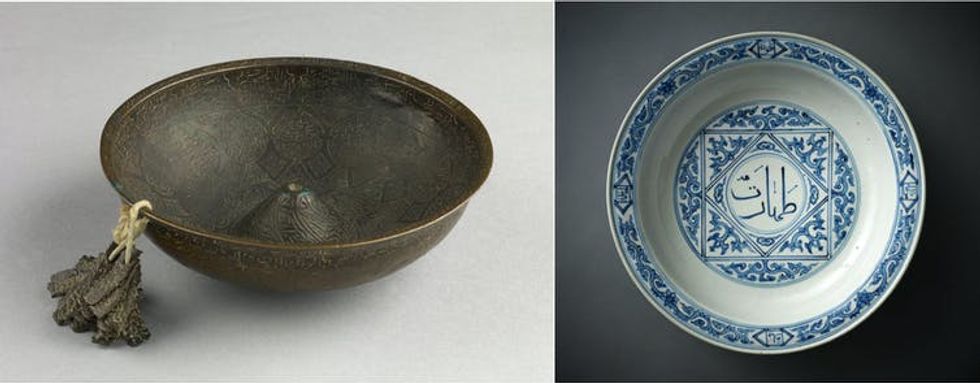
Alternatively, regular water could turn curative if a folk doctor poured it into special metal bowls decorated with talismanic words and images while praying. Some of these talismanic bowls specify the reason for their creation, so historians know they were used to heal everything from poison and dog bites to intestinal problems, “pain of the heart” – that is, heartbreak – and the plague. For centuries, Muslim women in labor were also cooled with water from these bowls.
A metal magico-medicinal bowl, left, and a ceramic ablutions basic inscribed with the word ‘taharat,’ meaning purity.
University of Michigan Hatcher Library/Aga Khan Museum
But amuletic objects and homeopathic practices still exist in the Islamic world, as they do in many faith cultures across the globe. Some Muslims still use magico-medicinal bowls at home; they’re sold on eBay.
Like prayer or meditation – which can have something of a placebo effect, bringing real benefits for both mind and body – Muslims facing sickness or other crises found strength and solace in religious objects for nearly a millennium.
As art objects, too, these artifacts speak to a human desire to seek comfort and cure in creativity and design. That is a feature of today’s pandemic, too.
The killer is not the virus but the immune response.
The current pandemic is unique not just because it is caused by a new virus that puts everyone at risk, but also because the range of innate immune responses is diverse and unpredictable. In some it is strong enough to kill. In others it is relatively mild.
My research relates to innate immunity. Innate immunity is a person’s inborn defense against pathogens that instruct the body’s adaptive immune system to produce antibodies against viruses. Those antibody responses can be later used for developing vaccination approaches. Working in the lab of Nobel laureate Bruce Beutler, I co-authored the paper that explained how the cells that make up the body’s innate immune system recognize pathogens, and how overreacting to them in general could be detrimental to the host. This is especially true in the COVID-19 patients who are overreacting to the virus.
Cell death – a chess game of sacrifice
I study inflammatory response and cell death, which are two principal components of the innate response. White blood cells called macrophages use a set of sensors to recognize the pathogen and produce proteins called cytokines, which trigger inflammation and recruit other cells of the innate immune system for help. In addition, macrophages instruct the adaptive immune system to learn about the pathogen and ultimately produce antibodies.
To survive within the host, successful pathogens silence the inflammatory response. They do this by blocking the ability of macrophages to release cytokines and alert the rest of the immune system. To counteract the virus’s silencing, infected cells commit suicide, or cell death. Although detrimental at the cellular level, cell death is beneficial at the level of the organism because it stops proliferation of the pathogen.
For example, the pathogen that caused the bubonic plague, which killed half of the human population in Europe between 1347 and 1351, was able to disable, or silence, people’s white blood cells and proliferate in them, ultimately causing the death of the individual. However, in rodents the infection played out differently. Just the infected macrophages of rodents died, thus limiting proliferation of the pathogen in the rodents’ bodies which enabled them to survive.
The “silent” response to plague is strikingly different from the violent response to SARS-CoV-2, the virus that causes COVID-19. This suggests that keeping the right balance of innate response is crucial for the survival of COVID-19 patients.
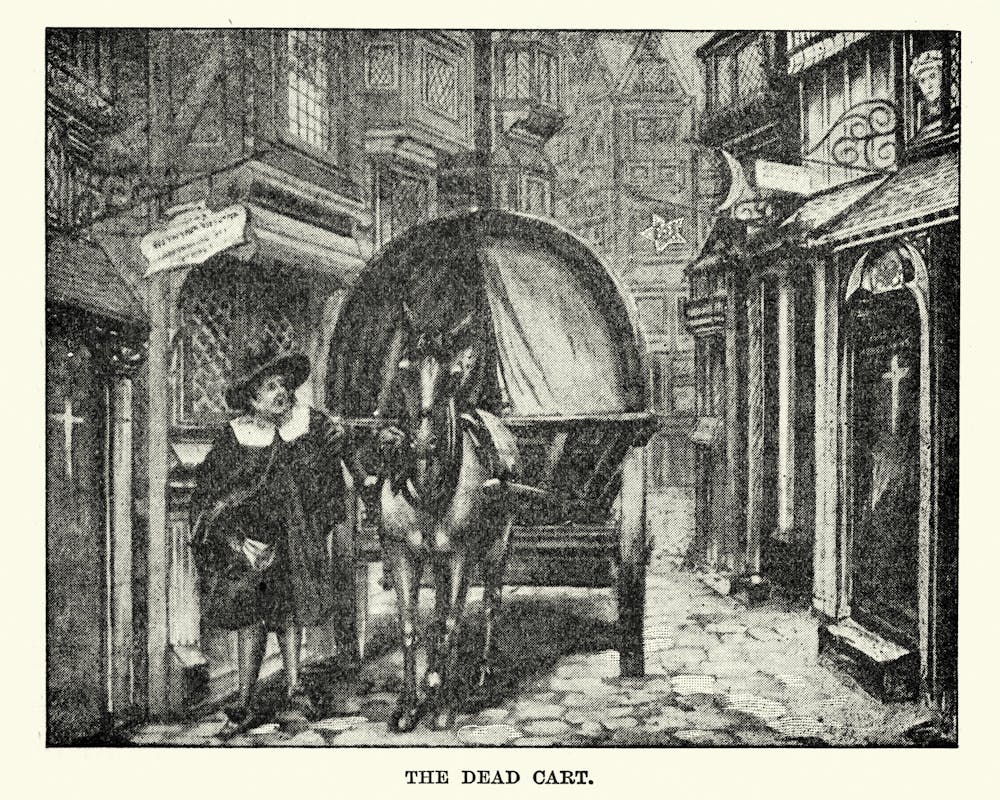
Vintage engraving of a dead cart collecting the bodies of plague victims during the last Great Plague of London, which extended from 1665 to 1666.
Here’s how an overreaction from the immune system can endanger a person fighting off an infection.
Some of the proteins that trigger inflammation, named chemokines, alert other immune cells – like neutrophils, which are professional microbe eaters – to convene at the site of infections where they can arrive first and digest the pathogen.
Others cytokines – such as interleukin 1b, interleukin 6 and tumor necrosis factor – guide neutrophils from the blood vessels to the infected tissue. These cytokines can increase heartbeat, elevate body temperature, trigger blood clots that trap the pathogen and stimulate the neurons in the brain to modulate body temperature, fever, weight loss and other physiological responses that have evolved to kill the virus.
When the production of these same cytokines is uncontrolled, immunologists describe the situation as a “cytokine storm.” During a cytokine storm, the blood vessels widen further (vasolidation), leading to low blood pressure and widespread blood vessel injury. The storm triggers a flood of white blood cells to enter the lungs, which in turn summon more immune cells that target and kill virus-infected cells. The result of this battle is a stew of fluid and dead cells, and subsequent organ failure.
The cytokine storm is a centerpiece of the COVID-19 pathology with devastating consequences for the host.
When the cells fail to terminate the inflammatory response, production of the cytokines make macrophages hyperactive. The hyperactivated macrophages destroy the stem cells in the bone marrow, which leads to anemia. Heightened interleukin 1b results in fever and organ failure. The excessive tumor necrosis factor causes massive death of the cells lining the blood vessels, which become clotted. At some point, the storm becomes unstoppable and irreversible.
Drugs that break the cytokine storm
One strategy behind the treatments for COVID is, in part, based in part on breaking the vicious cycle of the “cytokine storm.” This can be done by using antibodies to block the primary mediators of the storm, like IL6, or its receptor, which is present on all cells of the body.




 AFP/File / JOSEPH EID