A Japanese department store has scrapped a "period badge" for employees that let colleagues know they were menstruating, after the policy sparked an internet storm, a spokeswoman said Friday.
One of Daimaru's upscale department stores in the western city of Osaka began the program last month, adopting an idea proposed by female employees.
The voluntary badges were intended to alert colleagues to the idea that coworkers with severe menstrual pains -- or other period-related needs -- might require longer breaks or extra help lifting heavy objects.
But after local media reported the policy, prompting outrage on Twitter, several customers rang the store to question the merit of what is now dubbed a "period badge".
"We are not scrapping the programme itself because it is strictly for internal communication, among those who work here," a company spokeswoman told AFP.
But she said the store will use something other than the badge.
"Most of our staff are women and staff members support this programme. We will continue in a better way," she said.
The idea came as the luxury store prepared to launch a new section for products related to female hygiene on a floor dedicated to young women's fashion.
During its planning, staff openly discussed their experiences with periods and ways to improve the work environment.
To launch the section, the store worked with "Seiri-chan", a comic-book character whose name means "Ms. Period", which has been made into a new movie.
The store then created a badge that announced the start of the section's opening from November 22 on one side, with the pink character on the other.
"There was a time when speaking openly about periods just did not happen. Now we can do this," the Daimaru spokeswoman said.
"Everyone experiences periods differently. Through discussions, we believe this can lead to greater understanding of our experiences," she said.
Iraq's embattled premier announced Friday he will resign in keeping with the wishes of the country's top Shiite cleric, after nearly two months of anti-government protests that have cost more than 400 lives.
Adel Abdel Mahdi's written statement was greeted with cheers and blaring music across Baghdad's iconic Tahrir (Liberation) Square, where crowds have amassed since early October against a ruling class deemed corrupt and inefficient.
"I will submit to the esteemed parliament a formal letter requesting my resignation from the premiership," Abdel Mahdi wrote, just hours after Grand Ayatollah Ali Sistani called in his weekly sermon on parliament to replace the cabinet.
The sermon set off an avalanche of statements from political figures in support of a no-confidence vote on the government, before the prime minister's announcement.
Celebrations broke out in Tahrir, where young protesters dropped the stones they were preparing to throw at riot police and began dancing, an AFP photographer said.
"It's our first victory, and we're hoping for many more," shouted one demonstrator as the three-wheeled tuk-tuk vehicles used to ferry casualties pumped patriotic music into the square.
"It's also a victory for the martyrs who fell," he said.
The grassroots movement is the largest Iraq has seen in decades but also the deadliest, with more than 400 people dead and 15,000 wounded in the capital and Shiite-majority south, according to an AFP tally.
For weeks, Sistani had called for restraint in dealing with demonstrators and urged political parties to get "serious" about reform, but he ramped up demands on Friday.
"The parliament, from which this current government is drawn, is asked to reconsider its choice in this regard," he said in Friday's sermon delivered by a representative.
Within minutes, MP and former premier Haider al-Abadi called on lawmakers to convene Saturday for a "special session for a vote of no-confidence and to form a new independent government".
AFP / Haidar HAMDANI Iraqis carry the coffins of anti-government demonstrators killed during a crackdown on demonstrators in the restive south on Thursday, the single bloodiest day of protests since October 1
And the powerful Hashed al-Shaabi paramilitary network, which had backed the government, also appeared to change course.
Its parliamentary bloc, Fatah, called for "the necessary changes in the interests of Iraq".
- Bloodshed resumes -
The sudden turnaround came after one of the bloodiest days of protests yet, with 44 demonstrators killed and nearly 1,000 wounded on Thursday in Baghdad and across the south.
The bloodshed resumed on Friday, with two protesters shot dead in the flashpoint city of Nasiriyah and another killed in the shrine city of Najaf.
"The increasing numbers of deaths and injuries cannot be tolerated," said the UN's top official in Iraq, Jeanine Hennis-Plasschaert.
The majority of Thursday's dead fell in Nasiriyah, which counted 26 dead, including two who died Friday from injuries suffered the previous day.
AFP / Iraqi demonstrators gather as flames start consuming Iran's consulate in the southern Iraqi Shiite holy city of Najaf on November 27, 2019
In renewed rallies Friday in Nasiriyah, demonstrators encircled a police station and set ablaze five police cars.
And in Najaf, a massive funeral procession snaked through the streets carrying coffins of some of the 16 people killed there the previous day.
Clashes erupted there between protesters and armed men dressed in civilian clothes, with volleys of gunfire heard outside political party offices, according to witnesses.
Demonstrators felt emboldened by Sistani's sermon, which was "different than the previous ones", said Ali al-Sunbuli, an activist in Najaf.
The sermon began with a prayer for the protesters who died and then addressed parliament directly, not the cabinet or political parties.
"It's a sign that he doesn't recognise their legitimacy," said Sunbuli.
In Diwaniyah, another hotspot, protester Ahmad al-Badr said that Sistani's speech "was a big push for us".
- Turning tides -
The unrest in Iraq's south was unleashed after protesters stormed the Iranian consulate in Najaf late Wednesday, accusing the neighbouring country of propping up Iraq's government.
AFP / Haidar HAMDANI Nearly 400 people have died and some 15,000 wounded since Iraq's anti-government protests erupted on October 1
Tehran demanded Iraq take decisive action against the protesters, saying it was "disgusted" by developments.
In response, Abdel Mahdi ordered military chiefs to deploy in several provinces to "impose security and restore order" -- but chaos reigned instead.
Men in civilian clothes opened fire at demonstrators and tribal fighters deployed in the streets in their defence.
As the death toll climbed late Thursday, the premier sacked the commander he had dispatched to Nasiriyah and the provincial governor based in the city resigned.
Police officers speaking on condition of anonymity told AFP they had received orders Thursday to "finish off" the rallies.
Baghdad and the south have been rocked by the most widespread street unrest since the 2003 US-led invasion that toppled Saddam Hussein.
AFP /Anti-government protests in Iraq
Protesters are seeking an overhaul of the ruling elite, accused of corruption and embezzling state funds in a country scarred by decades of conflict and where infrastructure is failing.
Iraq is OPEC's second-largest crude producer but one in five Iraqis lives in poverty and youth unemployment stands at 25 percent, according to the World Bank.
Demonstrators have also called out Iraq's large eastern neighbour Iran, accusing it of political, economic and military overreach.
Top Iranian commander Qasem Soleimani last month convinced political factions to back the government, including firebrand cleric Moqtada Sadr, who had called on the premier to resign.
But as the tide appeared to turn again, Sadr resurfaced Thursday, saying it would "be the beginning of the end for Iraq" if the government did not step down.
Brazil on Thursday released revised statistics showing deforestation in the Amazon rainforest surpassed 10,000 square kilometers (3,860 square miles) in the year to July 2019, the highest in more than a decade.
The National Institute for Space Research (INPE) said last week that satellite data showed 9,762 square kilometers were cleared of trees in the 12-month period, an increase of 29.5 percent.
This week's revised statistics released by the INPE show the increase was even greater than thought: a 43 percent jump in deforestation in the world's largest rainforest, for a total loss of 10,100 square kilometers in the 12 months to July.
That's against a loss of 7,033 square kilometers between August 2017 and July 2018.
The deforestation is the largest since 2008, when 12,287 square kilometers of the Amazon were logged in a 12-month period.
Previous data showed clearing in the Amazon nearly doubled in the first eight months of this year, compared with the same period in 2018, to 6,404 square kilometers.
The data's announcement came after fires ravaged swaths of the rainforest earlier this year, igniting a global outcry and diplomatic feud between President Jair Bolsonaro and European leaders.
Far-right Bolsonaro is a proponent of developing agricultural and mining activities in the Amazon, 60 percent of which lies in Brazil's borders.
Faced with criticism over the fires and tree clearing, Bolsonaro accused non-government organizations of starting the blazes, and France and others of threatening Brazil's sovereignty over the rainforest.
In a figure-hugging sparkly dress, Val Monique tears around the stage, whipping up the crowd as she channels her inner Tina Turner and belts out "Proud Mary."
Monique is Panama's representative in the Karaoke World Championships, one of 40 amateur warblers selected from 30,000 entrants for the competition, which is being held this year for the first time in its spiritual home of Japan.
Accountants, teachers and economists from as far afield as the Faroe Islands, Guatemala and Brazil battled it out for the prestigious title of the world's best karaoke singer in the competition run since 2003.
And like everyone around the world who has ever grabbed the mic, for a brief time under the spotlight, the contestants found their 15 minutes of fame.
"Karaoke can make everyone feel for one moment like a professional. Only karaoke can give you those few minutes of glory on the stage," said Vladyslav Karasevych, a contestant from Ukraine.
AFP / Behrouz MEHRI Siri Sorensen from the Faroe Islands tones up before going on stage at the Karaoke World Championships
Resplendent in a black and white "Harlequin" outfit and white hat, and proudly waving a Ukrainian flag, Karasevych introduced his compatriots, including a woman dressed like "Hatsune Miku", a vocaloid character with long blue ponytails and a miniskirt.
"Karaoke makes us happy. He is an economist, I am an accountant, and she is a teacher, and we today stand on the stage like professionals, like stars," he said.
Among the karaoke classics featured on Thursday were Spandau Ballet's "Gold" sung by the Finnish entrant and "You'll Never Walk Alone", interpreted by the contestant from the Philippines.
The crown went to Jenny Ball from Britain, who sang Queen's "The Show Must Go On" in the semi-finals and Jennifer Hudson's "And I Am Telling You" in the final.
"Thank you so much. Arigato!" she exclaimed after her victorious performance on stage. "I don't know what to say!"
Her prize: a portable microphone and a medal.
The show closed with a chorus of the 1985 sing-along hit "We Are The World" -- an annual rendition.
- 'Great legs' -
The annual Karaoke World Championships were first held in Finland in 2003, the brainchild of a Finnish company.
AFP / Behrouz MEHRI There were 40 entrants selected from some 30,000 around the world
The final contestants were selected from some 30,000 applicants across the globe, according to Daiichikosho, a Japanese karaoke company backing the event.
The selection process differs from country to country, but in Japan the company asked wannabe competitors to upload their singing performances at karaoke parlours, said Daiichikosho official Kikumi Onchi.
Around 2,200 people applied just for Japan, considered the home of karaoke -- a word that means "empty orchestra" in Japanese -- and where the concept was born around 50 years ago.
"We listened to each one of the songs, selected several singers for regional competitions, and picked the final four singers for the world championships," Onchi told AFP.
One of the lucky Japanese contestants, Yuji Ogata, voiced delight at performing "at home" after he belted out "ai no sanka", the Japanese version of the Edith Piaf classic "L'hymne a l'amour" ("hymn to love").
"I myself thought the world championships was a far-fetched dream, but here it is happening in Tokyo, Japan," Ogata said.
Vladimir Brilov, a contestant from Russia, said he was making the most of his time in Japan, experiencing the unique Japanese karaoke culture.
"I was all alone because I wanted to feel comfortable," Brilov said. "I was a superhero for myself and that made me so pleased."
After the show, Panama's karaoke queen Monique paid tribute to her inspiration Tina Turner, an "amazing, powerful woman."
"She is, I don't know even how many years old, and she is still dancing, still singing. I wanted to have that same energy she has on stage and show off great legs like she shows off, even if she's 70-80 years old," she said of Turner, who turned 80 on Tuesday.
"I'm so excited. Being on stage was such a rush but adrenaline just hits you as soon as you are there on the stage. It was amazing," she told AFP.
"I just wanted to have fun and I think it was worth it."
A wooden fragment said to be from the crib of the infant Jesus arrived in Jerusalem on Friday on its way back to Bethlehem after a millenium-long absence.
The relic, housed in Rome since the seventh century, was presented to the Franciscan custodians of the Holy Land at a mass in the Notre Dame Catholic centre opposite the walls of Jerusalem's Old city.
It will be taken to Bethlehem on Saturday, in time for the traditional lighting of the Christmas tree in Manger Square.
The city, in the Israeli-occupied West Bank, is believed to have been the birthplace of Jesus.
The chief custodian for the Holy Land, Francesco Patton, said that the relic was sent from Bethlehem to Rome around the year 640 as gift to Pope Theodore I from Sophronius, Latin Patriarch of Jerusalem.
"The pope in Rome was Theodore, and he had Palestinian roots," Patton told AFP after the Friday morning mass.
Now, over a thousand years later it is returning to the city where it will be installed "forever" in Saint Catherine's church, adjoining the Basilica of the Nativity, he said.
- Holy homecoming -
"This is the first time that a the wooden part of the manger comes back," Patton added.
"Of course not the entire wooden structure because it is very fragile and it is impossible to transport from Rome to here."
The Catholic church does not speak of worshipping relics, which would be a form of idolatry, but rather of venerating them.
"Of course we don't venerate the relic because it is a piece of wood. We venerate the relic because the relic reminds us of the mystery of incarnation, to the fact that the son of God was born of Mary in Bethlehem more than 2,000 years ago," Patton said.
Bethlehem has planned celebrations stretching until Christmas for the homecoming of the relic, a sliver of wood about a centimeter wide and 2.5 centimeters long.
- Palestinian request -
During a visit to the Vatican for Middle East peace talks in December 2018, Palestinian president Mahmud Abbas asked Pope Francis to repatriate the crib fragment and his request was granted, said Palestinian envoy to the Holy See, Issa Kassissieh.
"We are thankful and President Abbas is thankful to his Holiness for giving us this precious gift as a sign of peace and hope," Kassissieh told AFP.
After mass in the intimate chapel, attended by about 80 people, a handful of the faithful knelt one by one in front of the fragment in its ornate reliquary.
The Franciscan custodians' website says that during its time in Rome the relic was visited by "very large number of pilgrims from all over the world" and is expected to attract many more to its home in Bethlehem.
In 1900, so the story goes, prominent physicist Lord Kelvin addressed the British Association for the Advancement of Science with these words: “There is nothing new to be discovered in physics now.”
How wrong he was. The following century completely turned physics on its head. A huge number of theoretical and experimental discoveries have transformed our understanding of the universe, and our place within it.
Don’t expect the next century to be any different. The universe has many mysteries that still remain to be uncovered – and new technologies will help us to solve them over the next 50 years.
The first concerns the fundamentals of our existence. Physics predicts that the Big Bang produced equal amounts of the matter you are made of and something called antimatter. Most particles of matter have an antimatter twin, identical but with the opposite electric charge. When the two meet, they annihilate each other, with all their energy converted into light.
The Large Hadron Collider (LHC) has offered some insight into this question. It collides protons at unimaginable speeds, creating heavy particles of matter and antimatter that decay into lighter particles, several of which had never been seen before.
The LHC has shown that matter and antimatter decay at slightly different rates. This goes part – but nowhere near all – of the way to explaining why we see an asymmetry in nature.
The problem is that compared to the precision physicists are used to, the LHC is like playing table tennis with a tennis racquet. As protons are made up of smaller particles, when they collide their innards get sprayed all over the place, making it much harder to spot new particles among the debris. This makes it difficult to accurately measure their properties for further clues to why so much antimatter has disappeared.
Three new colliders will change the game in the coming decades. Chief among them is the Future Circular Collider (FCC) – a 100km tunnel encircling Geneva, which will use the 27km LHC as a slipway. Instead of protons, the colliders will smash together electrons and their antiparticles, positrons, at much higher speeds than the LHC could achieve.
The LHC’s 27km collider is nothing compared to what’s coming.
Unlike protons, electrons and positrons are indivisible – so we’ll know exactly what we’re colliding. We’ll also be able to vary the energy at which the two collide, to produce specific antimatter particles, and measure their properties – particularly the way they decay – much more accurately.
These investigations could reveal entirely new physics. One possibility is that the disappearance of antimatter could be related to the existence of dark matter – the thus far undetectable particles that make up a whopping 85% of mass in the universe. The absence of antimatter and prevalence of dark matter probably owe themselves to the conditions present during the Big Bang, so these experiments probe right into the origins of our existence.
Its impossible to predict how as-yet hidden discoveries from collider experiments will change our lives. But the last time we looked at the world through a more powerful magnifying glass, we discovered subatomic particles and the world of quantum mechanics – which we’re currently harnessing to revolutionise computing, medicine and energy production.
Alone no more?
Just as much remains to be discovered on the cosmic scale – not least the age-old question of whether we’re alone in the universe. Despite the recent discovery of liquid water on Mars, there is not yet any evidence of microbial life. Even if found, the planet’s harsh environment means it would be incredibly primitive.
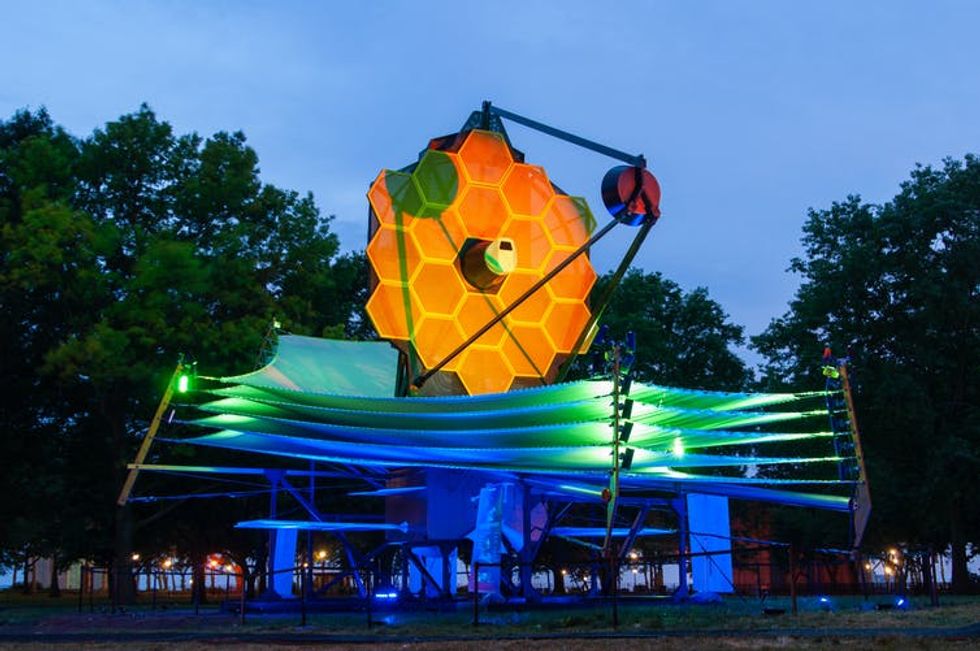
The search for life on planets in other star systems has so far not borne fruit. But the upcoming James Webb Space Telescope, launching in 2021, will revolutionise the way that we detect habitable exoplanets.
Unlike previous telescopes, which measure the dip in a star’s light as an orbiting planet passes in front of it, James Webb will use an instrument called a coronagraph to block the light from a star entering the telescope. This works in much the same way as using your hand to block sunlight from entering your eyes. The technique will allow the telescope to directly observe small planets that would ordinarily be overwhelmed by the bright glare of the star they orbit.
An illuminated full scale model of the James Webb Telescope.
Not only will the James Webb telescope be able to detect new planets, but it will also be able to determine if they’re able to support life. When the light from a star reaches a planet’s atmosphere, certain wavelengths are absorbed, leaving gaps in the reflected spectrum. Much like a barcode, these gaps provide a signature for the atoms and molecules of which the planet’s atmosphere is made.
The telescope will be able to read these “barcodes” to detect whether a planet’s atmosphere has the necessary conditions for life. In 50 years’ time, we could have targets for future interstellar space missions to determine what, or who, may live there.
Closer to home, Jupiter’s moon, Europa, has been identified as somewhere in our own solar system that could harbour life. Despite its cold temperature (−220°C), gravitational forces from the ultra-massive planet it orbits may slosh water beneath the surface around sufficiently to prevent it from freezing, making it a possible home for microbial or even aquatic life.
A new mission called Europa Clipper, set for launch in 2025, will confirm whether a sub-surface ocean exists and identify a suitable landing site for a subsequent mission. It will also observe jets of liquid water fired out from the planet’s icy surface to see if any organic molecules are present.
Whether its the tiniest building blocks of our existence or the vastness of space, the universe still holds a number of mysteries about its workings and our place within it. It will not give up its secrets easily – but the chances are that the universe will look fundamentally different in 50 years’ time.
Protesters in smoke-covered Sydney kicked off a fresh round of global protests against climate change on Friday, with activists and schoolchildren picketing the headquarters of bushfire-ravaged Australia's ruling party.
Hundreds of people gathered at the conservative Liberal party's offices, as protesters in several Asia-Pacific cities heeded the call to action from 16-year-old climate change campaigner Greta Thunberg.
The protests have taken on extra urgency in Australia -- the country's southeast has been devastated by hundreds of damaging bushfires in recent weeks.
The protesters -- brandishing placards that read "You're burning our future" and chanting "we will rise" -- turned out as Sydney was again enveloped in toxic smoke caused by the fires that have blanketed the city for much of the last month.
Six people have died and hundreds of homes have been destroyed in the crisis, which scientists say has been worsened by rising temperatures.
Drought and unseasonably hot, dry and windy conditions have fuelled the unprecedented blazes.
The target of the protesters' ire was Prime Minister Scott Morrison, who has angrily denied any link between the fires and climate change while defending his support for fossil fuels.
"Our government's inaction on the climate crisis has supercharged bushfires," said school strike leader Shiann Broderick. "People are hurting. Communities like ours are being devastated. Summer hasn't even begun."
Australia, with a population of 25 million, has low carbon emissions compared with the planet's biggest polluters, but is one of the world's leading coal exporters.
"The suggestion that (in) any way shape or form that Australia, accountable for 1.3 percent of the world's emissions, that the individual actions of Australia are impacting directly on specific fire events, whether it's here or anywhere else in the world, that doesn't bear up to credible scientific evidence," Morrison claimed earlier this month.
- Missed targets -
Protests also took place in Melbourne and Tokyo, where hundreds marched through the teeming Shinjuku district to raise awareness of the issue.
"I feel a sense of crisis because almost no one in Japan is interested" in climate change, said 19-year-old student Mio Ishida.
"I was really inspired by Greta's actions" she said. "I thought if I didn't act now, it would be too late. I wanted to do something I could do."
Last month, millions of people took to the streets in nearly every major global city for a series of "climate strikes".
The latest demonstrations come as 200 nations prepare to gather in Madrid next week for a 12-day UN climate conference.
The meeting will focus largely on finalising the "rulebook" for the 2015 Paris climate treaty, which becomes operational in 2021.
Scientists have warned that efforts to cap warming to 1.5 Celsius are failing, and that carbon emissions -- which are on the rise -- would need to fall 7.6 percent a year to meet the target.
The UN has reported that greenhouse gas levels in the atmosphere, the main driver of climate change, hit a record high last year.
The organisation has also warned that global temperatures are on pace to rise almost four Celsius by the end of the century -- an increase that could make some places virtually unhabitable.
Hong Kong police on Friday ended their two-week siege of a university campus that became a battleground with pro-democracy protesters, as activists vowed to hold fresh rallies and strikes in the coming days.
Renewed calls to hit the streets came after Beijing and city leader Carrie Lam refused further political concessions despite a landslide victory for pro-democracy parties in local elections last weekend.
Sunday's district council polls delivered a stinging rebuke to the financial hub's pro-Beijing establishment and undermined their argument that a silent majority were tired of the nearly six months of increasingly violent protests.
AFP / Hong Kong protests
They also ushered in a rare period of calm following weeks of spiralling unrest, with no clashes or tear gas battles between protesters and police for more than a week.
But the calm spell looks set to end as public anger grows once more over the lack of response to the election results by Beijing and Hong Kong's leaders.
Online forums used to organise the mass movement have filled with calls for a major rally on Sunday and a strike on Monday targeting the morning commute.
AFP / Philip FONG The calm spell looks set to end as public anger grows once more over the lack of response to the election results by Beijing and Hong Kong's leaders
"If the communist Hong Kong government ignores public opinion, we will blossom everywhere for five or six days straight... We have to set a deadline," read one post on the Reddit-like LIHKG forum, which got heavy approval from users.
The Sunday rally has received permission from authorities, but the fresh calls raise the spectre of a return to the kind of weekly political chaos that has battered Hong Kong for nearly six months and helped tip the city into recession.
Hundreds of office workers held flashmob rallies during their Friday lunch break in multiple locations across the city. Riot police were deployed but the protesters dispersed peacefully.
- University siege ends -
Earlier in the day police said they were closing the book on one of the most violent chapters of the protest movement -- the siege of the Hong Kong Polytechnic University.
The sprawling red-brick campus became a battleground on November 17 between police and protesters armed with bows and arrows as well as Molotov cocktails.
The standoff settled into a tense stalemate during which hundreds fled the campus -- some making daring escapes, others caught and beaten by officers during failed breakouts -- leaving a dwindling core of holdouts surrounded by police cordons.
AFP / Anthony WALLACE Thousands held a peaceful Thanksgiving themed rally in Hong Kong on Thursday night
After university leaders said almost all protesters had left, police teams moved in on Thursday to gather nearly 4,000 Molotov cocktails and other weapons left behind after the occupation.
On Friday afternoon police removed the cordons surrounding the campus and departed, ending the 13-day siege.
They said they had arrested a total of 1,377 people, including more than 800 who left the campus during the siege.
"Only 46 of the people arrested are students from Polytechnic University," its president Jin-Guang Teng told reporters.
"Polytechnic University is the biggest victim in the occupation of the campus."
The university now faces a mammoth clean-up with vast swathes of the campus ransacked, filled with broken glass, barricades and rotting food.
In a letter to students on Friday, university officials warned the campus was "still unsafe and will continue (to) be closed."
But members of the public still made their way onto campus.
"All the images of the battle came right back to my mind when I saw all the debris," one lady told Apple Daily in a live broadcast, bursting into tears.
AFP / Romeo GACAD Hong Kong's deeply unpopular leader Carrie Lam has acknowledged public dissatisfaction but ruled out further concessions
Hong Kong's protests are fuelled by years of seething anger over China's perceived erosion of liberties in the semi-autonomous city.
Millions of Hong Kongers marched in protest rallies throughout the summer after Lam's government introduced a bill allowing extraditions to the authoritarian mainland.
It was belatedly withdrawn under public pressure, but by then violent clashes between police and protesters had become the norm and the movement had snowballed into wider calls for police accountability and fully free elections.
More than 5,800 people have been arrested and nearly 1,000 charged according to government figures while police have fired more than 12,000 tear gas canisters.
Beijing denies stamping out Hong Kong's liberties and has portrayed the protests as a foreign-backed "colour revolution" aimed at destabilising mainland China.
Protesters in smoke-covered Sydney kicked off a fresh round of global protests against climate change on Friday, with activists and schoolchildren picketing the headquarters of bushfire-ravaged Australia's ruling party.
Hundreds of people gathered at the conservative Liberal party's offices to heed the call to action from 16-year-old climate change campaigner Greta Thunberg.
The protests have taken on extra urgency in Australia -- the country's southeast has been devastated by hundreds of damaging bushfires in recent weeks.
The protestors -- brandishing placards that read "You're burning our future" and chanting "we will rise" -- turned out as Sydney was again enveloped in toxic smoke caused by the fires that has blanketed the city for much of the last month.
Six people have died and hundreds of homes have been destroyed in the crisis, which scientists say has been worsened by rising temperatures.
Drought and unseasonably hot, dry and windy conditions have fuelled the unprecedented blazes.
The target of the protesters' ire was Prime Minister Scott Morrison, who has angrily denied any link between the fires and climate change while defending his support for fossil fuels.
"Our government's inaction on the climate crisis has supercharged bushfires," said school strike leader Shiann Broderick. "People are hurting. Communities like ours are being devastated. Summer hasn't even begun."
Australia, with a population of 25 million, has low carbon emissions compared with the planet's biggest polluters, but is one of the world's leading coal exporters.
"The suggestion that (in) any way shape or form that Australia, accountable for 1.3 percent of the world's emissions, that the individual actions of Australia are impacting directly on specific fire events, whether it's here or anywhere else in the world, that doesn't bear up to credible scientific evidence," Morrison claimed earlier this month.
Missed targets
Protests are expected later in the day in Melbourne, Brisbane and in cities across the world.
Last month, millions of people took to the streets in nearly every major global city for a series of "climate strikes".
The latest demonstrations come as 200 nations prepare to gather in Madrid next week for a 12-day UN climate conference.
The meeting will focus largely on finalising the "rulebook" for the 2015 Paris climate treaty, which becomes operational in 2021.
Scientists have warned that efforts to cap warming to 1.5 Celsius are failing, and that carbon emissions - which are on the rise -- would need to fall 7.6 percent a year to meet the target.
The UN has reported that greenhouse gas levels in the atmosphere, the main driver of climate change, hit a record high last year.
The organisation has also warned that global temperatures are on pace to rise almost four Celsius by the end of the century -- an increase that could make some places virtually unhabitable.
Turkey on Thursday accused Emmanuel Macron of sponsoring terrorism in reaction to new criticism by the French president about Ankara's operation in Syria.
Turkey last month launched an offensive against Kurdish-led forces in Syria, which Turkish President Recep Tayyip Erdogan said targeted the "terrorists" of the Kurdish People's Protection Units (YPG) militia and the Islamic State group.
But the move prompted criticism of Ankara that it was weakening the fight against dispersed IS elements with the operation against the YPG, which had been spearheading the fight against the jihadist group.
Macron, who has repeatedly criticised the Turkish offensive, said on Thursday that Ankara had presented its allies with a "fait accompli" that endangered the anti-IS coalition's action.
Macron's comments sparked a sharp reaction from Ankara, which accuses Paris of seeking to establish a Kurdish state in Syria.
"In any case, he (Macron) is sponsoring the terrorist organisation, he receives them regularly at the Elysee (presidential palace)," Turkish Foreign Minister Mevlut Cavusoglu was quoted as saying by state news agency Anadolu.
Ankara views the YPG as an offshoot of the Kurdish PKK, which has fought an insurgency inside Turkey for the past 35 years and is blacklisted as a terror group by Ankara and its Western allies.
"Let Macron not forget... Turkey is also a member of NATO. That it stands by its allies," he added.
Earlier Thursday, after talks with NATO chief Jens Stoltenberg in Paris, a combative Macron took aim at Turkey over its unilateral decision to attack the YPG.
"I respect the security interests of our Turkish ally, which has suffered numerous attacks on its soil," Macron said.
"But you cannot on the one hand say we are allies and demand solidarity in that regard and on the other hand present your allies with the fait accompli of a military operation that endangers the actions of the anti-IS coalition of which NATO is a member."
Billionaire former New York City Mayor Mike Bloomberg was paying a top advisor who was also likely on the payroll of a Ukrainian oligarch, according to an analysis of a new public filing by New York Times reporter Ken Vogel.
"Mike Bloomberg’s presidential pollster has ended his years-long representation of a Ukrainian oligarch briefly scrutinized by U.S. law enforcement during its investigation into Russian election-meddling," The Daily Beast reported on Tuesday.
"Pollster and pundit Doug Schoen told The Daily Beast on Tuesday that he has signed on to work on the former New York mayor’s 2020 Democratic presidential bid. In anticipation of that role, he said, he terminated a contract with billionaire investor Victor Pinchuk," The Beast reported. "Schoen’s work with Bloomberg predated his formal launch this past Sunday. An aide to the one-time mayor said that Schoen had done polling for them in anticipation of a presidential announcement in addition to his three successful mayoral runs."
Vogel looked at the timeline established by a new filing.
"Special counsel Robert Mueller briefly probed Pinchuk’s 2015 payment to the Donald J. Trump Foundation for a televised speech that Trump gave at the Ukrainian’s annual Yalta European Strategy conference," The Beast explained.
"Pinchuk’s name has also surfaced in the context of the ongoing impeachment inquiry against President Trump," The Beast noted. "Two years after Trump’s 2015 speech, Rudy Giuliani, who now serves as the president’s personal attorney, traveled to Kyiv to address Pinchuk’s foundation. While there, he met with then-Ukrainian president Petro Poroshenko and a top prosecutor in the country, Yuriy Lutsenko, who peddled baseless conspiracy theories, subsequently relayed by Giuliani, at the center of the impeachment inquiry."
"Pinchuk isn’t the only former client of Schoen’s whose work creates tantalizing and complicated political implications for Bloomberg’s run. Schoen also has done work for Trump himself, back when the president was in the real estate business and not electoral politics. Schoen advised Trump on a 150-story commercial and residential project that was to be dubbed 'Trump City' but never actually materialized," The Beast added.
They train with swords and fighting fans after their prayers and morning chants.
Meet the Himalayan kung fu nuns using their martial arts skills to challenge stereotypes about women's roles in the region's patriarchal societies.
"In the Himalayas, girls are never treated equally and girls are not given equal chances -- that's why we want to push the girls up," practitioner Jigme Konchok Lhamo, 25, told AFP.
"Kung fu has helped us in taking a stand on gender equality as we feel more confident, we feel strong physically and mentally.
"We are doing kung fu as an example for other girls."
The nuns are from the 800-strong Druk Amitabha Mountain Nunnery in Nepal and belong to the centuries-old Drukpa school of Tibetan Buddhism.
In 2008 as part of his mission to bring about gender equality in Buddhism, spiritual leader His Holiness Gyalwang Drukpa encouraged them to learn kung fu and take on traditional norms that forbid women and girls from leaving the confines of the nunneries, leading prayers or being fully ordained.
Emboldened by their fighting prowess, the nuns travel across South Asia to teach self-defence classes and promote awareness about human trafficking in a region where violence against women is rarely reported.
They also embark on gruelling mountain walks and cycling campaigns to reach out to remote communities.
Most recently, they completed a three-month, 5,200-mile (8,370-kilometre) "bicycle yatra (journey) for peace" from Nepal to the mountains of Ladakh in northern India, where they passed through villages and spread their messages of gender equality and empowerment.
Lhamo -- who was in New Delhi in early November after picking up an international award in New York for the nunnery's efforts to inspire young girls -- became a nun at just 12 despite strong disapproval from her family.
"There was a lot of criticism in the beginning. People didn't really like it because we were breaking rules," Lhamo said, after she and her fellow nuns put on a demonstration of their prowess.
They weilded tasselled swords and open, Chinese-style fighting fans -- which are used for signalling commands during combat -- emblazoned with dragons and phoenixes.
"But now when we go back to the same places we get a lot of good response.
"They call us to schools. They put the girls in front and the boys at the back. They give girls equal chances to ask questions and talk to us."
British Prime Minister Boris Johnson's Conservatives are heading for a comfortable win in next month's election, according to a detailed new poll, amid reports Thursday that the rival Labour party is refocusing its strategy.
The YouGov survey published late Wednesday said if the contest were held now, the Conservatives would snatch 44 seats from the main opposition party to win a 68-seat majority in the House of Commons.
The poll -- the biggest so far in this campaign to predict election results seat-by-seat -- uses a model that correctly forecast 93 percent of seats in the last election in 2017, according to YouGov.
Britain votes on December 12, with Johnson hoping to secure a majority to be able to push through his plan to leave the European Union at the end of January.
The data showed larger swings from Labour to the Conservatives in areas that are more pro-Brexit, especially in England's northern and central regions.
Labour has promised a new referendum on Brexit, and although leader Jeremy Corbyn says he would be neutral, many of his top team have said they would campaign to stay in the EU.
"As expected, the key thing deciding the extent to which each of these seats is moving against Labour (is) how that seat voted in the European Union referendum" in 2016, said Chris Curtis, YouGov's political research manager.
The Tories are keen not to seem complacent, however.
Dominic Cummings, a Johnson advisor who masterminded the 2016 Brexit campaign, warned just hours before the YouGov poll was published that the race remained tight.
"As someone who has worked on lots of campaigns, things are much tighter than they seem and there is a very real possibility of a hung parliament," he wrote in personal blog post addressed to Brexit supporters.
"Without a majority, the nightmare continues. All other MPs will gang together to stop Brexit and give EU citizens the vote," Cummings added.
- 'Best performance since 1987' -
Johnson, who took over a minority administration in July, missed his first Brexit deadline of October 31 due to opposition in parliament.
If his centre-right Conservatives win what will be the third election in four years next month, he has vowed to put his Brexit deal to MPs before Christmas.
He hopes to rush it through in time for Britain to leave the EU on the next deadline of January 31.
The YouGov poll predicts the Conservatives' total seat count would climb to 359 out of a total of 650, compared to 211 for Labour -- representing a 51-seat loss for the left-wing party.
"In terms of seats won, this would be the Conservatives' best performance since 1987," said the pollster, which analysed data including interviews with around 100,000 people.
The survey offered little consolation for Britain's smaller parties, which all oppose Brexit.
It envisages the Scottish National Party (SNP) gaining eight seats to 43, but the Liberal Democrats picking up just one extra seat, while Welsh party Plaid Cymru would remain on four and the Green Party on one.
- Labour switches focus -
Labour, which has been consistently behind in all polls for months, is now set to refocus its struggling campaign on constituencies that voted for Brexit in 2016, the BBC reported Thursday.
This will see more airtime given to Labour MPs who wanted to leave the EU, and more activists sent to Leave-voting seats.
The party will also reportedly emphasise that its plan for a new referendum is not a smokescreen to reverse Brexit but intended to give voters a genuine choice.
Labour may take heart from the YouGov tally showing that at least 30 seats earmarked as Conservative gains are still within five percent points reach, while several other recent polls show a closer contest overall.
Elsewhere, the respected Institute for Fiscal Studies (IFS) think tank on Thursday criticised spending claims made by both Labour and the Conservatives.
Labour have outlined a huge programme of public investment and nationalisations, while the Tories have also promised to end a decade of austerity.
But the IFS said neither were offering a "properly credible prospectus" in their manifesto.




 AFP / Haidar HAMDANI
  AFP /
AFP /  AFP / Haidar HAMDANI
  AFP /
AFP / AFP / Behrouz MEHRI
  AFP / Behrouz MEHRI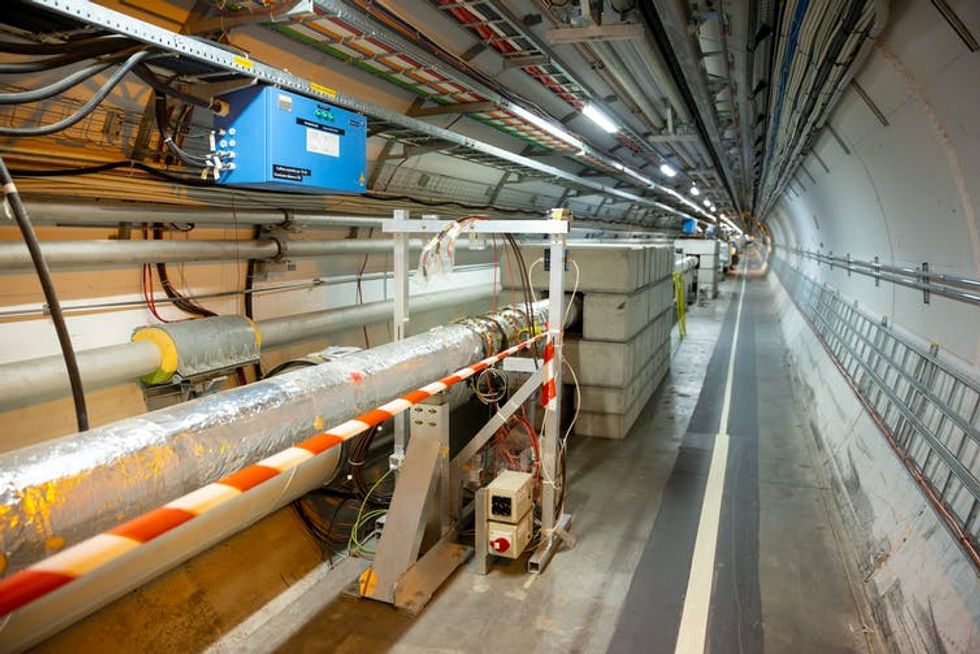

 AFP / Hong Kong protests
 AFP / Philip FONG The calm spell looks set to end as public anger grows once more over the lack of response to the election results by Beijing and Hong Kong's leaders
 AFP / Anthony WALLACE Thousands held a peaceful Thanksgiving themed rally in Hong Kong on Thursday night
  AFP / Romeo GACAD Hong Kong's deeply unpopular leader Carrie Lam has acknowledged public dissatisfaction but ruled out further concessions