President Donald Trump has lost another top official in his State Department, days after Marie Yovanovitch testified the department had been "hollowed out."
"Mina Chang, a high-ranking State Department staffer who vaulted into the public spotlight after NBC reported she had inflated her resumé, has resigned from her position," Politico reported Monday.
"Chang, the deputy assistant secretary in the State Department’s Bureau of Conflict and Stability Operations, was accused of overstating her academic credentials and creating a fake Time magazine cover with her face on it," Politico reported.
Her resignation letter was obtained by Politico.
“Resigning is the only acceptable moral and ethical option for me at this time,” Chang wrote.
“In already difficult times, the Department of State is experiencing what I and many believe is the worst and most profound moral crisis confronting career professionals and political appointees in the Department’s history,” she wrote. “Department morale is at its lowest, the professionalism and collegiality – once a hallmark of the U.S. diplomatic service — has all but disappeared.”
Chang also complained about Secretary of State Mike Pompeo not defending her, which has been a familiar theme in the impeachment proceedings.
“A character assassination based solely on innuendo was launched against me attacking my credentials and character,” she charged. “My superiors at the Department refused to defend me, stand up for the truth or allow me to answer the false charges against me.”
"How the hell is it possible for the U.S. policy to be any softer?"
U.S. Secretary of State Mike Pompeo announced Monday that the President Donald Trump administration will "soften" its stance on Israeli settlements in the occupied West Bank, a move that reverses decades of precedent and effectively kills the two-state solution peace process.
The Associated Press's Matthew Lee broke the story Monday afternoon.
Pompeo claimed that "calling the establishment of civilian settlements inconsistent with international law has not advanced the cause of peace."
"The hard truth is that there will never be a judicial resolution to the conflict," said Pompeo, "and arguments about who is right and who is wrong as a matter of international law will not bring peace."
According to Amnesty International, the settlements are a war crime:
The international community has consistently recognized that settlements contravene international law and create a situation which perpetuates a range of violations of Palestinian human rights including, but not limited to, discriminatory policies based on nationality, ethnicity, and religion.
U.S. policy toward the settlements has largely been limited to public rebukes with no actual consequences.
"How the hell is it possible for the US policy to be any softer?" CounterPunch's Jeffrey St. Clair wondered on Twitter.
Reaction to the announcement from peace advocates and progressives was filled with anger and disappointment.
"This kills any alleged 'peace process,'" tweetedNew York Times contributor Wajahat Ali. "There is no more two-state solution."
An original score of two minuets composed by Wolfgang Amadeus Mozart when he was just 16 blew past estimates at a Sotheby's auction in Paris on Monday, going under the hammer for 372,500 euros ($413,000).
It was nearly double the top estimated value of 200,000 euros set for the handwritten score dating from 1772, and which formed part of the extensive music collection of a fellow Austrian, the writer Stefan Zweig.
The unpublished, autographed score of the minuets -- a stylised dance -- contains a few corrections and minor modifications, including one or two that might be in the hand of Mozart's father, Leopold.
The manuscript was kept in Mozart's birthplace Salzburg by the composer's sister, Nannerl, before finding its way into Zweig's collection.
The score, the only one of the composer's "Six Minuets K.164" to still be in private hands, came from the library of the eminent Swiss bibliophile Jean-Francois Chaponniere.
Mozart, a child prodigy, began composing at a very early age under his father's guidance.
The sale comes ahead of an offering by rival auction house Christie's in Paris next week of a rare portrait of Mozart, made when the musical genius was just 13.
The work, one of few Mozart paintings still in private hands, is expected to fetch 800,000 to 1.2 million euros.
The largest of Saturn's many moons has lakes, mountains and dunes, with its surface scarred and crafted by many of the same forces which have shaped Earth, scientists said Monday.
A team led by Rosaly Lopes at the California Institute of Technology (Caltech) said Titan's visible exterior was "one of the most geologically diverse in the Solar System."
"Despite the differences in materials, temperatures and gravity fields between Earth and Titan, many of their surface features are similar and can be interpreted as products of the same geologic processes," the scientists said in an article in Nature Astronomy.
Using radar and infra-red data generated by the now defunct Cassini probe, which completed a 20-year mission by crashing into Saturn in 2017, the scientists said they could fill in many of the gaps in mapping Titan, some 1.2 billion kilometres (800 million miles) from Earth.
Dunes and lakes, they said, were relatively young while mountainous terrain appeared older.
Titan’s surface was sculpted by the accumulation and erosion of sediment and showed "clear latitudinal variation, with dunes at the equator, plains at mid-latitudes and labyrinth terrains and lakes at the poles," they said.
The region around the equator is arid, with Titan getting wetter closer to the poles.
Just as on Earth, Titan's surface has been marked by impact craters, liquid- and air-driven erosion, methane-laden rainfall, tectonic plate movement and possible volcanic activity.
Alice Le Gall, one of the team and working at Paris-Saclay University, said Titan "is the only known extra-terrestrial body to have liquid bodies on its surface."
Methane exists in three states -- solid, liquid and gas -- at super-cold temperatures. It produces a cycle similar to that of rain falling on Earth to form rivers and lakes, and then evaporating to form clouds again, Le Gall told AFP.
A new report from the Associated Press claims that Ukrainian President Volodymyr Zelensky privately admitted feeling pressured by the Trump administration to intervene in the 2020 election -- and American diplomats were aware of his concerns.
According to the AP's sources, American officials earlier this year were briefed on a meeting that Zelensky held in which he expressed concern that President Donald Trump's associates were trying to drag him into American politics with their demands that he launch an investigation of Burisma, the former employer of former Vice President Joe Biden's son, Hunter.
The AP says that there are "contemporaneous notes on Zelensky’s early anxiety about Trump’s interest in an investigation" that he expressed during the briefing, which could give Democrats evidence "to contradict Republican arguments that Zelensky never felt pressure to investigate Biden."
Amos Hochstein, an American who sits on the board of Ukrainian state-owned energy firm Naftogaz, participated in the Zelensky meeting and later briefed officials at the American embassy about the Ukrainian president's concerns.
In every other developed democratic country, the role of ambassador, with only very rare exceptions, is given to career diplomats who have spent decades learning the art of international relations.
In the U.S., however, many ambassadors are untrained in diplomacy, and have simply bought their way into a prestigious post.
The involvement of the American ambassador to the European Union, Gordon Sondland, in the Ukraine scandal has prompted interest in the media and Congress in the role of non-career ambassadors like him.
On Oct. 30, U.S. Rep. Ami Bera, a Democrat from California, introduced legislation that would require at least 70% of a president’s ambassadorial appointments to come from the ranks of career Foreign Service officers and civil servants.
Career appointees have to spend decades working their way up through the ranks in government before being nominated, as I did before becoming ambassador in Mozambique and later in Peru.
Bera’s bill likely does not have the support in Congress to ever be enacted. More importantly, it does not address what I think is the real problem with political appointee ambassadors. That is the selling of the title in exchange for campaign contributions to people who are clearly unqualified for the job.
While this is a time-honored practice used by presidents of both parties, it has arguably gotten worse under the Trump administration.
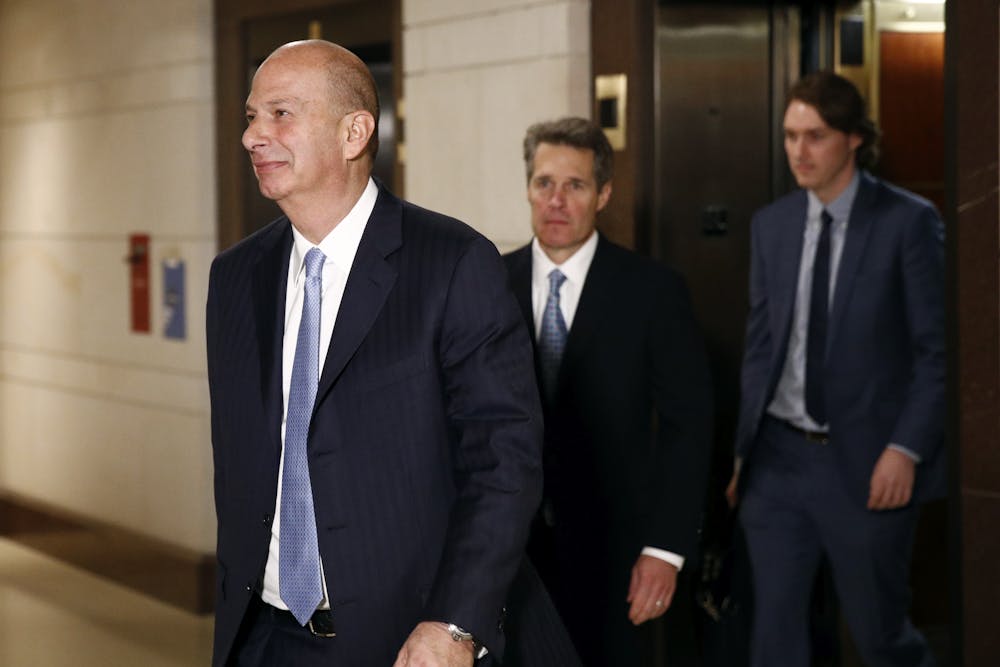
Gordon Sondland, left, walks to a secure area of the Capitol to testify as part of the House impeachment inquiry.
The Constitution says nothing about the qualifications required to be an ambassador. All it says is the president can appoint them with the advice and consent of the Senate.
In other words, a president can appoint whoever he wants for whatever reason he wants.
The Senate can refuse to confirm a nominee, but that has not happened in over a century. Instead, occasionally the Senate will refuse to vote on the nomination and the nominee languishes until either the Senate does decide to act or the White House withdraws the nomination.
That kind of delay is not uncommon, but it is almost always due to policy disputes between the two branches, rather than anything to do with the qualifications of the person being proposed for an ambassadorship.
2. Who’s qualified?
Deciding what qualifies someone to be the personal representative of the president abroad is therefore almost entirely up to the president.
During the Nixon administration, the president’s personal lawyer asked the wife of a wealthy department store owner for a US$250,000 campaign contribution in exchange for the ambassadorship to Costa Rica. She famously replied, “That’s a lot to pay for Costa Rica, isn’t it?” She eventually went to Luxembourg as ambassador, and shortly thereafter wrote checks to the Nixon re-election campaign that added up to $300,000.
The act states that those appointed to be an ambassador “should possess clearly demonstrated competence to perform the duties of a chief of mission,” including knowledge of the language, history and culture of the country.
It added that, given those requirements, such positions “should normally be accorded to career members of the Foreign Service, though circumstance will warrant appointments from time to time of qualified individuals who are not.”
It also stressed that “contributions to political campaigns should not be a factor in the appointment of an individual as a chief of mission.”
3. How many ambassadors are career diplomats?
Despite its intended purpose, the act did little to change how business was done in Washington.
The one exception was the Reagan administration, which got the figure up to 38% by sending Reaganites to places like Rwanda and Malawi, where normally only career ambassadors would dare to tread.
The question of percentages of political versus career ambassadors is one that sometimes attracts media interest, mainly because it is always higher than the usual 30% in the early part of any presidential term. That percentage cannot really be calculated in a meaningful way until the end of a term, because most political appointments are made in its first years.
For example, the percentage of political appointee ambassadors under Trump currently stands at about 45%. However, Trump has left 10 posts vacant that have always been filled by career ambassadors.
Another seven posts that would be career slots are in countries where relations have been downgraded or suspended, such as Venezuela and Bolivia. Most of those embassies will likely be filled by career people at some point.
In terms of posts that are normally held by career diplomats, there are only six – Croatia, Chile, Poland, Thailand, United Arab Emirates and Fiji – that currently have political appointee ambassadors.
4. How much does an ambassadorship cost?
While some political appointees are political allies and friends of the president, for many postings – particularly in Western Europe and the Caribbean, where 80% of the ambassadors are political appointees – who gets the job depends on money.
Even after the Foreign Service Act was passed, political contributions continued to play such a role that it was possible to estimate how much more London would cost than Lisbon. The larger a country’s economy and the number of tourists that visit it, the higher the price of becoming ambassador.
And for those who want to add a fancy title to their resume and have the money, a six or even seven figure price is not too high.
For his first inauguration, President Obama put a limit of $50,000 on contributions. President George W. Bush capped his at $250,000.
For Trump, the sky was the limit and the floodgates were opened for those who wanted to buy access or influence. More than 250 donors gave $100,000 or more, which amounted to over 90% of the $107 million that was collected for the inaugural festivities.
Though Sondland had not backed Trump in his bid to be the Republican candidate, he contributed$1 million after the election to Trump’s inaugural committee.
Under Trump, it’s not just the posts in rich countries and tropical paradises that are for sale. United Nations ambassador Kelly Craft and her husband contributed over $2 million to Trump’s election campaign and inauguration. She also gave generously to over half the Repubican senators on the Foreign Relations Committee that had to approve her nomination.
So while the percentage of political-appointee ambassadors may not increase all that much by the end of Trump’s current term, the price for buying one certainly has.
I think this practice of selling ambassadorships is unlikely to change, despite the image it creates abroad when a person with no knowledge of a country is put in charge of the American embassy there.
Democratic presidential candidate Sen. Elizabeth Warren has said she will appoint no big donors as ambassadors - period. But when I have contacted the campaigns of every other person seeking the nomination to ask if they would make a similar pledge, I have been met with silence. That is because in Washington money does the talking.
Dozens of Hong Kong protesters escaped a two-day police siege at a campus late Monday by shimmying down a rope from a bridge to awaiting motorbikes in a dramatic and perilous breakout that followed a renewed warning by Beijing of a possible intervention to end the crisis engulfing the city.
Clashes rumbled throughout the day between protesters and police who had threatened to use deadly force to dislodge activists holed-up in the Hong Kong Polytechnic University (PolyU).
The university siege has become a battle of wills between Hong Kong's stretched police force and the constantly-innovating protest movement.
Late Monday dozens of black-clad protesters used a rope to slither down several metres on to a motorway below where they were picked up by waiting motorbike riders.
In an apparently co-ordinated effort, thousands of Hong Kongers streamed towards the PolyU campus to break the siege, as clashes simultaneously raged with police nearby in Kowloon.
It was not immediately clear how many protesters remained inside PolyU.
Monday's events were part of a new phase of violence and drama that began last week and has led to chaos throughout the city of 7.5 million people, with schools closed, train lines disrupted and major roads blocked by barricades.
China has refused to budge on any of the protesters' demands, and warned it will not tolerate dissent in the semi-autonomous city.
Chinese soldiers briefly appearing on Hong Kong's streets over the weekend supposedly to clean up debris fuelled concerns it could intervene militarily.
China's ambassador to Britain upped the ante on Monday.
"The Hong Kong government is trying very hard to put the situation under control," Liu Xiaoming said.
"But if the situation becomes uncontrollable, the central government would certainly not sit on our hands and watch. We have enough resolution and power to end the unrest."
Earlier, police made dozens of arrests as protesters made a dash for it -- sometimes beating people with batons as they held them on the ground.
"Other than coming out to surrender I don't see any viable option for them," Cheuk Hau-yip, Police Commander of Kowloon West, told a press conference, before the daring breakout.
The area has been designated a 'riot' zone - a charge of rioting carries up to 10 years in prison - and Cheuk reiterated that police will use "live rounds" against protesters if faced with deadly weapons.
- Intense clashes -
Protests started in June as a peaceful kickback against a now-shelved China extradition bill, but have morphed into a confrontational action to defend the city's unique freedoms from perceived encroachment by Beijing.
Even by recent standards, the last few days have stood out as particularly violent, with one police officer hit in the leg by an arrow, and an armoured police vehicle torched.
Officers fired live rounds on Monday, though said they did not think anyone had been hit.
Hong Kong police routinely carry sidearms, but until now they have only used them in isolated incidents during running street clashes. Three people have been shot, none of them fatally.
They have largely relied on tear gas, water cannon and rubber bullets, but the new warning suggests a more proactive use of live rounds.
Protesters demand accountability from the police, who they accuse of heavy-handed tactics and abuse during the months of rolling unrest.
- 'Helpless' -
Fear gripped protesters inside the campus -- whose occupation is a twist in tactics by a leaderless movement so far defined by its fluid nature.
One 19-year-old, who gave her name as "K", said there was desperation among those who remained.
"Some people were crying badly, some were furious, some agonising, because they felt hopeless as we were left no way out of the campus.
"We don’t know when the police will storm in."
Protests erupted in several other parts of peninsula Hong Kong, with makeshift barricades across normally bustling shopping streets, the road surfaces strewn with bricks to hamper vehicles.
Police fired tear gas at groups who had gathered in the Tsim Sha Tsui and Jordan areas, where they also made a number of arrests, in hotspots active deep into the evening.
- 'Blossom everywhere' -
The unrest has rocked previously stable Hong Kong, tipping the international financial hub into recession and frightening off tourists.
Violence has worsened this month, with two men killed in separate incidents.
Demonstrators last week engineered a "Blossom Everywhere" campaign of blockades and vandalism, which shut down sections of Hong Kong's transport network and closed schools and shopping malls.
In his most strident comments on the crisis, Chinese President Xi Jinping said it threatened the "one country, two systems" model under which Hong Kong has been ruled since the 1997 handover from Britain.
On Saturday, dozens of soldiers from the Chinese People's Liberation Army briefly left their Hong Kong barracks to help clean-up the streets.
It was a rare and symbolic operation, as the troops are normally confined to barracks and are meant to be only called out in a time of emergency.
The Swedish Prosecution Authority said Monday it will provide an update with "new information" this week on a probe into a 2010 rape allegation against WikiLeaks founder Julian Assange.
The investigation concerns events which took place in August 2010 after a Swedish woman met the Australian at a WikiLeaks conference in Stockholm.
Assange has always denied the allegation.
In a statement, the prosecution agency said it was planning a press conference on Tuesday at 1300 GMT when the prosecutor will give a briefing on the "investigative measures taken" and "provide new information".
The 48-year-old has been held at a top-security British prison since April after police dragged him out of the Ecuadoran embassy in London, where he had been holed up since 2012 to avoid an extradition order to Sweden.
Assange was subsequently sentenced to 50 weeks in prison for breaching bail conditions when he took refuge in the embassy.
Following his arrest, Swedish authorities reopened their 2010 rape investigation, which had been closed in 2017 on the argument it was not possible to proceed with the probe as Assange could not be reached.
In September, prosecutors said they had interviewed seven witnesses over the summer and that Assange was suspected of rape.
Swedish deputy director of public prosecutions Eva-Marie Persson -- in charge of the investigation -- also said the material from the interviews was to be analysed further before she decided on how to proceed.
Assange is currently also the subject of a US extradition request to face charges relating to obtaining and disseminating classified information over the publishing of military documents and diplomatic cables through the WikiLeaks website.
Since his April arrest, questions regarding Assange's health have been raised, with him appearing frail and confused at court hearings.
- 'Die in jail' -
Earlier in November, John Shipton, Assange's father warned that his son "may die in jail".
His comments followed a warning from the UN's Special Rapporteur on Torture, Nils Melzer, who said that the treatment of Assange was putting his life "at risk".
Swedish judge Nils Petter Ekdahl told AFP that the prosecutor has a duty to try and bring a suspect to justice if the evidence warrants it.
"If you believe there is enough evidence for a conviction, even in an old case, the principal rule is to charge the person," Ekdahl said.
Ekdahl added that the prosecutor can under certain circumstances make exceptions to this rule. It could for instance be decided that even if a conviction is likely the sentence would probably be lenient owing to Assange's poor health -- and therefore decide not to pursue the case.
The statute of limitations in the case expires in August 2020.
Australia's Qantas on Monday rejected accusations of in-flight racism from US performer will.i.am, with the airline saying it would back legal action against the Black Eyed Peas frontman.
The multiple Grammy-winning artist had lashed out at a Qantas flight attendant and named her on Twitter after she called the police over an altercation during a flight from Brisbane to Sydney.
In his tweets, the star said the crew member had been "overly aggressive" and unnecessarily escalated the situation after he didn't hear an on-board safety briefing because he was wearing headphones.
Using the hashtag #RacistFlightAttendant, he said she was "beyond rude" and "took it to the next level by calling the police", five of whom were waiting for him when the 90-minute flight landed on Saturday.
"Thank god the other passengers testified that SHE was out of control," tweeted William Adams, better known by his stage name will.i.am, adding that the police had "finally" let him go.
He said he had complied "quickly & politely" with instructions from the woman to put his laptop away.
"I don't want to believe she racist. But she has clearly aimed all her frustrations only at the people of colour," he wrote.
A spokesman for the Australian flag carrier said Qantas "completely" rejected the suggestion that race was a factor in the incident.
"There was a misunderstanding on board, which seems to have been exacerbated by will.i.am wearing noise-cancelling headphones and not being able to hear instructions from crew," he said.
The airline initially said over the weekend that it would be "following up with will.i.am and wish him well for the rest of the tour".
But on Monday a spokesman said the airline would be willing to support legal action against the star.
"Absent a retraction, and if the crew member wanted to take the matter further, we'd certainly be willing to provide legal support for them to do this," he said.
Australia has extremely strict defamation laws and courts routinely rule in favour of those claiming reputational damage.
Black Eyed Peas ended a five-city Australia tour with a concert in Sydney on Saturday.
The incident came two months after Australian twin-sister pop duo The Veronicas were removed from a Qantas flight by police after a disagreement with staff over luggage.
Pope Francis, who years ago hoped to be a missionary in Japan, travels to the sites of the world's only atomic attacks this week seeking a ban on "immoral" nuclear weapons.
"Your country is well aware of the suffering caused by war," the Argentine pontiff, 82, said in a video message to the Japanese people on Monday.
"Together with you, I pray that the destructive power of nuclear weapons will never be unleashed again in human history. The use of nuclear weapons is immoral," said the head of the world's 1.3 billion Catholics.
Pope Francis flies to Asia on Tuesday, where he will first visit Thailand and then Japan, including the two cities destroyed by devastating US nuclear attacks during the Second World War.
Despite both countries having less than 0.6 percent Catholic populations, Francis is thirsty for interreligious dialogue with them.
He will arrive in Thailand on Wednesday before flying on to Japan on Saturday, where he will stay until November 26.
Sunday is set to be a marathon day with visits to Nagasaki and Hiroshima, where at least 74,000 people and 140,000 people respectively were killed by the atomic bombs attacks.
- 'You can't forget the bomb' -
The August 6, 1945 bombing of Hiroshima and of Nagasaki three days later contributed to Japan's surrender and the end of the Second World War on August 15, months after Nazi Germany capitulated.
Father Yoshio Kajiyama, director of the Jesuit social centre in Tokyo, was born in Hiroshima shortly after the war and is eagerly awaiting the pope's anti-nuclear speech.
"My grandfather died the day of the bomb in Hiroshima, I never knew him. Four days later my aunt died when she was 15 years old," said the 64-year-old.
"If you grow up in Hiroshima, you can't forget the bomb."
The pope will make "as vigorous an appeal as possible in favour of concerted measures to completely eliminate nuclear weapons," Vatican number two Cardinal Pietro Parolin told the United Nations in September.
A previous member of Japan's diplomatic mission to the Vatican, Shigeru Tokuyasu, said he hoped the visit would pull the world back from "the globalisation of indifference" over nuclear weapons.
But, said Tokuyasu, the pope should avoid discussing the politically sensitive issue of nuclear energy.
Francis is also to meet victims of the devastating 2011 earthquake that struck northeastern Japan and the subsequent tsunami that between them killed 18,500 people and sparked the nuclear power catastrophe at Fukushima.
- Fear of nuclear war -
Francis is used to railing against countries that make money from weapons and has already voiced his fear of a nuclear war.
In January last year, he printed cards with a photo of a Nagasaki bomb victim, inscribing the words "the fruit of war" above his signature.
The 1945 photo, captured by American photographer Joe O'Donnell, showed a small boy standing ramrod straight carrying his dead younger brother on his back while waiting for his turn at a cremation site.
The late pope John Paul II visited Japan in 1981, where at Hiroshima's peace monument he pointed to war as "the work of man".
In August, the city of Hiroshima called on Japan to sign the UN treaty calling for a ban on nuclear weapons, something that all the world's nuclear powers have refused to do.
Japan's 1967 its pacifist constitution commits to the principle of "not producing, possessing or allowing nuclear weapons on its territory," despite counting on the US nuclear umbrella for protection.
- Multi-ethnic Thailand -
Before arriving in Thailand on Wednesday, the pope praised the "multi-ethnic nation" which "has worked to promote harmony and peaceful coexistence, not only among its habitants but throughout Southeast Asia".
In a video message to the Thai people, the pope said he hoped to "strengthen ties of friendship" with Buddhists.
SinceFrancis' election six years ago, he has made two trips to Asia, visiting the Philippines and Sri Lanka in 2014, followed by Myanmar and Bangladesh in 2017.
On Thursday in Bangkok, the pontiff is to pay a visit to supreme patriarch Somdej Phra Maha Muneewong at a Buddhist temple.
"Bolivia is living through a violent, regressive, completely undemocratic power grab. All governments must sever relations with this illegal regime."
As indigenous-led protests against the military coup that ousted Evo Morales continued in the streets of Bolivia over the weekend in the face of violent repression by police forces, the government of self-declared Interim President Jeanine Añez on Sunday announced the creation of a "special apparatus" to arrest elected lawmakers from the majority Movement for Socialism party.
The Bolivian newspaper Los Tiempos reported that government minister Arturo Murillo announced plans Sunday to publish a "list" of leftist lawmakers he said are guilty of "subversion." Last week, Murillo vowed to "go hunting" for Morales' former top minister Juan Ramón Quintana, who has been forced into hiding.
In response, journalist Ben Norton said the Bolivian government is behaving like a "Pinochet-style dictatorship."
"Bolivia's far-right coup regime is become more authoritarian and murderous by the day," Norton tweeted Sunday.
Murillo's announcement came just days after the coup government's communications minister, Roxana Lizárraga, threatened to arrest journalists and members of the media "involved in sedition."
"This is outrageous and is correctly called a coup," environmentalist and author Naomi Klein said following Murillo's comments. "Bolivia is living through a violent, regressive, completely undemocratic power grab. All governments must sever relations with this illegal regime."
Last Tuesday, as Common Dreamsreported, Añez declared herself interim president of Bolivia despite lacking the constitutionally required number of lawmakers to approve her appointment. Añez's move was decried as illegitimate and undemocratic by socialist lawmakers and ordinary Bolivians, who rallied in the streets in protest.
Since seizing power, Añez—a right-wing lawmaker with a history of racist attacks on indigenous people—has moved quickly to drag government policy to the right.
Añez's revival of Catholic rituals in public events has caused more than a little discomfort because the Constitution defines Bolivia as a secular state. Her religious zeal has also caused concern among some Indigenous groups who associate Catholicism in politics with the former conservative governments that had long treated them as second-class citizens.
In a further shift from Mr. Morales' focus on Indigenous rights, Ms. Añez has filled her cabinet with politicians from the country's eastern lowlands, which are dominated by Bolivians of mixed or European descent. Many of her ministers have been staunch opponents of Mr. Morales' socialist policies or have served in previous conservative administrations.
The most radical changes have come from the Foreign Ministry. In just a few days, Ms. Añez, has cut Mr. Morales' alliances with leftist governments in the region. She broke off relations with President Nicolas Maduro of Venezuela and kicked out hundreds of Cuban doctors working in the country.
Additionally, the Times noted, Añez "issued a presidential decree exempting the military from criminal prosecution when maintaining public order." A day later, Bolivian security forces opened fire on indigenous anti-coup protestors in the city of Cochabamba, killing at least eight people and injuring dozens more.
Most lawmakers and presidential candidates in the United States have been completely silent about the military coup in Bolivia, even as the nation's military guns down peaceful demonstrators in the streets.
One of the few exceptions, 2020 Democratic presidential candidate Sen. Bernie Sanders (I-Vt.), once more condemned the coup during a forum hosted by Univision Saturday night.
"When the military intervenes... in my view, that's called a coup," Sanders said.
Russia said Monday it had handed over three navy ships it seized a year ago from Ukraine, in the latest move to ease tensions between the two countries ahead of a crucial summit.
After an exchange of prisoners in September and the withdrawal of some frontline forces over the last few weeks, the handover marked another step in trying to resolve the five-year conflict in eastern Ukraine.
Efforts have been building since the election this year of Volodymyr Zelensky as Ukraine's new president, and on Friday France announced he would hold his first face-to-face talks with Russian President Vladimir Putin in Paris on December 9.
The talks, which will also include French President Emmanuel Macron and German Chancellor Angela Merkel, will be the highest-level negotiations on the conflict since 2016.
Russia's foreign ministry said on Monday that the ships -- two gunboats and a tugboat -- had been handed over to Ukraine.
It said they had "illegally crossed the Russian border" and been held as evidence but were no longer needed.
There was no immediate confirmation of the handover from Kiev.
The Ukrainian ships were seized in November last year in the most serious confrontation between the two countries since the start of the conflict in 2014.
Russian forces boarded and took control of the vessels as they headed through the Kerch Strait, a narrow waterway giving access to the Sea of Azov that is used by Ukraine and Russia.
They captured 24 Ukrainian sailors, who were returned to Ukraine as part of the September prisoner swap.
Border officials had said on Sunday that the ships would be returned and local television showed footage of them being towed by the Russian coastguard through the Kerch Strait.
The election of Zelensky, a television comedian who shocked the country's elite by winning the presidency in April, has raised hopes the conflict with pro-Moscow separatists can finally be resolved.
Zelensky has said ending the war -- which has left some 13,000 dead -- is his top priority.
- First talks in years -
The conflict in Ukraine's industrial east broke out after Russia's 2014 annexation of the Ukrainian peninsula of Crimea, which led the West to impose wide-ranging sanctions on Moscow.
The separatists have declared unrecognized breakaway statelets in the mainly Russian-speaking Ukrainian eastern regions of Donetsk and Lugansk.
Ukraine and its Western allies accuse Moscow of giving financial and military backing to separatists, which Russia denies.
September's exchange was the first major step in years to reduce tensions, with the two countries swapping 70 prisoners.
It was followed over the last few weeks by the withdrawal of Ukrainian troops and separatist forces from several flashpoint areas along the frontline.
The four-way summit was initially announced by Macron for September, after talks with Putin in France, but was held up until the troop withdrawals took place.
The structure for the talks is known as the "Normandy format" after a first meeting brought together the four heads of state in France's Normandy region in 2014.
The last such meeting took place in Berlin in October 2016.
Kremlin spokesman Dmitry Peskov on Monday confirmed the talks would go ahead on December 9 but sought to downplay talk of a major breakthrough.
"There was a long delay, a long break in work under the Normandy format, and so we should not set expectations too high," he told reporters.
It aims to implement the "Minsk agreements", deals reached in 2014 and 2015 to end the conflict but which have yet to be properly put in place.
The talks are expected to focus on a roadmap that would give special status to the separatist territories if they conduct free and fair elections under the Ukrainian constitution.
The conflict has been a major drain on Ukraine's economy but Zelensky is facing opposition to his peace plan, especially from war veterans and nationalists.
Another summit between North Korea and the US would be "useless" unless Washington offers new concessions in their nuclear negotiations, Pyongyang said Monday, hours after Donald Trump hinted at the prospect.
"You should act quickly, get the deal done," Trump tweeted Sunday, referring to North Korean leader Kim Jong Un. "See you soon!"
Kim and Trump have met three times since June last year, but talks have been gridlocked since their Hanoi summit in February broke up in disagreement over sanctions relief, while October's working-level talks rapidly broke down in Sweden.
Pyongyang has set Washington a deadline of the end of the year to come forward with a fresh offer, and foreign ministry advisor Kim Kye Gwan said the US was "buying time while acting as if it has achieved progress".
He interpreted Trump's tweet as a "signal" for a new summit, he said in a statement carried by state news agency KCNA, but declared: "We are not interested in such useless talks any more."
"We will not give anything to the US president to brag about when we have received nothing in return," he went on, adding the North should be "rewarded for what President Trump touts as his achievements".
The implied criticism of Trump by name is a departure for Pyongyang, which has long limited its frustration to other administration officials.
Last month, adviser Kim declared: "Contrary to the political judgment and intention of President Trump, Washington political circles and DPRK policy makers of the US administration are hostile to the DPRK for no reason," using the initials of North Korea's official name.
In September he was fulsome in his praise for the US leader, saying that Trump was "different from his predecessors" and that he placed his hopes in "President Trump's wise option and bold decision".
But as the North's deadline approaches it has issued a series of increasingly assertive statements -- while also carrying out a number of weapons launches.
Washington should withdraw its "hostile policy" if it wants dialogue to continue, Kim said Monday, without elaborating further.
Trump's tweet came after Washington and Seoul agreed to postpone annual joint aerial exercises to create space for diplomacy with Pyongyang, which condemns such drills as preparations for invasion.