Fox News host Jesse Watters made the false claim that when President Donald Trump officially took office his children stopped doing international business out of caution. Donald Trump Jr. even retweeted the video of the claim.
Less than 24 hours after the tweet, Eric Trump destroyed the claim with an announcement of new development for Trump's Scotland golf course. Scotland is not in the United States and thus considered "international."
"Congratulations to our extraordinary @TrumpScotland team! Minutes ago, we received full and total approval for a new phase of development to include 500 homes, 50 cottages, sports center, retail and more," Eric Trump bragged.
The United States on Thursday announced travel sanctions against Cuba's Raul Castro and his family, accusing the former president of violations of human rights.
In his continued role as first secretary of the ruling Communist Party, "Raul Castro oversees a system that arbitrarily detains thousands of Cubans and currently holds more than 100 political prisoners," Secretary of State Mike Pompeo said.
The sanctions mean that the former president -- brother of late revolutionary leader Fidel Castro -- will be ineligible for travel to the United States.
While the 88-year-old former leader was unlikely to be planning a trip to Disneyland, the order also means that his immediate family will be denied entry into the United States.
Among those barred by the order is his daughter Mariela Castro Espin, who has become a prominent advocate for gay rights and HIV/AIDS awareness.
She visited San Francisco and New York in 2012, drawing an outcry from US-based critics of the Castros.
Pompeo said he also made the legal designation due to Raul Castro's support for Venezuela's leftist leader Nicolas Maduro, who presides over a crumbling economy.
"The United States strongly supports the rights of the Cuban and Venezuelan people," Pompeo said in a statement.
"We will continue to pursue all diplomatic and economic tools to help the Venezuelan people achieve the transition they deserve," he said.
President Donald Trump has vowed to rid Latin America of socialism, a stance that resonates with many Cuban and Venezuelan exiles in the politically crucial state of Florida.
His moves mark a sharp contrast from that of former president Barack Obama, who met Castro on a historic 2016 trip to Cuba as he sought to end decades of hostility.
Iranian President Hassan Rouhani challenged the US and others Thursday to provide evidence to back up their accusations that Tehran carried out this month's attack on a Saudi oil facility.
"Those who make the allegations must provide the needed proof. What is your evidence?" he told reporters in New York, a day after addressing the UN General Assembly.
The United States and Saudi Arabia have both, to varying degrees, blamed Iran for the strikes on the kingdom's Abqaiq plant and the Khurais oil field which knocked out half of Saudi Arabia's oil production.
France, Germany and Britain, which all remain committed to a nuclear deal with Iran that the US withdrew from last year, also pinned the blame on Iran this week.
Tehran has blasted the allegations as "ridiculous." It denies responsibility, and the attacks have been claimed by Yemen's Iranian-back Huthi rebels.
"If you do have any evidence or documentation please do make them available to me," Rouhani said, adding that the US, France, Britain and Germany "should stop" supplying weapons to Saudi Arabia.
The Iranian leader also said he would "of course" hold talks with the United States if President Donald Trump lifted sanctions and ended his policy of maximum pressure on Tehran.
Speculation was abuzz that the leaders of the arch-foes would meet on the sidelines of the General Assembly this week but Trump returned to Washington without a rendezvous taking place.
Rouhani has made the easing of economic pressure a pre-condition for any talks.
"If we reach a time when these preconditions are taken off the table, of course the possibility exists to talk with America," he said at Thursday's press conference.
French President Emmanuel Macron had shuttled between his US and Iranian counterparts over two days at the UN, trying to arrange an encounter that he hoped could help de-escalate tensions in the Middle East.
"I don't want to say that such plans will never be realized," Rouhani said of Macron's attempts at setting up a historic bilateral meeting.
Volodymyr Zelensky, a popular comedian until his shock election to the Ukrainian presidency this spring, is at the centre of a global scandal following a now notorious phone call with US leader Donald Trump.
In Kiev, opponents have lashed out against the "disaster" call but supporters say the transcript released this week showed Zelensky playing Trump to his own advantage.
During the conversation, Zelensky seemed to agree to Trump's request to probe his political rival Joe Biden -- which US Democrats have used to launch an impeachment process.
Zelensky also supported the US president's criticism of Kiev's European allies.
While Zelensky's critics say the transcript shows him to be inexperienced and weak in the face of a major power, analysts say the main political impact of the call will be felt in Washington rather than Kiev.
- 'Pathetic sycophant' -
Allies of former president Petro Poroshenko, who lost to Zelensky in an election in April, were quick to criticize the former entertainer.
"This is a disaster," Rostyslav Palvenko, an MP from Poroshenko's party, wrote on Facebook.
Another opposition MP, Volodymyr Ariev, said Zelensky "de-facto promising" Trump an investigation on his political rival risked trashing US bipartisan support for Kiev.
Many were alarmed by Zelensky's claim the Ukraine's next prosecutor would be "100 percent my person" and would be able to "look into" a case against Biden.
Opponents interpreted this as an ambition to control the judiciary.
The country's media and rights activists also criticized Zelensky for the language he used with the US leader.
"A pathetic sycophant in front of a more influential clown," activist Iryna Siedova wrote on Facebook.
- Agree '1000 percent' -
A high-ranking Ukrainian official speaking on condition of anonymity dismissed this criticism, saying the only part of the transcript "seriously problematic" for Zelensky were his comments on Kiev's EU allies.
After Trump told Zelensky that "Germany does almost nothing for you", Zelensky said he agreed with the US leader.
The comedian replied that he backed the US president "not only 100 percent, but actually 1,000 percent."
Along with Washington, France and Germany have been key supporters of Kiev as it fights a war in its east against Russian-backed separatists.
"How will we talk to France and Germany after this?" asked pro-Western ex-MP Victoria Voytsitska on Facebook.
Speaking in New York Thursday Zelensky said that he did not want to offend any of Kiev's allies but that "spoke the truth".
He explained that he was referring to the controversial Nord Stream 2 gas pipeline backed by Germany, which Kiev sees as a security threat.
The EU on Thursday defended the "unprecedented" backing it has given to Ukraine, with a spokesman calling it "the largest support package in the history of the EU."
- Lack of political experience -
Analysts said the phone call would have little domestic effect, while Zelensky's supporters said the ex-comedian managed to outsmart Trump.
"The story only has a foreign policy effect," said analyst Anatoliy Oktysyuk, even as it highlighted Zelensky's lack of political experience.
Ordinary Ukrainians said it was hard to tell whether the US leader pressured their president, and some believed it was Zelensky that was "playing" Trump.
"Zelensky knows what he's doing, he'll help Trump to keep his image and at the same time get something from him in exchange," Andriy, a biologist in his 30s, told AFP in central Kiev.
"I think Zelensky is clever and that's what he'll do."
Anatoly, a programmer, said it was important for the president to endear himself to Trump to secure support from Washington.
"But on the other hand he can lose support from other countries if he plays him too much," he said.
Even with ambitious global efforts to limit emissions, the study warns, "the increase in the frequency and extent of adverse weather extremes and related shocks on the production side would be unprecedented."
Underscoring the necessity of aggressive action to combat human-caused global warming, research published Wednesday warns that the majority of the world's wheat fields are at risk of enduring "severe, prolonged, and near-simultaneous droughts" by the end of the century—raising serious concerns about future food insecurity and political instability.
"Even under the ambitious mitigation scenario aimed to stabilize global warming at 2°C compared to pre-industrial levels, the increase in the frequency and extent of adverse weather extremes and related shocks on the production side would be unprecedented."
—study
"If only one country or region sees a drought there is less impact," said study co-author Song Feng of the University of Arkansas. "But if multiple regions are affected simultaneously, it can affect global production and food prices, and lead to food insecurity."
The peer-reviewed study, published in the journal Science Advances, was conducted by team of researchers from the United States, Europe, and Asia.
Wheat accounts for about 20 percent of all calories consumed by humans worldwide and the global demand for wheat products such as cereal is expected to rise in the coming decades, according to the U.N. Food and Agriculture Organization (FAO). Recognizing humanity's reliance on the crop as a key food source, the study's researchers analyzed various climate models to assess the rising risk of drought in wheat-producing regions.
"Global warming is expected to increase the frequency and intensity of severe water scarcity (SWS) events, which negatively affect rain-fed crops such as wheat," the study says. "Our projections show that, without climate change mitigation... up to 60 percent of the current wheat-growing area will face simultaneous SWS events by the end of this century, compared to 15 percent today."
Referencing a key goal of the Paris climate accord, researchers warn that "even under the ambitious mitigation scenario aimed to stabilize global warming at 2°C compared to pre-industrial levels, the increase in the frequency and extent of adverse weather extremes and related shocks on the production side would be unprecedented."
The impact on food prices and security will depend on multiple factors. As the study explains, "recent evidence suggests that variations in crop product prices are linked to simultaneously challenging economic factors, such as oil prices and exchange rates, as well as the occurrence of large-scale droughts and corresponding market and policy responses."
Reutersreported, citing co-author Petr Havlik, that "Africa would be the most affected region by the middle of the century."
Europe, the United States, and Russia would be severely hit, said Havlik, deputy director at Austria's International Institute for Applied Systems Analysis.
Africa is not a major wheat producer, but the crop provides 14 percent of the calories consumed by the continent's population, which is projected to double by 2050, Havlik said.
FAO projects that by 2050, global demand for cereals will increase by 43 percent compared with the 2006 level, "which is fairly conservative compared to other projections," and "will predominantly come from developing countries," the study notes. If those nations can't sustainably boost their supply, they will increasingly depend on imports.
Researchers warn that "these developments may increase food insecurity and, consequently, political instability and migration."
The new study "contributes substantially to the neglected area of climate extremes in agriculture, as it brings new data to light on how likely the shocks caused by drought might be in near future," Havlik toldBloomberg.
The research follows a landmark United Nations report from August which called for a global overhaul of the ways humans use land—including forestry, agriculture, and industrial and urban development—to meet the food needs of the world's growing human population and ensure a habitable planet.
On Sept. 19, the California Air Resources Board endorsed the Tropical Forest Standard, which sets the groundwork for electric utilities, oil refineries and other California polluters to “offset” their greenhouse gas emissions by paying governments in tropical forest areas not to cut down trees.
The standard is part of California’s ambitious climate policy, which includes aggressive emission reduction targets and limits the number of offsets polluters can purchase.
Tropical governments around the world may now try to get their offsets admitted into California. That could channel an estimated US$1 billion by 2030 toward protecting tropical forests – 100 times more than the European Union recently offered Brazil to aid in fighting fires in the Amazon.
Some indigenous peoples, policymakers, environmentalists and researchers view the standard as a novel way to financially support those struggling against the odds to protect tropical forests. Others say that not only won’t it stem deforestation – it could also harm vulnerable communities.
California’s ‘carbon market’
Policymakers have been considering ways that California might reduce tropical deforestation at least since I began my legal and anthropological research on forest offsets in the late 2000s.
The state is home to one of the world’s most important carbon markets, also known as “cap-and-trade.” Ten U.S. states, the European Union, Quebec and several Chinese cities use cap-and-trade programs to limit greenhouse gas pollution.
In cap-and-trade programs, regulators limit the amount of greenhouse gases emitted each year and issue “allowances” to pollute. Polluters may also “trade” these allowances among themselves.
The premise, from a global climate change perspective, is that it doesn’t matter where greenhouse gases are emitted: Their impact on the climate is the same.
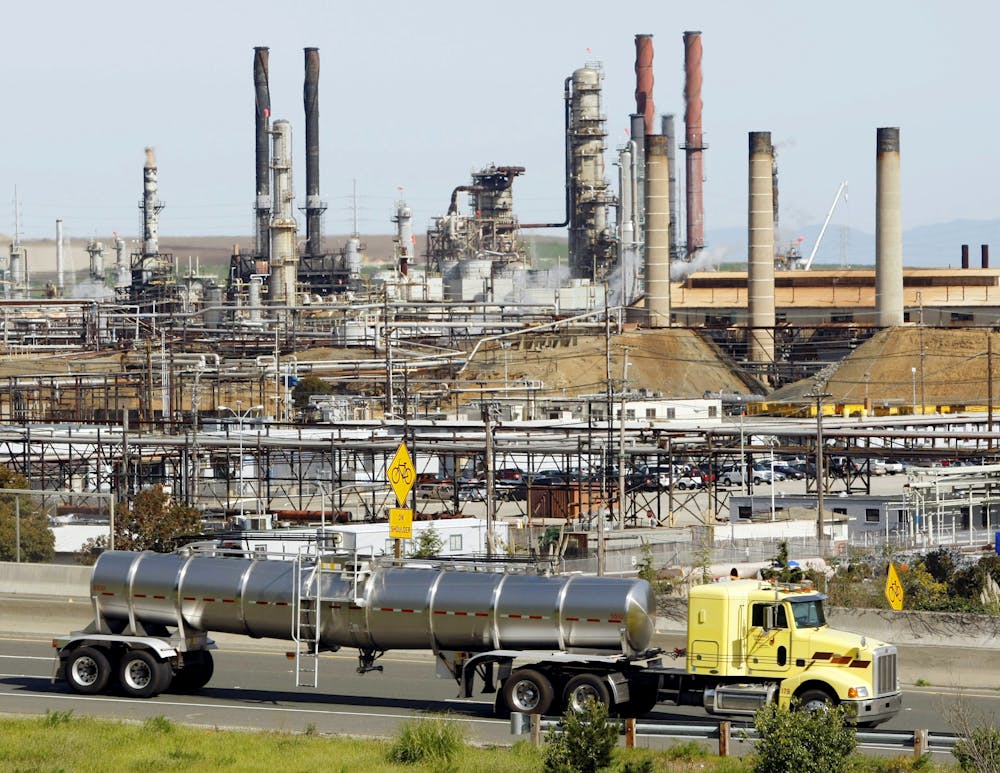
As a partial alternative to reducing their emissions, California polluters can already buy limited “offsets” from approved entities. For example, for every metric ton of carbon dioxide stored by the Yurok Tribe’s Northern Californian forests, the tribe can sell an offset to a California polluter. In exchange, polluters —- like the Chevron oil refinery in Richmond – can keep spewing some of their climate-changing pollutants.
In a few years, that same refinery could potentially pay the Brazilian state of Acre for protecting its rainforest.
But, ethically, California’s Tropical Forest Standard may be on shakier ground.
Like Catholic indulgences that absolve the sinner who pays the church, carbon offsets give amnesty to companies that would do better to change their ways.
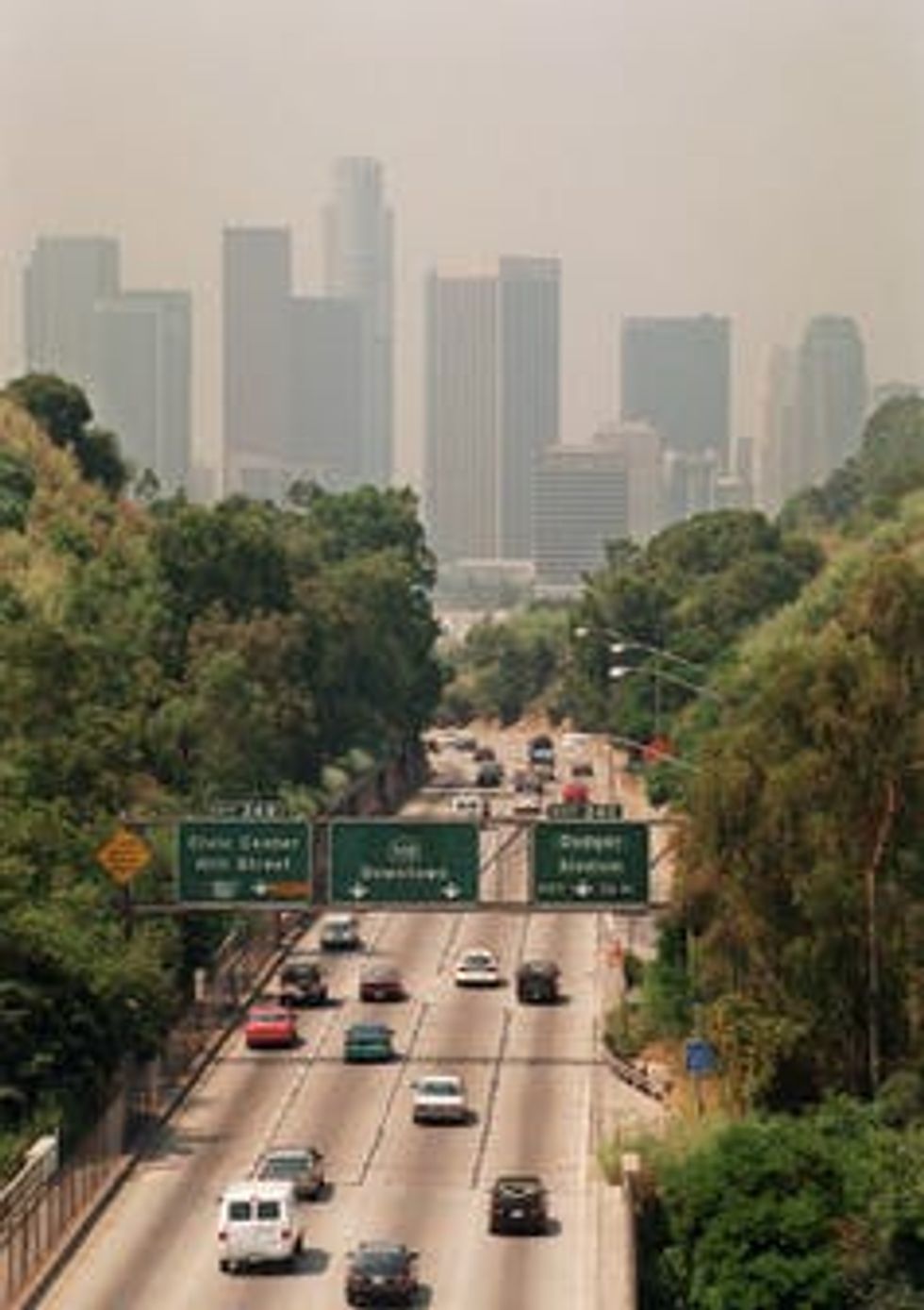
For people who live with smog, it matters where pollution is emitted.
This may buy the Earth some time while renewables and other low-carbon technologies develop further. But carbon offsets also delay the needed energy transition away from fossil fuels.
In protecting tropical forests rather than reducing pollution in California, then, the Tropical Forest Standard may exacerbate existing injustices back home.
Unintended consequences
Carbon offsets are already allowed in the California market. So does it matter whether polluters buy them from forests in Northern California or the tropics?
Ethically, yes. That’s because offsets from tropical forests can harm the people who live there.
Other forest carbon programs, like one in Ecuador, haven’t obtained meaningful consent or participation from local people. Since offsets can exacerbate existing inequalities, indigenous people and other marginalized communities are particularly vulnerable to such harms.
The Tropical Forest Standard was designed to avoid this. The standard requires that any offsets come from government anti-deforestation programs that meet its high social and environmental safeguards in entire jurisdictions – rather than from sketchy private ventures or oppressive states.
Supporters hope that tropical forest governments everywhere will strive to meet this stringent standard to access funding.
Critics of the Tropical Forest Standard also worry that it isn’t possible to know for sure that a forest would have been cut down without offset funding —- a concern also raised by other carbon offsets.
Big money flowing from California should incentivize governments to protect threatened forests. But it could also tempt them to claim that already safe forests are endangered.
Changing climate, changing ethics
From an environmental ethics standpoint, these details matter.
Climate change harms human and nonhuman life. If offset emissions reductions aren’t real, then they contribute to that harm.
Yet California has taken an ethical stance in endorsing the Tropical Forest Standard, too. Inaction on climate change endorses the status quo: Destruction of the Amazon and other tropical forests that are essential for a livable world.
With the window for avoiding the worst effects of climate change rapidly closing, the writer and climate activist Bill McKibben recently compared this moment to the last minutes of a football game.
“[I]f you are far enough behind, you dispense with caution,” he wrote, making riskier plays in the hopes of an unassured victory.
Israeli Prime Minister Benjamin Netanyahu launched into what could prove to be an impossible mission to form a new government Thursday after the president tasked him with doing so following deadlocked elections.
The mandate from President Reuven Rivlin on Wednesday night gave Netanyahu a temporary victory, but he must now cobble together a coalition without a clear path to a majority.
He will attempt to do so while facing potential corruption charges pending a hearing scheduled for October 2-3, and there are warnings that Israel could soon find itself headed to yet another election -- a third since April.
When accepting the mandate, Netanyahu again called on his main opponent Benny Gantz to join him in a unity government, but his challenger dismissed the premier's negotiating tactics so far as unserious.
Gantz says he should be prime minister under a unity government since his centrist Blue and White party finished as the largest, while also insisting he will not serve in a government with a premier facing a serious indictment.
Blue and White has sought to convince members of Netanyahu's right-wing Likud to replace him as leader and form a unity government together, but there is no sign for now of that happening.
The situation has led Netanyahu's critics to accuse him of effectively holding the country hostage, arguing that a unity coalition would be possible if he would step down.
But Netanyahu points out he has the support of more smaller parties in parliament than Gantz and has vowed not to abandon them in coalition talks.
He has given no indication he would willingly give up the post he has held for more than 13 years in all, a tenure that has made him Israel's longest-serving prime minister.
- 'Better person' -
Blue and White's number two Yair Lapid said Thursday that "Netanyahu didn't win the election. He lost.
"Benny Gantz is a better person than him and will be a better prime minister than him," Lapid wrote on Facebook.
"More people voted for (Blue and White) than for the Likud. They did so because they believe it's time for a discourse on values and a change of direction."
Likud's chief negotiator, Tourism Minister Yariv Levin, told Israeli radio Thursday the party was open to a rotating premiership.
"We realise that if we form a unity government, Netanyahu will not be prime minister for an entire term," he said.
Likud members have sought to shift blame for a possible third election onto Gantz -- a position Blue and White describe as absurd.
"At the moment, the option of third elections is more likely," Levin said.
Rivlin urged Gantz and Netanyahu to form a unity government before his announcement Wednesday, but was unable to lead them to a deal.
He proposed that the law be changed to allow Netanyahu to step aside for an indefinite amount of time to deal with his legal cases and Gantz serve as acting prime minister in the interim.
Levin said Likud was willing to negotiate on that basis.
In what appeared to be a sign of how far apart the two sides are, Levin said Likud invited Blue and White's negotiators for talks on Thursday, but they declined.
On Wednesday night, Blue and White negotiators also declined a meeting at Rivlin's residence before the president's announcement, he said.
- 'Netanyahu will fail' -
Final results from September 17 voting gave Blue and White 33 seats, ahead of Likud's 32, in the 120-seat parliament.
Netanyahu will now have 28 days to form a government, with a possible two-week extension.
If all attempts fail, Rivlin can then assign the task to someone else or ask 61 members of parliament to agree on a candidate.
There were signs Thursday that Gantz may prefer that Netanyahu has the first chance at forming a government, betting he will fail.
Ayman Odeh, head of the mainly Arab Joint List, which won 13 seats, said he was contacted by a Blue and White candidate and asked to limit his alliance's endorsement of Gantz as premier.
While the Arab alliance backed Gantz for prime minister, one of the parties within it accounting for three seats declined to join the endorsement.
That left Gantz with the endorsements of 54 parliament members compared to Netanyahu's 55.
Odeh said on his Facebook page that Blue and White believed "Netanyahu will fail to form a government and then Gantz will be asked".
George Washington, hero of the American Revolution and the country’s first president, in 1796 withheld documents the House of Representatives had requested from him regarding treaty negotiations with France.
Washington’s reluctance to hand over these documents has echoed through time, in conflicts between Congress and Presidents Monroe, Jefferson, Adams all the way to Presidents Coolidge, Kennedy, Nixon and Reagan, among others. For the most part, members of Congress still must rely on the president and his administration for information in the areas of foreign relations and intelligence.
In the latest version of that long-running tension between Congress and the president over power, Acting Director of National Intelligence Joseph Maguire is scheduled to testify on Sept. 26 before the House Intelligence Committee.
The testimony is part of a chain of events that began in mid-August of 2019 when an anonymous whistleblower filed a complaint with the inspector general for the intelligence community, who is tasked by Congress to identify problems in the national intelligence agencies. The complaint related to reports that President Trump pressured Ukraine to investigate former Vice President Joe Biden and his family. The developing conflict between Trump and Congress has involved, among other aspects, a struggle over who can have access to crucial documents.
The Intelligence Committee will no doubt use Maguire’s testimony as a preliminary step in the formal impeachment inquiry announced by House Speaker Nancy Pelosi, a Democrat, on Tuesday.
Questions about the degree to which the legislative and executive branches of the U.S. government should share power have arisen throughout the nation’s history. While a simple view of the American Constitution revolves around the idea that the federal government is divided into three coequal branches, this understanding is incomplete.
The Founders struggled with problems related to the separation of powers. The text of the Constitution, combined with subsequent legal analysis, shows tension between a desire to separate the branches and the need to integrate the federal government’s core functions.
Foreign relations and national security issues like those underlying the Ukraine conflict only exacerbate this tension.
President’s broad authority
Pelosi’s announcement relied heavily on references to the U.S. Constitution. At one point, she said, “Our republic endures because of the wisdom of our Constitution enshrined in three coequal branches of government serving as checks and balances on each other.”
Yet, what exactly does the Constitution say about the relationship among these three branches?
Over time, the Constitution’s language has been interpreted to grant the president broad authority in the conduct of foreign affairs. Many recognize presidential power is greatest when the president directs foreign policy.
The president’s broad power is partly by design. Imagine if the president had to publicly broadcast his strategy and build a legislative coalition every single time he communicated with a foreign leader.
And part of the president’s power is a result of the accumulation of laws granting policy authority to the executive branch over time.
Regardless, there is no question that the Founders intended for members of Congress to exercise oversight of presidential conduct in foreign policy. In fact, Congress first established a congressional committee to request executive branch documents relating to foreign relations in 1792.
Yet then, as now, lawmakers struggled to obtain the requested information.
Oversight system’s weaknesses
Because voters in contemporary politics reward or punish the president for issues that arise in foreign relations, presidents have a reason to control the narrative when it comes to national security.
Congress often has little incentive – or ability – to do much about it. There is waning congressional interest in oversight of foreign policy. Reelection concerns encourage members of Congress to focus their energies on domestic affairs and constituent service.
When legislators do get involved in foreign policy, they are often in a reactive position. Because of the president’s constitutional freedom to initiate contact with foreign powers, the president has an advantage over Congress.
Furthermore, the nature of the oversight system can hinder legislators’ responses to presidential action. It takes time and resources to coordinate a response, not to mention agreement among a majority of members of Congress.
What’s old is new again
So what makes the crisis involving Trump, Ukraine and the whistleblower different from other foreign policy power struggles between Congress and the executive branch?
Perhaps this is a Trump issue, not a foreign policy issue. More constituents are pressuring their Democratic congressmen to pursue impeachment than ever before. This straightforward conflict may provide a clear story for Democrats to tell.
And Congress has limited time and resources to force the executive branch to relinquish this information, particularly if Congress wishes to do so before the 2020 election.
While Congress can appeal to the courts to compel disclosure of documents it needs in its investigation of the Ukraine affair, it is unclear whether the courts would do so.
Separation of powers issues and what is called the political question doctrine – which says some disputes are too political in nature for the judiciary – makes courts reluctant to interfere in political fights between Congress and the president, particularly about national security.
While the current battle between Trump and congressional Democrats is newsworthy, it is not entirely new. The fight for information over the president’s negotiations with foreign powers is an inevitable consequence of the U.S. constitutional system.
Former French president Jacques Chirac, a colossal figure in France's politics for three decades, has died at the age of 86, his family told AFP on Thursday.
The centre-right Chirac rose to prominence as mayor of Paris before becoming prime minister and then serving as head of state from 1995-2007.
"President Jacques Chirac died this morning surrounded by his family, peacefully," his son-in-law Frederic Salat-Baroux told AFP.
AFP/File / Tim SLOAN Chirac opposed then US president George W. Bush's move to invade Iraq
His time at the Elysee saw France advance on European integration and, in a landmark moment for relations with Washington, loudly oppose the US-led invasion of Iraq in 2003.
But his legacy is also shadowed by a conviction for graft dating to his time as mayor of Paris. After leaving office he was handed a suspended jail term that nonetheless did little to dent his popularity among supporters.
- 'Made history' -
First elected head of state in 1995 and then re-elected in 2002, Chirac's 12 years in the Elysee Palace made him France's second longest-serving post-war president after his Socialist predecessor Francois Mitterrand.
On the international stage, Chirac will be best remembered for angering the United States with his public opposition to the 2003 war in Iraq.
AFP/File / Joël SAGET Chirac was a major figure of French and world politics
"Jacques Chirac is part of the history of France," said parliament speaker Richard Ferrand.
He said he left behind a "a France that was like him -- complex, sometimes crossed by contradictions and always motivated by an unbridled Republican passion."
Both chambers of France's parliament -- the lower House National Assembly and the upper house Senate -- observed a minute of silence as the news was announced.
- 'Loved France so much' -
A conservative politician but with an appeal that extended beyond the right, Chirac served two stints as prime minister in 1974-76 and 1986-88 and was mayor of his native Paris from 1977-1995.
It was his time at the helm of the French capital that resulted, once he had lost his presidential immunity, in a conviction for embezzlement and misuse of public funds.
AFP/File / JEAN-CLAUDE DELMAS Chirac was convicted of graft dating to his time as mayor of Paris
Chirac was found guilty in December 2011 of influence peddling, breach of trust and embezzlement.
He contested the ruling but did not appeal it, saying the French people "know who I am: an honest man" who worked only for "the grandeur of France and for peace."
Despite his long marriage to Bernadette, his passion for women was also renowned. He said just before leaving office: "There have been women I have loved a lot, as discreetly as possible."
He suffered a stroke in 2005 and underwent successful kidney surgery in December 2013, and was rarely seen in public in recent years.
A politician with a popular touch, who loved the company of farmers and whose other interests included Chinese art, Chirac was regarded by supporters as one of France's most charismatic post-war politicians.
"He loved France so much. He loved the people, he loved touching them, he loved seeing them, he loved laughing with them," Line Renaud, an actress and friend of the former leader, told BFM television channel.
European Commission and former Luxembourg premier Jean-Claude Juncker was "moved and devastated" to learn of Chirac's death, a spokeswoman said, adding that Europe was losing a "great statesman".
All sides of the political spectrum in France, for once, came together to pay tribute to what he had done for the country.
Chirac "loved France more than those who came after," said far-left leader Jean-Luc Melenchon.
Far-right National Rally leader Marine Le Pen said he was "capable of opposing madness and the war in Iraq".
Male mice that spent more than a month in space were able to successfully reproduce back on Earth, a study has found, the first evidence of how space travel affects reproduction in mammals.
There have been some signs that spending time in space could negatively affect sperm, including radiation damage seen in freeze-dried mouse sperm that spent nine months in outer space, and decreased sperm counts in rats that spent 13 days in orbit.
The research examined 12 male mice who spent 35 days aboard the International Space Station in specially designed cages.
Some of the mice experienced the weightlessness of microgravity, while others were in cages designed to offer artificial gravity.
Upon their return to Earth, the researchers used sperm from the mice to fertilise eggs from female mice who had not experienced space travel, and found the astronaut rodents produced healthy offspring.
The team, led by Masahito Ikawa, a professor at Osaka University, also examined the reproductive organs of the space-travelling mice, and checked their offspring for any signs that their parentage had negative effects.
"We conclude that short-term stays in outer space do not cause overt defects in the physiological function of male reproductive organs, sperm function, and offspring viability," says the study published Tuesday in the journal Scientific Reports.
Medical research has already shown that space travel has a variety of negative health effects, including deterioration of muscle and bone mass, as well as cell mutations caused by radiation exposure.
And previous studies have looked at the effects of space travel on the reproductive systems of species including sea urchins and birds.
But the new study is the first to examine the effects of space travel at the molecular level.
The research is only a first foray however, and does not necessarily indicate how the reproductive systems of human -- or indeed female mice -- are affected by space travel.
The researchers said they would like to examine aspects including how space travel affects male reproductive hormone levels and genetic expression in reproductive organs.
"The era where people can easily go into space is coming," the study says.
"Studies of the effects of space environment on the reproductive system are necessary to prevent undesirable effects in the next generation."
Archaeologists have uncovered the first evidence that our prehistoric ancestors in Europe weaned their infants much the way we do now, using specialised baby bottles to feed them animal milk.
The discovery casts rare light on childhood and child-rearing in ancient humans -- an area that experts say has long been overlooked.
"This is the first direct evidence for what babies and infants were eating and drinking in prehistory," Julie Dunne, the study's lead author and a biomolecular archaeologist at the University of Bristol, told AFP.
The research, published Thursday in the journal Nature, focuses on three bowls found in children's graves in Iron and Bronze Age burial grounds in modern-day Bavaria.
Two came from a cemetery complex dating to between 800 and 450 BC, and a third from a site dating between 1200 and 800 BC.
The bowls had narrow spouts and in some cases were shaped to look like animals, details that led archaeologists to suspect they were used as bottles to feed children.
To test the theory they extracted samples from inside the vessels and carried out careful chemical analysis.
They found that two of the bowls appeared to have contained milk from ruminants like cows and the third had traces of non-ruminant animal milk, possibly from a pig or human.
That information, paired with the location of the bowls inside the graves of children, led the researchers to conclude that the vessels were used as bottles to wean infants.
Other, older artefacts believed to be baby bottles have been found by archaeologists, but without clues to confirm purpose they served.
"It isn't until the Bronze and Iron Age that we find them in child graves, and this is crucial as it allows us to confirm that they are in fact used to feed babies and infants," said Dunne.
They offer "a rare glimpse into the ways that prehistoric families were attempting to deal with the challenges of infant nutrition and weaning at this inherently risky phase of the human lifecycle," the study says.
- 'Connection to the past' -
How our ancient ancestors practiced weaning -- moving a child from breast milk to other foods -- could help explain more about prehistoric child-rearing but also the development of human populations.
Some experts theorise, for example, that humans began weaning their infants earlier in life after they moved away from a hunter-gatherer lifestyle and settled into farming life, with access to crops and animal milk.
And mothers who stopped breastfeeding early would have returned to post-natal fertility faster, which may have helped fuel a key population explosion called the "Neolithic demographic transition".
Conversely however, weaning infants on animal milk may also have brought new risks.
Breast milk provides young children with complete nutrition in early life, while animal milk does not.
And unpasteurised milk also poses a risk of bacteria and infection that could have increased childhood mortality, the study notes.
Further research looking at the remains of prehistoric populations could shed light on whether animal milk caused a spike in infant mortality.
Dunne said she hoped to expand the research technique of sampling residue from ancient bowls to better understand how other early humans fed their infants.
"Similar vessels, although rare, do appear in other prehistoric cultures, such as Rome and ancient Greece," she said.
"Ideally we'd like to carry out a large geographic study and investigate whether they served the same purpose."
And for all the scientific insight the artefacts offer, Dunne said they should also be valued for the way connect us to our ancestors.
"They are almost toys as well as baby bottles and surely would have made the infants laugh," she said.
"I think this shows us the love and care these prehistoric people had for their babies and gives us a very real connection to people in the past."
Iran's president on Wednesday closed the door on meeting Donald Trump despite last-minute European efforts to ease tensions as the United States again ramped up punishing sanctions.
French President Emmanuel Macron had shuttled between his US and Iranian counterparts over two days at the United Nations, trying to arrange a historic encounter that he hoped could reduce the risk of all-out war in the Middle East.
But Iranian President Hassan Rouhani, addressing the UN General Assembly, said he would refuse talks so long as the United States maintains its economic pressure.
"I would like to announce that our response to any negotiation under sanctions is negative," Rouhani said.
He dismissed the idea of a photo-op with Trump, who is fond of drama and held three made-for-television meetings with North Korean leader Kim Jong Un.
"Memento photos are the final stage of negotiations, not the first one," he said.
He doubted the sincerity of the Trump administration to negotiate, pointing to officials' boasts of applying "the harshest sanctions in history" against Iran.
"How can someone believe them when the silent killing of a great nation, and pressure on the lives of 83 million Iranians, especially women and children, are welcomed by American government officials?"
"The Iranian nation will never, ever forget and forgive these crimes and these criminals," he said.
AFP/File / SAUL LOEB US Secretary of State Mike Pompeo (L) announces new sanctions targeting Iran's oil exports
Trump had already ruled out easing economic pressure and, hours before Rouhani's speech, his administration said it was stepping up sanctions.
In a proclamation posted on the White House website Wednesday, Trump authorized the restriction and suspension of entry of senior Iranian government officials and their immediate family into the United States, calling Tehran "a state sponsor of terrorism."
"Given that this behavior threatens peace and stability in the Middle East and beyond, I have determined that it is in the interest of the United States to take action," the proclamation said.
On Trump's last scheduled day at the annual UN summit of world leaders, Secretary of State Mike Pompeo said the United States would punish Chinese companies and their chief executives for buying Iranian oil.
"We're telling China, and all nations -- know that we will sanction every violation of sanctionable activity," Pompeo told a pressure group opposed to Iran's clerical regime on the sidelines of the United Nations.
"This is one of the largest sanctions actions the United States has taken against entities and individuals identified as transporting Iranian oil since our sanctions were re-imposed in November 2018," Pompeo said in a statement.
"This action is aimed to deny the Iranian regime critical income to engage in foreign conflicts, advance its ballistic missile development, and fund terror around the world," he said.
China, which is embroiled in a trade war as well as myriad other disputes with the United States, is believed to be the biggest foreign buyer of Iranian oil.
The Trump administration in May said it would unilaterally force all countries to stop buying Iran's oil, its major export, sending tensions soaring.
The United States blamed Iran for an attack earlier this month on the oil infrastructure of rival Saudi Arabia, which is waging a devastating offensive in Yemen.
France, Britain and Germany this week said they agreed with the US findings.
Pompeo, speaking at a news conference with Trump, said the United States had found a united front at the United Nations on Iran -- but was open to talks.
"We want a peaceful resolution with the Islamic Republic of Iran," Pompeo said.
"In the end, it'll be up to the Iranians to make that decision, or whether they'll choose violence and hate."
- Seeking to salvage deal -
AFP / LUDOVIC MARIN France's Emmanuel Macron (L) speaks with his Iranian counterpart Hassan Rouhani at the UN General Assembly
But the European powers, while criticizing Iran, believe that diplomacy is the best way forward.
The Europeans remain part of a nuclear accord negotiated by former US president Barack Obama, under which Iran drastically reduced its nuclear program in return for unmet promises of sanctions relief.
EU foreign policy chief Federica Mogherini acknowledged struggles to preserve the pact, from which Iran has stopped strict compliance as it presses for economic benefits.
"I will not hide that it is increasingly difficult to do it," she told reporters after talks among European powers.
"We will try and continue keeping the agreement in place and overcome the difficulties we are facing," she said.
Prime Minister Shinzo Abe of Japan, which has longstanding relations with Iran despite Tokyo's alliance with the United States, vowed to keep working to jumpstart talks.
AFP / Angela Weiss Japanese Prime Minister Shinzo Abe says he will keep trying to arrange talks between the United States and Iran
"Japan will continue to spare no effort in patiently and persistently seeking dialogue to ease tensions and realize peace and stability in the region," Abe said.
After weeks of speculation over a possible meeting, Trump's attention was likely elsewhere on Wednesday.
Leaders of the rival Democratic Party have opened an impeachment inquiry against him over allegations he pressured Ukraine's president to investigate the son of his potential 2020 presidential rival Joe Biden.
The opening concert of Beirut gay pride week was cancelled under pressure from religious institutions in Lebanon, organizers said.
Members of the LGBT community enjoy comparatively more freedom in Lebanon than in most other Middle East countries but still have no rights and face constant harassment.
The first gay pride event in Beirut was held in 2017 but consisted mostly of conferences and workshops, whereas the opening of this year's edition was due to be a concert at on of the capital's best known venues.
"Religious institutions called for the cancellation of the concert, linking it to the promotion of same-sex marriage and associating it to debauchery and immorality," Beirut Pride said in a statement late Wednesday.
Organizers said the entire schedule of events was suspended until further notice.
Beirut Pride said that the management of the theatre that had been due to host the opening party had received anonymous threats.
The former grand mufti of Lebanon, the country's top religious official, had issued a statement urging the authorities to stop the Beirut pride events.
Last year's edition was also suspended after one of the organizers was briefly arrested.
In July, a top Lebanese music festival cancelled a concert by Mashrou' Leila, which is arguably the country's best-known band and whose lead singer is openly gay.
Clerics had called for the cancellation of the concert in Byblos because some of the group's songs were deemed offensive to Christians.








 AFP/File / Tim SLOAN
  AFP/File / Joël SAGET
  AFP/File / JEAN-CLAUDE DELMAS
  AFP/File / SAUL LOEB
  AFP / LUDOVIC MARIN
  AFP / Angela Weiss