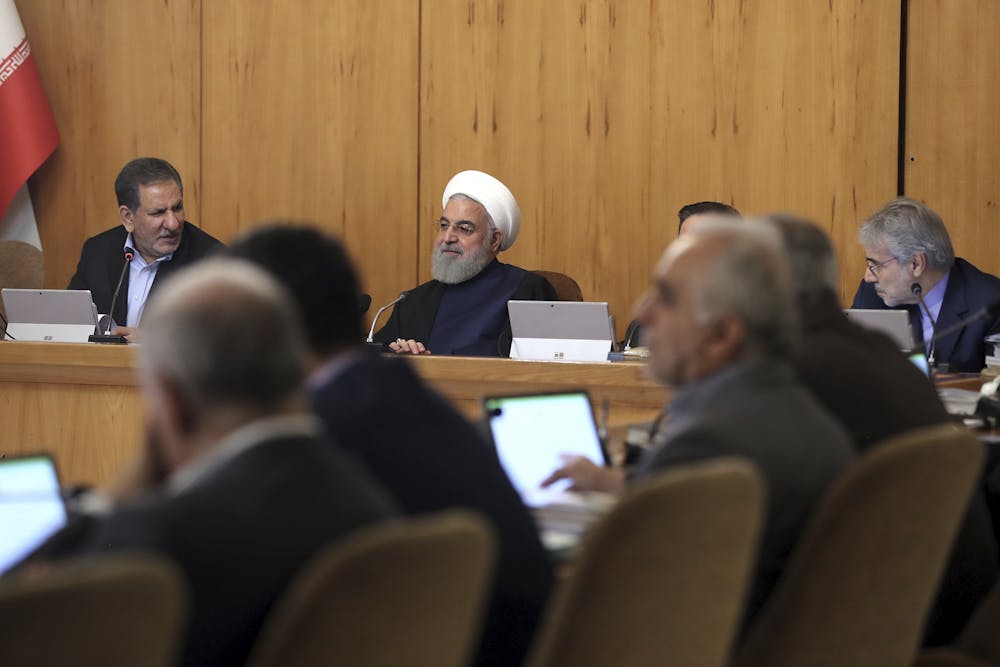
Iran said Monday it will surpass from June 27 its uranium stockpile limit set under the nuclear deal with world powers, turning up the pressure after the US walked away from the landmark pact last year.
"Today the countdown to pass the 300 kilogrammes reserve of enriched uranium has started and in 10 days time... we will pass this limit," Iran's atomic energy organisation spokesman Behrouz Kamalvandi said at a press conference broadcast live.
The move "will be reversed once other parties live up to their commitments," he added, speaking from the Arak nuclear plant south-west of Tehran.
On May 8, President Hassan Rouhani announced that Iran would stop observing restrictions on its stocks of enriched uranium and heavy water agreed under the 2015 nuclear deal.
He said the move was in retaliation for the unilateral US withdrawal from the accord a year earlier, which saw Washington impose tough economic sanctions on Tehran.
Tensions between Iran and the United States have escalated ever since, with Washington bolstering its military presence in the region and blacklisting Iran's Revolutionary Guards as a terrorist organisation.
The US has also blamed Iran for last week's attacks on two tankers in the Gulf of Oman, a charge Tehran has denied as "baseless".
Iran has threatened to go even further in scaling down nuclear commitments by July 8 unless remaining partners to the deal -- Britain, China, France, Germany and Russia -- help it circumvent US sanctions and especially enable it to sell its oil.
Under the agreement, Iran pledged to reduce its nuclear capacities for several years and allow international inspectors inside the country to monitor its activities in return for relief from international sanctions.
The deal set a limit on the number of uranium-enriching centrifuges, and restricted its right to enrich uranium to no higher than 3.67 percent, well below weapons-grade levels of around 90 percent.
It also called on Iran to export enriched uranium and heavy water to ensure that the country's reserves would stay within the production ceiling set by the agreement, yet recent US restrictions have made such exports virtually impossible.
- 'Save the deal' -
According to Rouhani, his ultimatum last month was intended to "save the (deal), not destroy it".
The three European parties to the accord created a trade mechanism meant to bypass US sanctions, but their attempt was dismissed by Iran's supreme leader Ayatollah Ali Khamenei as a "bitter joke."
If world powers do not step up to help Iran, the atomic energy organisation spokesman warned further steps could be taken.
"They range from going to 3.68 percent to any other percent according to the country's needs," said Kamalvandi.
Authorities are still debating whether to "redesign or revive" the Arak reactor, he added.
Uranium enriched to much higher levels than Iran's current stocks can be used as the fissile core of a nuclear weapon, while heavy water is a source of plutonium, which can be used as an alternative way to produce a warhead.
"A point to Europeans: if the first step took time to be done, other steps, especially increasing enrichment... need no more than a day or two," said Kamalvandi.
Germany has acknowledged the economic benefits Tehran hoped for from the deal were now "more difficult to obtain", but has urged Iran to fully respect the "extraordinarily important" nuclear deal.
The revolver with which Vincent van Gogh is believed to have shot himself is to go under the hammer Wednesday at a Paris auction house.
Billed as "the most famous weapon in the history of art", the seven mm Lefaucheux revolver is expected to fetch up to 60,000 euros ($67,000).
Van Gogh experts believe that he shot himself with the revolver near the village of Auvers-sur-Oise north of Paris, where he spent the last few months of his life in 1890.
Discovered by a farmer in 1965 in the same field where the troubled Dutch painter is thought to have fatally wounded himself, the gun has already been exhibited at the Van Gogh Museum in Amsterdam.
While Art Auction, who are selling the gun, say there is no way of being absolutely certain that it is the fatal weapon, tests showed it had been in the ground for 75 years, which would fit.
The Dutch artist had borrowed the gun from the owner of the inn in the village where he was staying.
He died 36 hours later after staggering wounded back to the auberge in the dark.
It was not his first dramatic act of self-harm. Two years earlier in 1888, he cut off his ear before offering it to a woman in a brothel in Arles in the south of France.
While most art historians agree that Van Gogh killed himself, that assumption has been questioned in recent years, with some researchers claiming that the fatal shot may have been fired accidentally by two local boys playing with the weapon in the field.
- Were local boys to blame? -
That theory won fresh support from a new biopic of the artist starring Willem Dafoe, "At Eternity's Gate".
Its director, the renowned American painter Julian Schnabel, told AFP that Van Gogh had painted 75 canvasses in his 80 days at Auvers-sur-Oise and was unlikely to be suicidal.
The legendary French screenwriter Jean-Claude Carriere -- who co-wrote the script with Schnabel -- insisted that there "is absolutely no proof he killed himself.
"Do I believe that Van Gogh killed himself? Absolutely not!" he declared when the film was premiered at the Venice film festival last September.
He said Van Gogh painted some of his best work in his final days, including his "Portrait of Dr Gachet", the local doctor who later tried to save his life.
It set a world record when it sold for $82.5 million in 1990.
The bullet Dr Gachet extracted from Van Gogh's chest was the same calibre as the one used by the Lefaucheux revolver.
- 'He was not at all sad' -
"Van Gogh was working constantly. Every day he made a new work. He was not at all sad," Carriere argued.
In the film the gun goes off after the two young boys, who were brothers, got into a struggle with the bohemian stranger.
Auction Art said that the farmer who found the gun in 1965 gave it to the owners of the inn at Auvers-sur-Oise, whose family are now selling it.
"Technical tests on the weapon have shown the weapon was used and indicate that it stayed in the ground for a period that would coincide with 1890," it said.
"All these clues give credence to the theory that this is the weapon used in the suicide."
That did not exclude, the auction house added, that the gun could also have been hidden or abandoned by the two young brothers in the field.
The auction comes as crowds are flocking to an immersive Van Gogh exhibition in the French capital which allows "the audience to enter his landscapes" through projections on the gallery's walls, ceilings and floors.
"Van Gogh, Starry Night" runs at the Atelier des Lumieres in the east of the city until December.
China's powerful President Xi Jinping has been dealt a rare setback with the suspension of unpopular legislation in Hong Kong following massive protests, but Beijing could bite back by tightening its grip on the semi-autonomous city, according to analysts.
Hundreds of thousands of protesters returned to the streets of Hong Kong on Sunday, calling for the resignation of the territory's pro-Beijing leader Carrie Lam -- even after she suspended a deeply unpopular bill that would have allowed extraditions to the mainland.
Xi is not used to such challenges, having consolidated his power and tightened his grip on civil society on the mainland since taking office in 2012.
But Hong Kongers defiantly demonstrated en masse in the past week against a bill that was seen as another sign of the Chinese Communist Party's growing influence in the city, which should enjoy its own laws and certain liberties such as freedom of speech until 2047 under the terms of its handover from Britain to China in 1997.
"It's a massive repudiation of the idea that Hong Kong will be effectively, over time, fully absorbed into mainland China," said Bill Bishop, publisher of the Sinocism China Newsletter.
"The party under Xi has become more worrisome and that's certainly a rejection of not just Xi but the party overall," Bishop said.
Beijing has sought to distance itself from the unrest, saying the bill was the brainchild of the Hong Kong government and portraying the violent demonstrations last week as a "riot" backed by foreign forces, while censors have worked to block discussion on social media.
Experts say Lam would not have pushed the legislation without guidance from her backers on the mainland, and on Monday Beijing said it will "continue to firmly support" the beleaguered chief executive.
But Xi himself has been physically distant: Away on a visit to Central Asia as protests turned violent on Wednesday, and returning on Sunday evening when hundreds of thousands flooded the streets again.
"This is a defeat for Xi Jinping," said Victoria Hui, a native Hong Konger and associate professor in political science at the University of Notre Dame in the United States.
"People don't believe that Carrie Lam would on her own accord try to rush through something that is not even in the Basic Law," Hui said.
- Avoid harsh crackdown -
The state-run China Daily said in an editorial that the bill was put on hold "so as to remove the excuse for the violence being instigated by those who do not have (Hong Kong's) best interests at heart."
Xi cemented his status as China's most powerful leader since Mao Zedong when the rubber-stamp parliament abolished presidential term limits last year.
But he has encountered a series of challenges since then, with analysts saying he is under pressure over the bruising trade war with the United States and a slowing economy.
Jean-Pierre Cabestan, a professor at Hong Kong Baptist University, said the extradition bill's suspension showed that Communist leaders "got scared" about the protest movement's potential repercussions for the mainland.
While Beijing will avoid an obvious harsh crackdown so as to not inflame tensions, it will still apply pressure in more subtle ways, according to analysts.
"You will see a redoubling of efforts by the party to squeeze Hong Kong in ways that are not necessarily going to be totally obvious," publisher Bishop said.
The role of the Communist Party and its organisations will likely intensify in Hong Kong, he added.
Authorities will likely adopt the same tactic used following the pro-democracy Umbrella Movement that shook the city in 2014 by arresting protest leaders, analysts said.
"Xi must be very tough. He won't give in easily," said Beijing-based political analyst Hua Po, noting that the extradition bill was merely suspended, not dropped.
Xi will "wait for the mood of Hong Kong citizens to gradually calm down and then punish a very small number of die-hards", Hua said.
The die-hards have proved resilient, however. One of the ringleaders of the Umbrella Movement, Joshua Wong, was released from prison Monday after serving a short sentence for his role -- and immediately vowed to rejoin the new protest wave.
Finally, Lam's decision to suspend the legislation could also have been a tactical retreat, as Beijing prepares to commemorate the 70th anniversary of the founding of People's Republic of China on October 1, Bishop said.
"A big mess in Hong Kong would really mar that celebration," he said.
Candidates to become Britain's next prime minister clashed over Brexit strategy at their first debate on Sunday but the frontrunner, Boris Johnson, dodged the confrontation.
The 90-minute debate on Channel 4 featured the five remaining candidates and an empty podium for Johnson, the gaffe-prone former foreign secretary and former mayor of London.
In sometimes ill-tempered exchanges, four of the five candidates said they would seek to renegotiate the draft Brexit divorce deal agreed with Brussels even though EU leaders have repeatedly ruled this out.
The fifth, International Development Secretary Rory Stewart, said he would press ahead with the current agreement even though it has been rejected by parliament three times this year in a process that has forced out the current prime minister, Theresa May.
Stewart is the candidate with the lowest number of endorsements from fellow Conservative MPs but has waged a strong campaign on social media, reaching out to centre-ground voters from different parties.
He repeatedly challenged the others to detail their own Brexit plans and accused them of "machismo", earning rounds of applause from the studio audience for his comments.
Foreign Secretary Jeremy Hunt, who supported staying in the EU during the 2016 referendum campaign but now supports Brexit, also struck a conciliatory tone.
No-deal Brexit 'deeply damaging'
The four candidates without Stewart said they would be willing to lead Britain out of the European Union without a divorce deal on October 31 -- the current deadline set by the EU. Johnson has also said Brexit must happen on that date "deal or no deal".
But Stewart said a no-deal Brexit would be "deeply damaging" and threatening self-harm in an attempt to extract concessions from Brussels was "nonsense".
Former Brexit Secretary Dominic Raab, who resigned from the government in protest at the government's compromises with Brussels, went further than the others in not ruling out the suspension of parliament if needed to stop MPs from blocking a no-deal Brexit.
Another candidate, Environment Secretary Michael Gove, responded saying: "I will not take Britain out of the European Union against the will of parliament."
Home Secretary Sajid Javid joined in saying: "You don't deliver on democracy by trashing democracy."
The debate also featured scrutiny of the candidates' backgrounds.
Javid, the son of a shopkeeper who immigrated to Britain from Pakistan, repeatedly made references to his humble upbringing saying he was not from Conservative Party "central casting" and could be "a messenger that can appeal to the whole country".
The presenter, Krishnan Guru-Murthy, also challenged them on more controversial issues that have come up in the campaign such as Gove's past cocaine use or Raab's critique of feminism and Stewart's repeated u-turns.
Johnson in the lead
Johnson has come under fire from his rivals for giving few interviews and public appearances.
He has claimed direct bickering between Conservative candidates will be counter-productive.
Conservative MPs will hold successive rounds of voting from Tuesday to reduce the candidates to just two, then 160,000 grassroots party members will pick the winner in a postal ballot.
The victor, who will become Britain's next prime minister, is set to be announced in the week starting on July 22.
Saudi Arabia’s crown prince blamed Iran for attacks on two oil tankers in the Gulf of Oman and called on the international community to take a “decisive stand”, but said that the kingdom does not want a war in the region.
Attacks on two oil tankers on Thursday, which the United States also blamed on Iran, have raised fears of broader confrontation in the region. Iran has denied any role in the strikes south of the Strait of Hormuz, a vital shipping route and major transit route for oil.
The explosions that damaged the Norwegian-owned Front Altair and the Japanese-owned Kokuka Courageous occurred while Japanese Prime Minister Shinzo Abe was in Tehran trying to help ease rising tensions between the United States and Iran.
'No respect'
“The Iranian regime did not respect the Japanese prime minister’s visit to Tehran and while he was there replied to his efforts by attacking two tankers, one of which was Japanese,” Crown Prince Mohammed bin Salman was quoted as saying in an interview with the Saudi-owned Asharq al-Awsat newspaper published on Sunday.
“The kingdom does not want a war in the region but it will not hesitate to deal with any threats to its people, its sovereignty, or its vital interests,” he said.
Tehran and Washington have both said they have no interest in a war. But this has done little to assuage concerns that the arch foes could stumble into conflict.
Security forces in Central African Republic beat and detained two journalists working for French news wire Agence France-Presse (AFP) covering a banned opposition protest in the capital Bangui, the reporters said Sunday.
Charles Bouessel, 28, and Florent Vergnes, 30, said they were held for more than six hours and questioned three times on Saturday after having been manhandled by members of the Central Office for the Suppression of Banditry (OCRB).
The pair also had their equipment confiscated and a camera smashed up.
AFP condemned the incident as "unjustifiable police violence".
"The protest was going well, the (police) let us film and clearly saw that we were not part of the rally," Bouessel said Sunday.
"Then the protesters were quickly dispersed. Trucks carrying OCRB members arrived and we heard live bullets being fired", he added.
The reporters said they were prevented from leaving the area despite telling the security forces that they were accredited journalists allowed to work in CAR.
The OCRB "seemed furious that we were filming the scene and charged at us," Bouessel said.
"One of them grabbed my camera and smashed it on the ground. I put my hands up in the air but received a first slap to the head. My backpack was snatched from me and thrown to the ground. When I asked to get them back... I received more punches."
- 'Grabbed by the throat' -
Vergnes, meanwhile, said he was "grabbed by the throat", slapped and "pistol-whipped in the back with a Kalashnikov".
Security forces also seized his bag, camera and mobile phone during the arrest.
"I had a nosebleed and my back and jaw hurt," he said, adding he saw a doctor in Bangui on Sunday.
AFP Director for Africa Boris Bachorz said the reporters had done nothing wrong.
"Charles Bouessel and Florent Vergnes did nothing but their work, for which they were duly accredited by the Central African Republic authorities, when they were arrested and beaten by members of the police before being detained for hours," Bachorz said in a statement.
"We ask the CAR authorities for assurances that these two journalists, like all their colleagues in Central African Republic, can continue to carry out their work without having to fear for their physical wellbeing."
Bachorz added that AFP would formally seek those assurances from CAR authorities on Monday.
Justice Minister Flavien Mbata said the two journalists had been arrested because they were present at a protest banned by the police.
"We demanded yesterday that they be released, which has happened," Mbata told AFP, adding further steps would be determined "once we have all the details".
Paris-based media rights campaigners Reporters Without Borders (RSF) denounced the treatment of the journalists.
"This bad treatment must not go unpunished," it said on its Twitter account.
The CAR is ranked 145th out of 180 countries in RSF's 2019 World Press Freedom Index, after dropping 33 places.
About two million protesters choked Hong Kong's streets in a powerful rebuke of a reviled extradition law, organisers said Sunday, piling pressure on the city's embattled pro-Beijing leader who apologised for causing "conflict" but refused to step down.
The show of force saw vast crowds marching for hours in tropical heat, calling for the resignation of chief executive Carrie Lam, who was forced to suspend the bill as public anger mounted.
Throngs of largely black-clad protesters snaked their way for miles through the streets to the city's parliament -- with the organisers' estimate for the crowd size doubling an already record-breaking demonstration the previous Sunday in the city of 7.3 million.
The estimate has not been independently verified but if confirmed it would be the largest demonstration in Hong Kong's history.
Hong Kong's biggest protest to date was a massive rally in support of Tiananmen protesters in May 1989, before Beijing's deadly crackdown, which sources at the time put at roughly 1.5 million strong.
Police, who historically give far lower estimates for political protests, said 338,000 people turned out at the demonstration's "peak" Sunday.
AFP /Hong Kong protests
Thousands were camping out overnight to continue the protest, including outside the legislature, with the police seemingly ceding the streets to the jubilant masses.
Critics fear the Beijing-backed law will entangle people in China's notoriously opaque and politicised courts and damage the city's reputation as a safe business hub.
Lam's office put out a statement late Sunday admitting that shortcomings in how her administration handled the law had "led to a lot of conflict and disputes" and "disappointed and distressed many citizens".
It came a day after she announced she would postpone the law indefinitely.
But it fell well short of protester demands that she resign, shelve the bill permanently and apologise for police using tear gas and rubber bullets earlier in the week.
The Civil Human Rights Front, which is organising the rallies, said Hong Kongers would protest and strike on Monday "until their voices are heard".
- Anger at police -
The international finance hub was rocked Wednesday by the worst political violence in decades as protesters were dispersed by baton-wielding riot police.
AFP / DALE DE LA REY Demonstrators queued to leave flowers and tributes at the site where a protester died after falling from a building where he had been holding an hours-long anti-extradition protest
Many accused the police of using excessive force, and anger was further fanned by authorities calling the largely young protesters "rioters".
Nearly 80 people were injured in the unrest -- including 22 police officers -- with both sides showing a willingness to escalate action and reaction to levels unseen in the usually stable business hub.
Police said they had no choice but to use force to meet violent protesters who besieged their lines outside the city's parliament.
But critics -- including legal and rights groups -- say officers used the violent actions of a tiny group of protesters as an excuse to unleash a sweeping crackdown on the predominantly young, peaceful crowd.
One man died Saturday when he fell from a building where he had been holding an hours-long anti-extradition protest.
He had unfurled a banner on scaffolding attached to an upscale mall, but fell when rescuers tried to haul him in. Police said they suspected the 35-year-old was suicidal.
Throughout the day, demonstrators queued for hours to leave flowers and tributes where he fell.
- Battling for the city's soul -
The extradition furore is just the latest chapter in what many see as a battle for the soul of Hong Kong.
For the last decade the city has been convulsed by political turbulence between pro-Beijing authorities and opponents who fear an increasingly assertive China is stamping on the city's unique freedoms and culture enjoyed since the handover from Britain in 1997.
Opposition to the extradition bill has united an unusually wide cross-section of Hong Kong, from influential legal and business bodies to religious leaders.
AFP / STR Organizers said about two million people demonstrated, in a powerful rebuke of a reviled extradition law that is backed by Beijing
Lam's decision to ignore those warnings and press ahead with the bill even after last weekend's massive rally placed her administration under pressure from both opponents and allies.
Advisers and pro-establishment lawmakers urged her to delay the bill after Wednesday's violence, while Beijing began to distance itself from her administration.
Her climbdown is a rare example of the city's unelected leaders caving-in to demonstrations -- something more recent administrations have been increasingly unwilling to do.
Two months of protests in 2014 calling for the right to directly elect Hong Kong's leader won no concessions from Beijing, and key figures from that movement are now in jail.
One of that movement's most prominent leaders, 22-year-old activist Joshua Wong, is due to be released from prison on Monday morning, his party said late Sunday.
It was not clear whether his early release was a gesture from the authorities or merely typical procedure under provisions for good behaviour.
- 'She has lost the public' -
"Her response is purely a PR strategy," 20-year-old protester Vivian Liu told AFP after Lam's statement. "And to define our protests as a riot is totally inappropriate."
AFP / Anthony WALLACE
The last marchers to leave the rally's starting point at a public park left about six hours after it started
"Personally I think she can no longer govern Hong Kong, she has lost the public," added Dave Wong, a 38-year-old protester who works in finance.
In mainland China, the internet was scrubbed clean of references to the massive rally, with entries for Hong Kong on search engines and social media platforms showing no sign of the demonstration.
The latest protest did not, however, go unnoticed in Washington, where Secretary of State Mike Pompeo said President Donald Trump would discuss the events with his Chinese counterpart Xi Jinping at the G20 summit later this month.
"We are watching the people of Hong Kong speak about the things they value," Pompeo said.
A new biography about Kim Jong Un by Anna Fifield is uncovering many of the unique moments in the childhood of the North Korean dictator. But one piece that isn't included in the book is her prediction for how the leader will die.
In a CNN interview with Brian Todd, Fifield explained that Kim's chain-smoking, drinking and consumption of rich and fatty foods would likely be his undoing. She doesn't anticipate he'll ever have a coup d'etat, but he could probably have a heart attack.
Other shocking observations she made include that Kim's parents had to bring in children so that he would have someone to play with him, effectively meaning his "friends" were paid for.
She also noted that she doesn't believe he is a psychopath or sociopath.
"He's brutal and a tyrant, but he is not psychopathic. He's not irrational. He approached this task in a very cold, clinical, ruthless way."
Fifield said that when it comes to the close relationship he's attempting to build with President Donald Trump, it's all for the purposes of manipulating the United States leader.
The New York Times is reporting that the United States is cyber attacking Russia's electric power grid and other targets—and that President Donald Trump is being kept out of the loop.
"The American strategy has shifted more toward offense, officials say, with the placement of potentially crippling malware inside the Russian system at a depth and with an aggressiveness that had never been tried before."
Trump has not been briefed on the operation because of “the possibility that he might countermand it or discuss it with foreign officials.”
The Times wrote:
“Two administration officials said they believed Mr. Trump had not been briefed in any detail about the steps to place ‘implants’ — software code that can be used for surveillance or attack — inside the Russian grid.
“Pentagon and intelligence officials described broad hesitation to go into detail with Mr. Trump about operations against Russia for concern over his reaction — and the possibility that he might countermand it or discuss it with foreign officials, as he did in 2017 when he mentioned a sensitive operation in Syria to the Russian foreign minister.”
New cyber laws were granted to the U.S. Cyber Command by the White House and Congress last year allowing such “clandestine military activity” in cyberspace to go ahead without the president’s approval.
Trump has lashed back at The Times, accusing the newspaper of committing a "virtual act of treason" over its reporting.
More importantly, The Times article asked:
"The question now is whether placing the equivalent of land mines in a foreign power network is the right way to deter Russia. While it parallels Cold War nuclear strategy, it also enshrines power grids as a legitimate target."
Israeli Prime Minister Benjamin Netanyahu spent his Father’s Day dedicating a new Trump Tower-type building that hasn't been built in a town that doesn't exist.
Standing in front of a large sign saying "Trump Heights," Netanyahu, who is being forced back into another election, announced the building before planning even began, Axios reported.
"Anyone who reads the fine print in this 'historic' decision will understand that this is nothing more than a nonbinding, fake policy," said Blue and White MK Zvi Hauser. "There is no budgeting, no planning, no location for a settlement, and there is no binding decision to implement the project. But at least they insisted on a name for the settlement."
Trump support has been tremendous for Netanyahu, Axios explained. He was supposed to build a coalition government after being elected but failed to do so by the deadline. Now he's being forced back into an electoral campaign, and the site explained he'll need Trump's help to get there.
He explained in the press conference that the building hasn't even been passed by his cabinet yet, but he said that they would pass a resolution to establish the town of Golan. Right now, the town only exists on paper.
"So what was actually decided is that the Ministry of Housing will start preliminary planning work. For now, there is not even a fund allocated to build the new town," Axios explained.
Trump tweeted: "Thank you Prime Minister Netanyahu and the state of Israel for this great honor."
It's unknown if Trump is aware that the town and tower don't exist.
Tens of thousands of people rallied in central Hong Kong on Sunday as public anger seethed following unprecedented clashes between protesters and police over an extradition law, despite a climbdown by the city's embattled leader.
Protesters chanted "Scrap the evil law!" as they marched through the streets to pile more pressure on chief executive Carrie Lam, who paused work on the hugely divisive bill Saturday after days of mounting pressure, saying she had misjudged the public mood.
Crowds of black-clad protesters were marching from a park on the main island to the city's parliament -- a repeat of a massive demonstration a week earlier that organisers said more than a million people attended.
Critics fear the Beijing-backed law will tangle-up people in China's notoriously opaque and politicised courts and damage the city's reputation as a safe business hub.
"Carrie Lam's response is very insincere. Knowing that the government won't withdraw the bill, I decided to come out today," said protester Terence Shek, 39, who had brought his children on the march.
The city was rocked by the worst political violence since its 1997 handover to China on Wednesday as tens of thousands of protesters were dispersed by riot police firing tear gas and rubber bullets.
"You're supposed to protect us not shoot at us" read one banner carried on Sunday, addressing the city's police force, while others marching held photos of police breaking up crowds in Wednesday's clashes.
Lam stopped short of committing to permanently scrap the proposal Saturday and the concession was swiftly rejected by protest leaders, who called on her to resign, permanently shelve the bill and apologise for police tactics.
"The extradition bill being suspended only means it can be revived any time Carrie Lam wants," said activist Lee Cheuk-yan.
Nearly 80 people were injured in this week's unrest, including 22 police officers, and one man died late Saturday when he fell from a building where he had been holding an hours-long anti-extradition protest.
He had unfurled a banner saying: "Entirely withdraw China extradition bill. We were not rioting. Released students and the injured".
Huge queues formed outside the high-end Pacific Place mall with flowers and written tributes piling up as demonstrators paid their respects.
Suspending the bill has done little to defuse simmering public anger and protest organisers have called for a city-wide strike Monday as well as Sunday's rally.
Jimmy Sham, from the main protest group the Civil Human Rights Front, likened Lam's offer to a "knife" that had been plunged into the city.
"Carrie Lam's speech yesterday in no way calmed down public anger," he said.
- 'Restore calm to the community' -
Lam's decision to press ahead with tabling the bill for debate in the legislature on Wednesday -- ignoring the record-breaking crowds three days earlier -- triggered fresh protests, which brought key parts of the city to a standstill and led to violent clashes with police.
Opposition to the bill united an unusually wide cross-section of Hong Kong, from influential legal and business bodies to religious leaders, as well as Western nations.
The protest movement has morphed in recent days from one specifically aimed at scrapping the extradition bill to a wider display of anger at Lam and Beijing over years of sliding freedoms.
A huge banner hanging from the city's Lion Rock mountain on Sunday read "Defend Hong Kong".
Lam had been increasingly isolated in her support for the bill, with even pro-Beijing lawmakers distancing themselves from the extradition proposals in recent days.
The Chinese government said suspending the bill was a good decision to "listen more widely to the views of the community and restore calm to the community as soon as possible".
- 'Keep the heat on' -
Critics were also angry that Lam missed repeated opportunities to apologise for what many saw as heavy-handed police tactics.
Police said they had no choice but to use force to meet violent protesters who besieged their lines outside the city's parliament on Wednesday.
But critics -- including legal and rights groups -- say officers used the actions of a tiny group of violent protesters as an excuse to unleash a sweeping crackdown on the predominantly young, peaceful protesters.
"The pro-democracy group will not stop at this point, they want to build on the momentum against Carrie Lam," political analyst Willy Lam told AFP. "They will keep the heat on and ride the momentum."
Protest leaders have called for police to drop charges against anyone arrested for rioting and other offences linked to Wednesday's clashes.
Activist Lee said opponents feared reprisals by the government and wanted assurances "that our Hong Kong people, our protesters, are not being harassed and politically prosecuted by this government".
Lam has argued that Hong Kong needs to reach an extradition agreement with the mainland, and says safeguards were in place to ensure dissidents or political cases would not be accepted.
An Israeli court Sunday convicted the wife of Prime Minister Benjamin Netanyahu of fraudulently using state funds for meals, under a plea bargain which saw her admit to lesser charges.
Sara Netanyahu was found guilty of exploiting the mistake of another person and ordered to pay a fine and compensation, in a deal approved by Jerusalem magistrates' court justice Avital Chen.
Netanyahu was also fined 10,000 shekels ($2,800) and ordered to reimburse the state a further 45,000 shekels, the latter of which she will pay in nine installments, at her request.
"The deal reached between the sides is worthy and appropriately reflects the deeds and their severity on the criminal level," Chen said in his ruling.
The 60-year-old, a high-profile presence at her husband's side throughout his long tenure in office, was initially charged in June 2018 with fraud and breach of trust for buying catered meals despite the presence of a cook at the minister's official residence.
The amended indictment, approved Sunday, dropped the graft charges.
It was the latest in a series of assaults on tankers transporting oil through the Gulf. In May, Saudi, Norwegian and Emirati oil tankers were attacked off the coast of the United Arab Emirates, causing damage but no casualties. The attacks have gone unclaimed, so the perpetrator is unknown – at least publicly.
U.S. ally Saudi Arabia, Iran’s regional rival, blamed the Iranian government and called the May attacks “naked aggression.” Saudi King Salman asked the international community to “use all means” to punish Iran.
U.S. national security adviser John Bolton, who has called for bombing Iran to cripple its nuclear program, has maintained that Iran is “almost certainly” responsible for the attacks. In May Bolton announced the deployment to the Persian Gulf of a carrier strike group and a nuclear-capable bomber task force, America’s most formidable military assets.
But the White House is squabbling over its objectives, which are far from clear. Trump administration officials do not seem to agree whether the U.S. wants behavior change or regime change. Should the U.S. use diplomacy or force? Are frustrated Iranians or frustrated Americans the target of this military deployment?
President Trump told U.K. television host Piers Morgan that military options are on the table but, “I’d much rather talk.”
As a scholar who has studied the onset of a number of wars, I believe these commentators underestimate the influence of shrewd warmongers like Bolton. They also fail to credit how quickly a trivial confrontation between industrialized forces can change a leader’s calculus and drag the great powers and their allies into war.
The showdown in the Persian Gulf is not like the U.S. and the Soviet Union incrementally adjusting the balance of power, as they did during the Cold War.
Mixed signals, bad timing and this kind of uncalibrated brinksmanship is how World War I began and spiraled out of control. It has brought the U.S. closer to the next Middle East war.
The current standoff began in May 2018 when President Trump reneged on the deal and later implemented a new “maximum pressure” campaign against Iran, which included economic sanctions punishing countries purchasing Iranian oil.
The U.K., France, China, Russia and Germany pledged to abide by the terms of the deal. Nevertheless, U.S. sanctions against Iranian industry at a time when Iran was complying with the deal are collapsing the Iranian economy.
U.S. Secretary of State Mike Pompeo maintains, without evidence or a tangible timeline, that grueling economic conditions created by the U.S. will turn frustrated Iranians against their leaders, provoking regime change.
That idea seems to me to be magical thinking. U.S. belligerence, especially when it has been rejected by the broader international community – as it is now by parties to the 2015 nuclear deal – is more likely to turn Iranians against the U.S., polarize U.S. allies and strengthen Iran’s hardliners.
Cosmopolitan Iranian youth, for example, who are the best hope for peace with the U.S., are the most likely group to turn against their government – but not if the Trump administration strangles their economy and threatens to invade their country.
Limited choices
In the meantime, Iran’s economic troubles are narrowing its options.
The prospect of economic collapse under draconian sanctions by the U.S. also provokes Iran’s leaders to instigate a confrontation sooner rather than later, while its military and proxies are strong. Iranian President Hassan Rouhani has given Germany, the U.K., France, China and Russia 60 days to honor their promise to buttress Iranian energy and banking sectors before taking additional steps to withdraw from the nuclear deal.
Iranian President Hassan Rouhani, center, announced on May 8, 2019 that his country would resume higher uranium enrichment if the Iran deal was acceptably not altered.
Iran’s economic and military weakness also encourages its leadership to cooperate more closely with America’s foreign adversaries, including Russia, despite Iran’s aversion to ceding precious influence in the region.
If the Iran-Russia relationship tightens, it will result in even greater tension with the U.S. Increased Iranian-Russian cooperation is also an invitation to U.S. leaders to strike before U.S. troops find themselves facing an emboldened Iranian military reinforced with Russian equipment and know-how.
With each day of U.S. sanctions, Iran’s leaders become increasingly desperate, with diminished leverage should the two countries face off on the battlefield or at the negotiating table.
Defusing the tension
With tensions rising, the U.S. has sent an additional 1,500 troops to the Middle East. Iran’s 60-day ultimatum to parties to the nuclear deal expires in early July.
There is still time for President Trump to extract the U.S. from this dangerous standoff that he allowed to escalate.
Trump’s greatest hope lies in Japanese Prime Minister Shinzo Abe.
Japan, which is not party to the 2015 nuclear deal, is a major purchaser of Iranian oil and Abe is perceived to be a neutral broker.
Abe is visiting Iran this week – the first Japanese leader to do so in four decades – and will meet with Supreme Leader Ayatollah Khamenei and Prime Minister Rouhani to discuss the standoff.
It is unclear what Abe can accomplish in this overheated climate. A potential solution lies in intense, nuanced diplomacy where the U.S., building on the 2015 nuclear deal, trades sanction relief for slightly tougher limits on Iran’s nuclear program.
This includes renegotiating the restrictions on Iran’s centrifuges, mandatory international inspections, and its accumulation of nuclear material. A slightly modified nuclear deal like Trump’s slightly modified trade agreement with Canada and Mexico, can be recast as victory by all.
Trump emerges as peacemaker and potential contender for the Nobel Prize. Iran’s leaders can then right their economy.
Trump’s winning outcome, however, is not the outcome Bolton has long advocated.
This is the price Bolton pays to remain the president’s national security adviser — filterer of Trump’s intelligence reports, first one in and last one out of the room whenever the president is discussing matters of war and peace.
If Abe fails, the current Iran crisis may yet become the culmination of Bolton’s lifelong ambition. When new explosions rock the Persian Gulf, U.S. troops are injured or killed by Iranian proxies in Iraq, or Iranian-made drones pepper the Saudi skies, will President Trump resist the urge to escalate?




 AFP /
AFP / AFP / DALE DE LA REY
  AFP / STR
  AFP / Anthony WALLACE