Shanahan worked at Boeing, one of the world's largest defense contractors, for more than 30 years before joining the Trump administration
In a move critics warned could further deepen the ties between the sprawling and immensely profitable private weapons industry and the U.S. government, the White House announced Thursday that President Donald Trump will nominate former Boeing executive Patrick Shanahan to head the Pentagon.
"Conflict of interest? Boeing is already the second-largest recipient of private contracts from the U.S. military."
—National Priorities Project
Shanahan has been serving as acting secretary of defense since the departure of former Pentagon chief Jim Mattis in January.
"When Patrick Shanahan was selected by Trump for a Pentagon post," The Nation's John Nichols tweeted Thursday in response to Shanahan's nomination, the Seattle Times wrote: 'Shanahan, 54, has no military or political experience. He is, however, familiar with defense procurement from the business side.' Very, very familiar."
In a column last year, Nichols described Shanahan—who worked at Boeing for 31 years before becoming Trump's deputy defense secretary—as "the embodiment of the military-industrial complex."
"His main claim to fame in the deputy post was his ardent advocacy for Trump's 'space force' scheme," Nichols wrote. "So what experience does Shanahan have? He is, literally and figuratively, the embodiment of the military-industrial complex about which former President Dwight Eisenhower warned Americans at the close of his presidency in 1961."
As NBCreported, Trump's decision to nominate Shanahan—who must be confirmed by the Senate—comes "just weeks after the Pentagon's internal watchdog cleared the longtime former Boeing executive of allegations he provided his old employer... with preferential treatment. Shanahan was accused of pushing Boeing fighter jets on the Air Force and Marines."
The National Priorities Project (NPP) highlighted Shanahan's potential conflicts of interest in a series of tweets following news of his nomination.
"Patrick Shanahan, former Boeing executive, is poised to keep running the Pentagon as Defense Secretary with President Trump's nomination," NPP wrote. "Conflict of interest? Boeing is already the second-largest recipient of private contracts from the U.S. military."
"Last year, the average taxpayer paid $102 for contracts with Boeing, " the group noted, "compared to just $40 for public housing and homeless assistance."
This work is licensed under a Creative Commons Attribution-Share Alike 3.0 License
The United States pulled the trigger Friday on a steep increase in tariffs on Chinese products and Beijing immediately vowed to hit back, turning up the heat before a second day of trade negotiations.
President Donald Trump got a briefing from his trade negotiators after the first day of talks with the Chinese side on Thursday, but made no move to hold off on the tariffs -- dashing hopes there might be a last-minute reprieve as the negotiations continued.
Minutes after the US increased punitive duties on $200 billion in imports from 10 to 25 percent, the Chinese commerce ministry said it "deeply regrets" the move and repeated its pledge to take "necessary countermeasures", without elaborating.
Locked in a trade dispute for more than a year, officials from the world's two biggest economies returned to the bargaining table late Thursday, led by Chinese Vice Premier Liu He, US Trade Representative Robert Lighthizer and US Treasury Secretary Steven Mnuchin.
Since last year, the two sides have exchanged tariffs on more than $360 billion in two-way trade, gutting US agricultural exports to China and weighing on both countries' manufacturing sectors.
Trump began the standoff because of complaints about unfair Chinese trade practices.
The US team met with Trump late Thursday night to brief him and "agreed to continue discussions" on Friday, the White House said in a statement.
AFP / Jonathan WALTERUS-China trade
Lighthizer and Mnuchin met the Chinese delegation for about 90 minutes Thursday evening and they had a working dinner with Liu.
"We hope the US and the Chinese side can meet each other halfway and work hard together to resolve existing problems through cooperation and consultation," the Chinese commerce ministry said in a statement.
Despite optimism from officials in recent weeks that the talks were moving towards a deal, tensions reignited this week after Trump angrily accused China of trying to backpedal on its commitments.
"They took many, many parts of that deal and they renegotiated. You can't do that," Trump said on Thursday.
But he held out hopes of salvaging a deal.
"It's possible to do it," Trump said. "I did get last night a very beautiful letter from President Xi (Jinping)."
At the same time, he said he would be happy to keep tariffs in place. And he has threatened to extend the tough duties to all Chinese goods.
Michael Taylor, a managing director for Moody’s Investors Service, said the tariff hike "further raises tensions" between the two countries.
"While we believe that a trade deal will eventually be reached between the US and China, the risk of a complete breakdown in trade talks has certainly increased," Taylor said.
- Tariffs increase -
The renewed tensions roiled global stock markets this week and unnerved exporters, though Chinese stocks closed sharply higher on Friday.
AFP / ANDREW CABALLERO-REYNOLDS US Trade Representative Robert Lighthizer (L) and Treasury Secretary Steven Mnuchin wait to greet Chinese Vice Premier Liu He for trade talks
Liu said on his arrival in Washington that the prospects for the talks were "promising," but warned that raising tariffs would be "harmful to both sides," and called instead for cooperation.
"I hope to engage in rational and candid exchanges with the US side," he told Chinese state media.
"Of course, China believes raising tariffs in the current situation is not a solution to the problem, but harmful to China, to the United States and to the whole world."
The higher duty rates will hit a vast array of Chinese-made electrical equipment, machinery, auto parts and furniture.
But due to a quirk in the implementation of the higher tariffs, products already on ships headed for US ports before midnight will only pay the 10 percent rate, US Customs and Border Protection explained.
That could effectively provide a grace period for the sides to avert serious escalation.
AFP / Andrew Caballero-Reynolds An anti-China protester (C) yells at a pro-China demonstrator outside the Office of the United States Trade Representative as US and Chinese officials hold tariff negotiations in Washington
"While we are disappointed that the stakes have been raised, we nevertheless support the ongoing effort by both sides to reach agreement on a strong, enforceable deal that resolves the fundamental, structural issues our members have long faced in China," said business lobby the American Chamber of Commerce in China.
The US is pressing China to change its policies on protections for intellectual property, massive subsidies for state-owned firms, and reduce the yawning trade deficit.
Derek Scissors, a China expert at the American Enterprise Institute, said the two sides had clashed over how much of the final trade agreement should be enshrined in a public document, something Beijing has long resisted.
"What the Chinese step-back primarily says is they don't want to publicly acknowledge that their existing laws, especially on IP, are flawed," he told AFP.
Washington is counting on the strong US economy to be able to withstand the impact of higher costs from the import duties and retaliation better than China, which has seen its growth slow.
While American companies complain of lost export markets, disrupted supply chains and higher costs, the US continues to see steady growth and falling unemployment.
A Chinese central bank advisor told state-run Financial News that Trump's tariff hike and Chinese retaliation would lower economic growth by 0.3 percentage points.
It is "within a controllable range", the advisor Ma Jun said.
Former military intelligence analyst Chelsea Manning was freed from a US jail on Thursday after two months in custody -- but faces a possible return to the lockup as soon as next week, a support group said.
Manning was jailed in early March for refusing to testify in a grand jury investigation targeting the anti-secrecy group WikiLeaks.
Her leak years earlier of classified documents related to the wars in Iraq and Afghanistan made her a hero to anti-war and anti-secrecy activists, and her actions helped make WikiLeaks a force in the global anti-secrecy movement.
A judge in March ruled Manning in contempt of court and ordered her held not as punishment but to force her testimony in the secret case, a spokesman for the US attorney in the Alexandria, Virginia federal court, just outside Washington, said at the time.
The support group, the Sparrow Project, said in Thursday's statement that Manning was released after 62 days, following the expiry of the grand jury's term.
"Unfortunately, even prior to her release, Chelsea was served with another subpoena. This means she is expected to appear before a different grand jury, on Thursday, May 16," Sparrow Project quoted Manning's legal team as saying.
"It is therefore conceivable that she will once again be held in contempt of court," and returned to the Alexandria Detention Center possibly as soon as May 16, the legal team said.
"Chelsea will continue to refuse to answer questions."
Manning has previously said she had "ethical" objections to the grand jury system and had answered all questions about her involvement with WikiLeaks years ago.
Manning was ordered to testify earlier this year for an investigation examining actions by WikiLeaks founder Julian Assange in 2010, according to her own description, inadvertent court revelations and media reports.
At the time Manning, a transgender woman then known as Bradley Manning, was a military intelligence analyst.
She delivered more than 700,000 classified documents into WikiLeaks's hands. The documents exposed cover-ups of possible war crimes and revealed internal US communications about other countries.
Sentenced in 2013 to 35 years in prison, she was released in May 2017 after the commutation of her sentence by president Barack Obama.
Each of these outbreaks is individually difficult to predict. But our research team has found that big year-to-year swings in the number of measles cases as a country approaches elimination are to be expected. By analyzing the patterns of measles outbreaks in Africa and the Americas since the 1980s, ourmulti-institutionteamofbiologistsandepidemiologists has identified a general pattern of measles infection over time as countries increase vaccination coverage and as birth rates decline.
Characterizing this trend, which we call the “canonical path to elimination,” means we can pinpoint the current positions of various countries along the path. Health policymakers can then prioritize where to focus, allocating appropriate solutions to help countries that either need to move farther down the path or simply hold on to their previous progress toward the end of measles.
At first, when a country begins to tackle the disease, the average number of cases decreases. At the same time, though, outbreaks become more variable from year to year. That is, one year might see almost no cases of the disease, while the following year has several hundred, or several thousand. This year-to-year variability is largest once the average number of cases drops below about five cases per 100,000 people in the population. Once a country hits that point, measles becomes both less common and less variable, signaling the final stages on the road to elimination.
Though they progress at different rates, countries tend to follow the ‘canonical path to elimantion.’ The number of measles cases initially declines while the year-to-year variability in outbreaks increases. Once a country turns the corner, measles cases are rare and the variability also decreases.
This general trend has important implications for countries on either side of that critical five cases per 100,000 tipping point.
Countries that haven’t yet reached that point, like DRC and Madagascar, can expect more variable outbreak dynamics as their vaccination programs continue to improve. Anticipating the likelihood of more variability year to year can help to plan appropriate contingency responses for when outbreaks do occur.
For countries that have already passed this tipping point, like the U.S. and Venezuela, backsliding vaccination rates will likely move the dynamics backwards on this canonical path. Rather than seeing a gradual increase in measles cases that would signal concern, these countries would first see a dramatic increase in the year-to-year variability in measles cases, with large outbreaks like the ones they’ve experienced in the last few years. That increased annual variability can be disruptive to public health systems since it requires dramatic shifts in funding and policies to contain outbreaks when they happen.
Moving along a known path
Identifying this general trend over time means that health policymakers now have a consistent way to identify where countries lie on the path to elimination, relative to the low measles/high variability tipping point. They can also see which direction countries are going – improving or backsliding – and how fast they’re moving. Notably, the path to elimination illustrates that as countries advance toward the tipping point we expect to see a slowdown in the rate of decline in average measles cases.
Looking to countries, and regions, that have moved quickly down the path to elimination can help public health officials identify policies that speed countries past the tipping point.
For example, countries in the Americas, on average, moved faster along the path between 1990 and 2005 than any other region. These rapid gains coincided with the rollout of a second routine dose of measles vaccine, from one country in 1990 to over half of countries in 2005, and declining birth rates.
Between the early 2000s and 2010, countries in the African region began to accelerate along the path to elimination – moving faster than any other region between 2005 and 2012. This time frame corresponds to a period of expanded nationwide vaccination campaigns. Countries increased access to vaccination through intense community-based vaccine distribution that provided new opportunities for children traditionally missed by clinic-based routine vaccination.
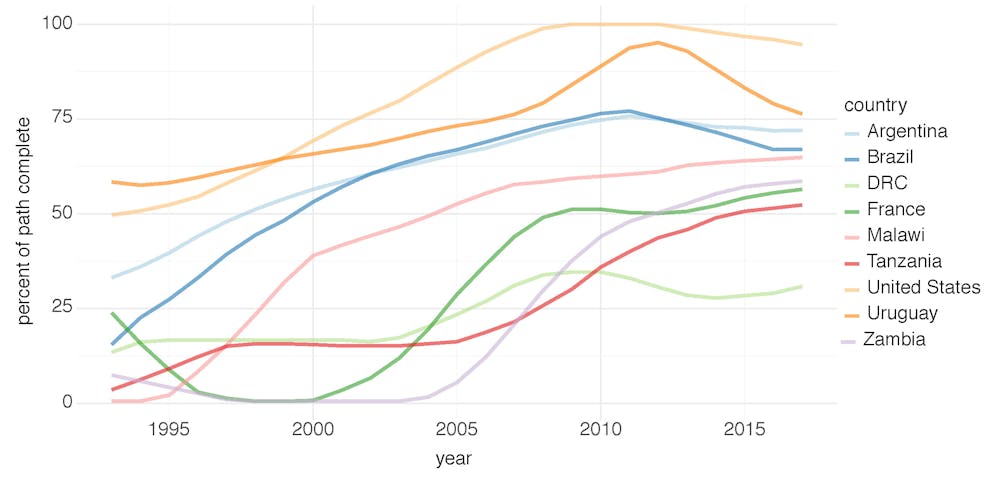
Key countries’ progress along the canonical path. Lines rising over time mean a nation is moving closer to elimination. Since 2012, the U.S. and Uruguay are moving backwards, away from this goal.
However, since the beginning of this decade, no region has made significant gains in progress. The Americas and Europe have actually moved backwards.
Unpredictability causes problems
This increase in year-to-year variability in measles outbreaks – for instance, annual cases in the United States have swung from 55 to 667 to 87 to over 750 in the last decade – can have an outsized impact.
In low- and middle-income countries, a dramatic increase in the number of measles cases can rapidly overwhelm already overburdened health systems. As a result, there’s a higher risk of death associated with each measles case, compared to lower incidence years. The measles outbreak in DRC this year has already resulted in over 1,000 deaths, the same number as the concurrent outbreak of Ebola virus there.
Philippine Health Secretary Francisco Duque III displays a graph showing the decline of the measles outbreak in the country, April 30, 2019.
A recent review of measles mortality illustrated a dramatic decline in the death rate due to measles infection globally. But in countries that are lagging behind on the path to elimination, the chance that a child with measles will die has changed the least. Thus, most children with measles in the world today are still likely to be at high risk of death because they are likely to have poor access to the medical services necessary to treat measles.
Year-to-year variability in measles outbreaks tends to increase as high-burden countries improve their vaccination programs. Outbreaks also become more variable because of backsliding vaccination rates in previously successful countries. The canonical path demonstrated in our research helps us to anticipate when and where these big year-to-year swings are likely to occur. Officials can then target health systems, surveillance and response infrastructure to be more efficient at detecting and minimizing the impact of outbreaks when they happen.
Facebook is unwittingly auto-generating content for terror-linked groups that its artificial intelligence systems do not recognize as extremist, according to a complaint made public on Thursday.
The National Whistleblowers Center in Washington carried out a five-month study of the pages of 3,000 members who liked or connected to organizations proscribed as terrorist by the US government.
Researchers found that the Islamic State group and al-Qaeda were "openly" active on the social network.
More worryingly, the Facebook's own software was automatically creating "celebration" and "memories" videos for extremist pages that had amassed sufficient views or "likes."
The Whistleblower's Center said it filed a complaint with the US Securities and Exchange Commission on behalf of a source that preferred to remain anonymous.
"Facebook's efforts to stamp out terror content have been weak and ineffectual," read an executive summary of the 48-page document shared by the center.
"Of even greater concern, Facebook itself has been creating and promoting terror content with its auto-generate technology."
Survey results shared in the complaint indicated that Facebook was not delivering on its claims about eliminating extremist posts or accounts.
The company told AFP it had been removing terror-linked content "at a far higher success rate than even two years go" since making heavy investments in technology.
"We don't claim to find everything and we remain vigilant in our efforts against terrorist groups around the world," the company said.
Facebook and other social media platforms have been under fire for not doing enough to curb messages of hate and violence, while at the same time criticized for failing to offer equal time for all viewpoints, no matter how unpleasant.
Facebook in March announced bans at the social network and Instagram on praise or support for white nationalism and white separatism.
For more than half a century, biologists studying Antarctica focused their research on understanding how organisms cope with the continent's severe drought and the coldest conditions on the planet.
One thing they didn't really factor in, however, was the role played by the nitrogen-rich droppings from colonies of cute penguins and seals -- until now.
A new study published Thursday in the journal Current Biology found the influential excrement supported thriving communities of mosses and lichens, which in turn sustained vast numbers of microscopic animals like springtails and mites for more than 1,000 meters (yards) beyond the colony.
"What we see is that the poo produced by seals and penguins partly evaporates as ammonia," said co-author Stef Bokhorst from the Department of Ecological Sciences at Vrije Universiteit Amsterdam.
"Then, the ammonia gets picked up by the wind and is blown inland, and this makes its way into the soil and provides the nitrogen that primary producers need in order to survive in this landscape."
Braving bitter temperatures, the researchers waded through fields of animal waste -- not to mention hordes of clamoring elephant seals and gentoo, chinstrap, and Adelie penguins -- to examine the surrounding soils and plants using infrared gas analyzers that measured their respiration.
ANGELICA CASANOVA/AFP / HO View of lichen forests in Collins Bay, in Chilean Antarctica on February 10, 2018
Samples brought back and examined in labs revealed that there were millions of tiny invertebrates per square meter because of the lack of predators in their environment -- unlike in European or American grasslands, where the number may typically be between 50,000 and 100,000.
"The more animals we get, the larger the footprint there is, and we're finding higher diversity in those sites," Bokhorst told AFP, emphasizing that species' richness was linked less with how cold or dry the region was and more to the nutrients added by the excrement.
Ultimately, the research allowed the team to map the hotspots across the Antarctic Peninsula, finding penguin colonies to be a proxy for biodiversity.
The maps can be updated in the future using satellite imagery to determine the size and location of breeding colonies, freeing future scientists from having to conduct treacherous fieldwork.
- 'Ideal natural laboratory' -
POOL/AFP/File / Mark RALSTON Seals lie on a frozen section of the Ross Sea at the Scott Base in Antarctica on November 12, 2016
For Bokhorst, Antarctica presented an "ideal natural laboratory" to study the relationship between nutrients and biodiversity because of the simplicity of the overall food web, in contrast to other parts of the world where ecosystems were far more complex.
"It makes it a lot easier to find driving factors," said Bokhorst.
But the study also underscored how interconnected the continent's ecosystem was -- and therefore its vulnerability to human activity.
All countries working on the continent are subject to the Antarctic Treaty System, which obliges them to protect its wildlife, but Bokhorst said the study showed "if you start poking at one end it will have an effect at the other end."
AFP/File / EITAN ABRAMOVICH The Antarctic Peninsula's vibrant invertebrate communities experience low predation, but the advent of tourism means there is an increasing chance people could bring seeds or even insects with them
"You need to keep a good eye that you're not overfishing the oceans so you're not harming food supplies, otherwise you're going to have an impact for biodiversity," he said.
The peninsula's vibrant invertebrate communities face few predators, but the advent of tourism means there is an increasing chance people could bring seeds or even insects with them.
These, in turn, could benefit from the soil enrichment and establish themselves, threatening the native species.
"That's a very good argument for why we should be careful with the Antarctic," said Bokhorst.
Pope Francis on Thursday passed a landmark new measure to oblige those who know about sex abuse in the Catholic Church to report it to their superiors, in a move which could bring countless new cases to light.
Every diocese in the world will now be obliged to have a system for the reporting of abuse, under a new law published by the Vatican following a global clerical paedophilia scandal.
But the requirement will not apply to secrets revealed to priests in the confessional.
It is time to learn from the "bitter lessons of the past", Francis said in the text of the legal decree, which comes into effect on June 1.
It follows a series of clerical assault cases in countries ranging from Australia to Chile, Germany and the US.
The "Motu Proprio", a legal document issued under the pope's personal authority, declares that anyone who has knowledge of abuse, or suspects it, is "obliged to report (it) promptly" to the Church, using "easily accessible systems".
Under the new measure, every diocese around the world is obliged by June 2020 to create a system for the reporting of sexual abuse by clerics, the use of child pornography and cover-ups of abuse.
The law could see the Vatican inundated with reports of abuse or cover-ups, as it applies retroactively, meaning those who know about old cases are obliged to flag them up as well.
- 'Bring predators to justice' -
The impact "likely will be felt most intensely outside the West, since places such as the US, Canada and some parts of Western Europe (though, ironically, not the pope's backyard in Italy), already have fairly robust reporting systems," said Vatican expert John Allen, on the online religious newspaper Crux Now.
The law only applies within the Church and has no force to oblige individuals to report abuse to civil authorities.
"The Motu Proprio shows Pope Francis expects swift and comprehensive progress," commented Cardinal Daniel DiNardo, head of the Bishops' Conference in the United States, where thousands have people have reported abuse.
It will "empower the Church everywhere to bring predators to justice, no matter what rank they hold," he said.
The US-based Survivors Network for those Abused by Priests (SNAP) said "mandated reporting is a good thing" but added in a statement that "we would have been far more impressed if this new law required church officials to report to police and prosecutors".
The document focuses particularly on the sexual or psychological abuse of children and vulnerable adults, but also targets sexual abuse and violence resulting from an abuse of authority -- such as the exploitation of nuns by priests.
Pope Francis admitting publicly in February that priests have used nuns as "sexual slaves" -- and may still be doing so.
- 'Exhaustive in scope' -
"The new norms... are exhaustive in scope, applying in some way to every ordained or vowed member of the 1.3 billion-person church," Vatican watcher Joshua McElwee wrote in the National Catholic Reporter.
That raises the question as to how realistic it is for the Vatican to promise a response to reports within 30 days, particularly considering there are scores of cases currently backlogged, Allen said.
Victims' groups have long called for Francis to put in place concrete measures to tackle clerical child abuse, but they want more, including the immediate dismissal of any cleric found guilty of even a single act of abuse, or of covering it up.
They also want all abusers or suspected abusers to be reported to police, and any abuse-related files handed over to them.
Some have called for priests who hear of abuse during confessions to be forced to report it. The new law stops short of that.
Catholics believe that within the confessional the penitent is talking to God, and everything in the confession is secret. A priest who reveals such secrets is automatically expelled from the Church.
It has been a disastrous week for President Donald Trump’s foreign policy.
First, the markets tumbled on the news that the administration is planning to slap higher tariffs on China, despite earlier indications that trade talks had been proceeding productively. The Wall Street Journal reported Thursday that the new bump in the road came when the Chinese government sensed weakness on Trump’s part:
…Beijing interpreted recent statements and actions by President Trump as a sign the U.S. was ready to make concessions, said people familiar with the thinking of the Chinese side.
High-level negotiations are scheduled to resume Thursday in Washington, but the expectations and the stakes have changed significantly. A week ago, the assumption was that negotiators would be closing the deal. Now, they are trying to keep it from collapsing.
The negotiations are hardly going according to plan, revealing the shallowness of Trump’s boasts of being a master dealmaker. That means his tariffs, which he falsely claims mostly hurt the Chinese, will worsen and continue to hurt American businesses, workers and consumers. Meanwhile, as economist Tyler Cowen persuasively argued in Bloomberg, the intent behind the trade talks is likely fatally misconceived from the start: Almost any conceivable deal would likely allow the Chinese practices that Trump complains about to persist.
The Trump administration’s position on Venezuela is no more promising, Trump and his aides have gone all in on backing the opponent to authoritarian President Nicolás Maduro. After a contested election, Juan Guaidó has tried to wrest control of the country from Maduro with the Trump administration’s vocal backing. His effort to seize control of the military and oust Maduro last week, however, was a bust.
The Washington Post reported Wednesday that even Trump seems to realize his administration’s position — which, despite legitimate criticisms of Maduro, echoed a long and disastrous history of American intervention in Latin American politics — was an embarrassing failure:
Trump has said that Maduro is a “tough cookie” and that aides should not have led him to believe that the Venezuelan leader could be ousted last week, when Guaidó led mass street protests that turned deadly.
Instead, Maduro rejected an offer to leave the country and two key figures in his government backed out of what Bolton said had been a plan to defect. Maduro publicly mocked Trump in response and said he wasn’t going anywhere, saying the United States had attempted a “foolish” coup.
Trump appears to have been led into this mess by National Security Adviser John Bolton, who both critics and the president himself seem to agree is a warmonger. And it’s not just Venezuela that’s been in Bolton’s sights — he’s even more bound and determined to start a war with Iran.
While Trump was lashing out at China, Bolton has been saber-rattling with Iran. Having labelled the Iranian Revolutionary Guard Corps a terrorist organization, Bolton and the administration are keen to interpret any response from the regime as a provocation. So on Sunday, Bolton announced that the U.S. would be sending carrier strike group and a bomber task force to the Persian Gulf out of fear that Iran would target American forces in the region. But the Daily Beast reported that some officials see this response as an overreaction to intelligence that was less serious than Bolton suggested — an allegation that would be consistent with the national security adviser’s aggressive and dubious history, which eventually even turned President George W. Bush against him.
Speaking of the ongoing tensions with Iran, Trump said Wednesday: “I hope to be able at some point, maybe it won’t happen, possibly won’t, to sit down and work out a fair deal, we’re not looking to hurt anybody.”
He added: “We just don’t want [Iran] to have nuclear weapons.”
Of course, if that were the goal, Trump could have just stayed in the nuclear deal with Iran negotiated under President Barack Obama that subjected the regime to strict oversight of its nuclear capacity and held the potential for retaliatory sanctions the deal was breached. Instead, after campaigning against it, Trump broke the agreement. It’s not clear what reason Iran would have to want to negotiate with Trump now.
But with the U.S. having broken its end of the bargain, Iran is backing away from the restrictions it had decided to place on its nuclear programs — even if it’s not outright violating the terms of the deal yet.
So it’s not clear at all what benefit the United States has gotten out of abandoning a deal that Trump now wants to replicate, even as Bolton is on the sidelines appearing to try to orchestrate a scenario that could justify a strike against Iran. Trump has repeatedly said he wants to avoid unnecessary foreign conflicts, but he may carelessly let Bolton take us there anyway.
And where Trump takes the lead in foreign policy, he hardly fares much better. The one area where Trump really has appeared to carve out his own, novel strategy is his diplomatic relations with North Korea. And it’s better an utter failure.
Trump has met with and praised the country’s monstrous dictator Kim Jong-un, repeatedly downplaying his oppression of the North Koreans and seeming to brush off the killing of American Otto Warmbier. After two summits that made no progress in actually addressing the problem of Kim’s nuclear arsenal, and having given the dictator the seat on the global stage that he craves, Trump said the two have “fallen in love.” He also declared that the nuclear threat from North Korea has been ended — a view shared by no experts in the region, or even, it seems, by Trump’s own advisers. Trump has essentially staked his own global credibility on the good faith of malevolent tyrant.
And this week, Kim is clearly taking advantage of Trump’s weakness. North Korea launched two more missiles this week, despite Trump previously boasting about the fact that his negotiations had led to “no Rocket or Nuclear testing.” And on Thursday, the Justice Department announced that the U.S. has seized a North Korean ship for allegedly violating sanctions. Clearly, Kim is testing his limits with Trump, knowing that diplomatic failure will be an embarrassing stain on Trump’s reputation.
When Trump has tried to exert his own will elsewhere on foreign policy, he’s likewise failed. Despite all the fulmination about Russia, and Trump’s personal chumminess with President Vladimir Putin aside, American relations with the country haven’t been fundamentally altered by the presidency. And despite overt efforts, Trump has been unable to actually withdraw American troops from Syria or Afghanistan.
One place the Trump administration really has had foreign policy success is in defeating ISIS, which has been significantly beaten back under his watch. But Trump is largely the beneficiary of timing here. The military has largely carried out the same strategy Obama had been pursuing — Trump never had a “secret plan to defeat ISIS” as he claimed.
“Whatever successes the Trump administration is claiming against ISIS are actually a product of the Obama administration’s approach,” Jennifer Cafarella of the Institute for the Study of War told Vox.
It’s not a surprise that Trump’s foreign policy would largely be a dud. He demonstrated throughout the 2016 campaign that he had little understanding of world (or domestic) affairs — and more, importantly, he had little interest in learning. He has simply flailed from one issue and approach to another while burning bridges with allies, weakening the United States’ global standing in immeasurable ways.
One of the co-founders of Facebook called on Thursday for the social media behemoth to be broken up, warning that the company's head, Mark Zuckerberg, had become far too powerful.
"It's time to break up Facebook," said Chris Hughes, who along with Zuckerberg founded the online network in their dorm room while both were students at Harvard University in 2004.
In an editorial published in The New York Times, Hughes said that Zuckerberg's "focus on growth led him to sacrifice security and civility for clicks," and warned that his global influence had become "staggering."
Zuckerberg not only controls Facebook but also the widely used Instagram and WhatsApp platforms, and Hughes said that Facebook's board works more like an advisory committee than a check on the chief executive's power.
"Facebook accepts that with success comes accountability," said vice president of global affairs and communications Nick Clegg.
"But you don’t enforce accountability by calling for the breakup of a successful American company."
Clegg, a British former deputy prime minister, reasoned that carefully crafted regulation of the internet is the way to hold technology companies accountable, and noted that Zuckerberg has been advocating for just that.
Facebook and its family of services have many competitors, and can find corporate efficiencies when it comes to data centers, talent and other resources that can work on its various offerings, Clegg said.
Hughes, who quit Facebook more than a decade ago, was pictured in the newspaper together with Zuckerberg when both were fresh-faced students launching Facebook as a campus networking tool.
He accused Facebook of acquiring or copying all of its competitors to achieve dominance in the social media field, meaning that investors were reluctant to back any rivals because they know they cannot compete for long.
Zuckerberg "has created a leviathan that crowds out entrepreneurship and restricts consumer choice," wrote Hughes, who is now a member of the Economic Security Project, which is pushing for a universal basic income in the United States.
After buying up its main competitors Instagram, where people can publish photos, and WhatsApp, a secure messaging service, Facebook now has 2.7 billion monthly users across its platforms and made a first quarter profit of $2.43 billion this year.
- 'Break up Facebook's monopoly' -
"The most problematic aspect of Facebook's power is Mark's unilateral control over speech. There is no precedent for his ability to monitor, organize and even censor the conversations of two billion people," said Hughes.
The company has been rocked by a series of scandals recently, including allowing its users' data to be harvested by research companies and its slow response to Russia using Facebook as a means to spread disinformation during the 2016 US election campaign.
The company is reportedly expecting to face a fine of $5 billion. It has also been investing heavily in staff and artificial intelligence to fight misinformation and other abuses at its platform.
"The American government needs to do two things: break up Facebook's monopoly and regulate the company to make it more accountable to the American people," Hughes said, urging the government to break away Instagram and WhatsApp and prevent new acquisitions for several years.
"Even after a breakup, Facebook would be a hugely profitable business with billions to invest in new technologies -- and a more competitive market would only encourage those investments," he said.
Hughes said the break-up, under existing anti-trust laws, would allow better privacy protections for social media users and would cost US authorities almost nothing.
Hughes said that he remained friends with Zuckerberg, noting that "he's human. But it's his very humanity that makes his unchecked power so problematic."
Remember when Trump revealed "code word" classified information to his Russian visitors, or last year when eight GOP lawmakers spent the 4th of July in Moscow?
“What does July 4th mean to me? Freedom,” Sen. Ron Johnson chirruped on Twitter on Independence Day.
For the Wisconsin Republican, it meant, specifically, the freedom to spend July 4 in Moscow with seven other Republican lawmakers posing for propaganda photos with Russian officials. On the same day it was reported in Britain that two more people had been poisoned by a Russian nerve agent British officials say came from Vladimir Putin’s regime. On the day after the Senate Intelligence Committee affirmed the U.S. intelligence community’s conclusion that Russia interfered in the election to help Donald Trump.
Johnson and his colleagues apparently exercised their freedom not to meet with opposition or civil society figures (those whom the Putin regime has not imprisoned or killed), avoiding the risk of offending their hosts. They also exercised their freedom to soft-pedal their criticism of the Russian government, leading Russian politicians and state media to mock them as supplicants.
Or Donald Trump, Jr., bragging about his and the Trump Organization's business dealings with Russia.
Or, Donald Trump himself, talking about his business dealings with Russia:
There's this tweet which refers to Senator Rand Paul (R-KY) delivering a letter from President trump to President Putin. Here's the story from Politico back in August of 2018. It also links to a CNN story about a sanctioned Russian corporate giant "investing $200 million in a Kentucky mill."
And, of course, these photos. The unprecedented act by President Donald Trump of inviting Russian Ambassador Sergei Kislyak and Foreign Minister Sergey Lavrov into the Oval Office, with no Secret Service present. It was then Trump told the Russians he had fired "nut job" FBI Director Jim Comey, saying it relieved "great pressure" for him.
A 72-year-old Frenchman arrived on the Caribbean island of Martinique Thursday to celebrate crossing the Atlantic in four months carried by the currents in a custom-made barrel.
"It was an exhilarating voyage but also quite risky," Jean-Jacques Savin said after embracing his partner Josyane for the first time since he was dropped into the waters off the Canary Islands on December 26.
Savin had already declared his trip a success as of April 27 when he officially entered the Caribbean after 122 days at sea.
Five days later, Savin and his barrel were hauled out of the water by a Dutch oil tanker, after he requested help to avoid being carried to the shores of the United States or another country, which would complicate the return of his vessel to France.
Martinique is one of France's overseas departments and French territory.
"My first few steps were difficult, it felt like being drunk," Savin told the roughly 23,000 followers on his Facebook page.
"It was my first hot shower with soap in 127 days... They offered whatever meal I wanted, I asked if it was possible to have two fried eggs."
AFP / Lionel CHAMOISEAU Jean-Jacques Savin, right, with his partner Josyane and his friend Pierre Glazot after arriving in Martinqiue
After a few days on the Dutch island of Saint-Eustache, a French tugboat brought the barrel and Savin to Martinique.
He lost four kilos (nine pounds) during his trip in the barrel, made from resin-coated plywood, heavily reinforced to resist waves and potential attacks by orca whales.
Measuring three metres (10 feet) long and 2.10 metres across, it gave him about 6 square metres (65 square feet) of cramped living space.
"Frankly, he hasn't lost that much weight," said his friend Pierre Galzot, also on hand to greet Savin in Fort-de-France,
But as a doctor, Galzot still advised him to "get a full check-up".
- Book in view -
Savin survived mainly on his stores of freeze-dried food and the occasional freshly caught fish, as well as supplies provided by the crews of ships he came across during the voyage.
Most of his days passed smoothly, providing displays of frolicking dolphins and the schools of fish seen through a porthole in the floor.
He nonetheless had plenty to keep him busy.
"Answering emails in the morning, that could take three hours, then fill in my trip log. That took up the morning, and then a nap in the afternoon," he said.
"I read a lot also I wrote my book" about the experience, which he plans to publish in August.
But there were a couple of close calls, including nearly being rammed by a cargo ship.
There was also a night of pummelling waves during a storm that threatened to turn the vessel completely upside down.
After crawling outside to reattach a vertical stabiliser, Savin found himself dangling off the side of the barrel by a rope.
It took half an hour of scrambling to pull himself back up, and Savin later posted pictures of his heavily bruised body.
After resting up with his family this summer, Savin already has another challenge in sight: swimming the English Channel.
He is also playing with the idea of trying to cross the Pacific ocean in a barrel if he can round up sponsors for what might be a six-month challenge.
"Now that I'm not at all in favour of," his friend Galzot said.
"Jean-Jacques has a good head on his shoulders. He's aware of his capabilities, and his limits."
The BBC fired a broadcaster for tweeting out a "stupid unthinking gag" comparing the royal baby to a chimpanzee.
The now-deleted tweet by 5 live presenter Danny Baker shows an image of a couple holding hands with a chimpanzee wearing clothing, captioned, "Royal Baby leaves hospital," reported the BBC.
The Duke and Duchess of Sussex welcomed a baby son, named Archie Harrison Mountbatten-Windsor, this week, and the BBC swiftly sacked Baker over his racist jab at the infant, whose grandmother Doria Ragland is African-American.
"This was a serious error of judgement," the corporation said in a statement. "Danny's a brilliant broadcaster but will no longer be presenting a weekly show with us."
Baker faced immediate backlash on Twitter, and he deleted the post and issued something like an apology.
"Sorry my gag pic of the little fella in the posh outfit has whipped some up. Never occurred to me because, well, mind not diseased," Baker said. "Soon as those good enough to point out its possible connotations got in touch, down it came. And that's it."
He insisted he thought the image was so funny he would have used it to welcome any celebrity's baby.
"Would have used same stupid pic for any other Royal birth or Boris Johnson kid or even one of my own," Baker tweeted. "It's a funny image. (Though not of course in that context.) Enormous mistake, for sure. Grotesque."
The 61-year-old Baker has been fired three times by the BBC, and this was the second time he was dropped from 5 live.
North Korea welcomed a US envoy's visit to Seoul by firing at least one projectile for the second time in a week Thursday, the South's military said, as Pyongyang seeks to up the ante in deadlocked nuclear negotiations with Washington.
The launch came after North Korea carried out a military drill and fired multiple projectiles on Saturday, with at least one believed to be a short-range missile.
It was also hours after the US Special Representative on North Korea, Stephen Biegun, arrived in Seoul late Wednesday for talks with South Korean officials on the allies' approach towards Pyongyang.
It is Biegun's first visit to Seoul since the Hanoi summit between US President Donald Trump and the North's leader Kim Jong Un collapsed without agreement on rolling back Pyongyang's nuclear programme in exchange for sanctions relief.
"We are still analysing whether it is a single or multiple projectiles," Joint Chiefs of Staff spokesman Kim Joon-rak told AFP, adding the launch fired in an eastward direction appeared to originate from Sino-ri in North Pyongan province.
The decades-old Sino-ri operational missile base, 75 kilometres (45 miles) northwest of Pyongyang, is one of North Korea's longest-running missile facilities and houses a regiment-sized unit equipped with Nodong-1 medium-range ballistic missiles, according to the Centre for Strategic & International Studies.
Anything fired from it in an easterly direction would have to cross the Korean peninsula before reaching the sea.
Biegun met his South Korean counterpart Lee Do-hoon for breakfast on Thursday but much of his schedule was not made public.
The US envoy is due to meet the South's foreign and unification ministers Friday as the security allies -- Washington stations 28,500 troops in the South to defend it from its neighbour -- work on their approach towards Pyongyang.
With Thursday's launch, said Hong Min, a senior researcher at the state-run Korea Institute for National Unification, "North Korea is sending a clear message that it will not be satisfied with humanitarian aid" being considered by Seoul.
"It is saying, 'We want security guarantees in return for the denuclearisation process'," he added.
"Kim could have felt he needed to show a strong military posture to ease complaints following a joint South-US military drill last month."
- 'Stop nonsense' -
A summit between South Korean President Moon Jae-in and the North's Kim Jong Un a year ago triggered a rapid diplomatic thaw on the peninsula, paving the way for a historic first meeting between Kim and Trump.
But their second summit in Vietnam in February broke up without an agreement or even a joint statement, and the North has since blamed Seoul for siding with Washington, leaving inter-Korean relations in limbo.
But Pyongyang, Seoul and Washington have all refrained from calling Saturday's launch a missile, which could jeopardise the ongoing diplomacy by violating UN Security Council resolutions as well as Kim's promise of a freeze on long-range missile tests.
The North has said Saturday's drill involved multiple Pyongyang "long-range multiple rocket launchers and tactical guided weapons".
But experts say it launched at least one short-range missile during the exercise, with a report on the respected 38 North website suggesting that it was a "direct import" of a Russian-produced Iskander.
"The debris generated by the launch in North Korea is a virtual match of a launch of Iskander conducted by Russia," it said.
If North Korea imported Iskanders from Russia, the report added, "it has an existing capacity to deliver warheads to targets in South Korea with great precision".
Pyongyang insisted earlier Thursday that Saturday's "routine drill" was conducted within its own waters and added the "flying objects" did not pose any threat to the US, South Korea and Japan.
"The firing of the intermediate- and long-range missile and the ICBM was not involved in it," a spokesman for the North's delegation for military talks with the South said in a statement carried by the official Korean Central News Agency.
He condemned Seoul's criticism of the launch, with KCNA's headline reading: "S. Korean military authorities urged to stop nonsense".
- Visits fall -
The number of South Koreans visiting the North has slumped this year with inter-Korean ties stalling, figures showed.
All civilian communication between the two countries -- which remain technically at war after the 1950-53 conflict ended with an armistice instead of a peace treaty -- is banned and South Koreans need government approvals to travel north.
So far this year only 617 have been granted permission, the unification ministry said, little more than the monthly average during 2018, when a total of 6,689 Southern citizens went North to attend government meetings, sports games, cultural and reunions for families separated since the Korean War.
"Due to domestic and foreign political events since the US-North Korea summit in Hanoi, it has decreased somewhat since last year," the ministry said in a statement.




 AFP / Jonathan WALTER
 AFP / ANDREW CABALLERO-REYNOLDS
  AFP / Andrew Caballero-Reynolds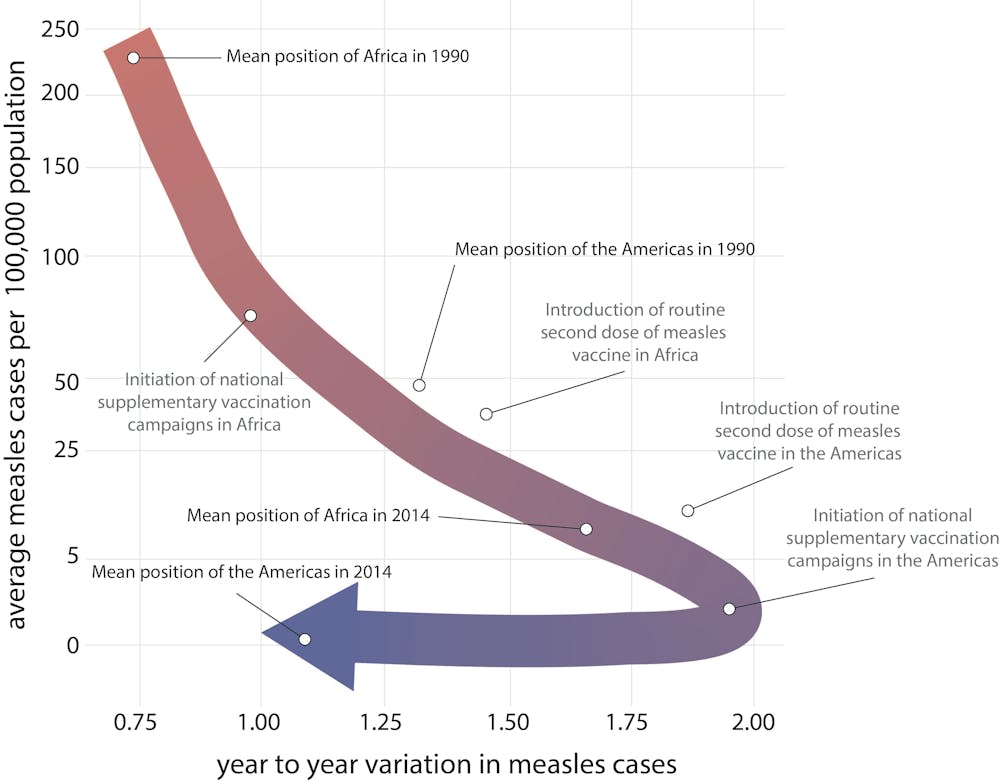


 ANGELICA CASANOVA/AFP / HO
  POOL/AFP/File / Mark RALSTON
  AFP/File / EITAN ABRAMOVICH
  AFP / Lionel CHAMOISEAU