The Federal Bureau of Investigation is not taking appropriate steps to review and assess potential maritime terrorism risks facing U.S. sea ports, the Justice Department’s internal watchdog has found.
The audit, released on Thursday by Inspector General Michael Horowitz, found that while top FBI officials believe the country faces a low maritime terrorism threat, that view is actually based on “incomplete and potentially inaccurate information.”
Moreover, the audit found that the FBI had not conducted its own formal assessment of the matter.
In a letter to Horowitz dated Aug. 30 that was released as part of the final audit, FBI Acting Section Chief Thomas Seiler for the External Audit and Compliance Section of the Inspection Division said the FBI concurs with all of the report’s recommendations and will work to implement them.
In 2005, the FBI created a Maritime Security Program as part of its National Joint Terrorism Task Force in its counterterrorism division. That program is meant to “prevent, penetrate, and dismantle criminal acts of terrorism” directed at ports.
The audit said that top FBI officials believed the terrorism threat in this space was low based on a small number of maritime incidents and investigations logged into its database.
However, the inspector general’s office found that the FBI was not properly coding maritime-related events into its database, and identified at least 10 incidents in the system that were not categorized correctly.
In addition, the report was critical of the role the FBI plays in helping the federal government vet port and rail workers and truck drivers who are able to gain unescorted access to ports through the use of biometric smart transportation security cards.
Although the program for issuing such cards falls to the Transportation Security Administration (TSA), a part of the Department of Homeland Security, the audit uncovered “significant deficiencies” related to the FBI’s role in providing information to TSA, such as information about terrorism watch-list targets and other intelligence to help reduce the risk that someone who poses a threat may be granted unfettered access to U.S. ports.
Some of the specific findings in the report were redacted due to national security.
However, in one section of the report that was unredacted, the audit revealed that FBI memos documenting threats that certain individuals may have posed were not shared with TSA.
Those unidentified people were later removed from the FBI’s terrorism watch list and still have transportation security cards.
Reporting by Sarah N. Lynch; Editing by Susan Thomas
Venezuelan intelligence officers Thursday arrested the chief of staff of Juan Guaido, the opposition leader recognized by the US and other countries as interim leader, Guaido and the opposition-ruled congress said on Twitter.
Roberto Marrero was grabbed by SEBIN officers when they staged a pre-dawn raid on his Caracas home, according to Guaido and a recorded voice message by Marrero published on social media.
The United States has repeatedly warned Venezuelan President Nicolas Maduro's government against arresting Guaido or his aides, and Washington's Secretary of State Mike Pompeo quickly called for Marrero's release.
"They have grabbed Roberto Marrero, my chief of staff. He yelled out that they planted two rifles and a grenade," Guaido tweeted. "The raid happened at around 2:00 am (0600 GMT). We don't know his whereabouts. He must be released immediately."
Maduro and Guaido both claim to be legitimate leader of Venezuela.
Maduro, 56, retains the loyalty of military brass and has control of state apparatus.
Guaido, 35, declared himself interim president on January 23 and has the backing of the US and more than 50 other countries, mostly in Latin America and the US.
"The United States condemns raids by Maduro's security services and detention of Roberto Marrero, Chief of Staff to Interim President @jguaido. We call for his immediate release. We will hold accountable those involved," Pompeo said on Twitter.
US President Donald Trump has said, as recently as Tuesday, that "all options" remain on the table in his drive to bring down Maduro, implying military action if he deemed it necessary.
So far, however, the power struggle in Venezuela has become bogged down in an impasse, with Maduro railing daily about the US "imperialists" trying to dislodge him and Guaido touring the country to rally supporters and pledge he'll be taking over "very soon."
- 'Ransacked' home -
Maduro's forces have reinforced obstacles blocking a border bridge linking Venezuela and Colombia to prevent Guaido's supporters trucking in US aid stockpiled on the other side. Extra shipping containers and concrete blocks have been moved into place on the bridge.
As well as seizing Marrero early Thursday, SEBIN officers raided the next-door home of an opposition lawmaker, Sergio Vergara, the opposition-ruled congress -- the National Assembly -- tweeted.
Vergara was not arrested. He told reporters that he saw Marrero bundled off into the street.
He said around 15 SEBIN officers "ransacked" his own home for around two hours, while asking where to find Marrero, a lawyer who works in the National Assembly.
"They started to bash on the door of Roberto Marrero's place, which is a few meters (yards) from my door, until they were able to get inside," he said.
"The dictatorship is abducting citizens," he added.
- US warning -
The United States has cautioned Maduro to not lay a finger on Guaido or National Assembly deputies or risk unspecified repercussions.
Trump's National Security Advisor John Bolton in January tweeted: "Any violence and intimidation against US diplomatic personnel, Venezuela's democratic leader, Juan Guaido, or the National Assembly itself would represent a grave assault on the rule of law and will be met with a significant response."
The United States has since withdrawn all its diplomats from Venezuela.
In just over a month, on April 28, increasingly harsh US sanctions on Venezuela will jump up a critical level with a ban on all oil sales to the United States, Venezuela's main crude buyer.
The step is expected to worsen already dire economic conditions ravaging Venezuela, a once-wealthy South American nation that has become impoverished under Maduro.
Pope Francis recently stated that Catholic nuns in various parts of the world, including Africa, Europe, India and Latin America, have suffered sexual abuse at the hands of priests and bishops.
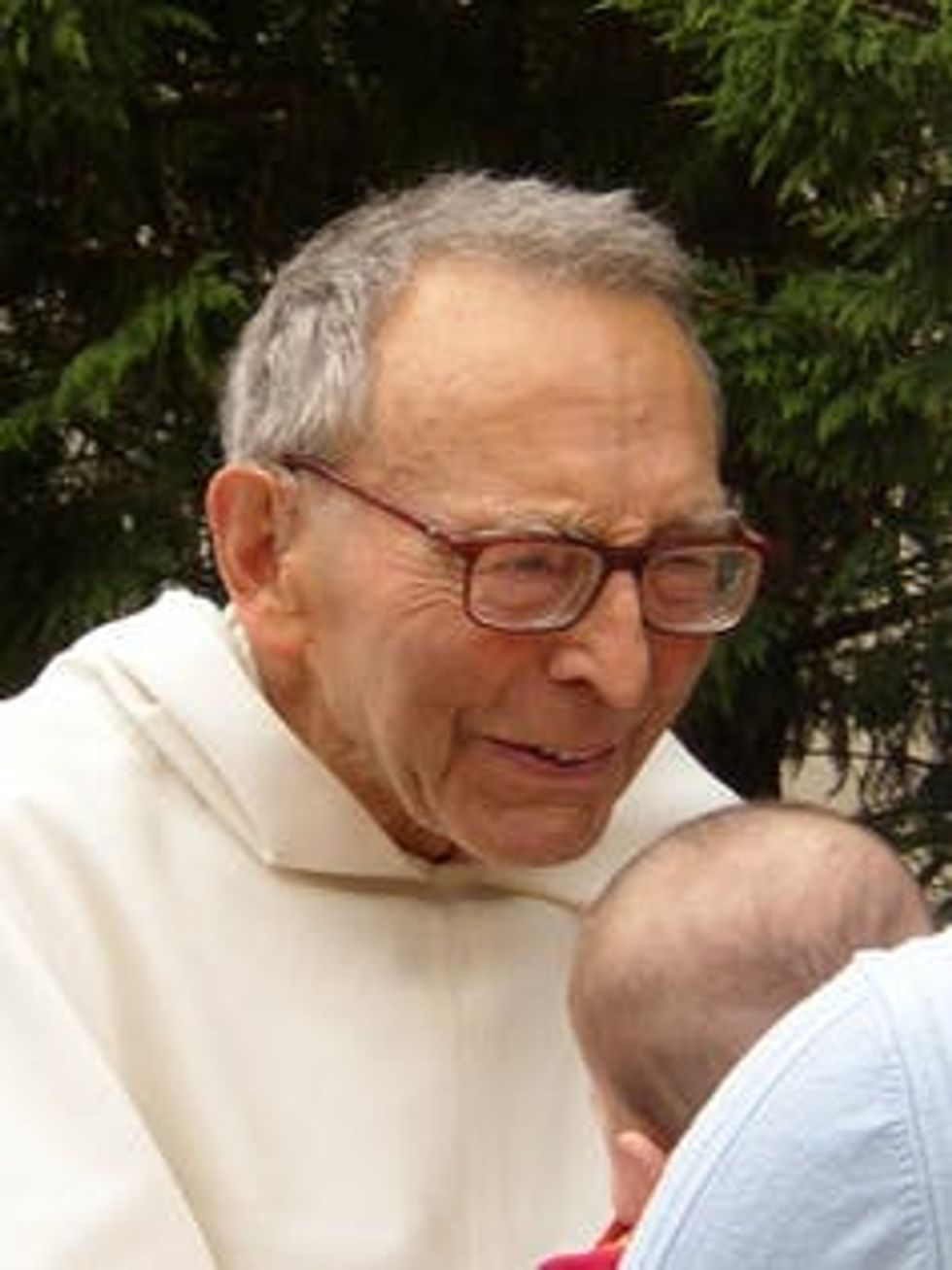
In his comments during a news conference held aboard the papal plane, Pope Francis referred to a high-profile scandal within the Community of St. John – a religious congregation comprising both men and women based in France. In 2013, the Community of St. John officially confirmed allegations that its founder Marie-Dominique Philippe, who died in 2006, had engaged in “gestures contrary to chastity,” including with nuns in his spiritual care.
Such problems are certainly not new. As scholars of ancient and medieval monasticism, our research reveals that sexual contact between the sexes has been a source of anxiety – and even scandal – from the time of the earliest Christian monasteries to the present.
In many cases, scandal, or even fear of scandal, resulted in tighter restrictions on contact between religious women and men.
Women and men in the desert
Aspiring nuns and monks are required to reject private property, marriage and biological family ties. Celibacy – abstinence from sexual relations – is implicit in the rejection of marriage and procreation and has always been central to the monastic ideal.
The monastic path has not been open to celibate women on their own, however. In late antiquity and the Middle Ages, the Church generally excluded women from the priesthood. Some branches of Christianity continue this practice today. And because a priest was always needed to administer the sacraments of the Communion, penance and last rites, no woman could avoid all contact with men.
One solution was to form double monasteries, sometimes also called dual-sex, twin, or brother and sister communities. This type of community is first mentioned in written sources from fourth-century Egypt and Cappadocia, in Turkey. They still exist in various forms today.
Mosaic of Emperor Justinian in the church of San Vitale, Ravenna, Italy.
While the exact living arrangements in the earliest double houses are not clearly explained in written sources, men and women tended to have their own quarters, divided in some cases by a river or a mountain.
From the beginning, double monasteries attracted negative attention. In fact, many of the earliest historical sources that refer to them call for their restriction or prohibition. The sixth-century law code of the Emperor Justinian, for example, prohibited the formation of new double communities in the Byzantine Empire. He ordered that women and men be separated within communities that were already established. Sexual contact between women and men was likely the most urgent cause for concern.
The church council held in Nicaea in 787 A.D. to discuss matters of Church doctrine and practice repeated the prohibition, stating that double monasteries had become “an offense and cause of complaint to many.”
The council ruled that “monks and nuns may not reside in one building, for living together gives occasion for incontinence. No monk may enter the woman’s quarter, and no nun converse apart with a monk.”
Anxiety about contact with women
Despite such legislation, double monasteries were never entirely eliminated. When they began to appear in greater numbers during the 12th century, they triggered renewed anxiety about contact between the sexes among both clerics and laypeople.
Clerics who wrote about these double communities often enumerated the strict rules in place to limit interaction between women and men. Direct physical contact between the sexes was carefully restricted to spiritual services such as hearing confessions and celebrating the mass.
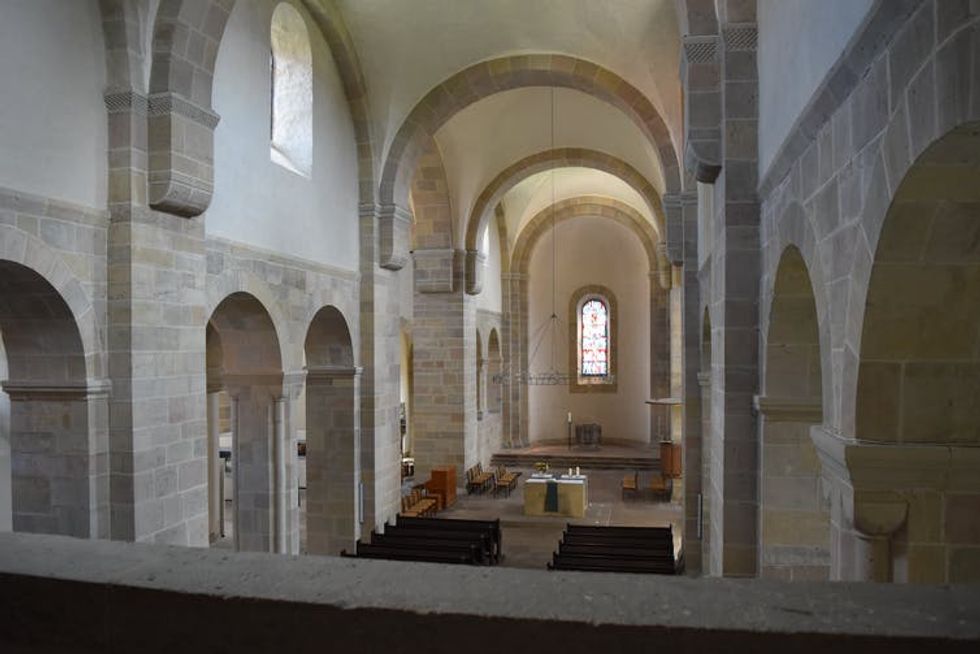
The women of Lippoldsberg could view the altar in their church only from a separate raised gallery of a church built in 1150.
The 12th-century monk Irimbert of Admont, located in what is modern Austria, claimed that his community’s women were locked within an enclosure secured with a three-lock door.
He stated that this door was only opened to admit a woman to the community, for a priest to enter to administer last rites to the dying, or to remove a nun’s body for burial.
Irimbert’s account may reflect the reality of life on the ground at 12th-century Admont, but he may also have been trying to avert criticism and deflect suspicion.
Scandal at Watton
One notorious scandal emerged during the same period in the Gilbertine Order of England. The Gilbertines organized religious houses with four subcommunities: two for women and two for men.
As the 12th-century monk Aelred of Rievaulx tells the story, a young nun at the monastery of Watton, whom he characterized as silly and lustful, conceived a child with one of the priory’s men.
When the pregnancy brought the affair to light, the nuns seized the man and forced the pregnant nun to castrate him. The nuns then shoved his severed testicles, “still stinking with blood,” into her mouth. Shortly after this horrific incident at Watton, Pope Alexander III investigated complaints made by a group of men within the broader community about the proximity of men and women in some of the order’s houses.
At least five bishops wrote to Alexander to assure him that men and women were now strictly segregated in the dual-sex Gilbertine communities within their dioceses.
As was common in the Middle Ages, Aelred laid the blame for the tragedy at Watton squarely at the feet of the nun.
Age-old restrictions
Returning to the present, however, both the current leader of the Community of St. John and Pope Francis have openly acknowledged that nuns were “preyed upon” by founder Marie-Dominique Philippe.
Among the internal “reforms” in the Community of St. John, like those in the centuries before, were measures for stricter enclosure of the community’s contemplative women.
Scholars have no witness to the lived experience of the women of Watton or the women of any of the double communities restricted by earlier legislation.
But the reforms within the Community of St. John split the women’s community and led to the departure of many of the sisters from the order. For many, as one news site reported, stricter enclosure was not in keeping with the character of the community they had chosen to enter for life. Their community was intended to be contemplative, not cloistered.
For the women who left the Community of St. John, seclusion was no longer an acceptable solution to a centuries-old problem.
A fire at a petrochemical storage site outside Houston destroyed 11 massive storage tanks before it was extinguished early Wednesday, Intercontinental Terminals Co officials said.
The company, a subsidiary of Mitsui & Co, has not yet determined what caused the blaze, but officials said at a briefing Wednesday that investigations by local officials have begun. Smoke from the fire was visible for dozens of miles.
Reporting by Erwin Seba; Editing by Chizu Nomiyama
Italian police on Wednesday rescued 51 children taken hostage by their school bus driver, who doused the vehicle in petrol and set it alight apparently in protest at migrant deaths in the Mediterranean.
Some of the children were tied up during the 30-minute ordeal, which saw the bus slam into a car but was brought to an end by police after one of the children was able to call for help. No one was seriously injured.
"It is a miracle, it could have been carnage. The police were outstanding, blocking the bus and getting the children off," said Milan prosecutor Francesco Greco.
Photos showed the burnt-out shell of the bus and the car, which were travelling on a road near Milan.
Driver Ousseynou Sy -- a 47-year-old Italian citizen of Senegalese origin -- explained under questioning that he wanted "to draw attention to the consequences of migration policies", according to his lawyer.
AFP / Flavio LO SCALZO The Milan police anti-terrorism unit has been charged with investigating the hostage-taking which lasted a little over 30 minutes
The 51 students in year two of secondary school in Crema were coming back from a sports outing accompanied by three adults when the driver abruptly changed route, announcing he was taking them all hostage.
"No one is getting out of here alive," he said, according to several of the students.
A dozen children and two of the adults were taken to hospital for smoke inhalation while the arrested driver also needed treatment for burns to his hands.
The Milan police anti-terrorism unit has been charged with investigating the hostage-taking which lasted a little over 30 minutes.
- Tied up -
However Sy had no links with Islamic terrorism, Alberto Nobili, head of counter-terrorism at the Milan public prosecutor's office, told a press conference, saying he "acted as a lone wolf".
Planning the hijack over several days, Nobili said Sy "wanted the whole world talking about his story". He posted a video on Youtube to explain his actions and say " Africa -- arise", directed at family and friends in Crema but also in Senegal.
The driver, armed with two canisters filled with petrol and a cigarette lighter, threatened the children, took their telephones and told the adults to tie them up with electric cable.
"I lost three children at sea," he said, according to one of the rescued children.
"He threatened us, said that if we moved he would pour the petrol and set it alight. He kept saying there were so many people in Africa who kept dying and that it was the fault of (deputy prime ministers) Di Maio and Salvini," a rescued girl told Italian media.
AFP / Flavio LO SCALZO Police blocked the bus in the street and broke open the back windows to get the children out before the vehicle went up in flames
Luigi Di Maio and in particular Matteo Salvini, who is also interior minister, have taken a hard line against migrants since they formed a populist coalition government in June, including trying to close Italian ports to ships that rescue migrants in the Mediterranean.
"Then the police arrived and saved us," the rescued girl said.
Prosecutor Greco said the man kept two of the children close to him, brandishing the lighter. The bus crashed into a car, from which a father and son escaped before it burst into flames.
One of the children managed to pick up a phone that had been dropped and call their parents who in turn phoned the police.
"I hurt my hands a bit picking it up... we were all terrified," the boy told Italian television.
Police blocked the bus in the street and broke open the back windows to get the children out before the vehicle went up in flames.
"The children were banging on the windows, calling for help," said Roberto Manucci, one of six carabineri at the scene.
Thousands of migrants have crossed from North Africa to Italy, many of them losing their lives on the dangerous journey.
"I want to put an end to it, I want to stop the deaths in the Mediterranean," several reports cited the driver as saying.
- Tough anti-migrant laws -
Sy had been an Italian citizen since 2004, with reports saying was divorced from his Italian wife and has two teenage children.
The interior ministry said in a statement that the driver had been previously caught driving while drunk and had sexually assaulted a minor. It gave no dates for the alleged offences.
Interior ministry sources said the minister was looking at withdrawing the driver's Italian citizenship, a move made possible by tough anti-migrant legislation adopted late last year.
Earlier on Wednesday Salvini said his immigration policies has saved thousands of lives. "Fewer departures, fewer arrivals, fewer deaths," he said.
A boulder-sized fish of a kind known to "sink yachts" has washed up on an Australian beach.
The 1.8 metre (six feet) specimen -- believed to be a Mola Mola, or ocean sunfish -- came ashore near the mouth of the Murray River in South Australia at the weekend.
The enormous creature is distinct for both its size and peculiar shape featuring a flattened body and fins.
The fish can weigh up to 2.5 tons (2,200 kilogrammes), according to National Geographic.
A photo circulating on social media showed two people on a beach standing over the giant specimen, which had died.
"The amount of news and media from all over the world wanting to report it has been on another level," Linette Grzelak, who posted the image to Facebook, told AFP.
"Never expected this."
South Australian Museum fish collection manager Ralph Foster said the fish was actually at the smaller end of the scale for the species.
Courtesy of Linette Grzelak/AFP / Handout Experts say this enormous specimen was actually only average size and the species can grow up to 2.5 tons (2,200 kgs)
It earned its name for basking in the sun near the ocean's surface, but is also known to dive several hundred metres (feet) into the depths, he said.
"I've actually had a good look at it, we get three species here and this is actually the rarest one in South Australian waters," Foster told the Australian Broadcasting Corporation (ABC).
"They can get a lot bigger... it's probably an average-sized one, they can get nearly twice as big as that," he added.
Mola Mola have also been known to damage vessels, Foster added.
"We get a lot of them hit by boats and some of them are so large they actually sink yachts," he said.
"We know very little about them, it's only in the last few years that technology has allowed us to start learning about them.
Finland ranked as the world's happiest country for the second year running while war-torn South Sudan sank to the least contented in a United Nations report released on Wednesday.
The Nordic nation of 5.5 million people, known for their love of forests, lakes and saunas, topped the study which used survey data asking citizens in 156 countries how happy they perceive themselves to be, as well as measures such as life expectancy, income and social support.
The other Nordic countries, as well as the Netherlands, Switzerland, Canada, New Zealand and Austria also made the top ten.
As well as performing well on all the indicators, the most content countries all tended to have very stable societies, with happiness levels changing comparatively little since 2005.
Despite the political turmoil brought by Brexit, Britain rose four places in the rankings to 15th.
The United States, meanwhile, continued its slide of recent years, dropping one spot to 19th place.
"This year's report provides sobering evidence of how addictions are causing considerable unhappiness and depression in the US," said professor Jeffrey Sachs, one of the report's authors.
The unhappiest nation was South Sudan, where the UN recently said 60 percent of people face food insecurity following a bloody civil war which has claimed the lives of an estimated 400,000 people.
Other conflict-ridden countries, such as Yemen, Afghanistan and the Central African Republic, also featured at the bottom of the table.
Released on the International Day of Happiness on March 20, the report warned that world happiness has declined in recent years, driven by a sustained fall in India, which this year ranked in 140th place.
This has coincided with a rise in negative feelings, "comprising worry, sadness and anger, especially marked in Asia and Africa, and more recently elsewhere," it said.
This year's publication also looked at how countries have performed in the happiness rankings since 2005.
Of the 20 largest gainers, half are in Central and Eastern Europe, five are in sub-Saharan Africa, and three in Latin America.
The five largest declines since 2005 were in Yemen, India, Syria, Botswana and Venezuela.
U.S.-backed Syrian fighters said they were still searching territory captured from Islamic State at its final enclave in eastern Syria on Thursday and denied a report the jihadists had been finally defeated.
The final capture of the Baghouz enclave at the Iraqi border will mark the end of Islamic State territorial rule that once spanned a third of Syria and Iraq after years of military campaigns by a range of international and local forces.
After weeks of fighting, the U.S.-backed Syrian Democratic Forces (SDF) took a big step towards capturing the besieged area on Tuesday when they seized an encampment where the jihadists had been mounting a last defense of the area.
“Combing continues in the Baghouz camp,” an SDF media official said, citing commanders of the operation on Thursday, after the Syrian Kurdish news outlet Hawar reported that the entire enclave had been captured and IS defeated.
“There is no truth (to the report of) the complete liberation of the village,” the official said.
The report on Hawar News, which is close to the Kurdish-led administration that runs much of northern Syria, was later removed from its website.
U.S. President Donald Trump said on Wednesday that a “tiny spot” of remaining IS territory would be “gone by tonight”.
French Foreign Minister Jean-Yves Le Drian, whose country has participated in the campaign, said on Wednesday he expected the announcement of the “final territorial defeat” to be made in the “next few days”.
Though the defeat of IS at Baghouz ends its grip over territory, it remains a threat, with fighters operating in remote territory elsewhere and capable of mounting insurgent attacks.
The U.S. military has warned that Islamic State may still count tens of thousands of fighters, dispersed throughout Iraq and Syria, with enough leaders and resources to present a menacing insurgency.
The Pentagon’s internal watchdog released a report last month saying Islamic State remained an active insurgent group and was regenerating functions and capabilities more quickly in Iraq than in Syria.
It warned the group could resurge in Syria within six to 12 months and regain limited territory without sustained pressure.
The United States believes Iraq is the location of its leader Abu Bakr al-Baghdadi, who stood at the pulpit of the great medieval mosque in Mosul in 2014 to declare himself caliph, sovereign over all Muslims.
Additional reporting by Rodi Said in Qamishli, Syria; Writing by Tom Perry in Beirut; Editing by Raissa Kasolowsky
U.S. Senator Marco Rubio met on Wednesday with the Haitian president and members of parliament and discussed the formation of a new Cabinet following the ouster this week of Jean Henry Ceant as prime minister.
The Florida Republican lawmaker arrived in the Haitian capital, Port-au-Prince, following crippling nationwide protests and a political crisis touched off by the dismissal of Ceant in a vote of no confidence by the country’s legislative body on Monday.
Haiti has had several prime ministers in recent years. President Jovenel Moise remains in office.
Rubio wrote on his Twitter account that he discussed the formation of a new government in his meeting with Gary Bodeau, head of the lower house, and Carl Cantave, president of the Senate.
Ceant took office in September as thousands of demonstrators were streaming through the streets in the main cities of the impoverished island nation.
In renewed protests since Feb. 7, many called for Moise to step down because of ballooning inflation, a weakening currency and allegations of misused funds from a Venezuelan oil subsidy scheme called PetroCaribe.
Ceant, who has likewise been blamed for the rampant inflation and protests, has insisted his dismissal on Monday was unconstitutional and that he is still the head of government.
Moise said on Twitter that he spoke with Rubio about security and holding parliamentary elections.
Rubio heads the Senate Foreign Relations Committee’s Subcommittee on Western Hemisphere, Transnational Crime, Civilian Security, Democracy, Human Rights and Global Women’s Issues.
His visit comes days before Moise and four other Caribbean leaders attend a meeting on Friday with U.S. President Donald Trump in Florida to discuss the political crisis in Venezuela and China’s commercial expansion.
Reporting by Ezequiel Abiu Lopez; Editing by Delphine Schrank and Peter Cooney
The bullet-riddled Al Noor mosque in Christchurch was being repaired, painted and cleaned ahead of Friday prayers, as grieving families buried more victims of New Zealand’s worst mass shooting.
Prime Minister Jacinda Ardern has announced that Friday’s call to prayers for Muslims will be broadcast nationally and there will be a two minute silence.
Armed police have been guarding mosques around New Zealand after 50 people were killed last Friday by a lone gunman who attacked worshippers at two mosques in Christchurch.
“We will have a heightened presence tomorrow in order to provide reassurance to people attending the Friday call for prayers,” police said in a statement on Thursday.
“Police have been working relentlessly, doing everything in our power to gather all appropriate evidence from what are active crime scenes so we can allow people to return to the mosques as quickly as possible.”
Both mosques attacked, the Al Noor and nearby Linwood mosque, plan to be reopened. Thousands of worshippers are expected at the Al Noor mosque, where the majority of victims died.
Most victims were migrants or refugees from countries such as Pakistan, India, Malaysia, Indonesia, Turkey, Somalia, Afghanistan and Bangladesh.
Australian Brenton Tarrant, 28, a suspected white supremacist who was living in Dunedin, on New Zealand’s South Island, has been charged with murder following the attack.
He was remanded without a plea and is due back in court on April 5, when police said he was likely to face more charges.
The first victims were buried on Wednesday and burials continued on Thursday, with the funeral of a school boy.
Families of the victims have been frustrated by the delay as under Islam bodies are usually buried within 24 hours.
A mass burial is expected to be held on Friday. Body washing will go on through the day and night to have the dead ready for burial, said one person involved in the process.
Police have identified and release to the families the bodies of some 30 victims.
Twenty nine people wounded in the attacks remained in hospital, eight still in intensive care.
Many have had to undergo multiple surgeries due to complicated gunshot wounds. The gunman used semi-automatic AR-15 rifles, with large magazines, and shotguns.
Ardern as vowed to change gun laws in the wake of the attack, possibly banning semi-automatic weapons. An announcement will be made before the next cabinet meeting on Monday.
The gunman broadcast his attack live on Facebook and it was quickly distributed to other platforms, prompting Ardern and others to rebuke technology companies and call for greater efforts to stop violence and extremist views being aired on social media.
Reporting by Tom Westbrook and Charlotte Greenfield in CHRISTCHURCH, Praveen Menon in WELLINGTON.; Editing by Michael Perry
New Zealand Prime Minister Jacinda Ardern said on Thursday that military style semi-automatics and assault rifles will be banned under stronger new gun laws following the killing of 50 people in the country’s worst mass shooting.
Ardern said she expects the new law to be in place by April 11 and buy-back scheme will be established for banned weapons.
“Now, six days after this attack, we are announcing a ban on all military style semi-automatics (MSSA) and assault rifles in New Zealand,” Ardern said.
“Related parts used to convert these guns into MSSAs are also being banned, along with all high-capacity magazines.”
Reporting by Praveen Menon; Editing by Michael Perry
Bayer's AG had hoped a new trial strategy focusing jurors on scientific evidence could stem a burgeoning tide of U.S. lawsuits over its glyphosate-based weed killer Roundup, but a second jury finding on Tuesday that the product caused cancer has narrowed the company’s options, some legal experts said.
Bayer shares tumbled more than 12 percent on Wednesday after a unanimous jury in San Francisco federal court found Roundup to be a “substantial factor” in causing California resident Edwin Hardeman’s non-Hodgkin’s lymphoma.
The jury decision was a blow to Bayer after the judge in the Hardeman case, at the company’s request, had split the trial, severely limiting evidence plaintiffs could present in the first phase. Tuesday’s defeat on terms considered advantageous to Bayer sets up the second phase to be even tougher and limits the grounds on which the company could appeal any final verdict, the experts said.
“The fact that Bayer lost this trial despite it being set up in the most favorable way for them is a huge setback,” said Thomas Rohback, a Connecticut-based defense lawyer.
Bayer in a statement on Tuesday said it stood behind the safety of Roundup and was confident the evidence in the second trial phase would show that Monsanto’s conduct was appropriate and the company not liable for Hardeman’s cancer.
The company, which bought Monsanto last year, on Wednesday declined to comment beyond that statement.
Tuesday’s finding did not address liability, which will be determined following the second trial phase that began on Wednesday.
Bayer denies glyphosate or Roundup cause cancer. The German company faces more than 11,200 lawsuits over the popular weed killer. Last August, following the first Roundup trial, a California state court jury issued a $289 million verdict against the company.
Two weeks after that verdict, which was later reduced to $78 million and is being appealed, Bayer Chief Executive Werner Baumann reassured analysts that the company had a new legal strategy based on focusing jurors on the scientific evidence.
“Bayer and the joint litigation team are working to ensure that, going forward, this overwhelming science will get the full consideration it deserves,” Baumann said in an Aug. 23 conference call.
A LOT AT STAKE
There is a lot at stake for Bayer, which acquired Roundup maker Monsanto last year for $63 billion. Though Bayer does not break out sales figures for Roundup, glyphosate is the world’s most widely used weed killer, and Roundup is the leading brand.
Bayer’s new strategy was focused on keeping out plaintiffs’ allegations that the company improperly influenced scientists, regulators and the public about the safety of Roundup. Bayer has denied it acted inappropriately and said in public statements following the August verdict that it thought the jury was inflamed by the claims of corporate misconduct.
Vince Chhabria, the San Francisco federal judge overseeing the Hardeman case, agreed with the company’s argument that such evidence was a “distraction” from the scientific question of whether glyphosate causes cancer. He agreed to split the trial in a January order.
Had Bayer had won the first phase, there would have been no second phase looking at company liability. Now that it has lost, almost all of the previously excluded evidence can be presented to the jury.
Plaintiffs’ lawyers hit Bayer with those allegations in their opening statements for the second phase on Wednesday. Aimee Wagstaff, one of Hardeman’s lawyers, said Monsanto influenced the science around Roundup through its “cozy” relationship with regulators.
Bayer could convince the jury in the second phase that, despite their finding that Roundup played a substantial role in Hardeman’s cancer, the company was not liable. Experts said that was unlikely.
“They could present evidence of how careful they were in developing Roundup, but that’s an uphill battle given that the scientific evidence was their strongest argument,” said Alexandra Lahav, a law professor at the University of Connecticut.
A lawyer for Bayer on Wednesday argued that Bayer could not be held liable because the U.S. Environmental Protection Agency, as well as other regulators worldwide, approved Roundup without a cancer warning.
If the Hardeman trial had not been split and a final verdict went against Bayer, the company might have been able to appeal any damages award to the U.S. 9th Circuit Court of Appeals by claiming the jury had been improperly swayed by inflammatory evidence, said Lori Jarvis, a Virginia-based mass tort defense lawyer. That argument will now be difficult to make.
“It would not be surprising at all for the 9th Circuit to uphold what the jury did in this case, particularly given the great effort Chhabria put into creating a level playing field for Monsanto,” Jarvis said.
Some lawyers said Bayer could still argue on appeal that plaintiffs’ experts and their scientific evidence were insufficient and statistically invalid and should not have been admitted at trial. But they noted the 9th Circuit, which oversees the San Francisco federal court, has generally been permissive in allowing expert testimony.
However, experts said it was probably too soon to write off Bayer’s legal strategy, noting future Roundup cases could result in different outcomes.
“It’s a relatively early phase in this litigation as a whole and we just need to see more trials to understand Bayer’s liability,” said Adam Zimmerman, a law professor at Los Angeles-based Loyola Law School.
Reporting by Tina Bellon; Editing by Anthony Lin and Bill Berkrot
The world’s biggest planemaker Boeing faced growing obstacles on Wednesday to returning its grounded 737 MAX fleet to the skies, while details emerged of an Indonesian crash with potential similarities to the Ethiopian disaster.
Aviation experts suspect an automated system, meant to stop stalling by dipping the nose, may be involved in both cases, with pilots struggling to override it as their jets plunged downwards.
But they stress neither investigation is complete and crew actions and training will also be closely scrutinised.
The March 10 Ethiopian Airlines crash has shaken the global aviation industry and cast a shadow over the flagship Boeing model intended to be a standard for decades to come, given parallels with the Lion Air calamity off Jakarta in October. The two crashes killed 346 people in all.
On Wednesday, the Seattle Times, citing unidentified sources familiar with the matter, reported the FBI was joining the criminal investigation into the MAX’s certification. The U.S. Justice Department is looking at the U.S. Federal Aviation Administration’s (FAA) oversight of Boeing, a person briefed on the matter said on Monday.
Meanwhile, the Pentagon Inspector General said on Wednesday it would investigate a complaint that Acting United States Secretary of Defense Patrick Shanahan, a former Boeing executive, violated ethical rules by allegedly promoting Boeing while in office.
Chicago-headquartered Boeing has promised a swift update of automatic flight software, but regulators in Europe and Canada want to be sure of the jet’s safety themselves, rather than rely on U.S. vetting.
As Ethiopian investigators pored over black box data from their crash, sources with knowledge of the doomed Lion Air cockpit voice recorder revealed how pilots scoured a manual in a losing battle to figure out why they were hurtling down to sea.
Investigators examining the Indonesian crash want to know how a computer ordered the plane to dive in response to data from a faulty sensor and whether pilots had enough training to respond appropriately to the emergency.
Communications showed that in the final moments, the captain tried in vain to find the right procedure in the handbook, while the first officer was unable to control the plane.
“It is like a test where there are 100 questions and when the time is up you have only answered 75,” said one of the sources with knowledge of the cockpit recording that has not been made public. “So you panic. It is a time-out condition.”
At the end, the sources told Reuters, the Indian-born captain, 31, was quiet, while the Indonesian officer, 41, said “Allahu Akbar” (“God is greatest”) - an Arabic phrase to express excitement, shock, praise or distress. The plane then hit water.
U.S. ‘CREDIBILITY DAMAGED’
Boeing has said there was a documented procedure to handle the problem, which crew are supposed to memorise.
A different crew on the same plane the evening before had the same situation but solved it after running through three checklists, though they did not pass on that information to the doomed Indonesian crew, according to a preliminary report by investigators released in November.
Shifting away from previous reliance on FAA vetting, Canada and the European Union will now seek their own guarantees of the MAX planes’ safety, complicating Boeing’s hopes to get them flying again.
Regulators want to be absolutely sure of Boeing’s new automated control system, known as MCAS (Maneuvering Characteristics Augmentation System), and that pilots are fully prepared to handle it. It is meant to prevent a loss of lift which can cause an aerodynamic stall and send the plane downwards in an uncontrolled way.
Facing such high-profile scrutiny, Boeing, one of the United States’ most prestigious exporters, reshuffled executives in its commercial airplanes unit to focus on the crash fallout.
VOICE RECORDINGS
The FAA said its “robust processes” and “full collaboration with the aviation community” were key to safety worldwide.
In Ethiopia, which is leading the investigation of the cause of the crash, experts were poring over the in-flight recording of the captain and first officer.
As with the Indonesia flight, they radioed about control problems shortly after take-off and sought to turn back, struggling to get their plane on track before it hit a field. However, experts emphasise every accident is a unique chain of human and technical factors.
Ethiopia’s civil aviation head Wosenyeleh Hunegnaw told Reuters the investigation was proceeding as quickly as possible within international standards. “I’m 100 percent sure the report will be issued within 30 days,” he said.
For now, more than 350 MAX aircraft are grounded around the world, and deliveries of nearly 5,000 more - worth more than $500 billion - are on hold.
Development of the 737 MAX, which offers savings of about 15 percent on fuel, began in 2011 after the successful launch by its main rival of the Airbus A320neo. The 737 MAX entered service in 2017.
While some airlines are worried about the impact on profits, they have been able to keep services going, swapping MAX planes for others, or using partner carriers.
Reporting by Maggie Fick and Jason Neely in Addis Ababa, David Shepardson in Washington, Tim Hepher in Paris, David Shepardson in Washington, David Ljunggren in Ottawa, Jamie Freed in Singapore, Cindy Silviana in Jakarta; Writing by Andrew Cawthorne and Ben Klayman; Editing by Jon Boyle and Grant McCool






 AFP / Flavio LO SCALZO
  AFP / Flavio LO SCALZO
  Courtesy of Linette Grzelak/AFP / Handout
.jpg)