The Republican-led U.S. Senate on Wednesday approved a resolution seeking to end U.S. support for the Saudi Arabia-led coalition in the war in Yemen, in a rebuke of President Donald Trump’s policy toward the kingdom.
The vote was 54-46 in the Senate, more than the 51 needed to pass in the 100-member Senate. The war powers resolution seeks to end any U.S. military involvement in the conflict, including providing targeting support for Saudi air strikes, without authorization from Congress.
The four-year-long civil war in Yemen, which pits the Saudi-led coalition against Houthi rebels backed by Iran, has killed tens of thousands of people and spawned what the United Nations calls the world’s most dire humanitarian crisis, with the country on the brink of famine.
Backers of the resolution, including a handful of Trump’s fellow Republicans as well as Democrats, argued that U.S. involvement in Yemen violates the constitutional requirement that Congress, not the president, should determine when the country goes to war.
The resolution must still be approved by the House of Representatives to be sent to the White House, which said earlier on Wednesday that Trump plans a veto. It would be the first of his two-year-long presidency.
Democrats and Republicans reintroduced the resolution two weeks ago as a way to send a strong message to Riyadh about the humanitarian disaster in Yemen. Many lawmakers also want to push Trump to demand a stronger response from the Saudi government to the murder of Saudi journalist Jamal Khashoggi at a Saudi consulate in Turkey in October.
Reporting by Patricia Zengerle; Editing by James Dalgleish
With just over two weeks to go until Brexit, Theresa May has once again failed to get her Brexit deal through parliament, leaving complete uncertainty about where the nation goes next. May lost the vote on her deal 391 to 242, a slightly higher level of support than in January but still a resounding defeat for a prime minister who increasingly appears to have lost control.
Following the defeat, the prime minister confirmed that MPs will now be able to vote on whether to oppose a no-deal Brexit. But she warned that the government would press ahead with planning for a no deal and that MPs would have to acknowledge that their vote does not change EU or UK law. If they fail to make a decision on what to do, no deal remains the default on March 29.
May said this will be a free vote, meaning she will not whip her party into voting to support her. In announcing this, she noted that “just like the referendum there are strongly held and equally legitimate views on both sides”, suggesting that this is another attempt to keep her fragile party together and prevent any more resignations, at least in the short term.
There will then be a vote on March 14 on whether to extend the Brexit process beyond March 29. But in another warning, May said “this does not solve the problems we face”. If MPs vote to extend, she said, the EU will want to know what they intend to do with that time. Do they want to revoke Article 50 entirely? Do they want to hold a second referendum? At the latter question, a large number of MPs cheered – while others shouted “no!”.
May added that she also believes there is still a majority for a deal. No one can doubt her tenacity and staying power. While other ministers have been scrambling to save their own careers and distance themselves from the ongoing mess, the prime minister has been nothing but persistent. Once again, pressure has been mounting on her to resign and although it is doubtful that such an action would really solve anything, after her Brexit deal was once again rejected by parliament, even May must be asking herself whether it is worth staying on.
Time to go?
May’s run as prime minister cannot go into the history books as anything other than a failure. To be fair, her inheritance from David Cameron was pretty lousy – a divided party tasked with delivering a major political action that had barely been planned for at all. But the difficulty of this task was compounded by weak leadership, a lack of party discipline and numerous bad decisions. Her latest was to try to sell a minor concession from the EU as a last minute victory to try and convince MPs to support her deal. Once again, they weren’t buying what she was selling.
Backbench MPs continue to stir up trouble from the sidelines, refusing to follow the party line and facing minimal repercussions for their disloyalty. May’s loss on this latest vote came after the European Research Group of backbenchers held a meeting in their so-called “star chamber”, agreeing to rebel en masse and further suggesting that May has lost control of her party.
The fact that May has managed to make her time as PM last nearly three years with all of this going on is pretty impressive. And there are no clear mechanisms to force her to step down if she decides not to. She has shown she can weather votes of no confidence and she is safe from another party leadership challenge until the end of the year. But following this latest rejection of her Brexit deal, it is hard to see what she can do next or why she would even want to go to all the effort.
Many suspect that May will simply get parliament to vote again, hoping that enough MPs will flinch at the last minute and vote for it to avoid a no deal Brexit. But while not as large as her first defeat, this loss was significant. And with her rivals once again sensing blood in the water, many people probably wouldn’t hold it against her if she just decided to abandon ship like so many before her and get a head start on the lucrative lecturing circuit that has served some of her predecessors so well.
Now what?
We know that the majority of MPs don’t want a no deal, but in voting against May’s deal they have made that much more likely. A vote in parliament against a no deal Brexit has no direct effect on the EU and Jean-Claude Juncker has already warned that there will be no third negotiation. It would be foolish to assume that this is not sincere. That all just makes a no deal more, not less, likely.
Taking this into account, it therefore isn’t clear if extending Article 50 will achieve much more than delaying the inevitable. Despite constant assurances from prominent Leavers that the EU will see sense at the last minute and give Britain what it wants, the remarkable outward unity of the EU has not wavered in the nearly three years since the referendum.
The fact is that the EU isn’t prepared to give into unrealistic demands from the UK to the detriment of itself. Given that the EU hasn’t seen fit to amend the terms of the deal by now, it is hard to see that this will change. The EU will likely grant an extension because it won’t want to be seen as forcing a no deal situation, but the fact that an extension into May would likely see Britain having to participate in the next European parliament elections raises issues for both sides.
Regardless of how well you think she has done in the job, there is little doubting that May has done more or less all she can as prime minister. Delivering Brexit was never going to be an easy task and it has proved all consuming. With other policies failing as a result and her party even more divided, it may now be time for her to her to retire from Number 10 and let her critics in the party make good on their claims that they could do it better.
The United States and India on Wednesday agreed to strengthen security and civil nuclear cooperation, including building six U.S. nuclear power plants in India, the two countries said in a joint statement.
The agreement came after two days of talks in Washington. The United States under President Donald Trump has been looking to sell more energy products to India, the world’s third-biggest buyer of oil.
The talks involved Indian Foreign Secretary Vijay Gokhale and Andrea Thompson, the U.S. undersecretary of state for arms control and international security.
“They committed to strengthen bilateral security and civil nuclear cooperation, including the establishment of six U.S. nuclear power plants in India,” the joint statement said.
It gave no further details of the nuclear plant project.
The two countries have been discussing the supply of U.S. nuclear reactors to energy-hungry India for more than a decade, but a longstanding obstacle has been the need to bring Indian liability rules in-line with international norms, which require the costs of any accident to be channeled to the operator rather than the maker of a nuclear power station.
Pittsburgh-based Westinghouse has been negotiating to build reactors in India for years, but progress has been slow, partly because of India’s nuclear liability legislation, and the project was thrown into doubt when Westinghouse filed for bankruptcy in 2017 after cost overruns on U.S. reactors.
Canada’s Brookfield Asset Management bought Westinghouse from Toshiba in August 2018. Last April Westinghouse received strong support from U.S. Energy Secretary Rick Perry for its India project, which envisaged the building of six AP1000 reactors in the state of Andhra Pradesh.
The agreement to build the reactors, announced in 2016, followed on from a U.S.-India civil nuclear agreement signed in 2008.
India plans to triple its nuclear capacity by 2024 to wean Asia’s third-largest economy off polluting fossil fuels.
Last October, India and Russia signed a pact to build six more nuclear reactors at a new site in India following summit talks between their leaders in New Delhi.
Reporting by Lesley Wroughton and David Brunnstrom; editing by Jonathan Oatis and Phil Berlowitz
Dozens of children were among scores of people feared trapped on Wednesday after a four-storey building collapsed in Nigeria's economic capital Lagos, rescuers told AFP, with at least four dead bodies pulled from the rubble.
The children were attending an "illegal school" inside the residential building when the structure collapsed, officials said.
"Dozens of children were trapped inside," said Adesina Tiamiyu, head of Lagos state emergency management agency (SEMA), which is supervising the rescue operation.
So far, emergency workers had pulled 40 people alive from the rubble, some of them badly injured, he said.
But they had also recovered "more than four dead bodies", Tiamiyu said without giving an exact figure.
Police said they believed scores of people were trapped under the rubble of the building which collapsed mid-morning in an area near Itafaji market on Lagos Island.
"We are getting additional cranes to be able to go deeper than where we are now to rescue more lives," said Lagos state governor Akinwunmi Ambode in a statement.
And he promised a full investigation, pledging there would be "punishment" for anyone found responsible for the building's collapse.
AFP / Sophie RAMIS Building collapse in Lagos
In chaotic scenes, panicked parents, local residents and shocked onlookers rushed to the area as police, firemen and medics staged a massive rescue operation.
It was not immediately clear how many people were inside when the building foundered.
Rescuers stressed there were no exact figures for the dead or injured, but one health official said 20 people had been taken to hospital.
- Blood and dust -
"We are still trying to find out how many are trapped inside," said police officer Seun Ariwyo, who said there were probably scores.
A young man helping rescue efforts who gave his name only as Derin said "at least 10 children" were trapped inside but "thought to be alive".
An AFP reporter at the scene saw at least eight people pulled from the wreckage, including a small boy with blood on his face.
Covered in dust, he was alive but unconscious and appeared to be badly hurt.
One local resident who witnessed the moment of collapse said there was no warning.
"We were smoking outside when the building just collapsed," Olamide Nuzbah told AFP in pidgin English.
- Distraught parents -
As rescuers worked furiously to reach those inside, distraught parents begged them to find their children.
AFP / SEGUN OGUNFEYITIMI Emergency and rescue personnel have been trying to find survivors
"Please, save my child, save my child!" wept one traumatised mother whose seven-year-old daughter was trapped inside, as people tried to console her.
School bags, toys and clothes could be seen among the piles of rubble as a bulldozer tried to clear a path through some of the wreckage to help the rescue efforts.
As the day wore on, an AFP correspondent saw several children being brought out, at least one of whom appeared to be dead.
Elsewhere, hundreds of local residents tried to help, passing water and helmets through to dust-covered rescuers working tirelessly to sift through the rubble, some of whom appeared to be distressed.
Many locals told AFP that the building, which was in an advanced state of disrepair, had been "earmarked" for demolition by the authorities in Lagos state.
"It is a residential building that was actually accommodating an illegal school," said Ambode, the state governor, confirming that most buildings in the area had been marked for demolition but saying some landlords had defied the move.
"We get resistance from landlords but we must continue to save lives," he said, pledging to step up measures against all structures that failed to meet the correct standards, saying they would be "quickly evacuated" and demolished.
Lagos, which has a population of 20 million people, is made up of a collection of islands.
AFP / SEGUN OGUNFEYITIMI The incident took place near Itafaji market on Lagos Island, a densely-populated area which is one of the city's oldest neighbourhoods
One of them is Lagos Island, a densely-populated area which is one of the city's oldest neighbourhoods.
It is characterised by its Afro-Brazilian architecture, a style brought over by thousands of freed slaves who headed back home after decades working the plantations in Brazil.
- Tragically common -
Despite efforts to renovate the area, a large number of abandoned buildings have been taken over by families or businesses, despite being dilapidated and unsafe.
Building collapses are tragically common in Nigeria, where building regulations are routinely flouted.
In September 2014, 116 people died -- 84 of them South Africans -- when a six-storey building collapsed in Lagos where a celebrity televangelist was preaching.
An inquiry found it had structural flaws and had been built illegally.
And two years later, at least 60 people were killed when the roof collapsed at a church in Uyo, the capital of Akwa Ibom state, in the east of the country.
U.S. President Donald Trump said on Wednesday he was in no rush to complete a trade pact with China and insisted that any deal include protection for intellectual property, a major sticking point between the two sides during months of negotiations.
Trump and Chinese President Xi Jinping had been expected to hold a summit at the president’s Mar-a-Lago property in Florida later this month, but no date has been set for a meeting and no in-person talks between their trade teams have been held in more than two weeks.
The president, speaking to reporters at the White House, said he thought there was a good chance a deal would be made, in part because China wanted one after suffering from U.S. tariffs on its goods.
But he acknowledged Xi may be wary of coming to a summit without an agreement in hand after seeing Trump end a separate summit in Vietnam with North Korean leader Kim Jong Un without a peace deal.
“I think President Xi saw that I’m somebody that believes in walking when the deal is not done, and you know there’s always a chance it could happen and he probably wouldn’t want that,” Trump said.
The president, who likes to emphasize his own deal-making abilities, said an agreement to end a months-long trade war could be finished ahead of a presidential meeting or completed in-person with his counterpart.
“We could do it either way. We could have the deal completed and come and sign, or we could get the deal almost completed and negotiate some of the final points. I would prefer that,” he said.
Trump decided last month not to increase tariffs on Chinese goods at the beginning of March, giving a nod to the success of negotiations so far.
But hurdles remain, and intellectual property is one of them. Washington accuses Beijing of forcing U.S. companies to share their intellectual property and transfer their technology to local partners in order to do business in China. Beijing denies it engages in such practices.
Asked on Wednesday if intellectual property had to be included in a trade deal, Trump said: “Yes it does.”
He indicated that from his perspective, a meeting with Xi was still likely.
“I think things are going along very well - we’ll just see what the date is,” Trump told reporters at the White House. “I’m in no rush. I want the deal to be right. ... I am not in a rush whatsoever. It’s got to be the right deal. It’s got to be a good deal for us and if it’s not, we’re not going to make that deal.”
Though Trump said he is not in a hurry, a trade deal this spring would give him a win to cite as an economic accomplishment as he advances his 2020 re-election campaign. The trade war has hurt the global economy and hung over stock markets, which would likely benefit from an end to the tensions.
In addition to smoothing over sticking points on content, the United States is eager to include a strong enforcement mechanism in a deal to ensure that Beijing can be held accountable if it breaks any of its terms.
U.S. Trade Representative Robert Lighthizer, who has spearheaded the talks from the American side, said on Tuesday that U.S. officials hoped they were in the final weeks of their talks with China but that major issues remained to be resolved.
Reporting by Steve Holland and Jeff Mason; additional reporting by Doina Chiacu; editing by Jonathan Oatis
Democrats in the U.S. House of Representatives gave a cool reception to the replacement for the North American Free Trade Agreement on Wednesday as the top U.S. trade negotiator opened a campaign to win broad support for the accord in Congress.
Several Democrats said a closed-door meeting between United States Trade Representative Robert Lighthizer and their caucus failed to ease their concerns about the new U.S.-Mexico-Canada Agreement’s (USMCA) provisions on labor, biologic drugs and some other issues.
A USTR spokeswoman declined to comment on the meeting.
The support of Democrats, who control the House, is considered important to passage of the USMCA, and Wednesday’s meeting at the U.S. Capitol signaled that the Trump administration has a lot of work to do to address the party’s concerns.
Democrats questioned whether new labor standards aimed at ensuring workers have the right to organize can be adequately enforced, as this depends partly on Mexico passing new labor laws.
“What you’re hearing is that a lot of people don’t think it’s good enough,” Representative Pramila Jayapal said of USMCA after the meeting, adding that she was concerned the new pact would not solve the biggest shortcoming of NAFTA, which allowed Mexican wages to stagnate.
“We know that when you don’t have strong enforcement provisions, you are essentially facilitating the outsourcing of jobs and bad worker protections and undercutting of U.S. workers,” said Jayapal.
NAFTA dealt with labor provisions in an unenforceable side-letter, allowing unions in Mexico to remain weak and wages low, drawing factories from the United States and Canada.
While USMCA’s labor chapter is part of the trade agreement itself and requires Mexico to adhere to International Labor Organization standards, Democrats questioned whether this could be adequately enforced through a state-to-state dispute settlement mechanism.
The Mexican government expects its Congress to pass a labor bill by the end of April that it says will strengthen the rights of unionized workers and fulfill its commitments under USMCA.
Mexico “could say they passed the laws, but the laws could be very weak,” said Representative Judy Chu, a Democrat on the House Ways and Means Committee.
She said Lighthizer told Democrats that he believed that Mexico’s labor law would meet the terms of the agreement and that any enforcement issues could be resolved through a subsequent agreement following ratification. Jayapal added that Lighthizer said this could be addressed through implementing legislation.
Some Democrats said that Lighthizer listened closely to their concerns and that he would work to address them.
“He understands the concerns of our caucus and he knows we’re not there yet,” said Representative Bill Pascrell.
Other Democrats raised concerns about the prospect for higher drug prices resulting from the USMCA’s provision for 10 years of data exclusivity for biologic drugs. The United States allows 12 years currently and negotiated a five-year exclusivity period in the Trans-Pacific Partnership trade deal, which President Donald Trump declined to join in 2017.
Representative Rosa DeLauro, a Democrat who opposed several previous trade deals, called this an “absolutely unbelievable giveaway to the pharmaceutical industry.”
House Ways and Means Committee Chairman Richard Neal, whose panel will handle the USMCA legislation, said the meeting did not provide any further clarity on the timing of the Trump administration’s submission of implementing legislation to Congress, or when a vote might occur.
Reporting by David Lawder; editing by Grant McCool
As the U.S. Senate prepared to vote on Thursday on a proposal to end President Donald Trump’s declaration of an emergency at the southern border, a Republican said he was gaining support for a second bill that would keep the emergency in effect temporarily.
Senator Mike Lee told reporters on Wednesday that support among Republicans was “very strong” for the bill he introduced on Tuesday evening. This could doom a House-passed bill terminating Trump’s declaration in the 100-member Senate.
A vote on Lee’s measure could come at some later date, according to an aide.
Four Republican senators previously said they back the House measure, and all their votes are needed to pass it, along with all 45 Democrats and two independents.
At stake is billions of dollars in funding for a wall along the U.S.-Mexico border that Trump is demanding but Congress has refused to fully provide.
Under the emergency declaration Trump signed on Feb. 15, he would take money from other federal programs to build the barrier. There are also court challenges asserting Congress, not the president, decides how taxpayer money is spent.
Republicans who oppose the national emergency are worried that future Democratic presidents could usurp the power of Congress to fund the government and use the tactic to pass their own pet programs. Lee’s bill addresses that concern by ending future emergency declarations after 30 days unless Congress votes to extend them.
That 30-day approval window would apply after Trump’s current border declaration expires in one year, meaning it could remain in place for at least one year without congressional approval.
Vice President Mike Pence met with Republican senators this week to push Lee’s plan, saying Trump would support it. On Wednesday, Democratic Representative Joaquin Castro of Texas told reporters Pence’s offers “are probably worthless” while Lee said “we should know very soon” if Trump will support the bill.
On Wednesday, Trump said his administration would have a news conference at the southern U.S. border in the next three weeks. He also said in a tweet that Republican senators should vote for “Border Security/No Crime.”
Castro said Pence “doesn’t speak for the president and it’s clear from past occasions he doesn’t have the authority to negotiate for the president.”
House Speaker Nancy Pelosi said she would not bring Lee’s proposal up for a vote, meaning it could not become law even with Trump’s support.
“Republican senators are proposing new legislation to allow the President to violate the Constitution just this once in order to give themselves cover,” Pelosi said in a statement.
“The House will not take up this legislation to give President Trump a pass,” she added.
Reporting by Amanda Becker, Richard Cowan, Doina Chiacu and Tim Ahmann; Additional reporting by Steve Holland, David Shepardson and Makini Brice; Editing by Chizu Nomiyama, Jeffrey Benkoe and David Gregorio
U.S. Secretary of State Mike Pompeo highlighted abuses in Iran, South Sudan, Nicaragua and China included in an annual State Department human rights report on Wednesday, saying Beijing was “in a league of its own” when it comes to violations.
Pompeo said the Iranian government had killed more than 20 people and arrested thousands without due process for protesting for their rights, “continuing a pattern of cruelty the regime has inflicted on the Iranian people for the last four decades.”
He said in South Sudan, military forces inflicted sexual violence against civilians based on their political allegiances and ethnicity, while peaceful protesters in Nicaragua had been fired on by snipers and government critics had “faced a policy of exile, jail or death.”
“Then there’s China, which is in league of its own when it comes to human rights violations,” Pompeo told reporters.
The State Department report said the Chinese government had in the past year significantly intensified its campaign of mass detention of members of Muslim minority groups in the Xinjiang region.
It said authorities there were reported to have arbitrarily detained 800,000 to possibly more than 2 million Uighurs, ethnic Kazakhs, and other Muslims in internment camps designed to erase religious and ethnic identities.
The report said government officials had claimed the camps were needed to combat terrorism, separatism, and extremism but international media, human rights organizations, and former detainees reported that security officials in the camps abused, tortured, and killed some detainees.
The U.S. report also changed its usual description of the Golan Heights from “Israeli-occupied” to “Israeli-controlled.”
A separate section on the West Bank and Gaza Strip, areas that Israel captured along with the Golan Heights in a 1967 Middle East war, also did not refer to those territories as being “occupied” or under “occupation.”
Reporting by Lesley Wroughton and David Brunnstrom; Editing by Chizu Nomiyama and Paul Simao
A man in the United Kingdom has been found guilty after smashing a seagull to death as horrified children watched after the bird knocked his chips out of his hand.
John Llewellyn Jones, 64, of Cardiff, killed the seagull during a day trip to Weston-super-Mare last year. Witnesses said he held the bird by its legs and smashed it into a wall, according to Wales Online.
The wild birds are a protected species under the UK's Wildlife and Countryside Act 1981.
Simon Evans, an inspector for the Royal Society for the Prevention of Cruelty to Animals inspector, said: "This was an unthinkable and despicable way to treat an animal with this gull smashed against a wall by the man solely because it knocked chips from his hand.
"This was deliberate cruelty borne from the fact that this man cared more for his chips than what his actions did to the poor gull. Simply, the man showed blatant disregard for an animal because he was annoyed about his chips.
"Witnesses saw the attack and shocked by-standers, including children, had to look on as the man killed the gull," Evans said.
Jones had pleaded not guilty in the killing. But he was found guilty after magistrates listened to witnesses who described the attack.
Jones was sentenced to a 12-week curfew and ordered to pay £750 in costs and also a £85 victim surcharge, Wales Online reported.
President Donald Trump's crime-ridden former campaign chairman Paul Manafort once tried to get in on a Vatican land scam, before he got involved in Ukrainian politics and running the scandal-plagued 2016 campaign.
Manafort and his then-business partner Rick Davis told associates they intended use Italian businessman Raffaello Follieri's purported access to the Vatican to get a sweetheart deal on real estate owned by the Catholic Church, two sources told The Daily Beast.
“It was intended to be an inside, sweetheart deal,” said a person who overheard numerous conversations between Manafort and Davis about Follieri.
Follieri pleaded guilty in 2008 to wire fraud, money laundering and conspiracy charges, and sentenced to more than four years in prison.
Federal prosecutors said Follieri, who dated actress Anne Hathaway for four years before his arrest at his parents' Trump Tower apartment, claimed to be the Vatican's chief financial officer as part of an elaborate scam.
Follieri claimed the Vatican wanted to sell off unused real estate to raise money to pay off costs related to its child sex scandals, and he cultivated ties to political and business elites.
He became close with Clinton ally Doug Band, and offered to help Hillary Clinton reach out to Catholic voters ahead of her 2008 presidential campaign.
Bill Clinton invited Follieri onstage at a Clinton Foundation event, and thanked him for a promised donation that he never made.
Sen. John McCain drew heavy criticism after celebrating his 70th birthday on a yacht Follieri had rented, and American lobbyist Tony Podesta sang his praises.
John Weaver, a longtime Republican operative who worked on McCain's 2008 presidential campaign, told The Daily Beast that he heard Manafort and Davis discuss their relationship with Follieri multiple times when he worked on a PAC that rented an office from the pair.
“I don’t know that they knew he was a fraudster, but peas of a pod travel together so none of that surprised me,” Weaver told the website. “They traveled in low circles with other authoritarian or fraudster-types.”
A spokesperson for Davis disputed that description of his relationship with Follieri, whose own spokesperson did not dispute the website's reporting.
Manafort's representatives declined to comment.
The former Trump campaign chairman is due back in court Wednesday for sentencing, where he could have 10 years added onto the four-year sentence he got last week.
When it comes to drones and warfare, the U.S. seems to have forgotten some valuable historical lessons.
On March 6, President Trump signed an executive order that revoked the requirement, formulated under the Obama administration, that U.S. intelligence officials must publicly report the number of civilians killed in CIA drone strikes outside declared war zones.
In this decision, Trump is bringing the U.S. back to where it once was: the state of non-transparency that defined Obama’s first term.
As a researcher who has studied the ethics of war and written extensively on drones, I recognize that the U.S. has returned to a time when the CIA drone program was not governed by ethics, but shrouded in mystery, a time when it discounted the importance of civilian casualties.
Remembering the past
One of the U.S. founding fathers understood the importance of civilian casualties.
In 1782, Benjamin Franklin, then U.S. ambassador to France, circulated a copy of a Boston newspaper with an article that detailed British atrocities against American civilians in the ongoing Revolutionary War. Franklin intended to have the article reprinted by British newspapers, which would get the story out to the British public and turn popular opinion against the government in power.
The catch: The story was completely fabricated. Franklin made it up based on anecdotes he had heard, counting on the supposition that the British public had little access to actual statistics on civilian casualties to ascertain its truth.
Recounted with pride today on the CIA’s website, Franklin’s antics touched off a public uproar in 18th-century Britain. The article was used by opposition Whig politicians to challenge continued British participation in the war.
This quaint historical anecdote reveals valuable moral lessons for today. On the one hand, it shows how civilian casualties are a tool of propaganda. On the other, it shows the role that the suffering of enemy civilians plays in establishing an eventual peace.
The Obama era
During Obama’s first term, there were hundreds of strikes in the tribal regions of Pakistan that the U.S. did not publicly acknowledge, with wildly divergent reports of civilian casualties.
When it came to drones, Obama was swayed by the principle of noncombatant immunity: the moral necessity of sparing civilians from the horrors of war whenever possible. He limited drone strikes to scenarios with near certainty that there would be no civilian casualties.
Obama’s ethical turn was a step forward. It emerged from his moral reckoning with the act of killing and the tragedy of civilians getting caught in the crossfire.
The Trump administration’s reversal on reporting civilian casualties is a step backward. It says a lot about the value – or lack thereof – placed on the lives of those living under drones. Trump’s executive order insulates the U.S. public from the tragedy of civilian deaths. Removing civilian deaths from the public view dehumanizes them, and in the process, eliminates the common threads of humanity that make peace possible.
Without public accountability, I worry that the Trump administration is paving the way for a more robust use of drones. Perhaps it will be similar to or even more permissive than Obama’s policy during his first term, when the U.S. carried out signature strikes, which targeted unidentified militants based on their behavior patterns and personal networks rather than the threat they posed. Trump has already taken steps to remove targeting constraints that had been codified under Obama.
Despite the White House claims to the contrary, research shows that such reporting is important for preventing civilian casualties. A lack of transparency leads to the disproportionate use of drones. Such a policy risks causing more civilian casualties, and has the potential to make more enemies than friends, diminish cooperation with allies in the global struggle against terrorist groups, and put the drone controversy back in the news in a negative way.
Looking back and moving forward
Franklin’s ruse demonstrates the power of using the tragedy of civilian casualties as propaganda. There is little doubt that U.S. enemies will use exaggerated reports of civilian casualties for propaganda purposes. Public transparency is a means to combat this propaganda, and perhaps more importantly, it provides a measure of checks and balance on the CIA.
More poignantly, Franklin abhorred the ease with which men kill and gloat about it. “Men,” he wrote later in 1782, “I find to be a Sort of Being very badly constructed, as they are generally more easily provok’d than reconcil’d, more disposed to do Mischief to each other than to make Reparation … without a Blush they assemble in great armies at NoonDay to destroy, and when they have kill’d as many as they can, they exaggerate the Number to augment the fancied Glory.”
Amidst this exaggerated killing, Franklin saw a common connection shared between enemies: the suffering of civilians. This made, in his mind, peace between enemies a genuine possibility.
With Trump’s executive order, the American public risks being lulled into ignorance about the plight of civilians living under drones, and does so at the peril of perpetual war with future enemies of America’s own making.
As early as Homer, more than 2,500 years ago, Greek mythology explored the idea of automatons and self-moving devices. By the third century B.C., engineers in Hellenistic Alexandria, in Egypt, were building real mechanical robots and machines. And such science fictions and historical technologies were not unique to Greco-Roman culture.
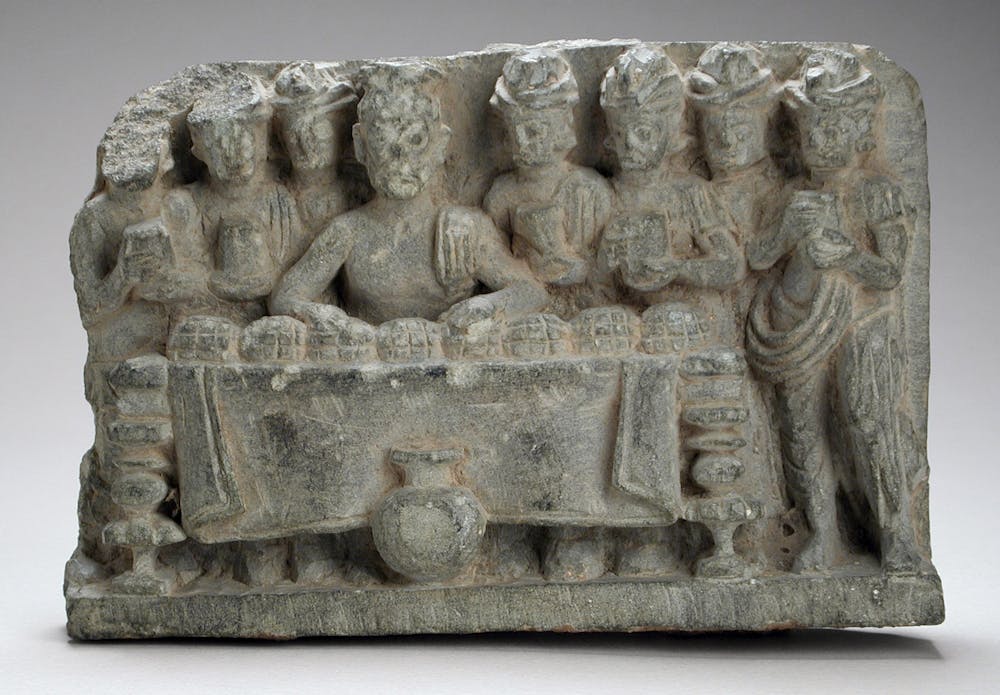
In my recent book “Gods and Robots,” I explain that many ancient societies imagined and constructed automatons. Chinese chronicles tell of emperors fooled by realistic androids and describe artificial servants crafted in the second century by the female inventor Huang Yueying. Techno-marvels, such as flying war chariots and animated beings, also appear in Hindu epics. One of the most intriguing stories from India tells how robots once guarded Buddha’s relics. As fanciful as it might sound to modern ears, this tale has a strong basis in links between ancient Greece and ancient India.
The story is set in the time of kings Ajatasatru and Asoka. Ajatasatru, who reigned from 492 to 460 B.C., was recognized for commissioning new military inventions, such as powerful catapults and a mechanized war chariot with whirling blades. When Buddha died, Ajatasatru was entrusted with defending his precious remains. The king hid them in an underground chamber near his capital, Pataliputta (now Patna) in northeastern India.
A sculpture depicting the distribution of the Buddha’s relics.
Traditionally, statues of giant warriors stood on guard near treasures. But in the legend, Ajatasatru’s guards were extraordinary: They were robots. In India, automatons or mechanical beings that could move on their own were called “bhuta vahana yanta,” or “spirit movement machines” in Pali and Sanskrit. According to the story, it was foretold that Ajatasatru’s robots would remain on duty until a future king would distribute Buddha’s relics throughout the realm.
Ancient robots and automatons
A statue of Visvakarman, the engineer of the universe.
Hindu and Buddhist texts describe the automaton warriors whirling like the wind, slashing intruders with swords, recalling Ajatasatru’s war chariots with spinning blades. In some versions the robots are driven by a water wheel or made by Visvakarman, the Hindu engineer god. But the most striking version came by a tangled route to the “Lokapannatti” of Burma – Pali translations of older, lost Sanskrit texts, only known from Chinese translations, each drawing on earlier oral traditions.
In this tale, many “yantakara,” robot makers, lived in the Western land of the “Yavanas,” Greek-speakers, in “Roma-visaya,” the Indian name for the Greco-Roman culture of the Mediterranean world. The Yavanas’ secret technology of robots was closely guarded. The robots of Roma-visaya carried out trade and farming and captured and executed criminals.
Robot makers were forbidden to leave or reveal their secrets – if they did, robotic assassins pursued and killed them. Rumors of the fabulous robots reached India, inspiring a young artisan of Pataliputta, Ajatasatru’s capital, who wished to learn how to make automatons.
In the legend, the young man of Pataliputta finds himself reincarnated in the heart of Roma-visaya. He marries the daughter of the master robot maker and learns his craft. One day he steals plans for making robots, and hatches a plot to get them back to India.
Certain of being slain by killer robots before he could make the trip himself, he slits open his thigh, inserts the drawings under his skin and sews himself back up. Then he tells his son to make sure his body makes it back to Pataliputta, and starts the journey. He’s caught and killed, but his son recovers his body and brings it to Pataliputta.
Once back in India, the son retrieves the plans from his father’s body, and follows their instructions to build the automated soldiers for King Ajatasatru to protect Buddha’s relics in the underground chamber. Well hidden and expertly guarded, the relics – and robots – fell into obscurity.
Two centuries after Ajatasatru, Asoka ruled the powerful Mauryan Empire in Pataliputta, 273-232 B.C. Asoka constructed many stupas to enshrine Buddha’s relics across his vast kingdom. According to the legend, Asoka had heard the legend of the hidden relics and searched until he discovered the underground chamber guarded by the fierce android warriors. Violent battles raged between Asoka and the robots.
In one version, the god Visvakarman helped Asoka to defeat them by shooting arrows into the bolts that held the spinning constructions together; in another tale, the old engineer’s son explained how to disable and control the robots. At any rate, Asoka ended up commanding the army of automatons himself.
Exchange between East and West
Is this legend simply fantasy? Or could the tale have coalesced around early cultural exchanges between East and West? The story clearly connects the mechanical beings defending Buddha’s relics to automatons of Roma-visaya, the Greek-influenced West. How ancient is the tale? Most scholars assume it arose in medieval Islamic and European times.
But I think the story could be much older. The historical setting points to technological exchange between Mauryan and Hellenistic cultures. Contact between India and Greece began in the fifth century B.C., a time when Ajatasatru’s engineers created novel war machines. Greco-Buddhist cultural exchange intensified after Alexander the Great’s campaigns in northern India.
Inscriptions in Greek and Aramaic on a monument originally erected by King Asoka at Kandahar, in what is today Afghanistan.
In 300 B.C., two Greek ambassadors, Megasthenes and Deimachus, resided in Pataliputta, which boasted Greek-influenced art and architecture and was the home of the legendary artisan who obtained plans for robots in Roma-visaya. Grand pillars erected by Asoka are inscribed in ancient Greek and name Hellenistic kings, demonstrating Asoka’s relationship with the West. Historians know that Asoka corresponded with Hellenistic rulers, including Ptolemy II Philadelphus in Alexandria, whose spectacular procession in 279 B.C. famously displayed complex animated statues and automated devices.
Historians report that Asoka sent envoys to Alexandria, and Ptolemy II sent ambassadors to Asoka in Pataliputta. It was customary for diplomats to present splendid gifts to show off cultural achievements. Did they bring plans or miniature models of automatons and other mechanical devices?
I cannot hope to pinpoint the original date of the legend, but it is plausible that the idea of robots guarding Buddha’s relics melds both real and imagined engineering feats from the time of Ajatasatru and Asoka. This striking legend is proof that the concepts of building automatons were widespread in antiquity and reveals the universal and timeless link between imagination and science.
The top Republican on the U.S. House Armed Services Committee said on Tuesday he opposed President Donald Trump’s plan to use $7 billion from the military budget to build a wall on the border with Mexico.
Representative Mac Thornberry said he backs the wall, but not with Pentagon funds, calling Trump’s overall $750 billion defense budget request “the bare minimum” of what the U.S. military needs.
“There are things you can’t do if you fund non-defense items with defense dollars, and I don’t think that’s a good idea whatever the merits of the other program,” Thornberry, a Republican representing the Texas Panhandle, said at a roundtable with journalists.
The comments from Thornberry, a former chairman of the Armed Services panel, underscored the bipartisan opposition facing the budget Trump sent to Congress on Monday, even among those who back many of his programs.
Democrats dismissed the budget proposal as dead on arrival.
Thornberry also questioned Trump’s request for $165 billion of the Pentagon’s war-fighting account, nearly three times last year’s $60 billion allocation, and widely seen as an attempt to spend more on the military without having to reach an agreement with Democrats on spending for domestic programs.
“I don’t think this is the Pentagon’s idea,” Thornberry said, instead calling for the two sides to negotiate a spending agreement.
Thornberry joined many of his fellow Republicans as well as Democrats in disputing the wisdom of steep cuts at the State Department - Trump proposed reducing spending on diplomacy by 23 percent and slashing more than 30 percent from foreign aid.
“We need the State Department,” he added.
Separately, Congress is on the verge of approving a resolution to reject Trump’s declaration of an emergency at the southern border as a way to get money to build the wall - and keep a campaign promise - without lawmakers’ approval.
Reporting by Patricia Zengerle, editing by G Crosse





 AFP / Sophie RAMIS
  AFP / SEGUN OGUNFEYITIMI
  AFP / SEGUN OGUNFEYITIMI