French citizen Mehdi Nemmouche was sentenced to life in jail on Monday for shooting dead four people in a Jewish museum in 2014, telling the court “life goes on” in his last words to the jury.
The families of victims and survivors of the attacks voiced relief at the end of a two-month-long jury trial dogged by controversy over what they denounced as conspiracy theories put forward by Nemmouche’s defense lawyers.
Nemmouche, 33, who staged the attack after coming back from Syria, spat out just that one short phrase ahead of the jury’s final deliberation on the length of his penalty on Monday.
Nacer Bendrer, another French citizen being tried as Nemmouche’s accomplice told the court, “I am ashamed to be here ... I am ashamed to have crossed paths with this guy. He is not a man, he is a monster.”
The 12-person jury convicted Bendrer to 15 years in prison for acting as an accomplice. He was suspected of providing the weapon used in the shooting.
The attack in May 2014 - the first by a Western European who fought with Islamist militant factions in Syria’s civil war - highlights the threat posed by jihadist returning home.
The shooting killed an Israeli tourist couple, Myriam and Emmanuel Riva, and two employees of the museum, Dominique Sabrier and Alexandre Strens.
In final words, the prosecutor Yves Moreau called on the jury to hand down a tough sentence: “He will get out of jail and he’ll go on another crusade and start killing again,” he was cited by the state broadcaster RTBF as saying on Monday.
Turning to Nemmouche, who was largely impassive and refused to speak during the trial, he took aim at his lack of contrition. “The cherry on the cake: you aren’t even capable of taking responsibility for your acts,” he said.
Nemmouche, 33 - who was radicalized in the jail, according to investigators - is also facing charges in France over his role in holding hostage journalists in Syria.
During the high-profile trial, the two French journalists had testified that they remembered Nemmouche as a deeply anti-Semitic, sadistic and full of hatred.
Defense lawyers, who had alleged that prosecutors doctored video footage of the attack and that Nemmouche was framed in a settling of accounts between spies including Mossad agents, said he would not appeal the sentence.
Reporting by Clement Rossingnol; Additional by Clare Roth; Writing by Alissa de Carbonnel; Editing by Jan Strupczewski
A dissident Republican group calling itself the “IRA” claimed responsibility on Tuesday for letter bombs sent to buildings in London and the University of Glasgow last week.
“The claim was allegedly made on behalf of the ‘IRA’,” British police said.
The group used a recognized codeword, police said.
Police blew up a parcel sent to the University of Glasgow on March 6, and said it was linked to three devices sent to major transport hubs in London the day before.
White postal bags holding small bombs were sent to London’s Heathrow and City airports and Waterloo, the capital’s busiest train station, on March 5. One device caught fire when opened but caused no injuries and services continued at all three hubs.
The group, which calls itself the IRA, is made up of militants opposed to Northern Ireland’s 1998 peace deal.
It is separate and far smaller than the Provisional IRA, which was responsible for almost half of the 3,600 deaths during 30 years of violence and which disbanded after the peace deal.
Dissident groups are smaller in number and capability though they have claimed lives in recent years including of two prison officers.
Reporting by Elisabeth O'Leary; editing by Guy Faulconbridge and William Schomberg
Stuck on ice with dogs that refused to mush, lead Iditarod sledder Nicolas Petit dropped from the famed Iditarod Trail Sled Dog Race late Monday.
An early favorite in the world’s best-known dog-sled race, Petit had been stuck for most of the day with his dogs on a section of Bering Sea ice about 200 miles from the finish line in Nome. The dogs refused to move, and Petit ultimately had them taken off the trail by snowmobile.
“Petit scratched in the best interest of his race team’s mental well-being,” said a statement released by Iditarod race managers.
The 1,000-mile race started on March 2 in Anchorage. The winner will take home about $50,000 and a new truck, part of a total race purse of $500,000.
Fifty-two mushers started the race. As of Monday night, seven, including Petit, had dropped out.
The winner is expected in Nome sometime early Wednesday.
The new Iditarod leaders as of Monday night were Pete Kaiser of Bethel, Alaska; Joar Leifseth Ulsom, a Norwegian musher who won last year’s race; and Jessie Royer of Fairbanks.
Kaiser, who is Yupik, would be the first Alaska Native musher to win the Iditarod since 2011. As of late Monday, he was at the village of Elim, about 120 miles from the Nome finish line.
Royer would be the first woman to win the race since 1990, when Susan Butcher claimed her fourth victory.
Petit ran into trouble last year in nearly the same spot of the Bering Sea Coast when he was in position to win the 2018 race. But Petit, a French musher who lives in the Alaska ski community of Girdwood, got lost in a snowstorm. Leisfeth Ulsom passed him, and Petit wound up in second place.
This year’s collapse was precipitated by a dog fight, Petit told race officials. The troubles started when a dog named Joee jumped on a younger dog, Petit said in a video posted on the Iditarod’s website.
“I yelled at Joee. And everybody heard Daddy yelling. It doesn’t happen. And then they wouldn’t go anymore. Anywhere. So we camped here,” he said in the interview, conducted Monday morning on the Bering Sea coast.
Reporting by Yereth Rosen in Anchorage, Alaska; additional writing by Rich McKay in Atlanta; editing by Larry King
Former Vice President Joe Biden, who is weighing a 2020 presidential bid, will find a friendly audience on Tuesday when he addresses a meeting of the International Association of Firefighters in Washington.
Biden has a decades-long relationship with the IAFF, a labor union that represents more than 300,000 workers, and IAFF President Harold Schaitberger has urged Biden to jump into the White House race.
An early endorsement from the union would give Biden extra momentum in a crowded field of more than a dozen Democrats jockeying for the party’s presidential nomination. It could also be an exception this election cycle.
With so many labor-friendly Democratic candidates in the mix, unions expect to have increased clout. But there will be stiff competition to get their formal backing, and endorsements may come later than in past cycles - or not at all, union leaders said in interviews.
“We aren’t rushing in making a decision this time around because we believe the field is so strong and we want to give people an opportunity to answer questions,” said Lee Saunders, the president of American Federation of State, County and Municipal Employees (AFSCME), which represents more than 1.6 million public employees.
Unions are a force in Democratic politics and endorsements can be a powerful force in primaries and general elections, marshalling the support of millions of union members across the country.
If labor groups hold off on endorsing, however, it could mean less organized support from their members for any specific candidate. Those efforts often include making phone calls and knocking on doors to educate and mobilize voters.
Randi Weingarten, the president of the American Federation of Teachers (AFT), which has about 1.7 million members, said the union’s executive council met in February to finalize an endorsement process designed to maximize local engagement that will be presented to members this month.
“You either chase a race or shape a race,” Weingarten said. “We want the candidates to not only hear the aspirations and the values and the needs of our members, we want the candidates to engage with us, not just tell us what they think, but answer the questions of our members.”
The Service Employees International Union (SEIU), with 1.9 million members, will bring back the “walk a day” program it used in the 2007-2008 presidential campaign and invite White House contenders to spend a day at work with one of its members. Participation in the program will be among the criteria the union uses as a baseline for supporting candidates, an official said.
Saunders and Weingarten said they could foresee a scenario in which their memberships are divided among several qualified candidates and the national unions do not endorse during the primary at all.
The AFT was the first national union to endorse Hillary Clinton in June 2015, early in her Democratic primary contest against Senator Bernie Sanders. AFSCME endorsed her in mid-October of that year, and SEIU endorsed Clinton the next month.
Sanders secured national endorsements from National Nurses United, the American Postal Workers Union and the Communications Workers of America.
The IAFF did not endorse a 2016 presidential candidate after Biden decided not to run.
In Iowa, which holds the first presidential nominating contest, Clinton defeated Sanders by less than one percentage point but won union households by 9 percentage points. AFSCME said hundreds of its members there knocked on more than 8,000 doors.
In the week before the November 2016 contest against now President Donald Trump, the SEIU mobilized tens of thousands of members and volunteers to knock on 1.4 million doors in swing states on Clinton’s behalf.
Weingarten said even if an AFT endorsement is delayed, or comes after the primary, the union will encourage its members to get involved with candidates they support.
“We’re not saying to people don’t get involved until we endorse,” Weingarten said.
Reporting by Amanda Becker; Editing by Colleen Jenkins and Phil Berlowitz
Like generals planning for the last war, oil company managers and government inspectors tend to believe that because they survived the 2010 BP Deepwater Horizon oil spill, they are ready for all contingencies. Today they are expanding drilling into deeper and deeper waters, and the Trump administration is opening more offshore areas to production.
In fact, however, the worst-case scenario for an oil spill catastrophe is not losing control of a single well, as occurred in the BP disaster. Much more damage would be done if one or more of the thousand or so production platforms that now blanket the Gulf of Mexico were destroyed without warning by a deep-sea mudslide.
Instead of one damaged wellhead, a mudslide would leave a tangled mess of pipes buried under a giant mass of sediments. It would be impossible to stop the discharge with caps or plugs, and there would be little hope of completing dozens of relief wells to stop discharge from damaged wells. Oil might flow for decades.
This scenario has already occurred, and we are seeing the results at a well off Louisiana, owned by Taylor Energy, that has been leaking oil since 2004. Based on this disaster and my 30 years of experience studying deep-sea oil and gas seeps, I believe that regulators and energy companies should be doing much more to prevent such catastrophes at other sites.
Active leases for oil and gas drilling in the Gulf of Mexico.
The mudslide that caused the Taylor Energy leak was not an isolated event. Many major features of the Gulf of Mexico’s continental slope – where the sea bottom descends from the continent’s outer edge down to the deep ocean floor – were formed when that slope failed. Their bathymetric contours show unmistakable signs of massive mudslides in the past.
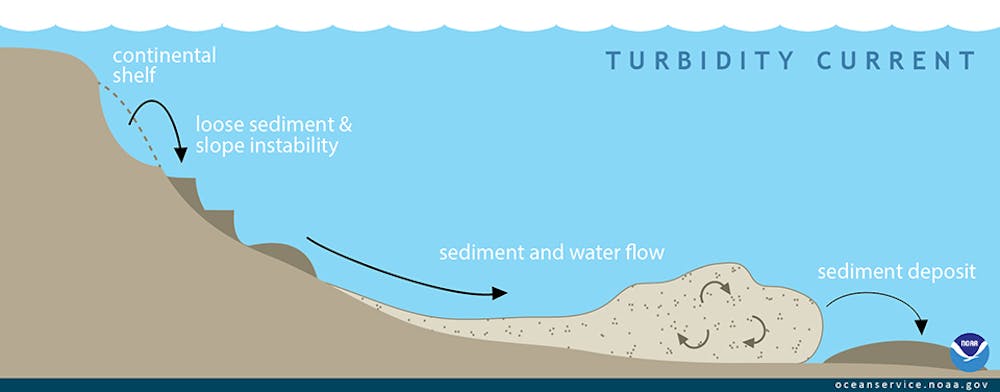
Despite generations of oil production, the sedimentary strata of the northern Gulf of Mexico still harbor billions of barrels of oil. The modern, loose material that lies atop these rock layers is also susceptible to failure, which generates a phenomenon known as turbidity currents. These are massive avalanches of sliding material partly suspended in water, which can travel for miles with astonishing speed.
One of the most famous turbidity currents occurred in 1929 following a 7.2 magnitude earthquake centered near Newfoundland’s Grand Banks. The resulting slide displaced over 40 cubic miles of material, traveling at 50 miles per hour for up to 300 miles.
Turbidity currents can be caused by earthquakes, collapsing slopes and other geological disturbances. Once set in motion, the turbid water rushes downward and can change the physical shape of the seafloor.
In 2004, storm surge and monster waves from Hurricane Ivan initiated the huge mudslide that destroyed the Taylor Energy platform, an aging facility called MC20A, located about 12 miles off the Mississippi River’s Birdfoot Delta. Company engineers claim it had only three flowing wells before it was toppled. Its wells were equipped with subsurface safety valves that were reportedly closed off when the platform was evacuated ahead of the storm.
These valves apparently failed, because miles-long oil slicks have been seen on the waters above ever since the 2004 mudslide. Despite years of effort and expenditure of more than US$230 million, oil is still flowing from beneath the legs of the downed platform at a magnitude I estimate to be at least 100 barrels per day. This event is the longest oil spill in U.S. history.
In deeper waters, modern platforms are specifically designed to resist hurricanes. However, earthquakes also occur in the northern Gulf of Mexico. The National Earthquake Information Center had recorded eight earthquakes in the region prior to 2009, with magnitudes ranging from 3.2 to 5.9. On May 6, 2018 a magnitude 4.6 event occurred at a depth of 6,500 feet.
Newer versions of subsurface safety valves on these platforms are intended to protect automatically against storms or ship collisions. Mudslides generated by earthquakes represent forces on an entirely different scale. Once a flow starts, it could travel for tens of miles, producing an unstoppable wave that would destroy whatever platforms and pipelines that lay in its path.
Modern deepwater oil and gas platforms dwarf Taylor Energy’s MC20A platform in every respect. They are located 100 miles or more from land in water 10 or 20 times deeper. Typically, platforms service a hub of pipelines and robotically controlled structures connecting scores of wells from other oilfields that can be 25 miles or more distant. They are designed for peak production rates of 100,000 to 200,000 barrels of oil per day.
How a deep-sea offshore drilling rig works.
Using platforms to monitor risk
How should planners prepare for this hazard? A 2007 Interior Department study analyzed the danger and proposed guidelines for assessing risks to platforms and pipelines, starting with studies to identify areas of steep or unstable bottom. The agency recently released a digital map of the northern Gulf of Mexico’s deeper waters that shows evidence of past mudslides with graphic realism. Slope failure and turbidity currents are truly part of the gulf’s nature.
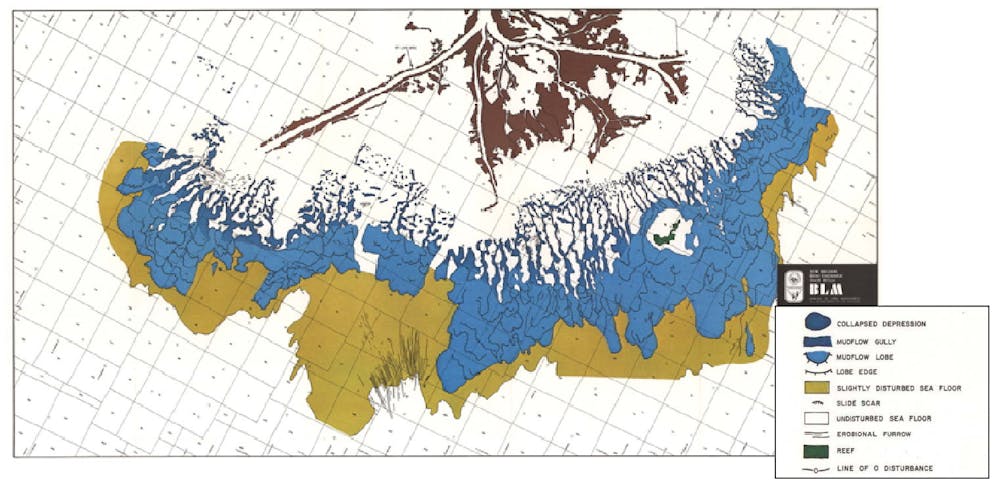
Ironically, however, the map doesn’t cover areas closer to shore. Our most comprehensive survey of mud deposits offshore from the Mississippi Delta dates to the 1980s, but over the last 40 years development and dredging have accelerated sediment loss from the Mississippi Delta. This near-shore sediment load represents a looming risk, much like snowpack in avalanche country.
The Mississippi Delta region of the Gulf of Mexico is crisscrossed by hundreds of miles of oil pipelines and dozens of still-producing oil platforms. As the 2007 Interior Department study showed, these structures are at risk for hurricane-generated mudslides. Obtaining updated survey information using modern methods should be a top priority.
Underwater features in the Mississippi Delta, mapped in 1980. Hundreds of pipelines cross this mudslide-prone area.
There are ways to assess risks in deeper areas as well, including zones such as the Atlantic coast where the Trump administration wants to expand offshore exploration and eventual oil production. This coast is also characterized by submarine canyons formed by turbidity currents.
Oil companies spend billions of dollars to install and operate offshore platforms, but typically resist requests to use their infrastructure for monitoring the marine environment. If they could be induced to cooperate, one option would be to install networks of ocean bottom seismometers to listen for earth movements that might signal risky instability. These systems could transmit data back to land over the platforms’ high-speed communication systems. Platforms could also be used to monitor the heat content of Gulf of Mexico waters, surveying for conditions that promote the rapid intensification of hurricanes.
In my view, U.S. regulators and energy companies have not paid enough attention to hidden vulnerabilities and long-term risks across our fossil fuel economy. But addressing this issue could produce real benefits. Conducting studies to identify unstable slopes will improve our understanding of the seabed. Monitoring for critical warning signs of storms will help coastal communities prepare. Better technology can make offshore infrastructure more durable, and informed regulation can make the offshore industry more vigilant. This would be the best-case scenario.
The sentencing of Australian Cardinal George Pell for child sex crimes will be broadcast live Wednesday in a rare move by the local judiciary, which had kept his trial under wraps for months with a draconian gag order.
Pell, the most senior Catholic clergyman ever found guilty of child sex abuse, faces a maximum 50 years in prison for assaulting two choirboys in a Melbourne cathedral in 1996-97.
The 77-year-old Australian was found guilty by a jury in December, but a suppression order from county court Chief Judge Peter Kidd prevented media from reporting the case until late February, when prosecutors withdrew plans to hold a second trial.
The controversial suppression order had banned any reporting on Pell's case since June 2018.
In support of the principles of "open justice", the Melbourne court said Tuesday it will allow video showing Justice Kidd reading out his sentencing remarks.
No-one else in the courtroom, including Pell who is currently in custody, will be filmed.
"The County Court is committed to the principles of open justice. Chief Judge Peter Kidd's sentencing remarks in this matter will be broadcast live," a County Court spokesman said in a brief statement.
Australian courtrooms rarely allow live broadcasts of court proceedings, and this is believed to be the first time the County Court in Melbourne is allowing such a move.
Pell has already lodged his leave to appeal the guilty verdict, with the hearings in the Court of Appeal scheduled to be heard on June 5-6.
The verdict ignited a storm of public debate about the Church's handling of child sex abuse allegations given Pell's lead role in setting up the process in Melbourne in 1996.
The case is also expected to encourage victims of alleged sex abuse by other clergy to come forward.
Advocates said the sentencing would be an important symbol for other survivors of child sex abuse.
"Hopefully, this sentencing can herald fundamental change in the Church and other institutions," Cathy Kezelman, the president of child abuse victims support group Blue Knot Foundation, said in a statement Tuesday.
"It needs to be a time for zero tolerance to abuse, and survivor respect, support and justice."
Former Texas congressman Beto O’Rourke is heading to the early presidential voting state of Iowa this weekend, fuelling speculation that the Democrat is poised to enter the White House race.
O’Rourke said last week he had made a decision about whether to seek the Democratic nomination for president. A trip to Iowa on Saturday, where the first votes in the nominating contest will be cast in February, suggests his entry into the race is imminent.
In an announcement posted on Twitter, Eric Giddens, an Iowa Democrat who is running in a special election for a state senate seat, said his campaign workers and O’Rourke will be urging students this Saturday at the University of Northern Iowa to vote in his election race.
The tweet by Giddens was accompanied by a video of O’Rourke speaking from his home city of El Paso, Texas, wearing a University of Northern Iowa baseball cap and urging UNI students to vote for Giddens.
“Supporting him for state Senate is the way that we get Iowa, and by extension, this country, back on the right track,” O’Rourke says. “UNI, we’re counting on you, and we’re looking forward to seeing you soon. Adios.”
Chris Evans, a spokesman for O’Rourke, confirmed in an email to Reuters that O’Rourke will be in Waterloo, Iowa, campaigning for Giddens on Saturday afternoon. He did not respond to requests about whether O’Rourke was planning to run for president.
With its position as first in the nation status when it comes to presidential nominating battles, Iowa can sometimes make or break candidacies and is an early and frequent destination for White House hopefuls.
Other Democratic presidential candidates have already visited Iowa ahead of O’Rourke’s visit.
O’Rourke, 46, rose to national prominence last year when he narrowly lost his bid to defeat Republican U.S. Senator Ted Cruz.
O’Rourke had previously said he would decide by the end of February if he would launch a White House campaign, and speculation around his plans mounted after several high-profile public appearances.
He sat for an interview with Oprah Winfrey in New York and held a rival rally last month to decry Trump’s immigration policy as the president promoted his planned border wall in El Paso. He has also visited the general election battleground state of Wisconsin.
Conor McGregor was arrested in Miami Beach on Monday after a fan said the Irish mixed martial arts fighter smashed his phone and walked off with the shattered remains, police records show.
McGregor, 30, was booked into a correctional center on suspicion of robbery and criminal mischief, according to an arrest affidavit. The incident took place shortly after 5 a.m. (0900 GMT) on Monday.
McGregor was later released on a $125,000 bond, the Miami Herald reported.
Samuel Rabin Jr., a Miami-based attorney representing McGregor, said the fighter was involved in a “minor altercation involving a cellphone” and would cooperate fully with police, the Herald reported.
The arrest report, which did not identify McGregor by name, said “the victim attempted to take a picture of the defendant with his cell phone” outside a hotel.
“The defendant slapped the victim’s phone out of his hand, causing it to fall to the floor. The defendant then stomped on the victim’s phone several times, damaging it,” the report said, adding that the device was valued at $1,000.
McGregor was charged in April 2018 with three counts of assault and one count of criminal mischief after police said he attacked a charter bus in New York carrying UFC fighters, .
He later pleaded guilty to a reduced disorderly conduct charge.
Reporting by Dan Whitcomb, additional reporting by Rich McKay; Editing by Alistair Bell and John Stonestreet
World Wide Web inventor Tim Berners-Lee on Monday slammed the increasing commodification of personal information and appealed for internet users to strive to maintain "complete control" of their data.
Berners-Lee, credited with creating the web in 1989, is on a mission to save his invention from a range of problems increasingly dominating online life, including misinformation and a lack of data protection.
"You should have complete control of your data. It's not oil. It's not a commodity," he told a small group of journalists gathered at Europe's physics lab CERN, where he first came up with the idea for the web 30 years ago.
When it comes to personal data, "you should not be able to sell it for money," he said, "because it's a right".
Berners-Lee, who last year launched a development platform called "Solid" aimed at giving users control of their data, described a frightening future if we do not rise to the challenge of privacy protection.
"There is a possible future you can imagine (in which) your browser keeps track of everything that you buy," he said.
In this scenario, "your browser actually has more information then Amazon does", he said, warning against complacency in expecting no harm will come from this loss of control over one's own data.
"We shouldn't assume that the world is going to stay like it is," he said.
People needed to do more to protect themselves and their data and not to simply expect that governments will look out for their best interests, he argued.
Berners-Lee told a Washington Post event last week that he launched the Solid projet in response to concerns about personal data being bought and sold without the consent of users.
- 'Don't fail the web -
The platform aimed "to separate the apps from the data storage" so users could decide where and how they would share their personal information, he said.
He acknowledged Monday that enforcible laws would be needed to protect the most sensitive personal data.
"Sometimes it has to be legislation which says personal data, you know, genetic data, should never be used," he said.
In addition to his work advocating for data protection, Berners-Lee has launched a "Contract for the Web", aimed at ensuring the integrity of online information.
In a letter published Monday, he hailed the opportunities the web had created, giving marginalised groups a voice and making daily life easier.
But he warned, "it has also created opportunity for scammers, given a voice to those who spread hatred, and made all kinds of crimes easier to commit".
He was nevertheless optimistic that the problems could be fixed.
"Given how much the web has changed in the past 30 years, it would be defeatist and unimaginative to assume that the web as we know it can't be changed for the better in the next 30," he wrote.
"If we give up on building a better web now, then the web will not have failed us. We will have failed the web."
Two senior U.S. senators asked U.S. Customs and Border Protection on Monday to provide information on a report that the agency inappropriately tracked seven American journalists covering the migrant caravan from Central America last year.
Republican Chuck Grassley, chairman of the Senate Finance Committee, and Ron Wyden, the panel’s top Democrat, wrote a letter to CBP Commissioner Kevin McAleenan asking for an unclassified briefing no later than Thursday.
They cited news reports alleging the border agency and the Department of Homeland Security “inappropriately flagged for scrutiny seven American journalists.”
“Unless CBP had reason to believe the individuals in question were inciting violence or physical conflict, it is deeply concerning that CBP appears to have targeted American journalists at our borders,” Grassley and Wyden wrote.
Representatives of the agency did not immediately respond to Reuters requests for comment on Monday.
The senators referred to an NBC News report last week about documents listing 10 journalists, an attorney and 47 others, some of them labeled organizers and instigators from the United States and elsewhere.
The NBC affiliate in San Diego, KNSD-TV, said it received the documents from an unidentified source in the Department of Homeland Security, which includes Customs and Border Protection.
At least three journalists and the attorney listed on the documents were unable to enter Mexico to work because of alerts placed on their passports and others have been subject to secondary screenings when crossing the border, the news station reported.
Reuters did not see the documents and was unable independently to corroborate NBC’s findings. One of the journalists the station said was listed was Go Nakamura, a photographer who has done several freelance assignments for Reuters and began covering the caravan on Nov. 10.
CBP spokesman Andrew Meehan said in a statement last week that the tracking was related to assaults on agents that occurred during November and January. CBP does not target journalists for inspections, he said.
Reporting by Mohammad Zargham; Editing by Peter Cooney
The future of Britain’s exit from the European Union hung in the balance on Tuesday as lawmakers prepared to vote on a divorce deal after Prime Minister Theresa May won last-minute assurances from the European Union.
Scrambling to plot an orderly path out of the Brexit maze just days before the United Kingdom is due to leave, May rushed to Strasbourg on Monday to agree ‘legally binding’ assurances with European Commission President Jean-Claude Juncker.
British lawmakers, who on Jan. 15 voted 432-202 against her deal, were on Tuesday studying the assurances with lawyers. The government’s top lawyer, Geoffrey Cox, is due to give his opinion on Tuesday ahead of the vote due around 1900 GMT.
“We have secured legal changes,” May said in a late night news conference in Strasbourg beside Juncker, 17 days before the United Kingdom is due to leave the EU on March 29.
May said the assurances created an arbitration channel for any disputes on the backstop, “entrenches in legally-binding form” existing commitments that it will be temporary and binds the UK and EU to starting work on replacing the backstop with other arrangements by December 2020.
After two-and-a-half years of haggling since the 2016 Brexit referendum, Juncker cautioned this was the last chance for Britain. “It is this deal or Brexit might not happen at all,” he said.
Sterling rose 1.5 percent against the dollar and to a near two-year high against the euro.
If lawmakers vote down May’s deal, she has promised a vote on Wednesday on whether to leave without a deal and, if they reject that, then a vote on whether to ask for a limited delay to Brexit.
The United Kingdom’s labyrinthine crisis over EU membership is approaching its finale with an array of possible outcomes, including a delay, a last-minute deal, a no-deal Brexit, a snap election or even another referendum.
Brexit will pitch the world’s fifth largest economy into the unknown and many fear it will divide the West as it grapples with both the unconventional U.S. presidency of Donald Trump and growing assertiveness from Russia and China.
BREXIT VOTE
Supporters of Brexit say while the divorce might bring some short-term instability, in the longer term it will allow the United Kingdom to thrive and also enable deeper EU integration without such a powerful reluctant member.
Brexit-supporting lawmakers in May’s party had accused her of botching the negotiations with Brussels. Many Brexiteers fear the backstop, aimed at avoiding controls on the border between the British province of Northern Ireland and EU-member Ireland, could trap the United Kingdom in the EU’s orbit indefinitely.
May announced three documents - a joint instrument, a joint statement and a unilateral declaration - which she said were aimed at addressing the Irish backstop, the most contentious part of the divorce deal she agreed with the EU in November.
Former Brexit Secretary David Davis welcomed the requirement to make alternative arrangements for the backstop, the date and the international arbitration.
“All those things together, make this just about, just about acceptable to me but it depends very, very heavily on a robust, clear response from (Attorney General Geoffrey) Cox,” Davis told Talk Radio. “If Geoffrey Cox is at all equivocal about it then I think it will fall again.”
The immediate reaction was cautious from Brexit-supporting lawmakers and from the Northern Irish Democratic Unionist Party (DUP) which props up May’s minority government.
“We will be taking appropriate advice, scrutinizing the text line by line and forming our own judgment,” a DUP spokesman said.
Jacob Rees-Mogg, leader of a faction in May’s Conservative Party demanding a clean break from the EU, also said he was waiting for legal advice. “This has been desperately rushed,” he told the BBC. “I think it would be better to have the vote tomorrow when people had more mature consideration.”
The motion put forward by the government said the joint instrument “reduces the risk” that the United Kingdom would be trapped in the backstop.
If the backstop comes into force and talks on the future relationship break down, May said the unilateral declaration she announced would make clear there was nothing to stop London from moving to leave the backstop.
Former Attorney General Dominic Grieve, an opponent of Brexit, said the changes to May’s deal did not make a material difference.
Additional reporting by Elisabeth O'Leary and Alistair Smout; Writing by Guy Faulconbridge; Editing by Janet Lawrence
As Venezuela’s five-day power blackout left homes without water, Lilibeth Tejedor found herself looking for it on Monday in the last place she would have imagined - a drain pipe feeding into a river carrying sewage through the capital, Caracas.
Tejedor, 28, joined dozens of people who had flocked to the Guaire river, which snakes along the bottom of a sharp ravine alongside Caracas’ main highway, to fill up a four-gallon (15 liter) plastic container.
Unlike the fetid liquid flowing through the Guaire river, the water emerging from the pipe was at least clear. Those who gathered to collect it said the water had been released by local authorities from reservoirs.
They added, however, that it was being carried through unsanitary pipes and should only be used to flush toilets or scrub floors.
“I’ve never even seen this before. It’s horrible, horrible,” said Tejedor, preparing to carry the container on a small hand cart back to her home in the neighborhood of San Agustin.
Tejedor, who works at a computer technology store, has a two-year-old daughter and takes care of two nieces.
“The ones that are most affected are the children, because how do you tell a child that there’s no water?” she said.
The lack of water has become one of the most excruciating side effects of the nationwide blackout that the government of President Nicolas Maduro has blamed on U.S.-backed sabotage but his critics call the product of corruption and incompetence.
The blackout has worsened the situation of a country already facing a hyperinflationary economic collapse that has spurred a mass migration and turned once-basic items like corn flour and toilet paper into unaffordable luxuries for most people.
After five days without electricity to pump water, Venezuelans from working-class neighborhoods to upscale apartment towers are complaining of increasingly infrequent showers, unwashed dishes, and stinking toilets.
Caracas needs 20,000 liters of water per second from nearby watersheds to maintain service, said Jose de Viana, an engineer who ran Caracas’ municipal water authority in the 1990s.
Last week that had fallen to around 13,000 and since Thursday’s blackout it has halted completely, he said.
‘KILLING US’
Many worry about the spread of disease. The lack of water compounds the inability to buy soap due to soaring prices or chronic shortages.
Opposition leader Juan Guaido, who in January invoked the constitution to assume the interim presidency after declaring Maduro’s re-election a fraud, led the country’s legislature on Monday in declaring a “state of alarm” over power problems.
Maduro is facing an unprecedented political crisis and the United States, which backs Guaido, has levied crippling oil industry sanctions meant to starve the government of its sources of foreign revenue.
Up the road from where Tejedor stood, hundreds of angry residents blocked the highway on Monday to demand that local authorities deliver a 20,000-liter cistern to supply water to the neighborhood of La Charneca.
“They’re killing us with hunger and thirst,” said Gladys Martinez, 52, a homemaker, who joined the demonstration that blocked two lanes of the highway, snarling traffic and drawing dozens of police and National Guard troops to the scene.
Along the riverbed, teenagers and children accompanied their parents to help carry water. As two children began stomping in the sewage, a woman warned them: “That water’s dirty! Don’t start playing around because remember there’s no medicine.”
Water trucks, a common sight in Caracas, are increasingly struggling to fill up because state-run reservoirs are running low.
On the northern edge of Caracas, where the city meets the El Avila national park, hundreds of people lined up to collect water from mountain streams.
Lack of water, along with the power outage, has become a major concern for hospitals - which have for years suffered from lack of equipment and supplies.
Jose Velez, 58, a security guard who also arrived at the Guaire to collect water, said the blackout had made life unbearable and wished the country’s politicians would agree on how to resolve the situation.
“I’m not interested in these politicians, they never agree on anything,” said Velez. “I want my life to go back to normal.”
Reporting by Brian Ellsworth and Vivian Sequera; Editing by Daniel Flynn and Rosalba O'Brien
The United States will withdraw all remaining diplomatic personnel from Venezuela this week, the U.S. State Department said late on Monday, citing the deteriorating situation in the country after months of political unrest.
It followed Washington’s Jan. 24 decision to withdraw all dependents and reduce embassy staff to a minimum in the South American country hit by unrest over a contested presidential election.
“This decision reflects the deteriorating situation in Venezuela as well as the conclusion that the presence of U.S. diplomatic staff at the embassy has become a constraint on U.S. policy,” the State Department said in a statement.
It did not give more details or set a day for when personnel would be withdrawn from the embassy in Caracas.
Venezuela’s congress on Monday declared a “state of alarm” over a five-day power blackout that has crippled the OPEC nation’s oil exports and left millions of citizens scrambling to find food and water.
Venezuela also suspended school and business activities on Tuesday due to the power blackout, Information Minister Jorge Rodriguez said in a televised broadcast on Monday, the third such cancellation since power went out last week.
The outage has added to discontent in a country already suffering from hyperinflation and a political crisis after opposition leader Juan Guaido assumed the interim presidency in January after declaring President Nicolas Maduro’s 2018 re-election a fraud.