Kilimnik has been linked to Russian intelligence and worked for former Donald Trump campaign chairman Paul Manafort.
In a revised court transcript, Manafort defense lawyer Kevin Downing referred to a "302 for an interview of Mr. Kilimnik."
A 302 is the name of the document FBI agents use to summarize a witness interview.
"On Thursday, U.S. District Judge Amy Berman Jackson ordered that some phrases in a previously redacted transcript of the Feb. 4 hearing be made public. Those phrases include “at the U.S. embassy in the Ukraine” and 'the United States State Department,'" Bloomberg explained.
The lawyer representing a porn star in a legal battle with US President Donald Trump said Thursday his office has previously unreleased footage of R&B superstar R. Kelly having sex with a young girl.
Michael Avenatti said his team discovered the graphic tape as representatives of multiple clients linked to accusations against the American singer, who has faced allegations of sexual assault for decades.
Kelly denied the latest allegations on Thursday via his lawyer Steve Greenberg, who said "I have not been contacted by anyone connected with law enforcement, nor has R. Kelly."
In a statement Avenatti said he gave the "new critical video evidence" against the artist to the Cook County State's Attorney in Chicago, where Kelly, 52, lives.
"We will continue to work tirelessly to ensure that this predator is brought to justice," Avenatti, 47, tweeted.
The attorney has become a public figure since filing a lawsuit for adult film actress Stormy Daniels in March last year seeking to invalidate a 2016 non-disclosure agreement over an alleged affair with Trump in 2006.
He said the events shown in the footage fell within the state of Illinois' statute of limitations.
The state's attorney's office told AFP it "cannot confirm or deny an investigation" but The New Yorker magazine, citing a law enforcement official, said an indictment is pending and Kelly could face arrest.
The tape, which is nearly 45 minutes long, is not the same video that saw Kelly face 21 counts of child pornography charges in 2002, a case in which he was acquitted six years later.
CNN, which obtained a copy of the new footage, described it as "clear and explicit." The network said two scenes show a naked man who appears to be Kelly engage in several sex acts with a female who calls out "daddy." The audio captured with the images suggests the girl is 14 years old.
- 'A predator and a criminal' -
In a statement the artist's lawyer accused women who have spoken out against Kelly of doing so to "make a buck" and dismissed the latest allegations: "Mr. Kelly denies that he has engaged in any illegal conduct, of any kind whatsoever."
"He would like to be able to continue to write and sing and produce and perform," Greenberg said, adding that Kelly is working on an album.
"In this age of hashtags we are too quick to rush to judgment simply because something is associated with a hashtag. A hashtag does not make claims credible," the lawyer said.
GETTY IMAGES NORTH AMERICA/AFP/File / Ethan Miller High-profile lawyer Michael Avenatti says his team discovered a graphic tape showing musician R. Kelly having sex with a minor
For decades the artist -- real name Robert Sylvester Kelly -- has faced lawsuits and accusations over child pornography, sex with minors, operating a sex cult and sexual battery.
In 1994 he wed his protege Aaliyah, the late R&B star who was 15 at the time.
Kelly, then 27, had produced the teenage singer's debut album titled "Age Ain't Nothing But a Number." Their marriage was later annulled, and Aaliyah died in a plane crash in 2001.
Despite unsettling claims against him, the decorated musician -- known for hits including "I Believe I Can Fly" -- has continued to perform and maintain a solid fan base.
But last month's release of an explosive docuseries entitled "Surviving R. Kelly" has shed new light on the R&B luminary's checkered past, while a #MuteRKelly movement aimed at preventing his music from airing has gained steam.
The artist's record company RCA dropped him last month following the release of the docuseries.
High-profile women's rights attorney Gloria Allred is also representing several women with accusations against the superstar.
"Mr. Kelly is a predator and a criminal who has preyed on young, vulnerable girls for far too long," Avenatti said. "The time has come for him to finally be held accountable for his actions."
President Donald Trump was set Thursday to declare a "national emergency" to help fund hundreds of miles of wall on the southern border to prevent migrants from crossing into the United States illegally from Mexico.
The White House said Trump would also sign a spending bill that would avert a government shutdown, but which only provides $1.375 billion for border barriers or fencing -- far from the $5.7 billion Trump wants.
Trump has for months teased the idea of declaring a national emergency, which would free up federal money from elsewhere, citing what the administration calls a "crisis" at the border.
More than 100,000 people were detained in October and November after entering the country illegally.
But trying to build a wall this way would face significant legal challenges.
- Trump does have emergency powers -
AFP / Jim WATSON US President Donald Trump has hinted he could use his emergency powers to move ahead with construction of a wall on the US-Mexico border if Congress will not fund it
The National Emergencies Act allows the president to declare a national emergency, providing a specific reason for it.
That then allows the mobilization of hundreds of dormant emergency powers under other laws. Those can permit the White House to declare martial law, suspend civil liberties, expand the military, seize property and restrict trade, communications and financial transactions.
But the powers are not unlimited, and can be blocked by Congress and the courts. During the Korean War in 1952, President Harry Truman sought to take over US steel factories to keep them producing in the face of a planned national strike by industry workers.
Steel companies took the case to the Supreme Court, which ruled in their favor, saying the president's emergency powers did not allow him to seize privately owned plants to avert a strike.
- All presidents use the National Emergencies Act -
AFP/File / Guillermo Arias Central American migrants climb the US-Mexico border fence to take a look before trying to cross from Tijuana to San Diego on New Year's Eve
Every recent president has used the NEA, and more than two dozen states of emergency are currently active, renewed annually.
George W. Bush invoked it after the September 11, 2001 Al-Qaeda attacks to be able to expand and ready the military beyond what was budgeted, and to undertake secret surveillance and employ interrogation methods on detainees widely denounced as torture.
Barack Obama tapped the NEA to declare an emergency in 2009 over the swine flu threat, giving authorities and hospitals extra powers to act quickly against the outbreak.
Most often, the NEA has been used in actions against other countries.
One NEA emergency in place since 1979 has restricted trade with Iran. Another, dating from 2006, blocks property of people who were deemed to be undermining democracy in Belarus.
- Powers, funds limited -
If Trump declares a national emergency, he could deploy more manpower to the border. But to build a wall, he would still have to find billions of dollars to fund it.
One emergency law permits the president to order "military construction projects" using funds already available in the military budget.
But could the wall be called a "military" project? There are strong restrictions on the US military and its funding being deployed for domestic, non-defense purposes, though emergency laws sometimes permit it.
Moreover, building the wall will require taking control of privately owned land that abuts much of the border, which could force years-long legal battles with landowners.
- Challenge from Congress -
The NEA gives Congress the right to immediately challenge a presidential emergency declaration, and a challenge would likely quickly pass the Democrat-controlled House of Representatives.
"It's not an emergency," House Leader Nancy Pelosi said Thursday.
"We will review our options and be prepared to respond appropriately," she added.
The Republican-controlled Senate would also have to decide whether they agree with the president's invocation of emergency powers to build a wall.
The head of a Philippine news website that has locked horns with President Rodrigo Duterte was freed on bail on Thursday, a day after her widely condemned arrest on libel charges that critics say is a government effort to bully journalists.
Maria Ressa, the award-winning head of news platform Rappler, was served a warrant live on television at her office on Wednesday for what media watchdogs said were trumped-up charges aimed at intimidating those who challenge Duterte’s rule.
“For me it’s about two things - abuse of power and weaponization of the law,” Ressa said.
“You have to express outrage and do it now. Press freedom is not just about journalists, is not just about us, it’s not just about me, it’s not just about Rappler. Press freedom is the foundation of every single right of every Filipino to the truth,” she told reporters after posting bail.
Ressa is accused of cyber libel over a 2012 Rappler article, which was updated in 2014, that linked a Filipino businessman to murder, human trafficking and drug smuggling. Rappler cited information contained in a 2002 intelligence report but did not say which agency compiled it.
The businessman’s lawyer says the information was wrong and that the article was defamatory and that he wants to clear his name.
A spokesman for the U.S. State Department emphasized the importance of freedom of expression and called Ressa “a highly respected and experienced journalist”.
“We hope these charges will be resolved quickly, in a way that fully respects the freedom of the press, allows Ms. Ressa and Rappler to continue to operate freely, and is consistent with the Philippines’ tradition of a free and independent press,” he said.
Duterte has made no secret of his annoyance at Rappler and has sparred frequently with its reporters, who are known for scrutinizing his policies and his appointments and for questioning the accuracy of his sweeping, often bellicose statements.
CRITICISM DISCOURAGED
Rappler’s reporting has accused his administration of creating a social media “ecosystem” designed to defend Duterte, threaten and discredit his opponents, and discourage Filipinos from criticizing him for fear of being attacked by online trolls. The government denies the accusations.
Duterte once suggested Rappler was American-owned and could therefore be linked to the U.S. Central Intelligence Agency. He called Rappler a “fake news outlet” and banned a reporter from covering his events.
Rappler, founded in 2010, is no stranger to legal challenges and faces ongoing cases over tax evasion and alleged ownership violations. It denies wrongdoing and says it will not be cowed into self-censorship.
This was the first time Ressa was arrested, although she said her release marked the sixth time she had been charged and granted bail.
Duterte’s spokesman, Salvador Panelo, said the libel case had nothing to do with the government and that Duterte had no interest in punishing journalists.
“That’s absolutely unrelated. The president has been criticized and he does not bother,” he told DZMM radio.
Ressa spent the night in a room at the National Bureau of Investigation headquarters in the capital, Manila, and was unable to post bail because the court was closed.
Her brief detention was criticized by journalists and activists at home and abroad. Former U.S. Secretary of State Madeleine Albright said it was an “outrageous” arrest that “must be condemned by all democratic nations”.
London-based Amnesty International said Duterte’s administration was using the law to “relentlessly intimidate and harass journalists”. Dabet Panelo of the National Union of Journalists of the Philippines said it would backfire and called for protests on Friday.
Additional reporting by Enrico dela Cruz in Manila and David Brunnstrom in Washington; Editing by Paul Tait and Matthew Lewis
The top Democrat in the U.S. Congress said on Thursday she might file a legal challenge if President Donald Trump declares a national emergency to secure funds to build a wall along the U.S. southern border, as the White House has said he would.
“I may,” House Speaker Nancy Pelosi said when asked by a reporter whether she would file a legal challenge. “We will review our options,” she said, adding that Democrats would response “appropriately.”
Reporting by Susan Cornwell; Writing by Tim Ahmann; Editing by Susan Thomas
A research group backed by Silicon Valley heavyweights on Thursday released a paper showing that technology that can generate realistic news stories from little more than a headline suggestion is poised to advance rapidly in the coming years.
OpenAI, the group backed by LinkedIn founder Reid Hoffman, among others, was founded to research how to make increasingly powerful artificial intelligence tools safer. It found, among other things, that computers - already used to write brief news reports from press releases - can be trained to read and write longer blocks of text more easily than previously thought.
One of the things the group showed in the paper is that their model is able to “write news articles about scientists discovering talking unicorns.”
The researchers want their fellow scientists to start discussing the possible bad effects of the technology before openly publishing every advance, similar to how nuclear physicists and geneticists consider how their work could be misused before making it public.
“It seems like there is a likely scenario where there would be steady progress,” said Alec Radford, one of the paper’s co-authors. “We should be having the discussion around, if this does continue to improve, what are the things we should consider?”
So-called language models that let computers read and write are usually “trained” for specific tasks such as translating languages, answering questions or summarizing text. That training often comes with expensive human supervision and special datasets.
The OpenAI paper found that a general purpose language model capable of many of those specialized tasks can be trained without much human intervention and by feasting on text openly available on the internet. That would remove two big barriers to its development.
The model remains a few years away from working reliably and requires pricey cloud computing to build. But that cost could come down rapidly.
“We’re within a couple of years of this being something that an enthusiastic hobbyist could do at home reasonably easily,” said Sam Bowman, an assistant professor at New York University who was not involved in the research but reviewed it. “It’s already something that a well-funded hobbyist with an advanced degree could put together with a lot of work.”
In a move that may spark controversy, OpenAI is describing its work in the paper but not releasing the model itself out of concern it could be misused.
“We’re not at a stage yet where we’re saying, this is a danger,” said Dario Amodei, OpenAI’s research director. “We’re trying to make people aware of these issues and start a conversation.”
Reporting by Stephen Nellis; Editing by Dan Grebler
Amazon.com Inc will not move forward with plans to build a headquarters in New York after rising opposition from local politicians, the third most-valuable public U.S. company said in on Thursday.
Amazon’s search for a second headquarters, which it described as HQ2, was deemed a massive, year-long public relations success, garnering worldwide publicity and interest from cities across the United States.
But its choice of New York ran into immediate criticism in the U.S. financial capital from potential neighbors in the Queens neighborhood it chose and for billions of dollars in tax breaks.
People briefed on the decision said Amazon had made the decision early Thursday after intense talks starting Wednesday and amid rising concerns about the small vocal minority. The people said Amazon will not shift any of the planned jobs to Tennessee or Virginia but plans to grow its existing network of locations.
Amazon had planned to have 700 employees in New York as part of the HQ2 project by the end of the year and did not plan to hit 25,000 in Queens for 10 years.
The company said it will not reopen the search process “at this time. We will proceed as planned in Northern Virginia and Nashville, and we will continue to hire and grow across our 17 corporate offices and tech hubs in the U.S. and Canada.”
The company had begun considering alternatives last week. The online retailer has not yet acquired any land for the project, which would make it easy to scrap its plans, a person briefed on the matter told Reuters on Friday.
The proposal ran into opposition from local politicians who opposed the $2.8-billion in incentives promised to Amazon in a deal secretly negotiated by New York Governor Andrew Cuomo and New York City Mayor Bill de Blasio.
The company said, “for Amazon, the commitment to build a new headquarters requires positive, collaborative relationships with state and local elected officials who will be supportive over the long-term.”
Newly-elected Congressional representative Alexandria Ocasio-Cortez was among the more high-profile critics of the deal from the Democratic Party’s leftward flank.
“Can everyday people come together and effectively organize against creeping overreach of one of the world’s biggest corporations?” she wrote on Twitter last week. “Yes, they can.”
Some residents in the neighborhood, once a scruffy haunt of artists that has rapidly gentrified with a burst of recent high-rise development, had also opposed the plan.
Long-time residents feared being forced out by rising rents and untenable pressure on already overburdened subway and sewage systems.
Cuomo was a staunch advocate of the project, touting not only the jobs it would create but the long-term tax revenues it would generate.
‘REALLY GOOD POKER PLAYERS’
Hours before the announcement, Amazon officials in New York betrayed no knowledge of the deal’s cancellation when they met with local community members on Thursday morning, said Kenny Greenberg, a neon artist and member of Long Island City’s community board.
“Either they are really good poker players or they were not aware,” Greenberg said of the Amazon representatives. “There was no hint of this at all.”
Greenberg said he had been open to Amazon’s arrival if it had led to improvements in infrastructure, but that “unanswered questions” continued to mount as time went on.
The meeting with Amazon officials had been held to answer concerns from the community about labor conditions for Amazon’s warehouse and delivery workers and the company’s opposition to labor unions.
One of the city’s most powerful private-sector unions, the Retail, Wholesale and Department Store Union, said the company’s abrupt exit confirmed its criticisms.
“Rather than addressing the legitimate concerns that have been raised by many New Yorkers Amazon says you do it our way or not at all, we will not even consider the concerns of New Yorkers – that’s not what a responsible business would do,” union spokeswoman Chelsea Connor said in a statement.
Chicago, Miami and Newark are among the passed-over finalists that have expressed interest in another chance to become the home of an Amazon project that could bring 25,000 jobs. Nashville, Tennessee, which was awarded a 5,000-person center, also said it was open to taking on a bigger role should New York withdraw from consideration.
Shares of Amazon were down 0.3 percent after the announcement.
Reporting by David Shepardson in Washington and Jonathan Allen in New York; Editing by Nick Zieminski
The World Health Organization warned Thursday that efforts to halt the spread of measles were "backsliding", with case numbers worldwide surging around 50 percent last year.
The UN health agency pointed to preliminary data showing that the disturbing trend of resurgent measles cases was happening at a global level, including in wealthy nations where vaccination coverage has historically been high.
"Our data are showing that there is a substantial increase in measles cases. We're seeing this in all regions," Katherine O'Brien, WHO's director of immunisation, vaccines and biologicals, told reporters in Geneva.
"We're having outbreaks that are protracted, that are sizable and that are growing," she said. "This is not an isolated problem."
O'Brien pointed out that less than 10 percent of actual measles cases are reported.
"So when we see the reported cases increasing by 50 percent, we know that we're heading in the wrong direction," she said, adding that the true number of infections was "in the millions".
Countries have until April to report measles cases registered in 2018 to the WHO.
But the agency said the data it has received so far showed that around 229,000 cases had already been reported, compared to 170,000 for 2017.
Last year, measles cause approximately 136,000 deaths around the world, according to WHO's preliminary figures.
Measles is a highly contagious disease, which can cause severe diarrhoea, pneumonia and vision loss and can be fatal in some cases, and remains "an important cause of death among young children," according to WHO.
This is frustrating since the disease can be easily prevented with two doses of a "safe and efficient" vaccine that has been in use since the 1960s, the UN agency said.
Up until 2016, the number of measles cases had been steadily declining, but since 2017 the number has soared, according to Katrina Kretsinger, who heads WHO's expanded immunisation programme.
"There are a number of outbreaks ... which are driving some of these increases," she told reporters, pointing to significant outbreaks in Ukraine, Madagascar, the Democratic Republic of Congo, Chad and Sierra Leone.
In poorer countries, marginalised communities and states in conflict, lacking access to the vaccine is the problem.
In Europe and other wealthy areas, meanwhile, experts blame the problem in part on complacency and misinformation about the vaccine.
The resurgence of the disease in some countries has been linked to medically baseless claims linking the measles vaccine to autism, which have been spread in part on social media by members of the so-called "anti-vax" movement.
"We're backsliding on the progress that has been made," O'Brien said.
"And we're not backsliding because we don't have the tools to prevent this. We do have the tools to prevent measles," she said.
"We're backsliding because of the failure to vaccinate."
Acting U.S. Defense Secretary Patrick Shanahan said on Thursday that he backed a strong NATO, a move likely to calm allies nervous about Washington’s commitment to the alliance after his predecessor resigned over differences with President Donald Trump.
“The United States is committed to NATO, our Article 5 obligations remain ironclad and America will continue to lead and support transatlantic unity (and) security,” Shanahan told a news conference at the end of his first NATO meeting.
In his December resignation letter, Jim Mattis laid bare what he saw as an irreparable divide between himself and Trump, and implicitly criticized the president for failing to value allies who have fought alongside the United States in several wars.
Mattis, who was seen as a reassuring presence by European allies, mentioned NATO twice in his resignation letter.
Shanahan, a former Boeing Co. executive, is not as well known in foreign policy circles, and allies have been keen to see whether he will push back on Trump rhetoric that has questioned the need for NATO.
In the past Trump has called NATO obsolete. He has also pushed NATO allies to spend more on defense and during a NATO meeting in July, told them in a closed-door meeting that governments needed to raise spending to 2 percent of economic output or the United States would go its own way.
INCREASED SPENDING
Shanahan, asked about Germany’s defense spending in particular, said 1.5 percent of GDP on defense was not enough.
“It is not (enough), it has to be more... the threat warrants more,” Shanahan said.
The German government has reassured the North Atlantic Treaty Organization (NATO) it will stick to its plans to continue increasing military spending to reach 1.5 percent of gross domestic product by 2024 despite declining tax revenues.
Those plans had been called into question after a Finance Ministry document seen by Reuters showed the government’s tax revenues were likely to rise less than expected in coming years due to a slowing economy.
Shanahan said the general public was not aware of the threats being faced by NATO countries, ranging from Russia and China to cybersecurity.
“What I hear from President Trump is that we collectively all need to (do) more, I don’t think there is a divergence,” he said.
“In my previous experience I wasn’t aware to the same degree of the emerging threats... With what I know now, I would spend more,” Shanahan said.
Article 5 that he referred to is the NATO principle that an attack against one ally should be seen as an attack against the group.
Reporting by Idrees Ali and Robin Emmott; Editing by Gareth Jones and Frances Kerry
U.S. Vice President Mike Pence accused Washington’s European allies on Thursday of trying to break U.S. sanctions against Tehran and called on them to withdraw from the Iran nuclear deal.
“Sadly, some of our leading European partners have not been nearly as cooperative. In fact, they have led the effort to create mechanisms to break up our sanctions,” Pence said during a conference on the Middle East organized by the United States in Warsaw.
Pence said a scheme set up by the EU to facilitate trade with Iran was “an effort to break American sanctions against Iran’s murderous revolutionary regime”.
“It is an ill-advised step that will only strengthen Iran, weaken the EU and create still more distance between Europe and the United States,” he said.
The Warsaw meeting was attended by more than 60 nations but major European powers such as Germany and France, part to the 2015 nuclear accord, refused to send their top diplomats.
Reporting by Justyna Pawlak, Lesley Wroughton, Agnieszka Barteczko and Alan Charlish
Passion and commitment are widely believed to be the foundation of strong romantic relationships.
But a relationship is made of two unique individuals, and personality traits these individuals possess or lack can often make a relationship more likely to endure.
In a recentstudy, we found that one trait in particular – humility – is an important indicator of successful relationships.
An honest view of shortcomings
Humility can sometimes be confused with low self-esteem, low confidence or meekness.
But researchers have come to realize that being humble generally indicates the presence of deeply admirable personal qualities. It means you have the ability to accurately assess your deficiencies without denying your skills and strengths.
For example, you might recognize that you’re smart but realize it would be absurd to call yourself all-knowing – especially when the scope of human knowledge is so vast. This is an honest and sober view of your shortcomings.
As the philosopher Jason Baehr has argued, “To be humble is to be attentive to and disposed to ‘own’ one’s limitations, weaknesses, and mistakes. A humble person does not ignore, avoid, or try to deny her limits or deficiencies.”
If you’re humble, you lack a host of negative qualities, such as arrogance and overconfidence. It means you can acknowledge mistakes, see value in things that are riddled with imperfections and identify areas for improvement.
The link between humility and forgiveness
Humility appears to be a huge asset to relationships. One study found that people tend to rate this quality highly in their significant other. It also found that someone who is humble is more likely to initiate a romantic relationship, perhaps because they’re less likely to see themselves as “too good” for someone else.
But in our study, we wanted to explore the link between humility and forgiveness in couples.
Humility is tricky to measure; we worried that people who were arrogant might presumptuously declare their humility, while people who were actually humble would, as a sign of their humility, downplay this trait.
So we approached this question by asking each partner in a romantic relationship about their own and their partner’s humility. We hoped that even if a truly humble person didn’t consider themselves humble, at least their partner would recognize this trait.
We asked 284 couples from the Detroit metropolitan area questions about how humble they were, how humble they thought their partner was and if they were likely to forgive their partner if they did something that was hurtful, like insulting them.
We found that people who felt their partner or spouse was humble were more likely to forgive them following a hurtful situation. This wasn’t true, however, of those who felt their partner or spouse was arrogant. Many of our respondents with arrogant partners indicated that because their partners were less likely to admit to any personal failings, they were less likely forgive them.
Interestingly, the strength of an individual’s social network can play a role too. If someone has a humble partner, they’re more likely to forgive that person. If someone has a lot of close, supportive friends and a humble partner, they’ll be even more likely to forgive that partner after he or she has screwed up. But if your partner is arrogant, it doesn’t matter how many great friends the couple has, they’ll still be less likely to be forgiven.
The ability to forgive is so important because pain is an inevitable part of any relationship. People mess up. They might say something they don’t mean, be unknowingly inconsiderate or forget an important event. So when looking for a partner, it’s probably a good idea to find someone who recognizes that making mistakes is part of being human.
In his State of the Union speech, President Trump called for ending the HIV epidemic in the United States within 10 years. Health and Human Services Secretary Alex Azar and senior public health officials stated that the government plans to focus on highly impacted areas and getting drugs to people at risk.
I am a social scientist with over 10 years of expertise in the area of health disparities. My research interests include understanding and addressing disparities in HIV and cancer outcomes, particularly among immigrant and minority populations, using a social determinants of health framework.
While remarkable progress has been made in the fight against HIV/AIDS, ending the epidemic will likely take longer than 10 years and will take more than drugs. That’s because the main driver of the disease has more to do with social inequity than with the virus alone.
This means that there are gaps along the continuum and these individuals are being lost at each step, including HIV testing and diagnosis, linkage to appropriate HIV care, support while in care, access to antiretroviral treatment, and support while on treatment. These gaps exist due to barriers such as poor access to services, poverty, food insecurity and homelessness, and stigma and discrimination.
A HIV hot spot: The South
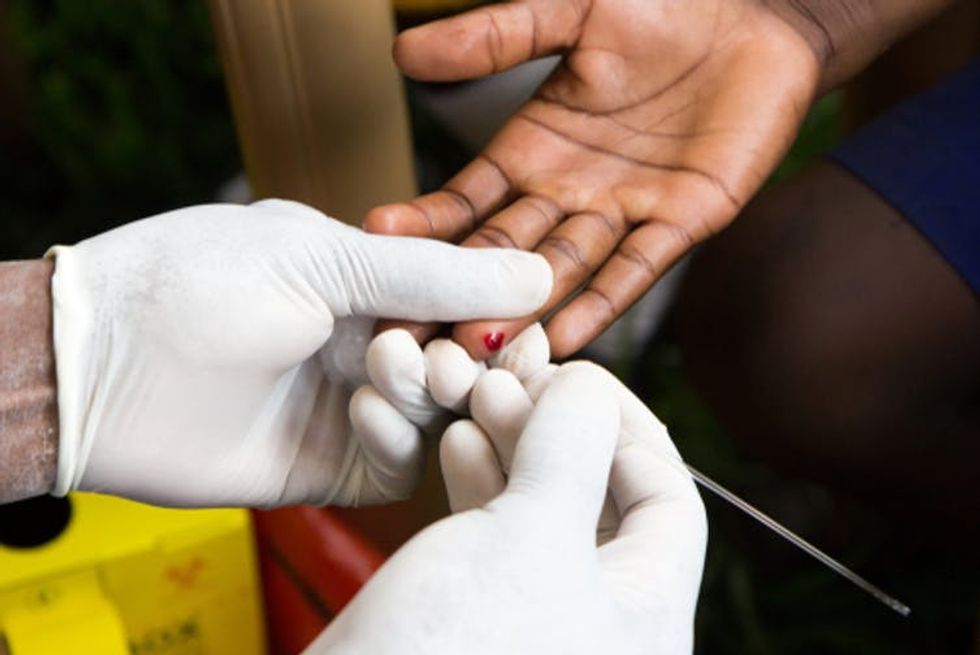
A nurse pricks the finger of a young person to draw blood to test for HIV.
Among the CDC’s most distressing recent findings: More than half of new HIV diagnoses in the United States occur in the South.
The heavy burden of HIV in the South is driven by factors such as concentrated poverty in cities, suburban areas and rural counties, high levels of unemployment, inadequate local health care infrastructure, and a lack of access to health insurance and quality health care services. Other important factors include increased stigma and discrimination toward those living with HIV. This can lead to people being afraid to get tested or seek treatment for fear that someone may find out they have HIV.
Gay and bisexual men account for 66 percent (25,748) of all diagnoses and 82 percent of HIV diagnoses among males. And, although African-Americans represent 13 percent of the U.S. population, they account for 43 percent (16,694) of HIV diagnoses. Likewise, Latinos represent 18 percent of the population but account for 26 percent (9,908) of HIV diagnoses.Racial and ethnic minority women account for a disproportionate share of diagnoses of HIV infection among women.
An arsenal beyond the medicine chest
HIV interventions that focus narrowly on pharmaceutical or drug innovations alone or individual behavior change cannot effectively address the magnitude and complexity of the HIV epidemic, as I explain in my recently published article with co-researcher David R. Williams, Ph.D. at Harvard T.H. Chan School of Public Health, in Public Health Reports. What we need most urgently today is a new generation of rigorously evaluated, cost-effective HIV interventions focused on the fundamental contextual factors for disease. These factors include:
access to adequate housing
access to quality health care and health insurance
access to child care
education, employment status, gender equality and income.
These factors are known generally as the social determinants of health (SDH) and have been viewed as the drivers of health for decades by many public health experts.
To cite a few examples, in one scientific study, structural community factors, such as poverty and poor employment opportunities, limited access to health care resources among women in the Deep South. In addition, stigma, transportation challenges, and access to illicit substances impacted health-seeking behavior and decision-making, and the ability to engage in HIV care.
Similarly, another study found that homeless individuals were more likely to be uninsured and less likely to adhere to their HIV anti-retroviral medication, demonstrating that housing is an important mechanism for improving the health of this vulnerable group.
With this scientific evidence in mind, it is perhaps unsurprising then, that despite three decades of public education and clinical campaigns, more than half of all the new infections in the entire region of North America, Western Europe and Central Europe occur in the U.S.
Make things fair
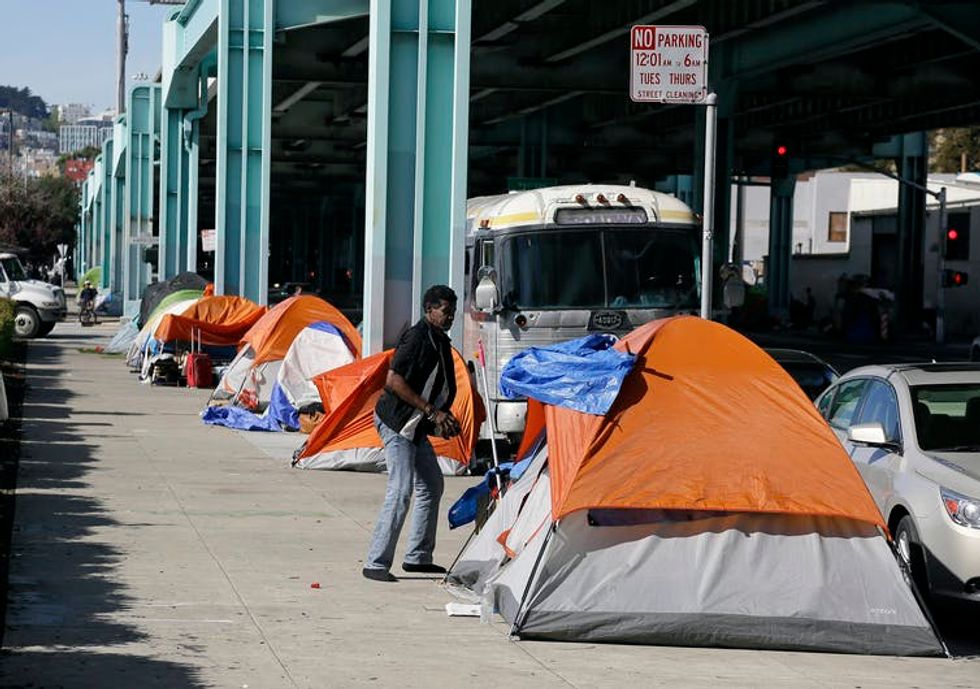
Tents for homeless people in San Francisco, Calif., where a lack of housing is a rising crisis. Gov. Gavin Newsom recently announced a plan to create new housing to provide homeless people with secure housing.
So what will it take to end the epidemic in the U.S.?
Put simply, to fight HIV, we need to address poverty and social inequity. This approach is the vital game-changer needed to eradicate the HIV epidemic in the U.S. Whenever feasible, social determinants need to be incorporated into behavioral and biomedical strategies to increase their likelihood of success. A new generation of HIV interventions focused on the fundamental SDHs should be the centerpiece of efforts to address HIV-related disparities.
There is growing scientific evidence documenting that interventions that address poverty and inequities in social and living conditions can be effective in reducing risks of HIV infection. Numerous studies reveal that improving education and affordable housing can reduce incidence rates of HIV and AIDS, because low levels of education and unstable housing have been found to decrease social stability and increase HIV risk behaviors.
These studies reveal that interventions that strengthen women’s income, housing stability and gender empowerment are associated with improved psychological well-being, economic productivity and reduced HIV risk. Improving access to care and enhancing quality of care can also contribute to reducing disparities in the incidence of HIV.
I believe Americans must commit to making it clear to our leaders and to all Americans that all sectors of society gain when we invest in tackling inequities in the most vulnerable areas. HIV/AIDS is not a partisan issue. Political will – and good will toward our most vulnerable fellow citizens – can engender a national “culture of health” that shatters boundaries, equalizes access, and makes HIV/AIDS a fading spectre from the past.
Maria De Jesus, Associate Professor, School of International Service, American University and Research Fellow at Center on Health, Risk, and Society, American University
When U.S. District Judge Brian Cogan read the verdict finding Joaquin “El Chapo” Guzman guilty of smuggling tons of drugs to the United States, he warned the 12 jurors who had decided the notorious Mexican drug lord’s fate not to speak to the press.
“Once that door is open, it can’t be closed again,” Cogan told the jury in federal court in Brooklyn on Tuesday. The jurors were escorted from the courthouse by armed federal marshals and their identities have been kept secret for fear of retaliation by the Sinaloa Cartel, which El Chapo headed.
Despite the judge’s unusual warning and the extraordinary security measures during the three-month trial, some legal experts said it could be difficult for the jury to remain anonymous and at least one law enforcement agent involved in the chase for Guzman said jurors might be at risk if their identities are leaked.
“The Eastern District of New York has done a great job to protect the witnesses and jurors, but in 2019 with social media and instant access to information, you can’t really hide,” said Derek Maltz, a former special agent-in-charge of Drug Enforcement Agency Special Operations, who coordinated federal agency activity to capture Guzman twice in Mexico.
Following the verdict, late-night television host Trevor Noah joked about the jurors needing plastic surgery to disguise themselves - dark humor that reflected a genuine concern about their safety.
Maltz said if the jurors’ identity became public, they could face potential threats from the Sinaloa Cartel, which has a strong presence in New York and a long history of violence and drug dealing in Mexico.
“They have plenty of operatives in that area that are ready to take orders from Mexico to take measures to keep this cartel moving ahead,” he said.
The Sinaloa Cartel has retaliated against enemies in the past, including members of rival cartels and undercover agents, by torturing and murdering them.
REASON TO FEAR?
John Gleeson, who led the prosecution team that won a conviction against crime boss John Gotti in 1992, said he was not aware of any case where jurors received formal protection after a trial.
Jurors who have delivered guilty verdicts to crime lords and serial murderers have “informally” sought post-trial protection, said Gleeson, once a judge in the same Eastern District.
When a jury in Brooklyn convicted drug ring leader Delroy Edwards in 1989, they sent a note to the judge asking if any precautionary measures would be taken on their behalf.
The answer was no.
Spokeswoman Lynzey Donahue for the U.S. Marshals Service, which is responsible for the protection of the federal judicial process, declined to comment on whether the agency has protected former jurors after other trials, or planned to protect the El Chapo jury.
Gleeson said protection would not be necessary since cartels have no incentive to target a jury once it renders its verdict.
“If you have any hopes really for post verdict relief of any sort, one good way to extinguish those is to tamper with the jury,” he said.
‘LOUDMOUTH UNCLE’
During El Chapo’s trial, authorities used armed guards and a bomb-sniffing dog and required passage through two metal detectors to enter the courtroom. But those efforts did not alleviate the concerns of some potential jurors.
At the start of the trial, many potential jurors expressed fear about deciding the fate of Guzman. One selected juror dropped out because of anxiety.
The courtroom was closed to the public and electronic and camera-equipped devices were banned, but a rotation of people who sat in the family and friends section of the courtroom throughout the trial, and who saw the jurors’ faces, put court security guards on high alert.
On the fourth day of deliberations, marshals arrested a spectator who claimed to be part of the Guzman family. Rene Javier Rivera Martinez had been convicted of multiple felonies in the United States and had a deportation order against him, said Rachael Yong Yow, a spokeswoman for Immigration and Customs Enforcement.
Guzman’s wife regularly appeared in court, and other family members occasionally attended.
The jurors’ continued anonymity ultimately depends on how much information they choose to share.
In the past, jurors who have served on high-profile cases have made money by signing book deals. In this case, sharing what happened in the deliberation room, even with immediate family, may put the jurors at risk.
“Some loudmouth uncle or aunt or sister or brother could actually put the jurors in a very difficult situation,” former DEA agent Maltz said.
Reporting by Gabriella Borter; Additional reporting by Tina Bellon and Jonathan Stempel; Editing by Frank McGurty, Noeleen Walder and Grant McCool




 GETTY IMAGES NORTH AMERICA/AFP/File / Ethan Miller
  AFP / Jim WATSON
  AFP/File / Guillermo Arias