The U.S. Supreme Court will decide the fate of a fiercely contested plan by President Donald Trump’s administration to add a citizenship question to the 2020 census, agreeing on Friday to an expedited review of a judge’s ruling blocking the plan.
The justices, in a brief order, granted the administration’s request to hear its appeal of Manhattan-based U.S. District Judge Jesse Furman’s Jan. 15 ruling even before a lower appeals court has considered the matter. Oral arguments in the case will take place in late April, with a ruling due by the end of June.
Furman ruled that Commerce Secretary Wilbur Ross had concealed the true motives for his “arbitrary and capricious” decision to add the citizenship question in violation of federal law.
Time is of the essence in the case, as the official census forms are due to be printed in the coming months.
Furman’s ruling came in lawsuits brought by 18 U.S. states, 15 cities and various civil rights groups challenging the administration’s decision to include the question. The plaintiffs said the question would scare immigrants and Latinos into abstaining from the census, disproportionately affecting Democratic-leaning states.
Trump has pursued hardline policies to limit legal and illegal immigration.
Opponents have accused the administration of trying to engineer an undercount of the true population and diminish the electoral representation of Democratic-leaning communities in Congress, benefiting Trump’s fellow Republicans. Non-citizens comprise an estimated 7 percent of people living in the United States.
The U.S. Constitution mandates a census every 10 years. The official population count is used in the allocation of seats in the U.S. House of Representatives and the distribution of billions of dollars in federal funds. There has not been a census question about citizenship status since 1950.
A federal appeals court said on Friday the Trump administration cannot cut off grants to Philadelphia for its refusal to cooperate with immigration authorities seeking to deport immigrants who are in the country illegally.
In a 3-0 decision, the 3rd U.S. Circuit Court of Appeals in Philadelphia said the U.S. attorney general lacked power to condition that city’s receipt of $1.6 million for local law enforcement on its compliance with three new requirements.
These included alerting Immigration and Customs Enforcement officials when undocumented immigrants are being released from prison, providing access to interview immigrants, and barring the withholding of immigrants’ citizenship status.
Several other “sanctuary cities” have also opposed to the requirements, and Chicago, New York and San Francisco have won court rulings blocking their enforcement.
In Friday’s decision, Circuit Judge Marjorie Rendell said the attorney general has only limited oversight of the program for awarding the Byrne Justice Assistance Grants.
“Allowing the attorney general to withhold all funds because a jurisdiction does not certify compliance with any federal law of the attorney general’s choosing undermines the predictability and consistency embedded in the program’s design,” Rendell wrote.
The U.S. Department of Justice did not immediately respond to requests for comment.
Friday’s decision largely upheld a June 2018 ruling by U.S. District Judge Michael Baylson in Philadelphia, but voided his requirement that the government obtain warrants before seeking custody of immigrants in city custody.
It was issued a couple of hours before President Donald Trump declared a national emergency to fund a wall at the U.S.-Mexico border without congressional approval. Democrats vowed to challenge his action as unconstitutional.
Philadelphia Mayor Jim Kenney praised the appeals court decision, in a statement referring to Trump’s declaration.
“The conditions imposed by the DOJ were an unconscionable attempt to bully the city and its residents into changing our policies,” Kenney said. “On the very day the president declared a bogus national emergency to build a useless wall, I say to our immigrant community: we are glad you call Philadelphia home.”
The case is Philadelphia v. Attorney General of the United States, 3rd U.S. Circuit Court of Appeals, No. 18-2648.
Reporting by Jonathan Stempel in New York, editing by G Crosse
NASA is accelerating plans to return Americans to the Moon, and this time, the US space agency says it will be there to stay.
Jim Bridenstine, NASA's administrator, told reporters Thursday that the agency plans to speed up plans backed by President Donald Trump to return to the moon, using private companies.
"It's important that we get back to the moon as fast as possible," said Bridenstine in a meeting at NASA's Washington headquarters, adding he hoped to have astronauts back there by 2028.
"This time, when we go to the Moon, we're actually going to stay. We're not going to leave flags and footprints and then come home to not go back for another 50 years" he said.
"We're doing it entirely different than every other country in the world. What we're doing is, we're making it sustainable so you can go back and forth regularly with humans."
The last person to walk on the Moon was Eugene Cernan in December 1972, during the Apollo 17 mission.
Before humans set foot on the lunar surface again, NASA aims to land an unmanned vehicle on the Moon by 2024, and is already inviting bids from the burgeoning private sector to build the probe.
The deadline for bids is March 25, with a first selection due in May, a tight timeline for an agency whose past projects have run years behind schedule and billions over budget.
"For us, if we had any wish, I would like to fly this calendar year. We want to go fast," said Thomas Zurbuchen, the associate administrator of NASA's Science Mission Directorate.
However, he admitted that "we may not be able to."
NASA's accelerated plans flesh out the Space Policy Directive that Trump signed in December 2017, envisaging a return to the Moon before a manned mission to Mars, possibly in the 2030s.
NASA plans to build a small space station, dubbed Gateway, in the Moon's orbit by 2026. It will serve as a way-station for trips to and from the lunar surface, but will not be permanently crewed like the International Space Station (ISS), currently in Earth's orbit.
As with the ISS, NASA would seek the participation of other countries, who could provide some of the necessary needed, such as modules for the Moon station or vehicles to allow landings on the surface.
"We want numerous providers competing on cost and innovation," Bridenstine said.
Before this manned program, NASA is also pushing to send scientific instruments and other technological tools to the Moon in 2020 or even before the end of this year.
The agency is also calling for quick-turnaround bids to manufacture and launch such instruments, offering financial incentives to make it happen fast.
"We care about speed," said Thomas Zurbuchen, associate administrator of NASA's Science Mission Directorate. "We do not expect that every one of those launches or every one of those landings will be successful. We are taking risks."
California and New York suggested on Friday they would take legal action against President Donald Trump’s national emergency declaration aimed at freeing up billions of dollars in funds to build a wall along the U.S. border with Mexico.
Trump’s move would circumvent Congress, and he predicted in comments made in the White House’s Rose Garden that the emergency declaration would face a lengthy legal challenge.
New York state’s Democratic attorney general, Letitia James, fired back almost immediately after Trump announced his action.
“We will not stand for this abuse of power and will fight back with every legal tool at our disposal,” she said in a statement.
Separately, California’s Democratic governor, Gavin Newsom, characterized the national emergency as “made-up.”
“Our message back to the White House is simple and clear: California will see you in court,” he added.
The Republican president has sought to build his promised wall along the southern border, which he says would stem the flow of drugs and stop illegal immigration.
Democrats, in turn, have said the wall would be ineffective and labeled it immoral.
Reporting by Makini Brice; editing by Susan Heavey and Jonathan Oatis
Thousands of British children marched out of lessons on Friday to demand action on climate change, earning a mild rebuke from the prime minister’s office for disrupting classes, but praise from the energy minister and activists.
Youngsters marched on Parliament Square in London and gathered in other cities carrying banners marked with “Climate change is worse than homework”, “Act now for our future” and other slogans.
“My teacher told me kids shouldn’t be going out, but we went because it’s important,” 11-year-old Rio told Reuters.
A spokeswoman for British Prime Minister Theresa May said that while the government welcomed the students’ engagement, the disruption to schools and lessons would be difficult for teachers.
Her energy minister Claire Perry however said she was “incredibly proud” of the young people while opposition Labour leader Jeremy Corbyn expressed his support for the “school kids of today whose futures are most on the line”.
Earlier this week, 224 academics from Oxford, Cambridge and other universities declared their support for the students in an open letter published in The Guardian.
“(Those taking part in the strike) have every right to be angry about the future that we shall bequeath to them, if proportionate and urgent action is not taken,” they wrote.
The British protests were part of a global ‘School Strike 4 Climate’ movement, which began in August 2018 when 16-year-old Swedish climate activist Greta Thunberg began protesting outside her parliament on school days.
Reporting by Madeleine Gandhi; Editing by Andrew Heavens
During his speech announcing a national emergency declaration Friday, President Donald Trump appeared to affect a fake Chinese accent to imitate China's President Xi Jinping — and Twitter users were immediately outraged at how racist it was.
When discussing illegal drug use in the United States, Trump brought up an anecdote in which he claimed President Xi told him China executes drug dealers.
"Their criminal list, a drug dealer gets a thing called the death penalty," the American president said. "Our criminal list, a drug dealer gets a thing called, 'how about a fine.'"
"When I asked President Xi — I said, 'Do you have a drug problem?' No, no, no," Trump continued.
Noting that China has 1.4 billion people, Trump said he asked why the country doesn't have a "drug problem."
"I said, 'Why?'" Trump recounted. "'Death penalty. We give death penalty to people that sell drugs. End of problem.'"
Many on Twitter said they were troubled by the president appearing to imitate the accent of a foreign leader.
"That fakey Chinese accent was racist [as f*ck]," Dr. Esther Choo, a popular science commentator, tweeted.
"Is Trump recommending the death penalty?" another user wrote. "And is he mimicking an Asian accent?"
Check out the best responses to Trump imitating the Chinese president below.
Fox News is doing everything possible to support President Donald Trump and his extraordinary decision to declare a national emergency to build his wall. The President at 10 AM Friday will deliver a speech from the Rose Garden at the White House to announce he will usurp over $6 billion from the Defense Dept. and re-allocate the funds for construction of his Souther Border wall.
"This is one of the reasons people went to the polls to vote for him – for that wall, and if you ask Republicans who support him and support the wall, they say it's common sense," says "Fox & Friends" co-host Ainsley Earhardt.
Earhardt neglects to mention the majority of Americans did not vote for Donald Trump – he lost the popular vote.
Steve Doocy claims taking the funds from Pentagon drug interdiction and military construction programs, "makes sense."
All these arguments are very carefully crafted to subtly convince Fox News viewers what President Trump is doing is right – even if it may be unconstitutional and will definitely end up in the courts.
Of course Fox News viewers want to be on the side of "Republicans who support him and support the wall," so of course they will end up agreeing that taking the extraordinary measure to declare a national emergency, when there is none, "makes sense," even when it does not.
The wall, Americans will remember, was a mnemonic device, "a memory trick for an undisciplined candidate," created by his political advisers to make sure he remembered to talk about immigration at his rallies.
Border crossings are at a 50-year low. There is no national emergency, and even if there were, Trump's claim it will all but eliminate illegal drugs being smuggled into the country is false, since the vast majority come through legal ports of entry.
The Vatican’s envoy to France is being investigated for sexual assault after he was accused of molesting an official at the Paris mayor’s office during a ceremony last month, a judicial source told AFP.
The envoy, 74-year-old Luigi Ventura, has been based in Paris since 2009 and serves as a diplomat for Pope Francis.
He was accused of molesting a man at the Paris townhall on January 17 where mayor Anne Hidalgo gave a New Year’s address to diplomats, religious leaders and civil society figures.
A complaint was filed by the mayor’s office on January 24 which led to an investigation being opened the day after, the judicial source said.
Le Monde newspaper first reported the investigation and the allegations against Ventura on Friday.
Why did the hominin cross the plain? We may never know. But anthropologists are pretty sure that a smattering of bare footprints preserved in volcanic ash in Laetoli, Tanzania bear witness to an evolutionary milestone. These small steps, taken roughly 3.5 million years ago, mark an early successful attempt by our common human ancestor to stand upright and stride on two feet, instead of four.
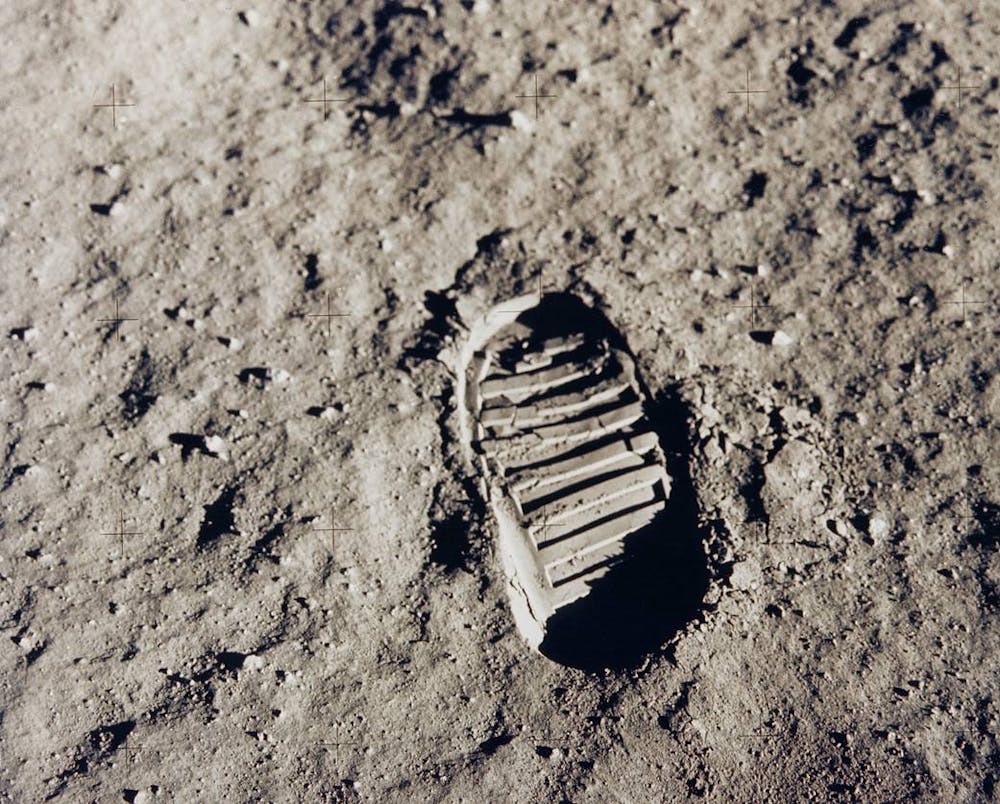
Nearly 50 years ago, Neil Armstrong also took a few small steps. On the moon. His bootprints, along with those of fellow astronaut Buzz Aldrin, are preserved in the lunar soil, called regolith, on what Aldrin described as the “magnificent desolation” of the moon’s surface. These prints, too, bear witness to an evolutionary milestone, as well as humankind’s greatest technological achievement. What’s more, they memorialize the work of the many individuals who worked to unlock the secrets of space and send humans there. And those small steps pay homage to the daring men and women who have dedicated – and those who lost – their lives to space exploration.
The evidence left by our bipedal ancestors are recognized by the international community and protected as human heritage. But the evidence of humanity’s first off-world exploits on the moon are not. These events, separated by 3.5 million years, demonstrate the same uniquely human desire to achieve, explore and triumph. They are a manifestation of our common human history. And they should be treated with equal respect and deference.
I’m a professor of aviation and space law and an associate director of the Air and Space Law Program at the University of Mississippi School of Law. My work focuses on the development of laws and guidelines that will assist and promote the successful and sustainable use of space and our transition into a multi-planet species. During the course of my research, I was shocked to discover that the bootprints left on the moon, and all they memorialize and represent, are not recognized as human heritage and may be accidentally or intentionally damaged or defaced without penalty.
One of Buzz Aldrin’s first bootprints from his Apollo 11 moonwalk on July 20, 1969.
And, just last year, Sotheby’s auctioned off a bag – the first bag that Neil Armstrong used to collect the first moon rocks and dust ever returned to Earth. The sale was entirely legal. This “first bag” ended up in the hands of a private individual after the U.S. government erroneously allowed it to be included in a public auction. Rather than return the bag to NASA, its new owner sold it to the highest bidder for US$1.8 million. That’s a hefty price tag and a terrible message. Imagine how much a private collector would pay for remnants of the first flag planted on the moon? Or even just some dust from Mare Tranquilitatis?
The fact is if people don’t think sites are important, there is no way to guarantee their safety – or the security of the artifacts they host. Had the first bag been recognized as an artifact, its trade would have been illegal.
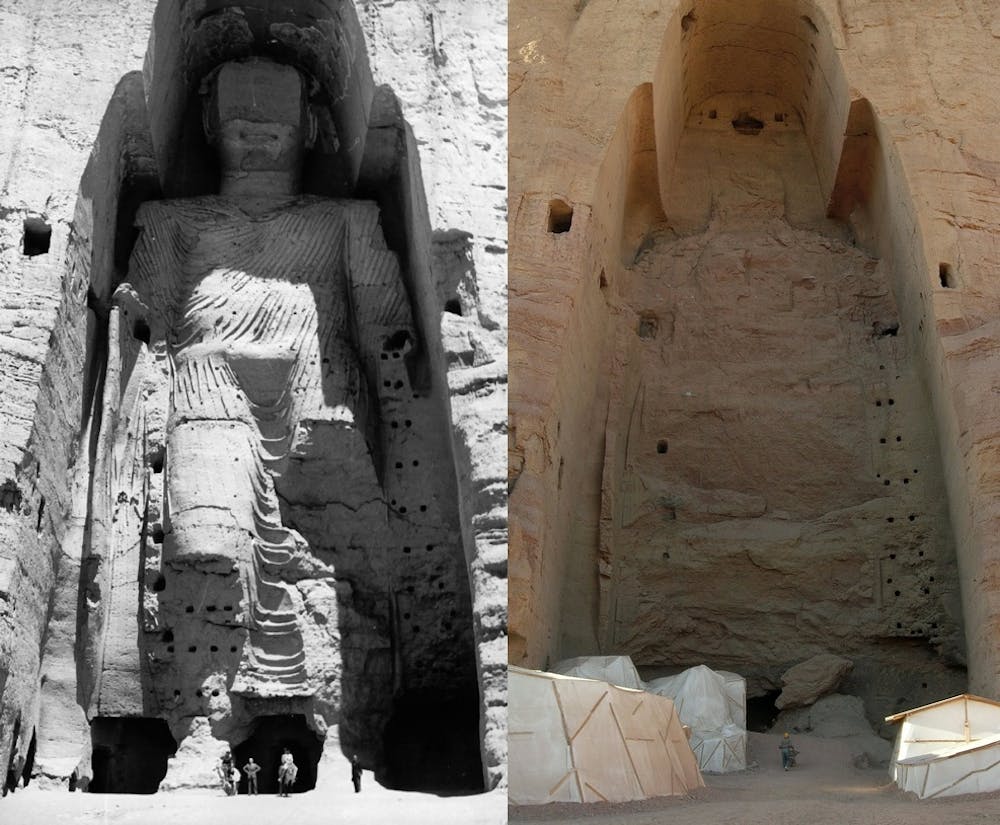
The taller Buddha of Bamiyan before (left) and after (right) destruction.
That’s why I co-founded the nonprofit For All Moonkind, the only organization in the world committed to making sure these sites are protected. Our mission is to ensure the Apollo 11 landing and similar sites in outer space are recognized for their outstanding value to humanity and protected, like those small steps in Laetoli, for posterity by the international community as part of our common human heritage.
Our group of nearly 100 volunteers – space lawyers, archaeologists, scientists, engineers, educators and communicators from five continents – is working together to build the framework that will assure a sustainable balance between protection and development in space.
Here on Earth, the international community identifies important sites by placing them on the World Heritage List, created by a convention signed by 193 nations. In this way, the international community has agreed to protect things like the cave paintings in Lascaux, France and Stonehenge, a ring of standing stones in Wiltshire, England.
There are no equivalent laws or internationally recognized regulations or even principles that protect the Apollo 11 landing site, known as Tranquility Base, or any other sites on the moon or in space. There is no law against running over the first bootprints imprinted on the moon. Or erasing them. Or carving them out of the moon’s regolith and selling them to the highest bidder.
Between 1957 and 1975, the international community did dedicate a tremendous amount of time and effort to negotiating a set of treaties and conventions that would, it was hoped, prevent the militarization of space and ensure freedom of access and exploration for all nations. At the time, cultural heritage in outer space did not exist and was not a concern. As such, it is not surprising that the Outer Space Treaty, which entered into force in 1967, doesn’t address the protection of human heritage. Today, this omission is perilous.
Because, sadly, humans are capable of reprehensible acts.
But as history shows, this trickle of explorers could soon become a rush. As we straddle the threshold of true space-faring capability, we have an extraordinary opportunity. We have time to protect our common heritage, humanity’s first steps, on the moon before it is vandalized or destroyed.
If we do this right, 3.5 million years from now, not only will his name be remembered, his bootprint will remain preserved and the story of how Tranquility Base became the cradle of our space-faring future will be remembered forever, along with the lessons of tumultuous history that got us to the moon. These lessons will help us come together as a human community and ultimately advance forward as a species.
To allow anything else to happen would be a giant mistake.
A US judge ruled Thursday against a butterfly sanctuary that had sued to keep President Donald Trump's proposed border wall from cutting the refuge in two.
For months the National Butterfly Center has been arguing that the wall would be devastating for those insects and other creatures living in this habitat in the Rio Grande Valley of Texas.
As many as 200 species of butterfly live in the sanctuary, as do bobcats, coyotes, skunk pigs, armadillos and Texas turtles.
Financing for a wall going through the sanctuary was approved last year and is separate from the border appropriation fight that is currently roiling Washington. Construction could begin in a matter of weeks, local people said.
AFP/File / SUZANNE CORDEIRO The entrance to the National Butterfly Center in Mission, Texas, which is fighting to keep out President Donald Trump's proposed border wall
The North American Butterfly Association, which runs the refuge, sued the government on grounds that the sanctuary is private property.
But federal judge Richard Leon ruled Thursday that the project can proceed.
"On the same day the president announces he will declare a state of emergency, the federal judge throws out our case. We are not going away that easily!", the butterfly center said in a tweet.
The White House announced Thursday that Trump will declare a national emergency on the border with Mexico to build the wall by bypassing Congress to access funds that lawmakers are denying him.
Runoff from recent floods in northern Australia is flowing onto parts of the Barrier Reef, scientists said Friday, starving coral of light and providing fodder for the predatory crown-of-thorns starfish.
Parts of northern Queensland are still reeling after nearly two weeks of unprecedented rainfall that turned roads into rivers and inundated hundreds of homes with floodwater.
Scientists at James Cook University say the floods swelled a number of rivers along hundreds of kilometres of coastline, spilling sediment onto the reef which has reduced water quality and much-needed sunlight.
AFP/File / Gal ROMA The 2,300-kilometre (1,400-mile) reef has already suffered from back-to-back coral bleaching in 2016 and 2017, where swathes have been killed by rising sea temperatures linked to climate change
"Coral reef and seagrass need light to maintain their growth and health," researcher Jane Waterhouse from James Cook University told AFP.
Calm weather following the extended period of rain means the murky water is yet to disperse.
It threatens to "smother" coral in areas worst hit, like at the mouth of north Queensland's Burdekin river, where a brown flood plume has spread some 100 kilometres offshore.
"If that were to stay there then eventually, it would not take that long for some of those systems to die off," Waterhouse added.
The effects will not be fully understood until monitoring was completed over the next few of months after sediment has dispersed and settled.
Matt Curnock/AFP / MATT CURNOCK Calm weather following the extended period of rain means the murky water is yet to disperse
The 2,300-kilometre (1,400-mile) reef has already suffered from back-to-back coral bleaching in 2016 and 2017, where swathes have been killed by rising sea temperatures linked to climate change.
The predatory crown-of-thorns starfish, which eat coral, have also proliferated on the reef due to pollution and agricultural runoff.
The recent floods have exacerbated the runoff, causing algae to grow in some areas.
"This provides a brilliant food source to allow those populations to thrive," Waterhouse added.
The United States began sending Central American families seeking asylum back to Mexico this week, a Mexican immigration source said on Thursday, while U.S. human rights groups sued the Trump administration, saying the policy puts migrants in danger.
Five families with a total of 16 people, including children from El Salvador, Honduras and Guatemala, arrived in the Mexican border city of Tijuana on Wednesday, according to a person who works in migration for the Mexican government, who asked not to be named.
In late January, the United States began sending non-Mexican migrants who had crossed at the U.S. border with Mexico back to Mexico to wait as their asylum requests are processed, a program called Migrant Protection Protocols. But until this week, only individual adults had been sent back, not children in family groups.
Rights groups say the program endangers asylum seekers by forcing them to remain in regions of Mexico experiencing record levels of violence.
“Both the U.S. and Mexican governments know that the border area is unsafe for women and children,” Michelle Brané, director of the Migrant Rights and Justice program at the Women’s Refugee Commission (WRC), said in a statement on the decision to return the families to Mexico.
“The U.S. government knows full well that asylum-seeking families are no threat to this nation.”
Sixty-three people have returned to Mexico so far under the program, the government source said.
Two shelters in Tijuana said they had received the families. They asked not to be named to avoid revealing their location.
The American Civil Liberties Union and immigrant rights groups filed a lawsuit on behalf of 11 anonymous asylum seekers on Thursday. The groups asked a U.S. judge to revoke the policy and order the government to bring the migrants back to the United States while their cases are processed.
The 11 asylum seekers from Central America were returned to Mexico since Jan. 30 to wait out their immigration cases, and now fear for their lives, according to the complaint.
The plaintiffs include a lesbian who said she was raped because of her sexual orientation and was forced to flee Honduras after her partner’s family threatened to kill them.
The lawsuit alleges the policy endangers migrants and violates U.S. immigration and administrative law, as well as universal norms of international law.
A spokesman for the U.S. Department of Justice said the government would defend the policy in court.
“Congress has explicitly authorized the Department of Homeland Security to return aliens arriving from a contiguous foreign territory to that territory during that alien’s immigration court proceedings,” said Steven Stafford of the DOJ.
In another sign of the political tension over immigration, the White House on Thursday said U.S. President Donald Trump will declare a national emergency to try to obtain funds for his promised wall on the Mexican border when he signs a bill to avert another government shutdown.
Mexico’s National Migration Institute and the U.S. Department of Homeland Security did not immediately respond to requests for comment.
Reporting by Lizbeth Diaz in Mexico City, Mica Rosenberg in New York and Kristina Cooke in San Francisco, Tom Hals in Wilmington, Delaware; writing by Julia Love; editing by Frank Jack Daniel and Rosalba O'Brien
U.S. Treasury Secretary Steven Mnuchin said in a tweet on Friday that he and U.S. Trade Representative Robert Lighthizer had “productive meetings” with China’s Vice Premier Liu He.
Mnuchin made the comment on Twitter after two days of high-level trade talks in Beijing aimed at resolving the two countries’ trade war, but he did not elaborate.
(Reporting by Michael Martina; Editing by Kim Coghill)





 AFP/File / SUZANNE CORDEIRO
  AFP/File / Gal ROMA
  Matt Curnock/AFP / MATT CURNOCK