Islamic State is far from defeated, and instead is morphing into an asymmetrical warfare force after the militant group lost almost all of the territory it once controlled in Syria, German Chancellor Angela Merkel said on Friday.
Merkel’s remarks at the inauguration of the Berlin headquarters of Germany’s foreign intelligence agency BND contradicted statements by U.S. President Donald Trump that the Islamist group has been defeated.
“The so-called Islamic State has been luckily driven out of its territory but this unfortunately doesn’t mean that Islamic State has disappeared,” Merkel said. “It is transforming into an asymmetrical warfare force. And this, of course, is a threat.”
The conservative chancellor said monitoring events in Syria was one of the BND’s top priorities, which also include tracking cyber threats and fake news designed to influence democratic elections.
Trump said on Wednesday that he expected a formal announcement as early as next week that the coalition fighting the militants has reclaimed all of the territory it previously held. In December he tweeted that the group has been “defeated.”
Trump wants to withdraw U.S. troops from Syria by the end of April, a plan that has alarmed European allies who fear Islamic State would resurface in Syria in the absence of a credible peace plan to end the country’s civil war.
“We remain a long way from peace in Syria,” said Merkel, adored by many of the more than 550,000 Syrians who have found refuge in Germany after she decided in 2015 to open the country’s borders to almost a million asylum seekers.
The BND’s new headquarters will house the agency’s 4,000 workers who will have to move from its current location near Munich.
The massive structure in the German capital’s central Mitte district took more than 10 years to complete and cost more than 1.4 billion euros, German media reported.
The building sits on 10 hectares of land and has some 260,000 sqm of office space.
Additional reporting by Sabine Siebold, Editing by William Maclean
A priest accused of molesting more than 80 boys is trying to block the release of a film about a scandal that has rocked the French Catholic church and put one of its most senior cardinals in the dock.
The acclaimed director Francois Ozon worked for years in secret on "By the Grace of God", which will be premiered Friday at the Berlin film festival.
But its release in France later this month is threatened, with the accused priest Bernard Preynat going to court to demand that it is not shown until after his trial, which is due to start later this year.
A lay voluntary worker for the Lyon diocese, Regine Maire, has also issued a legal challenge to have her name removed from the film.
The movie's premiere comes as Cardinal Philippe Barbarin, the archbishop of Lyon, and five others including Maire await the verdict of a court in the central eastern city on charges of covering up the abuse.
Ozon -- best known for "Swimming Pool" and "8 femmes" -- told AFP he had hoped the tortuous series of cases would have finished by now, but the film should be shown for "the public good".
- 'Breaking the silence' -
"When you try to break the silence, there is always resistance," he said. "I don't think this is happening by accident, because it is a film which is trying to break an omerta, and which deals with the silence."
AFP/File / Anne-Christine POUJOULAT The acclaimed director Francois Ozon worked for years in secret on "By the Grace of God", which will be premiered at the Berlin film festival
The scandal first broke in 2015 when a former scout Francois Devaux went public with allegations that Preynat had abused him as a child 25 years earlier.
Preynat was suspended by the church later that year and it later emerged that the cardinal had confronted him about "the rumours" in 2010 but the priest claimed he had changed.
Four years later Barbarin went to the Vatican about him without contacting the police.
Ozon said he had worked closely with several members of the survivors' group, La Parole Liberee (Freed Speech), Devaux set up, which has gathered the testimony of 85 people who claim to have been abused by Preynat in Lyon.
But the director said he tried to be "as even-handed and objective as possible. It is not a film of goodies and baddies, it is much more complex than that for the affected families and the institution itself, and I tried to show that".
"By the Grace of God" centres on Devaux and Alexandre Dussot-Hezez, "a fervent Catholic who discovers at the age of 40 that a priest who abused him is still alive and has access to children" through the church.
- Painful revelations -
But with the "liberation" that comes with daring to speak about something kept hidden for so long, Ozon said he wanted to show the "negative repercussions (victims can suffer) and the distressing boomerang effects on their partners, children, families and friends".
He insisted there were no major factual revelations in the film for anyone who has been following the case.
"Ninety percent of the film concerns the victims. It is their story. The rest are established facts from court documents, the press, documentaries and a book on the affair."
The film-maker hopes his intimate portrait of the victims' fight for justice will spark greater understanding of a difficult subject that mainstream cinema has rarely treated beyond the Oscar-winning "Spotlight".
"I don't know if cinema can change the world, but it can open debate," Ozon said.
"It's great when people come up to thank you and say it will shift things."
Ozon said the reaction from several French bishops and senior clergy who have seen the film had been positive.
And last month one of the most senior clerics in Lyon thanked Devaux for "shaking the church".
"I think the church wants things to change," said Ozon, who argued that a "lot of ordinary Catholics are sick of their religion being associated with paedophilia and want the hierarchy to sort the problem out once and for all".
“This year, American astronauts will go back to space in American rockets.”
This one sentence from the 2019 State of the Union address may have escaped your notice. It ended a paragraph in which the president paid tribute to astronaut Buzz Aldrin of the Apollo 11 mission to mark the the 50th anniversary of the first moon landing. From that point, the speech transitioned to increasing the standard of living for Americans in the 21st century. A small sentence, perhaps. Maybe perceived by some as a throwaway line. But behind these 12 words lies a revolution in how Americans will get to space in the future.
Americans have not flown to orbit aboard an American rocket or from an American launch pad since July 8, 2011. This gap of nearly eight years and counting is the longest in our history, eclipsing the six-year gap between Apollo-Soyuz in 1975 and the Space Shuttle program in 1981. Since the retirement of the Space Shuttle in 2011, the United States has paid Russia approximately US$75 million per seat to launch U.S. astronauts to the International Space Station aboard Soyuz spacecraft from a launch site in Kazakhstan.
However, as noted in the State of the Union, things will change in 2019. American astronauts are scheduled to fly to space from U.S. soil this summer, aboard three separate launch systems, developed not by the U.S. government and its contractor workforce, but instead by commercial spaceflight companies. It is a change that heralds a new era in manned space travel.
A new era of American spaceflight
SpaceX, Boeing and Virgin Galactic are all planning to send American astronauts into space in 2019. For SpaceX and Boeing – if the schedule holds and near-term test flights go well – their voyages will be orbital flights to the ISS launched from the Kennedy Space Center in Florida. SpaceX will fly two NASA astronauts in their Dragon Capsule on a Falcon 9 rocket, and Boeing will fly a crew of three in its CST-100 Starliner aboard an Atlas-V booster.
Virgin Galactic has already put Americans into space with their most recent flight in December 2018. Although this rocket did not orbit the Earth, and did just a quick “up and down” trajectory, it demonstrates amazing progress.
Most revolutions do not happen overnight, and our revolution in commercial human spaceflight is no exception. All of this activity can be traced back to the George W. Bush 43 administration, when NASA Administrator Dr. Michael D. Griffin put $500 million of NASA money on the table to help spur industry to develop commercial systems from which NASA could purchase delivery services, for crew and cargo, just as one buys airline tickets.
If I wish to fly from New York to Los Angeles, for example, I can go to a website, make a reservation, and enter my credit card number. I don’t have to build the airplane, construct the airport, own and operate the air-traffic control system, refine the fuel from crude oil, train the pilot, and so forth. I buy it as a simple commercial transaction. This mode is what NASA was after when the first commercial launch programs were established in 2006.
Launches return to American soil
Development has occurred on a schedule much longer than anticipated, creating the record gap in American launches. However, it has led directly to the establishment of multiple independent systems of cargo supply to space, aboard the SpaceX Falcon-9 and Orbital Science’s Antares launch vehicle. All told, this arrangement has worked extremely well, safely and in a cost-effective manner.
In 2019, human launch capability will be added to the ongoing portfolio of cargo flights, returning American astronauts to American launch vehicles, and eliminating the requirement to launch to the ISS on a Russian system. After almost two decades at NASA, I can say that this is, indeed, a big deal.
This revolution is just getting started. In the not-too-distant future, you can also expect to see Blue Origin, the space company founded by Amazon’s Jeff Bezos and Sierra Nevada Corporation begin similar flights to orbit. Bezos’ team is already flying suborbital cargo and science experiment flights to space on a reusable vehicle named New Shepard from their launch facility in Texas. Sierra Nevada will be flying their Dream Chaser vehicle, which looks much like a mini-space shuttle and lands on a runway, for cargo to ISS (first) and then people (later).
Revolutions – even those cloaked in a simple sentence – do not happen in an instant. It has been 13 years since NASA first worked to spur commercial development of launch capabilities. Eight years have elapsed since the retirement of the Space Shuttle. A revolution is in the making, totally transforming how we send American astronauts into space. Perhaps not overnight, but it is coming soon to a launch pad near you … and, yes, this revolution will be televised.
At a press conference on Feb. 1, López Obrador said his government would embrace what he called “Franciscan poverty” if it would “transfer funds to the people” and achieve “development, jobs and welfare.”
Francis of Assisi was a Catholic saint who disdained material wealth to follow Christ as a poor man.
López Obrador’s poverty vow is more bureaucratic than religious. As part of an ambitious effort to fight poverty and reduce government corruption, the president proposed to cut the salaries of public officials, including his own, slash federal budgets and lay off 70 percent of non-unionized federal workers. An estimated 276,290 public employees will lose their jobs.
Saying that even austerity budgets must guarantee the basic functioning of the government, Justice Alberto Pérez Dayán said López Obrador’s plan cannot go into effect until the Supreme Court rules on its constitutionality.
The decision has set up a standoff between the president and the courts, with Mexico’s federal budget and judicial independence hanging in the balance.
Reducing inequality, one tree at a time
López Obrador and his leftist Morena Party won a landslide victory in Mexico’s 2018 general election on promises that they would transform Mexico, empowering the underprivileged in a country with gaping inequality.
Since taking office on Dec. 1, López Obrador has suggested creating some 20,000 jobs in fruit production and wood harvesting by planting trees on a million acres of land in rural southern Mexico. He has also proposed paying small monthly pensions of up to 2,550 pesos – around US$134 – to Mexicans above the age of 68 and to people with disabilities who lack social security benefits.
Leftist governments usually fund social programs like this by raising taxes on the wealthy. López Obrador says he won’t do that. Instead, his administration hopes to recover public funds by cracking down on rampant corruption and saving money with fiscal austerity. That’s where the salary cuts and mass layoffs come into play.
López Obrador is an admirer of Benito Juárez, the indigenous president who ruled Mexico from 1858 to 1872. Juárez extolled the virtues of selfless public service, saying public servants should “devote themselves to work assiduously while resigning to live in … honorable modesty.”
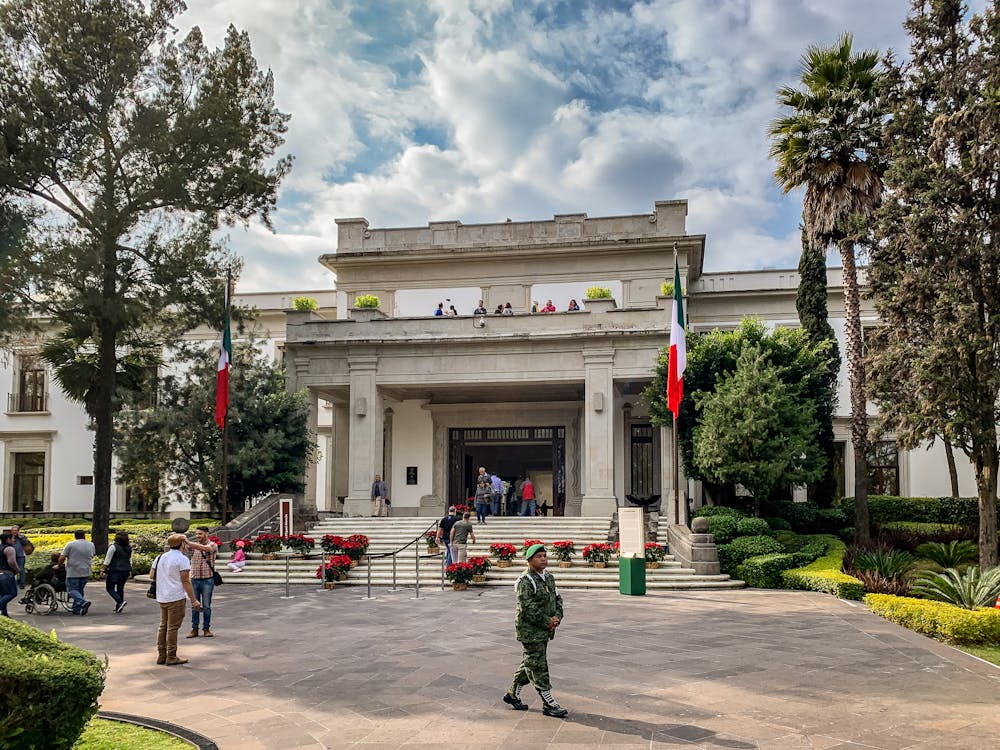
The Los Pinos presidential palace in Mexico City is now open to the public.
The wage gap between average workers and the Mexican head of state was the highest in the world last year, according to a report by the IG Group, a British financial services company. On average, Mexican workers earn around $15,311 a year.
López Obrador’s voluntary pay cut has drastically reduced the difference between his income and everyone else’s.
Attacks on the judiciary
Since the Mexican Constitution mandates that no public official should make more than the president, however, López Obrador has also effectively capped wages for all government employees.
To his mind, that’s a good thing.
The days of having “a rich government with a poor population” are over, the president told a crowd in December. He was speaking in the western state of Nayarit, pledging aid for victims of a recent hurricane.
In the same speech, López Obrador attacked the Supreme Court’s decision to suspend his pay cut plan, accusing Mexican judges – not just Justice Pérez Dayán – of selfishly wanting to keep their salaries and benefits intact.
In 2018, Supreme Court justices earned 269,215 pesos – around $14,000 a month.
The Supreme Court has since agreed to take a 25 percent pay cut “in accordance with the new policy of austerity that the presidency has demanded of the Supreme Court of Justice.” That puts their 2019 salaries at about $10,500 a month, not including benefits.
In adopting this measure, the Supreme Court also clarified that, as an independent branch of government directly protected by the Constitution, the judiciary is not bound by the salary standards established by López Obrador. The justices will decide how to implement austerity within the court system.
Beyond its questionable constitutionality, López Obrador’s de facto salary cap on public servants does not take into account the expertise, seniority or skills required of high-level positions.
Less than $5,700 a month is simply insufficient payment for the most highly skilled workers, Mexican constitutional expert Elisur Arteaga told the newspaper La Razon last year. He expects talent will flee the government for the private sector.
Nobody in Mexico thought that transforming the country would be easy when they voted López Obrador into office. To paraphrase Mexican pundit Jesús Silva-Herzog, fixing Mexico’s bloated and corrupt government was work for a surgeon with a scalpel.
López Obrador, it’s becoming clear, prefers a machete.
US lawmakers threatened Thursday to take tougher action against Saudi Arabia over the killing of journalist Jamal Khashoggi amid a new revelation that the kingdom's powerful crown prince spoke of going after him with a "bullet."
President Donald Trump faces a Friday deadline set by Congress to determine if Crown Prince Mohammed bin Salman ordered the assassination of Khashoggi, who was strangled and dismembered after entering the kingdom's consulate in Istanbul on October 2.
Special UN rapporteur, Agnes Callamard, said Thursday after a visit to Turkey that the killing of Khashoggi, who had written critical pieces on Saudi Arabia in The Washington Post, had been "planned and perpetrated" by Saudi officials.
The New York Times, citing officials who had seen US intelligence, said that Prince Mohammed had warned in an intercepted conversation to an aide in 2017 that he would go after Khashoggi "with a bullet" if he did not return to Saudi Arabia from the United States.
US intelligence understood that the ambitious 33-year-old heir apparent was ready to kill the journalist, although he may not have literally meant to shoot him, according to the newspaper.
The kingdom, after initially denying any knowledge of Khashoggi's disappearance, has acknowledged that a team killed him inside the embassy but described it as a rogue operation that did not involve the crown prince.
In October, the then top Republican and Democrat on the Senate Foreign Relations Committee invoked a law that gave the Trump administration 120 days -- until February 8 -- to determine whether Prince Mohammed ordered Khashoggi's murder and to outline actions against him.
- Congress ready to act -
Predicting little movement, a bipartisan group of senators on Thursday proposed a bill to cut off some weapons sales to Saudi Arabia including of tanks, long-range fighter jets and ordnance for automatic weapons.
The bill would also require sanctions against any Saudis involved in Khashoggi's killing and require State Department reports on human rights in the kingdom and in the conduct of its war in Yemen.
"Seeing as the Trump administration has no intention of insisting on full accountability for Mr. Khashoggi's murderers, it is time for Congress to step in and impose real consequences to fundamentally re-examine our relationship with the Kingdom of Saudi Arabia and with the Saudi-led coalition in Yemen," said Robert Menendez, the top Democrat on the Senate Foreign Relations Committee.
The bill enjoys support from top Republicans including Senator Lindsey Graham, usually a close ally of Trump.
"While Saudi Arabia is a strategic ally, the behavior of the crown prince ? in multiple ways ? has shown disrespect for the relationship and made him, in my view, beyond toxic," Graham said.
The Senate already voted in December to end support for the bloody Saudi-led offensive on rebels in Yemen, where millions are on the brink of starvation in what the United Nations calls the world's worst humanitarian crisis.
The move is likely to pass the new Democratic-led House of Representatives after a hearing on legislation Wednesday, although Trump could exercise his veto.
- Trump supports prince -
Secretary of State Mike Pompeo raised Khashoggi's killing among other issues during a meeting Thursday with Adel al-Jubeir, the Saudi minister of state for foreign affairs, according to the State Department.
But Trump has publicly said that he is not concerned whether Crown Prince Mohammed was involved in Khashoggi's killing, saying the Saudi alliance benefits Washington due to the kingdom's major purchases of weapons and its hostility to regional rival Iran.
Asked about Friday's deadline, State Department spokesman Robert Palladino said that the United States had already taken action over Khashoggi's killing, pointing to last year's revocation of visas for nearly two dozen Saudi officials and the freezing of assets of 17 others.
"We will continue to consult with the Congress and work to hold accountable those who are responsible for Jamal Khashoggi's killing," Palladino told reporters, declining to say if more action would be forthcoming.
In a joint statement accompanied by a rally outside the White House, six advocacy groups including Human Rights Watch, Reporters Without Borders and the Committee to Protect Journalists urged Trump to release CIA records on Khashoggi's death, support an independent investigation and press the Saudis to free detained reporters and activists.
"Notwithstanding public and congressional outrage and the reported findings of the CIA, the Trump administration appears to be engaged in a cover-up on behalf of the Saudi government," they wrote.
The British Academy of Film and Television Arts (BAFTA) has suspended “Bohemian Rhapsody” director Bryan Singer’s nomination for Sunday’s awards ceremony following allegations of sexual misconduct.
The 53-year-old was listed alongside producer Graham King and screenwriter Anthony McCarten for the Queen biopic’s nomination in the “Outstanding British Film” category.
But in a statement posted on its website late on Wednesday, BAFTA said it had informed Singer that his nomination had been suspended “in light of recent very serious allegations”.
There was no immediate reply to emails sent to Singer’s agent and lawyer seeking comment. There was no answer from a telephone number listed for his agent in California outside of office hours.
“BAFTA considers the alleged behavior completely unacceptable and incompatible with its values. This has led to Mr Singer’s suspended nomination,” BAFTA said.
“BAFTA notes Mr Singer’s denial of the allegations. The suspension of his nomination will therefore remain in place until the outcome of the allegations has been resolved.”
The BAFTA statement did not give any detail of the allegations.
Last month, U.S. magazine The Atlantic published an article in which four men accused Singer of sexual misconduct, including being molested or seduced by the director despite them being underage.
Singer has denied the allegations, saying in a statement published at the time by online magazine Deadline that The Atlantic article was “a homophobic smear piece”.
Singer, also known for “The Usual Suspects” and “X-Men”, was dropped as “Bohemian Rhapsody” director in late 2017, with Hollywood media reports citing clashes on set.
At the time, Twentieth Century Fox said filming had been temporarily halted in its last weeks “due to the unexpected unavailability of Bryan Singer”, according to The Hollywood Reporter.
The publication later put out a statement from Singer in which he said the studio would not allow him time off to “deal with pressing health matters concerning one of my parents” and that his contract was terminated.
BAFTA said the film was still nominated in the Outstanding British Film category and that “the other individuals named as candidates in respect of the film remain nominees”.
The awards ceremony will take place in London on Sunday.
Reporting by Marie-Louise Gumuchian; Editing by Alison Williams
Accused Mexican drug kingpin Joaquin “El Chapo” Guzman appeared cheerful as the jury in his U.S. trial ended its first week of deliberations on Thursday without reaching a verdict, grinning broadly as he hugged and bumped fists with his lawyers.
U.S. District Judge Brian Cogan dismissed the 12 weary-looking jurors from federal court in Brooklyn at about 4:15 p.m. They will resume deliberating on Monday morning.
Guzman, 61, is accused of trafficking tons of cocaine, heroin, marijuana and methamphetamine into the United States as leader of Mexico’s Sinaloa Cartel. He twice escaped from prison in Mexico. If convicted in the United States, he could face life in prison.
The defense has argued Guzman was set up as a “fall guy” by Ismael “El Mayo” Zambada, a Sinaloan drug kingpin who remains at large. Despite Guzman’s upbeat demeanor on Thursday, there has been no sign of what way the jury will decide.
Earlier in the afternoon, the jury sent a note asking to review the testimony of one a key prosecution witness, Juan Carlos “Chupeta” Ramirez, concerning a series of alleged cocaine shipments codenamed “Juanitas.”
Ramirez, who has pleaded guilty to U.S. charges and agreed to cooperate with prosecutors, testified that he sold Guzman tons of cocaine for export to the United States.
Cogan told the jurors that a transcript of the testimony would be ready for them by Monday.
Ramirez was one of more than 50 witnesses who testified during the 11-week trial, which offered the public an unprecedented look into the inner workings of the cartel, named for the state in northwestern Mexico where Guzman was born. [nL1N1ZO266]
Since they began deliberating Monday afternoon, the jurors have asked to review days of testimony from several witnesses, mostly from former associates of Guzman who agreed to testify against him after striking deals to cooperate with U.S. authorities.
The jurors must decide deliver a verdict on 10 criminal counts, one of which consists of 27 criminal violations. The charges include engaging in a continuing criminal enterprise, international drug trafficking and money laundering conspiracy.
Reporting by Brendan Pierson in New York; Editing by Alistair Bell
White House senior adviser Jared Kushner will travel to at least five Arab countries in late February to brief diplomats on the economic portion of a long-awaited U.S. peace proposal for the Middle East and seek their support, officials said on Thursday.
Kushner, who is the president’s influential son-in-law, and Trump’s Middle East envoy, Jason Greenblatt, plan stops in Oman, Bahrain, Saudi Arabia, the United Arab Emirates and Qatar on their week-long trip, two senior White House officials said. They may add two other countries to their itinerary.
Reporting By Steve Holland; Editing by Susan Thomas
U.S. Democratic Senator Jon Tester, a member of the committee trying to reach an agreement on border security, said a deal was possible as early as Friday.
Tester, speaking to reporters, said on Thursday he thought it was “entirely possible we could have a deal in a timely manner, which could be tomorrow but certainly by the weekend.”
Reporting by Richard Cowan in Washington; Editing by James Dalgleish
Iran’s Revolutionary Guards inaugurated a surface-to-surface ballistic missile with a range of 1,000 km (621 miles), the semi-official Fars news agency reported on Thursday, ignoring demands Western demands that Tehran halt its missile program.
Fars published pictures of an underground missile factory called “underground city”, saying the “Dezful” missile was a version of the Zolfaghar missile that has a 700 km range and a 450 kg (992 lb) warhead.
Iran says it has missiles with the range of up to 2,000 km, which puts Israel and U.S. military bases in the region within reach.
The EU has stepped up criticism of Iran’s ballistic missiles program, while the block remains committed to a 2015 nuclear deal between Iran and major powers.
A 2015 U.N. resolution that enshrines the nuclear deal “called upon” Iran to refrain for up to eight years from work on ballistic missiles designed to deliver nuclear weapons. Some states argue that the language does not make it obligatory.
President Donald Trump pulled out of the nuclear deal last year and reimposed sanctions on Iran. The EU has been trying to save the nuclear accord.
Reporting by Parisa Hafezi, Editing by William Maclean
A United Nations-led inquiry into the murder of Saudi journalist Jamal Khashoggi said on Thursday that evidence pointed to a brutal crime “planned and perpetrated” by Saudi officials.
Khashoggi’s killing by a team of Saudi operatives on Oct. 2 provoked widespread revulsion and tarnished the image of Crown Prince Mohammed bin Salman, previously admired in the West for pushing deep changes including tax reform, infrastructure projects and allowing women to drive.
U.S. intelligence agencies believe Crown Prince Mohammed ordered an operation to kill Khashoggi, a critic and Washington Post columnist, and say his body was dismembered and removed to a location still publicly unknown. Riyadh denies the prince had any involvement in the murder.
“Evidence collected during my mission to Turkey shows prime facie case that Mr. Khashoggi was the victim of a brutal and premeditated killing, planned and perpetrated by officials of the State of Saudi Arabia,” Agnes Callamard, U.N. special rapporteur for extrajudicial summary or arbitrary executions, said in statement issued in Geneva.
She said her Jan 28-Feb 3 mission to Turkey with a team of three experts “could not firmly establish whether the original intention was to abduct Mr. Khashoggi, with his murder planned only in the eventuality of this abduction failing.”
Saudi officials had “seriously undermined” and delayed Turkey’s efforts to investigate the crime scene at its Istanbul consulate, where Khashoggi had gone to get papers needed for his wedding, she said.
Neither the Saudi government communications office nor Turkey’s foreign ministry gave immediate responses to requests for comment on the report.
“CLEAN-UP OF THE CRIMES SCENES”
Delayed access to the consulate and residence and “clean up of the crimes scenes”, had severely limited the potential for the Turkish criminal forensic investigation to “produce telling evidence”, Callamard added.
After Khashoggi’s first visit to the consulate on Sept 28, Saudi planning included “the travel of the three teams that carried out the operation; the presence of a lookalike of Mr Khashoggi who was seen leaving the consulate; the presence of a forensic doctor; the escape of the teams’ members and, of course, the disposal of Mr. Khashoggi’s body.”
It was “unconscionable” that Saudi authorities continued to fail to disclose the whereabouts of Khashoggi’s remains, “after having admitted that he met his death within their custody in their consular premises,” she added.
Callamard said her team had access to part of “chilling and gruesome audio material” of Khashoggi’s death obtained by the Turkish intelligence agency. She had also been promised access to forensic and police reports critical to her inquiry.
A Saudi public prosecutor’s spokesman said late last year that 11 Saudis had been indicted and referred for trial over the case, with authorities seeking the death penalty for five.
Saudi Arabia has denied Turkey’s request for extradition of the 11 suspects, amid conflicting claims for jurisdiction, Callamard said. She had “major concerns” about the fairness of the trial proceedings and had sought an official visit to the kingdom.
Callamard is due to submits her final report in June to the U.N. Human Rights Council, including recommendations on formal criminal accountability.
Reporting by Stephanie Nebehay; additional reporting by William Maclean in London and Stephen Kalin in Riyadh; editing by John Stonestreet
NRA leadership embraced Russian double agent Maria Butina during the same period that she helped to arm anti-American groups overseas.
Butina actively supported Russian President Vladimir Putin’s military takeover of Crimea with a March 2014 news conference with a pro-Russian separatist group, and just four weeks later traveled to Indianapolis to meet with NRA executives, reported Mother Jones.
She touted her Kremlin connections at the news conference, held with the leader of the pro-Russian separatist group the Crimean Front, and Butina also mentioned a civilian gun initiative by Russian Deputy Prime Minister Dmitri Rogozin.
The gun group intended to expand into Crimea, and separatist group leader Sergei Veselovsky asked whether civilians could be armed to fight off Ukrainian militants rumored to be heading into the region.
"We will try to help maximally, of course, on the legal front," Butina assured the Crimean Front Leader. "We’ll tell people how to do it absolutely right, and how to behave in a self-defense scenario.”
Veselovsky had led a “Cossack self-defense unit” that just weeks earlier had stormed the offices of the independent Crimean Center for Investigative Journalism, and the journalists inside fled to Kiev as the militia group denounced them as "American agents."
The Crimean Front then took over the outlet, which was renamed "News Front" and is now reportedly funded by Russia security service, and push out anti-American content attacking U.S. sanctions and special counsel Robert Mueller.
Shortly after establishing public ties to the Crimean militia group, Butina was greeted as a VIP by top NRA officials at their annual conference in Indiana.
With his ratings down and state funds needed to hedge against new Western sanctions and raise living standards, Russian President Vladimir Putin cannot afford to get sucked into a costly nuclear arms race with the United States.
Alleging Russian violations, Washington said this month it was suspending its obligations under the Intermediate-range Nuclear Forces Treaty (INF) and starting the process of quitting it, untying its hands to develop new missiles.
That raises the prospect of a new arms race between Washington and Moscow, which denies flouting the treaty. Putin responded by saying Russia would mirror the U.S. moves by suspending its own obligations and quitting the pact.
But Putin, who has sometimes used bellicose rhetoric to talk up Russia’s standoff with the West and to rally Russians round the flag, did not up the ante.
He did not announce new missile deployments, said money for new systems must come from existing budget funds and declared that Moscow would not deploy new land-based missiles in Europe or elsewhere unless Washington did so first.
“...We must not and will not let ourselves be drawn into an expensive arms race,” Putin told Defence Minister Sergei Shoigu.
His statement was borne of necessity.
Harsh economic and political realities and memories of how the cost of the Cold War arms race contributed to the Soviet Union’s demise means Putin’s options are limited, a situation that may curb his appetite for expensive escalation in future.
“We need to keep in mind that the question of an arms race that could cut us into pieces is entirely realistic,” Sergei Dubinin, former governor of Russia’s central bank, told Russia’s RBC TV channel before Washington announced its exit.
He said the United States was trying to repeat its successful Cold War strategy of pushing Moscow into an arms race it could not afford and that Russia would be ill-advised to try to attain parity and needed a smart response instead.
Memories of empty supermarket shelves in the run-up to the 1991 Soviet collapse still haunt many older Russians as the then Soviet Union directed huge cash flows to the military-industrial complex to try to keep up with the United States while neglecting the consumer economy.
“They (the Americans) recall that the Soviet Union collapsed in part because it tried to keep up with the United States when it came to who produced more missiles, nuclear submarines and tanks,” Viktor Litovkin, a military expert, told the Russian army’s Zvezda TV channel.
“They are trying to do the same thing today.”
COUNTING THE COSTS
With the INF treaty suspended, Washington and Moscow have said they will develop previously prohibited short- and intermediate-range land-based missiles, with Russia saying it wants them ready by 2021.
Shoigu told Putin the money to develop two new land-based missile launchers would come from this year’s budget by reallocating existing funds.
Russia does not disclose the full extent of its military and national security spending, but says it will account for around 30 percent of its 18-trillion-rouble ($273-billion) budget this year.
Oil revenues mean Russia is not short of money. Its budget surplus this year is projected to be 1.932 trillion rubles ($29.3 billion) or 1.8 percent of gross domestic product. Russia’s foreign exchange reserves stand at $478 billion, the fifth largest in the world.
But the money is already allocated in a way dictated by Moscow’s difficult geopolitical situation and by Putin’s own increasingly tricky domestic political landscape. Reallocating the money would be painful.
Moscow is hoarding cash to try to give itself a $200-billion buffer against new Western sanctions and is embarking on a multi-billion dollar spending push to try to overhaul the country’s creaky infrastructure and raise living standards.
With signs of rising discontent over years of falling real incomes, rising prices, an increase in value-added tax and an unpopular plan to raise the pension age, Putin is under pressure to deliver.
Igor Nikolaev, director of auditor FBK’s Strategic Analysis Institute, said Putin might have to take money from other parts of the budget to fund a new arms race which would force him to scale back social spending plans or dip into the national wealth fund to top up the budget.
If a burgeoning arms race intensified, such a scenario would become more likely and Putin would be reluctant to spend more on defense in the current political climate, he said.
It would not be desirable, especially as we know what’s happening with real incomes and that there are problems with his rating,” said Nikolaev. “Cutting spending on national projects would receive a mixed reaction.”
Though re-elected last year until 2024, and therefore not under immediate political pressure, Putin’s trust rating has fallen to a 13-year low. A poll this month showed the number of Russians who believe their country is going in the wrong direction hit its highest level since 2006.
Putin’s symmetrical response to Washington, which involves developing new missiles, has already angered some Russians.
“Are new arms a source of joy?” wrote blogger Vladimir Akimov, saying the money would be better spent on lifting people out of poverty. “Why not begin by repairing the roads and knocking down the wooden shacks (that people live in) across the country.”
Additional reporting by Andrey Ostroukh, Editing by Timothy Heritage




 AFP/File / Anne-Christine POUJOULAT